

SIST EN 301 443 V2.2.1:2026
(Main)Satellite Earth Stations and Systems (SES) - Very Small Aperture Terminal (VSAT) - Transmit-only, transmit-and-receive, receive-only satellite earth stations operating in the 4 GHz and 6 GHz frequency bands - Harmonised Standard for access to radio spectrum
- Abstract
The present document specifies technical characteristic and methods of measurements for Very Small Aperture Terminal (VSAT) equipment which has the following characteristics:
• the VSAT is operating in one or more frequency ranges within the following bands allocated to the Fixed
Satellite Service (FSS), shared with other services, e.g. the Fixed Service (FS) and the Mobile Service (MS):
- 5,850 GHz to 7,075 GHz (Earth-to-space);
- 3,400 GHz to 4,200 GHz (space-to-Earth);
- 4,500 GHz to 4,800 GHz (space-to-Earth);
• the VSAT uses linear or circular polarization;
• the VSAT operates through a geostationary satellite at least 2° away from any other geostationary satellite operating in the same frequency band and covering the same area;
• the VSAT antenna diameter does not exceed 7,3 m, or equivalent effective area;
• the VSAT is either:
- a transmit-only VSAT: designed for transmission-only of radio-communications signals in the frequency band (earth-to-space) specified in the present clause; or
- a transmit-and-receive VSAT: designed for transmission-and-reception of radio-communications signals in the frequency bands specified in the present clause; or
- a receive-only VSAT: designed for reception-only of radio-communications signals in the frequency band (space-to-Earth) specified in the present clause;
• the VSAT is designed for unattended operation;
• the VSAT is operating as part of a satellite network (e.g. star, mesh or point-to-point) used for the distribution and/or exchange of information between users; the VSAT is controlled, and monitored for the transmit functionality, by a Centralized Control and Monitoring Facility (CCMF). The VSAT has to implement Control and Monitoring Functions with either Class A or Class B (structures of the radio states). The specifications associated to the CCMF facility are outside the scope of the present document. The present document applies to the VSAT with its ancillary equipment and its various terrestrial ports, and when operated within the boundary limits of the operational environmental profile defined for the intended use of the VSAT including all equipment as brought to the market. The present document does not contain any requirement, recommendation or information about the installation of the VSAT. All parts of the indoor unit related to reception, processing and presentation of the received information except the control channel are not within the scope of the present document. The syntax of the control channel messages is outside the scope of the present document. The present document is intended to cover the provisions of Directive 2014/53/EU (Radio Equipment Directive) [i.5] article 3.2. NOTE: The relationship between the present document and essential requirements of article 3.2 of
Directive 2014/53/EU [i.5] is given in annex A.
- Status
- Published
- Public Enquiry End Date
- 30-Sep-2026
- Publication Date
- 13-Oct-2026
- Technical Committee
- MOC - Mobile Communications
- Current Stage
- 6060 - National Implementation/Publication (Adopted Project)
- Start Date
- 12-Oct-2026
- Due Date
- 17-Dec-2026
- Completion Date
- 14-Oct-2026
Buy Documents
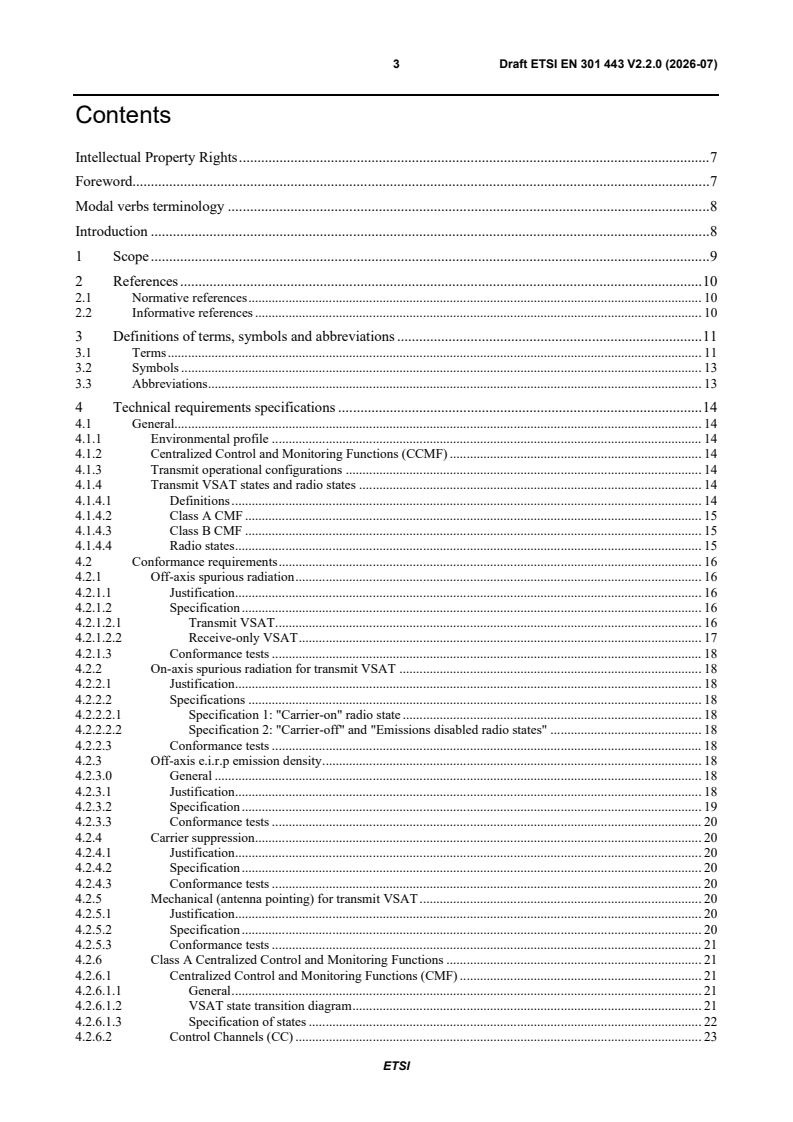
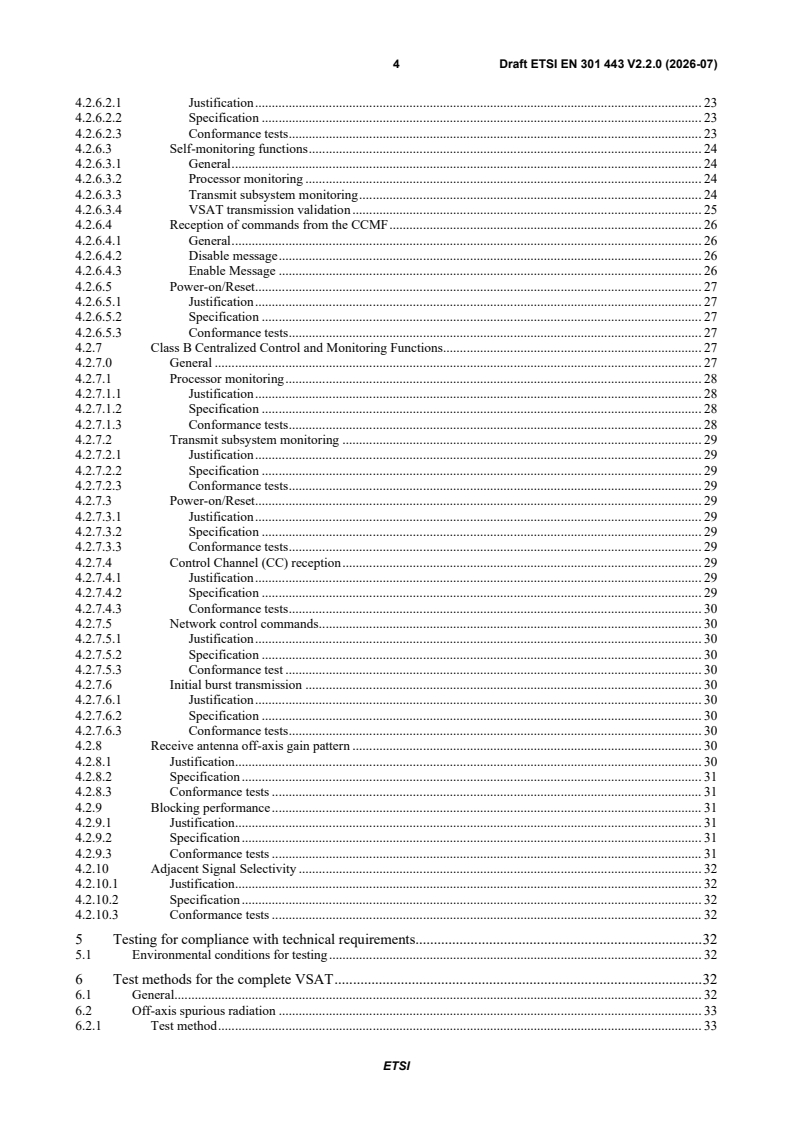
ETSI EN 301 443 V2.2.0 (2026-07) - Satellite Earth Stations and Systems (SES); Very Small Aperture Terminal (VSAT); Transmit-only, transmit-and-receive, receive-only satellite earth stations operating in the 4 GHz and 6 GHz frequency bands; Harmonised Standard for access to radio spectrum

SIST EN 301 443 V2.2.1:2026 is a harmonised European standard issued by ETSI for Very Small Aperture Terminal (VSAT) satellite earth stations in the 4 GHz and 6 GHz bands. It specifies the technical characteristics and measurement methods for transmit-only, transmit-and-receive and receive-only VSAT equipment used in fixed satellite service networks, so designers, test labs and conformity teams can check access to radio spectrum under Directive 2014/53/EU.
What does SIST EN 301 443 V2.2.1:2026 specify?
SIST EN 301 443 V2.2.1:2026 covers VSAT equipment operating in the Fixed Satellite Service (FSS) in the listed Earth-to-space and space-to-Earth bands, using linear or circular polarization, geostationary satellites at least 2° apart, and antennas up to 7.3 m diameter or equivalent effective area. It applies to complete VSAT equipment as brought to market, including ancillary equipment, terrestrial ports and the cable between indoor and outdoor units, within the declared environmental profile.
The standard excludes installation guidance, the indoor-unit functions for reception, processing and presentation of received information except the control channel, and the syntax of control channel messages. Its body is organized into scope, references, definitions, technical requirements, test conditions and test methods, with annexes that link the document to the Radio Equipment Directive and add test and uncertainty guidance.
| Annex | What it covers |
|---|---|
| Annex A | Relationship between the standard and the essential requirements of Directive 2014/53/EU article 3.2 |
| Annex B | Pointing stability methodology using numerical analysis and load application |
| Annex C | Maximum measurement uncertainty values |
| Annex D | Bibliography |
| Annex E | Change history |
What are the key requirements of SIST EN 301 443 V2.2.1:2026?
Clause 4.1 sets the operating context for the whole document. SIST EN 301 443 V2.2.1:2026 uses an environmental profile, a CCMF-controlled network model and a state-based view of transmit operation, so the equipment is assessed in the same conditions in which it is intended to be used.
Transmit states and control
Clause 4.1.4 and Table 1a define the transmit VSAT radio states and the control-and-monitoring states around them. The main states are out-of-service, checking, stand-by and in-service, with emissions-disabled, carrier-off and carrier-on radio states used to describe when the VSAT may transmit and when it must stay silent. In practice, this lets a designer map software and control logic to the required transmit behaviour.
Emissions limits
Clause 4.2.1 sets off-axis spurious radiation limits, including separate limits for carrier-on and carrier-off states and, for receive-only VSAT, radiated field-strength and off-axis spurious e.i.r.p. limits. Clause 4.2.3 covers off-axis e.i.r.p emission density within the nominated bandwidth, including different handling for burst transmission and cross-polarized components. For industry users, this is the core spectrum-sharing part of the standard: it is what protects other services from unwanted emissions.
Antenna and pointing
Clause 4.2.5 covers mechanical antenna pointing for transmit VSAT. It addresses alignment to the geostationary orbit for asymmetric main beams and requires continuous adjustment of linear polarization over at least 180° with a way to fix the angle accurately. In practice, this affects the antenna mount, polarization hardware and installation verification.
CCMF functions, Class A and Class B
Clauses 4.2.6 and 4.2.7 specify Centralized Control and Monitoring Functions (CCMF) for Class A and Class B control structures. They cover control channels, self-monitoring, reception of commands, power-on/reset, processor monitoring, transmit-subsystem monitoring, network control commands and initial burst transmission. The practical point is that a transmit VSAT must be able to receive enable and disable commands and react within the specified control logic and timing.
Receiver performance
Clauses 4.2.8, 4.2.9 and 4.2.10 cover the receive antenna off-axis gain pattern, blocking performance and adjacent signal selectivity. These checks matter when the VSAT is expected to reject interference from nearby carriers or other satellites, especially in shared-band networks.
Test conditions
Clause 5 requires testing at representative points within the operational environmental profile, and clause 6 requires tests on the complete VSAT as brought to market. Tests use maximum transmit power, maximum burst rate where relevant, and the applicable frequency points at the band edges and centre. The result is a test plan that reflects real equipment, not a simplified laboratory-only configuration.
What terms does SIST EN 301 443 V2.2.1:2026 define?
- Very Small Aperture Terminal (VSAT) - the complete equipment as brought to market, including outdoor unit, indoor unit and the connecting cable(s).
- Centralized Control and Monitoring Functions (CCMF) - the system-level functions that monitor and control the correct operation of transmit VSAT in a network.
- Control Channel (CC) - the channel or channels used by the VSAT to receive control information from the CCMF.
- Response Channel (RC) - the channel used by the VSAT to send monitoring information to the CCMF.
- EIRP / e.i.r.p - the maximum equivalent isotropically radiated power capability of the VSAT for its intended use.
- Environmental profile - the range of environmental conditions in which the equipment is required to comply with the standard.
- Transmit VSAT - a VSAT capable of transmission only, or transmission and reception.
- Spurious radiation - any radiation outside the nominated bandwidth.
Who uses SIST EN 301 443 V2.2.1:2026?
SIST EN 301 443 V2.2.1:2026 is used by VSAT manufacturers, RF and EMC test laboratories, compliance engineers, and conformity assessment teams. It is also relevant to satellite network operators who use CCMF-controlled VSAT networks and need to verify antenna pointing, emission control and control-channel behaviour.
For a buyer or quality manager, the standard is useful when checking whether a product claim matches a specific VSAT class, frequency band and control architecture. For a test lab, it gives the measurement setups and environmental conditions needed to produce a defensible test report.
What changed in SIST EN 301 443 V2.2.1:2026 from the previous edition?
This edition follows V2.2.0.
Which standards are used with SIST EN 301 443 V2.2.1:2026?
The normative references are:
- CISPR 16-1-5:2014 - provides antenna calibration test sites for 5 MHz to 18 GHz, supporting the radiated measurement arrangements.
- ERC/REC 74-01 (2021) - gives requirements for unwanted emissions in the spurious domain, which the standard uses for spurious-emission compliance.
Informative references that add context include:
- Directive 2014/53/EU - the Radio Equipment Directive that the standard supports.
- ETSI TR 102 375 - guidance on antenna radiation-pattern parts concerned by geostationary satellite orbit protection.
- ETSI TR 102 215 - guidance on measurement uncertainty above 1 GHz.
- ETSI EG 203 336 - guidance on technical parameters for harmonised standards under the RED.
What does the SIST EN 301 443 V2.2.1:2026 document contain?
The body of the standard gives the technical requirements and test methods for off-axis spurious radiation, on-axis spurious radiation, off-axis e.i.r.p emission density, antenna pointing, CCMF functions, receive antenna off-axis gain pattern, blocking performance and adjacent signal selectivity. It also includes state diagrams and tables for the transmit and control states, which help link the control logic to the radio behaviour.
The test chapters describe arrangements using spectrum analysers, power meters, oscilloscopes, substitution antennas and special test equipment where needed. Figures in the test clauses show the setups for radiated and conducted measurements, while Annex B adds a numerical method for pointing stability and Annex C gives recommended measurement uncertainty figures for radio frequency, power, spurious emissions and antenna gain patterns.
Buy Documents
ETSI EN 301 443 V2.2.0 (2026-07) - Satellite Earth Stations and Systems (SES); Very Small Aperture Terminal (VSAT); Transmit-only, transmit-and-receive, receive-only satellite earth stations operating in the 4 GHz and 6 GHz frequency bands; Harmonised Standard for access to radio spectrum
Get Certified
Connect with accredited certification bodies for this standard

ANCE
Mexican certification and testing association.

Intertek Slovenia
Intertek testing, inspection, and certification services in Slovenia.

LNE (Laboratoire National de Métrologie et d'Essais)
French national laboratory for metrology and testing.
Sponsored listings
Frequently Asked Questions
SIST EN 301 443 V2.2.1:2026 is a standard published by the Slovenian Institute for Standardization (SIST). Its full title is "Satellite Earth Stations and Systems (SES) - Very Small Aperture Terminal (VSAT) - Transmit-only, transmit-and-receive, receive-only satellite earth stations operating in the 4 GHz and 6 GHz frequency bands - Harmonised Standard for access to radio spectrum". This standard covers: The present document specifies technical characteristic and methods of measurements for Very Small Aperture Terminal (VSAT) equipment which has the following characteristics: • the VSAT is operating in one or more frequency ranges within the following bands allocated to the Fixed Satellite Service (FSS), shared with other services, e.g. the Fixed Service (FS) and the Mobile Service (MS): - 5,850 GHz to 7,075 GHz (Earth-to-space); - 3,400 GHz to 4,200 GHz (space-to-Earth); - 4,500 GHz to 4,800 GHz (space-to-Earth); • the VSAT uses linear or circular polarization; • the VSAT operates through a geostationary satellite at least 2° away from any other geostationary satellite operating in the same frequency band and covering the same area; • the VSAT antenna diameter does not exceed 7,3 m, or equivalent effective area; • the VSAT is either: - a transmit-only VSAT: designed for transmission-only of radio-communications signals in the frequency band (earth-to-space) specified in the present clause; or - a transmit-and-receive VSAT: designed for transmission-and-reception of radio-communications signals in the frequency bands specified in the present clause; or - a receive-only VSAT: designed for reception-only of radio-communications signals in the frequency band (space-to-Earth) specified in the present clause; • the VSAT is designed for unattended operation; • the VSAT is operating as part of a satellite network (e.g. star, mesh or point-to-point) used for the distribution and/or exchange of information between users; the VSAT is controlled, and monitored for the transmit functionality, by a Centralized Control and Monitoring Facility (CCMF). The VSAT has to implement Control and Monitoring Functions with either Class A or Class B (structures of the radio states). The specifications associated to the CCMF facility are outside the scope of the present document. The present document applies to the VSAT with its ancillary equipment and its various terrestrial ports, and when operated within the boundary limits of the operational environmental profile defined for the intended use of the VSAT including all equipment as brought to the market. The present document does not contain any requirement, recommendation or information about the installation of the VSAT. All parts of the indoor unit related to reception, processing and presentation of the received information except the control channel are not within the scope of the present document. The syntax of the control channel messages is outside the scope of the present document. The present document is intended to cover the provisions of Directive 2014/53/EU (Radio Equipment Directive) [i.5] article 3.2. NOTE: The relationship between the present document and essential requirements of article 3.2 of Directive 2014/53/EU [i.5] is given in annex A.
The present document specifies technical characteristic and methods of measurements for Very Small Aperture Terminal (VSAT) equipment which has the following characteristics: • the VSAT is operating in one or more frequency ranges within the following bands allocated to the Fixed Satellite Service (FSS), shared with other services, e.g. the Fixed Service (FS) and the Mobile Service (MS): - 5,850 GHz to 7,075 GHz (Earth-to-space); - 3,400 GHz to 4,200 GHz (space-to-Earth); - 4,500 GHz to 4,800 GHz (space-to-Earth); • the VSAT uses linear or circular polarization; • the VSAT operates through a geostationary satellite at least 2° away from any other geostationary satellite operating in the same frequency band and covering the same area; • the VSAT antenna diameter does not exceed 7,3 m, or equivalent effective area; • the VSAT is either: - a transmit-only VSAT: designed for transmission-only of radio-communications signals in the frequency band (earth-to-space) specified in the present clause; or - a transmit-and-receive VSAT: designed for transmission-and-reception of radio-communications signals in the frequency bands specified in the present clause; or - a receive-only VSAT: designed for reception-only of radio-communications signals in the frequency band (space-to-Earth) specified in the present clause; • the VSAT is designed for unattended operation; • the VSAT is operating as part of a satellite network (e.g. star, mesh or point-to-point) used for the distribution and/or exchange of information between users; the VSAT is controlled, and monitored for the transmit functionality, by a Centralized Control and Monitoring Facility (CCMF). The VSAT has to implement Control and Monitoring Functions with either Class A or Class B (structures of the radio states). The specifications associated to the CCMF facility are outside the scope of the present document. The present document applies to the VSAT with its ancillary equipment and its various terrestrial ports, and when operated within the boundary limits of the operational environmental profile defined for the intended use of the VSAT including all equipment as brought to the market. The present document does not contain any requirement, recommendation or information about the installation of the VSAT. All parts of the indoor unit related to reception, processing and presentation of the received information except the control channel are not within the scope of the present document. The syntax of the control channel messages is outside the scope of the present document. The present document is intended to cover the provisions of Directive 2014/53/EU (Radio Equipment Directive) [i.5] article 3.2. NOTE: The relationship between the present document and essential requirements of article 3.2 of Directive 2014/53/EU [i.5] is given in annex A.
SIST EN 301 443 V2.2.1:2026 is classified under the following ICS (International Classification for Standards) categories: 33.060.30 - Radio relay and fixed satellite communications systems. The ICS classification helps identify the subject area and facilitates finding related standards.
SIST EN 301 443 V2.2.1:2026 is available in PDF format for immediate download after purchase. The document can be added to your cart and obtained through the secure checkout process. Digital delivery ensures instant access to the complete standard document.
Standards Content (Sample)
Draft ETSI EN 301 443 V2.2.0 (2026-07)
HARMONISED EUROPEAN STANDARD
Satellite Earth Stations and Systems (SES);
Very Small Aperture Terminals (VSAT);
Transmit-only, transmit-and-receive, receive-only satellite
earth stations operating in the 4 GHz and 6 GHz
frequency bands;
Harmonised Standard for access to radio spectrum
2 Draft ETSI EN 301 443 V2.2.0 (2026-07)
Reference
REN/SES-00432
Keywords
regulation, satellite, VSAT
ETSI
650 Route des Lucioles
F-06921 Sophia Antipolis Cedex - FRANCE
Tel.: +33 4 92 94 42 00 Fax: +33 4 93 65 47 16
Siret N° 348 623 562 00017 - APE 7112B
Association à but non lucratif enregistrée à la
Sous-Préfecture de Grasse (06) N° w061004871
Important notice
The present document can be downloaded from the
ETSI Search & Browse Standards application.
The present document may be made available in electronic versions and/or in print. The content of any electronic and/or
print versions of the present document shall not be modified without the prior written authorization of ETSI. In case of any
existing or perceived difference in contents between such versions and/or in print, the prevailing version of an ETSI
deliverable is the one made publicly available in PDF format on ETSI deliver repository.
Users should be aware that the present document may be revised or have its status changed,
this information is available in the Milestones listing.
If you find errors in the present document, please send your comments to
the relevant service listed under Committee Support Staff.
If you find a security vulnerability in the present document, please report it through our
Coordinated Vulnerability Disclosure (CVD) program.
Notice of disclaimer & limitation of liability
The information provided in the present deliverable is directed solely to professionals who have the appropriate degree of
experience to understand and interpret its content in accordance with generally accepted engineering or
other professional standard and applicable regulations.
No recommendation as to products and services or vendors is made or should be implied.
In no event shall ETSI be held liable for loss of profits or any other incidental or consequential damages.
Any software contained in this deliverable is provided "AS IS" with no warranties, express or implied, including but not
limited to, the warranties of merchantability, fitness for a particular purpose and non-infringement of intellectual property
rights and ETSI shall not be held liable in any event for any damages whatsoever (including, without limitation, damages
for loss of profits, business interruption, loss of information, or any other pecuniary loss) arising out of or related to the use
of or inability to use the software.
Copyright Notification
No part of this document may be reproduced in any form, by any means and in any media, without the prior written
authorization of ETSI and except as expressly permitted below.
By way of exception and when the document is a normative deliverable (European Standard (EN),
Technical Specification (TS), Group Specification (GS) or ETSI Standard (ES)), ETSI authorizes to reproduce
and incorporate into products, services and technical documentation only those extracts (e.g. templates) that are strictly
necessary for the technical implementation of the normative deliverable, to ensure compliance with the latter.
Nothing in this notice shall be construed as limiting any mandatory exceptions to copyright provided by applicable law.
© ETSI 2026.
All rights reserved.
ETSI
3 Draft ETSI EN 301 443 V2.2.0 (2026-07)
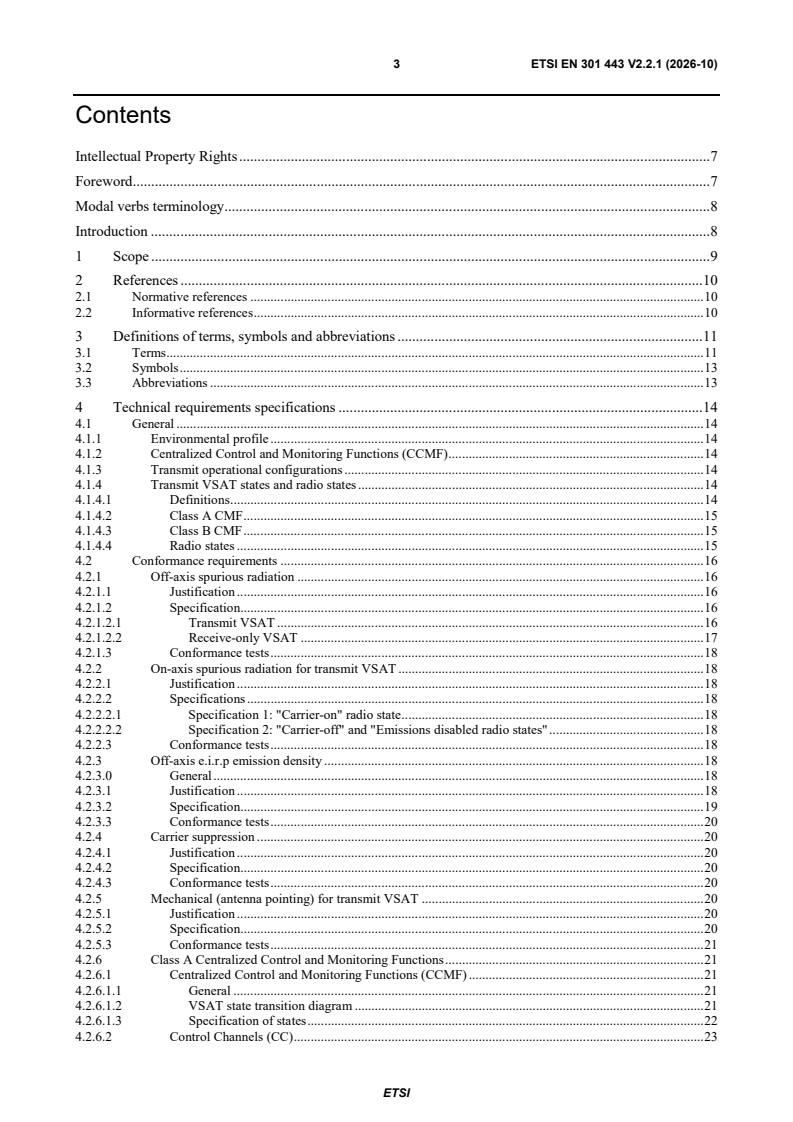
Contents
Intellectual Property Rights . 7
Foreword. 7
Modal verbs terminology . 8
Introduction . 8
1 Scope . 9
2 References . 10
2.1 Normative references . 10
2.2 Informative references . 10
3 Definitions of terms, symbols and abbreviations . 11
3.1 Terms . 11
3.2 Symbols . 13
3.3 Abbreviations . 13
4 Technical requirements specifications . 14
4.1 General . 14
4.1.1 Environmental profile . 14
4.1.2 Centralized Control and Monitoring Functions (CCMF) . 14
4.1.3 Transmit operational configurations . 14
4.1.4 Transmit VSAT states and radio states . 14
4.1.4.1 Definitions . 14
4.1.4.2 Class A CMF . 15
4.1.4.3 Class B CMF . 15
4.1.4.4 Radio states . 15
4.2 Conformance requirements . 16
4.2.1 Off-axis spurious radiation . 16
4.2.1.1 Justification. 16
4.2.1.2 Specification . 16
4.2.1.2.1 Transmit VSAT . 16
4.2.1.2.2 Receive-only VSAT . 17
4.2.1.3 Conformance tests . 18
4.2.2 On-axis spurious radiation for transmit VSAT . 18
4.2.2.1 Justification. 18
4.2.2.2 Specifications . 18
4.2.2.2.1 Specification 1: "Carrier-on" radio state . 18
4.2.2.2.2 Specification 2: "Carrier-off" and "Emissions disabled radio states" . 18
4.2.2.3 Conformance tests . 18
4.2.3 Off-axis e.i.r.p emission density . 18
4.2.3.0 General . 18
4.2.3.1 Justification. 18
4.2.3.2 Specification . 19
4.2.3.3 Conformance tests . 20
4.2.4 Carrier suppression . 20
4.2.4.1 Justification. 20
4.2.4.2 Specification . 20
4.2.4.3 Conformance tests . 20
4.2.5 Mechanical (antenna pointing) for transmit VSAT . 20
4.2.5.1 Justification. 20
4.2.5.2 Specification . 20
4.2.5.3 Conformance tests . 21
4.2.6 Class A Centralized Control and Monitoring Functions . 21
4.2.6.1 Centralized Control and Monitoring Functions (CMF) . 21
4.2.6.1.1 General . 21
4.2.6.1.2 VSAT state transition diagram . 21
4.2.6.1.3 Specification of states . 22
4.2.6.2 Control Channels (CC) . 23
ETSI
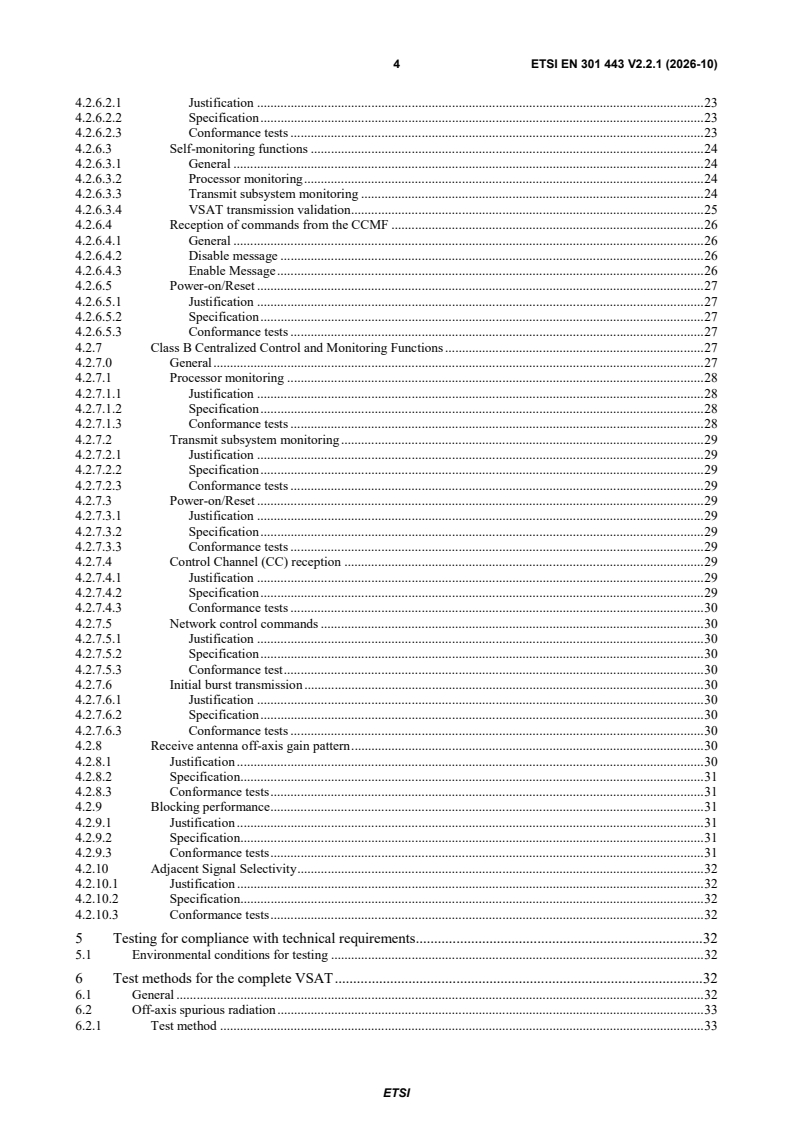
4 Draft ETSI EN 301 443 V2.2.0 (2026-07)
4.2.6.2.1 Justification . 23
4.2.6.2.2 Specification . 23
4.2.6.2.3 Conformance tests . 23
4.2.6.3 Self-monitoring functions . 24
4.2.6.3.1 General . 24
4.2.6.3.2 Processor monitoring . 24
4.2.6.3.3 Transmit subsystem monitoring . 24
4.2.6.3.4 VSAT transmission validation . 25
4.2.6.4 Reception of commands from the CCMF . 26
4.2.6.4.1 General . 26
4.2.6.4.2 Disable message . 26
4.2.6.4.3 Enable Message . 26
4.2.6.5 Power-on/Reset . 27
4.2.6.5.1 Justification . 27
4.2.6.5.2 Specification . 27
4.2.6.5.3 Conformance tests . 27
4.2.7 Class B Centralized Control and Monitoring Functions. 27
4.2.7.0 General . 27
4.2.7.1 Processor monitoring . 28
4.2.7.1.1 Justification . 28
4.2.7.1.2 Specification . 28
4.2.7.1.3 Conformance tests . 28
4.2.7.2 Transmit subsystem monitoring . 29
4.2.7.2.1 Justification . 29
4.2.7.2.2 Specification . 29
4.2.7.2.3 Conformance tests . 29
4.2.7.3 Power-on/Reset . 29
4.2.7.3.1 Justification . 29
4.2.7.3.2 Specification . 29
4.2.7.3.3 Conformance tests . 29
4.2.7.4 Control Channel (CC) reception . 29
4.2.7.4.1 Justification . 29
4.2.7.4.2 Specification . 29
4.2.7.4.3 Conformance tests . 30
4.2.7.5 Network control commands . 30
4.2.7.5.1 Justification . 30
4.2.7.5.2 Specification . 30
4.2.7.5.3 Conformance test . 30
4.2.7.6 Initial burst transmission . 30
4.2.7.6.1 Justification . 30
4.2.7.6.2 Specification . 30
4.2.7.6.3 Conformance tests . 30
4.2.8 Receive antenna off-axis gain pattern . 30
4.2.8.1 Justification. 30
4.2.8.2 Specification . 31
4.2.8.3 Conformance tests . 31
4.2.9 Blocking performance . 31
4.2.9.1 Justification. 31
4.2.9.2 Specification . 31
4.2.9.3 Conformance tests . 31
4.2.10 Adjacent Signal Selectivity . 32
4.2.10.1 Justification. 32
4.2.10.2 Specification . 32
4.2.10.3 Conformance tests . 32
5 Testing for compliance with technical requirements. 32
5.1 Environmental conditions for testing . 32
6 Test methods for the complete VSAT . 32
6.1 General . 32
6.2 Off-axis spurious radiation . 33
6.2.1 Test method . 33
ETSI
5 Draft ETSI EN 301 443 V2.2.0 (2026-07)
6.2.1.a General . 33
6.2.1.0 Multi-carrier operation . 34
6.2.1.1 Up to 1 000 MHz . 34
6.2.1.1.1 Test site . 34
6.2.1.1.2 Measuring receivers . 34
6.2.1.1.3 Procedure . 35
6.2.1.2 Above 1 000 MHz . 35
6.2.1.2.0 General . 35
6.2.1.2.1 Identification of the significant frequencies of spurious radiation . 35
6.2.1.2.2 Measurement of radiated power levels of identified spurious radiation . 36
6.2.1.2.3 Measurement of conducted spurious radiation at the antenna flange . 37
6.3 On-axis spurious radiation for transmit VSAT . 38
6.3.1 Test method . 38
6.3.1.1 Test site . 38
6.3.1.2 Method of measurement . 38
6.3.1.2.1 General . 38
6.3.1.2.2 Method of measurement at the antenna flange . 38
6.3.1.2.3 Method of measurement with a test antenna . 39
6.4 Off-axis e.i.r.p emission density within the band. 40
6.4.0 General . 40
6.4.1 Test method . 40
6.4.1.1 General . 40
6.4.1.2 Transmit output power density . 41
6.4.1.2.1 General . 41
6.4.1.2.2 Test site . 41
6.4.1.2.3 Method of measurement . 41
6.4.1.3 Antenna transmit gain . 42
6.4.1.3.1 General . 42
6.4.1.3.2 Test site . 42
6.4.1.3.3 Method of measurement . 42
6.4.1.4 Antenna transmit radiation patterns . 43
6.4.1.4.1 General . 43
6.4.1.4.2 Test site . 43
6.4.1.4.3 Method of measurement . 43
6.4.1.4.4 Co-polar radiation pattern -azimuth . 44
6.4.1.4.5 Co-polar radiation pattern - elevation . 44
6.4.1.4.6 Cross-polar radiation pattern - azimuth . 45
6.4.1.4.7 Cross-polar radiation pattern - elevation . 45
6.4.2 Computation of results . 46
6.5 Carrier suppression . 46
6.5.1 Test method . 46
6.6 Antenna pointing for transmit VSAT . 46
6.6.1 Test method . 46
6.7 Class A Centralized Control and Monitoring Functions . 47
6.7.1 General . 47
6.7.2 Test arrangement . 47
6.7.3 Control Channels (CC) . 48
6.7.3.1 Test method . 48
6.7.3.1.0 General . 48
6.7.3.1.1 Test method for internal CC. 48
6.7.3.1.2 Test method for external CC . 49
6.7.4 Processor monitoring. 49
6.7.4.1 Test method . 49
6.7.5 Transmit subsystem monitoring . 49
6.7.5.1 Test method . 49
6.7.6 VSAT transmission validation . 50
6.7.6.1 Test method for VSAT validation by the CCMF for VSAT using internal CC . 50
6.7.6.2 Test method for VSAT validation by receiving station(s) for VSAT using internal CC . 50
6.7.6.3 Test method for transmission validation for VSAT using external CC . 50
6.7.7 Reception of commands from the CCMF . 50
6.7.7.1 Test method . 50
6.7.8 Power-on/Reset . 50
ETSI
6 Draft ETSI EN 301 443 V2.2.0 (2026-07)
6.7.8.1 Test method . 50
6.8 Class B Centralized Control and Monitoring Functions . 51
6.8.0 General . 51
6.8.1 Test arrangement . 51
6.8.2 Processor monitoring - Test method . 52
6.8.3 Transmit subsystem monitoring - Test method . 52
6.8.4 Power-on/Reset - Test method . 53
6.8.5 Control Channel (CC) reception - Test method. 53
6.8.6 Network Control commands - Test method . 54
6.8.7 Initial burst transmission - Test method . 55
6.9 Receive antenna off-axis gain pattern . 56
6.9.1 Test method . 56
6.9.1.1 Test site . 56
6.9.1.2 Method of measurement . 56
6.9.1.3 Computation . 57
6.10 Blocking performance . 57
6.10.1 Test method . 57
6.11 Adjacent Signal Selectivity . 57
6.11.1 Test method . 57
7 Void . 58
Annex A (informative): Relationship between the present document and the essential
requirements of Directive 2014/53/EU . 59
Annex B (normative): Pointing stability methodology . 62
Annex C (informative): Maximum measurement uncertainty . 63
Annex D (informative): Bibliography . 64
Annex E (informative): Change history . 65
History . 66
ETSI
7 Draft ETSI EN 301 443 V2.2.0 (2026-07)
Intellectual Property Rights
Essential patents
IPRs essential or potentially essential to normative deliverables (European Standard (EN), Technical Specification (TS),
Group Specification (GS) or ETSI Standard (ES)) may have been declared to ETSI. The declarations pertaining to these
essential IPRs, if any, are publicly available for ETSI members and non-members, and can be found in
ETSI SR 000 314: "Intellectual Property Rights (IPRs); Essential, or potentially Essential, IPRs notified to ETSI in
respect of ETSI standards", which is available from the ETSI Secretariat. Latest updates are available on the
ETSI IPR online database.
Pursuant to the ETSI Directives including the ETSI IPR Policy, no investigation regarding the essentiality of IPRs,
including IPR searches, has been carried out by ETSI. No guarantee can be given as to the existence of other IPRs not
referenced in ETSI SR 000 314 (or the updates on the ETSI Web server) which are, or may be, or may become,
essential to the present document.
Trademarks
The present document may include trademarks and/or tradenames which are asserted and/or registered by their owners.
ETSI claims no ownership of these except for any which are indicated as being the property of ETSI, and conveys no
right to use or reproduce any trademark and/or tradename. Mention of those trademarks in the present document does
not constitute an endorsement by ETSI of products, services or organizations associated with those trademarks.
DECT™, PLUGTESTS™, UMTS™ and the ETSI logo are trademarks of ETSI registered for the benefit of its
Members. 3GPP™, LTE™ and 5G™ logo are trademarks of ETSI registered for the benefit of its Members and of the
3GPP Organizational Partners. oneM2M™ logo is a trademark of ETSI registered for the benefit of its Members and of ®
the oneM2M Partners. GSM and the GSM logo are trademarks registered and owned by the GSM Association.
Foreword
This draft Harmonised European Standard (EN) has been produced by ETSI Technical Committee Satellite Earth
Stations and Systems (SES), and is now submitted for the combined Public Enquiry and Vote phase of the ETSI
Standardisation Request deliverable Approval Procedure (SRdAP).
The present document has been prepared under the Commission's standardisation request C(2015) 5376 final [i.2] to
provide one voluntary means of conforming to the essential requirements of Directive 2014/53/EU [i.5] on the
harmonisation of the laws of the Member States relating to the making available on the market of radio equipment and
repealing Directive 1999/5/EC.
Once the present document is cited in the Official Journal of the European Union under that Directive, compliance with
the normative clauses of the present document given in table A.1 confers, within the limits of the scope of the present
document, a presumption of conformity with the corresponding essential requirements of that Directive, and associated
EFTA regulations.
Proposed national transposition dates
Date of latest announcement of this EN (doa): 3 months after ETSI publication
Date of latest publication of new National Standard
or endorsement of this EN (dop/e): 6 months after doa
Date of withdrawal of any conflicting National Standard (dow): 18 months after doa
ETSI
8 Draft ETSI EN 301 443 V2.2.0 (2026-07)
Modal verbs terminology
In the present document "shall", "shall not", "should", "should not", "may", "need not", "will", "will not", "can" and
"cannot" are to be interpreted as described in clause 3.2 of the ETSI Drafting Rules (Verbal forms for the expression of
provisions).
"must" and "must not" are NOT allowed in ETSI deliverables except when used in direct citation.
Introduction
Void.
Figure 1: Void
ETSI
9 Draft ETSI EN 301 443 V2.2.0 (2026-07)
1 Scope
The present document specifies technical characteristic and methods of measurements for Very Small Aperture
Terminal (VSAT) equipment which has the following characteristics:
• the VSAT is operating in one or more frequency ranges within the following bands allocated to the Fixed
Satellite Service (FSS), shared with other services, e.g. the Fixed Service (FS) and the Mobile Service (MS):
- 5,850 GHz to 7,075 GHz (Earth-to-space);
- 3,400 GHz to 4,200 GHz (space-to-Earth);
- 4,500 GHz to 4,800 GHz (space-to-Earth);
• the VSAT uses linear or circular polarization;
• the VSAT operates through a geostationary satellite at least 2° away from any other geostationary satellite
operating in the same frequency band and covering the same area;
• the VSAT antenna diameter does not exceed 7,3 m, or equivalent effective area;
• the VSAT is either:
- a transmit-only VSAT: designed for transmission-only of radio-communications signals in the frequency
band (earth-to-space) specified in the present clause; or
- a transmit-and-receive VSAT: designed for transmission-and-reception of radio-communications signals
in the frequency bands specified in the present clause; or
- a receive-only VSAT: designed for reception-only of radio-communications signals in the frequency
band (space-to-Earth) specified in the present clause;
• the VSAT is designed for unattended operation;
• the VSAT is operating as part of a satellite network (e.g. star, mesh or point-to-point) used for the distribution
and/or exchange of information between users; the VSAT is controlled, and monitored for the transmit
functionality, by a Centralized Control and Monitoring Facility (CCMF). The VSAT has to implement Control
and Monitoring Functions with either Class A or Class B (structures of the radio states). The specifications
associated to the CCMF facility are outside the scope of the present document.
The present document applies to the VSAT with its ancillary equipment and its various terrestrial ports, and when
operated within the boundary limits of the operational environmental profile defined for the intended use of the VSAT
including all equipment as brought to the market.
The present document does not contain any requirement, recommendation or information about the installation of the
VSAT.
All parts of the indoor unit related to reception, processing and presentation of the received information except the
control channel are not within the scope of the present document. The syntax of the control channel messages is outside
the scope of the present document. The present document is intended to cover the provisions of Directive 2014/53/EU
(Radio Equipment Directive) [i.5] article 3.2.
NOTE: The relationship between the present document and essential requirements of article 3.2 of
Directive 2014/53/EU [i.5] is given in annex A.
ETSI
10 Draft ETSI EN 301 443 V2.2.0 (2026-07)
2 References
2.1 Normative references
References are either specific (identified by date of publication and/or edition number or version number) or
non-specific. For specific references, only the cited version applies. For non-specific references, the latest version of the
referenced document (including any amendments) applies.
Referenced documents which are not found to be publicly available in the expected location might be found in the
ETSI docbox.
NOTE: While any hyperlinks included in this clause were valid at the time of publication, ETSI cannot guarantee
their long-term validity.
The following referenced documents are necessary for the application of the present document.
[1] Void.
[2] Void.
[3] CISPR 16-1-5:2014: "Specification for radio disturbance and immunity measuring apparatus and
methods - Part 1-5: Radio disturbance and immunity measuring apparatus - Antenna calibration
test sites for 5 MHz to 18 GHz".
[4] Void.
[5] Void.
[6] ERC/REC 74-01 (2021): "Unwanted emissions in the spurious domain".
2.2 Informative references
References are either specific (identified by date of publication and/or edition number or version number) or
non-specific. For specific references, only the cited version applies. For non-specific references, the latest version of the
referenced document (including any amendments) applies.
NOTE: While any hyperlinks included in this clause were valid at the time of publication, ETSI cannot guarantee
their long-term validity.
The following referenced documents may be useful in implementing an ETSI deliverable or add to the reader's
understanding, but are not required for conformance to the present document.
[i.1] Void.
[i.2] Commission Implementing Decision C(2015) 5376 of 4.8.2015 on a standardisation request to the
European Committee for Electrotechnical Standardisation and to the European
Telecommunications Standards Institute as regards radio equipment in support of
Directive 2014/53/EU of the European Parliament and of the Council.
[i.3] Void.
[i.4] ETSI TR 102 375 (V1.2.1): "Satellite Earth Stations and Systems (SES); Guidelines for
determining the parts of satellite earth station ant
...
HARMONISED EUROPEAN STANDARD
Satellite Earth Stations and Systems (SES);
Very Small Aperture Terminal (VSAT);
Transmit-only, transmit-and-receive, receive-only satellite
earth stations operating in the 4 GHz and 6 GHz
frequency bands;
Harmonised Standard for access to radio spectrum
2 ETSI EN 301 443 V2.2.1 (2026-10)
Reference
REN/SES-00432
Keywords
regulation, satellite, VSAT
ETSI
650 Route des Lucioles
F-06921 Sophia Antipolis Cedex - FRANCE
Tel.: +33 4 92 94 42 00 Fax: +33 4 93 65 47 16
Siret N° 348 623 562 00017 - APE 7112B
Association à but non lucratif enregistrée à la
Sous-Préfecture de Grasse (06) N° w061004871
Important notice
The present document can be downloaded from the
ETSI Search & Browse Standards application.
The present document may be made available in electronic versions and/or in print. The content of any electronic and/or
print versions of the present document shall not be modified without the prior written authorization of ETSI. In case of any
existing or perceived difference in contents between such versions and/or in print, the prevailing version of an ETSI
deliverable is the one made publicly available in PDF format on ETSI deliver repository.
Users should be aware that the present document may be revised or have its status changed,
this information is available in the Milestones listing.
If you find errors in the present document, please send your comments to
the relevant service listed under Committee Support Staff.
If you find a security vulnerability in the present document, please report it through our
Coordinated Vulnerability Disclosure (CVD) program.
Notice of disclaimer & limitation of liability
The information provided in the present deliverable is directed solely to professionals who have the appropriate degree of
experience to understand and interpret its content in accordance with generally accepted engineering or
other professional standard and applicable regulations.
No recommendation as to products and services or vendors is made or should be implied.
In no event shall ETSI be held liable for loss of profits or any other incidental or consequential damages.
Any software contained in this deliverable is provided "AS IS" with no warranties, express or implied, including but not
limited to, the warranties of merchantability, fitness for a particular purpose and non-infringement of intellectual property
rights and ETSI shall not be held liable in any event for any damages whatsoever (including, without limitation, damages
for loss of profits, business interruption, loss of information, or any other pecuniary loss) arising out of or related to the use
of or inability to use the software.
Copyright Notification
No part of this document may be reproduced in any form, by any means and in any media, without the prior written
authorization of ETSI and except as expressly permitted below.
By way of exception and when the document is a normative deliverable (European Standard (EN),
Technical Specification (TS), Group Specification (GS) or ETSI Standard (ES)), ETSI authorizes to reproduce
and incorporate into products, services and technical documentation only those extracts (e.g. templates) that are strictly
necessary for the technical implementation of the normative deliverable, to ensure compliance with the latter.
Nothing in this notice shall be construed as limiting any mandatory exceptions to copyright provided by applicable law.
© ETSI 2026.
All rights reserved.
ETSI
3 ETSI EN 301 443 V2.2.1 (2026-10)
Contents
Intellectual Property Rights . 7
Foreword . 7
Modal verbs terminology . 8
Introduction . 8
1 Scope . 9
2 References . 10
2.1 Normative references . 10
2.2 Informative references . 10
3 Definitions of terms, symbols and abbreviations . 11
3.1 Terms . 11
3.2 Symbols . 13
3.3 Abbreviations . 13
4 Technical requirements specifications . 14
4.1 General . 14
4.1.1 Environmental profile . 14
4.1.2 Centralized Control and Monitoring Functions (CCMF) . 14
4.1.3 Transmit operational configurations . 14
4.1.4 Transmit VSAT states and radio states . 14
4.1.4.1 Definitions . 14
4.1.4.2 Class A CMF . 15
4.1.4.3 Class B CMF . 15
4.1.4.4 Radio states . 15
4.2 Conformance requirements . 16
4.2.1 Off-axis spurious radiation . 16
4.2.1.1 Justification . 16
4.2.1.2 Specification. 16
4.2.1.2.1 Transmit VSAT . 16
4.2.1.2.2 Receive-only VSAT . 17
4.2.1.3 Conformance tests . 18
4.2.2 On-axis spurious radiation for transmit VSAT . 18
4.2.2.1 Justification . 18
4.2.2.2 Specifications . 18
4.2.2.2.1 Specification 1: "Carrier-on" radio state . 18
4.2.2.2.2 Specification 2: "Carrier-off" and "Emissions disabled radio states" . 18
4.2.2.3 Conformance tests . 18
4.2.3 Off-axis e.i.r.p emission density . 18
4.2.3.0 General . 18
4.2.3.1 Justification . 18
4.2.3.2 Specification. 19
4.2.3.3 Conformance tests . 20
4.2.4 Carrier suppression . 20
4.2.4.1 Justification . 20
4.2.4.2 Specification. 20
4.2.4.3 Conformance tests . 20
4.2.5 Mechanical (antenna pointing) for transmit VSAT . 20
4.2.5.1 Justification . 20
4.2.5.2 Specification. 20
4.2.5.3 Conformance tests . 21
4.2.6 Class A Centralized Control and Monitoring Functions . 21
4.2.6.1 Centralized Control and Monitoring Functions (CCMF) . 21
4.2.6.1.1 General . 21
4.2.6.1.2 VSAT state transition diagram . 21
4.2.6.1.3 Specification of states . 22
4.2.6.2 Control Channels (CC) . 23
ETSI
4 ETSI EN 301 443 V2.2.1 (2026-10)
4.2.6.2.1 Justification . 23
4.2.6.2.2 Specification . 23
4.2.6.2.3 Conformance tests . 23
4.2.6.3 Self-monitoring functions . 24
4.2.6.3.1 General . 24
4.2.6.3.2 Processor monitoring . 24
4.2.6.3.3 Transmit subsystem monitoring . 24
4.2.6.3.4 VSAT transmission validation . 25
4.2.6.4 Reception of commands from the CCMF . 26
4.2.6.4.1 General . 26
4.2.6.4.2 Disable message . 26
4.2.6.4.3 Enable Message . 26
4.2.6.5 Power-on/Reset . 27
4.2.6.5.1 Justification . 27
4.2.6.5.2 Specification . 27
4.2.6.5.3 Conformance tests . 27
4.2.7 Class B Centralized Control and Monitoring Functions . 27
4.2.7.0 General . 27
4.2.7.1 Processor monitoring . 28
4.2.7.1.1 Justification . 28
4.2.7.1.2 Specification . 28
4.2.7.1.3 Conformance tests . 28
4.2.7.2 Transmit subsystem monitoring . 29
4.2.7.2.1 Justification . 29
4.2.7.2.2 Specification . 29
4.2.7.2.3 Conformance tests . 29
4.2.7.3 Power-on/Reset . 29
4.2.7.3.1 Justification . 29
4.2.7.3.2 Specification . 29
4.2.7.3.3 Conformance tests . 29
4.2.7.4 Control Channel (CC) reception . 29
4.2.7.4.1 Justification . 29
4.2.7.4.2 Specification . 29
4.2.7.4.3 Conformance tests . 30
4.2.7.5 Network control commands . 30
4.2.7.5.1 Justification . 30
4.2.7.5.2 Specification . 30
4.2.7.5.3 Conformance test . 30
4.2.7.6 Initial burst transmission . 30
4.2.7.6.1 Justification . 30
4.2.7.6.2 Specification . 30
4.2.7.6.3 Conformance tests . 30
4.2.8 Receive antenna off-axis gain pattern . 30
4.2.8.1 Justification . 30
4.2.8.2 Specification. 31
4.2.8.3 Conformance tests . 31
4.2.9 Blocking performance . 31
4.2.9.1 Justification . 31
4.2.9.2 Specification. 31
4.2.9.3 Conformance tests . 31
4.2.10 Adjacent Signal Selectivity . 32
4.2.10.1 Justification . 32
4.2.10.2 Specification. 32
4.2.10.3 Conformance tests . 32
5 Testing for compliance with technical requirements . 32
5.1 Environmental conditions for testing . 32
6 Test methods for the complete VSAT . 32
6.1 General . 32
6.2 Off-axis spurious radiation . 33
6.2.1 Test method . 33
ETSI
5 ETSI EN 301 443 V2.2.1 (2026-10)
6.2.1.a General . 33
6.2.1.0 Multi-carrier operation . 34
6.2.1.1 Up to 1 000 MHz . 34
6.2.1.1.1 Test site. 34
6.2.1.1.2 Measuring receivers . 34
6.2.1.1.3 Procedure . 35
6.2.1.2 Above 1 000 MHz . 35
6.2.1.2.0 General . 35
6.2.1.2.1 Identification of the significant frequencies of spurious radiation . 35
6.2.1.2.2 Measurement of radiated power levels of identified spurious radiation . 36
6.2.1.2.3 Measurement of conducted spurious radiation at the antenna flange . 37
6.3 On-axis spurious radiation for transmit VSAT . 38
6.3.1 Test method . 38
6.3.1.1 Test site . 38
6.3.1.2 Method of measurement . 38
6.3.1.2.1 General . 38
6.3.1.2.2 Method of measurement at the antenna flange . 38
6.3.1.2.3 Method of measurement with a test antenna . 39
6.4 Off-axis e.i.r.p emission density within the band . 40
6.4.0 General . 40
6.4.1 Test method . 40
6.4.1.1 General . 40
6.4.1.2 Transmit output power density . 41
6.4.1.2.1 General . 41
6.4.1.2.2 Test site. 41
6.4.1.2.3 Method of measurement . 41
6.4.1.3 Antenna transmit gain . 42
6.4.1.3.1 General . 42
6.4.1.3.2 Test site. 42
6.4.1.3.3 Method of measurement . 42
6.4.1.4 Antenna transmit radiation patterns . 43
6.4.1.4.1 General . 43
6.4.1.4.2 Test site. 43
6.4.1.4.3 Method of measurement . 43
6.4.1.4.4 Co-polar radiation pattern -azimuth . 44
6.4.1.4.5 Co-polar radiation pattern - elevation . 44
6.4.1.4.6 Cross-polar radiation pattern - azimuth . 45
6.4.1.4.7 Cross-polar radiation pattern - elevation . 45
6.4.2 Computation of results . 46
6.5 Carrier suppression . 46
6.5.1 Test method . 46
6.6 Antenna pointing for transmit VSAT . 46
6.6.1 Test method . 46
6.7 Class A Centralized Control and Monitoring Functions . 47
6.7.1 General . 47
6.7.2 Test arrangement . 47
6.7.3 Control Channels (CC) . 48
6.7.3.1 Test method . 48
6.7.3.1.0 General . 48
6.7.3.1.1 Test method for internal CC . 48
6.7.3.1.2 Test method for external CC . 49
6.7.4 Processor monitoring . 49
6.7.4.1 Test method . 49
6.7.5 Transmit subsystem monitoring . 49
6.7.5.1 Test method . 49
6.7.6 VSAT transmission validation . 50
6.7.6.1 Test method for VSAT validation by the CCMF for VSAT using internal CC . 50
6.7.6.2 Test method for VSAT validation by receiving station(s) for VSAT using internal CC. 50
6.7.6.3 Test method for transmission validation for VSAT using external CC . 50
6.7.7 Reception of commands from the CCMF . 50
6.7.7.1 Test method . 50
6.7.8 Power-on/Reset . 50
ETSI
6 ETSI EN 301 443 V2.2.1 (2026-10)
6.7.8.1 Test method . 50
6.8 Class B Centralized Control and Monitoring Functions . 51
6.8.0 General . 51
6.8.1 Test arrangement . 51
6.8.2 Processor monitoring - Test method . 52
6.8.3 Transmit subsystem monitoring - Test method . 52
6.8.4 Power-on/Reset - Test method . 53
6.8.5 Control Channel (CC) reception - Test method . 53
6.8.6 Network Control commands - Test method . 54
6.8.7 Initial burst transmission - Test method . 55
6.9 Receive antenna off-axis gain pattern . 56
6.9.1 Test method . 56
6.9.1.1 Test site . 56
6.9.1.2 Method of measurement . 56
6.9.1.3 Computation . 57
6.10 Blocking performance . 57
6.10.1 Test method . 57
6.11 Adjacent Signal Selectivity . 57
6.11.1 Test method . 57
7 Void . 58
Annex A (informative): Relationship between the present document and the essential
requirements of Directive 2014/53/EU . 59
Annex B (normative): Pointing stability methodology . 62
Annex C (informative): Maximum measurement uncertainty . 63
Annex D (informative): Bibliography . 64
Annex E (informative): Change history . 65
History . 66
ETSI
7 ETSI EN 301 443 V2.2.1 (2026-10)
Intellectual Property Rights
Essential patents
IPRs essential or potentially essential to normative deliverables (European Standard (EN), Technical Specification (TS),
Group Specification (GS) or ETSI Standard (ES)) may have been declared to ETSI. The declarations pertaining to these
essential IPRs, if any, are publicly available for ETSI members and non-members, and can be found in
ETSI SR 000 314: "Intellectual Property Rights (IPRs); Essential, or potentially Essential, IPRs notified to ETSI in
respect of ETSI standards", which is available from the ETSI Secretariat. Latest updates are available on the
ETSI IPR online database.
Pursuant to the ETSI Directives including the ETSI IPR Policy, no investigation regarding the essentiality of IPRs,
including IPR searches, has been carried out by ETSI. No guarantee can be given as to the existence of other IPRs not
referenced in ETSI SR 000 314 (or the updates on the ETSI Web server) which are, or may be, or may become,
essential to the present document.
Trademarks
The present document may include trademarks and/or tradenames which are asserted and/or registered by their owners.
ETSI claims no ownership of these except for any which are indicated as being the property of ETSI, and conveys no
right to use or reproduce any trademark and/or tradename. Mention of those trademarks in the present document does
not constitute an endorsement by ETSI of products, services or organizations associated with those trademarks.
DECT™, PLUGTESTS™, UMTS™ and the ETSI logo are trademarks of ETSI registered for the benefit of its
Members. 3GPP™, LTE™ and 5G™ logo are trademarks of ETSI registered for the benefit of its Members and of the
3GPP Organizational Partners. oneM2M™ logo is a trademark of ETSI registered for the benefit of its Members and of ®
the oneM2M Partners. GSM and the GSM logo are trademarks registered and owned by the GSM Association.
Foreword
This Harmonised European Standard (EN) has been produced by ETSI Technical Committee Satellite Earth Stations
and Systems (SES).
The present document has been prepared under the Commission's standardisation request C(2015) 5376 final [i.2] to
provide one voluntary means of conforming to the essential requirements of Directive 2014/53/EU [i.5] on the
harmonisation of the laws of the Member States relating to the making available on the market of radio equipment and
repealing Directive 1999/5/EC.
Once the present document is cited in the Official Journal of the European Union under that Directive, compliance with
the normative clauses of the present document given in table A.1 confers, within the limits of the scope of the present
document, a presumption of conformity with the corresponding essential requirements of that Directive, and associated
EFTA regulations.
National transposition dates
Date of adoption of this EN: 5 October 2026
Date of latest announcement of this EN (doa): 31 January 2027
Date of latest publication of new National Standard
or endorsement of this EN (dop/e): 31 July 2027
Date of withdrawal of any conflicting National Standard (dow): 31 July 2028
ETSI
8 ETSI EN 301 443 V2.2.1 (2026-10)
Modal verbs terminology
In the present document "shall", "shall not", "should", "should not", "may", "need not", "will", "will not", "can" and
"cannot" are to be interpreted as described in clause 3.2 of the ETSI Drafting Rules (Verbal forms for the expression of
provisions).
"must" and "must not" are NOT allowed in ETSI deliverables except when used in direct citation.
Introduction
Void.
Figure 1: Void
ETSI
9 ETSI EN 301 443 V2.2.1 (2026-10)
1 Scope
The present document specifies technical characteristic and methods of measurements for Very Small Aperture
Terminal (VSAT) equipment which has the following characteristics:
• the VSAT is operating in one or more frequency ranges within the following bands allocated to the Fixed
Satellite Service (FSS), shared with other services, e.g. the Fixed Service (FS) and the Mobile Service (MS):
- 5,850 GHz to 7,075 GHz (Earth-to-space);
- 3,400 GHz to 4,200 GHz (space-to-Earth);
- 4,500 GHz to 4,800 GHz (space-to-Earth);
• the VSAT uses linear or circular polarization;
• the VSAT operates through a geostationary satellite at least 2° away from any other geostationary satellite
operating in the same frequency band and covering the same area;
• the VSAT antenna diameter does not exceed 7,3 m, or equivalent effective area;
• the VSAT is either:
- a transmit-only VSAT: designed for transmission-only of radio-communications signals in the frequency
band (earth-to-space) specified in the present clause; or
- a transmit-and-receive VSAT: designed for transmission-and-reception of radio-communications signals
in the frequency bands specified in the present clause; or
- a receive-only VSAT: designed for reception-only of radio-communications signals in the frequency
band (space-to-Earth) specified in the present clause;
• the VSAT is designed for unattended operation;
• the VSAT is operating as part of a satellite network (e.g. star, mesh or point-to-point) used for the distribution
and/or exchange of information between users; the VSAT is controlled, and monitored for the transmit
functionality, by a Centralized Control and Monitoring Facility (CCMF). The VSAT has to implement Control
and Monitoring Functions with either Class A or Class B (structures of the radio states). The specifications
associated to the CCMF facility are outside the scope of the present document.
The present document applies to the VSAT with its ancillary equipment and its various terrestrial ports, and when
operated within the boundary limits of the operational environmental profile defined for the intended use of the VSAT
including all equipment as brought to the market.
The present document does not contain any requirement, recommendation or information about the installation of the
VSAT.
All parts of the indoor unit related to reception, processing and presentation of the received information except the
control channel are not within the scope of the present document. The syntax of the control channel messages is outside
the scope of the present document. The present document is intended to cover the provisions of Directive 2014/53/EU
(Radio Equipment Directive) [i.5] article 3.2.
NOTE: The relationship between the present document and essential requirements of article 3.2 of
Directive 2014/53/EU [i.5] is given in annex A.
ETSI
10 ETSI EN 301 443 V2.2.1 (2026-10)
2 References
2.1 Normative references
References are either specific (identified by date of publication and/or edition number or version number) or
non-specific. For specific references, only the cited version applies. For non-specific references, the latest version of the
referenced document (including any amendments) applies.
Referenced documents which are not found to be publicly available in the expected location might be found in the
ETSI docbox.
NOTE: While any hyperlinks included in this clause were valid at the time of publication, ETSI cannot guarantee
their long-term validity.
The following referenced documents are necessary for the application of the present document.
[1] Void.
[2] Void.
[3] CISPR 16-1-5:2014: "Specification for radio disturbance and immunity measuring apparatus and
methods - Part 1-5: Radio disturbance and immunity measuring apparatus - Antenna calibration
test sites for 5 MHz to 18 GHz".
[4] Void.
[5] Void.
[6] ERC/REC 74-01 (2021): "Unwanted emissions in the spurious domain".
2.2 Informative references
References are either specific (identified by date of publication and/or edition number or version number) or
non-specific. For specific references, only the cited version applies. For non-specific references, the latest version of the
referenced document (including any amendments) applies.
NOTE: While any hyperlinks included in this clause were valid at the time of publication, ETSI cannot guarantee
their long-term validity.
The following referenced documents may be useful in implementing an ETSI deliverable or add to the reader's
understanding, but are not required for conformance to the present document.
[i.1] Void.
[i.2] Commission Implementing Decision C(2015) 5376 of 4.8.2015 on a standardisation request to the
European Committee for Electrotechnical Standardisation and to the European
Telecommunications Standards Institute as regards radio equipment in support of
Directive 2014/53/EU of the European Parliament and of the Council.
[i.3] Void.
[i.4] ETSI TR 102 375 (V1.2.1): "Satellite Earth Stations and Systems (SES); Guidelines for
determining the parts of satellite earth station antenna radiation patterns concerned by the
geostationary satellite orbit protection".
[i.5] Directive 2014/53/EU of the Europ
...
SLOVENSKI STANDARD
01-december-2026
Satelitske zemeljske postaje in sistemi (SES) - Satelitski terminal z zelo majhno
antensko odprtino (VSAT) - Oddajne, oddajno-sprejemne ali sprejemne satelitske
zemeljske postaje, ki delujejo v frekvenčnih pasovih 4 GHz in 6 GHz -
Harmonizirani standard za dostop do radijskega spektra
Satellite Earth Stations and Systems (SES) - Very Small Aperture Terminal (VSAT) -
Transmit-only, transmit-and-receive, receive-only satellite earth stations operating in the
4 GHz and 6 GHz frequency bands - Harmonised Standard for access to radio spectrum
Ta slovenski standard je istoveten z: ETSI EN 301 443 V2.2.1 (2026-10)
ICS:
33.060.30 Radiorelejni in fiksni satelitski Radio relay and fixed satellite
komunikacijski sistemi communications systems
2003-01.Slovenski inštitut za standardizacijo. Razmnoževanje celote ali delov tega standarda ni dovoljeno.
HARMONISED EUROPEAN STANDARD
Satellite Earth Stations and Systems (SES);
Very Small Aperture Terminal (VSAT);
Transmit-only, transmit-and-receive, receive-only satellite
earth stations operating in the 4 GHz and 6 GHz
frequency bands;
Harmonised Standard for access to radio spectrum
2 ETSI EN 301 443 V2.2.1 (2026-10)
Reference
REN/SES-00432
Keywords
regulation, satellite, VSAT
ETSI
650 Route des Lucioles
F-06921 Sophia Antipolis Cedex - FRANCE
Tel.: +33 4 92 94 42 00 Fax: +33 4 93 65 47 16
Siret N° 348 623 562 00017 - APE 7112B
Association à but non lucratif enregistrée à la
Sous-Préfecture de Grasse (06) N° w061004871
Important notice
The present document can be downloaded from the
ETSI Search & Browse Standards application.
The present document may be made available in electronic versions and/or in print. The content of any electronic and/or
print versions of the present document shall not be modified without the prior written authorization of ETSI. In case of any
existing or perceived difference in contents between such versions and/or in print, the prevailing version of an ETSI
deliverable is the one made publicly available in PDF format on ETSI deliver repository.
Users should be aware that the present document may be revised or have its status changed,
this information is available in the Milestones listing.
If you find errors in the present document, please send your comments to
the relevant service listed under Committee Support Staff.
If you find a security vulnerability in the present document, please report it through our
Coordinated Vulnerability Disclosure (CVD) program.
Notice of disclaimer & limitation of liability
The information provided in the present deliverable is directed solely to professionals who have the appropriate degree of
experience to understand and interpret its content in accordance with generally accepted engineering or
other professional standard and applicable regulations.
No recommendation as to products and services or vendors is made or should be implied.
In no event shall ETSI be held liable for loss of profits or any other incidental or consequential damages.
Any software contained in this deliverable is provided "AS IS" with no warranties, express or implied, including but not
limited to, the warranties of merchantability, fitness for a particular purpose and non-infringement of intellectual property
rights and ETSI shall not be held liable in any event for any damages whatsoever (including, without limitation, damages
for loss of profits, business interruption, loss of information, or any other pecuniary loss) arising out of or related to the use
of or inability to use the software.
Copyright Notification
No part of this document may be reproduced in any form, by any means and in any media, without the prior written
authorization of ETSI and except as expressly permitted below.
By way of exception and when the document is a normative deliverable (European Standard (EN),
Technical Specification (TS), Group Specification (GS) or ETSI Standard (ES)), ETSI authorizes to reproduce
and incorporate into products, services and technical documentation only those extracts (e.g. templates) that are strictly
necessary for the technical implementation of the normative deliverable, to ensure compliance with the latter.
Nothing in this notice shall be construed as limiting any mandatory exceptions to copyright provided by applicable law.
© ETSI 2026.
All rights reserved.
ETSI
3 ETSI EN 301 443 V2.2.1 (2026-10)
Contents
Intellectual Property Rights . 7
Foreword . 7
Modal verbs terminology . 8
Introduction . 8
1 Scope . 9
2 References . 10
2.1 Normative references . 10
2.2 Informative references . 10
3 Definitions of terms, symbols and abbreviations . 11
3.1 Terms . 11
3.2 Symbols . 13
3.3 Abbreviations . 13
4 Technical requirements specifications . 14
4.1 General . 14
4.1.1 Environmental profile . 14
4.1.2 Centralized Control and Monitoring Functions (CCMF) . 14
4.1.3 Transmit operational configurations . 14
4.1.4 Transmit VSAT states and radio states . 14
4.1.4.1 Definitions . 14
4.1.4.2 Class A CMF . 15
4.1.4.3 Class B CMF . 15
4.1.4.4 Radio states . 15
4.2 Conformance requirements . 16
4.2.1 Off-axis spurious radiation . 16
4.2.1.1 Justification . 16
4.2.1.2 Specification. 16
4.2.1.2.1 Transmit VSAT . 16
4.2.1.2.2 Receive-only VSAT . 17
4.2.1.3 Conformance tests . 18
4.2.2 On-axis spurious radiation for transmit VSAT . 18
4.2.2.1 Justification . 18
4.2.2.2 Specifications . 18
4.2.2.2.1 Specification 1: "Carrier-on" radio state . 18
4.2.2.2.2 Specification 2: "Carrier-off" and "Emissions disabled radio states" . 18
4.2.2.3 Conformance tests . 18
4.2.3 Off-axis e.i.r.p emission density . 18
4.2.3.0 General . 18
4.2.3.1 Justification . 18
4.2.3.2 Specification. 19
4.2.3.3 Conformance tests . 20
4.2.4 Carrier suppression . 20
4.2.4.1 Justification . 20
4.2.4.2 Specification. 20
4.2.4.3 Conformance tests . 20
4.2.5 Mechanical (antenna pointing) for transmit VSAT . 20
4.2.5.1 Justification . 20
4.2.5.2 Specification. 20
4.2.5.3 Conformance tests . 21
4.2.6 Class A Centralized Control and Monitoring Functions . 21
4.2.6.1 Centralized Control and Monitoring Functions (CCMF) . 21
4.2.6.1.1 General . 21
4.2.6.1.2 VSAT state transition diagram . 21
4.2.6.1.3 Specification of states . 22
4.2.6.2 Control Channels (CC) . 23
ETSI
4 ETSI EN 301 443 V2.2.1 (2026-10)
4.2.6.2.1 Justification . 23
4.2.6.2.2 Specification . 23
4.2.6.2.3 Conformance tests . 23
4.2.6.3 Self-monitoring functions . 24
4.2.6.3.1 General . 24
4.2.6.3.2 Processor monitoring . 24
4.2.6.3.3 Transmit subsystem monitoring . 24
4.2.6.3.4 VSAT transmission validation . 25
4.2.6.4 Reception of commands from the CCMF . 26
4.2.6.4.1 General . 26
4.2.6.4.2 Disable message . 26
4.2.6.4.3 Enable Message . 26
4.2.6.5 Power-on/Reset . 27
4.2.6.5.1 Justification . 27
4.2.6.5.2 Specification . 27
4.2.6.5.3 Conformance tests . 27
4.2.7 Class B Centralized Control and Monitoring Functions . 27
4.2.7.0 General . 27
4.2.7.1 Processor monitoring . 28
4.2.7.1.1 Justification . 28
4.2.7.1.2 Specification . 28
4.2.7.1.3 Conformance tests . 28
4.2.7.2 Transmit subsystem monitoring . 29
4.2.7.2.1 Justification . 29
4.2.7.2.2 Specification . 29
4.2.7.2.3 Conformance tests . 29
4.2.7.3 Power-on/Reset . 29
4.2.7.3.1 Justification . 29
4.2.7.3.2 Specification . 29
4.2.7.3.3 Conformance tests . 29
4.2.7.4 Control Channel (CC) reception . 29
4.2.7.4.1 Justification . 29
4.2.7.4.2 Specification . 29
4.2.7.4.3 Conformance tests . 30
4.2.7.5 Network control commands . 30
4.2.7.5.1 Justification . 30
4.2.7.5.2 Specification . 30
4.2.7.5.3 Conformance test . 30
4.2.7.6 Initial burst transmission . 30
4.2.7.6.1 Justification . 30
4.2.7.6.2 Specification . 30
4.2.7.6.3 Conformance tests . 30
4.2.8 Receive antenna off-axis gain pattern . 30
4.2.8.1 Justification . 30
4.2.8.2 Specification. 31
4.2.8.3 Conformance tests . 31
4.2.9 Blocking performance . 31
4.2.9.1 Justification . 31
4.2.9.2 Specification. 31
4.2.9.3 Conformance tests . 31
4.2.10 Adjacent Signal Selectivity . 32
4.2.10.1 Justification . 32
4.2.10.2 Specification. 32
4.2.10.3 Conformance tests . 32
5 Testing for compliance with technical requirements . 32
5.1 Environmental conditions for testing . 32
6 Test methods for the complete VSAT . 32
6.1 General . 32
6.2 Off-axis spurious radiation . 33
6.2.1 Test method . 33
ETSI
5 ETSI EN 301 443 V2.2.1 (2026-10)
6.2.1.a General . 33
6.2.1.0 Multi-carrier operation . 34
6.2.1.1 Up to 1 000 MHz . 34
6.2.1.1.1 Test site. 34
6.2.1.1.2 Measuring receivers . 34
6.2.1.1.3 Procedure . 35
6.2.1.2 Above 1 000 MHz . 35
6.2.1.2.0 General . 35
6.2.1.2.1 Identification of the significant frequencies of spurious radiation . 35
6.2.1.2.2 Measurement of radiated power levels of identified spurious radiation . 36
6.2.1.2.3 Measurement of conducted spurious radiation at the antenna flange . 37
6.3 On-axis spurious radiation for transmit VSAT . 38
6.3.1 Test method . 38
6.3.1.1 Test site . 38
6.3.1.2 Method of measurement . 38
6.3.1.2.1 General . 38
6.3.1.2.2 Method of measurement at the antenna flange . 38
6.3.1.2.3 Method of measurement with a test antenna . 39
6.4 Off-axis e.i.r.p emission density within the band . 40
6.4.0 General . 40
6.4.1 Test method . 40
6.4.1.1 General . 40
6.4.1.2 Transmit output power density . 41
6.4.1.2.1 General . 41
6.4.1.2.2 Test site. 41
6.4.1.2.3 Method of measurement . 41
6.4.1.3 Antenna transmit gain . 42
6.4.1.3.1 General . 42
6.4.1.3.2 Test site. 42
6.4.1.3.3 Method of measurement . 42
6.4.1.4 Antenna transmit radiation patterns . 43
6.4.1.4.1 General . 43
6.4.1.4.2 Test site. 43
6.4.1.4.3 Method of measurement . 43
6.4.1.4.4 Co-polar radiation pattern -azimuth . 44
6.4.1.4.5 Co-polar radiation pattern - elevation . 44
6.4.1.4.6 Cross-polar radiation pattern - azimuth . 45
6.4.1.4.7 Cross-polar radiation pattern - elevation . 45
6.4.2 Computation of results . 46
6.5 Carrier suppression . 46
6.5.1 Test method . 46
6.6 Antenna pointing for transmit VSAT . 46
6.6.1 Test method . 46
6.7 Class A Centralized Control and Monitoring Functions . 47
6.7.1 General . 47
6.7.2 Test arrangement . 47
6.7.3 Control Channels (CC) . 48
6.7.3.1 Test method . 48
6.7.3.1.0 General . 48
6.7.3.1.1 Test method for internal CC . 48
6.7.3.1.2 Test method for external CC . 49
6.7.4 Processor monitoring . 49
6.7.4.1 Test method . 49
6.7.5 Transmit subsystem monitoring . 49
6.7.5.1 Test method . 49
6.7.6 VSAT transmission validation . 50
6.7.6.1 Test method for VSAT validation by the CCMF for VSAT using internal CC . 50
6.7.6.2 Test method for VSAT validation by receiving station(s) for VSAT using internal CC. 50
6.7.6.3 Test method for transmission validation for VSAT using external CC . 50
6.7.7 Reception of commands from the CCMF . 50
6.7.7.1 Test method . 50
6.7.8 Power-on/Reset . 50
ETSI
6 ETSI EN 301 443 V2.2.1 (2026-10)
6.7.8.1 Test method . 50
6.8 Class B Centralized Control and Monitoring Functions . 51
6.8.0 General . 51
6.8.1 Test arrangement . 51
6.8.2 Processor monitoring - Test method . 52
6.8.3 Transmit subsystem monitoring - Test method . 52
6.8.4 Power-on/Reset - Test method . 53
6.8.5 Control Channel (CC) reception - Test method . 53
6.8.6 Network Control commands - Test method . 54
6.8.7 Initial burst transmission - Test method . 55
6.9 Receive antenna off-axis gain pattern . 56
6.9.1 Test method . 56
6.9.1.1 Test site . 56
6.9.1.2 Method of measurement . 56
6.9.1.3 Computation . 57
6.10 Blocking performance . 57
6.10.1 Test method . 57
6.11 Adjacent Signal Selectivity . 57
6.11.1 Test method . 57
7 Void . 58
Annex A (informative): Relationship between the present document and the essential
requirements of Directive 2014/53/EU . 59
Annex B (normative): Pointing stability methodology . 62
Annex C (informative): Maximum measurement uncertainty . 63
Annex D (informative): Bibliography . 64
Annex E (informative): Change history . 65
History . 66
ETSI
7 ETSI EN 301 443 V2.2.1 (2026-10)
Intellectual Property Rights
Essential patents
IPRs essential or potentially essential to normative deliverables (European Standard (EN), Technical Specification (TS),
Group Specification (GS) or ETSI Standard (ES)) may have been declared to ETSI. The declarations pertaining to these
essential IPRs, if any, are publicly available for ETSI members and non-members, and can be found in
ETSI SR 000 314: "Intellectual Property Rights (IPRs); Essential, or potentially Essential, IPRs notified to ETSI in
respect of ETSI standards", which is available from the ETSI Secretariat. Latest updates are available on the
ETSI IPR online database.
Pursuant to the ETSI Directives including the ETSI IPR Policy, no investigation regarding the essentiality of IPRs,
including IPR searches, has been carried out by ETSI. No guarantee can be given as to the existence of other IPRs not
referenced in ETSI SR 000 314 (or the updates on the ETSI Web server) which are, or may be, or may become,
essential to the present document.
Trademarks
The present document may include trademarks and/or tradenames which are asserted and/or registered by their owners.
ETSI claims no ownership of these except for any which are indicated as being the property of ETSI, and conveys no
right to use or reproduce any trademark and/or tradename. Mention of those trademarks in the present document does
not constitute an endorsement by ETSI of products, services or organizations associated with those trademarks.
DECT™, PLUGTESTS™, UMTS™ and the ETSI logo are trademarks of ETSI registered for the benefit of its
Members. 3GPP™, LTE™ and 5G™ logo are trademarks of ETSI registered for the benefit of its Members and of the
3GPP Organizational Partners. oneM2M™ logo is a trademark of ETSI registered for the benefit of its Members and of ®
the oneM2M Partners. GSM and the GSM logo are trademarks registered and owned by the GSM Association.
Foreword
This Harmonised European Standard (EN) has been produced by ETSI Technical Committee Satellite Earth Stations
and Systems (SES).
The present document has been prepared under the Commission's standardisation request C(2015) 5376 final [i.2] to
provide one voluntary means of conforming to the essential requirements of Directive 2014/53/EU [i.5] on the
harmonisation of the laws of the Member States relating to the making available on the market of radio equipment and
repealing Directive 1999/5/EC.
Once the present document is cited in the Official Journal of the European Union under that Directive, compliance with
the normative clauses of the present document given in table A.1 confers, within the limits of the scope of the present
document, a presumption of conformity with the corresponding essential requirements of that Directive, and associated
EFTA regulations.
National transposition dates
Date of adoption of this EN: 5 October 2026
Date of latest announcement of this EN (doa): 31 January 2027
Date of latest publication of new National Standard
or endorsement of this EN (dop/e): 31 July 2027
Date of withdrawal of any conflicting National Standard (dow): 31 July 2028
ETSI
8 ETSI EN 301 443 V2.2.1 (2026-10)
Modal verbs terminology
In the present document "shall", "shall not", "should", "should not", "may", "need not", "will", "will not", "can" and
"cannot" are to be interpreted as described in clause 3.2 of the ETSI Drafting Rules (Verbal forms for the expression of
provisions).
"must" and "must not" are NOT allowed in ETSI deliverables except when used in direct citation.
Introduction
Void.
Figure 1: Void
ETSI
9 ETSI EN 301 443 V2.2.1 (2026-10)
1 Scope
The present document specifies technical characteristic and methods of measurements for Very Small Aperture
Terminal (VSAT) equipment which has the following characteristics:
• the VSAT is operating in one or more frequency ranges within the following bands allocated to the Fixed
Satellite Service (FSS), shared with other services, e.g. the Fixed Service (FS) and the Mobile Service (MS):
- 5,850 GHz to 7,075 GHz (Earth-to-space);
- 3,400 GHz to 4,200 GHz (space-to-Earth);
- 4,500 GHz to 4,800 GHz (space-to-Earth);
• the VSAT uses linear or circular polarization;
• the VSAT operates through a geostationary satellite at least 2° away from any other geostationary satellite
operating in the same frequency band and covering the same area;
• the VSAT antenna diameter does not exceed 7,3 m, or equivalent effective area;
• the VSAT is either:
- a transmit-only VSAT: designed for transmission-only of radio-communications signals in the frequency
band (earth-to-space) specified in the present clause; or
- a transmit-and-receive VSAT: designed for transmission-and-reception of radio-communications signals
in the frequency bands specified in the present clause; or
- a receive-only VSAT: designed for reception-only of radio-communications signals in the frequency
band (space-to-Earth) specified in the present clause;
• the VSAT is designed for unattended operation;
• the VSAT is operating as part of a satellite network (e.g. star, mesh or point-to-point) used for the distribution
and/or exchange of information between users; the VSAT is controlled, and monitored for the transmit
functionality, by a Centralized Control and Monitoring Facility (CCMF). The VSAT has to implement Control
and Monitoring Functions with either Class A or Class B (structures of the radio states). The specifications
associated to the CCMF facility are outside the scope of the present document.
The present document applies to the VSAT with its ancillary equipment and its various terrestrial ports, and when
operated within the boundary limits of the operational environmental profile defined for the intended use of the VSAT
including all equipment as brought to the market.
The present document does not contain any requirement, recommendation or information about the installation of the
VSAT.
All parts of the indoor unit related to reception, processing and presentation of the received information except the
control channel are not within the scope of the present document. The syntax of the control channel messages is outside
the scope of the present document. The present document is intended to cover the provisions of Directive 2014/53/EU
(Radio Equipment Directive) [i.5] article 3.2.
NOTE: The relationship between the present document and essential requirements of article 3.2 of
Directive 2014/53/EU [i.5] is given in annex A.
ETSI
10 ETSI EN 301 443 V2.2.1 (2026-10)
2 References
2.1 Normative references
References are either specific (identified by date of publication and/or edition number or version number) or
non-specific. For specific references, only the cited version applies. For non-specific references, the latest version of the
referenced document (including any amendments) applies.
Referenced documents which are not found to be publicly available in the expected location might be found in the
ETSI docbox.
NOTE: While any hyperlinks included in this clause were valid at the time of publication, ETSI cannot guarantee
their long-term validity.
The following referenced documents are necessary for the application of the present document.
[1] Void.
[2] Void.
[3] CISPR 16-1-5:2014: "Specification for radio disturbance and immunity measuring apparatus and
methods - Part 1-5: Radio disturbance and immunity measuring apparatus - Antenna calibration
test si
...