

SIST EN 17339:2025/oprA1:2026
(Amendment)Transportable gas cylinders - Hoop wrapped and fully wrapped carbon composite cylinders and tubes for hydrogen
General Information
- Abstract
This document specifies minimum requirements for the materials, design, construction, prototype testing and routine manufacturing inspections of composite gas cylinders and tubes for compressed hydrogen.
NOTE 1 Unless specified in the text, for the purposes of this document, the word “cylinder” includes tubes.
This document applies to
- fully wrapped composite cylinders (Type 3 and Type 4)
- hoop wrapped cylinders (Type 2)
with carbon fibres intended to be permanently mounted in a frame (e.g. bundle or trailer) with a test pressure of not less than 300 bar, with:
— non-metallic liners (for Type 4) or seamless metallic liners (for Type 2 and Type 3),
— a maximum water capacity of 3 000 l
— a maximum working pressure of 1 000 bar.
— the product of working pressure times water capacity (p x V) not exceeding 1 000 000 bar.l.
NOTE 2 A glass fibre protective layer is sometimes applied to the external surface of the cylinder
- Status
- Not Published
- Public Enquiry End Date
- 02-Aug-2026
- Technical Committee
- TLP - Pressure vessels
- Current Stage
- 4020 - Public enquire (PE) (Adopted Project)
- Start Date
- 28-May-2026
- Due Date
- 15-Oct-2026
- Completion Date
- 10-Aug-2026

Overview
SIST EN 17339:2025/oprA1:2026 establishes the minimum requirements for materials, design, construction, prototype testing, and routine manufacturing inspections of transportable gas cylinders and tubes made from hoop wrapped and fully wrapped carbon composite materials intended for compressed hydrogen. Developed by the Slovenski inštitut za standardizacijo (SIST), this standard applies to high-pressure composite cylinders (Types 2, 3, and 4), which are crucial for the safe storage and transportation of hydrogen in industries such as energy, mobility, and process engineering.
This standard aims to harmonize the safety and performance benchmarks across the European market for hydrogen storage solutions, ensuring reliability and compliance for manufacturers and end-users.
Key Topics
- Scope of Applicability:
- Fully wrapped composite cylinders (Type 3 and Type 4)
- Hoop wrapped composite cylinders (Type 2)
- Applications for cylinders with test pressures not less than 300 bar and up to 1,000 bar working pressure
- Maximum water capacity of 3,000 liters and p x V value not exceeding 1,000,000 bar·l
- Material and Design Requirements:
- Use of carbon fiber reinforcements with non-metallic liners (Type 4) or seamless metallic liners (Type 2 & 3)
- Incorporation of optional protective layers such as glass fiber on the cylinder’s external surface
- Construction and Manufacturing:
- Detailed provisions related to components, including possible permanent additions such as neck rings, foot rings, and dome protectors
- Guidelines for prototype and design variant testing
- Performance Testing:
- Blunt impact resistance at specific cylinder locations
- Hydraulic pressurizing procedures at varying temperatures (e.g., 65°C and –40°C) and under cyclic pressures
- Regular production testing of carbon fiber and matrix properties
- Quality Assurance:
- Certification procedures for type testing and design variant testing to ensure consistency and traceability
Applications
The standard is essential in several key application areas:
- Hydrogen Storage and Distribution:
Used in bundles or trailers for transport and storage, these cylinders support the safe distribution of hydrogen fuel for industrial, mobility, and energy applications. - Hydrogen Refueling Infrastructure:
Essential for high-capacity refueling stations, especially as the hydrogen economy expands in the transport sector. - Industrial Gas Supply Chains:
Provides specifications that facilitate international trade and secure logistics of compressed hydrogen for factories, laboratories, and power plants. - Sustainable Mobility:
Promotes the use of composite hydrogen cylinders in zero-emission vehicles and public transport, advancing clean energy objectives. - Research and Development:
Sets a technical foundation for innovations in high-pressure hydrogen vessel design, making it valuable for R&D teams focused on next-generation composite materials and safer storage systems.
Related Standards
For comprehensive compliance and best practices, organizations should also consider the following related standards:
- EN 17339:2024 - General requirements for transportable composite gas cylinders and tubes for hydrogen
- ISO 11119 series - Addresses composite cylinder and tube requirements for gases, including hydrogen
- EN ISO 9809-1, EN ISO 9809-2 - Cover requirements for seamless steel gas cylinders that may be used with hydrogen
- SIST EN 12245 - Specifies requirements for fully wrapped composite cylinders
- ISO/TR 15916 - Addresses basic considerations for hydrogen safety
By referencing SIST EN 17339:2025/oprA1:2026, manufacturers and users can ensure their hydrogen storage solutions align with recognized European benchmarks for safety, quality, and performance in the hydrogen supply chain.
Relations
- Effective Date
- 01-Jul-2026
Get Certified
Connect with accredited certification bodies for this standard

Institut za varilstvo d.o.o. (Welding Institute)
Slovenia's leading welding institute since 1952. ISO 3834, EN 1090, pressure equipment certification, NDT personnel, welder qualification. Only IIW Au
Sponsored listings
Frequently Asked Questions
SIST EN 17339:2025/oprA1:2026 is a draft published by the Slovenian Institute for Standardization (SIST). Its full title is "Transportable gas cylinders - Hoop wrapped and fully wrapped carbon composite cylinders and tubes for hydrogen". This standard covers: This document specifies minimum requirements for the materials, design, construction, prototype testing and routine manufacturing inspections of composite gas cylinders and tubes for compressed hydrogen. NOTE 1 Unless specified in the text, for the purposes of this document, the word “cylinder” includes tubes. This document applies to - fully wrapped composite cylinders (Type 3 and Type 4) - hoop wrapped cylinders (Type 2) with carbon fibres intended to be permanently mounted in a frame (e.g. bundle or trailer) with a test pressure of not less than 300 bar, with: — non-metallic liners (for Type 4) or seamless metallic liners (for Type 2 and Type 3), — a maximum water capacity of 3 000 l — a maximum working pressure of 1 000 bar. — the product of working pressure times water capacity (p x V) not exceeding 1 000 000 bar.l. NOTE 2 A glass fibre protective layer is sometimes applied to the external surface of the cylinder
This document specifies minimum requirements for the materials, design, construction, prototype testing and routine manufacturing inspections of composite gas cylinders and tubes for compressed hydrogen. NOTE 1 Unless specified in the text, for the purposes of this document, the word “cylinder” includes tubes. This document applies to - fully wrapped composite cylinders (Type 3 and Type 4) - hoop wrapped cylinders (Type 2) with carbon fibres intended to be permanently mounted in a frame (e.g. bundle or trailer) with a test pressure of not less than 300 bar, with: — non-metallic liners (for Type 4) or seamless metallic liners (for Type 2 and Type 3), — a maximum water capacity of 3 000 l — a maximum working pressure of 1 000 bar. — the product of working pressure times water capacity (p x V) not exceeding 1 000 000 bar.l. NOTE 2 A glass fibre protective layer is sometimes applied to the external surface of the cylinder
SIST EN 17339:2025/oprA1:2026 is classified under the following ICS (International Classification for Standards) categories: 23.020.35 - Gas cylinders. The ICS classification helps identify the subject area and facilitates finding related standards.
SIST EN 17339:2025/oprA1:2026 has the following relationships with other standards: It is inter standard links to SIST EN 17339:2025. Understanding these relationships helps ensure you are using the most current and applicable version of the standard.
SIST EN 17339:2025/oprA1:2026 is associated with the following European legislation: EU Directives/Regulations: 2008/68/EC; Standardization Mandates: M/TDG. When a standard is cited in the Official Journal of the European Union, products manufactured in conformity with it benefit from a presumption of conformity with the essential requirements of the corresponding EU directive or regulation.
SIST EN 17339:2025/oprA1:2026 is available in PDF format for immediate download after purchase. The document can be added to your cart and obtained through the secure checkout process. Digital delivery ensures instant access to the complete standard document.
Standards Content (Sample)
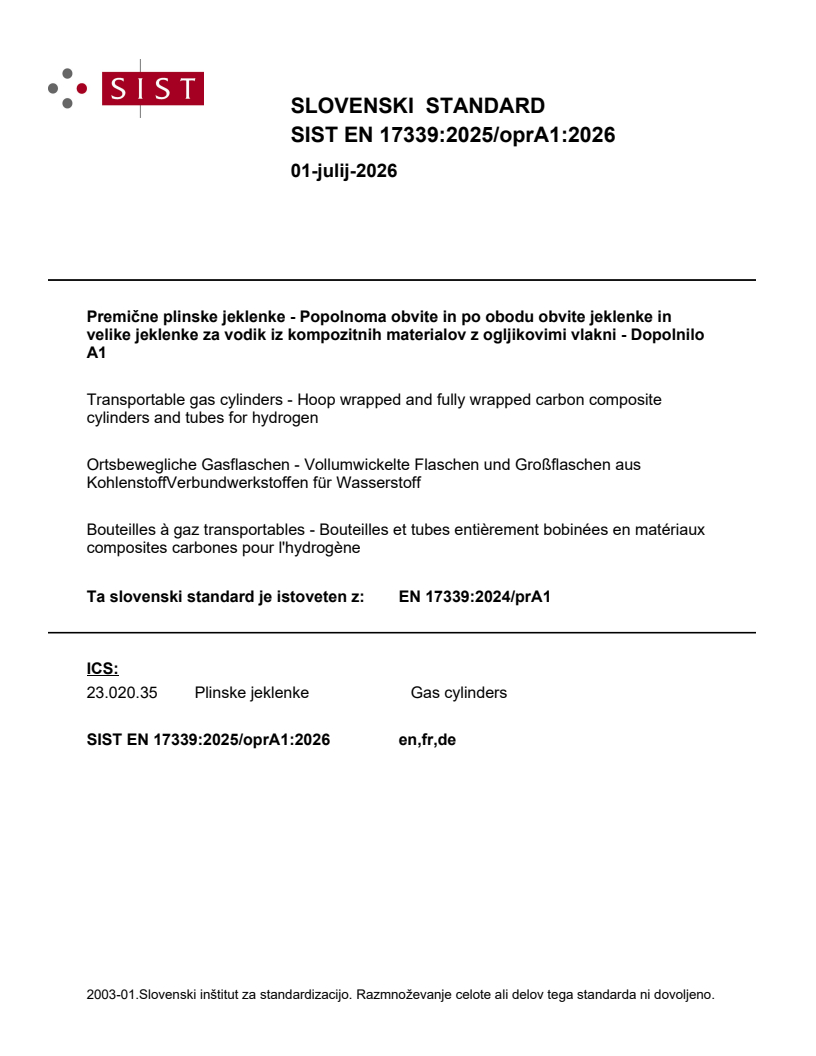
SLOVENSKI STANDARD
01-julij-2026
Premične plinske jeklenke - Popolnoma obvite in po obodu obvite jeklenke in
velike jeklenke za vodik iz kompozitnih materialov z ogljikovimi vlakni - Dopolnilo
A1
Transportable gas cylinders - Hoop wrapped and fully wrapped carbon composite
cylinders and tubes for hydrogen
Ortsbewegliche Gasflaschen - Vollumwickelte Flaschen und Großflaschen aus
KohlenstoffVerbundwerkstoffen für Wasserstoff
Bouteilles à gaz transportables - Bouteilles et tubes entièrement bobinées en matériaux
composites carbones pour l'hydrogène
Ta slovenski standard je istoveten z: EN 17339:2024/prA1
ICS:
23.020.35 Plinske jeklenke Gas cylinders
2003-01.Slovenski inštitut za standardizacijo. Razmnoževanje celote ali delov tega standarda ni dovoljeno.
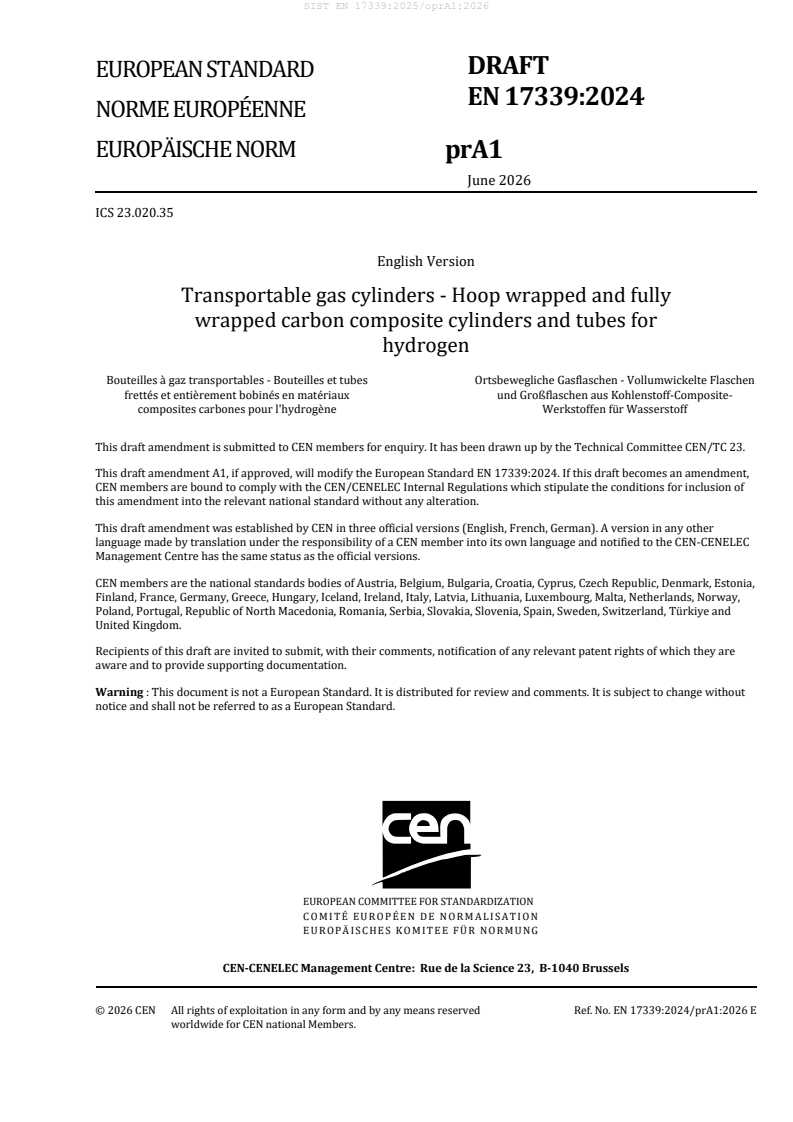
DRAFT
EUROPEAN STANDARD
EN 17339:2024
NORME EUROPÉENNE
EUROPÄISCHE NORM
prA1
June 2026
ICS 23.020.35
English Version
Transportable gas cylinders - Hoop wrapped and fully
wrapped carbon composite cylinders and tubes for
hydrogen
Bouteilles à gaz transportables - Bouteilles et tubes Ortsbewegliche Gasflaschen - Vollumwickelte Flaschen
frettés et entièrement bobinés en matériaux und Großflaschen aus Kohlenstoff-Composite-
composites carbones pour l'hydrogène Werkstoffen für Wasserstoff
This draft amendment is submitted to CEN members for enquiry. It has been drawn up by the Technical Committee CEN/TC 23.
This draft amendment A1, if approved, will modify the European Standard EN 17339:2024. If this draft becomes an amendment,
CEN members are bound to comply with the CEN/CENELEC Internal Regulations which stipulate the conditions for inclusion of
this amendment into the relevant national standard without any alteration.
This draft amendment was established by CEN in three official versions (English, French, German). A version in any other
language made by translation under the responsibility of a CEN member into its own language and notified to the CEN-CENELEC
Management Centre has the same status as the official versions.
CEN members are the national standards bodies of Austria, Belgium, Bulgaria, Croatia, Cyprus, Czech Republic, Denmark, Estonia,
Finland, France, Germany, Greece, Hungary, Iceland, Ireland, Italy, Latvia, Lithuania, Luxembourg, Malta, Netherlands, Norway,
Poland, Portugal, Republic of North Macedonia, Romania, Serbia, Slovakia, Slovenia, Spain, Sweden, Switzerland, Türkiye and
United Kingdom.
Recipients of this draft are invited to submit, with their comments, notification of any relevant patent rights of which they are
aware and to provide supporting documentation.
Warning : This document is not a European Standard. It is distributed for review and comments. It is subject to change without
notice and shall not be referred to as a European Standard.
EUROPEAN COMMITTEE FOR STANDARDIZATION
COMITÉ EUROPÉEN DE NORMALISATION
EUROPÄISCHES KOMITEE FÜR NORMUNG
CEN-CENELEC Management Centre: Rue de la Science 23, B-1040 Brussels
© 2026 CEN All rights of exploitation in any form and by any means reserved Ref. No. EN 17339:2024/prA1:2026 E
worldwide for CEN national Members.
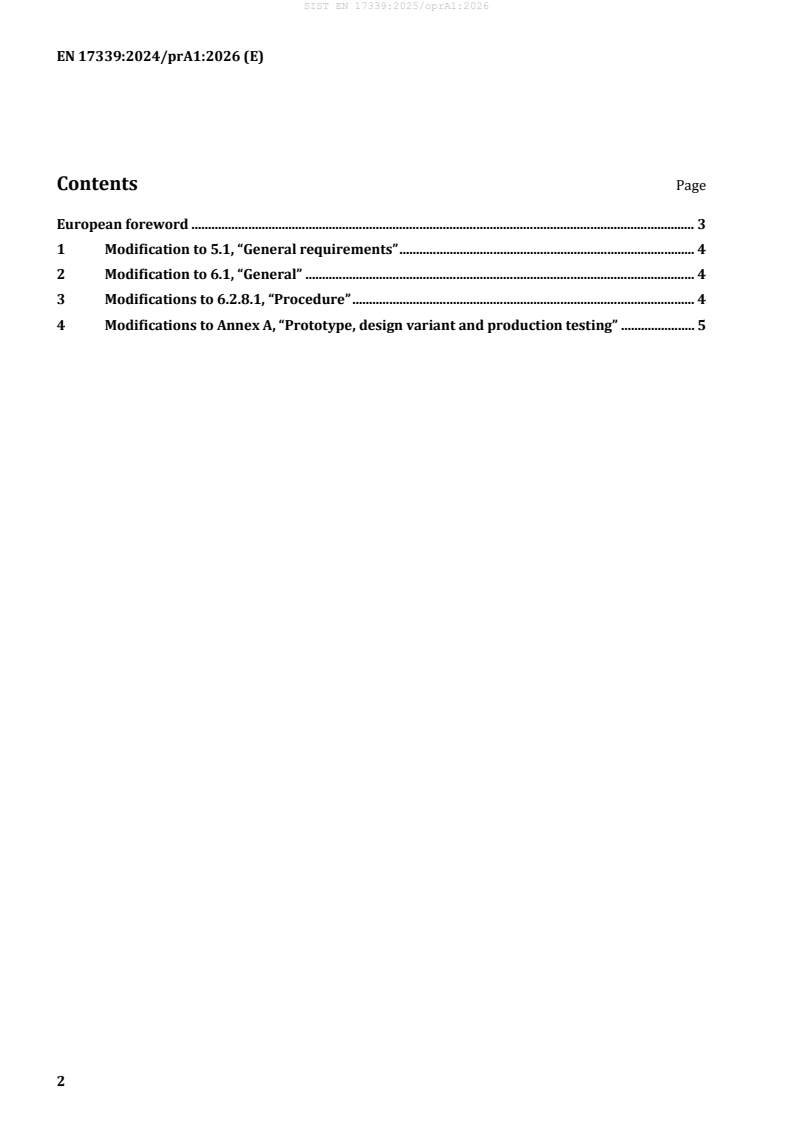
Contents Page
European foreword . 3
1 Modification to 5.1, “General requirements” . 4
2 Modification to 6.1, “General” .
...