

SIST EN 1014-4:2011
(Main)Wood preservatives - Creosote and creosoted timber - Methods of sampling and analysis - Part 4: Determination of the water-extractable phenols content of creosote
- Abstract
This European Standard specifies a high performance liquid chromatographic (HPLC) method for the determination of the water-extractable phenols content of creosote.
For reasons of precision, this standard is applicable to the determination of the water-extractable phenols content of creosotes containing more than 10 g of water-extractable phenols per kilogram of creosote.
- Status
- Published
- Public Enquiry End Date
- 29-Jan-2009
- Publication Date
- 02-Feb-2011
- Technical Committee
- LLZ - Les, lesni izdelki in zaščita lesa
- Current Stage
- 6060 - National Implementation/Publication (Adopted Project)
- Start Date
- 17-Jun-2010
- Due Date
- 22-Aug-2010
- Completion Date
- 03-Feb-2011



SIST EN 1014-4:2011 is the Slovenian standard adopting EN 1014-4:2010 from CEN. It specifies a high performance liquid chromatographic (HPLC) method for determining the water-extractable phenols content of creosote, mainly for laboratory testing and product control. For precision reasons, it is intended for creosotes containing more than 10 g of water-extractable phenols per kilogram of creosote.
What does SIST EN 1014-4:2011 specify?
SIST EN 1014-4:2011 specifies the test method, sample preparation, calculation, precision statements and reporting needed to measure water-extractable phenols in creosote. The method uses water extraction followed by HPLC analysis with a reversed-phase column and isocratic elution.
The document is organized into clauses on scope, normative references, principle, reagents, apparatus, preparation of calibration solutions and test samples, procedure, calculation, expression of results, precision and test report.
| Annex | What it covers |
|---|---|
| Annex A | Example of chromatogram and operating conditions |
| Annex B | Interpretation of the test results |
What are the key requirements of SIST EN 1014-4:2011?
Scope and applicability, Clause 1 - SIST EN 1014-4:2011 applies to creosotes with more than 10 g/kg of water-extractable phenols. In practice, this matters because the standard itself notes that precision is better suited to that concentration range.
Test principle, Clause 3 - SIST EN 1014-4:2011 requires the creosote sample to be extracted with water, then the aqueous extract to be analyzed by HPLC at constant temperature with a reversed-phase packed column and isocratic elution. The measured peaks are compared with a reference phenol solution, so the result is based on a direct chromatographic comparison rather than a visual estimate.
Reagents and standards, Clause 4 - SIST EN 1014-4:2011 specifies HPLC-grade acetonitrile, methanol and acetic acid, water of grade 1 to EN ISO 3696, and a set of phenol standards. This gives a defined chemical basis for calibration, which is important because the method depends on matching the phenols extracted from creosote.
Apparatus, Clause 5 - SIST EN 1014-4:2011 calls for a calibrated HPLC system, a 10 µl injector loop, a C18 reversed-phase column, a UV detector set to 276 nm and suitable balances and glassware. It also allows another HPLC configuration if it gives at least the same resolution, which lets laboratories use equivalent equipment without changing the method outcome.
Sample preparation, Clause 6 - SIST EN 1014-4:2011 gives separate procedures for “large” and “small” samples and requires duplicate test samples. The sample must be a single phase, and any creosote with crystals at room temperature has to be heated until it is homogeneous, because uneven samples would distort the extraction result.
Procedure, Clause 7 - SIST EN 1014-4:2011 sets the detector wavelength at 276 nm, the flow rate at 1.0 ml/min and requires calibration solutions and test samples to be run at the same temperature within ±0.5 °C. The peaks for each individual phenol are then measured, so the laboratory has a repeatable basis for quantification.
Calculation, results and precision, Clauses 8 to 10 - SIST EN 1014-4:2011 requires calculation of each individual phenol and the total water-extractable phenols content, then reporting the average result in g/kg rounded to the nearest 1 g/kg. It also gives repeatability and reproducibility limits, which are used to judge whether duplicate or inter-laboratory results are suspect.
What terms does SIST EN 1014-4:2011 use?
- HPLC - High performance liquid chromatography, the analytical technique used to separate and measure the phenols in the aqueous extract.
- Creosote - The material being tested, whether sampled directly or obtained from creosoted timber for analysis.
- Water-extractable phenols - The phenolic components that pass into water during the extraction step and are then measured by HPLC.
- Calibration solution - A prepared solution of known phenols content used to relate peak height to concentration.
- Test sample - The prepared aqueous portion of the creosote extract that is injected into the chromatograph.
- Repeatability - A check on whether duplicate results from the same operator agree closely enough to be trusted.
- Reproducibility - A check on whether results from different laboratories agree closely enough to be trusted.
Who uses SIST EN 1014-4:2011?
SIST EN 1014-4:2011 is used by analytical laboratories, quality control teams and technical staff working with creosote and creosoted timber. It is also relevant to organizations that need standardized results for sampling, product assessment or comparison of laboratory data.
The method is especially useful where creosote is sampled according to EN 1014-1 or obtained from creosoted timber according to EN 1014-2. Annex B notes that results from creosoted timber need careful interpretation because the material can change during service life.
What changed in SIST EN 1014-4:2011 from the previous edition?
SIST EN 1014-4:2011 supersedes EN 1014-4:1995.
Which standards are used with SIST EN 1014-4:2011?
- EN ISO 3696:1995 - supplies the water quality requirement for laboratory water used in the method.
- EN 1014-1 - gives the procedure for sampling creosote.
- EN 1014-2 - gives the procedure for obtaining a creosote sample from creosoted timber for later analysis.
- EN 1014-3 - is the related part of the series for determining benzo(a)pyrene content of creosote.
What does the SIST EN 1014-4:2011 document contain?
The document contains the full laboratory method: reagent preparation, calibration solution preparation, apparatus setup, sample extraction, chromatographic run conditions, calculation steps and the reporting requirements. It also includes precision information based on inter-laboratory testing with large test samples.
Annex A gives an example chromatogram and shows the operating conditions used to obtain it. Annex B explains how to interpret the result, especially for creosote taken from treated timber, where the measured water-extractable phenols content may be lower than in the original creosote.
Relations
- Effective Date
- 28-Jan-2026
- Effective Date
- 28-Jan-2026
- Effective Date
- 28-Jan-2026
- Effective Date
- 01-Oct-2010
Get Certified
Connect with accredited certification bodies for this standard

ECOCERT
Organic and sustainability certification.

Eurofins Food Testing Global
Global leader in food, environment, and pharmaceutical product testing.

Intertek Bangladesh
Intertek certification and testing services in Bangladesh.
Sponsored listings
Frequently Asked Questions
SIST EN 1014-4:2011 is a standard published by the Slovenian Institute for Standardization (SIST). Its full title is "Wood preservatives - Creosote and creosoted timber - Methods of sampling and analysis - Part 4: Determination of the water-extractable phenols content of creosote". This standard covers: This European Standard specifies a high performance liquid chromatographic (HPLC) method for the determination of the water-extractable phenols content of creosote. For reasons of precision, this standard is applicable to the determination of the water-extractable phenols content of creosotes containing more than 10 g of water-extractable phenols per kilogram of creosote.
This European Standard specifies a high performance liquid chromatographic (HPLC) method for the determination of the water-extractable phenols content of creosote. For reasons of precision, this standard is applicable to the determination of the water-extractable phenols content of creosotes containing more than 10 g of water-extractable phenols per kilogram of creosote.
SIST EN 1014-4:2011 is classified under the following ICS (International Classification for Standards) categories: 71.100.50 - Wood-protecting chemicals. The ICS classification helps identify the subject area and facilitates finding related standards.
SIST EN 1014-4:2011 has the following relationships with other standards: It is inter standard links to SIST EN ISO 3696:1998, SIST EN 13991:2003, SIST EN 13991:2024, SIST EN 1014-4:2004. Understanding these relationships helps ensure you are using the most current and applicable version of the standard.
SIST EN 1014-4:2011 is associated with the following European legislation: EU Directives/Regulations: 305/2011, 89/106/EEC. When a standard is cited in the Official Journal of the European Union, products manufactured in conformity with it benefit from a presumption of conformity with the essential requirements of the corresponding EU directive or regulation.
SIST EN 1014-4:2011 is available in PDF format for immediate download after purchase. The document can be added to your cart and obtained through the secure checkout process. Digital delivery ensures instant access to the complete standard document.
Standards Content (Sample)
2003-01.Slovenski inštitut za standardizacijo. Razmnoževanje celote ali delov tega standarda ni dovoljeno.Holzschutzmittel - Kreosot (Teerimprägnieröl) und damit imprägniertes Holz - Probenahme und Analyse - Teil 4: Bestimmung des Gehaltes an wasserextrahierbaren Phenolen im KreosotProduits de préservation du bois - Créosote et bois créosoté - Méthodes d'échantillonnage et d'analyse - Partie 4 : Détermination de la teneur en phénols extractibles à l'eau de la créosoteWood preservatives - Creosote and creosoted timber - Methods of sampling and analysis - Part 4: Determination of the water-extractable phenols content of creosote71.100.50Wood-protecting chemicalsICS:Ta slovenski standard je istoveten z:EN 1014-4:2010SIST EN 1014-4:2011en,fr,de01-marec-2011SIST EN 1014-4:2011SLOVENSKI
STANDARD
EUROPEAN STANDARD NORME EUROPÉENNE EUROPÄISCHE NORM
EN 1014-4
June 2010 ICS 71.100.50 Supersedes EN 1014-4:1995English Version
Wood preservatives - Creosote and creosoted timber - Methods of sampling and analysis - Part 4: Determination of the water-extractable phenols content of creosote
Produits de préservation du bois - Créosote et bois créosoté - Méthodes d'échantillonnage et d'analyse -Partie 4 : Détermination de la teneur en phénols extractibles à l'eau de la créosote
Holzschutzmittel - Kreosot (Teerimprägnieröl) und damit imprägniertes Holz - Probenahme und Analyse - Teil 4: Bestimmung des Gehaltes an wasserextrahierbaren Phenolen im Kreosot This European Standard was approved by CEN on 12 May 2010.
CEN members are bound to comply with the CEN/CENELEC Internal Regulations which stipulate the conditions for giving this European Standard the status of a national standard without any alteration. Up-to-date lists and bibliographical references concerning such national standards may be obtained on application to the CEN Management Centre or to any CEN member.
This European Standard exists in three official versions (English, French, German). A version in any other language made by translation under the responsibility of a CEN member into its own language and notified to the CEN Management Centre has the same status as the official versions.
CEN members are the national standards bodies of Austria, Belgium, Bulgaria, Croatia, Cyprus, Czech Republic, Denmark, Estonia, Finland, France, Germany, Greece, Hungary, Iceland, Ireland, Italy, Latvia, Lithuania, Luxembourg, Malta, Netherlands, Norway, Poland, Portugal, Romania, Slovakia, Slovenia, Spain, Sweden, Switzerland and United Kingdom.
EUROPEAN COMMITTEE FOR STANDARDIZATION
COMITÉ EUROPÉEN DE NORMALISATION EUROPÄISCHES KOMITEE FÜR NORMUNG
Management Centre:
Avenue Marnix 17,
B-1000 Brussels © 2010 CEN All rights of exploitation in any form and by any means reserved worldwide for CEN national Members. Ref. No. EN 1014-4:2010: ESIST EN 1014-4:2011
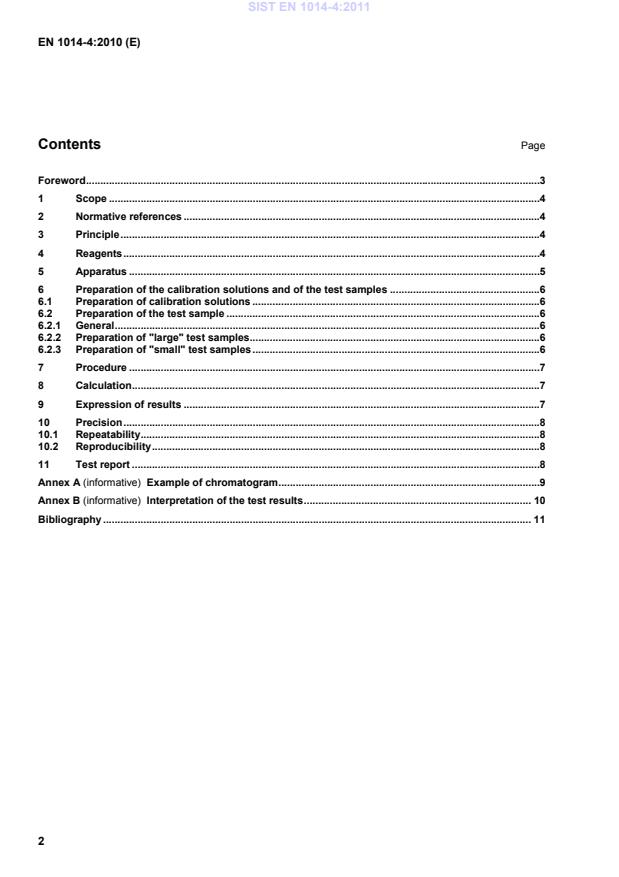
2 Contents Page Foreword .31Scope .42Normative references .43Principle .44Reagents .45Apparatus .56Preparation of the calibration solutions and of the test samples .66.1Preparation of calibration solutions .66.2Preparation of the test sample .66.2.1General .66.2.2Preparation of "large" test samples.66.2.3Preparation of "small" test samples .67Procedure .78Calculation .79Expression of results .710Precision .810.1Repeatability .810.2Reproducibility .811Test report .8Annex A (informative)
Example of chromatogram .9Annex B (informative)
Interpretation of the test results . 10Bibliography . 11 SIST EN 1014-4:2011
This European Standard shall be given the status of a national standard, either by publication of an identical text or by endorsement, at the latest by December 2010, and conflicting national standards shall be withdrawn at the latest by December 2010. Attention is drawn to the possibility that some of the elements of this document may be the subject of patent rights. CEN [and/or CENELEC] shall not be held responsible for identifying any or all such patent rights.
This document supersedes EN 1014-4:1995. This standard forms part of a series of standards relating to the sampling and analysis of creosote and creosoted timber. The other standards of the series are: EN 1014-1, Wood preservatives
Creosote and creosoted timber
Methods of sampling and analysis
Part 1: Procedure for sampling creosote EN 1014-2, Wood preservatives
Creosote and creosoted timber
Methods of sampling and analysis
Part 2: Procedure for obtaining a sample of creosote from creosoted timber for subsequent analysis EN 1014-3, Wood preservatives
Creosote and creosoted timber
Methods of sampling and analysis
Part 3: Determination of the benzo(a)pyrene content of creosote According to the CEN/CENELEC Internal Regulations, the national standards organizations of the following countries are bound to implement this European Standard: Austria, Belgium, Bulgaria, Croatia, Cyprus, Czech Republic, Denmark, Estonia, Finland, France, Germany, Greece, Hungary, Iceland, Ireland, Italy, Latvia, Lithuania, Luxembourg, Malta, Netherlands, Norway, Poland, Portugal, Romania, Slovakia, Slovenia, Spain, Sweden, Switzerland and the United Kingdom.
4 1 Scope This European Standard specifies a high performance liquid chromatographic (HPLC) method for the determination of the water-extractable phenols content of creosote. For reasons of precision, this standard is applicable to the determination of the water-extractable phenols content of creosotes containing more than 10 g of water-extractable phenols per kilogram of creosote. 2 Normative references The following referenced documents are indispensable for the application of this document. For dated references, only the edition cited applies. For undated references, the latest edition of the referenced document (including any amendments) applies. EN ISO 3696:1995, Water for analytical laboratory use – Specification and test methods (ISO 3696:1987) 3 Principle The creosote sample is extracted with water. The aqueous extract is analyzed using high performance chromatography (HPLC) at constant temperature with a reversed phase packed column and isocratic elution. The result is compared with that from a known reference standard containing various phenols known to be extracted by water from creosote. 4 Reagents 4.1 Acetonitrile HPLC grade. 4.2 Water according to grade 1 of EN ISO 3696:1995. 4.3 Methanol HPLC grade. 4.4 Acetic acid, HPLC grade. 4.5 Phenol purity 98 % (m/m) minimum. 4.6 2-methylphenol (o-cresol) purity 98 % (m/m) minimum. 4.7 3-methylphenol (m-cresol) purity 98 % (m/m) minimum. 4.8 4-methylphenol (p-cresol) purity 98 % (m/m) minimum. 4.9 1,2-dihydroxybenzene (catechol) purity 98 % (m/m) minimum. 4.10 1,3-dihydroxybenzene (resorcinol) purity 98 % (m/m) minimum. 4.11 1,4-dihydroxy
...