

oSIST prEN 16641:2026
(Main)Textile floor coverings - Guidelines for acceptable colour deviations
- Abstract
This document gives guidance in case of complaints when a colour deviation is observed before or after installation of a textile floor covering by the installer and/or end user.
The colour deviation can be observed within different parts of the installation or between the installed textile floor covering and the initially presented reference sample of the manufacturer on which the choice for ordering was made.
- Status
- Not Published
- Public Enquiry End Date
- 24-Dec-2026
- Technical Committee
- ITEK - Textile and textile products
- Current Stage
- 4020 - Public enquire (PE) (Adopted Project)
- Start Date
- 26-Oct-2026
- Due Date
- 15-Mar-2027

oSIST prEN 16641:2026 is a draft European standard published by SIST for textile floor coverings. It gives guidance for handling complaints about colour deviations before or after installation, so installers, manufacturers, assessors, and end users can judge whether the difference is acceptable.
What does oSIST prEN 16641:2026 specify?
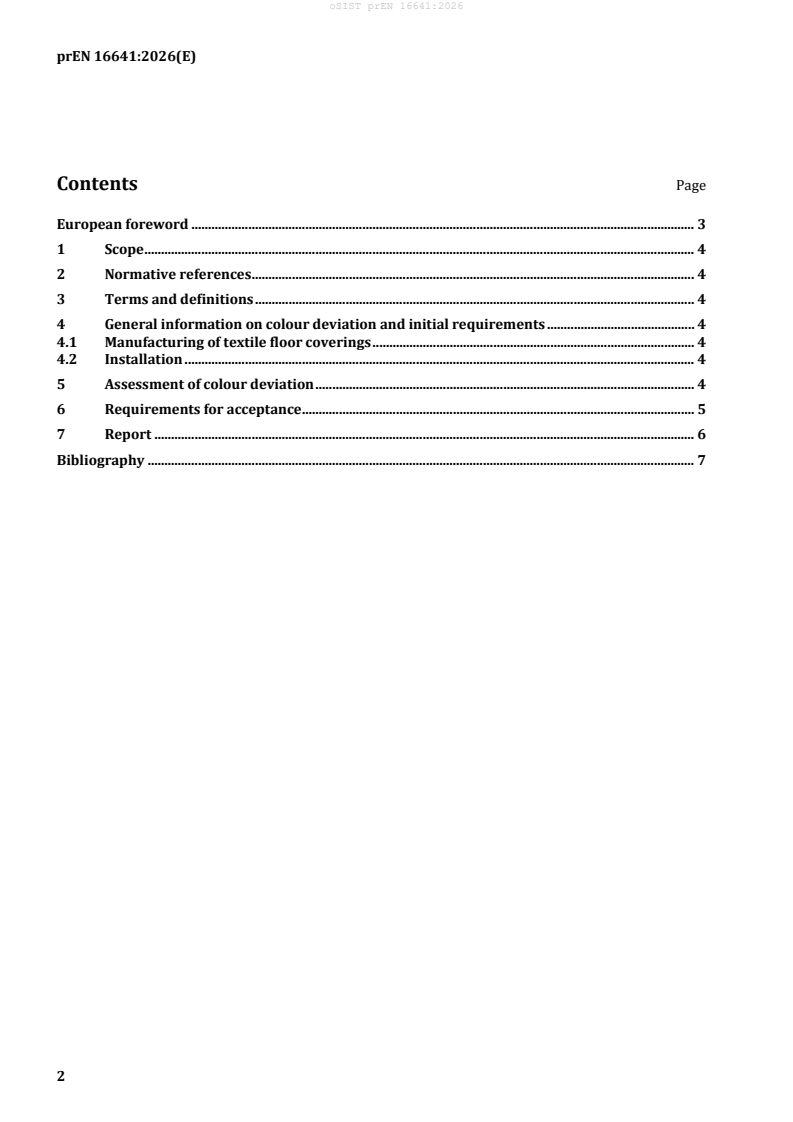
oSIST prEN 16641:2026 covers colour deviation complaints for textile floor coverings, either within the installed area or between the installed product and the manufacturer’s reference sample used for ordering. The document is organized into clauses on scope, normative references, terms and definitions, general information, assessment, acceptance, and reporting, followed by a bibliography.
What are the key requirements of oSIST prEN 16641:2026?
- Clause 4.1 explains that small colour differences can occur during manufacturing because of dyeing methods, visual colour assessment, process changes, different completion dates, and later deliveries. In practice, this means some variation is part of normal production and should be judged in context.
- Clause 4.2 recommends installing textile floor coverings from the same production batch in one room, with the room boundary generally ending at the doors unless otherwise agreed. For larger projects, the manufacturer and the installer are advised to agree an installation plan so the total quantity can be divided into smaller colour-equal batches.
- Clause 4.2 also requires the installer to check colour uniformity before installation. When sheets or tiles are installed together, colour uniformity is relevant only when the manufacturing direction is the same. This matters because different directions can change the visual impression.
- Clause 5 requires assessment with the larger grey scales from EN 20105-A02. The scale that most closely matches the observed deviation gives the result, and no visible deviation corresponds to grade 5. This gives a common visual method for deciding how large the difference looks.
- Clause 5 says the assessment should be made on an area that is representative of the complaint, and, when available, the installed product should be compared with an uninstalled manufacturer’s reference sample before installation. The assessment should be carried out by trained and qualified assessors, preferably three, and the median of their results becomes the final result.
- Clause 6 sets the acceptance logic. A grey-scale result of grade 4 or higher is treated as production-bound and acceptable, while grade 2-3 or lower is not acceptable. Grade 3 or 3-4 depends on how much the difference affects the overall appearance.
- Clause 6 also says that in large areas, small tone differences are not a reason for complaint if the overall appearance is not substantially affected. For new installations, the final furnished room, artificial lighting, and shadows need to be considered because they can reduce or hide visible differences.
- Clause 7 requires a written report. The report must identify the product and colour reference, the manufacturer’s reference sample if used, the location examined, the room situation, the number of assessors, each assessor’s result, the median result, and the reference to this document.
What terms does oSIST prEN 16641:2026 define?
This document uses the terms and definitions given in ISO 2424. Key terms in practice are:
- colour deviation - the visible difference in tone, depth, or purity between parts of a textile floor covering or between the installed product and the reference sample.
- reference sample - the manufacturer’s sample on which the ordering decision was based and, when available, the sample used for pre-installation comparison.
- production batch - a group of material that Clause 4.2 recommends keeping together in one room where possible to reduce visible differences.
- grey scale - the EN 20105-A02 set of paired grey fabrics used to judge how close the deviation is to the defined colour-fastness grades.
- assessor - a trained and qualified person who performs the comparison; preferably three assessors are used and the median result is recorded.
Who uses oSIST prEN 16641:2026?
oSIST prEN 16641:2026 is used by installers, manufacturers, end users, and people handling complaints about textile floor coverings. Quality managers, specifiers, and buyers use it to set expectations for batch selection, installation planning, and acceptance decisions on site. It is also useful for assessors who need a consistent way to document visible colour differences.
What changed in oSIST prEN 16641:2026 from the previous edition?
oSIST prEN 16641:2026 will supersede EN 16641:2019. The stated technical changes are the removal of the reference to CEN/TS 14472-2 in Clauses 2 and 4.2 because it was withdrawn in 2023, a clearer description of assessment and assessors in Clause 5, and more detailed acceptance criteria in Clause 6.
Which standards are used with oSIST prEN 16641:2026?
- EN 20105-A02, Textiles - Tests for colour fastness - Part A02: Grey scale for assessing change in colour - provides the grey scales used to judge the colour deviation.
- ISO 2424, Textile floor coverings - Vocabulary - supplies the terms and definitions used throughout the document.
- EN ISO 105-A01, Textiles - Tests for colour fastness - Part A01: General principles of testing - appears in the bibliography as background reading on colour fastness testing.
What does the oSIST prEN 16641:2026 document contain?
The document combines guidance text with a practical assessment method and a reporting structure. It explains why colour nuances can vary in manufacturing, how installation layout and manufacturing direction affect the visual result, and how to compare a complaint area against the larger grey scales. The report clause gives the information to record so the assessment can be traced later: product identification, site location, the assessors, individual results, and the median result.
Relations
- Effective Date
- 24-Dec-2025
Frequently Asked Questions
oSIST prEN 16641:2026 is a draft published by the Slovenian Institute for Standardization (SIST). Its full title is "Textile floor coverings - Guidelines for acceptable colour deviations". This standard covers: This document gives guidance in case of complaints when a colour deviation is observed before or after installation of a textile floor covering by the installer and/or end user. The colour deviation can be observed within different parts of the installation or between the installed textile floor covering and the initially presented reference sample of the manufacturer on which the choice for ordering was made.
This document gives guidance in case of complaints when a colour deviation is observed before or after installation of a textile floor covering by the installer and/or end user. The colour deviation can be observed within different parts of the installation or between the installed textile floor covering and the initially presented reference sample of the manufacturer on which the choice for ordering was made.
oSIST prEN 16641:2026 is classified under the following ICS (International Classification for Standards) categories: 97.150 - Floor coverings. The ICS classification helps identify the subject area and facilitates finding related standards.
oSIST prEN 16641:2026 has the following relationships with other standards: It is inter standard links to SIST EN 16641:2020. Understanding these relationships helps ensure you are using the most current and applicable version of the standard.
oSIST prEN 16641:2026 is available in PDF format for immediate download after purchase. The document can be added to your cart and obtained through the secure checkout process. Digital delivery ensures instant access to the complete standard document.
Standards Content (Sample)
Contents
- 1 Scope
- 2 Normative references
- 3 Terms and definitions
- 4 General information on colour deviation and initial requirements
- 4.1 Manufacturing of textile floor coverings
- 4.2 Installation
- 5 Assessment of colour deviation
- 6 Requirements for acceptance
- 7 Report
- Bibliography
1 Scope
This document gives guidance in case of complaints when a colour deviation is observed before or after installation of a textile floor covering by the installer and/or end user. The colour deviation can be observed within different parts of the installation or between the installed textile floor covering and the initially presented reference sample of the manufacturer on which the choice for ordering was made.
2 Normative references
The following documents are referred to in the text in such a way that some or all of their content constitutes requirements of this document. For dated references, only the edition cited applies. For undated references, the latest edition of the referenced document (including any amendments) applies. EN 20105-A02, Textiles – Tests for colour fastness – Part A02: Grey scale for assessing change in colour (ISO 105:A02) ISO 2424, Textile floor coverings - Vocabulary
3 Terms and definitions
For the purposes of this document, the terms and definitions given in ISO 2424 apply.
4 General information on colour deviation and initial requirements
4.1 Manufacturing of textile floor coverings
During the manufacturing of textile floorcoverings, it is not always possible to maintain equal colour nuances. Slight differences in colour can occur due to different dyeing methods, visual colour assessment, changes in manufacturing processes, different dates of completion, subsequent deliveries, etc.
...