


SIST EN 474-1:2007+A5:2018
(Main)Earth-moving machinery - Safety - Part 1: General requirements
Earth-moving machinery - Safety - Part 1: General requirements
This European Standard specifies the general safety requirements for earth-moving machinery ) described in EN ISO 6165:2006, except rollers and horizontal directional drill.
NOTE 1 Rollers are covered by EN 500.
NOTE 2 Horizontal directional drills are covered by EN 791.
This European Standard also applies to derivative machinery (see 3.1.2) designed primarily for use with equipment to loosen, pick-up, move, transport, distribute and grade earth and rock.
This European Standard gives the common safety requirements for earth-moving machinery families and is intended to be used in conjunction with one of the EN 474 parts 2 to 12. These machine specific parts EN 474-2 to -12 do not repeat the requirements from EN 474-1:2006+A1:2009, but add or replace the requirements for the family in question.
NOTE 3 The requirements specified in this part of the standard are common to two or more families of earth- moving machinery.
This part gives specific requirements for demolition machinery.
Specific requirements in EN 474 parts 2 to 12 take precedence over the respective requirements of EN 474-1:2006+A1:2009.
For multipurpose machinery the parts of the standard that cover the specific functions and applications have to be used e.g. a compact loader also used as a trencher shall use the relevant requirements of EN 474 parts 1, 3 and 10.
The standard also covers general requirements for attachments intended to be used with earth moving machine families covered in the scope.
Except for part 12 this European Standard does not deal with the electrical hazards related to the main circuits and drives of machinery when the principal source of energy is electrical.
This European Standard does not deal with towing of trailers.
This European Standard deals with all significant hazards, hazardous situations and events relevant to earth-moving machinery, when used as intended and under conditions of misuse which are reasonably foreseeable by the manufacturer (see Clause 4). This European Standard specifies the appropriate technical measures to eliminate or reduce risks arising from the significant hazards, hazardous situations and events during commissioning, operation and maintenance of earth-moving machinery.
This European Standard is not applicable to earth moving machines, which are manufactured before the date of publication of this European Standard by CEN.
Erdbaumaschinen - Sicherheit - Teil 1: Allgemeine Anforderungen
Diese Europäische Norm& legt allgemeine sicherheitstechnische Anforderungen für
Erdbaumaschinen1) fest, die in EN ISO 6165:2006 beschrieben sind, ausgenommen hiervon sind Walzen und
Horizontalbohrmaschinen.
ANMERKUNG 1 Walzen werden in EN 500 behandelt.
ANMERKUNG 2 Horizontalbohrmaschinen werden in EN 791 behandelt.
%Diese Europäische Norm& gilt auch für artverwandte Maschinen (siehe 3.1.2), die vorrangig für die
Verwendung mit Arbeitseinrichtungen zum Lösen, Aufnehmen, Bewegen, Transportieren, Verteilen und
Planieren von Erdreich und Gestein vorgesehen sind.
%Diese Europäische Norm& beschreibt gemeinsame Sicherheitsanforderungen für Erdbaumaschinen
und ist dazu vorgesehen, zusammen mit einem der Teile von EN 474, Teil 2 bis Teil 12, angewendet zu
werden. Diese maschinenspezifischen Teile (EN 474-2 bis EN 474-12) wiederholen nicht die Anforderungen
von !EN 474-1:2006+A1:2009", sondern ergänzen bzw. ersetzen Anforderungen für die jeweilige
Maschinenart.
ANMERKUNG 3 Die Anforderungen, die in diesem Teil der Normenreihe beschrieben sind, treffen auf zwei oder
mehr Arten von Erdbaumaschinen zu.
'Dieser Teil enthält spezifische Anforderungen für Abrissmaschinen.(
Die spezifischen Anforderungen von EN 474, Teil 2 bis Teil 12, haben Vorrang vor den entsprechenden Anforderungen
in!EN 474-1:2006+A1:2009".
Für Mehrzweckmaschinen sind die Teile der Normenreihe anzuwenden, die die spezifischen Funktionen und
Einsatzarten behandeln. Für einen Kompaktlader, der z. B. auch als Grabenfräse eingesetzt wird, sind die
zutreffenden Anforderungen von EN 474-1, EN 474-3 und EN 474-10 zu berücksichtigen.
Die Norm enthält auch allgemeine Anforderungen für Arbeitsausrüstungen, die dazu bestimmt sind, in
Verbindung mit den im Anwendungsbereich beschriebenen Erdbaumaschinen eingesetzt zu werden.
Elektrische Gefährdungen, die durch den Hauptstromkreis und den Antrieb hervorgerufen werden, !
werden, außer in Teil 12, in dieser Europäischen Norm nicht behandelt", wenn die Primär-Energiequelle
Elektrizität ist.
!Diese Europäische Norm behandelt nicht das Ziehen von Anhängern."
Diese Europäische Norm behandelt alle signifikanten Gefährdungen, Gefährdungssituationen und
Gefährdungsereignisse, die auf Erdbaumaschinen zutreffen, wenn sie bestimmungsgemäß verwendet
werden. Die nach vernünftigem Ermessen für den Hersteller vorhersehbare Nutzung der Maschine
außerhalb der bestimmungsgemäßen Verwendung ist ebenfalls berücksichtigt (siehe Abschnitt 4). Die
entsprechenden Maßnahmen, um die Risiken, die von den signifikanten Gefährdungen,
Gefährdungssituationen und Gefährdungsereignissen während der Inbetriebnahme, des Betriebs und der
Instandhaltung der Erdbaumaschine ausgehen, zu verhindern oder zu minimieren, sind in dieser
Europäischen Norm beschrieben.
Diese Europäische Norm gilt nicht für Erdbaumaschinen, die vor Veröffentlichung dieser Europäischen Norm
durch CEN hergestellt wurden.
Engins de terrassement - Sécurité - Partie 1: Prescriptions générales
La présente Norme européenne spécifie les prescriptions générales de sécurité applicables aux engins de terrassement 1) définis par l’EN ISO 6165:2006, à l'exception des compacteurs.
NOTE 1 L’EN 500 traite des compacteurs.
NOTE 2 Les appareils de forage dirigé sont couverts par l’EN 791.
La présente Norme européenne s'applique aussi aux machines dérivées (voir 3.1.2) conçues principalement pour être utilisées avec un équipement de travail permettant de désagréger, prendre, déplacer, transporter et répandre des matériaux ou de niveler des matériaux ou de la roche.
La présente Norme européenne donne les prescriptions de sécurité communes applicables à tous les types d'engins de terrassement et doit être utilisée conjointement avec l’une des parties 2 à 12 de l’EN 474. Ces parties (EN 474-2 à -12) qui sont spécifiques aux différentes machines ne répètent pas les prescriptions de l’EN 474-1:2006+A1:2009, mais en ajoutent ou en remplacent certaines applicables à l’engin correspondant.
NOTE 3 Les prescriptions de sécurité communes spécifiées dans la présente partie de la norme concernent plus de deux familles d'engins de terrassement.
La présente partie donne des prescriptions spécifiques pour les machines de démolition.
Les prescriptions spécifiques des EN 474 parties 2 à 12 prennent le pas sur les prescriptions correspondantes de l’EN 474-1:2006+A1:2009".
Pour les engins de terrassement polyvalents, les parties de la norme qui traitent des fonctions et configurations spécifiques doivent être utilisées, par exemple une mini-chargeuse également utilisée comme trancheuse doit utiliser les prescriptions pertinentes des parties EN 474-1, -3 et -10.
La norme traite également des prescriptions générales relatives aux accessoires destinés à être utilisés avec des familles d’engins de terrassement citées dans le domaine d’application.
À l'exception de la partie 12, la présente Norme européenne ne traite pas des risques électriques liés aux circuits principaux de puissance et de commande des machines lorsque la principale source d’énergie est électrique.
La présente Norme européenne ne traite pas des remorques attelées à un véhicule.
La présente Norme européenne traite de tous les phénomènes, situations et événements dangereux significatifs relatifs aux engins de terrassement lorsqu'ils sont utilisés comme prévu ou dans des conditions de mauvais usage que le fabricant peut raisonnablement prévoir (voir Article 4). La présente Norme européenne prescrit les mesures techniques appropriées pour éliminer ou réduire les risques dus aux phénomènes, situations et événements dangereux significatifs survenant lors de la mise en service, du fonctionnement et de la maintenance des engins de terrassement.
La présente Norme européenne n’est pas applicable aux engins de terrassement fabriqués avant la date de publication de la présente Norme européenne par le CEN.
Stroji za zemeljska dela - Varnost - 1. del: Splošne zahteve
General Information
- Status
- Withdrawn
- Publication Date
- 06-Feb-2018
- Withdrawal Date
- 17-Oct-2019
- Technical Committee
- I13 - Imaginarni 13
- Current Stage
- 9900 - Withdrawal (Adopted Project)
- Start Date
- 17-Oct-2019
- Due Date
- 09-Nov-2019
- Completion Date
- 18-Oct-2019
Relations
- Consolidates
SIST EN 474-1:2007+A4:2014/AC:2014 - Earth-moving machinery - Safety - Part 1: General requirements - Effective Date
- 24-Mar-2021
- Consolidates
SIST EN 474-1:2007+A4:2014 - Earth-moving machinery - Safety - Part 1: General requirements - Effective Date
- 20-Sep-2017
- Consolidates
SIST EN 474-1:2007+A4:2014/kFprA5:2017 - Earth-moving machinery - Safety - Part 1: General requirements - Effective Date
- 20-Sep-2017
- Consolidated By
SIST EN 474-1:2007+A6:2019 - Earth-moving machinery - Safety - Part 1: General requirements - Effective Date
- 31-Jul-2019
- Effective Date
- 14-Mar-2018


Frequently Asked Questions
SIST EN 474-1:2007+A5:2018 is a standard published by the Slovenian Institute for Standardization (SIST). Its full title is "Earth-moving machinery - Safety - Part 1: General requirements". This standard covers: This European Standard specifies the general safety requirements for earth-moving machinery ) described in EN ISO 6165:2006, except rollers and horizontal directional drill. NOTE 1 Rollers are covered by EN 500. NOTE 2 Horizontal directional drills are covered by EN 791. This European Standard also applies to derivative machinery (see 3.1.2) designed primarily for use with equipment to loosen, pick-up, move, transport, distribute and grade earth and rock. This European Standard gives the common safety requirements for earth-moving machinery families and is intended to be used in conjunction with one of the EN 474 parts 2 to 12. These machine specific parts EN 474-2 to -12 do not repeat the requirements from EN 474-1:2006+A1:2009, but add or replace the requirements for the family in question. NOTE 3 The requirements specified in this part of the standard are common to two or more families of earth- moving machinery. This part gives specific requirements for demolition machinery. Specific requirements in EN 474 parts 2 to 12 take precedence over the respective requirements of EN 474-1:2006+A1:2009. For multipurpose machinery the parts of the standard that cover the specific functions and applications have to be used e.g. a compact loader also used as a trencher shall use the relevant requirements of EN 474 parts 1, 3 and 10. The standard also covers general requirements for attachments intended to be used with earth moving machine families covered in the scope. Except for part 12 this European Standard does not deal with the electrical hazards related to the main circuits and drives of machinery when the principal source of energy is electrical. This European Standard does not deal with towing of trailers. This European Standard deals with all significant hazards, hazardous situations and events relevant to earth-moving machinery, when used as intended and under conditions of misuse which are reasonably foreseeable by the manufacturer (see Clause 4). This European Standard specifies the appropriate technical measures to eliminate or reduce risks arising from the significant hazards, hazardous situations and events during commissioning, operation and maintenance of earth-moving machinery. This European Standard is not applicable to earth moving machines, which are manufactured before the date of publication of this European Standard by CEN.
This European Standard specifies the general safety requirements for earth-moving machinery ) described in EN ISO 6165:2006, except rollers and horizontal directional drill. NOTE 1 Rollers are covered by EN 500. NOTE 2 Horizontal directional drills are covered by EN 791. This European Standard also applies to derivative machinery (see 3.1.2) designed primarily for use with equipment to loosen, pick-up, move, transport, distribute and grade earth and rock. This European Standard gives the common safety requirements for earth-moving machinery families and is intended to be used in conjunction with one of the EN 474 parts 2 to 12. These machine specific parts EN 474-2 to -12 do not repeat the requirements from EN 474-1:2006+A1:2009, but add or replace the requirements for the family in question. NOTE 3 The requirements specified in this part of the standard are common to two or more families of earth- moving machinery. This part gives specific requirements for demolition machinery. Specific requirements in EN 474 parts 2 to 12 take precedence over the respective requirements of EN 474-1:2006+A1:2009. For multipurpose machinery the parts of the standard that cover the specific functions and applications have to be used e.g. a compact loader also used as a trencher shall use the relevant requirements of EN 474 parts 1, 3 and 10. The standard also covers general requirements for attachments intended to be used with earth moving machine families covered in the scope. Except for part 12 this European Standard does not deal with the electrical hazards related to the main circuits and drives of machinery when the principal source of energy is electrical. This European Standard does not deal with towing of trailers. This European Standard deals with all significant hazards, hazardous situations and events relevant to earth-moving machinery, when used as intended and under conditions of misuse which are reasonably foreseeable by the manufacturer (see Clause 4). This European Standard specifies the appropriate technical measures to eliminate or reduce risks arising from the significant hazards, hazardous situations and events during commissioning, operation and maintenance of earth-moving machinery. This European Standard is not applicable to earth moving machines, which are manufactured before the date of publication of this European Standard by CEN.
SIST EN 474-1:2007+A5:2018 is classified under the following ICS (International Classification for Standards) categories: 53.100 - Earth-moving machinery. The ICS classification helps identify the subject area and facilitates finding related standards.
SIST EN 474-1:2007+A5:2018 has the following relationships with other standards: It is inter standard links to SIST EN 474-1:2007+A4:2014/AC:2014, SIST EN 474-1:2007+A4:2014, SIST EN 474-1:2007+A4:2014/kFprA5:2017, SIST EN 474-1:2007+A6:2019, SIST EN 474-1:2007+A5:2018/kFprA6:2019. Understanding these relationships helps ensure you are using the most current and applicable version of the standard.
SIST EN 474-1:2007+A5:2018 is associated with the following European legislation: EU Directives/Regulations: 2006/42/EC; Standardization Mandates: M/396. When a standard is cited in the Official Journal of the European Union, products manufactured in conformity with it benefit from a presumption of conformity with the essential requirements of the corresponding EU directive or regulation.
SIST EN 474-1:2007+A5:2018 is available in PDF format for immediate download after purchase. The document can be added to your cart and obtained through the secure checkout process. Digital delivery ensures instant access to the complete standard document.
Standards Content (Sample)
2003-01.Slovenski inštitut za standardizacijo. Razmnoževanje celote ali delov tega standarda ni dovoljeno.Stroji za zemeljska dela - Varnost - 1. del: Splošne zahteveErdbaumaschinen - Sicherheit - Teil 1: Allgemeine AnforderungenEngins de terrassement - Sécurité - Partie 1: Prescriptions généralesEarth-moving machinery - Safety - Part 1: General requirements53.100Stroji za zemeljska delaEarth-moving machineryICS:Ta slovenski standard je istoveten z:EN 474-1:2006+A5:2018SIST EN 474-1:2007+A5:2018en,fr,de01-marec-2018SIST EN 474-1:2007+A5:2018SLOVENSKI
STANDARD
EUROPEAN STANDARD NORME EUROPÉENNE EUROPÄISCHE NORM
EN 474-1:2006+A5
January 2018 ICS 53.100 Supersedes EN 474-1:2006+A4:2013
English Version
Earth-moving machinery - Safety - Part 1: General requirements
Engins de terrassement - Sécurité - Partie 1: Prescriptions générales
Erdbaumaschinen - Sicherheit - Teil 1: Allgemeine Anforderungen This European Standard was approved by CEN on 17 April 2006
and includes Amendment 5 approved by CEN on 1 October 2017.
CEN members are bound to comply with the CEN/CENELEC Internal Regulations which stipulate the conditions for giving this European Standard the status of a national standard without any alteration. Up-to-date lists and bibliographical references concerning such national standards may be obtained on application to the CEN-CENELEC Management Centre or to any CEN member.
This European Standard exists in three official versions (English, French, German). A version in any other language made by translation under the responsibility of a CEN member into its own language and notified to the CEN-CENELEC Management Centre has the same status as the official versions.
CEN members are the national standards bodies of Austria, Belgium, Bulgaria, Croatia, Cyprus, Czech Republic, Denmark, Estonia, Finland, Former Yugoslav Republic of Macedonia, France, Germany, Greece, Hungary, Iceland, Ireland, Italy, Latvia, Lithuania, Luxembourg, Malta, Netherlands, Norway, Poland, Portugal, Romania, Serbia, Slovakia, Slovenia, Spain, Sweden, Switzerland, Turkey and United Kingdom.
EUROPEAN COMMITTEE FOR STANDARDIZATION
COMITÉ EUROPÉEN DE NORMALISATION
EUROPÄISCHES KOMITEE FÜR NORMUNG
CEN-CENELEC Management Centre:
Rue de la Science 23,
B-1040 Brussels © 2018 CEN All rights of exploitation in any form and by any means reserved worldwide for CEN national Members. Ref. No. EN 474-1:2006+A5:2018 E SIST EN 474-1:2007+A5:2018
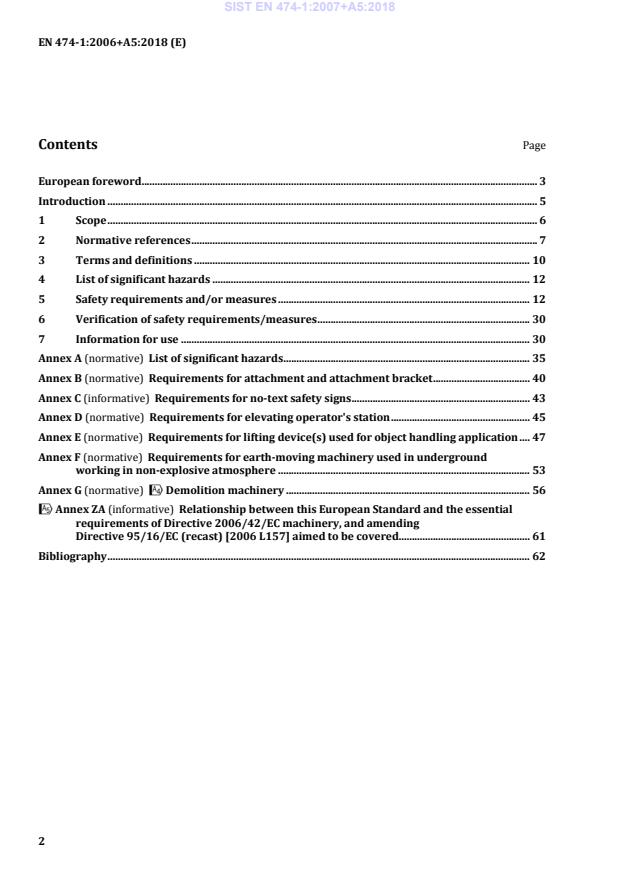
List of significant hazards . 35 Annex B (normative)
Requirements for attachment and attachment bracket . 40 Annex C (informative)
Requirements for no-text safety signs . 43 Annex D (normative)
Requirements for elevating operator's station . 45 Annex E (normative)
Requirements for lifting device(s) used for object handling application . 47 Annex F (normative)
Requirements for earth-moving machinery used in underground working in non-explosive atmosphere . 53 Annex G (normative)
'Demolition machinery . 56 )Annex ZA (informative)
Relationship between this European Standard and the essential requirements of Directive 2006/42/EC machinery, and amending Directive 95/16/EC (recast) [2006 L157] aimed to be covered . 61 Bibliography . 62
The modifications of the related CEN Corrigendum have been implemented at the appropriate places in the text and are indicated by the tags ˜™. This document has been prepared under a mandate given to CEN by the European Commission and the European Free Trade Association, and supports essential requirements of EU Directive. !For relationship with EU Directive(s), see %informative Annex ZA&, which is an integral part of this document." EN 474 "Earth-moving machinery — Safety" comprises the following parts: — Part 1: General requirements — Part 2: Requirements for tractor-dozers — Part 3: Requirements for loaders — Part 4: Requirements for backhoe-loaders — Part 5: Requirements for hydraulic excavators — Part 6: Requirements for dumpers — Part 7: Requirements for scrapers — Part 8: Requirements for graders — Part 9: Requirements for pipe-layers — Part 10: Requirements for trenchers SIST EN 474-1:2007+A5:2018
!EN 474-1:2006+A1:2009". For multipurpose machinery the parts of the standard that cover the specific functions and applications have to be used e.g. a compact loader also used as a trencher shall use the relevant requirements of EN 474 parts 1, 3 and 10. The standard also covers general requirements for attachments intended to be used with earth moving machine families covered in the scope. !Except for part 12 this European Standard does not deal" with the electrical hazards related to the main circuits and drives of machinery when the principal source of energy is electrical. !This European Standard does not deal with towing of trailers." This European Standard deals with all significant hazards, hazardous situations and events relevant to earth-moving machinery, when used as intended and under conditions of misuse which are reasonably foreseeable by the manufacturer (see Clause 4). This European Standard specifies the appropriate technical measures to eliminate or reduce risks arising from the significant hazards, hazardous situations and events during commissioning, operation and maintenance of earth-moving machinery. This European Standard is not applicable to earth moving machines, which are manufactured before the date of publication of this European Standard by CEN.
1) For travelling on public roads the national traffic regulations apply until harmonised requirements are available. (A CEN-standard is under preparation.) SIST EN 474-1:2007+A5:2018
!EN 474-3:2006+A1:2009" and !EN 474-4:2006+A1:2009". The term "rated lift capacity" is defined in
ISO 10567:1992 and used in !EN 474-5:2006+A3:2013". Both terms are equivalent. '3.6 demolition machine machine based on earth moving machinery (see EN ISO 6165) and including equipment and attachment (working tool – e.g. processor or breaker) specifically designed to demolish, cut, loosen, separate, pick up, transport and distribute component parts of buildings, civil engineering structures 3.7 processor attachment with tooth, teeth and/or cutting edges, used for demolition or deconstruction 3.8 hydraulic hammer or breaker equipment which uses the hydraulic power source of the carrier machine to accelerate a piston (sometimes gas-assisted), which then hits a tool Note 1 to entry: The stress wave generated by kinetic action flows through the tool into the material, which causes the material to break. Hydraulic hammers need a supply of pressurised oil to function. The complete carrier/hammer unit is controlled by an operator, usually seated in the cabin of the carrier. 3.9 high reach equipment multi piece rigid or telescopic equipment with the primary function of operating specialised attachments for the demolition of structures at heights that cannot be reached by standard backhoe equipment 3.10 base machine machine with a cab or canopy and operator protective structures if required, without equipment or attachments but possessing the necessary mountings for such equipment and attachments [SOURCE: ISO 6016:2008, 3.1.1]( SIST EN 474-1:2007+A5:2018
Figure 1 — Minimum clearance of lower limbs at access to the operator's station on machines with articulated steering )deleted text* 5.3 Operator's station 5.3.1 General requirements 5.3.1.1 Machinery equipment !The driving position of ride-on drivers shall be designed and constructed in such a way that a driver's cab may be fitted, provided this does not increase the risk and there is room for it." Machines with an operating mass less than 1 500 kg are not required to have a cab. Machines with an operating mass greater than or equal to 1 500 kg shall be equipped with a cab, unless the foreseeable adverse weather conditions allow all-year operation without a cab (negotiated between manufacturer and user). Machines shall be equipped with a cab and a contamination protective system if the machine is intended for use in unhealthy environments, e.g. contaminated areas (negotiated between manufacturer and user). See 5.14.1. If a hazard due to projection of splinters exists, e.g. operation with a hydraulic- or demolition-hammer, an adequate protection such as bullet proof glass, mesh guard or an equivalent protection is required. 5.3.1.2 Minimum space The minimum space available to the operator shall be as defined in !EN ISO 3411:2007" (except as amended in 5.3.2.5). For compact machines the minimum space envelope width (dimension 920 mm in !EN ISO 3411:2007, Figure 4") may be reduced to 650 mm. The minimum space and location of the controls at the operator's station shall meet the requirements specified in EN ISO 6682:1995. SIST EN 474-1:2007+A5:2018
The minimum dimensions given in Table 1 are also required for machines having a front or rear window which are located (in an opened position) above the operator's seat. 5.3.2.6 Heating and ventilation system If a heating system is fitted it shall either: a) comply with !ISO/DIS 10263-4:2007", or b) have the capability of increasing the temperature of the air inside the cab and maintain a temperature of + 18°C at expected ambient temperature the machine is intended for. The minimum starting with the engine at working temperature as specified by the manufacturer. Measurement of the system capacity shall be made at three points. The three points shall be located in a vertical plane through the SIP and parallel to the longitudinal axis of the machine as follows (see )Figure 2*): 1) at filament position centre-point as defined in )ISO 5006:2017*; 2) at the SIP as defined in EN ISO 5353:1998; 3) 100 mm above floor plate and 600 mm in front of SIP. SIST EN 474-1:2007+A5:2018
) Figure 2 — Location of measuring points * c) Alternatively, the heating capacity can be determined by calculation. The ventilation system shall be capable of providing the cab with filtered fresh air at the minimum of 43 m3/h. The filter shall be tested according to !ISO/DIS 10263-2:2007". NOTE The filter element selection depends on the intended operating environment conditions. 5.3.2.7 Defrosting system Machine with a cab shall provide facilities to defrost the front and rear window(s), for example by means of a heating system or a particular defrosting device. NOTE A testing method of windscreen defrosting system is described in !ISO/DIS 10263-5:2007". 5.3.2.8 Pressurisation system Where a cab is provided with a pressurisation system, it shall be tested according to
!ISO/DIS 10263-3:2007" and shall provide an interior relative pressure of at least 50 Pa. 5.3.2.9 Doors and windows Doors, windows and flaps shall be securely held in their functional positions; measures shall be taken for preventing inadvertent opening. Doors shall be retained at their intended operating position(s) by a positive engagement device. A primary opening designed to be held securely open as an intended operating position, shall be releasable from the operator's station. Windows shall be made of safety glass or other material which provides similar safety performance (see e.g. ECE R43). Roof windows do not need additional mechanical safeguarding. The front and rear window(s) shall be fitted with motorised windscreen wiper(s) and washer(s). The tank of the window washer(s) shall be easily accessible. SIST EN 474-1:2007+A5:2018
ISO 14401-2:2004. 5.8.2 Lighting, signalling and marking lights, and reflex-reflector devices Work lights and reflex-reflector devices shall be provided and shall comply with ISO 12509:2004. Lighting, signalling and marking lights, if provided, shall comply with the appropriate clauses of ISO 12509:2004. 5.9 Warning devices and safety signs Earth-moving machinery shall be equipped with: — an audible warning device (horn) controlled from the operator's station, the A-weighed sound pressure level of which shall be greater than or equal to 93 dB. The value shall be measured 7 m from the foremost point of the machine with equipment/attachment in its travel position as defined in !ISO 6395:2008". The test procedure shall be in accordance with ISO 9533:1989; — safety signs (see Annex C for examples. See also 7.1). 5.10 Tyres and rims Rubber-tyred earth-moving machinery shall have tyre and rim load performance adapted to the purpose and application. Rims shall have clear identificatio
...
Questions, Comments and Discussion
Ask us and Technical Secretary will try to provide an answer. You can facilitate discussion about the standard in here.
Loading comments...