


SIST EN 14389:2024
(Main)Road traffic noise reducing devices - Procedures for assessing long term performance
Road traffic noise reducing devices - Procedures for assessing long term performance
This document specifies a method for evaluating the working life of noise reducing devices used alongside roads according to the relevant exposure conditions.
It also specifies a method for determining the acoustic characteristic at the end of the working life.
Lärmschutzvorrichtungen an Straßen - Verfahren zur Bewertung der Langzeitwirksamkeit
Dieses Dokument legt ein Verfahren zur Bewertung der Nutzungsdauer von Lärmschutzvorrichtungen, die entlang von Straßen verwendet werden, nach den relevanten Expositionsbedingungen fest.
Es legt zudem ein Verfahren zur Bestimmung der akustischen Eigenschaften am Ende der Nutzungsdauer fest.
Dispositifs de réduction du bruit du trafic routier - Méthodes d'évaluation des performances à long terme
Le présent document spécifie une méthode d’évaluation de la durée de vie des dispositifs de réduction du bruit utilisés le long des routes en fonction des conditions d’exposition.
Il spécifie également une méthode de détermination des caractéristiques acoustiques en fin de durée de vie.
Protihrupne ovire za cestni promet - Postopki za ocenjevanje dolgoročne učinkovitosti
Ta dokument določa metodo za ocenjevanje življenjske dobe protihrupnih naprav, ki se uporabljajo ob cestah v skladu z ustreznimi pogoji izpostavljanja.
Prav tako podaja metodo za določevanje akustičnih lastnosti na koncu življenjske dobe.
General Information
- Status
- Published
- Public Enquiry End Date
- 27-Feb-2022
- Publication Date
- 17-Jan-2024
- Technical Committee
- OCE - Road equipment
- Current Stage
- 6060 - National Implementation/Publication (Adopted Project)
- Start Date
- 09-Jan-2024
- Due Date
- 15-Mar-2024
- Completion Date
- 18-Jan-2024
Relations
- Effective Date
- 01-Feb-2024
Overview
EN 14389:2023 (CEN) specifies procedures for assessing the long‑term performance and declared working life of road traffic noise reducing devices (RTNRDs) used alongside roads. The standard defines how to evaluate the behaviour of both acoustic and structural elements under relevant roadside exposure conditions and how to determine the acoustic characteristic at the end of the working life.
Key topics and technical requirements
- Scope: Method to evaluate working life and acoustic performance at end‑of‑life for noise barriers, claddings, covers and added devices.
- Material behaviour approach: Determination of working life is based on the properties and ageing behaviour of constituent materials under classified environmental exposures (see Annex A).
- Environmental exposure classes: Roadside exposure categories (from EN IEC 60721‑3‑4) cover agents and climatic variations such as UV radiation, freeze/thaw, de‑icing salts, water spray, biological activity, traffic vibration, ozone, etc.
- Separate assessment: Acoustic and structural elements may have different working lives and must be assessed separately under the same exposure conditions.
- Performance targets: Evaluation shall indicate the acoustic indicators (e.g., sound reduction indices and absorption characteristics) expected at the end of the working life. (Measurement of DL is omitted where not applicable.)
- Prevention measures: Manufacturers must document measures taken to limit ageing effects (material selection, corrosion protection, drainage to avoid water retention, dimensional stability allowances, etc.).
- Documentation and reporting: A formal report must include product geometry, materials, cross‑section drawings, installation and maintenance manuals, evidence for working life, and acoustic performance projections (detailed list items a–k are specified in the standard).
- Use of related material standards: Annex B lists material standards and guidance (e.g., durability of wood, concrete, steel coatings) that can be used when assessing long‑term performance.
Applications and users
EN 14389:2023 is intended for:
- Manufacturers of noise barriers and acoustic elements preparing declarations of working life and performance.
- Designers and specifiers drafting procurement documents and technical requirements for roadside installations.
- Independent evaluating bodies and testing laboratories performing long‑term performance assessments and producing compliance reports.
- Highway authorities, asset managers and contractors who need installation and maintenance instructions to achieve declared working life.
- Consultants assessing lifecycle acoustic performance and durability of road noise mitigation measures.
Related standards
- EN 14388 - Characteristics for RTNRDs
- EN 1793 (Parts 1,2,5,6) - Acoustic test methods
- EN 1794 (Parts 1,2) - Non‑acoustic performance tests
- prEN 17383 - Sustainability KPIs (draft)
- EN IEC 60721‑3‑4 - Environmental classification (referenced for exposure classes)
- Annex B references (examples): EN 350, EN 335, EN 10025, EN 10169 - material durability and coating standards
Keywords: EN 14389:2023, road traffic noise reducing devices, long‑term performance, working life, acoustic performance, environmental exposure classes, noise barriers, durability assessment.

Frequently Asked Questions
SIST EN 14389:2024 is a standard published by the Slovenian Institute for Standardization (SIST). Its full title is "Road traffic noise reducing devices - Procedures for assessing long term performance". This standard covers: This document specifies a method for evaluating the working life of noise reducing devices used alongside roads according to the relevant exposure conditions. It also specifies a method for determining the acoustic characteristic at the end of the working life.
This document specifies a method for evaluating the working life of noise reducing devices used alongside roads according to the relevant exposure conditions. It also specifies a method for determining the acoustic characteristic at the end of the working life.
SIST EN 14389:2024 is classified under the following ICS (International Classification for Standards) categories: 17.140.30 - Noise emitted by means of transport; 93.080.30 - Road equipment and installations. The ICS classification helps identify the subject area and facilitates finding related standards.
SIST EN 14389:2024 has the following relationships with other standards: It is inter standard links to SIST EN 14389-1:2015. Understanding these relationships helps ensure you are using the most current and applicable version of the standard.
SIST EN 14389:2024 is available in PDF format for immediate download after purchase. The document can be added to your cart and obtained through the secure checkout process. Digital delivery ensures instant access to the complete standard document.
Standards Content (Sample)
SLOVENSKI STANDARD
01-februar-2024
Nadomešča:
SIST EN 14389-1:2015
Protihrupne ovire za cestni promet - Postopki za ocenjevanje dolgoročne
učinkovitosti
Road traffic noise reducing devices - Procedures for assessing long term performance
Lärmschutzvorrichtungen an Straßen - Verfahren zur Bewertung der
Langzeitwirksamkeit
Dispositifs de réduction du bruit du trafic routier - Méthodes d'évaluation des
performances à long terme
Ta slovenski standard je istoveten z: EN 14389:2023
ICS:
17.140.30 Emisija hrupa transportnih Noise emitted by means of
sredstev transport
93.080.30 Cestna oprema in pomožne Road equipment and
naprave installations
2003-01.Slovenski inštitut za standardizacijo. Razmnoževanje celote ali delov tega standarda ni dovoljeno.
EN 14389
EUROPEAN STANDARD
NORME EUROPÉENNE
September 2023
EUROPÄISCHE NORM
ICS 93.080.30 Supersedes EN 14389-1:2015, EN 14389-2:2015
English Version
Road traffic noise reducing devices - Procedures for
assessing long term performance
Dispositifs de réduction du bruit du trafic routier - Lärmschutzvorrichtungen an Straßen - Verfahren zur
Méthodes d'évaluation des performances à long terme Bewertung der Langzeitwirksamkeit
This European Standard was approved by CEN on 28 May 2023.
CEN members are bound to comply with the CEN/CENELEC Internal Regulations which stipulate the conditions for giving this
European Standard the status of a national standard without any alteration. Up-to-date lists and bibliographical references
concerning such national standards may be obtained on application to the CEN-CENELEC Management Centre or to any CEN
member.
This European Standard exists in three official versions (English, French, German). A version in any other language made by
translation under the responsibility of a CEN member into its own language and notified to the CEN-CENELEC Management
Centre has the same status as the official versions.
CEN members are the national standards bodies of Austria, Belgium, Bulgaria, Croatia, Cyprus, Czech Republic, Denmark, Estonia,
Finland, France, Germany, Greece, Hungary, Iceland, Ireland, Italy, Latvia, Lithuania, Luxembourg, Malta, Netherlands, Norway,
Poland, Portugal, Republic of North Macedonia, Romania, Serbia, Slovakia, Slovenia, Spain, Sweden, Switzerland, Türkiye and
United Kingdom.
EUROPEAN COMMITTEE FOR STANDARDIZATION
COMITÉ EUROPÉEN DE NORMALISATION
EUROPÄISCHES KOMITEE FÜR NORMUNG
CEN-CENELEC Management Centre: Rue de la Science 23, B-1040 Brussels
© 2023 CEN All rights of exploitation in any form and by any means reserved Ref. No. EN 14389:2023 E
worldwide for CEN national Members.
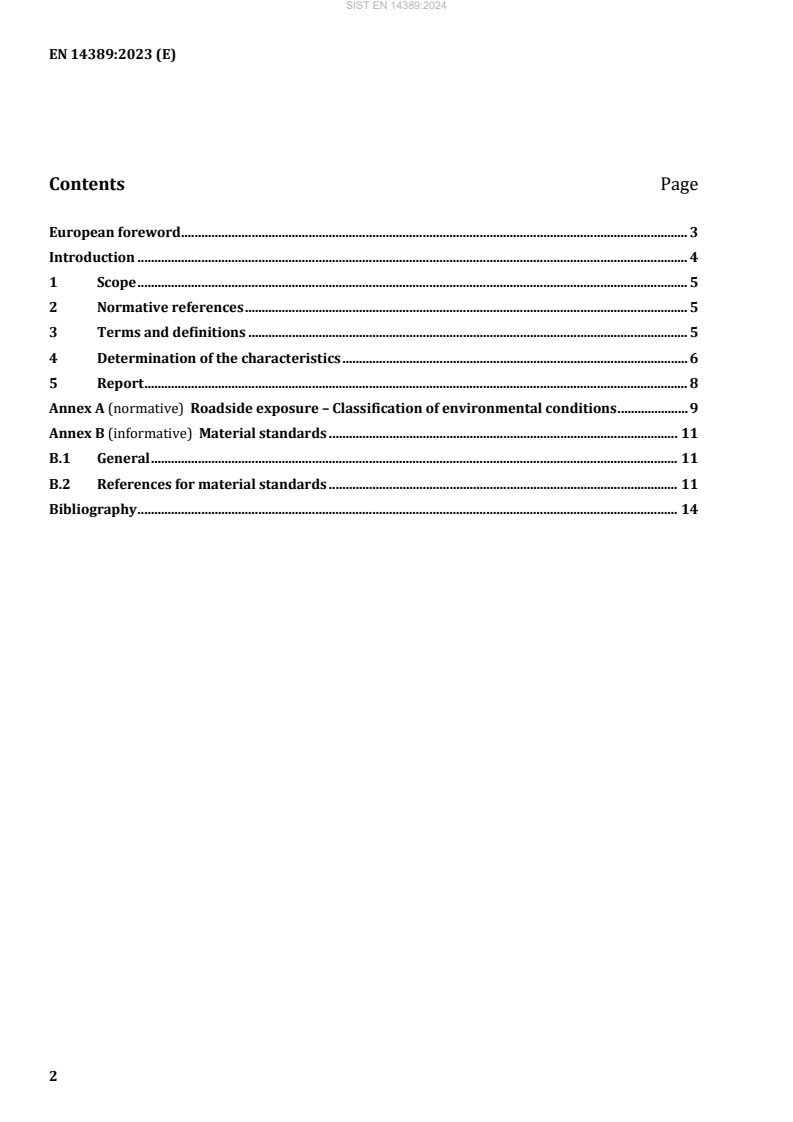
Contents Page
European foreword . 3
Introduction . 4
1 Scope . 5
2 Normative references . 5
3 Terms and definitions . 5
4 Determination of the characteristics . 6
5 Report . 8
Annex A (normative) Roadside exposure – Classification of environmental conditions . 9
Annex B (informative) Material standards . 11
B.1 General . 11
B.2 References for material standards . 11
Bibliography . 14
European foreword
This document (EN 14389:2023) has been prepared by Technical Committee CEN/TC 226 “Road
equipment”, the secretariat of which is held by AFNOR.
This European Standard shall be given the status of a national standard, either by publication of an
identical text or by endorsement, at the latest by March 2024, and conflicting national standards shall
be withdrawn at the latest by March 2024.
Attention is drawn to the possibility that some of the elements of this document may be the subject of
patent rights. CEN shall not be held responsible for identifying any or all such patent rights.
This document supersedes EN 14389-1:2015 and EN 14389-2:2015.
The main change compared to the previous edition is the inclusion of the method for assessing long
term performance regarding “non-acoustic” characteristics.
This document is intended to be read in conjunction with:
— EN 14388, Road traffic noise reducing devices — Characteristics;
— EN 1793, Road traffic noise reducing devices — Test method for determining the acoustic
performance:
— Part 1: Intrinsic characteristics — Sound absorption under diffuse sound field conditions;
— Part 2: Intrinsic characteristics — Airborne sound insulation under diffuse sound field conditions;
— Part 5: Intrinsic characteristics — Sound absorption under direct sound field conditions;
— Part 6: Intrinsic characteristics — Airborne sound insulation under direct sound field conditions;
— EN 1794, Road traffic noise reducing devices — Non-acoustic performance:
— Part 1: Methods of determination of the mechanical and stability characteristics;
— Part 2: Methods of determination of the general safety and environmental characteristics;
— prEN 17383, Road traffic noise reducing devices — Sustainability: Key Performance Indicators (KPIs)
Declaration.
Any feedback and questions on this document should be directed to the users’ national standards body.
A complete listing of these bodies can be found on the CEN website.
According to the CEN-CENELEC Internal Regulations, the national standards organisations of the
following countries are bound to implement this European Standard: Austria, Belgium, Bulgaria,
Croatia, Cyprus, Czech Republic, Denmark, Estonia, Finland, France, Germany, Greece, Hungary, Iceland,
Ireland, Italy, Latvia, Lithuania, Luxembourg, Malta, Netherlands, Norway, Poland, Portugal, Republic of
North Macedonia, Romania, Serbia, Slovakia, Slovenia, Spain, Sweden, Switzerland, Türkiye and the
United Kingdom.
Introduction
Road traffic noise reducing devices alongside roads are expected to maintain their characteristics
during the declared working life.
Resistance to electrolytic or/and chemical corrosion and embrittlement, dimensional stability and
ageing resistance are considered by the manufacturer for different environmental conditions.
A change of acoustic characteristics can be foreseen depending on the material used and the
environmental exposure conditions. Significant deterioration of the acoustic characteristics is avoided
when appropriate materials for the roadside environment are used and manufacturer’s
recommendations for installation and maintenance are respected.
1 Scope
This document specifies a method for evaluating the working life of noise reducing devices used
alongside roads according to the relevant exposure conditions.
It also specifies a method for determining the acoustic characteristic at the end of the working life.
2 Normative references
There are no normative references in this document.
3 Terms and definitions
For the purposes of this document, the following terms and definitions apply.
ISO and IEC maintain terminology databases for use in standardization at the following addresses:
• ISO Online browsing platform: available at https://www.iso.org/obp
• IEC Electropedia: available at https://www.electropedia.org/
3.1
road traffic noise reducing device
RTNRD
device that is designed to reduce the propagation of traffic noise away from the road environment
Note 1 to entry: The RTNRD can comprise acoustic elements (3.2) only, or both structural (3.3) and acoustic
elements.
Note 2 to entry: Applications of RTNRDs include noise barriers (3.4), claddings (3.5), covers (3.6) and added
devices (3.7).
3.2
acoustic element
element whose primary function is to provide the acoustic characteristic of the device
3.3
structural element
element whose primary function is to support or hold in place acoustic elements
3.4
noise barrier
RTNRD which obstructs the direct transmission of airborne sound emanating from road traffic
3.5
cladding
RTNRD which is attached to a wall or other structure and reduces the amount of sound reflected off the
structure
3.6
cover
RTNRD which either spans or overhangs the road
3.7
added device
added component that influences the acoustic characteristic of the original noise reducing device
Note 1 to entry: The added device is acting primarily on the diffracted sound energy.
3.8
working life
period of time during which the declared performance(s) of the product will be maintained
3.9
roadside exposure
conditions experienced by the RTNRD
4 Determination of the characteristics
The determination of the working life of RTNRDs shall be based on the behaviour of the materials they
are made of with reference to different environmental categories with possible variations as given in
Table A.1 in Annex A of this document.
Standards of construction and any material tests conducted should provide evidence of resistance to
specified conditions selected from the following:
I. Chemical agents Location dependent
II. De-icing salt Location/climate dependent
III. Dirty water/dust Location/climate dependent
IV. Dew Climate dependent
V. Freeze/thaw Climate dependent
VI. Cold Climate dependent
VII. Heat Climate dependent
VIII. UV radiation Climate dependent
IX. Traffic vibration Location dependent
X. Biological process Climate dependent
XI. Ozone Location dependent
XII. Water Climate dependent
XIII. Water spray (wet/dry) Location dependent
NOTE Special care is taken for combinations of different materials, whether inside a single device or in
combination with other devices (for example: a combination of different acoustic elements or another
combination of acoustic and structural elements).
Adverse effects on long-term performance of contact with the ground shall be considered.
If water retention may degrade the working life, evaluation shall be made of the extent to which the
RTNRD is retaining water.
If a change in humidity and/or temperature and/or UV affects the dimensional stability of materials
used in the construction, then evaluation shall be made of how RTNRDs shall allow for such changes
and ensure characteristics remain fulfilled along the whole working life.
Where different materials are used in the construction, evaluation shall be made of the appropriate
measures taken to avoid electrolytic and chemical corrosion or interaction that could adversely affect
working life.
The working life of structural and acoustic elements can be different; therefore, it shall be assessed
under the same exposure conditions.
Evaluation shall be made of what the relevant acoustic characteristics (DL and/or DL and/or
α,NRD RI
DL and/or DL ) will be at the end of the working lifetime of the RTNRD.
SI,E SI,P
The evaluation for the characteristic DL is omitted, as the measurement method according to the
R
corresponding technical standard cannot be applied to check the performance of the product at the end
of the working life.
The corresponding working life in years shall be defined under the exposure classes, listed in Table 1,
together with the value expressed in decibels of the acoustic performances at the end of the working
life.
Where relevant standards exist, long term performance shall be assessed using them (see Annex B).
The evaluation can be omitted for any exposure classes not covered by the intended use of the RTNRD.
Table 1 — Example of working life and acoustic performance at the end of the working life as a
function of exposure classes
Working life expressed in Acoustic performance at the end of the
years working life expressed in dB
Environmental
class of exposure
Acoustic Structural
DL DL DL DL
α,NRD RI SI,E SI,P
element element
4B1
4B2
4C2
4C3
4C4
4K2
4K3
4M3
4M4
4S2
4Z6
4Z7
Evaluation shall be made for both structural and acoustic elements. The evaluation shall include:
a) the list of measures taken to limit the effects of ageing on the product;
b) the working life corresponding to the specific environmental exposure classes;
c) evidence of evaluation of working life;
d) evidence of the acoustic performances at the end of the wo
...
Questions, Comments and Discussion
Ask us and Technical Secretary will try to provide an answer. You can facilitate discussion about the standard in here.
Loading comments...