

SIST EN 20-2:2024
(Main)Wood preservatives - Determination of the protective effectiveness against Lyctus brunneus (Stephens) - Part 2: Application by impregnation (Laboratory method)
General Information
- Abstract
This part of the EN 20 series specifies a method for the determination of the protective effectiveness or the toxic values of a wood preservative against infection by Lyctus brunneus (Stephens) in wood which has been treated previously by full impregantion.
This method is applicable to:
- water-insoluble chemicals which are being studied as active insecticides; or
- organic formulsation, as supplied or as prepared in the laboratory by dilution of concentrates.
This method is applicable to water-based preservatives.
NOTE This method can be used in conjuction with ageing procedures, which do not remove the added nutrient.
- Status
- Published
- Public Enquiry End Date
- 08-Dec-2022
- Publication Date
- 04-Feb-2024
- Technical Committee
- LLZ - Les, lesni izdelki in zaščita lesa
- Current Stage
- 6060 - National Implementation/Publication (Adopted Project)
- Start Date
- 24-Jan-2024
- Due Date
- 30-Mar-2024
- Completion Date
- 05-Feb-2024

Overview
EN 20-2:2023 (CEN) - Wood preservatives - Determination of the protective effectiveness against Lyctus brunneus (Stephens) - Part 2: Application by impregnation (Laboratory method) - defines a laboratory test method to assess the protective effectiveness or toxic values of wood preservatives against the powderpost beetle Lyctus brunneus. The standard applies mainly to water-based preservatives, water‑insoluble active chemicals and organic formulations (as supplied or diluted from concentrates). It replaces the 1993 edition and aligns test duration and procedures with other EN 20 series documents.
Key topics and requirements
- Test principle: nutrient-enriched wood specimens are fully impregnated with preservative solutions and exposed to adult Lyctus brunneus; protection is judged by comparing infestation to untreated controls.
- Applicability: water-based preservatives; water‑insoluble actives; organic formulations. Can be used in conjunction with ageing procedures that do not remove added nutrients.
- Specimen preparation: use of a susceptible wood species and pre‑impregnation with a defined nutrient solution to ensure test uniformity across laboratories.
- Exposure and assessment: adults from cultures (≤48 h after emergence) are used; test duration is aligned with EN 20-1 and extended to 20 weeks.
- Environmental control: culturing chamber at (26 ± 2) °C and (75 ± 5) % RH; conditioning chamber at (20 ± 2) °C and (65 ± 5) % RH; drying chamber at (30 ± 2) °C.
- Materials and reagents: specified items include paraffin wax for end-sealing, peptone, D(+)-glucose, filter paper and approved solvents/diluents (excluding hazardous solvents like benzene).
- Safety: precautions for handling flammable/toxic materials and isolation of highly active products are emphasized.
- Annexes: include a test report example, culturing technique for Lyctus brunneus and information on parasites/predators.
Applications
- Laboratory evaluation of new or existing wood preservatives, insecticidal actives and formulations.
- Determination of minimum effective concentrations (toxic values) for regulatory dossiers, product development and quality control.
- Comparative testing for product claims related to resistance against Lyctus brunneus and similar lyctid beetles (results may not be directly comparable across different lyctid species).
Who should use this standard
- Chemical manufacturers and formulators of wood preservatives
- R&D and quality-control laboratories performing wood protection testing
- Regulatory bodies assessing insecticidal efficacy and product registration
- Independent test houses and certification organizations
Related standards
- Other parts of the EN 20 series (e.g., EN 20-1) for complementary test methods and harmonized test durations.
- ISO 3696 for laboratory water quality referenced in the standard.
Keywords: EN 20-2:2023, wood preservatives, Lyctus brunneus, impregnation, laboratory method, protective effectiveness, wood protection testing, CEN.
Relations
- Effective Date
- 01-Mar-2024
- Effective Date
- 09-Feb-2026
- Effective Date
- 28-Jan-2026
- Effective Date
- 28-Jan-2026
- Effective Date
- 28-Jan-2026
Get Certified
Connect with accredited certification bodies for this standard

ECOCERT
Organic and sustainability certification.

Eurofins Food Testing Global
Global leader in food, environment, and pharmaceutical product testing.

Intertek Bangladesh
Intertek certification and testing services in Bangladesh.
Sponsored listings
Frequently Asked Questions
SIST EN 20-2:2024 is a standard published by the Slovenian Institute for Standardization (SIST). Its full title is "Wood preservatives - Determination of the protective effectiveness against Lyctus brunneus (Stephens) - Part 2: Application by impregnation (Laboratory method)". This standard covers: This part of the EN 20 series specifies a method for the determination of the protective effectiveness or the toxic values of a wood preservative against infection by Lyctus brunneus (Stephens) in wood which has been treated previously by full impregantion. This method is applicable to: - water-insoluble chemicals which are being studied as active insecticides; or - organic formulsation, as supplied or as prepared in the laboratory by dilution of concentrates. This method is applicable to water-based preservatives. NOTE This method can be used in conjuction with ageing procedures, which do not remove the added nutrient.
This part of the EN 20 series specifies a method for the determination of the protective effectiveness or the toxic values of a wood preservative against infection by Lyctus brunneus (Stephens) in wood which has been treated previously by full impregantion. This method is applicable to: - water-insoluble chemicals which are being studied as active insecticides; or - organic formulsation, as supplied or as prepared in the laboratory by dilution of concentrates. This method is applicable to water-based preservatives. NOTE This method can be used in conjuction with ageing procedures, which do not remove the added nutrient.
SIST EN 20-2:2024 is classified under the following ICS (International Classification for Standards) categories: 71.100.50 - Wood-protecting chemicals. The ICS classification helps identify the subject area and facilitates finding related standards.
SIST EN 20-2:2024 has the following relationships with other standards: It is inter standard links to SIST EN 20-2:1996, SIST ISO 3696:1995, SIST EN 599-1:2009+A1:2014, SIST EN 599-1:2009, SIST-TS CEN/TS 15679:2008. Understanding these relationships helps ensure you are using the most current and applicable version of the standard.
SIST EN 20-2:2024 is associated with the following European legislation: EU Directives/Regulations: 305/2011. When a standard is cited in the Official Journal of the European Union, products manufactured in conformity with it benefit from a presumption of conformity with the essential requirements of the corresponding EU directive or regulation.
SIST EN 20-2:2024 is available in PDF format for immediate download after purchase. The document can be added to your cart and obtained through the secure checkout process. Digital delivery ensures instant access to the complete standard document.
Standards Content (Sample)
SLOVENSKI STANDARD
01-marec-2024
Nadomešča:
SIST EN 20-2:1996
Zaščitna sredstva za les - Določanje učinkovitosti preventivne zaščite proti rjavem
parketarju Lyctus brunneus (Stephens) - 2. del: Globinska impregnacija lesa
(laboratorijska metoda)
Wood preservatives - Determination of the protective effectiveness against Lyctus
brunneus (Stephens) - Part 2: Application by impregnation (Laboratory method)
Holzschutzmittel - Bestimmung der vorbeugenden Wirkung gegenüber Lyctus brunneus
(Stephens) - Teil 2: Anwendung durch Volltränkung (Laboratoriumsverfahren)
Produits de préservation du bois - Détermination de l'efficacité protectrice vis-à-vis de
Lyctus brunneus (Stephens) - Partie 2 : Application par traitement en profondeur
(Méthode de laboratoire)
Ta slovenski standard je istoveten z: EN 20-2:2023
ICS:
71.100.50 Kemikalije za zaščito lesa Wood-protecting chemicals
2003-01.Slovenski inštitut za standardizacijo. Razmnoževanje celote ali delov tega standarda ni dovoljeno.
EN 20-2
EUROPEAN STANDARD
NORME EUROPÉENNE
December 2023
EUROPÄISCHE NORM
ICS 71.100.50 Supersedes EN 20-2:1993
English Version
Wood preservatives - Determination of the protective
effectiveness against Lyctus brunneus (Stephens) - Part 2:
Application by impregnation (Laboratory method)
Produits de préservation du bois - Détermination de Holzschutzmittel - Bestimmung der vorbeugenden
l'efficacité protectrice vis-à-vis de Lyctus brunneus Wirkung gegenüber Lyctus brunneus (Stephens) - Teil
(Stephens) - Partie 2 : Application par traitement en 2: Anwendung durch Volltränkung
profondeur (Méthode de laboratoire) (Laboratoriumsverfahren)
This European Standard was approved by CEN on 6 November 2023.
CEN members are bound to comply with the CEN/CENELEC Internal Regulations which stipulate the conditions for giving this
European Standard the status of a national standard without any alteration. Up-to-date lists and bibliographical references
concerning such national standards may be obtained on application to the CEN-CENELEC Management Centre or to any CEN
member.
This European Standard exists in three official versions (English, French, German). A version in any other language made by
translation under the responsibility of a CEN member into its own language and notified to the CEN-CENELEC Management
Centre has the same status as the official versions.
CEN members are the national standards bodies of Austria, Belgium, Bulgaria, Croatia, Cyprus, Czech Republic, Denmark, Estonia,
Finland, France, Germany, Greece, Hungary, Iceland, Ireland, Italy, Latvia, Lithuania, Luxembourg, Malta, Netherlands, Norway,
Poland, Portugal, Republic of North Macedonia, Romania, Serbia, Slovakia, Slovenia, Spain, Sweden, Switzerland, Türkiye and
United Kingdom.
EUROPEAN COMMITTEE FOR STANDARDIZATION
COMITÉ EUROPÉEN DE NORMALISATIO N
EUROPÄISCHES KOMITEE FÜR NORMUN G
CEN-CENELEC Management Centre: Rue de la Science 23, B-1040 Brussels
© 2023 CEN All rights of exploitation in any form and by any means reserved Ref. No. EN 20-2:2023 E
worldwide for CEN national Members.
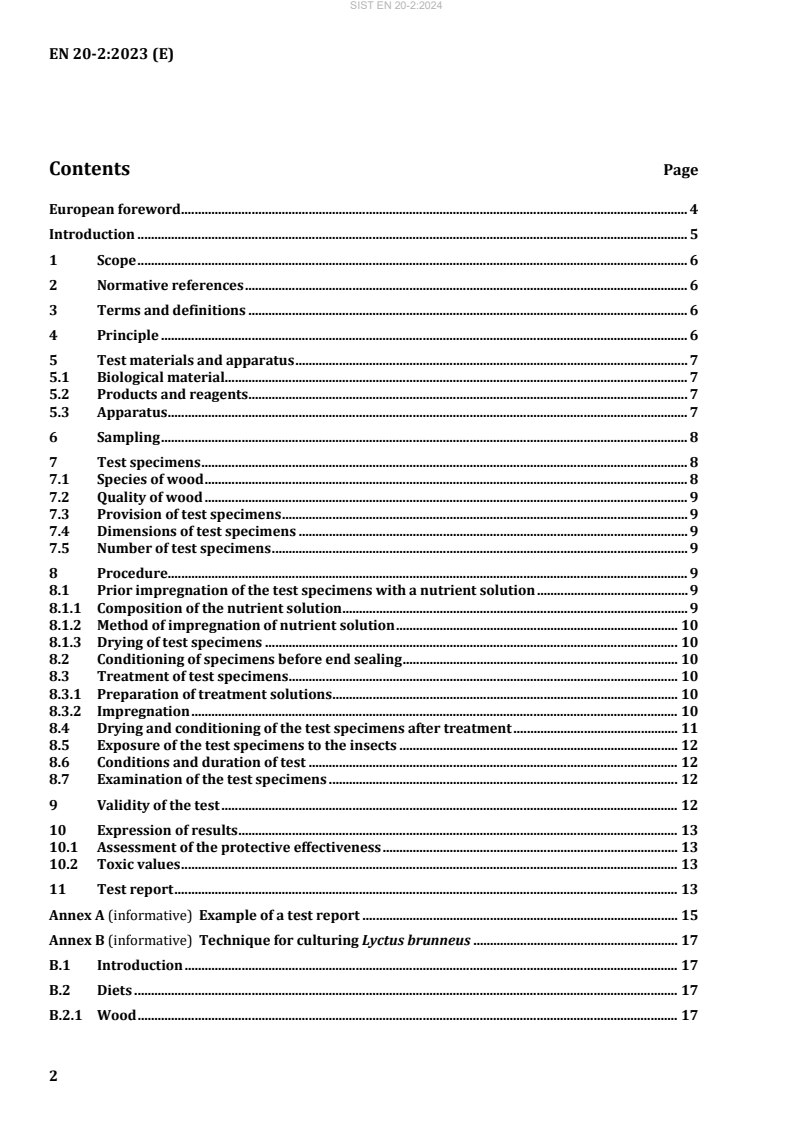
Contents Page
European foreword . 4
Introduction . 5
1 Scope . 6
2 Normative references . 6
3 Terms and definitions . 6
4 Principle . 6
5 Test materials and apparatus . 7
5.1 Biological material . 7
5.2 Products and reagents . 7
5.3 Apparatus . 7
6 Sampling . 8
7 Test specimens . 8
7.1 Species of wood . 8
7.2 Quality of wood . 9
7.3 Provision of test specimens . 9
7.4 Dimensions of test specimens . 9
7.5 Number of test specimens . 9
8 Procedure. 9
8.1 Prior impregnation of the test specimens with a nutrient solution . 9
8.1.1 Composition of the nutrient solution . 9
8.1.2 Method of impregnation of nutrient solution . 10
8.1.3 Drying of test specimens . 10
8.2 Conditioning of specimens before end sealing . 10
8.3 Treatment of test specimens . 10
8.3.1 Preparation of treatment solutions . 10
8.3.2 Impregnation . 10
8.4 Drying and conditioning of the test specimens after treatment . 11
8.5 Exposure of the test specimens to the insects . 12
8.6 Conditions and duration of test . 12
8.7 Examination of the test specimens . 12
9 Validity of the test . 12
10 Expression of results . 13
10.1 Assessment of the protective effectiveness . 13
10.2 Toxic values . 13
11 Test report . 13
Annex A (informative) Example of a test report . 15
Annex B (informative) Technique for culturing Lyctus brunneus . 17
B.1 Introduction . 17
B.2 Diets . 17
B.2.1 Wood . 17
B.2.2 Artificial diet . 19
B.3 Obtaining adult beetles . 19
B.4 Culturing procedure . 20
B.5 Identification of sex . 20
B.6 Precautions against infestation by parasites . 20
Annex C (informative) Principal parasites and predators of Lyctus . 21
C.1 Mites . 21
C.2 Insects . 21
Bibliography . 22
European foreword
This document (EN 20-2:2023) has been prepared by Technical Committee CEN/TC 38 “Durability of
wood and wood-based products”, the secretariat of which is held by SIS.
This European Standard shall be given the status of a national standard, either by publication of an
identical text or by endorsement, at the latest by June 2024, and conflicting national standards shall be
withdrawn at the latest by June 2024.
Attention is drawn to the possibility that some of the elements of this document may be the subject of
patent rights. CEN shall not be held responsible for identifying any or all such patent rights.
This document supersedes EN 20-2:1993.
The main changes compared to the previous edition EN 20-2:1993 are listed below:
a) the source of peptone is no longer specified (5.2.6);
b) other wood species than oak may be used for the test under certain circumstances (7.1);
c) tests with solvent control may be omitted, when the solvent is water (7.5);
d) test duration was alined with EN 20-1 and extended to 20 weeks (8.6);
e) new pictures were used for Figure B.1, Figure B.2 and Figure B.3.
NOTE Test results obtained according to earlier versions of this document and when the tests had started
before this version of EN 20-2 was published are considered valid.
Any feedback and questions on this document should be directed to the users’ national standards body.
A complete listing of these bodies can be found on the CEN website.
According to the CEN-CENELEC Internal Regulations, the national standards organisations of the
following countries are bound to implement this European Standard: Austria, Belgium, Bulgaria, Croatia,
Cyprus, Czech Republic, Denmark, Estonia, Finland, France, Germany, Greece, Hungary, Iceland, Ireland,
Italy, Latvia, Lithuania, Luxembourg, Malta, Netherlands, Norway, Poland, Portugal, Republic of North
Macedonia, Romania, Serbia, Slovakia, Slovenia, Spain, Sweden, Switzerland, Türkiye and the United
Kingdom.
Introduction
This Part of the EN 20 series describes a laboratory method of testing which gives a basis for assessment
of the protective effectiveness of a wood preservative against Lyctus brunneus. It allows the
determination of the concentration at which the preservative completely prevents the development of
infestation from egg-laying in fully impregnated wood of susceptible species.
It can also be used with formulations ready for use.
The species Lyctus brunneus is chosen because of its particular practical relevance and because it can be
used easily in laboratory tests. The method can be used with other lyctid species, but the results might
not be comparable with those obtained with Lyctus brunneus.
The test specimens are enriched with a defined nutrient solution, before exposure to egg-laying, in order
to ensure uniformity of nutrient quality of test specimens between different laboratories.
This laboratory method provides one criterion by which the value of a product can be assessed. In making
this assessment, the methods by which the preservative may be applied should be taken into account. It
is further recommended that results from this test should be supplemented by those from other
appropriates tests, and above all by comparison with practical experience.
When products which are very active at low concentrations are used, it is very important to take suitable
precautions to isolate and separate, as far as possible, operations involving chemical products, other
products, treated wood, laboratory apparatus and clothing. Suitable precautions should include the use
of separate rooms, areas within rooms, extraction facilities and conditioning chambers as well as special
training for personnel.
1 Scope
This part of the EN 20 series specifies a method for the determination of the protective effectiveness or
the toxic values of a wood preservative against infection by Lyctus brunneus (Stephens) in wood which
has been treated previously by full impregantion.
This method is applicable to:
— water-insoluble chemicals which are being studied as active insecticides; or
— organic formulsation, as supplied or as prepared in the laboratory by dilution of concentrates.
This method is applicable to water-based preservatives.
NOTE This method can be used in conjuction with ageing procedures, which do not remove the added nutrient.
2 Normative references
The following documents are referred to in the text in such a way that some or all of their content
constitutes requirements of this document. For dated references, only the edition cited applies. For
undated references, the latest edition of the referenced document (including any amendments) applies.
ISO 3696, Water for analytical laboratory use — Specification and test methods
3 Terms and definitions
For the purposes of this document, the following terms and definitions apply.
ISO and IEC maintain terminology databases for use in standardization at the following addresses:
— IEC Electropedia: available at https://www.electropedia.org/
— ISO Online browsing platform: available at https://www.iso.org/obp
3.1
representative sample
sample having its physical or chemical characteristics identical to the volumetric average characteristics
of the total volume being sampled
3.2
supplier
sponsor of the test
4 Principle
Depending on the test being carried out either:
— a set of test specimens of a susceptible wood species is impregnated with nutrient solution and then
impregnated with a solution of the preservative; or
— if toxic values are to be determined, several sets of tests specimens of a susceptible wood species are
impregnated with a nutrient solution and then impregnated with a series of solutions in which the
concentration of preservative is ranged in a given progression.
The treated test specimens are exposed to adult Lyctus brunneus and the resulting attack compared to
that in untreated controls. If the preservation has been prepared in the laboratory by dilution of a
concentrate or by dissolution of a solid, the resulting attack is also compared to that in solvent or diluent
treated controls.
5 Test materials and apparatus
5.1 Biological material
Lyctus brunneus (Stephens), insects emerged from cultures not more than 48h before use in the test.
NOTE The culturing of Lyctus brunneus requires care in order to obtain a regular supply of adults which have
not already laid eggs. The culturing technique, which experiences has shown to be suitable, is described in Annex B.
5.2 Products and reagents
5.2.1 Paraffin wax, for sealing the relevant surfaces of test specimens to be treated with solutions
NOTE Paraffiin wax with a setting point of 52 °C to 54 °C has been found to be suitable.
5.2.2 Filter paper, ordinary quality medium-fast grade
5.2.3 Paste, for securing filter paper. The paste shall be starch-free, non-toxic to Lyctus and insoluble
in the product under test
NOTE Sodium carboxymethyl cellulose, food grade, has been found to be suitable.
5.2.4 Water, complying with grade 3 of ISO 3696
5.2.5 Solvent or diluent, a volatile liquid that will dissolve or dilute the preservative but does not leave
a residue in the wood at the end of the post-treatment conditioning period that has a toxic effet on the
insects
CAUTION — Do not use benzene or other solvents which pose on health risk.
5.2.6 Peptone
5.2.7 D (+)-glucose
5.2.8 Fine cloth of cotton of linen, with a mesh aperture of less than 0,3 mm
5.3 Apparatus
5.3.1 Culturing chamber, with air circulation, controlled at (26 ± 2) °C, and at relative humidity
(75 ± 5) %
5.3.2 Conditioning chamber, well ventilated, controlled at (20 ± 2) °C and relative humidity
(65 ± 5) %
The conditioning of specimens may be carried out in the laboratory work area (see 5.3.4) provided that
this has the conditions specified for the conditioning chamber (see 5.3.2).
5.3.3 Drying chamber, well ventilated, controlled at (30 ± 2) °C
5.3.4 Laboratory work area, well ventilated, where treatment of the test specimens is carried out
CAUTION — It is essential to follow safety procedures for handling flammable and toxic materials. Avoid
excessive exposure of operators to solvents of their vapours.
5.3.5 Testing chamber, with conditions identical to those of the culturing chamber (see 5.3.1)
5.3.6 Treatment vessels, of material that does not react withnthewood preservative under test; for
example, glass for organic products
5.3.7 Vacuum vessel(s), fitted with stopcocks
5.3.8 Vaccum pump, fitted with a pressure gauge and capable of maintaining a pressure of 700 Pa
5.3.9 Weights, to provide ballast for the test specimens. The weights shall not react with any materials
with which they come into contact during the test
5.3.10 Safety equipment and protective clothing, appropriate for the test product and the test solvent,
to ensure the safety of the operator
5.3.11 Test container, suitable for holding the test specimens and of material resistant to the solvents
used
NOTE Jars of approximately 60 mm diameter and 100 mm height have been found to be suitable.
5.3.12 Drying vessel(s), capable of holding sets of five test specimens (7.4), provided with a cloes-fitting
cover and containing support that will give minimum contact with treated test specimens to be place on
them. The vessels and supports shall be of materials that do not react with the preservative under test,
for example glass
5.3.13 Ordinary laboratory equipment, including a balance capable of weighing to an accuracy of
0,01 g
5.3.14 X-ray apparatus, (optional) with tungsten target and beryllium window, with voltage and
current continuously variable in the range:
— voltage: 10 kV to 50 kV;
— current: 0 mA to 15 mA
6 Sampling
The sample of preservative shall be representative of the product to be tested. Samples shall be stored
and handled in accordance with any written recommendations from the supplier.
For the sampling of preservatives from bulk supplies, the procedure given in EN 212 should be used.
7 Test specimens
7.1 Species of wood
The test shall be carried out on European oak. This shall comprise sessile oak, Quercus petraea
(Mattuschka) Lieblin, and pedunculate oak, Quercus robur Linnaeus.
Other wood species, with demonstrated susceptiblity to Lyctus brunneus (Stephens), like Triplochiton
scleroxylon, may be used instead of European oak.
7.2 Quality of wood
Use only sound sapwood with between 2 annual growth rings per 10 mm and 10 annual growth rings per
10 mm, straight-grainded without knots. The wood, having few tyloses, shall not have been floated or
subjected to any chemical treatment and shall be dried without delay as described in 7.3.
7.3 Provision of test specimens
Remove the bark from the freshly cut billets and then cut them into lengths (from which strips
25 mm × 15 mm in cross-section will be cut). Immediately place the billets in the drying chamber (5.3.3)
stacked with spaces between individual billets so as to allow movement of air through the stack. Retain
the billets in the drying chamber until their moisture contents are reduced to 15 % mass fraction (see
ISO 13061-1).
NOTE Moisture meters of the two-pronged electrical conductivity type are suitable for assessing moisture
content.
Cut the sapwood of the dried billets into planted strips 25 mm × 15 mm cross section and with the wide
longitudinal faces oriented tangentially. Cut the specimens for test from the planed strips. The individual
specimens for test shall be cut cleanly and shall have sharp edges.
The specimens required for a test shall be taken from at least tow lots each corresponding to a different
tree or two sapwood strips taken diametrically opposed positions in the same log. The specimens from
the two sources shalle be combined and the test specimens taken at random from them.
7.4 Dimensions of test specimens
The dimensi
...