

SIST EN 14988:2017/kFprA1:2019
(Amendment)Children's high chairs - Requirements and test methods
General Information
- Abstract
This European Standard specifies safety requirements for free standing children's high chairs that elevate children to dining table height usually for the purposes of feeding or eating. Children's high chairs are for children up to 3 years of age who are capable of sitting unaided.
With the exception of special high chairs for medical purposes, this standard applies to children's high chairs for domestic and non-domestic use.
NOTE If a children's high chair has to or can be converted into other functions, additional European Standards may apply.
- Status
- Not Published
- Public Enquiry End Date
- 03-Apr-2019
- Technical Committee
- POH - Furniture
- Current Stage
- 98 - Abandoned project (Adopted Project)
- Start Date
- 20-Oct-2020
- Due Date
- 25-Oct-2020
- Completion Date
- 20-Oct-2020
- Directive
- 2001/95/EC - General product safety


Overview
EN 14988:2017/FprA1 (CEN) - Children's high chairs - Requirements and test methods - is a European standard setting safety and test requirements for free‑standing high chairs that elevate children (up to 3 years old and able to sit unaided) to dining table height for feeding or eating. It covers domestic and non‑domestic use and excludes special high chairs for medical purposes. The FprA1 (draft amendment A1) updates specific safety tests and labeling requirements.
Key topics and technical requirements
- Scope and age range: High chairs for children up to 3 years who can sit unaided; convertible functions may trigger additional standards.
- Structural safety and compression points: Hazardous compression points (e.g., between tray and structure) are assessed using a vertical downward force - amendment A1 specifies a 50 N test force in the most onerous tray position.
- Restraint systems:
- Requirements for active and passive restraints, including conditions when an additional passive crotch restraint is required for products with a horizontal element (tray/bar).
- Passive crotch restraint must prevent the leg probe passing from one leg opening to the other when tested.
- Filling materials and coverings:
- Parts containing filling material (except certain areas) must have at least one covering.
- Accessibility tests use a 12 mm diameter probe; amendment A1 limits probe insertion to no more than 6 mm into any opening that gives access to filling material.
- Choking/ingestion hazards: Seams and coverings shall resist separation that would allow a child to insert fingers or a probe and pull out clumps of filling (simulated by the 12 mm probe).
- Warnings and labeling:
- Mandatory warning: “WARNING Never leave the child unattended” accompanied by a graphical symbol (Figure 29). Amendment A1 defines symbol proportions, minimum diameter (25 mm) and colors.
Applications
- Use EN 14988:2017/FprA1 to design, evaluate and certify high chairs for safety compliance in European markets. Practical applications include:
- Product design and development (manufacturers and OEMs)
- Type testing and conformity assessment (test laboratories)
- Regulatory compliance and market surveillance (authorities and retailers)
- Procurement specifications for childcare facilities and hospitality sectors
Who should use this standard
- High chair manufacturers, product designers, safety engineers, test labs, importers/retailers, product certification bodies, and regulatory agencies focused on child product safety.
Related standards
- Convertible or multifunctional high chairs and medical high chairs may be subject to additional European standards. Consult relevant CEN technical committees for overlap and harmonization with other furniture and children’s product standards.
Keywords: EN 14988:2017, children's high chairs, high chair safety, test methods, CEN, restraint systems, filling material accessibility, compression point test, warning label.
Relations
- Effective Date
- 28-Jan-2026
- Effective Date
- 28-Jan-2026
- Effective Date
- 28-Jan-2026
- Effective Date
- 01-Apr-2020
- Effective Date
- 01-Mar-2019
Frequently Asked Questions
SIST EN 14988:2017/kFprA1:2019 is a draft published by the Slovenian Institute for Standardization (SIST). Its full title is "Children's high chairs - Requirements and test methods". This standard covers: This European Standard specifies safety requirements for free standing children's high chairs that elevate children to dining table height usually for the purposes of feeding or eating. Children's high chairs are for children up to 3 years of age who are capable of sitting unaided. With the exception of special high chairs for medical purposes, this standard applies to children's high chairs for domestic and non-domestic use. NOTE If a children's high chair has to or can be converted into other functions, additional European Standards may apply.
This European Standard specifies safety requirements for free standing children's high chairs that elevate children to dining table height usually for the purposes of feeding or eating. Children's high chairs are for children up to 3 years of age who are capable of sitting unaided. With the exception of special high chairs for medical purposes, this standard applies to children's high chairs for domestic and non-domestic use. NOTE If a children's high chair has to or can be converted into other functions, additional European Standards may apply.
SIST EN 14988:2017/kFprA1:2019 is classified under the following ICS (International Classification for Standards) categories: 97.140 - Furniture; 97.190 - Equipment for children. The ICS classification helps identify the subject area and facilitates finding related standards.
SIST EN 14988:2017/kFprA1:2019 has the following relationships with other standards: It is inter standard links to SIST EN ISO 9342-1:2023, SIST EN ISO 8980-3:2022, SIST EN ISO 14889:2025, SIST EN 14988:2017+A1:2020, SIST EN 14988:2017. Understanding these relationships helps ensure you are using the most current and applicable version of the standard.
SIST EN 14988:2017/kFprA1:2019 is associated with the following European legislation: EU Directives/Regulations: 2001/95/EC; Standardization Mandates: M/527. When a standard is cited in the Official Journal of the European Union, products manufactured in conformity with it benefit from a presumption of conformity with the essential requirements of the corresponding EU directive or regulation.
SIST EN 14988:2017/kFprA1:2019 is available in PDF format for immediate download after purchase. The document can be added to your cart and obtained through the secure checkout process. Digital delivery ensures instant access to the complete standard document.
Standards Content (Sample)
SLOVENSKI STANDARD
SIST EN 14988:2017/oprA1:2019
01-marec-2019
Otroški visoki stoli - Zahteve in preskusne metode - Dopolnilo A1
Children's high chairs - Requirements and test methods
Kinderhochstühle - Anforderungen und Prüfverfahren
Chaises hautes pour enfants - Exigences et méthodes d'essai
Ta slovenski standard je istoveten z: EN 14988:2017/prA1:2019
ICS:
97.140 Pohištvo Furniture
97.190 Otroška oprema Equipment for children
SIST EN 14988:2017/oprA1:2019 en,fr,de
2003-01.Slovenski inštitut za standardizacijo. Razmnoževanje celote ali delov tega standarda ni dovoljeno.
SIST EN 14988:2017/oprA1:2019
SIST EN 14988:2017/oprA1:2019
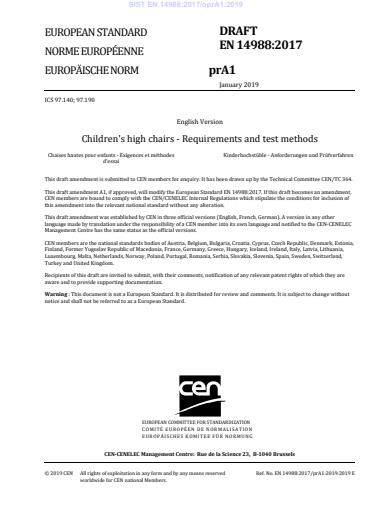
DRAFT
EUROPEAN STANDARD
EN 14988:2017
NORME EUROPÉENNE
EUROPÄISCHE NORM
prA1
January 2019
ICS 97.140; 97.190
English Version
Children's high chairs - Requirements and test methods
Chaises hautes pour enfants - Exigences et méthodes Kinderhochstühle - Anforderungen und Prüfverfahren
d'essai
This draft amendment is submitted to CEN members for enquiry. It has been drawn up by the Technical Committee CEN/TC 364.
This draft amendment A1, if approved, will modify the European Standard EN 14988:2017. If this draft becomes an amendment,
CEN members are bound to comply with the CEN/CENELEC Internal Regulations which stipulate the conditions for inclusion of
this amendment into the relevant national standard without any alteration.
This draft amendment was established by CEN in three official versions (English, French, German). A version in any other
language made by translation under the responsibility of a CEN member into its own language and notified to the CEN-CENELEC
Management Centre has the same status as the official versions.
CEN members are the national standards bodies of Austria, Belgium, Bulgaria, Croatia, Cyprus, Czech Republic, Denmark, Estonia,
Finland, Former Yugoslav Republic of Macedonia, France, Germany, Greece, Hungary, Iceland, Ireland, Italy, Latvia, Lithuania,
Luxembourg, Malta, Netherlands, Norway, Poland, Portugal, Romania, Serbia, Slovakia, Slovenia, Spain, Sweden, Switzerland,
Turkey and United Kingdom.
Recipients of this draft are invited to submit, with their comments, notification of any relevant patent rights of which they are
aware and to provide supporting documentation.
Warning : This document is not a European Standard. It is distributed for review and comments. It is subject to change without
notice and shall not be referred to as a European Standard.
EUROPEAN COMMITTEE FOR STANDARDIZATION
COMITÉ EUROPÉEN DE NORMALISATION
EUROPÄISCHES KOMITEE FÜR NORMUNG
CEN-CENELEC Management Centre: Rue de la Science 23, B-1040 Brussels
© 2019 CEN All rights of exploitation in any form and by any means reserved Ref. No. EN 14988:2017/prA1:2019:2019 E
worldwide for CEN national Members.
SIST EN 14988:2017/oprA1:2019
EN 14988:2017/prA1:2019 (E)
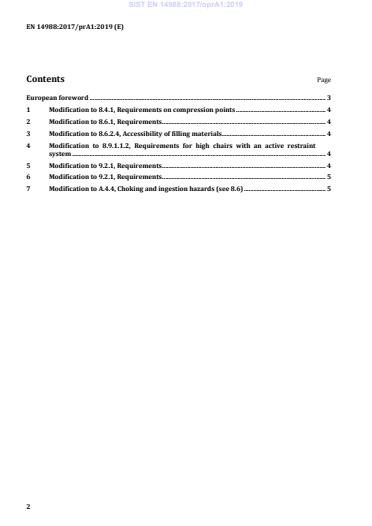
Contents Page
European foreword . 3
1 Modification to 8.4.1, Requirements on compression points . 4
2 Modification to 8.6.1, Requirements . 4
3 Modification to 8.6.2.4, Accessibility of filling materials . 4
4 Modification to 8.9.1.1.2, Requirements for high chairs with an active restraint
system .
...