


SIST EN 302 645 V1.1.1:2010
(Main)Electromagnetic compatibility and Radio spectrum Matters (ERM) - Short Range Devices - Global Navigation Satellite Systems (GNSS) Repeaters - Harmonized EN covering the essential requirements of article 3.2 of the R&TTE directive
Electromagnetic compatibility and Radio spectrum Matters (ERM) - Short Range Devices - Global Navigation Satellite Systems (GNSS) Repeaters - Harmonized EN covering the essential requirements of article 3.2 of the R&TTE directive
The present document applies to GNSS repeaters. GNSS pseudolites as well as GNSS Receivers are not covered by the present document. GNSS repeaters are devices designed to re-transmit GNSS signals unchanged inside buildings in order to provide a usable signal for GNSS receivers that are out of sight of the GNSS satellite constellation or that they are unable to connect to GNSS signal simulators. A number of potential uses for such devices have been identified, such as the provision of a signal for test and development purposes and avoiding the need for receivers in emergency vehicles to re-acquire lock upon leaving a garage. These radio equipment types are capable of operating in all or part of the frequency bands given in table 1.
The type of equipment covered by the present document is as follows:
Fixed installed GNSS repeater equipment with a transmit antenna that is for indoor installation. The equipment is fitted with integral or dedicated antenna(s). The GNSS repeater consists of a linear amplifier with a predetermined maximum power output and a maximum gain between in and output channel. The intended use is inside a building with its receiving antenna outside and the transmitting antenna inside the building. Mobile or portable GNSS repeaters are excluded from the application of the present document. The present document fulfils the purpose of providing the requirements and associated measurement methods to fulfil the requirements of the R&TTE directive for efficient spectrum use and to protect the primary service and radio services in adjacent frequency bands. In addition to the present document, other ENs that specify technical requirements in respect of essential requirements under other parts of article 3 of the R&TTE Directive may apply to equipment within the scope of the present document.
Elektromagnetna združljivost in zadeve v zvezi z radijskim spektrom (ERM) - Naprave kratkega dosega (SRD) - Ponavljalniki (repetitorji) globalnih navigacijskih satelitskih sistemov (GNSS) - Harmonizirani EN, ki zajema bistvene zahteve člena 3.2 direktive R&TTE
Pričujoči dokument velja za GNSS ponavjalnike. GNSS pseudo-sateliti in GNSS sprejemniki niso zajeti s pričujočim dokumentom. GNSS ponavljalniki so naprave, ki so načrtovane, da ponovno oddajajo signale, in sicer nespremenjeno skozi zgradbe, da zagotovijo uporaben signal za GNSS sprejemnike, ki so zunaj vidnega polja GNSS satelitskih konstelacij ali se niso zmožni povezati na GNSS simulatorje signala. Določeno je bilo število potencialnih uporab, kot zagotavljanje signala za namene preskušanja in razvoja in izogibanje potrebi sprejemnikov v intervencijskih vozilih, da ponovno vzpostavijo povezavo po izhodu iz garaže. Te vrste radijske opreme so zmožne delovanja v vseh ali katerem koli delu frekvenčnih pasov, kot so navedeni v tabeli 1-1.
Vrste opreme, ki jo pričujoči dokument zajema, so:
stalne postavitve GNSS ponavljalne opreme za oddajno opremo, ki je namenjena za postavitve v zaprtih prostorih. Oprema je opremljena z vgrajenimi ali namenskimi antenami. GNSS ponavljalnik je sestavljen iz linearnega ojačevalnika z vnaprej določeno maksimalno izhodno močjo in maksimalnim dobitkom med vhodnim in izhodnim kanalom. Predvidena uporaba je znotraj stavb, z njegovo sprejemno anteno zunaj stavbe in oddajno anteno znotraj. Mobilni ali prenosni GNSS ponavljalniki so izvzeti iz uporabe pričujočega dokumenta. Pričujoči dokument izpolnjuje namen zagotavljanja zahtev in povezanih merilnih metod za izpolnjevanje zahtev direktive R&TTE za učinkovito rabo spektra za zaščito glavne storitve in radio storitve v sosednjih frekvenčnih pasovih. Poleg pričujočega dokumenta, se ostali EN, ki določajo tehnične zahteve v skladu z bistvenimi zahtevami v drugih delih člena 3 direktive R&TTE, lahko uporabljajo za opremo znotraj področja uporabe pričujočega dokumenta.
General Information
Standards Content (Sample)
Draft ETSI EN 302 645 V1.1.1 (2009-05)
Harmonized European Standard (Telecommunications series)
Electromagnetic compatibility
and Radio spectrum Matters (ERM);
Short Range Devices;
Global Navigation Satellite Systems (GNSS) Repeaters;
Harmonized EN covering the essential requirements
of article 3.2 of the R&TTE Directive
2 Draft ETSI EN 302 645 V1.1.1 (2009-05)
Reference
DEN/ERM-TG28-0422
Keywords
navigation, radio, repeater, satellite
ETSI
650 Route des Lucioles
F-06921 Sophia Antipolis Cedex - FRANCE
Tel.: +33 4 92 94 42 00 Fax: +33 4 93 65 47 16
Siret N° 348 623 562 00017 - NAF 742 C
Association à but non lucratif enregistrée à la
Sous-Préfecture de Grasse (06) N° 7803/88
Important notice
Individual copies of the present document can be downloaded from:
http://www.etsi.org
The present document may be made available in more than one electronic version or in print. In any case of existing or
perceived difference in contents between such versions, the reference version is the Portable Document Format (PDF).
In case of dispute, the reference shall be the printing on ETSI printers of the PDF version kept on a specific network drive
within ETSI Secretariat.
Users of the present document should be aware that the document may be subject to revision or change of status.
Information on the current status of this and other ETSI documents is available at
http://portal.etsi.org/tb/status/status.asp
If you find errors in the present document, please send your comment to one of the following services:
http://portal.etsi.org/chaircor/ETSI_support.asp
Copyright Notification
No part may be reproduced except as authorized by written permission.
The copyright and the foregoing restriction extend to reproduction in all media.
© European Telecommunications Standards Institute 2009.
All rights reserved.
TM TM TM TM
DECT , PLUGTESTS , UMTS , TIPHON , the TIPHON logo and the ETSI logo are Trade Marks of ETSI registered
for the benefit of its Members.
TM
3GPP is a Trade Mark of ETSI registered for the benefit of its Members and of the 3GPP Organizational Partners.
LTE™ is a Trade Mark of ETSI currently being registered
for the benefit of its Members and of the 3GPP Organizational Partners.
GSM® and the GSM logo are Trade Marks registered and owned by the GSM Association.
ETSI
3 Draft ETSI EN 302 645 V1.1.1 (2009-05)
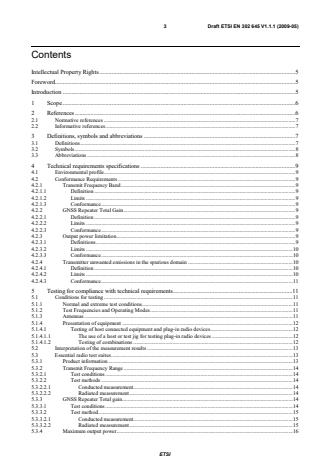
Contents
Intellectual Property Rights.5
Foreword.5
Introduction .5
1 Scope.6
2 References.6
2.1 Normative references.7
2.2 Informative references.7
3 Definitions, symbols and abbreviations .7
3.1 Definitions.7
3.2 Symbols.8
3.3 Abbreviations.8
4 Technical requirements specifications .9
4.1 Environmental profile.9
4.2 Conformance Requirements.9
4.2.1 Transmit Frequency Band.9
4.2.1.1 Definition.9
4.2.1.2 Limits.9
4.2.1.3 Conformance.9
4.2.2 GNSS Repeater Total Gain.9
4.2.2.1 Definition.9
4.2.2.2 Limits.9
4.2.2.3 Conformance.9
4.2.3 Output power limitation.9
4.2.3.1 Definitions.9
4.2.3.2 Limits.10
4.2.3.3 Conformance.10
4.2.4 Transmitter unwanted emissions in the spurious domain .10
4.2.4.1 Definition.10
4.2.4.2 Limits.10
4.2.4.3 Conformance.11
5 Testing for compliance with technical requirements.11
5.1 Conditions for testing .11
5.1.1 Normal and extreme test conditions.11
5.1.2 Test Frequencies and Operating Modes.11
5.1.3 Antennas.11
5.1.4 Presentation of equipment .12
5.1.4.1 Testing of host connected equipment and plug-in radio devices.12
5.1.4.1.1 The use of a host or test jig for testing plug-in radio devices .12
5.1.4.1.2 Testing of combinations .12
5.2 Interpretation of the measurement results .13
5.3 Essential radio test suites.13
5.3.1 Product information.13
5.3.2 Transmit Frequency Range.14
5.3.2.1 Test conditions.14
5.3.2.2 Test methods .14
5.3.2.2.1 Conducted measurement.14
5.3.2.2.2 Radiated measurement.14
5.3.3 GNSS Repeater Total gain.14
5.3.3.1 Test conditions.14
5.3.3.2 Test method.15
5.3.3.2.1 Conducted measurement.15
5.3.3.2.2 Radiated measurement.15
5.3.4 Maximum output power.16
ETSI
4 Draft ETSI EN 302 645 V1.1.1 (2009-05)
5.3.4.1 Test conditions.16
5.3.4.2 Test method.16
5.3.4.2.1 Conducted measurement.16
5.3.4.2.2 Radiated measurement.17
5.3.5 Transmitter unwanted emissions in the spurious domain .17
5.3.5.1 Test conditions.17
5.3.5.2 Test method.17
5.3.5.2.1 Conducted measurement.17
5.3.5.2.2 Radiated measurement.19
Annex A (normative): HS Requirements and conformance Test specifications Table (HS-
RTT).20
Annex B (normative): Test sites and arrangements for radiated measurements.22
B.1 Test sites.22
B.1.1 Open air test sites .22
B.1.2 Anechoic chamber.23
B.1.2.1 General.23
B.1.2.2 Description.23
B.1.2.3 Influence of parasitic reflections.23
B.1.2.4 Calibration and mode of use .24
B.2 Test antenna.25
B.3 Substitution antenna .26
Annex C (normative): General description of measurement .27
C.1 Conducted measurements.27
C.2 Radiated measurements.27
C.3 Substitution measurement .28
Annex D (informative): The EN title in the official languages .29
Annex E (informative): Bibliography.30
History .31
ETSI
5 Draft ETSI EN 302 645 V1.1.1 (2009-05)
Intellectual Property Rights
IPRs essential or potentially essential to the present document may have been declared to ETSI. The information
pertaining to these essential IPRs, if any, is publicly available for ETSI members and non-members, and can be found
in ETSI SR 000 314: "Intellectual Property Rights (IPRs); Essential, or potentially Essential, IPRs notified to ETSI in
respect of ETSI standards", which is available from the ETSI Secretariat. Latest updates are available on the ETSI Web
server (http://webapp.etsi.org/IPR/home.asp).
Pursuant to the ETSI IPR Policy, no investigation, including IPR searches, has been carried out by ETSI. No guarantee
can be given as to the existence of other IPRs not referenced in ETSI SR 000 314 (or the updates on the ETSI Web
server) which are, or may be, or may become, essential to the present document.
Foreword
This Harmonized European Standard (Telecommunications series) has been produced by ETSI Technical Committee
Electromagnetic compatibility and Radio spectrum Matters (ERM), and is now submitted for the Public Enquiry phase
of the ETSI standards Two-step Approval Procedure.
The present document has been produced by ETSI in response to a mandate from the European Commission issued
under Council Directive 98/34/EC (as amended) [i.2] laying down a procedure for the provision of information in the
field of technical standards and regulations.
The present document is intended to become a Harmonized Standard, the reference of which will be published in the
Official Journal of the European Communities referencing the Directive 1999/5/EC [i.1] of the European Parliament
and of the Council of 9 March 1999 on radio equipment and telecommunications terminal equipment and the mutual
recognition of their conformity ("the R&TTE Directive").
Technical specifications relevant to Directive 1999/5/EC [i.1] are given in annex A.
Proposed national transposition dates
Date of latest announcement of this EN (doa): 3 months after ETSI publication
Date of latest publication of new National Standard
or endorsement of this EN (dop/e): 6 months after doa
Date of withdrawal of any conflicting National Standard (dow): 18 months after doa
Introduction
The present document is part of a set of standards developed by ETSI and is designed to fit in a modular structure to
cover all radio and telecommunications terminal equipment within the scope of the R&TTE Directive. The modular
structure is shown in EG 201 399 [i.3].
ETSI
6 Draft ETSI EN 302 645 V1.1.1 (2009-05)
1 Scope
The present document applies to GNSS repeaters. GNSS pseudolites as well as GNSS Receivers are not covered by the
present document.
GNSS repeaters are devices designed to re-transmit GNSS signals unchanged inside buildings in order to provide a
usable signal for GNSS receivers that are out of sight of the GNSS satellite constellation or that they are unable to
connect to GNSS signal simulators. A number of potential uses for such devices have been identified, such as the
provision of a signal for test and development purposes and avoiding the need for receivers in emergency vehicles to
re-acquire lock upon leaving a garage.
These radio equipment types are capable of operating in all or part of the frequency bands given in table 1.
Table 1: Radiocommunications service frequency bands
Radiocommunications service frequency bands
Transmit 1 164 MHz to 1 215 MHz
Receive 1 164 MHz to 1 215 MHz
Transmit 1 215 MHz to 1 300 MHz
Receive 1 215 MHz to 1 300 MHz
Transmit 1 559 MHz to 1 610 MHz
Receive 1 559 MHz to 1 610 MHz
The type of equipment covered by the present document is as follows:
• fixed installed GNSS repeater equipment with a transmit antenna that is for indoor installation. The equipment
is fitted with integral or dedicated antenna(s). The GNSS repeater consist of a linear amplifier with a
predetermined maximum power output and a maximum gain between in and output channel. The intended use
is inside a building with its receiving antenna outside and the transmitting antenna inside the building.
Mobile or portable GNSS repeaters are excluded from the application of the present document.
The present document fulfils the purpose of providing the requirements and associated measurement methods to fulfil
the requirements of the R&TTE directive for efficient spectrum use and to protect the primary service and radio
services in adjacent frequency bands.
2 References
References are either specific (identified by date of publication and/or edition number or version number) or
non-specific.
• For a specific reference, subsequent revisions do not apply.
• Non-specific reference may be made only to a complete document or a part thereof and only in the following
cases:
- if it is accepted that it will be possible to use all future changes of the referenced document for the
purposes of the referring document;
- for informative references.
ETSI
7 Draft ETSI EN 302 645 V1.1.1 (2009-05)
Referenced documents which are not found to be publicly available in the expected location might be found at
http://docbox.etsi.org/Reference.
NOTE: While any hyperlinks included in this clause were valid at the time of publication ETSI cannot guarantee
their long term validity.
2.1 Normative references
The following referenced documents are indispensable for the application of the present document. For dated
references, only the edition cited applies. For non-specific references, the latest edition of the referenced document
(including any amendments) applies.
[1] ETSI TR 100 028 (2001-12) (all parts): "Electromagnetic compatibility and Radio spectrum
Matters (ERM); Uncertainties in the measurement of mobile radio equipment characteristics".
[2] CISPR 16 (2006), (parts 1-1, 1-4 and 1-5): "Specifications for radio disturbance and immunity
measuring apparatus and methods; Part 1: Radio disturbance and immunity measuring apparatus".
2.2 Informative references
The following referenced documents are not essential to the use of the present document but they assist the user with
regard to a particular subject area. For non-specific references, the latest version of the referenced document (including
any amendments) applies.
[i.1] Directive 1999/5/EC of the European Parliament and of the Council of 9 March 1999 on radio
equipment and telecommunications terminal equipment and the mutual recognition of their
conformity (R&TTE Directive).
[i.2] Council Directive 98/34/EC of the European Parliament and of the Council of 22 June 1998 laying
down a procedure for the provision of information in the field of technical standards and
regulations.
NOTE: It can be found under www.ero.dk.
[i.3] ETSI EG 201 399 (V2.1.1): "Electromagnetic compatibility and Radio spectrum Matters (ERM);
A guide to the production of candidate Harmonized Standards for application under the R&TTE
Directive".
3 Definitions, symbols and abbreviations
3.1 Definitions
For the purposes of the present document, the terms and definitions given in the R&TTE Directive [i.4] and the
following apply:
combined equipment: any combination of non-radio equipment that requires a plug-in radio device to offer full
functionality
dedicated antenna: antenna external to the equipment, using an antenna connector with a cable and which has been
designed or developed for one or more specific types of equipment
NOTE: It is the combination of dedicated antenna and radio equipment that has to be compliant with the
regulations.
frequency band: one of the frequency ranges defined in table 1 of the present document
GNSS bands: frequency bands from 1 164 MHz to 1 215 MHz, 1 215 MHz to 1 300 MHz, and from 1 559 MHz to
1 610 MHz
ETSI
8 Draft ETSI EN 302 645 V1.1.1 (2009-05)
GNSS pseudolites: (pseudo satellites) are ground based radio transmitters that transmit a GNSS-like navigation signal
host equipment: any equipment which has complete user functionality when not connected to the radio equipment part
and to which the radio equipment part provides additional functionality and to which connection is necessary for the
radio equipment part to offer functionality
integral antenna: antenna designed as a fixed part of the equipment, without the use of an external connector and as
such which cannot be disconnected from the equipment by the user with the intent to connect another antenna
NOTE: An integral antenna may be fitted internally or externally. In the case where the antenna is external, a
non-detachable cable not exceeding 3 m length is allowed.
plug-in radio device: radio equipment module intended to be used with or within host, combined or multi-radio
equipment, using their control functions and power supply
radiated measurements: measurements which involve the absolute measurement of a radiated EM field
stand-alone radio equipment: equipment that is intended primarily as communications equipment and that is normally
used on a stand-alone basis
3.2 Symbols
For the purposes of the present document, the following symbols apply:
dB decibel
dBi antenna gain relative to isotropic radiator in decibel
dBr decibel relative to the maximum power
E electrical field strength
f frequency
f nominal centre frequency
c
G GNSS repeater total system gain
total
G antenna gain
P equivalent isotropically radiated power level
R distance
µs microsecond
3.3 Abbreviations
For the purposes of the present document, the following abbreviations apply:
CEPT European Conference of Postal and Telecommunications Administrations
e.i.r.p. equivalent isotropically radiated power
e.r.p. effective radiated power
EC European Commission
ECC Electronic Communications Committee
EM Electromagnetic
EMC Electro Magnetic Compatibility
GNSS Global Navigation Satellite System
HS Harmonized Standard
IF Intermediate Frequency
-6
ppm parts per million = 10
PSD Power Spectral Density
RF Radio Frequency
rms root mean square
UUT Unit Under Test
ETSI
9 Draft ETSI EN 302 645 V1.1.1 (2009-05)
4 Technical requirements specifications
4.1 Environmental profile
The technical requirements of the present document apply under the environmental profile for operation of the
equipment, which shall be stated by the manufacturer. The equipment shall comply with all the technical requirements
of the present document at all times when operating within the boundary limits of the stated operational environmental
profile.
4.2 Conformance Requirements
4.2.1 Transmit Frequency Band
4.2.1.1 Definition
The transmit frequency bands are the GNSS frequency bands, or part of these bands, in which the GNSS repeater can
re-transmit received signals (see table 1).
4.2.1.2 Limits
The actual transmit frequency band should be maintained within the GNSS bands.
4.2.1.3 Conformance
Conformance tests as defined in clause 5.3.2 shall be carried out.
4.2.2 GNSS Repeater Total Gain
4.2.2.1 Definition
The total gain of the GNSS repeater, G is the measured maximum gain of all included radio frequency amplifiers
total ,
added to the sum of the declared maximum gain of all attached antennas (the declared identified maximum gain of the
GNSS repeater receive antenna and the declared maximum gain of the GNSS re-broadcast antenna).
Installed cable losses of up to 3 dB can be assumed.
4.2.2.2 Limits
The total gain will calculated from the measured amplifier gain and the declared maximum of the antenna gains across
the declared transmit frequencies within the GNSS bands. The acceptable G gain limit is 45 dB. If cable losses are
total
assumed for the equipment, then G may not exceed 48 dB.
total
4.2.2.3 Conformance
Conformance tests as defined in clause 5.3.3 shall be carried out.
4.2.3 Output power limitation
4.2.3.1 Definitions
The output power limitation is the maximum equivalent isotropically radiated power (e.i.r.p.) of the equipment for a
sinusoidal input signal of any power level.
ETSI
10 Draft ETSI EN 302 645 V1.1.1 (2009-05)
It relates to the maximum output power level of the system. It is not related to the level of re-radiated GNSS signal.
Re-radiated GNSS signals would be limited to a significantly lower level by virtue of the limitation on gain given in
clause 4.2.2.
4.2.3.2 Limits
The maximum output power shall not exceed -20 dBm for a sinusoidal input signal within any of the frequency bands
given in table 1.
The limiting output power capability shall not exceed -27 dBm for a sinusoidal input signal with a frequency of
1 151 MHz or below.
4.2.3.3 Conformance
Conformance tests as defined in clause 5.3.4 shall be carried out.
4.2.4 Transmitter unwanted emissions in the spurious domain
4.2.4.1 Definition
These are radio frequency emissions outside the GNSS bands, other than those of the wanted emissions and associated
sidebands.
4.2.4.2 Limits
The level of spurious emissions shall not exceed the limits given in tables 2 and 3.
Table 2: General transmitter spurious emission limits outside the GNSS bands
Frequency range Maximum power, e.r.p. Bandwidth
(above 1 GHz: e.i.r.p.)
30 MHz to 47 MHz -36 dBm 100 kHz
47 MHz to 74 MHz -54 dBm 100 kHz
74 MHz to 87,5 MHz -36 dBm 100 kHz
87,5 MHz to 118 MHz -54 dBm 100 kHz
118 MHz to 174 MHz -36 dBm 100 kHz
174 MHz to 230 MHz -54 dBm 100 kHz
230 MHz to 470 MHz -36 dBm 100 kHz
470 MHz to 862 MHz -54 dBm 100 kHz
862 MHz to 1 GHz -36 dBm 100 kHz
1 GHz to 1,164 GHz -30 dBm 1 MHz
1 300 GHz to 1 559 GHz -30 dBm 1 MHz
1 610 GHz to -30 dBm 1 MHz
12 750 GHz
Table 3: Specific spurious emissions limits in geographic coverage
area of systems operating in other frequency bands
System type operating in Band for co-existence Maximum Level Measurement
the same geographical requirement Bandwidth
area
Aeronautical systems 960 MHz to 1151 MHz -52 dBm 1 MHz
DCS 1 800 1 805 MHz to 1 880 MHz -47 dBm 100 kHz
1 710 MHz to 1 785 MHz -61 dBm 100 kHz
PCS 1 900 1 930 MHz to 1 990 MHz -47 dBm 100 kHz
1 850 MHz to 1 910 MHz -61 dBm 100 kHz
UTRAN TDD 1 900 MHz to 1 920 MHz -52 dBm 1 MHz
ETSI
11 Draft ETSI EN 302 645 V1.1.1 (2009-05)
4.2.4.3 Conformance
Conformance tests as defined in clause 5.3.4 shall be carried out.
5 Testing for compliance with technical requirements
5.1 Conditions for testing
5.1.1 Normal and extreme test conditions
Tests defined in the present document shall be carried out under normal test conditions and where stated, under the
extreme test conditions as declared by the manufacturer (see clause 4.1).
5.1.2 Test Frequencies and Operating Modes
The measurements for the RF gain and Output Power Limitation shall be performed at the lowest and highest frequency
for each of the stated frequency ranges the GNSS repeater is intended to re-transmit. The measurements for transmitter
and receiver spurious emissions shall be performed when operating on one of the frequencies for each of the stated
frequency ranges.
If the equipment has different nominal transmit bandwidths, the measurements need to be repeated for each of the
repeater transmit bandwidth.
For the purpose of testing of the GNSS repeater for its maximum gain an input signal shall be provided to the receiver
front end (either the connector, or in case of an integrated antenna, to the receiving antenna).
Confirmation of the total gain of the system can be measured by sweeping a narrow band 20 kHz signal across the
transmit bandwidth, the swept input signal to be set at a value of -80 dBm/20 kHz. The resultant value displayed on a
spectrum analyser using peak hold shall not exceed a value of -35 dBm/20 kHz.
For the purpose of testing of the GNSS repeater unwanted emissions, a white-noise input signal shall be provided to the
receiver front end (either the connector, or in case of an integrated antenna, to the receiving antenna).
NOTE: Only a relatively small power is needed. Assuming a GNSS signal strength of -160 dBW/24 MHz
(approximately -144 dBm/1 MHz) at the earth surface referenced to an isotropic antenna, and a typical
receive antenna gain of 3 dBi, the typical GNSS input signal would by approximately -140 dBm/MHz.
A white-noise signal source from a signal generator shall be applied to the input of the GNSS receiver with a PSD of
-105 dBm/MHz for the purpose of testing the transmit frequency range.
5.1.3 Antennas
The equipment can have either integral or dedicated antennas.
Dedicated antennas, further referred to as dedicated external antennas, are antennas that are physically external to the
equipment and which are assessed in combination with the equipment against the requirements in the present document.
NOTE: It should be noted that assessment does not necessarily lead to testing.
An antenna assembly referred to in the present document is understood as the combination of the antenna (integral or
dedicated), its coaxial cable and if applicable, its antenna connector and associated switching components.
Although the measurement methods in the present document allow conducted measurements to be performed, it should
be noted that the equipment together with all its intended antenna assemblies shall comply with the applicable technical
requirements defined in the present document.
ETSI
12 Draft ETSI EN 302 645 V1.1.1 (2009-05)
5.1.4 Presentation of equipment
5.1.4.1 Testing of host connected equipment and plug-in radio devices
For combined equipment and for radio parts for which connection to or integration with host equipment is required to
offer functionality to the radio, different alternative test approaches are permitted. Where more than one such
combination is intended, testing shall not be repeated for combinations of the radio part and various host equipment
where the latter are substantially similar.
Where more than one such combination is intended and the combinations are not substantially similar, one combination
shall be tested against all requirements of the present document and all other combinations shall be tested separately for
radiated spurious emissions only.
5.1.4.1.1 The use of a host or test jig for testing plug-in radio devices
Where the radio part is a plug-in radio device which is intended to be used within a variety of combinations, a suitable
test configuration consisting of either a test jig or a typical host equipment shall be used. This shall be representative for
the range of combinations in which the device may be used. The test jig shall allow the radio equipment part to be
powered and stimulated as if connected to or inserted into host or combined equipment. Measurements shall be made to
all requirements of the present document.
5.1.4.1.2 Testing of combinations
5.1.4.1.2.1 Alternative A: General approach for combinations
Combined equipment or a combination of a plug-in radio device and a specific type of host equipment may be used for
testing according to the full requirements of the present document.
5.1.4.1.2.2 Alternative B: For host equipment with a plug-in radio device
A combination of a plug-in radio device and a specific type of host equipment may be used for testing according to the
full requirements of the present document.
For radiated spurious emission tests the most appropriate standard shall be applied to the host equipment. The plug-in
radio device shall meet the radiated spurious emissions requirements as described in the present document.
5.1.4.1.2.3 Alternative C: For combined equipment with a plug-in radio device
Combined equipment may be used for testing according to the full requirements of the present document.
For radiated spurious emissions the requirements of the most appropriate harmonized EMC standard shall be applied to
the non-radio equipment. The plug-in radio device shall meet the radiated spurious emissions requirements as described
in the present document.
In the case where the plug-in radio device is totally integrated and cannot operate independently, radiated spurious
emissions for the combination shall be tested using the most appropriate harmonized standard with the radio part in
receive and/or standby mode. If the frequency range is less then the one defined in the present document, additional
measurements according to the requirements in the present document shall be performed to cover the remaining parts of
the frequency range. With the radio in transmit mode, the radiated spurious emissions requirements of the present
document shall be applied.
5.1.4.1.2.4 Alternative D: For equipment with multiple radios
Multi-radio equipment, where at least one of the radio parts is within the scope of the present document, may be used
for testing according to the full requirements of the present document. Additional requirements and limits for
multi-radio equipment are set out in the relevant harmonized radio product standards applicable to the other radio parts.
When measuring spurious emissions in the receive and/or standby mode, it is essential that none of the transmitters
within the combined equipment are transmitting.
ETSI
13 Draft ETSI EN 302 645 V1.1.1 (2009-05)
5.1.4.1.2.4.1 The spurious emissions from each radio can be identified
Where the spurious emissions from each radio can be identified, then the spurious emissions from each radio are
assessed to the relevant harmonized radio standard.
5.1.4.1.2.4.2 The spurious emissions from each radio cannot be identified
Where the spurious emissions from each radio cannot be identified, then the combined equipment is assessed to the
spurious emission requirements contained in all of the relevant harmonized radio standards applicable to the radios
contained within the combined product.
Where the applicable harmonized radio standards contain different limits and measuring conditions, then the combined
product is assessed to the harmonized radio standard that specifies the least stringent limits for the common part of the
frequency measurement ranges. To assess the remaining parts of the frequency measurement ranges the limits from the
relevant harmonized radio standard should be used.
5.2 Interpretation of the measurement results
The interpretation of the results recorded in a test report for the measurements described in the present document shall
be as follows:
• the measured value related to the corresponding limit shall be used to decide whether an equipment meets the
requirements of the present document;
• the value of the measurement uncertainty for the measurement of each parameter shall be separately included
in the test report;
• the recorded value of the measurement uncertainty shall be, for each measurement, equal to or lower than the
figures in table 4.
The measurement uncertainty figures shall be calculated in accordance with TR 100 028 [1] and shall correspond to an
expansion factor (coverage factor) k = 1,96 or k = 2 (which provide confidence levels of respectively 95 % and 95,45 %
in the case where the distributions characterizing the actual measurement uncertainties are normal (Gaussian)).
Table 4 is based on such expansion factors.
Table 4: Maximum measurement uncertainty
Parameter Uncertainty
-5
RF frequency
±1 x 10
RF power conducted ±1,5 dB
RF power radiated ±6 dB
Humidity ±5 %
Temperature
±1 °C
5.3 Essential radio test suites
5.3.1 Product information
The following information is necessary in order to carry out the test suites:
• the operating frequency range(s) of the equipment;
• for each of the frequency ranges, the corresponding nominal re-transmission bandwidth(s) of the equipment;
• the type of the antenna: integral or dedicated;
• the intended combination(s) of the radio equipment power settings and one or more antenna assemblies and
their corresponding eirp spectral density levels;
ETSI
14 Draft ETSI EN 302 645 V1.1.1 (2009-05)
• the normal and the extreme operating conditions (e.g. voltage and temperature) that apply to the equipment;
• the type of equipment, for example: stand-alone equipment, plug-in radio device, combined equipment, etc.
5.3.2 Transmit Frequency Range
5.3.2.1 Test conditions
These measurements shall be performed under normal test conditions.
For a UUT with antenna connector(s) and using dedicated external antenna(s), or for a UUT with integral antenna(s) but
with a temporary antenna connector provided, conducted measurements shall be used.
For a UUT with integral antenna(s) and without a temporary antenna connector, radiated measurements shall be used.
5.3.2.2 Test methods
5.3.2.2.1 Conducted measurement
The UUT shall be connected to the spectrum analyser.
The settings of the spectrum analyser shall be adjusted to optimize the instruments frequency accuracy.
The white- noise input signal from a signal generator shall be applied to the UUT.
In the case of devices with an external antenna, the antenna and device input and output impedance should be
investigated. If these impedances are not equal to those of the spectrum analyser and the noise source, the resulting
mismatch uncertainty should be added to the total uncertainty of the conducted measurement not exceeding the values
in table 4.
The Max Hold function shall be selected and the centre frequency shall be adjusted to the centre re-transmission
frequency of the UUT.
The maximum mean value of the power envelope shall be measured and recorded. The frequency span of the spectrum
analyser shall be reduced and the marker shall be moved in a positive frequency increment until the upper, (relative to
the centre frequency), -10 dBr relative to the maximum of re-transmission is reached. This value shall be noted as f1.
The marker shall then be moved in a negative frequency increment until the lower, (relative to the centre frequency),
- 10 dBr point is reached. This value shall be noted as f2.
The centre of re-transmission is calculated as (f1 + f2)/2. This value shall be compared with declared re-transmission
centre frequency for the respective GNSS band to calculate the frequency error which shall be recorded.
5.3.2.2.2 Radiated measurement
The test set up as described in annex B shall be used with a spectrum analyser of sufficient accuracy and sensitivity
attached to the test antenna.
NOTE: An open air test site is most likely not usable for this test due to the GNSS signal interfering with the
retransmitted signal.
The test procedure is as described under clause 5.3.2.2.1. Mismatch uncertainties do not apply.
5.3.3 GNSS Repeater Total gain
5.3.3.1 Test conditions
For a UUT with antenna connector(s) and using dedicated external antenna(s), or for a UUT with integral antenna(s) but
with a temporary antenna connector provided, conducted measurements shall be used.
For a UUT with integral antenna(s) and without a temporary antenna connector, radiated measurements shall be used.
ETSI
15 Draft ETSI EN 302 645 V1.1.1 (2009-05)
The UUT shall be configured to operate at the highest stated transmitter output power level, i.e. the highest gain step.
5.3.3.2 Test method
5.3.3.2.1 Conducted measurement
These measurements need only to be performed at normal test conditions.
For the purpose of this test, the minimum transmitter on-time from the signal generator shall be 10 seconds.
The transmitter shall be connected to the measuring equipment via a suitable attenuator and the Gain G as defined
total
shall be measured and recorded.
The Gain G shall be determined using a spectrum analyser of adequate bandwidth.
total
The Gain G to be measured is the highest gain found in any 1 MHz band.
total
Step 0:
Connect the signal generator transmitter output signal to the spectrum analyser and check that the signal is set at
-80 dBm/20 kHz.
Step 1:
Connect the UUT to the spectrum analyser and use the following settings:
• Centre Frequency: The centre frequency of the GNSS re-transmission under test.
• Resolution BW: 20 kHz.
• Video BW: 20 kHz.
• Frequency Span: 2 x Nominal re-transmission bandwidth (e.g. 40 MHz for a 20 MHz
re-transmission bandwidth).
• Detector Mode: Average.
• Trace Mode: Max Hold.
Step 2:
When the trace is complete, record the level against frequency.
NOTE: The detector mode "Average" is often referred to as "RMS Average" but do not use Video Average.
Step 3:
When the trace is complete, the trace shall be captured using the "Hold" or "View" option on the spectrum analyser.
Find the maximum value of the trace and place the analyser marker on this maximum. The difference between this and
the -80 dBm/20 kHz level is recorded Gain G
total.
In case of conducted measurements on smart antenna systems operating in a mode with multiple transmit chains active
simultaneously, the G of each transmit chain shall be measured separately to calculate the total G for the UUT.
total total
Step 4:
G shall be recorded in the test report.
total
5.3.3.2.2 Radiated measurement
When performing radiated measurements on a UUT with a directional antenna, the UUT shall be configured/positioned
for maximum e.i.r.p. in the horizontal plane.
E
...
Final draft ETSI EN 302 645 V1.1.1 (2010-01)
Harmonized European Standard (Telecommunications series)
Electromagnetic compatibility
and Radio spectrum Matters (ERM);
Short Range Devices;
Global Navigation Satellite Systems (GNSS) Repeaters;
Harmonized EN covering the essential requirements
of article 3.2 of the R&TTE Directive
2 Final draft ETSI EN 302 645 V1.1.1 (2010-01)
Reference
DEN/ERM-TG28-0422
Keywords
navigation, radio, repeater, satellite
ETSI
650 Route des Lucioles
F-06921 Sophia Antipolis Cedex - FRANCE
Tel.: +33 4 92 94 42 00 Fax: +33 4 93 65 47 16
Siret N° 348 623 562 00017 - NAF 742 C
Association à but non lucratif enregistrée à la
Sous-Préfecture de Grasse (06) N° 7803/88
Important notice
Individual copies of the present document can be downloaded from:
http://www.etsi.org
The present document may be made available in more than one electronic version or in print. In any case of existing or
perceived difference in contents between such versions, the reference version is the Portable Document Format (PDF).
In case of dispute, the reference shall be the printing on ETSI printers of the PDF version kept on a specific network drive
within ETSI Secretariat.
Users of the present document should be aware that the document may be subject to revision or change of status.
Information on the current status of this and other ETSI documents is available at
http://portal.etsi.org/tb/status/status.asp
If you find errors in the present document, please send your comment to one of the following services:
http://portal.etsi.org/chaircor/ETSI_support.asp
Copyright Notification
No part may be reproduced except as authorized by written permission.
The copyright and the foregoing restriction extend to reproduction in all media.
© European Telecommunications Standards Institute 2010.
All rights reserved.
TM TM TM TM
DECT , PLUGTESTS , UMTS , TIPHON , the TIPHON logo and the ETSI logo are Trade Marks of ETSI registered
for the benefit of its Members.
TM
3GPP is a Trade Mark of ETSI registered for the benefit of its Members and of the 3GPP Organizational Partners.
LTE™ is a Trade Mark of ETSI currently being registered
for the benefit of its Members and of the 3GPP Organizational Partners.
GSM® and the GSM logo are Trade Marks registered and owned by the GSM Association.
ETSI
3 Final draft ETSI EN 302 645 V1.1.1 (2010-01)
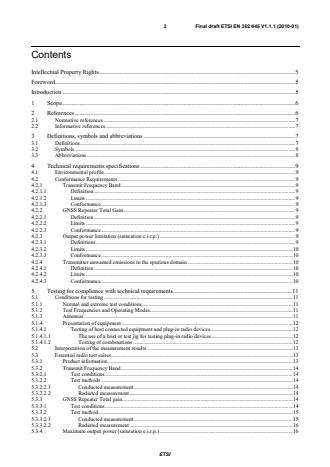
Contents
Intellectual Property Rights . 5
Foreword . 5
Introduction . 5
1 Scope . 6
2 References . 6
2.1 Normative references . 7
2.2 Informative references . 7
3 Definitions, symbols and abbreviations . 7
3.1 Definitions . 7
3.2 Symbols . 8
3.3 Abbreviations . 8
4 Technical requirements specifications . 9
4.1 Environmental profile . 9
4.2 Conformance Requirements . 9
4.2.1 Transmit Frequency Band . 9
4.2.1.1 Definition . 9
4.2.1.2 Limits . 9
4.2.1.3 Conformance . 9
4.2.2 GNSS Repeater Total Gain . 9
4.2.2.1 Definition . 9
4.2.2.2 Limits . 9
4.2.2.3 Conformance . 9
4.2.3 Output power limitation (saturation e.i.r.p.) . 9
4.2.3.1 Definitions . 9
4.2.3.2 Limits . 10
4.2.3.3 Conformance . 10
4.2.4 Transmitter unwanted emissions in the spurious domain . 10
4.2.4.1 Definition . 10
4.2.4.2 Limits . 10
4.2.4.3 Conformance . 10
5 Testing for compliance with technical requirements . 11
5.1 Conditions for testing . 11
5.1.1 Normal and extreme test conditions. 11
5.1.2 Test Frequencies and Operating Modes . 11
5.1.3 Antennas . 11
5.1.4 Presentation of equipment . 12
5.1.4.1 Testing of host connected equipment and plug-in radio devices . 12
5.1.4.1.1 The use of a host or test jig for testing plug-in radio devices . 12
5.1.4.1.2 Testing of combinations . 12
5.2 Interpretation of the measurement results . 13
5.3 Essential radio test suites . 13
5.3.1 Product information . 13
5.3.2 Transmit Frequency Band . 14
5.3.2.1 Test conditions . 14
5.3.2.2 Test methods . 14
5.3.2.2.1 Conducted measurement. 14
5.3.2.2.2 Radiated measurement . 14
5.3.3 GNSS Repeater Total gain . 14
5.3.3.1 Test conditions . 14
5.3.3.2 Test method . 15
5.3.3.2.1 Conducted measurement. 15
5.3.3.2.2 Radiated measurement . 16
5.3.4 Maximum output power (saturation e.i.r.p.) . 16
ETSI
4 Final draft ETSI EN 302 645 V1.1.1 (2010-01)
5.3.4.1 Test conditions . 16
5.3.4.2 Test method . 16
5.3.4.2.1 Conducted measurement. 16
5.3.4.2.2 Radiated measurement . 17
5.3.5 Transmitter unwanted emissions in the spurious domain . 17
5.3.5.1 Test conditions . 17
5.3.5.2 Test method . 18
5.3.5.2.1 Conducted measurement. 18
5.3.5.2.2 Radiated measurement . 19
Annex A (normative): HS Requirements and conformance Test specifications Table (HS-
RTT) . 20
Annex B (normative): Test sites and arrangements for radiated measurements . 22
B.1 Test sites . 22
B.1.1 Open air test sites . 22
B.1.2 Anechoic chamber . 23
B.1.2.1 General . 23
B.1.2.2 Description . 23
B.1.2.3 Influence of parasitic reflections . 23
B.1.2.4 Calibration and mode of use . 24
B.2 Test antenna . 25
B.3 Substitution antenna . 26
Annex C (normative): General description of measurement . 27
C.1 Conducted measurements . 27
C.2 Radiated measurements . 27
C.3 Substitution measurement . 28
Annex D (informative): The EN title in the official languages . 29
Annex E (informative): Bibliography . 30
History . 31
ETSI
5 Final draft ETSI EN 302 645 V1.1.1 (2010-01)
Intellectual Property Rights
IPRs essential or potentially essential to the present document may have been declared to ETSI. The information
pertaining to these essential IPRs, if any, is publicly available for ETSI members and non-members, and can be found
in ETSI SR 000 314: "Intellectual Property Rights (IPRs); Essential, or potentially Essential, IPRs notified to ETSI in
respect of ETSI standards", which is available from the ETSI Secretariat. Latest updates are available on the ETSI Web
server (http://webapp.etsi.org/IPR/home.asp).
Pursuant to the ETSI IPR Policy, no investigation, including IPR searches, has been carried out by ETSI. No guarantee
can be given as to the existence of other IPRs not referenced in ETSI SR 000 314 (or the updates on the ETSI Web
server) which are, or may be, or may become, essential to the present document.
Foreword
This Harmonized European Standard (Telecommunications series) has been produced by ETSI Technical Committee
Electromagnetic compatibility and Radio spectrum Matters (ERM), and is now submitted for the Vote phase of the
ETSI standards Two-step Approval Procedure.
The present document has been produced by ETSI in response to a mandate from the European Commission issued
under Council Directive 98/34/EC (as amended) [i.2] laying down a procedure for the provision of information in the
field of technical standards and regulations.
The present document is intended to become a Harmonized Standard, the reference of which will be published in the
Official Journal of the European Communities referencing the Directive 1999/5/EC [i.1] of the European Parliament
and of the Council of 9 March 1999 on radio equipment and telecommunications terminal equipment and the mutual
recognition of their conformity ("the R&TTE Directive").
Technical specifications relevant to Directive 1999/5/EC [i.1] are given in annex A.
Proposed national transposition dates
Date of latest announcement of this EN (doa): 3 months after ETSI publication
Date of latest publication of new National Standard
or endorsement of this EN (dop/e): 6 months after doa
Date of withdrawal of any conflicting National Standard (dow): 18 months after doa
Introduction
The present document is part of a set of standards developed by ETSI and is designed to fit in a modular structure to
cover all radio and telecommunications terminal equipment within the scope of the R&TTE Directive [i.1]. The
modular structure is shown in EG 201 399 [i.3].
ETSI
6 Final draft ETSI EN 302 645 V1.1.1 (2010-01)
1 Scope
The present document applies to GNSS repeaters. GNSS pseudolites as well as GNSS Receivers are not covered by the
present document.
GNSS repeaters are devices designed to re-transmit GNSS signals unchanged inside buildings in order to provide a
usable signal for GNSS receivers that are out of sight of the GNSS satellite constellation or that they are unable to
connect to GNSS signal simulators. A number of potential uses for such devices have been identified, such as the
provision of a signal for test and development purposes and avoiding the need for receivers in emergency vehicles to
re-acquire lock upon leaving a garage.
These radio equipment types are capable of operating in all or part of the frequency bands given in table 1.
Table 1: Radiocommunications service frequency bands
Radiocommunications service frequency bands
Transmit 1 164 MHz to 1 215 MHz
Receive 1 164 MHz to 1 215 MHz
Transmit 1 215 MHz to 1 300 MHz
Receive 1 215 MHz to 1 300 MHz
Transmit 1 559 MHz to 1 610 MHz
Receive 1 559 MHz to 1 610 MHz
The type of equipment covered by the present document is as follows:
• Fixed installed GNSS repeater equipment with a transmit antenna that is for indoor installation. The equipment
is fitted with integral or dedicated antenna(s). The GNSS repeater consists of a linear amplifier with a
predetermined maximum power output and a maximum gain between in and output channel. The intended use
is inside a building with its receiving antenna outside and the transmitting antenna inside the building.
Mobile or portable GNSS repeaters are excluded from the application of the present document.
The present document fulfils the purpose of providing the requirements and associated measurement methods to fulfil
the requirements of the R&TTE directive for efficient spectrum use and to protect the primary service and radio
services in adjacent frequency bands.
In addition to the present document, other ENs that specify technical requirements in respect of essential requirements
under other parts of article 3 of the R&TTE Directive may apply to equipment within the scope of the present
document.
NOTE: A list of such ENs is included on the web site http://www.newapproach.org.
2 References
References are either specific (identified by date of publication and/or edition number or version number) or
non-specific.
• For a specific reference, subsequent revisions do not apply.
• Non-specific reference may be made only to a complete document or a part thereof and only in the following
cases:
- if it is accepted that it will be possible to use all future changes of the referenced document for the
purposes of the referring document;
- for informative references.
Referenced documents which are not found to be publicly available in the expected location might be found at
http://docbox.etsi.org/Reference.
ETSI
7 Final draft ETSI EN 302 645 V1.1.1 (2010-01)
NOTE: While any hyperlinks included in this clause were valid at the time of publication ETSI cannot guarantee
their long term validity.
2.1 Normative references
The following referenced documents are indispensable for the application of the present document. For dated
references, only the edition cited applies. For non-specific references, the latest edition of the referenced document
(including any amendments) applies.
[1] ETSI TR 100 028 (2001) (all parts): "Electromagnetic compatibility and Radio spectrum Matters
(ERM); Uncertainties in the measurement of mobile radio equipment characteristics".
[2] CISPR 16 (2006), (parts 1-1, 1-4 and 1-5): "Specifications for radio disturbance and immunity
measuring apparatus and methods; Part 1: Radio disturbance and immunity measuring apparatus".
2.2 Informative references
The following referenced documents are not essential to the use of the present document but they assist the user with
regard to a particular subject area. For non-specific references, the latest version of the referenced document (including
any amendments) applies.
[i.1] Directive 1999/5/EC of the European Parliament and of the Council of 9 March 1999 on radio
equipment and telecommunications terminal equipment and the mutual recognition of their
conformity (R&TTE Directive).
[i.2] Council Directive 98/34/EC of the European Parliament and of the Council of 22 June 1998 laying
down a procedure for the provision of information in the field of technical standards and
regulations.
NOTE: It can be found under www.ero.dk.
[i.3] ETSI EG 201 399 (V2.1.1): "Electromagnetic compatibility and Radio spectrum Matters (ERM);
A guide to the production of candidate Harmonized Standards for application under the R&TTE
Directive".
[i.4] CEPT ECC Report 129: "Technical and operational provisions required for the use of GNSS
repeaters".
3 Definitions, symbols and abbreviations
3.1 Definitions
For the purposes of the present document, the terms and definitions given in the R&TTE Directive [i.1] and the
following apply:
combined equipment: any combination of non-radio equipment that requires a plug-in radio device to offer full
functionality
dedicated antenna: antenna external to the equipment, using an antenna connector with a cable and which has been
designed or developed for one or more specific types of equipment
NOTE: It is the combination of dedicated antenna and radio equipment that has to be compliant with the
regulations.
frequency band: one of the frequency ranges defined in table 1 of the present document
GNSS bands: frequency bands from 1 164 MHz to 1 215 MHz, 1 215 MHz to 1 300 MHz, and from 1 559 MHz to
1 610 MHz
ETSI
8 Final draft ETSI EN 302 645 V1.1.1 (2010-01)
GNSS pseudolites: (pseudo satellites) are ground based radio transmitters that provide an alternative ranging signal,
which with other pseudolites signals or satellite signals can give a navigation solution
host equipment: any equipment which has complete user functionality when not connected to the radio equipment part
and to which the radio equipment part provides additional functionality and to which connection is necessary for the
radio equipment part to offer functionality
integral antenna: antenna designed as a fixed part of the equipment, without the use of an external connector and as
such which cannot be disconnected from the equipment by the user with the intent to connect another antenna
NOTE: An integral antenna may be fitted internally or externally. In the case where the antenna is external, a
non-detachable cable not exceeding 3 m length is allowed.
plug-in radio device: radio equipment module intended to be used with or within host, combined or multi-radio
equipment, using their control functions and power supply
radiated measurements: measurements which involve the absolute measurement of a radiated EM field
stand-alone radio equipment: equipment that is intended primarily as communications equipment and that is normally
used on a stand-alone basis
3.2 Symbols
For the purposes of the present document, the following symbols apply:
dB decibel
dBi antenna gain relative to isotropic radiator in decibel
dBr decibel relative to the maximum power
E electrical field strength
f frequency
f nominal centre frequency
c
G GNSS repeater total system gain
total
G antenna gain
P equivalent isotropically radiated power level
R distance
µs microsecond
3.3 Abbreviations
For the purposes of the present document, the following abbreviations apply:
CEPT European Conference of Postal and Telecommunications Administrations
e.i.r.p. equivalent isotropically radiated power
e.r.p. effective radiated power
EC European Commission
ECC Electronic Communications Committee
EM Electromagnetic
EMC Electro Magnetic Compatibility
GNSS Global Navigation Satellite System
HS Harmonized Standard
IF Intermediate Frequency
-6
ppm parts per million = 10
PSD Power Spectral Density
RF Radio Frequency
rms root mean square
UUT Unit Under Test
ETSI
9 Final draft ETSI EN 302 645 V1.1.1 (2010-01)
4 Technical requirements specifications
4.1 Environmental profile
The technical requirements of the present document apply under the environmental profile for operation of the
equipment, which shall be stated by the manufacturer. The equipment shall comply with all the technical requirements
of the present document at all times when operating within the boundary limits of the stated operational environmental
profile.
4.2 Conformance Requirements
4.2.1 Transmit Frequency Band
4.2.1.1 Definition
The transmit frequency bands are the GNSS frequency bands, or part of these bands, in which the GNSS repeater can
re-transmit received signals (see table 1).
4.2.1.2 Limits
The actual transmit frequency band should be maintained within the GNSS bands.
4.2.1.3 Conformance
Conformance tests as defined in clause 5.3.2 shall be carried out.
4.2.2 GNSS Repeater Total Gain
4.2.2.1 Definition
The total gain of the GNSS repeater, G is the measured maximum gain of all included radio frequency amplifiers
total ,
added to the sum of the declared maximum gain of all attached antennas (the declared identified maximum gain of the
GNSS repeater receive antenna and the declared maximum gain of the GNSS re-broadcast antenna).
G [dB] = GNSS repeater antenna gain(s) + amplifier gain – cable losses
total
4.2.2.2 Limits
The total gain will calculated from the measured amplifier gain and the declared maximum of the antenna gains across
the declared transmit frequencies within the GNSS bands. The G gain limit is 45 dB [i.4]. Installed cable losses of
total
up to 3 dB can be assumed.
4.2.2.3 Conformance
Conformance tests as defined in clause 5.3.3 shall be carried out.
4.2.3 Output power limitation (saturation e.i.r.p.)
4.2.3.1 Definitions
The saturation output power is the maximum equivalent isotropically radiated power (e.i.r.p.) of the equipment for a
sinusoidal input signal of any power level. It relates to the maximum output power level of the system when presented
with a high level non-GNSS signal such as a radar pulse. It is not related to the level of re-radiated GNSS signal.
ETSI
10 Final draft ETSI EN 302 645 V1.1.1 (2010-01)
Re-radiated GNSS signals would be limited to a significantly lower level by virtue of the limitation on gain given in
clause 4.2.2.
4.2.3.2 Limits
The maximum output power shall not exceed -20 dBm for a sinusoidal input signal within any of the frequency bands
given in table 1.
The limiting output power capability shall not exceed -27 dBm for a sinusoidal input signal with a frequency of
1 151 MHz or below.
4.2.3.3 Conformance
Conformance tests as defined in clause 5.3.4 shall be carried out.
4.2.4 Transmitter unwanted emissions in the spurious domain
4.2.4.1 Definition
These are radio frequency emissions outside the GNSS bands, other than those of the wanted emissions and associated
sidebands.
4.2.4.2 Limits
The level of spurious emissions shall not exceed the limits given in tables 2 and 3.
Table 2: General transmitter spurious emission limits outside the GNSS bands
Frequency range Maximum power, e.r.p. Bandwidth
(above 1 GHz: e.i.r.p.)
30 MHz to 47 MHz -36 dBm 100 kHz
47 MHz to 74 MHz -54 dBm 100 kHz
74 MHz to 87,5 MHz -36 dBm 100 kHz
87,5 MHz to 118 MHz -54 dBm 100 kHz
118 MHz to 174 MHz -36 dBm 100 kHz
174 MHz to 230 MHz -54 dBm 100 kHz
230 MHz to 470 MHz -36 dBm 100 kHz
470 MHz to 862 MHz -54 dBm 100 kHz
862 MHz to 1 GHz -36 dBm 100 kHz
1 GHz to 1,164 GHz -30 dBm 1 MHz
1,300 GHz to 1,559 GHz -30 dBm 1 MHz
1,610 GHz to 12,750 GHz -30 dBm 1 MHz
Table 3: Specific spurious emissions limits in geographic coverage
area of systems operating in other frequency bands
System type operating in Band for co-existence Maximum power, Measurement
the same geographical area requirement e.r.p. Bandwidth
(above 1 GHz: e.i.r.p.)
Aeronautical systems 960 MHz to 1 151 MHz -52 dBm 1 MHz
DCS 1 800 1 805 MHz to 1 880 MHz -47 dBm 100 kHz
1 710 MHz to 1 785 MHz -61 dBm 100 kHz
PCS 1 900 1 930 MHz to 1 990 MHz -47 dBm 100 kHz
1 850 MHz to 1 910 MHz -61 dBm 100 kHz
UTRAN TDD 1 900 MHz to 1 920 MHz -52 dBm 1 MHz
4.2.4.3 Conformance
Conformance tests as defined in clause 5.3.4 shall be carried out.
ETSI
11 Final draft ETSI EN 302 645 V1.1.1 (2010-01)
5 Testing for compliance with technical requirements
5.1 Conditions for testing
5.1.1 Normal and extreme test conditions
Tests defined in the present document shall be carried out under normal test conditions and where stated, under the
extreme test conditions as declared by the manufacturer (see clause 4.1).
5.1.2 Test Frequencies and Operating Modes
The measurements for the RF gain and Output Power Limitation shall be performed at the lowest and highest frequency
for each of the stated frequency ranges the GNSS repeater is intended to re-transmit. The measurements for transmitter
and receiver spurious emissions shall be performed when operating on one of the frequencies for each of the stated
frequency ranges.
If the equipment has different nominal transmit bandwidths, the measurements need to be repeated for each of the
repeater transmit bandwidth.
For the purpose of testing of the GNSS repeater for its maximum gain an input signal shall be provided to the receiver
front end (either the connector, or in case of an integrated antenna, to the receiving antenna).
Confirmation of the total gain of the system can be measured by sweeping a narrow band 20 kHz signal across the
transmit bandwidth, the swept input signal to be set at a value of -80 dBm/20 kHz. The resultant value displayed on a
spectrum analyser using peak hold shall not exceed a value of -35 dBm/20 kHz. However, if the measured saturation
output power is significantly lower than -20 dBm, this lower value should be used to avoid saturation effects giving an
incorrect value of gain, through clause 4.2.2.
For the purpose of testing of the GNSS repeater unwanted emissions, a white-noise input signal shall be provided to the
receiver front end (either the connector, or in case of an integrated antenna, to the receiving antenna).
NOTE: Only a relatively small power is needed. Assuming a GNSS signal strength of -160 dBW/24 MHz
(approximately -144 dBm/MHz) at the earth surface referenced to an isotropic antenna, and a typical
receive antenna gain of 3 dBi, the typical GNSS input signal would by approximately -140 dBm/MHz.
A white-noise signal source from a signal generator shall be applied to the input of the GNSS receiver with a PSD of
-105 dBm/MHz for the purpose of testing the transmit frequency range.
5.1.3 Antennas
The equipment can have either integral or dedicated antennas.
Dedicated antennas, further referred to as dedicated external antennas, are antennas that are physically external to the
equipment and which are assessed in combination with the equipment against the requirements in the present document.
NOTE: It should be noted that assessment does not necessarily lead to testing.
An antenna assembly referred to in the present document is understood as the combination of the antenna (integral or
dedicated), its coaxial cable and if applicable, its antenna connector and associated switching components.
Although the measurement methods in the present document allow conducted measurements to be performed, it should
be noted that the equipment together with all its intended antenna assemblies shall comply with the applicable technical
requirements defined in the present document.
ETSI
12 Final draft ETSI EN 302 645 V1.1.1 (2010-01)
5.1.4 Presentation of equipment
5.1.4.1 Testing of host connected equipment and plug-in radio devices
For combined equipment and for radio parts for which connection to or integration with host equipment is required to
offer functionality to the radio, different alternative test approaches are permitted. Where more than one such
combination is intended, testing shall not be repeated for combinations of the radio part and various host equipment
where the latter are substantially similar.
Where more than one such combination is intended and the combinations are not substantially similar, one combination
shall be tested against all requirements of the present document and all other combinations shall be tested separately for
radiated spurious emissions only.
5.1.4.1.1 The use of a host or test jig for testing plug-in radio devices
Where the radio part is a plug-in radio device which is intended to be used within a variety of combinations, a suitable
test configuration consisting of either a test jig or a typical host equipment shall be used. This shall be representative for
the range of combinations in which the device may be used. The test jig shall allow the radio equipment part to be
powered and stimulated as if connected to or inserted into host or combined equipment. Measurements shall be made to
all requirements of the present document.
5.1.4.1.2 Testing of combinations
5.1.4.1.2.1 Alternative A: General approach for combinations
Combined equipment or a combination of a plug-in radio device and a specific type of host equipment may be used for
testing according to the full requirements of the present document.
5.1.4.1.2.2 Alternative B: For host equipment with a plug-in radio device
A combination of a plug-in radio device and a specific type of host equipment may be used for testing according to the
full requirements of the present document.
For radiated spurious emission tests the most appropriate standard shall be applied to the host equipment. The plug-in
radio device shall meet the radiated spurious emissions requirements as described in the present document.
5.1.4.1.2.3 Alternative C: For combined equipment with a plug-in radio device
Combined equipment may be used for testing according to the full requirements of the present document.
For radiated spurious emissions the requirements of the most appropriate harmonized EMC standard shall be applied to
the non-radio equipment. The plug-in radio device shall meet the radiated spurious emissions requirements as described
in the present document.
In the case where the plug-in radio device is totally integrated and cannot operate independently, radiated spurious
emissions for the combination shall be tested using the most appropriate harmonized standard with the radio part in
receive and/or standby mode. If the frequency range is less than the one defined in the present document, additional
measurements according to the requirements in the present document shall be performed to cover the remaining parts of
the frequency range. With the radio in transmit mode, the radiated spurious emissions requirements of the present
document shall be applied.
5.1.4.1.2.4 Alternative D: For equipment with multiple radios
Multi-radio equipment, where at least one of the radio parts is within the scope of the present document, may be used
for testing according to the full requirements of the present document. Additional requirements and limits for
multi-radio equipment are set out in the relevant harmonized radio product standards applicable to the other radio parts.
When measuring spurious emissions in the receive and/or standby mode, it is essential that none of the transmitters
within the combined equipment are transmitting.
ETSI
13 Final draft ETSI EN 302 645 V1.1.1 (2010-01)
5.1.4.1.2.4.1 The spurious emissions from each radio can be identified
Where the spurious emissions from each radio can be identified, then the spurious emissions from each radio are
assessed to the relevant harmonized radio standard.
5.1.4.1.2.4.2 The spurious emissions from each radio cannot be identified
Where the spurious emissions from each radio cannot be identified, then the combined equipment is assessed to the
spurious emission requirements contained in all of the relevant harmonized radio standards applicable to the radios
contained within the combined product.
Where the applicable harmonized radio standards contain different limits and measuring conditions, then the combined
product is assessed to the harmonized radio standard that specifies the least stringent limits for the common part of the
frequency measurement ranges. To assess the remaining parts of the frequency measurement ranges the limits from the
relevant harmonized radio standard should be used.
5.2 Interpretation of the measurement results
The interpretation of the results recorded in a test report for the measurements described in the present document shall
be as follows:
• the measured value related to the corresponding limit shall be used to decide whether an equipment meets the
requirements of the present document;
• the value of the measurement uncertainty for the measurement of each parameter shall be separately included
in the test report;
• the recorded value of the measurement uncertainty shall be, for each measurement, equal to or lower than the
figures in table 4.
The measurement uncertainty figures shall be calculated in accordance with TR 100 028 [1] and shall correspond to an
expansion factor (coverage factor) k = 1,96 or k = 2 (which provide confidence levels of respectively 95 % and 95,45 %
in the case where the distributions characterizing the actual measurement uncertainties are normal (Gaussian)).
Table 4 is based on such expansion factors.
Table 4: Maximum measurement uncertainty
Parameter Uncertainty
-5
RF frequency
±1 x 10
RF power conducted ±1,5 dB
RF power radiated ±6 dB
Humidity ±5 %
Temperature
±1 °C
5.3 Essential radio test suites
5.3.1 Product information
The following information is necessary in order to carry out the test suites:
• the operating frequency range(s) of the equipment;
• for each of the frequency ranges, the corresponding nominal re-transmission bandwidth(s) of the equipment;
• the type of the antenna: integral or dedicated;
• the intended combination(s) of the radio equipment power settings and one or more antenna assemblies and
their corresponding e.i.r.p. spectral density levels;
ETSI
14 Final draft ETSI EN 302 645 V1.1.1 (2010-01)
• the normal and the extreme operating conditions (e.g. voltage and temperature) that apply to the equipment;
• the type of equipment, for example: stand-alone equipment, plug-in radio device, combined equipment, etc.
5.3.2 Transmit Frequency Band
5.3.2.1 Test conditions
These measurements shall be performed under normal test conditions.
For a UUT with antenna connector(s) and using dedicated external antenna(s), or for a UUT with integral antenna(s) but
with a temporary antenna connector provided, conducted measurements shall be used.
For a UUT with integral antenna(s) and without a temporary antenna connector, radiated measurements shall be used.
5.3.2.2 Test methods
The transmit frequency bands are the GNSS frequency bands, or part of these bands, in which the GNSS repeater can
re-transmit received signals (see table 1).
5.3.2.2.1 Conducted measurement
The UUT shall be connected to the spectrum analyser.
The settings of the spectrum analyser shall be adjusted to optimize the instruments frequency accuracy.
The white- noise input signal from a signal generator shall be applied to the UUT.
In the case of devices with an external antenna, the antenna and device input and output impedance should be
investigated. If these impedances are not equal to those of the spectrum analyser and the noise source, the resulting
mismatch uncertainty should be added to the total uncertainty of the conducted measurement not exceeding the values
in table 4.
The Max Hold function shall be selected and the centre frequency shall be adjusted to the centre re-transmission
frequency of the UUT.
The maximum mean value of the power envelope shall be measured and recorded. The frequency span of the spectrum
analyser shall be reduced and the marker shall be moved in a positive frequency increment until the upper, (relative to
the centre frequency), -10 dBr relative to the maximum of re-transmission is reached. This value shall be noted as f1.
The marker shall then be moved in a negative frequency increment until the lower, (relative to the centre frequency),
-10 dBr point is reached. This value shall be noted as f2.
The centre of re-transmission is calculated as (f1 + f2)/2. This value shall be recorded.
5.3.2.2.2 Radiated measurement
The test set up as described in annex B shall be used with a spectrum analyser of sufficient accuracy and sensitivity
attached to the test antenna.
NOTE: An open air test site is most likely not usable for this test due to the GNSS signal interfering with the
retransmitted signal.
The test procedure is as described under clause 5.3.2.2.1. Mismatch uncertainties do not apply.
5.3.3 GNSS Repeater Total gain
5.3.3.1 Test conditions
For a UUT with antenna connector(s) and using dedicated external antenna(s), or for a UUT with integral antenna(s) but
with a temporary antenna connector provided, conducted measurements shall be used.
ETSI
15 Final draft ETSI EN 302 645 V1.1.1 (2010-01)
For a UUT with integral antenna(s) and without a temporary antenna connector, radiated measurements shall be used.
The UUT shall be configured to operate at the highest stated transmitter output power level, i.e. the highest gain step.
5.3.3.2 Test method
5.3.3.2.1 Conducted measurement
These measurements need only to be performed at normal test conditions.
For the purpose of this test, the minimum transmitter on-time from the signal generator shall be 10 seconds.
The transmitter shall be connected to the measuring equipment via a suitable attenuator and the Gain G as defined
total
shall be measured and recorded.
The Gain G shall be determined using a spectrum analyser of adequate bandwidth.
total
The Gain G to be measured is the highest gain found in any 1 MHz band.
total
Step 0:
Connect the signal generator transmitter output signal to the spectrum analyser and check that the signal is set at
-80 dBm/20 kHz.
Step 1:
Connect the UUT to the spectrum analyser and use the following settings:
• Centre Frequency: The centre frequency of the GNSS re-transmission under test.
• Resolution BW: 20 kHz.
• Video BW: 20 kHz.
• Frequency Span: 2 x Nominal re-transmission bandwidth (e.g. 40 MHz for a 20 MHz
re-transmiss
...
Harmonized European Standard (Telecommunications series)
Electromagnetic compatibility
and Radio spectrum Matters (ERM);
Short Range Devices;
Global Navigation Satellite Systems (GNSS) Repeaters;
Harmonized EN covering the essential requirements
of article 3.2 of the R&TTE Directive
2 ETSI EN 302 645 V1.1.1 (2010-03)
Reference
DEN/ERM-TG28-0422
Keywords
navigation, radio, repeater, satellite
ETSI
650 Route des Lucioles
F-06921 Sophia Antipolis Cedex - FRANCE
Tel.: +33 4 92 94 42 00 Fax: +33 4 93 65 47 16
Siret N° 348 623 562 00017 - NAF 742 C
Association à but non lucratif enregistrée à la
Sous-Préfecture de Grasse (06) N° 7803/88
Important notice
Individual copies of the present document can be downloaded from:
http://www.etsi.org
The present document may be made available in more than one electronic version or in print. In any case of existing or
perceived difference in contents between such versions, the reference version is the Portable Document Format (PDF).
In case of dispute, the reference shall be the printing on ETSI printers of the PDF version kept on a specific network drive
within ETSI Secretariat.
Users of the present document should be aware that the document may be subject to revision or change of status.
Information on the current status of this and other ETSI documents is available at
http://portal.etsi.org/tb/status/status.asp
If you find errors in the present document, please send your comment to one of the following services:
http://portal.etsi.org/chaircor/ETSI_support.asp
Copyright Notification
No part may be reproduced except as authorized by written permission.
The copyright and the foregoing restriction extend to reproduction in all media.
© European Telecommunications Standards Institute 2010.
All rights reserved.
TM TM TM TM
DECT , PLUGTESTS , UMTS , TIPHON , the TIPHON logo and the ETSI logo are Trade Marks of ETSI registered
for the benefit of its Members.
TM
3GPP is a Trade Mark of ETSI registered for the benefit of its Members and of the 3GPP Organizational Partners.
LTE™ is a Trade Mark of ETSI currently being registered
for the benefit of its Members and of the 3GPP Organizational Partners.
GSM® and the GSM logo are Trade Marks registered and owned by the GSM Association.
ETSI
3 ETSI EN 302 645 V1.1.1 (2010-03)
Contents
Intellectual Property Rights . 5
Foreword . 5
Introduction . 5
1 Scope . 6
2 References . 6
2.1 Normative references . 7
2.2 Informative references . 7
3 Definitions, symbols and abbreviations . 7
3.1 Definitions . 7
3.2 Symbols . 8
3.3 Abbreviations . 8
4 Technical requirements specifications . 9
4.1 Environmental profile . 9
4.2 Conformance Requirements . 9
4.2.1 Transmit Frequency Band . 9
4.2.1.1 Definition . 9
4.2.1.2 Limits . 9
4.2.1.3 Conformance . 9
4.2.2 GNSS Repeater Total Gain . 9
4.2.2.1 Definition . 9
4.2.2.2 Limits . 9
4.2.2.3 Conformance . 9
4.2.3 Output power limitation (saturation e.i.r.p.) . 10
4.2.3.1 Definitions . 10
4.2.3.2 Limits . 10
4.2.3.3 Conformance . 10
4.2.4 Transmitter unwanted emissions in the spurious domain . 10
4.2.4.1 Definition . 10
4.2.4.2 Limits . 10
4.2.4.3 Conformance . 11
5 Testing for compliance with technical requirements . 11
5.1 Conditions for testing . 11
5.1.1 Normal and extreme test conditions. 11
5.1.2 Test Frequencies and Operating Modes . 11
5.1.3 Antennas . 11
5.1.4 Presentation of equipment . 12
5.1.4.1 Testing of host connected equipment and plug-in radio devices . 12
5.1.4.1.1 The use of a host or test jig for testing plug-in radio devices . 12
5.1.4.1.2 Testing of combinations . 12
5.2 Interpretation of the measurement results . 13
5.3 Essential radio test suites . 14
5.3.1 Product information . 14
5.3.2 Transmit Frequency Band . 14
5.3.2.1 Test conditions . 14
5.3.2.2 Test methods . 14
5.3.2.2.1 Conducted measurement. 14
5.3.2.2.2 Radiated measurement . 15
5.3.3 GNSS Repeater Total gain . 15
5.3.3.1 Test conditions . 15
5.3.3.2 Test method . 15
5.3.3.2.1 Conducted measurement. 15
5.3.3.2.2 Radiated measurement . 16
5.3.4 Maximum output power (saturation e.i.r.p.) . 16
ETSI
4 ETSI EN 302 645 V1.1.1 (2010-03)
5.3.4.1 Test conditions . 16
5.3.4.2 Test method . 16
5.3.4.2.1 Conducted measurement. 16
5.3.4.2.2 Radiated measurement . 17
5.3.5 Transmitter unwanted emissions in the spurious domain . 18
5.3.5.1 Test conditions . 18
5.3.5.2 Test method . 18
5.3.5.2.1 Conducted measurement. 18
5.3.5.2.2 Radiated measurement . 20
Annex A (normative): HS Requirements and conformance Test specifications Table
(HS-RTT) . 21
Annex B (normative): Test sites and arrangements for radiated measurements . 23
B.1 Test sites . 23
B.1.1 Open air test sites . 23
B.1.2 Anechoic chamber . 24
B.1.2.1 General . 24
B.1.2.2 Description . 24
B.1.2.3 Influence of parasitic reflections . 24
B.1.2.4 Calibration and mode of use . 25
B.2 Test antenna . 26
B.3 Substitution antenna . 27
Annex C (normative): General description of measurement . 28
C.1 Conducted measurements . 28
C.2 Radiated measurements . 28
C.3 Substitution measurement . 29
Annex D (informative): The EN title in the official languages . 30
Annex E (informative): Bibliography . 31
History . 32
ETSI
5 ETSI EN 302 645 V1.1.1 (2010-03)
Intellectual Property Rights
IPRs essential or potentially essential to the present document may have been declared to ETSI. The information
pertaining to these essential IPRs, if any, is publicly available for ETSI members and non-members, and can be found
in ETSI SR 000 314: "Intellectual Property Rights (IPRs); Essential, or potentially Essential, IPRs notified to ETSI in
respect of ETSI standards", which is available from the ETSI Secretariat. Latest updates are available on the ETSI Web
server (http://webapp.etsi.org/IPR/home.asp).
Pursuant to the ETSI IPR Policy, no investigation, including IPR searches, has been carried out by ETSI. No guarantee
can be given as to the existence of other IPRs not referenced in ETSI SR 000 314 (or the updates on the ETSI Web
server) which are, or may be, or may become, essential to the present document.
Foreword
This Harmonized European Standard (Telecommunications series) has been produced by ETSI Technical Committee
Electromagnetic compatibility and Radio spectrum Matters (ERM).
The present document has been produced by ETSI in response to a mandate from the European Commission issued
under Council Directive 98/34/EC (as amended) [i.2] laying down a procedure for the provision of information in the
field of technical standards and regulations.
The present document is intended to become a Harmonized Standard, the reference of which will be published in the
Official Journal of the European Communities referencing the Directive 1999/5/EC [i.1] of the European Parliament
and of the Council of 9 March 1999 on radio equipment and telecommunications terminal equipment and the mutual
recognition of their conformity ("the R&TTE Directive").
Technical specifications relevant to Directive 1999/5/EC [i.1] are given in annex A.
National transposition dates
Date of adoption of this EN: 12 March 2010
Date of latest announcement of this EN (doa): 30 June 2010
Date of latest publication of new National Standard
or endorsement of this EN (dop/e): 31 December 2010
Date of withdrawal of any conflicting National Standard (dow): 31 December 2011
Introduction
The present document is part of a set of standards developed by ETSI and is designed to fit in a modular structure to
cover all radio and telecommunications terminal equipment within the scope of the R&TTE Directive [i.1]. The
modular structure is shown in EG 201 399 [i.3].
ETSI
6 ETSI EN 302 645 V1.1.1 (2010-03)
1 Scope
The present document applies to GNSS repeaters. GNSS pseudolites as well as GNSS Receivers are not covered by the
present document.
GNSS repeaters are devices designed to re-transmit GNSS signals unchanged inside buildings in order to provide a
usable signal for GNSS receivers that are out of sight of the GNSS satellite constellation or that they are unable to
connect to GNSS signal simulators. A number of potential uses for such devices have been identified, such as the
provision of a signal for test and development purposes and avoiding the need for receivers in emergency vehicles to
re-acquire lock upon leaving a garage.
These radio equipment types are capable of operating in all or part of the frequency bands given in table 1.
Table 1: Radiocommunications service frequency bands
Radiocommunications service frequency bands
Transmit 1 164 MHz to 1 215 MHz
Receive 1 164 MHz to 1 215 MHz
Transmit 1 215 MHz to 1 300 MHz
Receive 1 215 MHz to 1 300 MHz
Transmit 1 559 MHz to 1 610 MHz
Receive 1 559 MHz to 1 610 MHz
The type of equipment covered by the present document is as follows:
• Fixed installed GNSS repeater equipment with a transmit antenna that is for indoor installation. The equipment
is fitted with integral or dedicated antenna(s). The GNSS repeater consists of a linear amplifier with a
predetermined maximum power output and a maximum gain between in and output channel. The intended use
is inside a building with its receiving antenna outside and the transmitting antenna inside the building.
Mobile or portable GNSS repeaters are excluded from the application of the present document.
The present document fulfils the purpose of providing the requirements and associated measurement methods to fulfil
the requirements of the R&TTE directive for efficient spectrum use and to protect the primary service and radio
services in adjacent frequency bands.
In addition to the present document, other ENs that specify technical requirements in respect of essential requirements
under other parts of article 3 of the R&TTE Directive may apply to equipment within the scope of the present
document.
NOTE: A list of such ENs is included on the web site http://www.newapproach.org.
2 References
References are either specific (identified by date of publication and/or edition number or version number) or
non-specific.
• For a specific reference, subsequent revisions do not apply.
• Non-specific reference may be made only to a complete document or a part thereof and only in the following
cases:
- if it is accepted that it will be possible to use all future changes of the referenced document for the
purposes of the referring document;
- for informative references.
Referenced documents which are not found to be publicly available in the expected location might be found at
http://docbox.etsi.org/Reference.
ETSI
7 ETSI EN 302 645 V1.1.1 (2010-03)
NOTE: While any hyperlinks included in this clause were valid at the time of publication ETSI cannot guarantee
their long term validity.
2.1 Normative references
The following referenced documents are indispensable for the application of the present document. For dated
references, only the edition cited applies. For non-specific references, the latest edition of the referenced document
(including any amendments) applies.
[1] ETSI TR 100 028 (2001) (all parts): "Electromagnetic compatibility and Radio spectrum Matters
(ERM); Uncertainties in the measurement of mobile radio equipment characteristics".
[2] CISPR 16 (2006), (parts 1-1, 1-4 and 1-5): "Specifications for radio disturbance and immunity
measuring apparatus and methods; Part 1: Radio disturbance and immunity measuring apparatus".
2.2 Informative references
The following referenced documents are not essential to the use of the present document but they assist the user with
regard to a particular subject area. For non-specific references, the latest version of the referenced document (including
any amendments) applies.
[i.1] Directive 1999/5/EC of the European Parliament and of the Council of 9 March 1999 on radio
equipment and telecommunications terminal equipment and the mutual recognition of their
conformity (R&TTE Directive).
[i.2] Council Directive 98/34/EC of the European Parliament and of the Council of 22 June 1998 laying
down a procedure for the provision of information in the field of technical standards and
regulations.
NOTE: It can be found under www.ero.dk.
[i.3] ETSI EG 201 399 (V2.1.1): "Electromagnetic compatibility and Radio spectrum Matters (ERM);
A guide to the production of candidate Harmonized Standards for application under the R&TTE
Directive".
[i.4] CEPT ECC Report 129: "Technical and operational provisions required for the use of GNSS
repeaters".
3 Definitions, symbols and abbreviations
3.1 Definitions
For the purposes of the present document, the terms and definitions given in the R&TTE Directive [i.1] and the
following apply:
combined equipment: any combination of non-radio equipment that requires a plug-in radio device to offer full
functionality
dedicated antenna: antenna external to the equipment, using an antenna connector with a cable and which has been
designed or developed for one or more specific types of equipment
NOTE: It is the combination of dedicated antenna and radio equipment that has to be compliant with the
regulations.
frequency band: one of the frequency ranges defined in table 1 of the present document
GNSS bands: frequency bands from 1 164 MHz to 1 215 MHz, 1 215 MHz to 1 300 MHz, and from 1 559 MHz to
1 610 MHz
ETSI
8 ETSI EN 302 645 V1.1.1 (2010-03)
GNSS pseudolites: (pseudo satellites) are ground based radio transmitters that provide an alternative ranging signal,
which with other pseudolites signals or satellite signals can give a navigation solution
host equipment: any equipment which has complete user functionality when not connected to the radio equipment part
and to which the radio equipment part provides additional functionality and to which connection is necessary for the
radio equipment part to offer functionality
integral antenna: antenna designed as a fixed part of the equipment, without the use of an external connector and as
such which cannot be disconnected from the equipment by the user with the intent to connect another antenna
NOTE: An integral antenna may be fitted internally or externally. In the case where the antenna is external, a
non-detachable cable not exceeding 3 m length is allowed.
plug-in radio device: radio equipment module intended to be used with or within host, combined or multi-radio
equipment, using their control functions and power supply
radiated measurements: measurements which involve the absolute measurement of a radiated EM field
stand-alone radio equipment: equipment that is intended primarily as communications equipment and that is normally
used on a stand-alone basis
3.2 Symbols
For the purposes of the present document, the following symbols apply:
dB decibel
dBi antenna gain relative to isotropic radiator in decibel
dBr decibel relative to the maximum power
E electrical field strength
f frequency
f nominal centre frequency
c
G GNSS repeater total system gain
total
G antenna gain
P equivalent isotropically radiated power level
R distance
µs microsecond
3.3 Abbreviations
For the purposes of the present document, the following abbreviations apply:
CEPT European Conference of Postal and Telecommunications Administrations
e.i.r.p. equivalent isotropically radiated power
e.r.p. effective radiated power
EC European Commission
ECC Electronic Communications Committee
EM Electromagnetic
EMC Electro Magnetic Compatibility
GNSS Global Navigation Satellite System
HS Harmonized Standard
IF Intermediate Frequency
-6
ppm parts per million = 10
PSD Power Spectral Density
RF Radio Frequency
rms root mean square
UUT Unit Under Test
ETSI
9 ETSI EN 302 645 V1.1.1 (2010-03)
4 Technical requirements specifications
4.1 Environmental profile
The technical requirements of the present document apply under the environmental profile for operation of the
equipment, which shall be stated by the manufacturer. The equipment shall comply with all the technical requirements
of the present document at all times when operating within the boundary limits of the stated operational environmental
profile.
4.2 Conformance Requirements
4.2.1 Transmit Frequency Band
4.2.1.1 Definition
The transmit frequency bands are the GNSS frequency bands, or part of these bands, in which the GNSS repeater can
re-transmit received signals (see table 1).
4.2.1.2 Limits
The actual transmit frequency band should be maintained within the GNSS bands.
4.2.1.3 Conformance
Conformance tests as defined in clause 5.3.2 shall be carried out.
4.2.2 GNSS Repeater Total Gain
4.2.2.1 Definition
The total gain of the GNSS repeater, G is the measured maximum gain of all included radio frequency amplifiers
total ,
added to the sum of the declared maximum gain of all attached antennas (the declared identified maximum gain of the
GNSS repeater receive antenna and the declared maximum gain of the GNSS re-broadcast antenna).
G [dB] = GNSS repeater antenna gain(s) + amplifier gain – cable losses
total
4.2.2.2 Limits
The total gain will calculated from the measured amplifier gain and the declared maximum of the antenna gains across
the declared transmit frequencies within the GNSS bands. The G gain limit is 45 dB [i.4]. Installed cable losses of
total
up to 3 dB can be assumed.
4.2.2.3 Conformance
Conformance tests as defined in clause 5.3.3 shall be carried out.
ETSI
10 ETSI EN 302 645 V1.1.1 (2010-03)
4.2.3 Output power limitation (saturation e.i.r.p.)
4.2.3.1 Definitions
The saturation output power is the maximum equivalent isotropically radiated power (e.i.r.p.) of the equipment for a
sinusoidal input signal of any power level. It relates to the maximum output power level of the system when presented
with a high level non-GNSS signal such as a radar pulse. It is not related to the level of re-radiated GNSS signal.
Re-radiated GNSS signals would be limited to a significantly lower level by virtue of the limitation on gain given in
clause 4.2.2.
4.2.3.2 Limits
The maximum output power shall not exceed -20 dBm for a sinusoidal input signal within any of the frequency bands
given in table 1.
The limiting output power capability shall not exceed -27 dBm for a sinusoidal input signal with a frequency of
1 151 MHz or below.
4.2.3.3 Conformance
Conformance tests as defined in clause 5.3.4 shall be carried out.
4.2.4 Transmitter unwanted emissions in the spurious domain
4.2.4.1 Definition
These are radio frequency emissions outside the GNSS bands, other than those of the wanted emissions and associated
sidebands.
4.2.4.2 Limits
The level of spurious emissions shall not exceed the limits given in tables 2 and 3.
Table 2: General transmitter spurious emission limits outside the GNSS bands
Frequency range Maximum power, e.r.p. Bandwidth
(above 1 GHz: e.i.r.p.)
30 MHz to 47 MHz -36 dBm 100 kHz
47 MHz to 74 MHz -54 dBm 100 kHz
74 MHz to 87,5 MHz -36 dBm 100 kHz
87,5 MHz to 118 MHz -54 dBm 100 kHz
118 MHz to 174 MHz -36 dBm 100 kHz
174 MHz to 230 MHz -54 dBm 100 kHz
230 MHz to 470 MHz -36 dBm 100 kHz
470 MHz to 862 MHz -54 dBm 100 kHz
862 MHz to 1 GHz -36 dBm 100 kHz
1 GHz to 1,164 GHz -30 dBm 1 MHz
1,300 GHz to 1,559 GHz -30 dBm 1 MHz
1,610 GHz to 12,750 GHz -30 dBm 1 MHz
ETSI
11 ETSI EN 302 645 V1.1.1 (2010-03)
Table 3: Specific spurious emissions limits in geographic coverage
area of systems operating in other frequency bands
System type operating in Band for co-existence Maximum power, Measurement
the same geographical area requirement e.r.p. Bandwidth
(above 1 GHz: e.i.r.p.)
Aeronautical systems 960 MHz to 1 151 MHz -52 dBm 1 MHz
DCS 1 800 1 805 MHz to 1 880 MHz -47 dBm 100 kHz
1 710 MHz to 1 785 MHz -61 dBm 100 kHz
PCS 1 900 1 930 MHz to 1 990 MHz -47 dBm 100 kHz
1 850 MHz to 1 910 MHz -61 dBm 100 kHz
UTRAN TDD 1 900 MHz to 1 920 MHz -52 dBm 1 MHz
4.2.4.3 Conformance
Conformance tests as defined in clause 5.3.4 shall be carried out.
5 Testing for compliance with technical requirements
5.1 Conditions for testing
5.1.1 Normal and extreme test conditions
Tests defined in the present document shall be carried out under normal test conditions and where stated, under the
extreme test conditions as declared by the manufacturer (see clause 4.1).
5.1.2 Test Frequencies and Operating Modes
The measurements for the RF gain and Output Power Limitation shall be performed at the lowest and highest frequency
for each of the stated frequency ranges the GNSS repeater is intended to re-transmit. The measurements for transmitter
and receiver spurious emissions shall be performed when operating on one of the frequencies for each of the stated
frequency ranges.
If the equipment has different nominal transmit bandwidths, the measurements need to be repeated for each of the
repeater transmit bandwidth.
For the purpose of testing of the GNSS repeater for its maximum gain an input signal shall be provided to the receiver
front end (either the connector, or in case of an integrated antenna, to the receiving antenna).
Confirmation of the total gain of the system can be measured by sweeping a narrow band 20 kHz signal across the
transmit bandwidth, the swept input signal to be set at a value of -80 dBm/20 kHz. The resultant value displayed on a
spectrum analyser using peak hold shall not exceed a value of -35 dBm/20 kHz. However, if the measured saturation
output power is significantly lower than -20 dBm, this lower value should be used to avoid saturation effects giving an
incorrect value of gain, through clause 4.2.2.
For the purpose of testing of the GNSS repeater unwanted emissions, a white-noise input signal shall be provided to the
receiver front end (either the connector, or in case of an integrated antenna, to the receiving antenna).
NOTE: Only a relatively small power is needed. Assuming a GNSS signal strength of -160 dBW/24 MHz
(approximately -144 dBm/MHz) at the earth surface referenced to an isotropic antenna, and a typical
receive antenna gain of 3 dBi, the typical GNSS input signal would by approximately -140 dBm/MHz.
A white-noise signal source from a signal generator shall be applied to the input of the GNSS receiver with a PSD of
-105 dBm/MHz for the purpose of testing the transmit frequency range.
5.1.3 Antennas
The equipment can have either integral or dedicated antennas.
ETSI
12 ETSI EN 302 645 V1.1.1 (2010-03)
Dedicated antennas, further referred to as dedicated external antennas, are antennas that are physically external to the
equipment and which are assessed in combination with the equipment against the requirements in the present document.
NOTE: It should be noted that assessment does not necessarily lead to testing.
An antenna assembly referred to in the present document is understood as the combination of the antenna (integral or
dedicated), its coaxial cable and if applicable, its antenna connector and associated switching components.
Although the measurement methods in the present document allow conducted measurements to be performed, it should
be noted that the equipment together with all its intended antenna assemblies shall comply with the applicable technical
requirements defined in the present document.
5.1.4 Presentation of equipment
5.1.4.1 Testing of host connected equipment and plug-in radio devices
For combined equipment and for radio parts for which connection to or integration with host equipment is required to
offer functionality to the radio, different alternative test approaches are permitted. Where more than one such
combination is intended, testing shall not be repeated for combinations of the radio part and various host equipment
where the latter are substantially similar.
Where more than one such combination is intended and the combinations are not substantially similar, one combination
shall be tested against all requirements of the present document and all other combinations shall be tested separately for
radiated spurious emissions only.
5.1.4.1.1 The use of a host or test jig for testing plug-in radio devices
Where the radio part is a plug-in radio device which is intended to be used within a variety of combinations, a suitable
test configuration consisting of either a test jig or a typical host equipment shall be used. This shall be representative for
the range of combinations in which the device may be used. The test jig shall allow the radio equipment part to be
powered and stimulated as if connected to or inserted into host or combined equipment. Measurements shall be made to
all requirements of the present document.
5.1.4.1.2 Testing of combinations
5.1.4.1.2.1 Alternative A: General approach for combinations
Combined equipment or a combination of a plug-in radio device and a specific type of host equipment may be used for
testing according to the full requirements of the present document.
5.1.4.1.2.2 Alternative B: For host equipment with a plug-in radio device
A combination of a plug-in radio device and a specific type of host equipment may be used for testing according to the
full requirements of the present document.
For radiated spurious emission tests the most appropriate standard shall be applied to the host equipment. The plug-in
radio device shall meet the radiated spurious emissions requirements as described in the present document.
5.1.4.1.2.3 Alternative C: For combined equipment with a plug-in radio device
Combined equipment may be used for testing according to the full requirements of the present document.
For radiated spurious emissions the requirements of the most appropriate harmonized EMC standard shall be applied to
the non-radio equipment. The plug-in radio device shall meet the radiated spurious emissions requirements as described
in the present document.
ETSI
13 ETSI EN 302 645 V1.1.1 (2010-03)
In the case where the plug-in radio device is totally integrated and cannot operate independently, radiated spurious
emissions for the combination shall be tested using the most appropriate harmonized standard with the radio part in
receive and/or standby mode. If the frequency range is less than the one defined in the present document, additional
measurements according to the requirements in the present document shall be performed to cover the remaining parts of
the frequency range. With the radio in transmit mode, the radiated spurious emissions requirements of the present
document shall be applied.
5.1.4.1.2.4 Alternative D: For equipment with multiple radios
Multi-radio equipment, where at least one of the radio parts is within the scope of the present document, may be used
for testing according to the full requirements of the present document. Additional requirements and limits for
multi-radio equipment are set out in the relevant harmonized radio product standards applicable to the other radio parts.
When measuring spurious emissions in the receive and/or standby mode, it is essential that none of the transmitters
within the combined equipment are transmitting.
5.1.4.1.2.4.1 The spurious emissions from each radio can be identified
Where the spurious emissions from each radio can be identified, then the spurious emissions from each radio are
assessed to the relevant harmonized radio standard.
5.1.4.1.2.4.2 The spurious emissions from each radio cannot be identified
Where the spurious emissions from each radio cannot be identified, then the combined equipment is assessed to the
spurious emission requirements contained in all of the relevant harmonized radio standards applicable to the radios
contained within the combined product.
Where the applicable harmonized radio standards contain different limits and measuring conditions, then the combined
product is assessed to the harmonized radio standard that specifies the least stringent limits for the common part of the
frequency measurement ranges. To assess the remaining parts of the frequency measurement ranges the limits from the
relevant harmonized radio standard should be used.
5.2 Interpretation of the measurement results
The interpretation of the results recorded in a test report for the measurements described in the present document shall
be as follows:
• the measured value related to the corresponding limit shall be used to decide whether an equipment meets the
requirements of the present document;
• the value of the measurement uncertainty for the measurement of each parameter shall be separately included
in the test report;
• the recorded value of the measurement uncertainty shall be, for each measurement, equal to or lower than the
figures in table 4.
The measurement uncertainty figures shall be calculated in accordance with TR 100 028 [1] and shall correspond to an
expansion factor (coverage factor) k = 1,96 or k = 2 (which provide confidence levels of respectively 95 % and 95,45 %
in the case where the distributions characterizing the actual measurement uncertainties are normal (Gaussian)).
Table 4 is based on such expansion factors.
Table 4: Maximum measurement uncertainty
Parameter Uncertainty
-5
RF frequency
±1 x 10
RF power conducted ±1,5 dB
RF power radiated ±6 dB
Humidity ±5 %
Temperature
±1 °C
ETSI
14 ETSI EN 302 645 V1.1.1 (2010-03)
5.3 Essential radio test suites
5.3.1 Product information
The following information is necessary in order to carry out the test suites:
• the operating frequency range(s) of the equipment;
• for each of the frequency ranges, the corresponding nominal re-transmission bandwidth(s) of the equipment;
• the type of the antenna: integral or dedicated;
• the intended combination(s) of the radio equipment power settings and one or more antenna assemblies and
their corresponding e.i.r.p. spectral density levels;
• the normal and the extreme operating conditions (e.g. voltage and temperature) that apply to the equipment;
• the type of equipment, for example: stand-alone equipment, plug-in radio device, combined equipment, etc.
5.3.2 Transmit Frequency Band
5.3.2.1 Test conditions
These measurements shall be performed under normal test conditions.
For a UUT with antenna connector(s) and using dedicated external antenna(s), or for a UUT with integral antenna(s) but
with a temporary antenna connector provided, conducted measurements shall be used.
For a UUT with integral antenna(s) and without a temporary antenna connector, radiated measurements shall be used.
5.3.2.2 Test methods
The transmit frequency bands are the GNSS frequency bands, or part of these bands, in which the GNSS repeater can
re-transmit received signals (see table 1).
5.3.2.2.1 Conducted measurement
The UUT shall be connected to the spectrum analyser.
The settings of the spectrum analyser shall be adjusted to optimize the instruments frequency accuracy.
The white- noise input signal from a signal generator shall be applied to the UUT.
In the case of devices with an external antenna, the antenna and device input and output impedance should be
investigated. If these impedances are not equal to those of the spectrum analyser and the noise source, the resulting
mismatch uncertainty should be added to the total uncertainty of the conducted measurement not exceeding the values
in table 4.
The Max Hold function shall be selected and the centre frequency shall be adjusted to the centre re-transmission
frequency of the UUT.
The maximum mean value of the power envelope shall be measured and recorded. The frequency span of the spectrum
analyser shall be reduced and the marker shall be moved in a positive frequency increment until the upper, (relative to
the centre frequency), -10 dBr relative to the maximum of re-transmission is reached. This value shall be noted as f1.
The marker shall then be moved in a negative frequency increment until the lower, (relative to the centre frequency),
-10 dBr point is reached. This value shall be noted as f2.
The centre of re-transmission is calculated as (f1 + f2)/2. This value shall be recorded.
ETSI
15 ETSI EN 302 645 V1.1.1 (2010-03)
5.3.2.2.2 Radiated measurement
The test set up as described in annex B shall be used with a spectrum analyser of sufficient accuracy and sensitivity
attached to the test antenna.
NOTE: An open air test site is most likely not usable for this test due to the GNSS signal interfering with the
retransmitted signal.
The test procedure is as described under clause 5.3.2.2.1. Mismatch uncertainties do not apply.
5.3.3 GNSS Repeater Total gain
5.3.3.1 Test conditions
For a UUT with antenna connector(s) and using dedicated external antenna(s), or for a UUT with integral antenna(s) but
with a temporary antenna connector provided, conducted measurements shall be used.
For a UUT with integral antenna(s) and without a temporary antenna connector, radiated measurements shall be used.
The UUT shall be configured to operate at the highest stated transmitter output power level, i.e. the highest gain step.
5.3.3.2 Test method
5.3.3.2.1 Conducted measurement
These measurements need only to be performed at normal test conditions.
For the purpose of this test, the minimum transmitter on-time from the signal generator shall be 10 seconds.
The transmitter shall be connected to the measuring equipment via a suitable attenuator and the Gain G as defined
total
shall be measured and recorded.
The Gain G shall be determined using a spectrum analyser of adequate bandwidth.
total
The Gain G to be measured is the highest gain found in any 1 MHz band.
total
Step 0:
Connect the signal generator transmitter output signal to the spectrum analyser and check that the signal is set at
-80 dBm/20 kHz.
Step 1:
Connect the UUT to the spectrum analyser and use the following settings:
• Centre Frequency: The centre frequency of the GNSS re-transmission under test.
• Resolution BW: 20 kHz.
• Video BW: 20 kHz.
• Frequency Span: 2 x Nominal re-transmission bandwidth (e.g. 40 MHz for a 20 MHz
re-transmission bandwidth).
• Detector Mode: Average.
• Trace Mode: Max Hold.
Step 2:
Connect signal generator to UUT.
When the trace is complete, record the level against frequency.
ETSI
16 ETSI EN 302 645
...
2003-01.Slovenski inštitut za standardizacijo. Razmnoževanje celote ali delov tega standarda ni dovoljeno.Electromagnetic compatibility and Radio spectrum Matters (ERM) - Short Range Devices - Global Navigation Satellite Systems (GNSS) Repeaters - Harmonized EN covering the essential requirements of article 3.2 of the R&TTE directive33.100.01Elektromagnetna združljivost na splošnoElectromagnetic compatibility in general33.060.20Sprejemna in oddajna opremaReceiving and transmitting equipmentICS:Ta slovenski standard je istoveten z:EN 302 645 Version 1.1.1SIST EN 302 645 V1.1.1:2010en01-maj-2010SIST EN 302 645 V1.1.1:2010SLOVENSKI
STANDARD
ETSI ETSI EN 302 645 V1.1.1 (2010-03) 2
Reference DEN/ERM-TG28-0422 Keywords navigation, radio, repeater, satellite ETSI 650 Route des Lucioles F-06921 Sophia Antipolis Cedex - FRANCE
Tel.: +33 4 92 94 42 00
Fax: +33 4 93 65 47 16
Siret N° 348 623 562 00017 - NAF 742 C Association à but non lucratif enregistrée à la Sous-Préfecture de Grasse (06) N° 7803/88
Important notice Individual copies of the present document can be downloaded from: http://www.etsi.org The present document may be made available in more than one electronic version or in print. In any case of existing or perceived difference in contents between such versions, the reference version is the Portable Document Format (PDF). In case of dispute, the reference shall be the printing on ETSI printers of the PDF version kept on a specific network drive within ETSI Secretariat. Users of the present document should be aware that the document may be subject to revision or change of status. Information on the current status of this and other ETSI documents is available at http://portal.etsi.org/tb/status/status.asp If you find errors in the present document, please send your comment to one of the following services: http://portal.etsi.org/chaircor/ETSI_support.asp Copyright Notification No part may be reproduced except as authorized by written permission. The copyright and the foregoing restriction extend to reproduction in all media.
© European Telecommunications Standards Institute 2010. All rights reserved.
DECTTM, PLUGTESTSTM, UMTSTM, TIPHONTM, the TIPHON logo and the ETSI logo are Trade Marks of ETSI registered for the benefit of its Members. 3GPPTM is a Trade Mark of ETSI registered for the benefit of its Members and of the 3GPP Organizational Partners. LTE™ is a Trade Mark of ETSI currently being registered for the benefit of its Members and of the 3GPP Organizational Partners. GSM® and the GSM logo are Trade Marks registered and owned by the GSM Association. SIST EN 302 645 V1.1.1:2010
ETSI ETSI EN 302 645 V1.1.1 (2010-03) 3 Contents Intellectual Property Rights . 5 Foreword . 5 Introduction . 5 1 Scope . 6 2 References . 6 2.1 Normative references . 7 2.2 Informative references . 7 3 Definitions, symbols and abbreviations . 7 3.1 Definitions . 7 3.2 Symbols . 8 3.3 Abbreviations . 8 4 Technical requirements specifications . 9 4.1 Environmental profile . 9 4.2 Conformance Requirements . 9 4.2.1 Transmit Frequency Band . 9 4.2.1.1 Definition . 9 4.2.1.2 Limits . 9 4.2.1.3 Conformance . 9 4.2.2 GNSS Repeater Total Gain . 9 4.2.2.1 Definition . 9 4.2.2.2 Limits . 9 4.2.2.3 Conformance . 9 4.2.3 Output power limitation (saturation e.i.r.p.) . 10 4.2.3.1 Definitions . 10 4.2.3.2 Limits . 10 4.2.3.3 Conformance . 10 4.2.4 Transmitter unwanted emissions in the spurious domain . 10 4.2.4.1 Definition . 10 4.2.4.2 Limits . 10 4.2.4.3 Conformance . 11 5 Testing for compliance with technical requirements . 11 5.1 Conditions for testing . 11 5.1.1 Normal and extreme test conditions. 11 5.1.2 Test Frequencies and Operating Modes . 11 5.1.3 Antennas . 11 5.1.4 Presentation of equipment . 12 5.1.4.1 Testing of host connected equipment and plug-in radio devices . 12 5.1.4.1.1 The use of a host or test jig for testing plug-in radio devices . 12 5.1.4.1.2 Testing of combinations . 12 5.2 Interpretation of the measurement results . 13 5.3 Essential radio test suites . 14 5.3.1 Product information . 14 5.3.2 Transmit Frequency Band . 14 5.3.2.1 Test conditions . 14 5.3.2.2 Test methods . 14 5.3.2.2.1 Conducted measurement. 14 5.3.2.2.2 Radiated measurement . 15 5.3.3 GNSS Repeater Total gain . 15 5.3.3.1 Test conditions . 15 5.3.3.2 Test method . 15 5.3.3.2.1 Conducted measurement. 15 5.3.3.2.2 Radiated measurement . 16 5.3.4 Maximum output power (saturation e.i.r.p.) . 16 SIST EN 302 645 V1.1.1:2010
ETSI ETSI EN 302 645 V1.1.1 (2010-03) 4 5.3.4.1 Test conditions . 16 5.3.4.2 Test method . 16 5.3.4.2.1 Conducted measurement. 16 5.3.4.2.2 Radiated measurement . 17 5.3.5 Transmitter unwanted emissions in the spurious domain . 18 5.3.5.1 Test conditions . 18 5.3.5.2 Test method . 18 5.3.5.2.1 Conducted measurement. 18 5.3.5.2.2 Radiated measurement . 20 Annex A (normative): HS Requirements and conformance Test specifications Table (HS-RTT) . 21 Annex B (normative): Test sites and arrangements for radiated measurements . 23 B.1 Test sites . 23 B.1.1 Open air test sites . 23 B.1.2 Anechoic chamber . 24 B.1.2.1 General . 24 B.1.2.2 Description . 24 B.1.2.3 Influence of parasitic reflections . 24 B.1.2.4 Calibration and mode of use . 25 B.2 Test antenna . 26 B.3 Substitution antenna . 27 Annex C (normative): General description of measurement . 28 C.1 Conducted measurements . 28 C.2 Radiated measurements . 28 C.3 Substitution measurement . 29 Annex D (informative): The EN title in the official languages . 30 Annex E (informative): Bibliography . 31 History . 32
ETSI ETSI EN 302 645 V1.1.1 (2010-03) 5 Intellectual Property Rights IPRs essential or potentially essential to the present document may have been declared to ETSI. The information pertaining to these essential IPRs, if any, is publicly available for ETSI members and non-members, and can be found in ETSI SR 000 314: "Intellectual Property Rights (IPRs); Essential, or potentially Essential, IPRs notified to ETSI in respect of ETSI standards", which is available from the ETSI Secretariat. Latest updates are available on the ETSI Web server (http://webapp.etsi.org/IPR/home.asp). Pursuant to the ETSI IPR Policy, no investigation, including IPR searches, has been carried out by ETSI. No guarantee can be given as to the existence of other IPRs not referenced in ETSI SR 000 314 (or the updates on the ETSI Web server) which are, or may be, or may become, essential to the present document. Foreword This Harmonized European Standard (Telecommunications series) has been produced by ETSI Technical Committee Electromagnetic compatibility and Radio spectrum Matters (ERM). The present document has been produced by ETSI in response to a mandate from the European Commission issued under Council Directive 98/34/EC (as amended) [i.2] laying down a procedure for the provision of information in the field of technical standards and regulations. The present document is intended to become a Harmonized Standard, the reference of which will be published in the Official Journal of the European Communities referencing the Directive 1999/5/EC [i.1] of the European Parliament and of the Council of 9 March 1999 on radio equipment and telecommunications terminal equipment and the mutual recognition of their conformity ("the R&TTE Directive"). Technical specifications relevant to Directive 1999/5/EC [i.1] are given in annex A.
National transposition dates Date of adoption of this EN: 12 March 2010 Date of latest announcement of this EN (doa): 30 June 2010 Date of latest publication of new National Standard or endorsement of this EN (dop/e):
31 December 2010 Date of withdrawal of any conflicting National Standard (dow): 31 December 2011
Introduction The present document is part of a set of standards developed by ETSI and is designed to fit in a modular structure to cover all radio and telecommunications terminal equipment within the scope of the R&TTE Directive [i.1]. The modular structure is shown in EG 201 399 [i.3]. SIST EN 302 645 V1.1.1:2010
ETSI ETSI EN 302 645 V1.1.1 (2010-03) 6 1 Scope The present document applies to GNSS repeaters. GNSS pseudolites as well as GNSS Receivers are not covered by the present document. GNSS repeaters are devices designed to re-transmit GNSS signals unchanged inside buildings in order to provide a usable signal for GNSS receivers that are out of sight of the GNSS satellite constellation or that they are unable to connect to GNSS signal simulators. A number of potential uses for such devices have been identified, such as the provision of a signal for test and development purposes and avoiding the need for receivers in emergency vehicles to re-acquire lock upon leaving a garage. These radio equipment types are capable of operating in all or part of the frequency bands given in table 1. Table 1: Radiocommunications service frequency bands
Radiocommunications service frequency bands Transmit 1 164 MHz to 1 215 MHz Receive
1 164 MHz to 1 215 MHz Transmit 1 215 MHz to 1 300 MHz Receive 1 215 MHz to 1 300 MHz Transmit
1 559 MHz to 1 610 MHz Receive 1 559 MHz to 1 610 MHz
The type of equipment covered by the present document is as follows: • Fixed installed GNSS repeater equipment with a transmit antenna that is for indoor installation. The equipment is fitted with integral or dedicated antenna(s). The GNSS repeater consists of a linear amplifier with a predetermined maximum power output and a maximum gain between in and output channel. The intended use is inside a building with its receiving antenna outside and the transmitting antenna inside the building.
Mobile or portable GNSS repeaters are excluded from the application of the present document. The present document fulfils the purpose of providing the requirements and associated measurement methods to fulfil the requirements of the R&TTE directive for efficient spectrum use and to protect the primary service and radio services in adjacent frequency bands. In addition to the present document, other ENs that specify technical requirements in respect of essential requirements under other parts of article 3 of the R&TTE Directive may apply to equipment within the scope of the present document. NOTE: A list of such ENs is included on the web site http://www.newapproach.org. 2 References References are either specific (identified by date of publication and/or edition number or version number) or non-specific. • For a specific reference, subsequent revisions do not apply. • Non-specific reference may be made only to a complete document or a part thereof and only in the following cases: - if it is accepted that it will be possible to use all future changes of the referenced document for the purposes of the referring document; - for informative references. Referenced documents which are not found to be publicly available in the expected location might be found at http://docbox.etsi.org/Reference. SIST EN 302 645 V1.1.1:2010
ETSI ETSI EN 302 645 V1.1.1 (2010-03) 7 NOTE: While any hyperlinks included in this clause were valid at the time of publication ETSI cannot guarantee their long term validity. 2.1 Normative references The following referenced documents are indispensable for the application of the present document. For dated references, only the edition cited applies. For non-specific references, the latest edition of the referenced document (including any amendments) applies. [1] ETSI TR 100 028 (2001) (all parts): "Electromagnetic compatibility and Radio spectrum Matters (ERM); Uncertainties in the measurement of mobile radio equipment characteristics". [2] CISPR 16 (2006), (parts 1-1, 1-4 and 1-5): "Specifications for radio disturbance and immunity measuring apparatus and methods; Part 1: Radio disturbance and immunity measuring apparatus". 2.2 Informative references The following referenced documents are not essential to the use of the present document but they assist the user with regard to a particular subject area. For non-specific references, the latest version of the referenced document (including any amendments) applies. [i.1] Directive 1999/5/EC of the European Parliament and of the Council of 9 March 1999 on radio equipment and telecommunications terminal equipment and the mutual recognition of their conformity (R&TTE Directive). [i.2] Council Directive 98/34/EC of the European Parliament and of the Council of 22 June 1998 laying down a procedure for the provision of information in the field of technical standards and regulations. NOTE: It can be found under www.ero.dk. [i.3] ETSI EG 201 399 (V2.1.1): "Electromagnetic compatibility and Radio spectrum Matters (ERM); A guide to the production of candidate Harmonized Standards for application under the R&TTE Directive". [i.4] CEPT ECC Report 129: "Technical and operational provisions required for the use of GNSS repeaters". 3 Definitions, symbols and abbreviations 3.1 Definitions For the purposes of the present document, the terms and definitions given in the R&TTE Directive [i.1] and the following apply: combined equipment: any combination of non-radio equipment that requires a plug-in radio device to offer full functionality dedicated antenna: antenna external to the equipment, using an antenna connector with a cable and which has been designed or developed for one or more specific types of equipment NOTE: It is the combination of dedicated antenna and radio equipment that has to be compliant with the regulations. frequency band: one of the frequency ranges defined in table 1 of the present document GNSS bands: frequency bands from 1 164 MHz to 1 215 MHz, 1 215 MHz to 1 300 MHz, and from 1 559 MHz to 1 610 MHz SIST EN 302 645 V1.1.1:2010
ETSI ETSI EN 302 645 V1.1.1 (2010-03) 8 GNSS pseudolites: (pseudo satellites) are ground based radio transmitters that provide an alternative ranging signal, which with other pseudolites signals or satellite signals can give a navigation solution host equipment: any equipment which has complete user functionality when not connected to the radio equipment part and to which the radio equipment part provides additional functionality and to which connection is necessary for the radio equipment part to offer functionality integral antenna: antenna designed as a fixed part of the equipment, without the use of an external connector and as such which cannot be disconnected from the equipment by the user with the intent to connect another antenna NOTE: An integral antenna may be fitted internally or externally. In the case where the antenna is external, a non-detachable cable not exceeding 3 m length is allowed. plug-in radio device: radio equipment module intended to be used with or within host, combined or multi-radio equipment, using their control functions and power supply
radiated measurements: measurements which involve the absolute measurement of a radiated EM field stand-alone radio equipment: equipment that is intended primarily as communications equipment and that is normally used on a stand-alone basis 3.2 Symbols For the purposes of the present document, the following symbols apply: dB decibel dBi antenna gain relative to isotropic radiator in decibel dBr decibel relative to the maximum power E electrical field strength f frequency fc nominal centre frequency Gtotal GNSS repeater total system gain G antenna gain P equivalent isotropically radiated power level R distance µs microsecond 3.3 Abbreviations For the purposes of the present document, the following abbreviations apply: CEPT European Conference of Postal and Telecommunications Administrations e.i.r.p. equivalent isotropically radiated power e.r.p. effective radiated power EC European Commission ECC Electronic Communications Committee EM Electromagnetic EMC Electro Magnetic Compatibility GNSS Global Navigation Satellite System HS Harmonized Standard IF Intermediate Frequency ppm parts per million = 10-6 PSD Power Spectral Density RF Radio Frequency rms root mean square UUT Unit Under Test SIST EN 302 645 V1.1.1:2010
ETSI ETSI EN 302 645 V1.1.1 (2010-03) 9 4 Technical requirements specifications 4.1 Environmental profile The technical requirements of the present document apply under the environmental profile for operation of the equipment, which shall be stated by the manufacturer. The equipment shall comply with all the technical requirements of the present document at all times when operating within the boundary limits of the stated operational environmental profile. 4.2 Conformance Requirements 4.2.1 Transmit Frequency Band 4.2.1.1 Definition The transmit frequency bands are the GNSS frequency bands, or part of these bands, in which the GNSS repeater can re-transmit received signals (see table 1). 4.2.1.2 Limits The actual transmit frequency band should be maintained within the GNSS bands. 4.2.1.3 Conformance Conformance tests as defined in clause 5.3.2 shall be carried out. 4.2.2 GNSS Repeater Total Gain
4.2.2.1 Definition The total gain of the GNSS repeater, Gtotal , is the measured maximum gain of all included radio frequency amplifiers added to the sum of the declared maximum gain of all attached antennas (the declared identified maximum gain of the GNSS repeater receive antenna and the declared maximum gain of the GNSS re-broadcast antenna).
Gtotal [dB] = GNSS repeater antenna gain(s) + amplifier gain – cable losses 4.2.2.2 Limits The total gain will calculated from the measured amplifier gain and the declared maximum of the antenna gains across the declared transmit frequencies within the GNSS bands. The Gtotal gain limit is 45 dB [i.4]. Installed cable losses of up to 3 dB can be assumed. 4.2.2.3 Conformance Conformance tests as defined in clause 5.3.3 shall be carried out. SIST EN 302 645 V1.1.1:2010
ETSI ETSI EN 302 645 V1.1.1 (2010-03) 10 4.2.3 Output power limitation (saturation e.i.r.p.) 4.2.3.1 Definitions The saturation output power is the maximum equivalent isotropically radiated power (e.i.r.p.) of the equipment for a sinusoidal input signal of any power level. It relates to the maximum output power level of the system when presented with a high level non-GNSS signal such as a radar pulse. It is not related to the level of re-radiated GNSS signal. Re-radiated GNSS signals would be limited to a significantly lower level by virtue of the limitation on gain given in clause 4.2.2. 4.2.3.2 Limits The maximum output power shall not exceed -20 dBm for a sinusoidal input signal within any of the frequency bands given in table 1. The limiting output power capability shall not exceed -27 dBm for a sinusoidal input signal with a frequency of 1 151 MHz or below. 4.2.3.3 Conformance Conformance tests as defined in clause 5.3.4 shall be carried out. 4.2.4 Transmitter unwanted emissions in the spurious domain 4.2.4.1 Definition These are radio frequency emissions outside the GNSS bands, other than those of the wanted emissions and associated sidebands. 4.2.4.2 Limits The level of spurious emissions shall not exceed the limits given in tables 2 and 3. Table 2: General transmitter spurious emission limits outside the GNSS bands Frequency range Maximum power, e.r.p. (above 1 GHz: e.i.r.p.) Bandwidth 30 MHz to 47 MHz -36 dBm 100 kHz 47 MHz to 74 MHz -54 dBm 100 kHz 74 MHz to 87,5 MHz -36 dBm 100 kHz 87,5 MHz to 118 MHz -54 dBm 100 kHz 118 MHz to 174 MHz -36 dBm 100 kHz 174 MHz to 230 MHz -54 dBm 100 kHz 230 MHz to 470 MHz -36 dBm 100 kHz 470 MHz to 862 MHz -54 dBm 100 kHz 862 MHz to 1 GHz -36 dBm 100 kHz 1 GHz to 1,164 GHz -30 dBm 1 MHz 1,300 GHz to 1,559 GHz -30 dBm 1 MHz 1,610 GHz to 12,750 GHz -30 dBm 1 MHz
ETSI ETSI EN 302 645 V1.1.1 (2010-03) 11 Table 3: Specific spurious emissions limits in geographic coverage
area of systems operating in other frequency bands System type operating in the same geographical area Band for co-existence requirement Maximum power, e.r.p. (above 1 GHz: e.i.r.p.) Measurement Bandwidth Aeronautical systems 960 MHz to 1 151 MHz -52 dBm 1 MHz DCS 1 800 1 805 MHz to 1 880 MHz -47 dBm 100 kHz
1 710 MHz to 1 785 MHz -61 dBm 100 kHz PCS 1 900 1 930 MHz to 1 990 MHz -47 dBm 100 kHz
1 850 MHz to 1 910 MHz -61 dBm 100 kHz UTRAN TDD 1 900 MHz to 1 920 MHz -52 dBm 1 MHz
4.2.4.3 Conformance Conformance tests as defined in clause 5.3.4 shall be carried out. 5 Testing for compliance with technical requirements 5.1 Conditions for testing 5.1.1 Normal and extreme test conditions Tests defined in the present document shall be carried out under normal test conditions and where stated, under the extreme test conditions as declared by the manufacturer (see clause 4.1). 5.1.2 Test Frequencies and Operating Modes The measurements for the RF gain and Output Power Limitation shall be performed at the lowest and highest frequency for each of the stated frequency ranges the GNSS repeater is intended to re-transmit. The measurements for transmitter and receiver spurious emissions shall be performed when operating on one of the frequencies for each of the stated frequency ranges. If the equipment has different nominal transmit bandwidths, the measurements need to be repeated for each of the repeater transmit bandwidth. For the purpose of testing of the GNSS repeater for its maximum gain an input signal shall be provided to the receiver front end (either the connector, or in case of an integrated antenna, to the receiving antenna).
Confirmation of the total gain of the system can be measured by sweeping a narrow band 20 kHz signal across the transmit bandwidth, the swept input signal to be set at a value of -80 dBm/20 kHz. The resultant value displayed on a spectrum analyser using peak hold shall not exceed a value of -35 dBm/20 kHz. However, if the measured saturation output power is significantly lower than -20 dBm, this lower value should be used to avoid saturation effects giving an incorrect value of gain, through clause 4.2.2. For the purpose of testing of the GNSS repeater unwanted emissions, a white-noise input signal shall be provided to the receiver front end (either the connector, or in case of an integrated antenna, to the receiving antenna).
NOTE: Only a relatively small power is needed. Assuming a GNSS signal strength of -160 dBW/24 MHz (approximately -144 dBm/MHz) at the earth surface referenced to an isotropic antenna, and a typical receive antenna gain of 3 dBi, the typical GNSS input signal would by approximately -140 dBm/MHz.
A white-noise signal source from a signal generator shall be applied to the input of the GNSS receiver with a PSD of -105 dBm/MHz for the purpose of testing the transmit frequency range. 5.1.3 Antennas The equipment can have either integral or dedicated antennas.
ETSI ETSI EN 302 645 V1.1.1 (2010-03) 12 Dedicated antennas, further referred to as dedicated external antennas, are antennas that are physically external to the equipment and which are assessed in combination with the equipment against the requirements in the present document.
NOTE: It should be noted that assessment does not necessarily lead to testing. An antenna assembly referred to in the present document is understood as the combination of the antenna (integral or dedicated), its coaxial cable and if applicable, its antenna connector and associated switching components. Although the measurement methods in the present document allow conducted measurements to be performed, it should be noted that the equipment together with all its intended antenna assemblies shall comply with the applicable technical requirements defined in the present document. 5.1.4 Presentation of equipment 5.1.4.1 Testing of host connected equipment and plug-in radio devices For combined equipment and for radio parts for which connection to or integration with host equipment is required to offer functionality to the radio, different alternative test approaches are permitted. Where more than one such combination is intended, testing shall not be repeated for combinations of the radio part and various host equipment where the latter are substantially similar. Where more than one such combination is intended and the combinations are not substantially similar, one combination shall be tested against all requirements of the present document and all other combinations shall be tested separately for radiated spurious emissions only. 5.1.4.1.1 The use of a host or test jig for testing plug-in radio devices Where the radio part is a plug-in radio device which is intended to be used within a variety of combinations, a suitable test configuration consisting of either a test jig or a typical host equipment shall be used. This shall be representative for the range of combinations in which the device may be used. The test jig shall allow the radio equipment part to be powered and stimulated as if connected to or inserted into host or combined equipment. Measurements shall be made to all requirements of the present document. 5.1.4.1.2 Testing of combinations 5.1.4.1.2.1 Alternative A: General approach for combinations Combined equipment or a combination of a plug-in radio device and a specific type of host equipment may be used for testing according to the full requirements of the present document. 5.1.4.1.2.2 Alternative B: For host equipment with a plug-in radio device A combination of a plug-in radio device and a specific type of host equipment may be used for testing according to the full requirements of the present document. For radiated spurious emission tests the most appropriate standard shall be applied to the host equipment. The plug-in radio device shall meet the radiated spurious emissions requirements as described in the present document. 5.1.4.1.2.3 Alternative C: For combined equipment with a plug-in radio device Combined equipment may be used for testing according to the full requirements of the present document.
For radiated spurious emissions the requirements of the most appropriate harmonized EMC standard shall be applied to the non-radio equipment. The plug-in radio device shall meet the radiated spurious emissions requirements as described in the present document. SIST EN 302 645 V1.1.1:2010
ETSI ETSI EN 302 645 V1.1.1 (2010-03) 13 In the case where the plug-in radio device is totally integrated and cannot operate independently, radiated spurious emissions for the combination shall be tested using the most appropriate harmonized standard with the radio part in receive and/or standby mode. If the frequency range is less than the one defined in the present document, additional measurements according to the requirements in the present document shall be performed to cover the remaining parts of the frequency range. With the radio in transmit mode, the radiated spurious emissions requirements of the present document shall be applied. 5.1.4.1.2.4 Alternative D: For equipment with multiple radios Multi-radio equipment, where at least one of the radio parts is within the scope of the present document, may be used for testing according to the full requirements of the present document. Additional requirements and limits for multi-radio equipment are set out in the relevant harmonized radio product standards applicable to the other radio parts. When measuring spurious emissions in the receive and/or standby mode, it is essential that none of the transmitters within the combined equipment are transmitting.
5.1.4.1.2.4.1 The spurious emissions from each radio can be identified Where the spurious emissions from each radio can be identified, then the spurious emissions from each radio are assessed to the relevant harmonized radio standard.
5.1.4.1.2.4.2 The spurious emissions from each radio cannot be identified Where the spurious emissions from each radio cannot be identified, then the combined equipment is assessed to the spurious emission requirements contained in all of the relevant harmonized radio standards applicable to the radios contained within the combined product. Where the applicable harmonized radio standards contain different limits and measuring conditions, then the combined product is assessed to the harmonized radio standard that specifies the least stringent limits for the common part of the frequency measurement ranges. To assess the remaining parts of the frequency measurement ranges the limits from the relevant harmonized radio standard should be used.
5.2 Interpretation of the measurement results The interpretation of the results recorded in a test report for the measurements described in the present document shall be as follows: • the measured value related to the corresponding limit shall be used to decide whether an equipment meets the requirements of the present document; • the value of the measurement uncertainty for the measurement of each parameter shall be separately included in the test report; • the recorded value of the measurement uncertainty shall be, for each measurement, equal to or lower than the figures in table 4. The measurement uncertainty figures shall be calculated in accordance with TR 100 028 [1] and shall correspond to an expansion factor (coverage factor) k = 1,96 or k = 2 (which provide confidence levels of respectively 95 % and 95,45 % in the case where the distributions characterizing the actual measurement uncertainties are normal (Gaussian)). Table 4 is based on such expansion factors. Table 4: Maximum measurement uncertainty Parameter Uncertainty RF frequency
±1 x 10⁻⁵ RF power conducted ±1,5 dB RF power radiated ±6 dB Humidity ±5 % Temperature ±1 °C
ETSI ETSI EN 302 645 V1.1.1 (2010-03) 14 5.3 Essential radio test suites 5.3.1 Product information The following information is necessary in order to carry out the test suites: • the operating frequency range(s) of the equipment; • for each of the frequency ranges, the corresponding nominal re-transmission bandwidth(s) of the equipment; • the type of the antenna: integral or dedicated; • the intended combination(s) of the radio equipment power settings and one or more antenna assemblies and their corresponding e.i.r.p. spectral density levels; • the normal and the extreme operating conditions (e.g. voltage and temperature) that apply to the equipment; • the type of equipment, for example: stand-alone equipment, plug-in radio device, combined equipment, etc. 5.3.2 Transmit Frequency Band 5.3.2.1 Test conditions These measurements shall be performed under normal test conditions. For a UUT with antenna connector(s) and using dedicated external antenna(s), or for a UUT with integral antenna(s) but with a temporary antenna connector provided, conducted measurements shall be used.
For a UUT with integral antenna(s) and without a temporary antenna connector, radiated measurements shall be used. 5.3.2.2 Test methods The transmit frequency bands are the GNSS frequency bands, or part of these bands, in which the GNSS repeater can re-transmit received signals (see table 1). 5.3.2.2.1 Conducted measurement The UUT shall be connected to the spectrum analyser.
The settings of the spectrum analyser shall be adjusted to optimize the instruments frequency accuracy. The white- noise input signal from a signal generator shall be applied to the UUT. In the case of devices with an external antenna, the antenna and device input and output impedance should be investigated. If these impedances are not equal to those of the spectrum analyser and the noise source, the resulting mismatch uncertainty should be added to the total uncertainty of the conducted measurement not exceeding the values in table 4. The Max Hold function shall be selected and the centre frequency shall be adjusted to the centre re-transmission frequency of the UUT. The maximum mean value of the power envelope shall be measured and recorded. The frequency span of the spectrum analyser shall be reduced and the marker shall be moved in a positive frequency increment until the upper, (relative to the centre frequency), -10 dBr relative to the maximum of re-transmission is reached. This value shall be noted as f1. The marker shall then be moved in a negative frequency increment until the lower, (relative to the centre frequency),
-10 dBr point is reached. This value shall be noted as f2. The centre of re-transmission is calculated as (f1 + f2)/2. This value shall be recorded. SIST EN 302 645 V1.1.1:2010
ETSI ETSI EN 302 645 V1.1.1 (2010-03) 15 5.3.2.2.2 Radiated measurement The test set up as described in annex B shall be used with a spectrum analyser of sufficient accuracy and sensitivity attached to the test antenna.
NOTE: An open air test site is most likely not usable for this test due to the GNSS signal interfering with the retransmitted signal. The test procedure is as described under clause 5.3.2.2.1. Mismatch uncertainties do not apply. 5.3.3 GNSS Repeater Total gain 5.3.3.1 Test conditions For a UUT with antenna connector(s) and using dedicated external antenna(s), or for a UUT with integral antenna(s) but with a temporary antenna connector provided, conducted measurements shall be used.
For a UUT with integral antenna(s) and without a temporary antenna connector, radiated measurements shall be used. The UUT shall be configured to operate at the highest stated transmitter output power level, i.e. the highest gain step.
5.3.3.2 Test method 5.3.3.2.1 Conducted measurement These measurements need only to be performed at normal test conditions. For the purpose of this test, the minimum transmitter on-time from the signal generator shall be 10 seconds. The transmitter shall be connected to the measuring equipment via a suitable attenuator and the Gain Gtotal as defined shall be measured and recorded. The Gain Gtotal shall be determined using a spectrum analyser of adequate bandwidth.
The Gain Gtotal to be measured is the highest gain found in any 1 MHz band. Step 0:
Connect the signal generator transmitter output signal to the spectrum analyser and check that the signal is set at -80 dBm/20 kHz. Step 1: Connect the UUT to the spectrum analyser and use the following settings: • Centre Frequency: The centre frequency of the GNSS re-transmission under test. • Resolution BW: 20 kHz. • Video BW: 20 kHz. • Frequency Span: 2 x Nominal re-transmission bandwidth (e.g. 40 MHz for a 20 MHz
re-transmission bandwidth). • Detector Mode: Average. • Trace Mode: Max Hold. Step 2: Connect signal generator to UUT. When the trace is complete, record the level against frequency. SIST EN 302 645 V1.1.1:2010
ETSI ETSI EN 302 645 V1.1.1 (2010-03) 16 NOTE: The detector mode "Average" is often referred to as "RMS Average" but do not use Video Average. Step 3: When the trace is complete, capture the trace using the "Hold" or "View" option on the spectrum analyser. Find the maximum value of the trace and place the analyser marker on this maximum. The difference between this and the -80 dBm
...
Questions, Comments and Discussion
Ask us and Technical Secretary will try to provide an answer. You can facilitate discussion about the standard in here.
Loading comments...