

SIST EN ISO 20236:2025
(Main)Water quality - Determination of total organic carbon (TOC), dissolved organic carbon (DOC), total bound nitrogen (TNb) and dissolved bound nitrogen (DNb) after high temperature catalytic oxidative combustion (ISO 20236:2024)
General Information
- Abstract
This document specifies a method to determine the total organic carbon (TOC), dissolved organic carbon (DOC), total bound nitrogen (TNb) and dissolved bound nitrogen (DNb) in the form of free ammonia, ammonium, nitrite, nitrate and organic compounds capable of conversion to nitrogen oxides.
Cyanide, cyanate and particles of elemental carbon (soot), when present in the sample, can be determined together with the organic carbon.
Dissolved nitrogen gas (N2) is not determined.
NOTE Generally, the method can be applied for the determination of total carbon (TC) and total inorganic carbon (TIC) – see Annex A.
The method is applicable to water samples (e.g. drinking water, raw water, ground water, surface water, sea water, waste water, leachates).
This document is applicable to determination of TOC and DOC ≥1 mg/l and TNb and DNb ≥1 mg/l. The upper working range is restricted by instrument-dependent conditions (e.g. injection volume). Higher concentrations can be determined after appropriate dilution of the sample. The determination of concentrations <1 mg/l is dependent on instrument conditions applying appropriate calibration.
For samples containing volatile organic compounds (e.g. industrial waste water), the application of the difference method can be considered – see Annex A.
The procedure is carried out by automated analysis.
- Status
- Published
- Public Enquiry End Date
- 19-Nov-2023
- Publication Date
- 28-Jan-2025
- Technical Committee
- KAV - Water quality
- Current Stage
- 6060 - National Implementation/Publication (Adopted Project)
- Start Date
- 28-Jan-2025
- Due Date
- 04-Apr-2025
- Completion Date
- 29-Jan-2025


Overview
EN ISO 20236:2024 (adopted by CEN) specifies a standardized analytical method for measuring total organic carbon (TOC), dissolved organic carbon (DOC), total bound nitrogen (TNb) and dissolved bound nitrogen (DNb) in water by high temperature catalytic oxidative combustion. The method covers carbon and nitrogen present as free ammonia, ammonium, nitrite, nitrate and organic compounds that convert to nitrogen oxides. It applies to a wide range of water matrices (drinking water, raw water, groundwater, surface water, seawater, wastewater, leachates) and is designed for automated analysis.
Key topics and requirements
- Analytical principle: high temperature catalytic oxidative combustion with subsequent detection of carbon and nitrogen species.
- Scope of analytes: TOC, DOC, TNb, DNb; cyanide, cyanate and elemental carbon (soot) may also be determined with organic carbon. Dissolved N2 is excluded.
- Applicability and limits:
- Intended for TOC/DOC ≥ 1 mg/L and TNb/DNb ≥ 1 mg/L.
- Lower concentrations (<1 mg/L) can be determined depending on instrument sensitivity and calibration.
- Upper range is instrument-dependent; samples with higher concentrations require appropriate dilution.
- Quality and system controls: system checks, particle-processing control, calibration and validity checks are required to ensure reliable automated operation.
- Interferences and special cases: guidance on sampling, interferences (volatile organics, particles) and use of the difference method (Annex A) for samples with volatile organic compounds. Clause A.5 requires difference-method results to be referenced in reports.
- Support material: Annex B - interlaboratory performance data; Annex C - alternative detection techniques for TNb/DNb. Reagents, apparatus and detailed procedures are specified.
Applications and users
EN ISO 20236:2024 is intended for:
- Environmental and commercial water testing laboratories performing water quality monitoring.
- Regulatory agencies and compliance testing for drinking water and wastewater discharge.
- Wastewater treatment operators tracking organic carbon and bound nitrogen loads.
- Research laboratories studying carbon/nitrogen cycling in aquatic systems.
- Industrial process monitoring where TOC/DOC and bound nitrogen are critical control parameters.
Practical benefits include standardized, reproducible results across labs, suitability for automated high-throughput testing, and compatibility with regulatory reporting.
Related standards
- ISO/EN standards on water quality and carbon/nitrogen measurement (see normative references in EN ISO 20236:2024).
- Annex A of ISO 20236:2024 addresses TC/TIC determination and the difference method for volatile organics; Annexes B and C provide validation and alternative detection guidance.
Keywords: EN ISO 20236:2024, ISO 20236:2024, water quality, TOC, DOC, TNb, DNb, high temperature catalytic oxidative combustion, total organic carbon, dissolved organic carbon, total bound nitrogen, dissolved bound nitrogen.
Relations
- Effective Date
- 01-Mar-2025
- Effective Date
- 01-Mar-2025
- Effective Date
- 25-Aug-2026
- Effective Date
- 28-Jan-2026
- Effective Date
- 28-Jan-2026
- Effective Date
- 28-Jan-2026
Get Certified
Connect with accredited certification bodies for this standard

CIS Institut d.o.o.
Personal Protective Equipment (PPE) certification body. Notified Body NB-2890 for EU Regulation 2016/425 PPE.

Kiwa BDA Testing
Building and construction product certification.
Kmetijski inštitut Slovenije
Agricultural Institute of Slovenia. Soil testing, plant health, agricultural product analysis.
Sponsored listings
Frequently Asked Questions
SIST EN ISO 20236:2025 is a standard published by the Slovenian Institute for Standardization (SIST). Its full title is "Water quality - Determination of total organic carbon (TOC), dissolved organic carbon (DOC), total bound nitrogen (TNb) and dissolved bound nitrogen (DNb) after high temperature catalytic oxidative combustion (ISO 20236:2024)". This standard covers: This document specifies a method to determine the total organic carbon (TOC), dissolved organic carbon (DOC), total bound nitrogen (TNb) and dissolved bound nitrogen (DNb) in the form of free ammonia, ammonium, nitrite, nitrate and organic compounds capable of conversion to nitrogen oxides. Cyanide, cyanate and particles of elemental carbon (soot), when present in the sample, can be determined together with the organic carbon. Dissolved nitrogen gas (N2) is not determined. NOTE Generally, the method can be applied for the determination of total carbon (TC) and total inorganic carbon (TIC) – see Annex A. The method is applicable to water samples (e.g. drinking water, raw water, ground water, surface water, sea water, waste water, leachates). This document is applicable to determination of TOC and DOC ≥1 mg/l and TNb and DNb ≥1 mg/l. The upper working range is restricted by instrument-dependent conditions (e.g. injection volume). Higher concentrations can be determined after appropriate dilution of the sample. The determination of concentrations <1 mg/l is dependent on instrument conditions applying appropriate calibration. For samples containing volatile organic compounds (e.g. industrial waste water), the application of the difference method can be considered – see Annex A. The procedure is carried out by automated analysis.
This document specifies a method to determine the total organic carbon (TOC), dissolved organic carbon (DOC), total bound nitrogen (TNb) and dissolved bound nitrogen (DNb) in the form of free ammonia, ammonium, nitrite, nitrate and organic compounds capable of conversion to nitrogen oxides. Cyanide, cyanate and particles of elemental carbon (soot), when present in the sample, can be determined together with the organic carbon. Dissolved nitrogen gas (N2) is not determined. NOTE Generally, the method can be applied for the determination of total carbon (TC) and total inorganic carbon (TIC) – see Annex A. The method is applicable to water samples (e.g. drinking water, raw water, ground water, surface water, sea water, waste water, leachates). This document is applicable to determination of TOC and DOC ≥1 mg/l and TNb and DNb ≥1 mg/l. The upper working range is restricted by instrument-dependent conditions (e.g. injection volume). Higher concentrations can be determined after appropriate dilution of the sample. The determination of concentrations <1 mg/l is dependent on instrument conditions applying appropriate calibration. For samples containing volatile organic compounds (e.g. industrial waste water), the application of the difference method can be considered – see Annex A. The procedure is carried out by automated analysis.
SIST EN ISO 20236:2025 is classified under the following ICS (International Classification for Standards) categories: 13.060.50 - Examination of water for chemical substances. The ICS classification helps identify the subject area and facilitates finding related standards.
SIST EN ISO 20236:2025 has the following relationships with other standards: It is inter standard links to SIST EN ISO 20236:2022, SIST ISO 20236:2019, oSIST ISO 8466-1:2026, SIST EN ISO 19111:2020/A2:2024, SIST EN 12566-3:2005+A2:2013, SIST EN 12566-3:2005+A1:2009. Understanding these relationships helps ensure you are using the most current and applicable version of the standard.
SIST EN ISO 20236:2025 is available in PDF format for immediate download after purchase. The document can be added to your cart and obtained through the secure checkout process. Digital delivery ensures instant access to the complete standard document.
Standards Content (Sample)
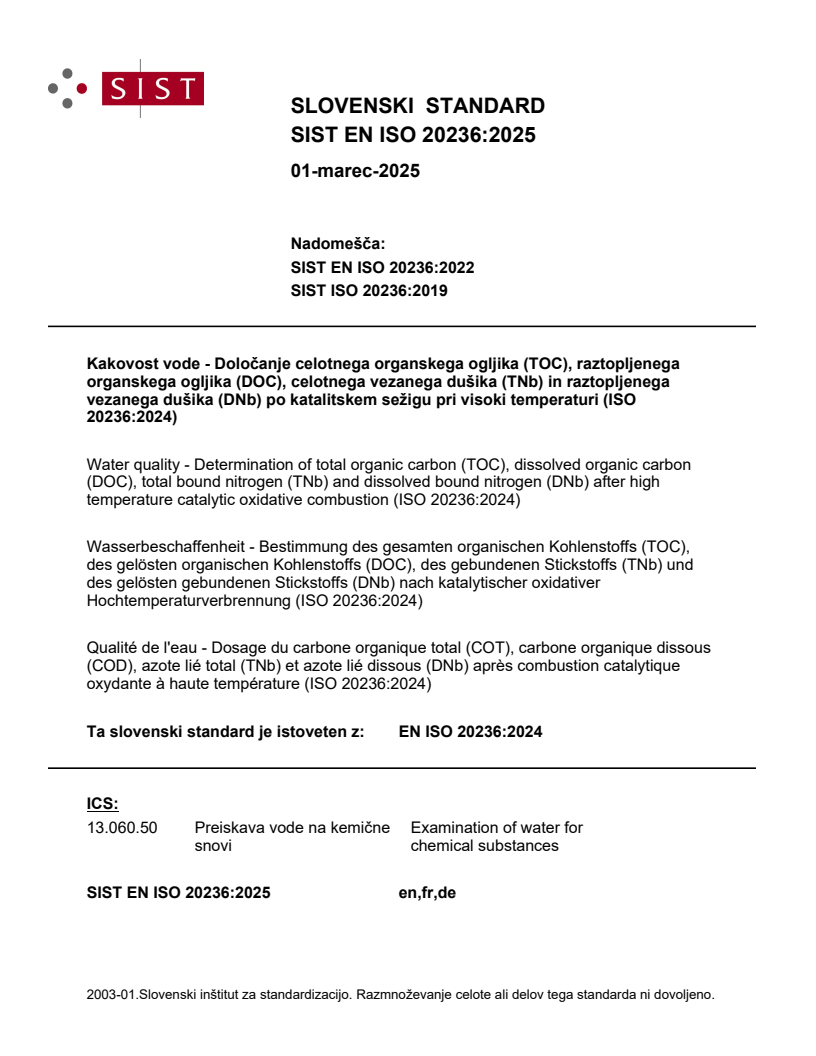
SLOVENSKI STANDARD
01-marec-2025
Nadomešča:
SIST EN ISO 20236:2022
SIST ISO 20236:2019
Kakovost vode - Določanje celotnega organskega ogljika (TOC), raztopljenega
organskega ogljika (DOC), celotnega vezanega dušika (TNb) in raztopljenega
vezanega dušika (DNb) po katalitskem sežigu pri visoki temperaturi (ISO
20236:2024)
Water quality - Determination of total organic carbon (TOC), dissolved organic carbon
(DOC), total bound nitrogen (TNb) and dissolved bound nitrogen (DNb) after high
temperature catalytic oxidative combustion (ISO 20236:2024)
Wasserbeschaffenheit - Bestimmung des gesamten organischen Kohlenstoffs (TOC),
des gelösten organischen Kohlenstoffs (DOC), des gebundenen Stickstoffs (TNb) und
des gelösten gebundenen Stickstoffs (DNb) nach katalytischer oxidativer
Hochtemperaturverbrennung (ISO 20236:2024)
Qualité de l'eau - Dosage du carbone organique total (COT), carbone organique dissous
(COD), azote lié total (TNb) et azote lié dissous (DNb) après combustion catalytique
oxydante à haute température (ISO 20236:2024)
Ta slovenski standard je istoveten z: EN ISO 20236:2024
ICS:
13.060.50 Preiskava vode na kemične Examination of water for
snovi chemical substances
2003-01.Slovenski inštitut za standardizacijo. Razmnoževanje celote ali delov tega standarda ni dovoljeno.
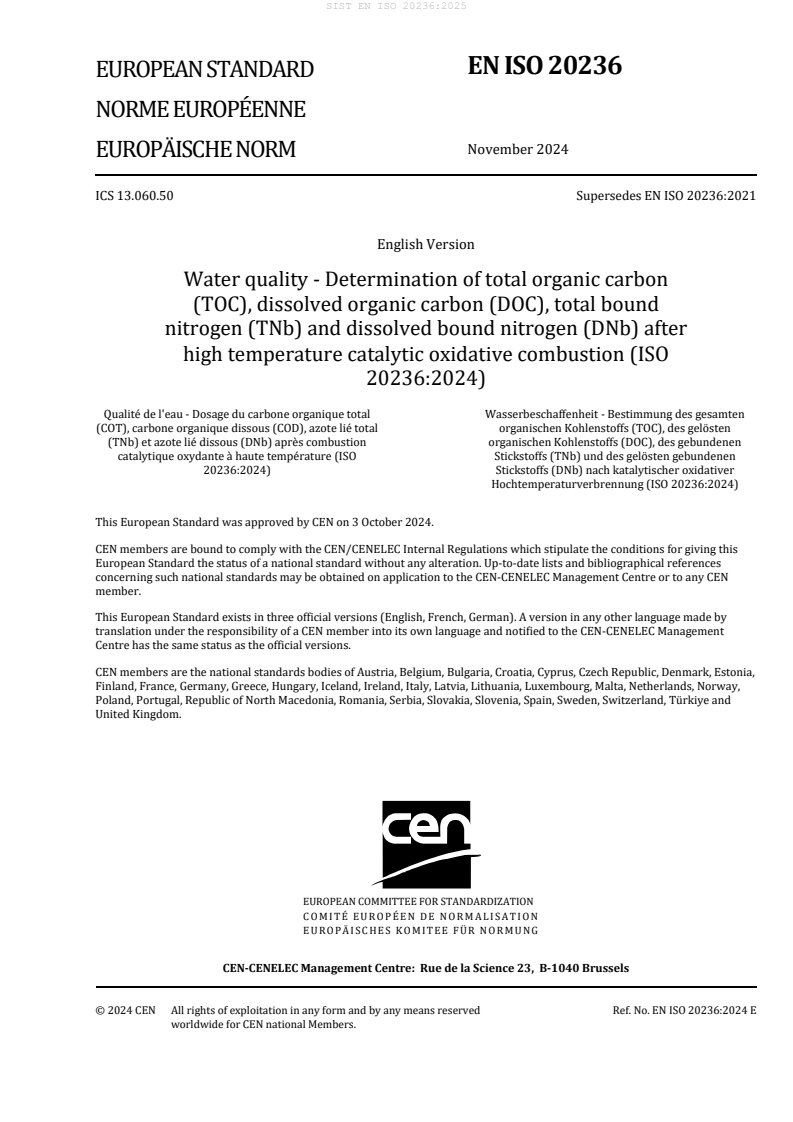
EN ISO 20236
EUROPEAN STANDARD
NORME EUROPÉENNE
November 2024
EUROPÄISCHE NORM
ICS 13.060.50 Supersedes EN ISO 20236:2021
English Version
Water quality - Determination of total organic carbon
(TOC), dissolved organic carbon (DOC), total bound
nitrogen (TNb) and dissolved bound nitrogen (DNb) after
high temperature catalytic oxidative combustion (ISO
20236:2024)
Qualité de l'eau - Dosage du carbone organique total Wasserbeschaffenheit - Bestimmung des gesamten
(COT), carbone organique dissous (COD), azote lié total organischen Kohlenstoffs (TOC), des gelösten
(TNb) et azote lié dissous (DNb) après combustion organischen Kohlenstoffs (DOC), des gebundenen
catalytique oxydante à haute température (ISO Stickstoffs (TNb) und des gelösten gebundenen
20236:2024) Stickstoffs (DNb) nach katalytischer oxidativer
Hochtemperaturverbrennung (ISO 20236:2024)
This European Standard was approved by CEN on 3 October 2024.
CEN members are bound to comply with the CEN/CENELEC Internal Regulations which stipulate the conditions for giving this
European Standard the status of a national standard without any alteration. Up-to-date lists and bibliographical references
concerning such national standards may be obtained on application to the CEN-CENELEC Management Centre or to any CEN
member.
This European Standard exists in three official versions (English, French, German). A version in any other language made by
translation under the responsibility of a CEN member into its own language and notified to the CEN-CENELEC Management
Centre has the same status as the official versions.
CEN members are the national standards bodies of Austria, Belgium, Bulgaria, Croatia, Cyprus, Czech Republic, Denmark, Estonia,
Finland, France, Germany, Greece, Hungary, Iceland, Ireland, Italy, Latvia, Lithuania, Luxembourg, Malta, Netherlands, Norway,
Poland, Portugal, Republic of North Macedonia, Romania, Serbia, Slovakia, Slovenia, Spain, Sweden, Switzerland, Türkiye and
United Kingdom.
EUROPEAN COMMITTEE FOR STANDARDIZATION
COMITÉ EUROPÉEN DE NORMALISATION
EUROPÄISCHES KOMITEE FÜR NORMUNG
CEN-CENELEC Management Centre: Rue de la Science 23, B-1040 Brussels
© 2024 CEN All rights of exploitation in any form and by any means reserved Ref. No. EN ISO 20236:2024 E
worldwide for CEN national Members.
Contents Page
European foreword . 3
European foreword
This document (EN ISO 20236:2024) has been prepared by Technical Committee ISO/TC 147 "Water
quality" in collaboration with Technical Committee CEN/TC 230 “Water analysis” the secretariat of
which is held by DIN.
This European Standard shall be given the status of a national standard, either by publication of an
identical text or by endorsement, at the latest by May 2025, and conflicting national standards shall be
withdrawn at the latest by May 2025.
Attention is drawn to the possibility that some of the elements of this document may be the subject of
patent rights. CEN shall not be held responsible for identifying any or all such patent rights.
This document supersedes EN ISO 20236:2021.
Any feedback and questions on this document should be directed to the users’ national standards
body/national committee. A complete listing of these bodies can be found on the CEN website.
According to the CEN-CENELEC Internal Regulations, the national standards organizations of the
following countries are bound to implement this European Standard: Austria, Belgium, Bulgaria,
Croatia, Cyprus, Czech Republic, Denmark, Estonia, Finland, France, Germany, Greece, Hungary, Iceland,
Ireland, Italy, Latvia, Lithuania, Luxembourg, Malta, Netherlands, Norway, Poland, Portugal, Republic of
North Macedonia, Romania, Serbia, Slovakia, Slovenia, Spain, Sweden, Switzerland, Türkiye and the
United Kingdom.
Endorsement notice
The text of ISO 20236:2024 has been approved by CEN as EN ISO 20236:2024 without any modification.
International
Standard
ISO 20236
Second edition
Water quality — Determination
2024-11
of total organic carbon (TOC),
dissolved organic carbon (DOC),
total bound nitrogen (TNb) and
dissolved bound nitrogen (DNb)
after high temperature catalytic
oxidative combustion
Qualité de l'eau — Dosage du carbone organique total (COT),
carbone organique dissous (COD), azote lié total (TNb) et azote
lié dissous (DNb) après combustion catalytique oxydante à haute
température
Reference number
ISO 20236:2024(en) © ISO 2024
ISO 20236:2024(en)
© ISO 2024
All rights reserved. Unless otherwise specified, or required in the context of its implementation, no part of this publication may
be reproduced or utilized otherwise in any form or by any means, electronic or mechanical, including photocopying, or posting on
the internet or an intranet, without prior written permission. Permission can be requested from either ISO at the address below
or ISO’s member body in the country of the requester.
ISO copyright office
CP 401 • Ch. de Blandonnet 8
CH-1214 Vernier, Geneva
Phone: +41 22 749 01 11
Email: copyright@iso.org
Website: www.iso.org
Published in Switzerland
ii
ISO 20236:2024(en)
Contents Page
Foreword .iv
Introduction .v
1 Scope . 1
2 Normative references . 1
3 Terms and definitions . 1
4 Principle . 3
5 Interferences . 3
5.1 General .3
5.2 TOC or DOC .4
5.3 TNb or DNb .4
6 Reagents . 4
7 Apparatus . 7
8 Quality requirements for the analytical system. 8
8.1 System check .8
8.2 Particle processing control . .8
9 Sampling and sample preparation . 9
10 Procedure . 9
10.1 General .9
10.2 Calibration .10
10.3 Validity check of the calibration function .10
10.4 Measurement .10
10.4.1 General .10
10.4.2 Determination .10
11 E v a luat ion .12
12 Expression of results .12
13 Test report .12
Annex A (normative) Determination of TOC applying the difference method .13
Annex B (informative) Performance data for TOC or DOC, and TNb or DNb .16
Annex C (informative) Alternative detection techniques for TNb and DNb .18
Bibliography . 19
iii
ISO 20236:2024(en)
Foreword
ISO (the International Organization for Standardization) is a worldwide federation of national standards
bodies (ISO member bodies). The work of preparing International Standards is normally carried out through
ISO technical committees. Each member body interested in a subject for which a technical committee
has been established has the right to be represented on that committee. International organizations,
governmental and non-governmental, in liaison with ISO, also take part in the work. ISO collaborates closely
with the International Electrotechnical Commission (IEC) on all matters of electrotechnical standardization.
The procedures used to develop this document and those intended for its further maintenance are described
in the ISO/IEC Directives, Part 1. In particular, the different approval criteria needed for the different types
of ISO documents should be noted. This document was drafted in accordance with the editorial rules of the
ISO/IEC Directives, Part 2 (see www.iso.org/directives).
ISO draws attention to the possibility that the implementation of this document may involve the use of (a)
patent(s). ISO takes no position concerning the evidence, validity or applicability of any claimed patent
rights in respect thereof. As of the date of publication of this document, ISO had not received notice of (a)
patent(s) which may be required to implement this document. However, implementers are cautioned that
this may not represent the latest information, which may be obtained from the patent database available at
www.iso.org/patents. ISO shall not be held responsible for identifying any or all such patent rights.
Any trade name used in this document is information given for the convenience of users and does not
constitute an endorsement.
For an explanation of the voluntary nature of standards, the meaning of ISO specific terms and expressions
related to conformity assessment, as well as information about ISO's adherence to the World Trade
Organization (WTO) principles in the Technical Barriers to Trade (TBT), see www.iso.org/iso/foreword.html.
This document was prepared by Technical Committee ISO/TC 147, Water quality, Subcommittee SC 2, Physical,
chemical and biochemical methods, in collaboration with the European Committee for Standardization
(CEN) Technical Committee CEN/TC 230, Water analysis, in accordance with the Agreement on technical
cooperation between ISO and CEN (Vienna Agreement).
This second edition cancels and replaces the first edition (ISO 20236:2018), which has been technically
revised.
The main changes are as follows:
— the method to determine concentrations <1 mg/l of C and N has been expanded;
— the normative references have been updated;
— the method to apply single component standard calibration solutions e.g. based on as ammonium sulfate
or potassium nitrate, has been expanded;
— Clause A.5 has been added in order to require referencing the difference methods with the results report.
Any feedback or questions on this document should be directed to the user’s national standards body. A
complete listing of these bodies can be found at www.iso.org/members.html.
iv
ISO 20236:2024(en)
Introduction
Total organic carbon (TOC), dissolved organic carbon (DOC), total bound nitrogen (TNb) and dissolved
bound nitrogen (DNb) are an analytical convention, whose characteristic is a parameter used for water
quality control purposes. These parameters represent the sum of organically bound carbon as well as the
sum of inorganic and organic nitrogen (but not nitrogen gas), which can be dissolved in water or bonded
to dissolved or suspended matter under specified conditions and, if the sample is not filtered, includes
that associated with suspended matter. It does not give information on the nature of the substances. The
abbreviations TOC, DOC, TNb, DNb, TC and TIC refer to values determined by the high temperature method.
Details of a validation interlaboratory trial with the performance data for TOC or DOC and TNb or DNb, all
using the high temperature method in this document, are given in Annex B.
v
International Standard ISO 20236:2024(en)
Water quality — Determination of total organic carbon (TOC),
dissolved organic carbon (DOC), total bound nitrogen (TNb)
and dissolved bound nitrogen (DNb) after high temperature
catalytic oxidative combustion
WARNING — Persons using this document should be familiar with normal laboratory practice. This
document does not purport to address all of the safety problems, if any, associated with its use. It is
the responsibility of the user to establish appropriate safety and health practices.
IMPORTANT — It is absolutely essential that tests conducted in accordance with this document be
carried out by suitably qualified staff.
1 Scope
This document specifies a method to determine the total organic carbon (TOC), dissolved organic carbon
(DOC), total bound nitrogen (TNb) and dissolved bound nitrogen (DNb) in the form of free ammonia,
ammonium, nitrite, nitrate and organic compounds capable of conversion to nitrogen oxides.
Cyanide, cyanate and particles of elemental carbon (soot), when present in the sample, can be determined
together with the organic carbon.
Dissolved nitrogen gas (N ) is not determined.
NOTE Generally, the method can be applied for the determination of total carbon (TC) and total inorganic carbon
(TIC) – see Annex A.
The method is applicable to water samples (e.g. drinking water, raw water, ground water, surface water, sea
water, waste water, leachates).
This document is applicable to determination of TOC and DOC ≥1 mg/l and TNb and DNb ≥1 mg/l. The
upper working range is restricted by instrument-dependent conditions (e.g. injection volume). Higher
concentrations can be determined after appropriate dilution of the sample. The determination of
concentrations <1 mg/l is dependent on instrument conditions applying appropriate calibration.
For samples containing volatile organic compounds (e.g. industrial waste water), the application of the
difference method can be considered – see Annex A.
The procedure is carried out by automated analysis.
2 Normative references
The following documents are referred to in the text in such a way that some or all of their content constitutes
requirements of this document. For dated references, only the edition cited applies. For undated references,
the latest edition of the referenced document (including any amendments) applies.
ISO 8466-1, Water quality — Calibration and evaluation of analytical methods — Part 1: Linear calibration
function
3 Terms and definitions
For the purposes of this document, the following terms and definitions apply.
ISO 20236:2024(en)
ISO and IEC maintain terminology databases for use in standardization at the following addresses:
— ISO Online browsing platform: available at https:// www .iso .org/ obp
— IEC Electropedia: available at https:// www .electropedia .org/
3.1
total carbon
TC
sum of measured organically and inorganically bound carbon present in water, including elemental carbon
Note 1 to entry: The total carbon is defined as measured under the conditions of the method described in this
document.
3.2
total inorganic carbon
TIC
sum of measured inorganic carbon present in water
Note 1 to entry: The total inorganic carbon is defined as measured under the conditions of the method described in
this document.
Note 2 to entry: The total inorganic carbon is measured as CO originating only from carbonates, hydrogen carbonates
and dissolved carbon dioxide.
3.3
total organic carbon
TOC
sum of measured organically bound carbon present in water, bonded to dissolved or suspended matter,
including cyanate, thiocyanate and elemental carbon
Note 1 to entry: The total organic carbon is defined as measured under the conditions of the method described in this
document.
Note 2 to entry: Volatile organic carbon cannot be guaranteed to be determined by the method.
Note 3 to entry: Generally, total organic carbon includes organic compounds in water that cannot be purged under the
conditions of this method, also known as non-purgeable organic carbon (NPOC).
3.4
dissolved organic carbon
DOC
sum of measured organically bound carbon present in water originating from compounds passing through a
membrane filter of 0,45 µm pore size, including cyanate and thiocyanate
Note 1 to entry: The dissolved organic carbon is defined as measured under the conditions of the method described in
this document.
3.5
total bound nitrogen
TNb
sum of measured organically bound and inorganically bound nitrogen present in water or suspended matter
Note 1 to entry: The total bound nitrogen is defined as measured under the conditions of the method described in this
document.
ISO 20236:2024(en)
3.6
dissolved bound nitrogen
DNb
sum of measured organically and inorganically bound nitrogen present in water originating from compounds
passing through a 0,45 µm membrane filter
Note 1 to entry: The dissolved bound nitrogen is defined as measured under the conditions of the method described in
this document.
3.7
chemiluminescence
emission of light by an atom or molecule that is in an excited state as the result of a chemical reaction
4 Principle
Thermal catalytic combustion of organic carbon, and inorganic and organic nitrogen in an oxygen-containing
atmosphere is done at ≥680 °C to determine TOC or DOC and at ≥720 °C to determine TNb or DNb.
The TOC or DOC determination is carried out according to the direct measurement method.
Prior to combustion, remove inorganic carbon by acidification and purging with a carrier gas (6.7).
NOTE Platinum and cerium(IV), for example, can be used as catalyst material for combustion. The catalyst
serves to accelerate the oxidation process of carbon containing water constituents in excess of oxygen to produce the
required carbon dioxide gas for the detection process. Depending on combustion temperature and temperatures in
the combustion zone, different catalysts can be used, e.g. metals or metal oxides for temperatures ≥680 °C or sintered
alumina for temperatures around 1 200 °C, according to specifications of different suppliers.
The oxidation of organic carbon (TOC and DOC) present in the sample to carbon dioxide is carried out with
oxygen or synthetic air followed by the detection of the formed CO by means of infrared (IR) spectrometry.
The combustion and conversion of inorganic and organic nitrogen present in the sample to nitric oxide is
carried out with oxygen or synthetic air. The reaction with ozone gives electronically excited nitrogen oxides
(NO). The detection of the formed NO is carried out by a chemiluminescence detector (CLD). See Annex C for
alternative detection techniques.
This document can be applied for the determination of TOC or DOC and TNb or DNb separately or for
simultaneous TOC or DOC and TNb or DNb determinations, for example connecting the IR detector with a
chemiluminescence detector in series.
Quality control is necessary to check the validity of the calibration function (see 10.3). Repeating sample
measurement can be necessary. The method of standard addition can be required if matrix interferences are
expected (see 5.3 and 10.4.2.1).
5 Interferences
5.1 General
Interferences with the determination of TOC or DOC and TNb or DNb can arise from memory effects.
Replicate injections are necessary (see 10.4.1).
Detergents, oils and fats can influence the surface tension of the sample, causing erroneous data. A dilution
of the sample can reduce such risk.
Samples with extreme pH values, highly buffered samples and samples with high salt contents can cause
interference. Seek advice from the instrument manufacturer to solve these interferences.
Suspended material can lead to a loss of quality of the analytical result. If a homogenized sample containing
suspended material produces results obtained from injections of independent aliquots in different vials that
deviate by more than 10 %, an accurate TOC or TNb result cannot be obtained on the sample (see Annex B).
ISO 20236:2024(en)
5.2 TOC or DOC
Inorganic carbon (e.g. CO or ions of carbonic acid) present in the sample interferes with the determination
of TOC or DOC. Inorganic carbon is removed by acidification and purging with a gas that is free from CO and
organic compounds prior to TOC or DOC determination (see 10.4.2.2 and 10.4.2.3).
NOTE 1 Alternatively, the differential method determining the TC and TIC separately can be applied (see Annex A).
The TOC can be calculated by subtracting TIC from TC. This calculation leads to correct results only as long as carbon
monoxide, cyanide, cyanate and thiocyanate are present in negligible concentrations.
NOTE 2 Purgeable organic carbon substances, such as benzene, toluene, cyclohexane and chloroform, can partly
escape upon stripping (see 10.4.2.2 and 10.4.2.3). In the presence of these substances, the TOC concentration can be
determined separately, for example, by applying the differential method (see Annex A).
5.3 TNb or DNb
High loads of DOC or TOC can lead to poor recovery of TNb or DNb. Suspected problems can be identified by
determining the nitrogen before and after suitable dilution, or by using standard addition techniques.
NOTE The phrase “high loads” cannot be quantified as it generally depends on, for example, sample matrix
properties, equipment applied or working range chosen.
Not all organic nitrogen compounds are quantitatively converted to nitrogen oxide by the combustion
procedure described, and consequently to nitrogen dioxide by the reaction with ozone. Poor recoveries can
occur with compounds containing either double- or triple-bonded nitrogen atoms. The use of a calibration
function calculated according to 10.2 and applying a nitrogen mixed standard solution II (6.9.3.4) can
result in a TNb bias for ammonium-N determinations (e.g. ammonium sulfate solution) and for nitrate-N
determinations (e.g. potassium nitrate solution). In this case, a single standard (ammonium sulfate or
potassium nitrate) can be used.
The use of sulfuric acid for sample preservation or acidification can lead to reduced TNb or DNb results
when the calibration standards are not acidified in the same way as the samples.
6 Reagents
Use reagents of pro analysis grade, if available.
Dry all solid reagents for at least 1 h at (105 ± 5) °C. Store the dried solid in a desiccator before weighing.
NOTE It is not necessary to dry cellulose before usage.
Prepare alternative concentrations and volumes of solutions as described hereafter, if necessary.
Alternatively, use commercially available stock solutions of the required concentration.
When applying the simultaneous determination of TNb and TOC, the stock solution (6.5) or an appropriate
mixture of the 1 000 mg/l TOC and TNb stock solutions (6.5 or 6.8.2 with 6.9.3.1 or 6.9.3.2 or 6.9.3.3) for the
preparation of standard, calibration and system check solutions can be used.
6.1 Water.
The contents of carbon and bound nitrogen in water used for the preparation of samples and solutions
shall be sufficiently low to be negligible in comparison with the lowest TOC and TNb concentration to be
determined.
6.2 Sulfuric acid, (H SO ) ρ = 1,84 g/ml.
2 4
6.3 Hydrochloric acid, (HCl) ω = 30 % to 32 %.
6.4 Nicotinic acid, (C H NO ), >99,5 %.
6 5 2
ISO 20236:2024(en)
6.5 TOC and TNb stock solution for system check.
Place 8,793 g of nicotinic acid (6.4) in a 1 000 ml volumetric flask. Dissolve and dilute to volume with water (6.1).
The solution contains 5 147 mg/l of carbon and 1 000 mg/l of nitrogen.
The solution is stable for six months if stored at (3 ± 2) °C.
6.6 Blank solution.
Fill a 100 ml volumetric flask with water (6.1).
6.7 Oxygen or synthetic air, free from impurities (e.g. carbon dioxide, organic carbon, nitrogen
compounds) with influence of the determinant.
Use gases in accordance with the manufacturer’s specifications, e.g. a volume fraction of oxygen of 99,7 %.
6.8 Reagents for the TOC or DOC determination.
6.8.1 Potassium hydrogen phthalate, C H KO .
8 5 4
6.8.2 Potassium hydrogen phtha
...