


SIST EN 17712:2025
(Main)Plant biostimulants - Detection of Staphylococcus aureus
Plant biostimulants - Detection of Staphylococcus aureus
This document specifies a method to verify that the pathogen Staphylococcus aureus is absent from microbial plant biostimulants. The method is based on the enumeration of coagulase-positive staphylococci in a sample by counting of colonies obtained on a solid medium (Baird-Parker medium) after aerobic incubation at 36 °C ± 2 °C.
This document is applicable to all formulations of microbial plant biostimulants in liquid or solid form. This document is not applicable to other fertilizing products.
This document is applicable to the blends of fertilizing products where a blend is a mix of at least two of the following component EU fertilising products categories: Fertilizers, Liming Materials, Soil Improvers, Growing Media, Plant Biostimulants and where the following category Plant Biostimulants is the highest % in the blend by mass or volume, or in the case of liquid form by dry mass. If Plant Biostimulants is not the highest % in the blend, the European Standard for the highest % of the blend applies. In case a blend of fertilizing products is composed of components in equal quantity or in case the component EU fertilising products used for the blend have identical formulations , the user decides which standard to apply.
Pflanzen-Biostimulanzien - Nachweis von Staphylococcus aureus
Dieses Dokument legt ein Verfahren fest, mit dem verifiziert werden kann, dass das Pathogen Staphylococcus aureus in mikrobiellen Pflanzen-Biostimulanzien nicht vorhanden ist. Das Verfahren beruht auf der Zählung von koagulase-positiven Staphylokokken in einer Probe durch Zählung der Kolonien, die auf einem festen Medium (Baird-Parker-Medium) nach aerober Bebrütung bei (36 ± 2) °C erhalten werden.
Dieses Dokument ist anwendbar für alle Formulierungen von mikrobiellen Pflanzen-Biostimulanzien in flüssiger oder fester Form. Dieses Dokument ist für andere Düngeprodukte nicht anwendbar.
Dieses Dokument ist für die Mischungen von Düngeprodukten anwendbar, in denen eine Mischung aus mindestens zwei der folgenden Kategorien von Komponenten-EU Düngeprodukten besteht: Düngemittel, Kalkdünger, Bodenverbesserungsmittel, Kultursubstrate, Pflanzen-Biostimulanzien und wenn die folgende Kategorie Pflanzen-Biostimulanzien prozentual den höchsten Massen- oder Volumenanteil in der Mischung bzw., bei flüssiger Form, den höchsten Trockenmasseanteil aufweist. Wenn Pflanzen-Biostimulanzien nicht den höchsten prozentualen Anteil in der Mischung ausmachen, ist die für den höchsten prozentualen Anteil geltende Europäische Norm anwendbar. Falls eine Düngemittelmischung aus Komponenten gleicher Menge besteht oder falls die für die Mischung verwendeten Komponenten-EU Düngeprodukte identische Formulierungen haben, entscheidet der Anwender, welche Norm angewendet wird.
Biostimulants des végétaux - Recherche de Staphylococcus aureus
Le présent document spécifie une méthode pour vérifier que le pathogène Staphylococcus aureus est absent dans les biostimulants microbiens des végétaux. La méthode repose sur le dénombrement des staphylocoques à coagulase positive dans un échantillon en comptant les colonies obtenues sur un milieu solide (milieu de Baird-Parker) après incubation aérobie à 36 °C ± 2 °C.
Le présent document est applicable à toutes les formulations de biostimulants microbiens des végétaux sous forme liquide ou solide. Le présent document n’est pas applicable aux autres fertilisants.
Le présent document est applicable aux mélanges de fertilisants constitués d’au moins deux composants appartenant aux catégories de fertilisants UE suivantes : engrais, amendements minéraux basiques, amendements du sol, supports de culture, biostimulants des végétaux et, dans lesquels la catégorie Biostimulants des végétaux représente le % le plus élevé du mélange en masse ou en volume, ou dans le cas d’un liquide, en masse sèche. Si les biostimulants des végétaux ne représentent pas le % le plus élevé du mélange, la Norme européenne relative au composant représentant le % le plus élevé du mélange s’applique. Dans le cas où un mélange de fertilisants contient des composants en quantité égale ou dans le cas où les composants des fertilisants UE utilisés pour le mélange ont des formulations identiques, l’utilisateur décide quelle norme appliquer.
Rastlinski biostimulanti - Ugotavljanje prisotnosti Staphylococcus aureus
Ta dokument določa metodo, s katero se preverja neprisotnost patogena Staphylococcus aureus v rastlinskih biostimulantih. Metoda temelji na ugotavljanju števila koagulazno pozitivnih stafilokokov v vzorcu s štetjem kolonij, pridobljenih v trdnem gojišču (Baird-Parkerjevo gojišče) po aerobni inkubaciji pri temperaturi 36 °C ± 2 °C.
Ta dokument se uporablja za vse formulacije mikrobnih rastlinskih biostimulantov v tekočem ali trdnem stanju.
Ta dokument se ne uporablja za druga sredstva za gnojenje.
Ta dokument se uporablja za mešanice sredstev za gnojenje, ki vsebujejo najmanj dve od naslednjih kategorij sredstev za gnojenje EU: gnojila, sredstva za apnenje, izboljševalci tal, rastni substrati in rastlinski biostimulanti, pri čemer rastlinski biostimulanti predstavljajo največji masni ali prostorninski odstotek mešanice ali, v primeru tekoče oblike, odstotek suhe mase. Če rastlinski biostimulanti ne predstavljajo največjega odstotka v mešanici, se uporablja evropski standard za največji odstotek mešanice. Če vsebuje mešanica sredstev za gnojenje sestavine v enakih količinah ali če imajo posamezna sredstva za gnojenje EU, uporabljena za mešanico, enake formulacije1, standard za uporabo izbere uporabnik.
General Information
- Status
- Published
- Public Enquiry End Date
- 02-Jun-2023
- Publication Date
- 06-Jan-2025
- Technical Committee
- KAT - Soil quality
- Current Stage
- 6060 - National Implementation/Publication (Adopted Project)
- Start Date
- 20-Dec-2024
- Due Date
- 24-Feb-2025
- Completion Date
- 07-Jan-2025
Relations
- Effective Date
- 01-Feb-2025
Overview
EN 17712:2024 - "Plant biostimulants - Detection of Staphylococcus aureus" (CEN) specifies a microbiological method to verify the absence of Staphylococcus aureus in microbial plant biostimulants. The standard defines a presence/absence test on a representative 25 g or 25 ml sample by selective enrichment and plating, suitable for all liquid and solid formulations of microbial plant biostimulants and certain blends where biostimulants are the dominant component.
Key search terms: EN 17712:2024, plant biostimulants, Staphylococcus aureus detection, microbial safety, EU fertilising products regulation.
Key topics and technical requirements
- Test principle: selective enrichment in modified Giolitti‑Cantoni broth followed by isolation on Baird‑Parker Rabbit Plasma Fibrinogen (RPF) agar.
- Incubation conditions: aerobic incubation of plates at 36 °C ± 2 °C, examined after 24 h (and 48 h if necessary); enrichment incubations at 36 °C ± 2 °C for 24 h and 48 h.
- Target organisms: enumeration and identification of coagulase‑positive staphylococci, with colony morphology and coagulase/RPF reactions used to confirm S. aureus.
- Result reporting: expressed as presence or absence of S. aureus in 25 g / 25 ml of sample.
- Scope limits: applicable only to microbial plant biostimulants (liquid and solid) and relevant blends; not applicable to other fertilizing products.
- Supporting material: composition and preparation of media and reagents are provided in Annex A; method performance characteristics (sensitivity, specificity, PPV/NPV, interlaboratory data) are covered in Clause 13 and Annex B.
- Laboratory practice: follows general microbiology guidance (EN ISO 7218:2024) and recommends media performance testing comparable to EN ISO 11133.
Practical applications
- Quality control and product release: routine microbiological testing of biostimulant batches to ensure safety and market readiness.
- Regulatory compliance: supports conformity with Regulation (EU) 2019/1009 for EU fertilising products (see Annex ZA).
- Risk management: screening for pathogenic contamination during manufacturing, storage and formulation of microbial biostimulants.
- Research and development: validating formulation changes or production processes to avoid S. aureus contamination.
Who should use this standard
- Microbiology laboratories performing product testing
- Biostimulant manufacturers and QA/QC teams
- Certification bodies and notified bodies assessing compliance with EU fertilising products regulation
- R&D and regulatory affairs professionals in agritech and fertilizer industries
Related standards
- EN ISO 7218:2024 - Microbiology of the food chain: general guidance
- EN 17702‑1:2024 - Sampling and sample preparation (Plant biostimulants)
- EN 17708:2024 - Preparation of sample for microbial analysis
- EN 17724:2024 - Terminology; plus references to EN ISO 11133 (media performance) and Annex ZA (Regulation (EU) 2019/1009)
Using EN 17712:2024 helps ensure reliable, standardized detection of S. aureus in plant biostimulants, supporting product safety, regulatory conformity, and market confidence.

Frequently Asked Questions
SIST EN 17712:2025 is a standard published by the Slovenian Institute for Standardization (SIST). Its full title is "Plant biostimulants - Detection of Staphylococcus aureus". This standard covers: This document specifies a method to verify that the pathogen Staphylococcus aureus is absent from microbial plant biostimulants. The method is based on the enumeration of coagulase-positive staphylococci in a sample by counting of colonies obtained on a solid medium (Baird-Parker medium) after aerobic incubation at 36 °C ± 2 °C. This document is applicable to all formulations of microbial plant biostimulants in liquid or solid form. This document is not applicable to other fertilizing products. This document is applicable to the blends of fertilizing products where a blend is a mix of at least two of the following component EU fertilising products categories: Fertilizers, Liming Materials, Soil Improvers, Growing Media, Plant Biostimulants and where the following category Plant Biostimulants is the highest % in the blend by mass or volume, or in the case of liquid form by dry mass. If Plant Biostimulants is not the highest % in the blend, the European Standard for the highest % of the blend applies. In case a blend of fertilizing products is composed of components in equal quantity or in case the component EU fertilising products used for the blend have identical formulations , the user decides which standard to apply.
This document specifies a method to verify that the pathogen Staphylococcus aureus is absent from microbial plant biostimulants. The method is based on the enumeration of coagulase-positive staphylococci in a sample by counting of colonies obtained on a solid medium (Baird-Parker medium) after aerobic incubation at 36 °C ± 2 °C. This document is applicable to all formulations of microbial plant biostimulants in liquid or solid form. This document is not applicable to other fertilizing products. This document is applicable to the blends of fertilizing products where a blend is a mix of at least two of the following component EU fertilising products categories: Fertilizers, Liming Materials, Soil Improvers, Growing Media, Plant Biostimulants and where the following category Plant Biostimulants is the highest % in the blend by mass or volume, or in the case of liquid form by dry mass. If Plant Biostimulants is not the highest % in the blend, the European Standard for the highest % of the blend applies. In case a blend of fertilizing products is composed of components in equal quantity or in case the component EU fertilising products used for the blend have identical formulations , the user decides which standard to apply.
SIST EN 17712:2025 is classified under the following ICS (International Classification for Standards) categories: 65.080 - Fertilizers. The ICS classification helps identify the subject area and facilitates finding related standards.
SIST EN 17712:2025 has the following relationships with other standards: It is inter standard links to SIST-TS CEN/TS 17712:2023. Understanding these relationships helps ensure you are using the most current and applicable version of the standard.
SIST EN 17712:2025 is associated with the following European legislation: EU Directives/Regulations: 2019/1009; Standardization Mandates: M/564, M/564 AMD 1, M/XXX. When a standard is cited in the Official Journal of the European Union, products manufactured in conformity with it benefit from a presumption of conformity with the essential requirements of the corresponding EU directive or regulation.
SIST EN 17712:2025 is available in PDF format for immediate download after purchase. The document can be added to your cart and obtained through the secure checkout process. Digital delivery ensures instant access to the complete standard document.
Standards Content (Sample)
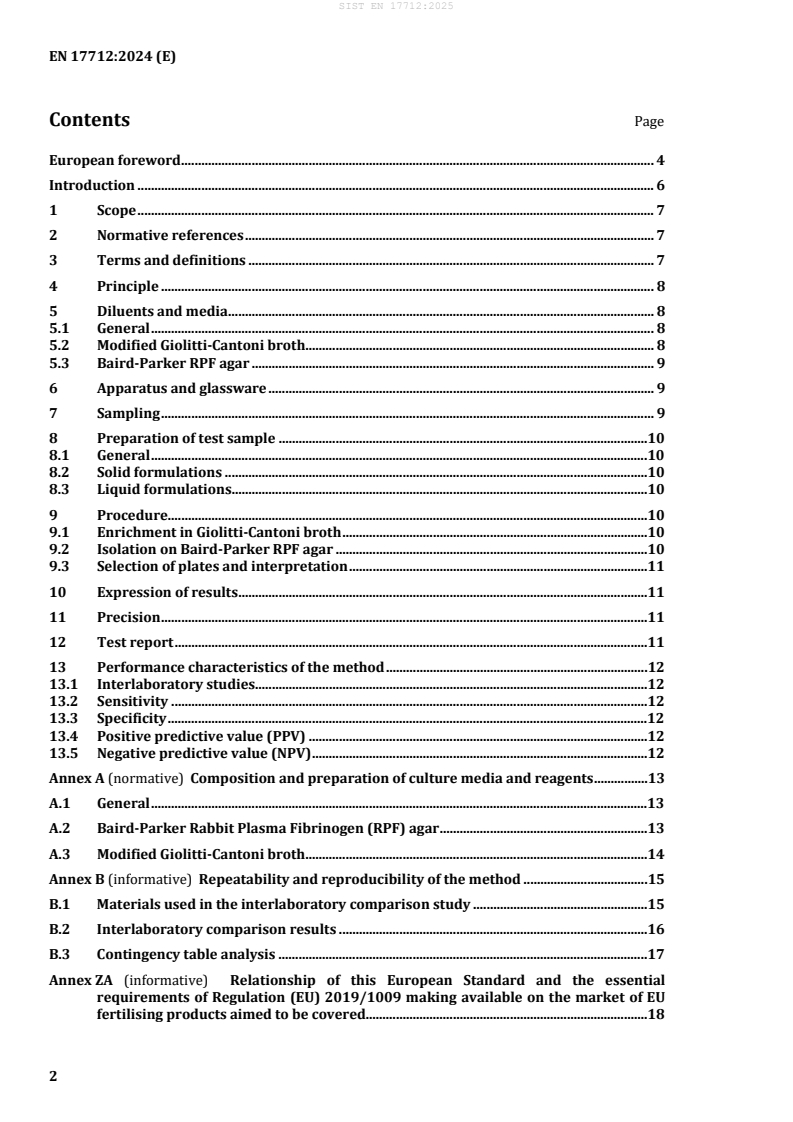
SLOVENSKI STANDARD
01-februar-2025
Nadomešča:
SIST-TS CEN/TS 17712:2023
Rastlinski biostimulanti - Ugotavljanje prisotnosti Staphylococcus aureus
Plant biostimulants - Detection of Staphylococcus aureus
Pflanzen-Biostimulanzien - Nachweis von Staphylococcus aureus
Biostimulants des végétaux - Recherche de Staphylococcus aureus
Ta slovenski standard je istoveten z: EN 17712:2024
ICS:
65.080 Gnojila Fertilizers
2003-01.Slovenski inštitut za standardizacijo. Razmnoževanje celote ali delov tega standarda ni dovoljeno.
EN 17712
EUROPEAN STANDARD
NORME EUROPÉENNE
November 2024
EUROPÄISCHE NORM
ICS 65.080 Supersedes CEN/TS 17712:2022
English Version
Plant biostimulants - Detection of Staphylococcus aureus
Biostimulants des végétaux - Recherche de Pflanzen-Biostimulanzien - Nachweis von
Staphylococcus aureus Staphylococcus aureus
This European Standard was approved by CEN on 26 August 2024.
CEN members are bound to comply with the CEN/CENELEC Internal Regulations which stipulate the conditions for giving this
European Standard the status of a national standard without any alteration. Up-to-date lists and bibliographical references
concerning such national standards may be obtained on application to the CEN-CENELEC Management Centre or to any CEN
member.
This European Standard exists in three official versions (English, French, German). A version in any other language made by
translation under the responsibility of a CEN member into its own language and notified to the CEN-CENELEC Management
Centre has the same status as the official versions.
CEN members are the national standards bodies of Austria, Belgium, Bulgaria, Croatia, Cyprus, Czech Republic, Denmark, Estonia,
Finland, France, Germany, Greece, Hungary, Iceland, Ireland, Italy, Latvia, Lithuania, Luxembourg, Malta, Netherlands, Norway,
Poland, Portugal, Republic of North Macedonia, Romania, Serbia, Slovakia, Slovenia, Spain, Sweden, Switzerland, Türkiye and
United Kingdom.
EUROPEAN COMMITTEE FOR STANDARDIZATION
COMITÉ EUROPÉEN DE NORMALIS A T IO N
EUROPÄISCHES KOMITEE FÜR NORMUN G
CEN-CENELEC Management Centre: Rue de la Science 23, B-1040 Brussels
© 2024 CEN All rights of exploitation in any form and by any means reserved Ref. No. EN 17712:2024 E
worldwide for CEN national Members.
Contents Page
European foreword . 4
Introduction . 6
1 Scope . 7
2 Normative references . 7
3 Terms and definitions . 7
4 Principle . 8
5 Diluents and media . 8
5.1 General . 8
5.2 Modified Giolitti-Cantoni broth. 8
5.3 Baird-Parker RPF agar . 9
6 Apparatus and glassware . 9
7 Sampling . 9
8 Preparation of test sample .10
8.1 General .10
8.2 Solid formulations .10
8.3 Liquid formulations.10
9 Procedure.10
9.1 Enrichment in Giolitti-Cantoni broth .10
9.2 Isolation on Baird-Parker RPF agar .10
9.3 Selection of plates and interpretation .11
10 Expression of results .11
11 Precision .11
12 Test report .11
13 Performance characteristics of the method .12
13.1 Interlaboratory studies .12
13.2 Sensitivity .12
13.3 Specificity .12
13.4 Positive predictive value (PPV) .12
13.5 Negative predictive value (NPV) .12
Annex A (normative) Composition and preparation of culture media and reagents .13
A.1 General .13
A.2 Baird-Parker Rabbit Plasma Fibrinogen (RPF) agar .13
A.3 Modified Giolitti-Cantoni broth.14
Annex B (informative) Repeatability and reproducibility of the method .15
B.1 Materials used in the interlaboratory comparison study .15
B.2 Interlaboratory comparison results .16
B.3 Contingency table analysis .17
Annex ZA (informative) Relationship of this European Standard and the essential
requirements of Regulation (EU) 2019/1009 making available on the market of EU
fertilising products aimed to be covered.18
Bibliography . 19
European foreword
This document (EN 17712:2024) has been prepared by Technical Committee CEN/TC 455 “Plant
biostimulants”, the secretariat of which is held by AFNOR.
This European Standard shall be given the status of a national standard, either by publication of an
identical text or by endorsement, at the latest by May 2025, and conflicting national standards shall be
withdrawn at the latest by May 2025.
Attention is drawn to the possibility that some of the elements of this document may be the subject of
patent rights. CEN shall not be held responsible for identifying any or all such patent rights.
This document supersedes CEN/TS 17712:2022.
— the European foreword, Introduction and Scope have been updated for consistency with other
standards;
— normative references have been updated;
— in Clause 3, the definitions have been revised;
— in Clause 7 and Clause 8, the sampling instructions have been replaced by the relevant normative
reference;
— in Clause 8, the sample preparation instructions have been updated in line with comments received;
— in Clause 9, the procedure has been clarified and references to the media and apparatus required
have been added;
— a new Clause 10 has been added to specify how the results of the test should be expressed;
— in Clause 12, new elements have been added to the test report requirements;
— Annexes A and B have been revised for consistency with other standards;
— Annex ZA has been added.
This document has been prepared under a standardization request addressed to CEN by the European
Commission. The Standing Committee of the EFTA States subsequently approves these requests for its
Member States.
For the relationship with EU Legislation, see informative Annex ZA, which is an integral part of this
document.
Any feedback and questions on this document should be directed to the users’ national standards body.
A complete listing of these bodies can be found on the CEN website.
According to the CEN-CENELEC Internal Regulations, the national standards organisations of the
following countries are bound to implement this European Standard: Austria, Belgium, Bulgaria, Croatia,
Cyprus, Czech Republic, Denmark, Estonia, Finland, France, Germany, Greece, Hungary, Iceland, Ireland,
Italy, Latvia, Lithuania, Luxembourg, Malta, Netherlands, Norway, Poland, Portugal, Republic of North
Macedonia, Romania, Serbia, Slovakia, Slovenia, Spain, Sweden, Switzerland, Türkiye and the United
Kingdom.
Introduction
The European Committee for Standardization (CEN) was requested by the European Commission (EC) to
draft European Standards or European Standardization deliverables to support the implementation of
Regulation (EU) 2019/1009 of 5 June 2019 [1] laying down rules on the making available on the market
of EU fertilising products (“FPR” or “Fertilising Products Regulation”).
This standardization request, presented as SR M/564 and relevant amendments, also contributes to the
Communication on “Innovating for Sustainable Growth: A Bio economy for Europe”. The interest in plant
biostimulants has increased significantly in Europe as a valuable tool to use in agriculture.
Standardization was identified as having an important role in order to promote the use of biostimulants.
The work of CEN/TC 455 seeks to improve the reliability of the supply chain, thereby improving the
confidence of farmers, industry, and consumers in biostimulants, and will promote and support
commercialisation of the European biostimulant industry.
WARNING — Persons using this document should be familiar with normal laboratory practice. This
document does not purport to address all of the safety problems, if any, associated with its use. It is the
responsibility of the user to establish appropriate safety and health practices and to ensure compliance
with any national regulatory conditions.
IMPORTANT — It is absolutely essential that tests conducted in accordance with this document be
carried out by suitably trained staff.
1 Scope
This document specifies a method to verify that the pathogen Staphylococcus aureus is absent from
microbial plant biostimulants. The method is based on the enumeration of coagulase-positive
staphylococci in a sample by counting of colonies obtained on a solid medium (Baird-Parker medium)
after aerobic incubation at 36 °C ± 2 °C.
This document is applicable to all formulations of microbial plant biostimulants in liquid or solid form.
This document is not applicable to other fertilizing products.
This document is applicable to the blends of fertilizing products where a blend is a mix of at least two of
the following component EU fertilising products categories: Fertilizers, Liming Materials, Soil Improvers,
Growing Media, Plant Biostimulants and where the following category Plant Biostimulants is the highest
% in the blend by mass or volume, or in the case of liquid form by dry mass. If Plant Biostimulants is not
the highest % in the blend, the European Standard for the highest % of the blend applies. In case a blend
of fertilizing products is composed of components in equal quantity or in case the component EU
fertilising products used for the blend have identical formulations , the user decides which standard to
apply.
2 Normative references
The following documents are referred to in the text in such a way that some or all of their content
constitutes requirements of this document. For dated references, only the edition cited applies. For
undated references, the latest edition of the referenced document (including any amendments) applies.
EN ISO 7218:2024, Microbiology of the food chain — General requirements and guidance for
microbiological examinations (ISO 7218:2024)
EN 17702-1:2024, Plant biostimulants — Sampling and sample preparation — Part 1: Sampling
EN 17708:2024, Plant biostimulants — Preparation of sample for microbial analysis
EN 17724:2024, Plant biostimulants — Terminology
3 Terms and definitions
For the purposes of this document, the terms and definitions given in EN 17724:2024 and the following
apply.
ISO and IEC maintain terminological databases for use in standardization at the following addresses:
— ISO Online browsing platform: available at https://www.iso.org/obp
— IEC Electropedia: available at https://www.electropedia.org/
3.1
coagulase-positive staphylococci
bacteria that form typical and/or atypical colonies on the surface of Baird-Parker agar and show a
positive coagulase reaction or a specific rabbit plasma reaction on Rabbit Plasma Fibrinogen (RPF) agar
An example of such a blend is a product with 2 claimed functions consisting of a non-microbial plant biostimulant
and an organic fertilizer composed of 1kg/kg of plant biostimulant from seaweed.
3.2
Staphylococcus aureus
bacterium which forms colonies fitting the description of the species on Baird-Parker RPF agar after
incubation for 24 h at a temperature of 36 °C ± 2 °C under aerobic conditions
Note 1 to entry: S. aureus is a facultatively anaerobic, Gram-positive coccus, which appears as grape-like clusters
when visualized under a microscope, and has round, usually golden-yellow colonies, often with haemolysis, when
grown on selective blood agar plates.
Note 2 to entry: Typical S. aureus colonies present a white (almost opaque) halo surrounding the colony due to the
coagulation of plasma, forming fibrinogen from fibrin.
Note 3 to entry: S. aureus colony description:
— circular;
— convex;
— entire margin;
— grey to black (due to the reduction of potassium tellurite to telluride), with a clear zone around the centre of
the colony, comparable to a halo.
Note 4 to entry: Colony size varies between 1 mm and 2 mm in diameter.
4 Principle
From a representative sample of the microbial plant biostimulant, an initial suspension shall be prepared
with the modified Giolitti-Cantoni broth. This selective enrichment medium shall be incubated under
anaerobic conditions at 36 °C ± 2 °C for 24 h and 48 h. After that, the presence of presumptive coagulase-
positive staphylococci (3.1) is indicated by the reduction of potassium tellurite.
The solid selective culture medium (Baird-Parker RPF agar) shall then be inoculated with the enrichment
medium with presumptive coagulase-positive staphylococci. Baird-Parker RPF agar plates shall be
incubated at 36 °C ± 2 °C and examined after 24 h (and 48 h if necessary) for the presence of typical S.
aureus colonies (3.2).
The result is given as the presence or absence of S. aureus in the 25 g or 25 ml of microbial plant
biostimulant sample.
5 Diluents and media
5.1 General
For current laboratory practice, EN ISO 7218:2024 shall be followed. Performance testing of culture
media is recommended to be done in accordance with standards comparable to EN ISO 11133:2014 [2].
Composition of culture media and reagents and their preparation are described in Annex A (normative).
5.2 Modified Giolitti-Cantoni broth
The modified Giolitti-Cantoni broth is used as the selective enrichment medium in this method. This
liquid medium shall be prepared in accordance with Annex A.
As impacted by EN ISO 11133:2014/A1:2018 and EN ISO 11133:2014/A2:2020
5.3 Baird-Parker RPF agar
The Baird-Parker agar [3], [4], [5] supplemented with Rabbit Plasma Fibrinogen (RPF) is used as the
second selective medium in this method. This solid medium shall be prepared in accordance with
Annex A.
6 Apparatus and glassware
Usual microbiological laboratory equipment and, in particular, the following:
6.1 Apparatus for wet sterilization (autoclave), the specifications in EN ISO 7218:2024 shall be
followed.
6.2 Incubator, for maintaining the inoculated media, plates and tubes within the temperature range
36 °C ± 2 °C.
6.3 Drying cabinet or incubator, capable of maintaining 25 °C ± 1 °C and 50 °C ± 1 °C.
6.4 Water bath or similar apparatus, capable of maintaining 47 °C ± 2 °C.
6.5 Test tubes, flasks or bottles with screw caps, of appropriate capacity, for sterilization and
storage of culture media and incubation of liquid media; in particular, sterile haemolysis tubes, or round-
bottom bottles of approximate dimensions 10 mm × 75 mm.
6.6 Petri dishes, sterile, made of glass or plastic.
6.7 Sterile loops
6.8 Straight wire, preferred when handling pathogenic bacteria as it prevents splashes and avoids risk
of cross-contamination.
6.9 Wire incinerator, used for sterilizing metal loops and straight wires.
6.10 Pasteur pipette
6.11 Total-delivery graduated pipettes, of nominal capacities 1 ml, 2 ml and 10 ml, graduated in
0,1 ml, 0,1 ml and 0,5 ml divisions, respectively.
6.12 Spreaders, sterile, made of glass or plastic.
6.13 pH-meter, capable of being read to the nearest 0,01 pH unit at 25 °C, enabling measurements to be
made which are accurate to ±0,1 pH unit.
6.14 Paddle blender, to extract and wash intact microbes into a solution, which is then used for
downstream analysis.
6.15 Magnetic stirrer
6.16 Sterile filter membrane, 0,22 μm pore size.
7 Sampling
A representative sample of 25 g or 25 ml of the plant biostimulant shall be obtained according to
EN 17702-1:2024.
...
Questions, Comments and Discussion
Ask us and Technical Secretary will try to provide an answer. You can facilitate discussion about the standard in here.
Loading comments...