

SIST EN 363:2019
(Main)Personal fall protection equipment - Personal fall protection systems
General Information
- Abstract
This European Standard specifies the general characteristics and assembly of personal fall protection systems. It gives examples for the specific types of personal fall protection systems and describes how components may be assembled into systems.
- Status
- Published
- Public Enquiry End Date
- 29-Jul-2016
- Publication Date
- 07-Jan-2019
- Technical Committee
- OVP - Personal protecting equipment
- Current Stage
- 6060 - National Implementation/Publication (Adopted Project)
- Start Date
- 19-Dec-2018
- Due Date
- 23-Feb-2019
- Completion Date
- 08-Jan-2019

Overview
EN 363:2018 - published by CEN (prepared by CEN/TC 160) - defines the general characteristics and assembly principles for personal fall protection systems. It describes system categories (restraint, work positioning, rope access, fall arrest, rescue), gives illustrative examples and assembly guidance, and supersedes EN 363:2008. EN 363 is a systems-level European Standard: it explains how components may be combined into safe personal fall protection systems but does not set product test methods or detailed performance criteria (these are covered in product standards).
Key topics and requirements
- System scope and terminology: clear definitions for personal fall protection system, restraint system, work positioning system, rope access system, fall arrest system and rescue system.
- Assembly principles: guidance on selecting and combining components into a system, including suitability for intended use, workplace characteristics, user competence, component compatibility and ergonomics.
- Component interaction: warns about interactions (for example compatibility between anchor devices and energy-absorbing components) and advises against side-by-side (parallel) use of multiple fall-arrest devices because arrest loads may exceed safe limits.
- Safety considerations: requirements to account for anchorage strength and position, the need to plan for rescue and to prevent suspension trauma, and to calculate minimum clearance below the user to avoid collision with ground or obstacles.
- Performance limit: fall arrest systems are designed to limit impact force on the body; EN 363 states an impact force limit of 6 kN during fall arrest.
- Informative annexes: Annex A/B summarize significant technical changes from the previous edition and provide background/rationale for updates.
Practical applications
EN 363:2018 is used to design, specify and document safe personal fall protection systems across industries where work at height occurs:
- Construction, roofing and façade work
- Industrial maintenance, towers and masts
- Window cleaning and building access
- Rope access and specialist inspection work
- Emergency rescue planning and procedures
Use EN 363 when selecting system architectures, preparing work-at-height procedures, performing risk assessments, and ensuring rescue and clearance considerations are addressed.
Who should use this standard
- Safety managers and competent persons responsible for fall-protection programs
- PPE and fall-protection system designers and manufacturers (for system guidance)
- Specifiers, procurement teams and facility managers
- Training providers and rescue planners
- Regulators and inspectors auditing fall-protection systems
Related standards
EN 363 is a systems-level standard and is intended to be used together with relevant product standards, for example:
- EN 361 (full body harness), EN 358 / EN 813 (work positioning, sit belts)
- EN 362 (connectors), EN 795 (anchor devices), CEN/TS 16415
- EN 355 (energy absorbers), EN 360 (retractable fall arresters)
- EN 353-1 / EN 353-2 (guided type fall arresters), EN 12841 (rope adjustment devices)
- EN 1891 (work/low stretch ropes), EN 354 (lanyards)
Following EN 363:2018 helps ensure coherent, compatible system assemblies and safer work-at-height practices.
Relations
- Effective Date
- 01-Feb-2019
- Referred By
SIST EN 13586:2026 - Cranes - Access - Effective Date
- 12-Aug-2026
- Effective Date
- 28-Jan-2026
- Effective Date
- 28-Jan-2026
- Effective Date
- 28-Jan-2026
- Effective Date
- 28-Jan-2026
- Effective Date
- 28-Jan-2026
- Referred By
SIST EN 362:2005 - Personal protective equipment against falls from a height - Connectors - Effective Date
- 28-Jan-2026
- Effective Date
- 28-Jan-2026
- Effective Date
- 28-Jan-2026
- Effective Date
- 28-Jan-2026
- Effective Date
- 28-Jan-2026
- Effective Date
- 28-Jan-2026
- Effective Date
- 28-Jan-2026
- Effective Date
- 28-Jan-2026
Get Certified
Connect with accredited certification bodies for this standard

CIS Institut d.o.o.
Personal Protective Equipment (PPE) certification body. Notified Body NB-2890 for EU Regulation 2016/425 PPE.

Kiwa BDA Testing
Building and construction product certification.
Kmetijski inštitut Slovenije
Agricultural Institute of Slovenia. Soil testing, plant health, agricultural product analysis.
Sponsored listings
Frequently Asked Questions
SIST EN 363:2019 is a standard published by the Slovenian Institute for Standardization (SIST). Its full title is "Personal fall protection equipment - Personal fall protection systems". This standard covers: This European Standard specifies the general characteristics and assembly of personal fall protection systems. It gives examples for the specific types of personal fall protection systems and describes how components may be assembled into systems.
This European Standard specifies the general characteristics and assembly of personal fall protection systems. It gives examples for the specific types of personal fall protection systems and describes how components may be assembled into systems.
SIST EN 363:2019 is classified under the following ICS (International Classification for Standards) categories: 13.340.60 - Protection against falling and slipping. The ICS classification helps identify the subject area and facilitates finding related standards.
SIST EN 363:2019 has the following relationships with other standards: It is inter standard links to SIST EN 363:2008, SIST EN 13586:2026, SIST EN 358:2019, SIST EN 353-2:2025, SIST EN ISO 14122-4:2005, SIST EN 795:2012, SIST EN 16307-3, SIST EN 362:2005, SIST EN 813:2024, SIST EN 15011:2021, SIST EN 1496:2017, SIST EN 528:2021+A1:2022, SIST EN 528:2008, SIST EN 528:2021, SIST EN 12841:2024. Understanding these relationships helps ensure you are using the most current and applicable version of the standard.
SIST EN 363:2019 is associated with the following European legislation: EU Directives/Regulations: 89/686/EEC; Standardization Mandates: M/031. When a standard is cited in the Official Journal of the European Union, products manufactured in conformity with it benefit from a presumption of conformity with the essential requirements of the corresponding EU directive or regulation.
SIST EN 363:2019 is available in PDF format for immediate download after purchase. The document can be added to your cart and obtained through the secure checkout process. Digital delivery ensures instant access to the complete standard document.
Standards Content (Sample)
2003-01.Slovenski inštitut za standardizacijo. Razmnoževanje celote ali delov tega standarda ni dovoljeno.SDGFLPersönliche Absturzschutzausrüstung - Persönliche AbsturzschutzsystemeÉquipement de protection individuelle contre les chutes de hauteur - Systèmes individuels de protection contre les chutesPersonal fall protection equipment - Personal fall protection systems13.340.60Protection against falling and slippingICS:Ta slovenski standard je istoveten z:EN 363:2018SIST EN 363:2019en,fr,de01-februar-2019SIST EN 363:2019SLOVENSKI
STANDARDSIST EN 363:20081DGRPHãþD
EUROPEAN STANDARD NORME EUROPÉENNE EUROPÄISCHE NORM
EN 363
December
t r s z ICS
s uä u v rä x r Supersedes EN
u x uã t r r zEnglish Version
Personal fall protection equipment æ Personal fall protection systems Équipement de protection individuelle contre les chutes de hauteur æ Systèmes individuels de protection contre les chutes
Persönliche Absturzschutzausrüstung æ Persönliche Absturzschutzsysteme This European Standard was approved by CEN on
s w July
t r s zä
egulations which stipulate the conditions for giving this European Standard the status of a national standard without any alterationä Upætoædate lists and bibliographical references concerning such national standards may be obtained on application to the CENæCENELEC Management Centre or to any CEN memberä
translation under the responsibility of a CEN member into its own language and notified to the CENæCENELEC Management Centre has the same status as the official versionsä
CEN members are the national standards bodies of Austriaá Belgiumá Bulgariaá Croatiaá Cyprusá Czech Republicá Denmarká Estoniaá Finlandá Former Yugoslav Republic of Macedoniaá Franceá Germanyá Greeceá Hungaryá Icelandá Irelandá Italyá Latviaá Lithuaniaá Luxembourgá Maltaá Netherlandsá Norwayá Polandá Portugalá Romaniaá Serbiaá Slovakiaá Sloveniaá Spainá Swedená Switzerlandá Turkey and United Kingdomä
EUROPEAN COMMITTEE FOR STANDARDIZATION COMITÉ EUROPÉEN DE NORMALISATION EUROPÄISCHES KOMITEE FÜR NORMUNG
CEN-CENELEC Management Centre:
Rue de la Science 23,
B-1040 Brussels
t r s z CEN All rights of exploitation in any form and by any means reserved worldwide for CEN national Membersä Refä Noä EN
u x uã t r s z ESIST EN 363:2019
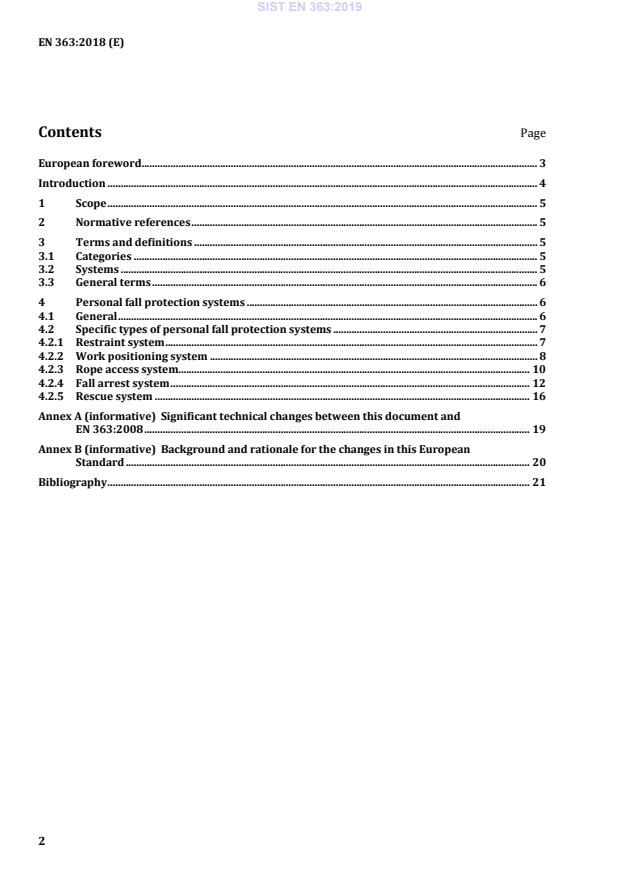
Significant technical changes between this document and EN 363:2008 . 19 Annex B (informative)
Background and rationale for the changes in this European Standard . 20 Bibliography . 21 SIST EN 363:2019
...