

SIST EN ISO 12945-4:2021
(Main)Textiles - Determination of fabric propensity to surface pilling, fuzzing or matting - Part 4: Assessment of pilling, fuzzing or matting by visual analysis (ISO 12945-4:2020)
General Information
- Abstract
This document specifies a method for the visual assessment of pilling, fuzzing, and matting respectively of textile fabrics. This method is applicable to most of woven and knitted fabrics, including napped fabrics (fleeces, inlay fabrics).
- Status
- Published
- Public Enquiry End Date
- 29-Sep-2019
- Publication Date
- 06-Dec-2020
- Technical Committee
- ITEK - Textile and textile products
- Current Stage
- 6060 - National Implementation/Publication (Adopted Project)
- Start Date
- 02-Dec-2020
- Due Date
- 06-Feb-2021
- Completion Date
- 07-Dec-2020


Overview
EN ISO 12945-4:2020 - Textiles: Determination of fabric propensity to surface pilling, fuzzing or matting - Part 4 - specifies a standardized visual assessment method for evaluating pilling, fuzzing and matting on textile fabrics. The method is applicable to most woven and knitted fabrics, including napped constructions (e.g., fleeces and inlay fabrics). It complements the physical abrasion/tumble methods defined in other parts of ISO 12945.
Key topics and requirements
- Scope: Visual grading of surface deterioration (pilling, fuzzing, matting) after specimens are prepared and treated according to ISO 12945‑1, ISO 12945‑2 or ISO 12945‑3.
- Assessment environment: Use an assessment unit illuminated with artificial daylight D65 (per ISO 3668), brightness ≥ 600 lx, warm‑up ≥ 10 min; illuminant positioned at 5°–15° to specimen plane; assessment in a darkened room to avoid stray light.
- Viewing distance & placement: Observer’s eye 30–50 cm from specimen; tested specimen mounted left, reference right; remove loose debris before grading.
- Grading scales: Separate 5‑point descriptive scales for pilling, fuzzing and matting (5 = no change; 1 = severe/dense). Half‑grades (e.g., 3-4) are permitted and can be reported digitally (e.g., “3,5”).
- Observers & results: Multiple observers recommended. Laboratory result is the average of observer averages. If observer disagreement ≥ 1 grade persists, report minimum and maximum in addition to the mean.
- Supporting tools: Photographic rating standards or in‑house visual references may be used if agreed and reported. An “extreme condition” check (rotating specimen to accentuate defects) may be used and must be reported.
- Reporting: Include method used (reference part for specimen preparation), lighting/assessment unit details, grades, observer data and any photographic standards used.
Practical applications and users
This standard is essential for:
- Textile manufacturers and mills for quality control of finished fabrics.
- Independent test laboratories performing standardized fabric testing.
- Apparel and home‑textile brands specifying fabric durability and appearance retention.
- R&D teams evaluating new fiber blends, finishes or fabric constructions for resistance to pilling, fuzzing and matting.
- Specifiers and procurement teams requiring consistent visual performance metrics.
Keywords: EN ISO 12945-4:2020, textile pilling, fuzzing, matting, visual assessment, fabric testing standard, pilling assessment.
Related standards
- ISO 12945-1 - Pilling box method
- ISO 12945-2 - Modified Martindale method
- ISO 12945-3 - Random tumble pilling method
- ISO 3668 - Visual comparison of colour (lighting reference)
Get Certified
Connect with accredited certification bodies for this standard

Control Union Certifications
Global certification for agriculture and sustainability.

Hohenstein Institut
Textile testing and certification.

Bureau Veritas Bangladesh
Bureau Veritas certification services in Bangladesh.
Sponsored listings
Frequently Asked Questions
SIST EN ISO 12945-4:2021 is a standard published by the Slovenian Institute for Standardization (SIST). Its full title is "Textiles - Determination of fabric propensity to surface pilling, fuzzing or matting - Part 4: Assessment of pilling, fuzzing or matting by visual analysis (ISO 12945-4:2020)". This standard covers: This document specifies a method for the visual assessment of pilling, fuzzing, and matting respectively of textile fabrics. This method is applicable to most of woven and knitted fabrics, including napped fabrics (fleeces, inlay fabrics).
This document specifies a method for the visual assessment of pilling, fuzzing, and matting respectively of textile fabrics. This method is applicable to most of woven and knitted fabrics, including napped fabrics (fleeces, inlay fabrics).
SIST EN ISO 12945-4:2021 is classified under the following ICS (International Classification for Standards) categories: 59.080.01 - Textiles in general. The ICS classification helps identify the subject area and facilitates finding related standards.
SIST EN ISO 12945-4:2021 is available in PDF format for immediate download after purchase. The document can be added to your cart and obtained through the secure checkout process. Digital delivery ensures instant access to the complete standard document.
Standards Content (Sample)
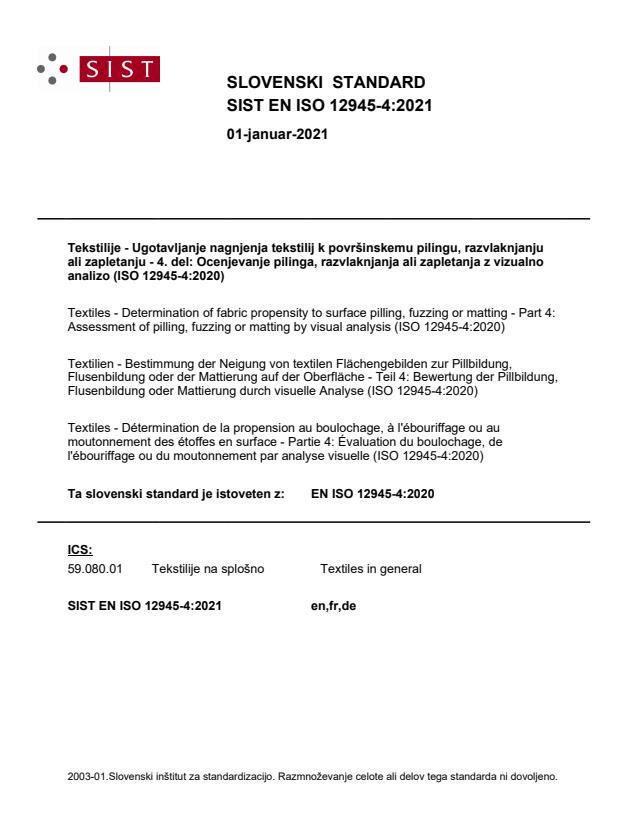
SLOVENSKI STANDARD
01-januar-2021
Tekstilije - Ugotavljanje nagnjenja tekstilij k površinskemu pilingu, razvlaknjanju
ali zapletanju - 4. del: Ocenjevanje pilinga, razvlaknjanja ali zapletanja z vizualno
analizo (ISO 12945-4:2020)
Textiles - Determination of fabric propensity to surface pilling, fuzzing or matting - Part 4:
Assessment of pilling, fuzzing or matting by visual analysis (ISO 12945-4:2020)
Textilien - Bestimmung der Neigung von textilen Flächengebilden zur Pillbildung,
Flusenbildung oder der Mattierung auf der Oberfläche - Teil 4: Bewertung der Pillbildung,
Flusenbildung oder Mattierung durch visuelle Analyse (ISO 12945-4:2020)
Textiles - Détermination de la propension au boulochage, à l'ébouriffage ou au
moutonnement des étoffes en surface - Partie 4: Évaluation du boulochage, de
l'ébouriffage ou du moutonnement par analyse visuelle (ISO 12945-4:2020)
Ta slovenski standard je istoveten z: EN ISO 12945-4:2020
ICS:
59.080.01 Tekstilije na splošno Textiles in general
2003-01.Slovenski inštitut za standardizacijo. Razmnoževanje celote ali delov tega standarda ni dovoljeno.
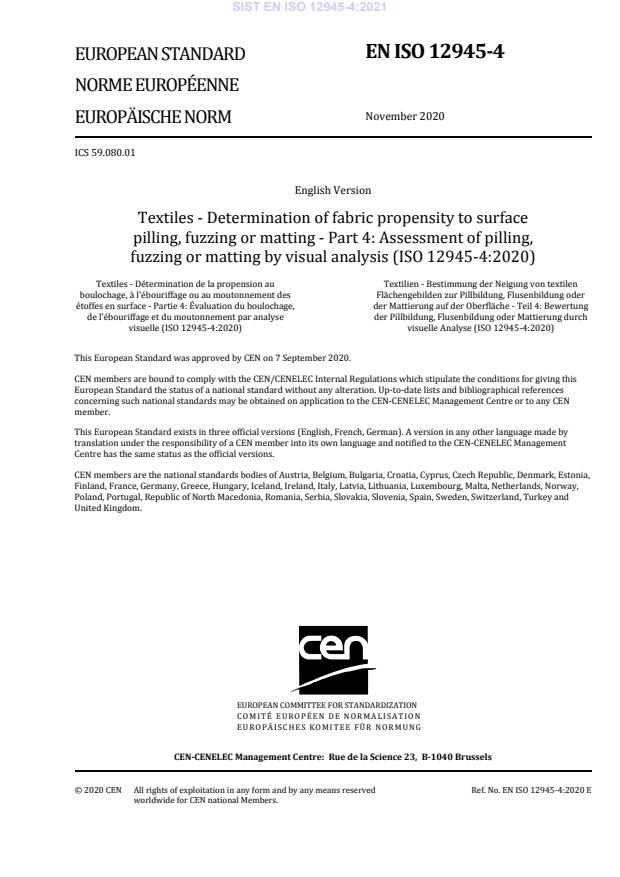
EN ISO 12945-4
EUROPEAN STANDARD
NORME EUROPÉENNE
November 2020
EUROPÄISCHE NORM
ICS 59.080.01
English Version
Textiles - Determination of fabric propensity to surface
pilling, fuzzing or matting - Part 4: Assessment of pilling,
fuzzing or matting by visual analysis (ISO 12945-4:2020)
Textiles - Détermination de la propension au Textilien - Bestimmung der Neigung von textilen
boulochage, à l'ébouriffage ou au moutonnement des Flächengebilden zur Pillbildung, Flusenbildung oder
étoffes en surface - Partie 4: Évaluation du boulochage, der Mattierung auf der Oberfläche - Teil 4: Bewertung
de l'ébouriffage et du moutonnement par analyse der Pillbildung, Flusenbildung oder Mattierung durch
visuelle (ISO 12945-4:2020) visuelle Analyse (ISO 12945-4:2020)
This European Standard was approved by CEN on 7 September 2020.
CEN members are bound to comply with the CEN/CENELEC Internal Regulations which stipulate the conditions for giving this
European Standard the status of a national standard without any alteration. Up-to-date lists and bibliographical references
concerning such national standards may be obtained on application to the CEN-CENELEC Management Centre or to any CEN
member.
This European Standard exists in three official versions (English, French, German). A version in any other language made by
translation under the responsibility of a CEN member into its own language and notified to the CEN-CENELEC Management
Centre has the same status as the official versions.
CEN members are the national standards bodies of Austria, Belgium, Bulgaria, Croatia, Cyprus, Czech Republic, Denmark, Estonia,
Finland, France, Germany, Greece, Hungary, Iceland, Ireland, Italy, Latvia, Lithuania, Luxembourg, Malta, Netherlands, Norway,
Poland, Portugal, Republic of North Macedonia, Romania, Serbia, Slovakia, Slovenia, Spain, Sweden, Switzerland, Turkey and
United Kingdom.
EUROPEAN COMMITTEE FOR STANDARDIZATION
COMITÉ EUROPÉEN DE NORMALISATION
EUROPÄISCHES KOMITEE FÜR NORMUNG
CEN-CENELEC Management Centre: Rue de la Science 23, B-1040 Brussels
© 2020 CEN All rights of exploitation in any form and by any means reserved Ref. No. EN ISO 12945-4:2020 E
worldwide for CEN national Members.
Contents Page
European foreword . 3
European foreword
This document (EN ISO 12945-4:2020) has been prepared by Technical Committee ISO/TC 38
"Textiles" in collaboration with Technical Committee CEN/TC 248 “Textiles and textile products” the
secretariat of which is held by BSI.
This European Standard shall be given the status of a national standard, either by publication of an
identical text or by endorsement, at the latest by May 2021, and conflicting national standards shall be
withdrawn at the latest by May 2021.
Attention is drawn to the possibility that some of the elements of this document may be the subject of
patent rights. CEN shall not be held responsible for identifying any or all such patent rights.
According to the CEN-CENELEC Internal Regulations, the national standards organizations of the
following countries are bound to implement this European Standard: Austria, Belgium, Bulgaria,
Croatia, Cyprus, Czech Republic, Denmark, Estonia, Finland, France, Germany, Greece, Hungary, Iceland,
Ireland, Italy, Latvia, Lithuania, Luxembourg, Malta, Netherlands, Norway, Poland, Portugal, Republic of
North Macedonia, Romania, Serbia, Slovakia, Slovenia, Spain, Sweden, Switzerland, Turkey and the
United Kingdom.
Endorsement notice
The text of ISO 12945-4:2020 has been approved by CEN as EN ISO 12945-4:2020 without any
modification.
INTERNATIONAL ISO
STANDARD 12945-4
First edition
2020-10
Textiles — Determination of fabric
propensity to surface pilling, fuzzing
or matting —
Part 4:
Assessment of pilling, fuzzing and
matting by visual analysis
Textiles — Détermination de la propension au boulochage, à
l'ébouriffage ou au moutonnement des étoffes en surface —
Partie 4: Évaluation du boulochage, de l’ébouriffage et du
moutonnement par analyse visuelle
Reference number
ISO 12945-4:2020(E)
©
ISO 2020
ISO 12945-4:2020(E)
© ISO 2020
All rights reserved. Unless otherwise specified, or required in the context of its implementation, no part of this publication may
be reproduced or utilized otherwise in any form or by any means, electronic or mechanical, including photocopying, or posting
on the internet or an intranet, without prior written permission. Permission can be requested from either ISO at the address
below or ISO’s member body in the country of the requester.
ISO copyright office
CP 401 • Ch. de Blandonnet 8
CH-1214 Vernier, Geneva
Phone: +41 22 749 01 11
Email: copyright@iso.org
Website: www.iso.org
Published in Switzerland
ii © ISO 2020 – All rights reserved
ISO 12945-4:2020(E)
Contents Page
Foreword .iv
1 Scope . 1
2 Normative references . 1
3 Terms and definitions . 1
4 Principle . 2
5 Apparatus . 2
6 Preparation of test specimens . 3
7 Assessment of pilling, fuzzing, and matting . 3
8 Results . 5
9 Test report . 5
Bibliography . 6
ISO 12945-4:2020(E)
Foreword
ISO (the International Organization for Standardization) is a worldwide federation of national standards
bodies (ISO member bodies). The work of preparing International Standards is normally carried out
through ISO technical committees. Each member body interested in a subject for which a technical
committee has been established has the right to be represented on that committee. International
organizations, governmental and non-governmental, in liaison with ISO, also take part in the work.
ISO collaborates closely with the International Electrotechnical Commission (IEC) on all matters of
electrotechnical standardization.
The procedures used to develop this document and those intended for its further maintenance are
described in the ISO/IEC Directives, Part 1. In particular, the different approval criteria needed for the
different types of ISO documents should be noted. This document was drafted in accordance with the
editorial rules of the ISO/IEC Directives, Part 2 (see www .iso .org/ directives).
Attention is drawn to the possibility that some of the elements of this document may be the subject of
patent rights. ISO shall not be held responsible for identifying any or all such patent rights. Details of
any patent rights identified during the development of the document will be in the Introduction and/or
on the ISO list of patent declarations received (see www .iso .org/ pat
...