

oSIST prEN 13201-3:2026
(Main)Road lighting - Part 3: Calculation of performance
General Information
- Abstract
This European Standard specifies the conventions and mathematical procedures to be adopted in calculating the photometric performance of road lighting installations designed in accordance with the parameters described in EN 13201-2 to ensure that every lighting calculation is based on the same mathematical principles.
The design procedure of a lighting installation also requires the knowledge of the parameters involved in the described model, their tolerances and variability. These aspects are not considered in this part of EN 13201 but a procedure to analyse their contribution in the expected results is suggested in EN 13201-4 and it can also be used in the design phase.
- Status
- Not Published
- Public Enquiry End Date
- 29-Jun-2026
- Technical Committee
- STV - Steklo, svetloba in razsvetljava v gradbeništvu
- Current Stage
- 4020 - Public enquire (PE) (Adopted Project)
- Start Date
- 25-Mar-2026
- Due Date
- 12-Aug-2026
- Completion Date
- 08-Jul-2026

Overview
oSIST prEN 13201-3:2026:2026 is a European draft standard published by CEN, focusing on the calculation of photometric performance for road lighting installations. This standard specifies the conventions and mathematical procedures that must be used to ensure that lighting calculations across Europe are based on harmonized, reliable, and repeatable mathematical principles. Its methods support the design and verification of road lighting in accordance with EN 13201-2 performance parameters, making it fundamental for lighting engineers and planners aiming to meet regulatory requirements for public and street lighting.
Key Topics
- Mathematical Conventions: Defines standard approaches for photometric calculations, including the treatment of luminaires as point sources, neglecting light obstruction and reflection from surroundings, and assuming a flat, uniformly reflective road surface.
- Photometric Data Handling: Outlines requirements for the use of luminous intensity data (I-table) and reduced luminance coefficient data (r-table) in lighting calculations, including required coordinate systems and data interpolation techniques.
- Calculation Procedures:
- Determining luminous intensity in specific directions (using C, γ coordinates).
- Calculating photometric quantities such as luminance, illuminance (horizontal, hemispherical, semi-cylindrical, vertical), and observer positions.
- Procedures for calculating performance metrics such as average luminance, uniformity, threshold increment, and edge illuminance ratio.
- Data Presentation Rules: Standardizes the number of decimal digits for results, ensures consistent rounding, and prescribes reporting requirements for design compliance.
- Use of Symbols and Abbreviations: Provides a comprehensive glossary of terms and symbols to facilitate accurate and efficient communication in lighting calculations.
Applications
This standard is essential for:
- Road Lighting Design: Ensures consistency and comparability of lighting calculations for motorways, urban streets, and pedestrian areas.
- Performance Verification: Provides a common basis for verifying whether lighting installations meet performance requirements in EN 13201-2.
- Software Development: Establishes clear mathematical procedures that can be implemented in lighting design software to automate and standardize calculations.
- Tender Specifications: Enables public authorities and contractors to specify and verify lighting performance using harmonized European criteria.
- Auditing and Compliance: Supports inspectors and regulators in assessing delivered lighting systems against documented requirements.
Related Standards
For fully compliant road lighting design and assessment, oSIST prEN 13201-3:2026 should be used in conjunction with:
- EN 13201-2: Road lighting - Part 2: Performance requirements; details specific lighting levels and uniformity targets to be achieved.
- EN 13032-1: Light and lighting - Measurement and presentation of photometric data of lamps and luminaires.
- EN 12665: Light and lighting - Basic terms and criteria for specifying lighting requirements.
- EN 13201-4: Road lighting - Part 4: Methods of measuring lighting performance; suggested for analysis of parameter tolerances and variability as part of the design and verification process.
Practical Value
By following oSIST prEN 13201-3:2026:
- Lighting engineers benefit from clear, unified calculation procedures, minimizing the risk of errors and ensuring installations meet both technical and regulatory standards.
- Municipalities and public road agencies can compare proposals from different suppliers and assess compliance with confidence, fostering fair competition and quality assurance.
- Software vendors have a reference for implementing accurate, standardized algorithms in design tools.
Utilizing the methods set out in oSIST prEN 13201-3:2026 delivers improved safety, energy efficiency, and visual comfort on public roads and contributes to the uniform application of road lighting standards across Europe.
Keywords: road lighting standards, oSIST prEN 13201-3:2026, photometric performance, lighting calculation, CEN, street lighting design, performance verification, public lighting, EN 13201-2, lighting software, urban lighting, European standardization.
Relations
- Effective Date
- 07-Apr-2025
Get Certified
Connect with accredited certification bodies for this standard

Zavod za gradbeništvo Slovenije (ZAG) - Inšpekcija
ZAG inspection body for construction products, structures, and materials.
Sponsored listings
Frequently Asked Questions
oSIST prEN 13201-3:2026 is a draft published by the Slovenian Institute for Standardization (SIST). Its full title is "Road lighting - Part 3: Calculation of performance". This standard covers: This European Standard specifies the conventions and mathematical procedures to be adopted in calculating the photometric performance of road lighting installations designed in accordance with the parameters described in EN 13201-2 to ensure that every lighting calculation is based on the same mathematical principles. The design procedure of a lighting installation also requires the knowledge of the parameters involved in the described model, their tolerances and variability. These aspects are not considered in this part of EN 13201 but a procedure to analyse their contribution in the expected results is suggested in EN 13201-4 and it can also be used in the design phase.
This European Standard specifies the conventions and mathematical procedures to be adopted in calculating the photometric performance of road lighting installations designed in accordance with the parameters described in EN 13201-2 to ensure that every lighting calculation is based on the same mathematical principles. The design procedure of a lighting installation also requires the knowledge of the parameters involved in the described model, their tolerances and variability. These aspects are not considered in this part of EN 13201 but a procedure to analyse their contribution in the expected results is suggested in EN 13201-4 and it can also be used in the design phase.
oSIST prEN 13201-3:2026 is classified under the following ICS (International Classification for Standards) categories: 93.080.40 - Street lighting and related equipment. The ICS classification helps identify the subject area and facilitates finding related standards.
oSIST prEN 13201-3:2026 has the following relationships with other standards: It is inter standard links to SIST EN 13201-3:2016. Understanding these relationships helps ensure you are using the most current and applicable version of the standard.
oSIST prEN 13201-3:2026 is available in PDF format for immediate download after purchase. The document can be added to your cart and obtained through the secure checkout process. Digital delivery ensures instant access to the complete standard document.
Standards Content (Sample)
SLOVENSKI STANDARD
01-maj-2026
Cestna razsvetljava - 3. del: Izračun fotometričnih lastnosti
Road lighting - Part 3: Calculation of performance
Straßenbeleuchtung - Teil 3: Berechnung der Gütemerkmale
Eclairage public - Partie 3: Calcul des performances
Ta slovenski standard je istoveten z: prEN 13201-3
ICS:
93.080.40 Cestna razsvetljava in Street lighting and related
pripadajoča oprema equipment
2003-01.Slovenski inštitut za standardizacijo. Razmnoževanje celote ali delov tega standarda ni dovoljeno.
DRAFT
EUROPEAN STANDARD
NORME EUROPÉENNE
EUROPÄISCHE NORM
May 2026
ICS Will supersede EN 13201-3:2015
English Version
Road lighting - Part 3: Calculation of performance
Eclairage public - Partie 3: Calcul des performances Straßenbeleuchtung - Teil 3: Berechnung der
Gütemerkmale
This draft European Standard is submitted to CEN members for enquiry. It has been drawn up by the Technical Committee
CEN/TC 169.
If this draft becomes a European Standard, CEN members are bound to comply with the CEN/CENELEC Internal Regulations
which stipulate the conditions for giving this European Standard the status of a national standard without any alteration.
This draft European Standard was established by CEN in three official versions (English, French, German). A version in any other
language made by translation under the responsibility of a CEN member into its own language and notified to the CEN-CENELEC
Management Centre has the same status as the official versions.
CEN members are the national standards bodies of Austria, Belgium, Bulgaria, Croatia, Cyprus, Czech Republic, Denmark, Estonia,
Finland, France, Germany, Greece, Hungary, Iceland, Ireland, Italy, Latvia, Lithuania, Luxembourg, Malta, Netherlands, Norway,
Poland, Portugal, Republic of North Macedonia, Romania, Serbia, Slovakia, Slovenia, Spain, Sweden, Switzerland, Türkiye and
United Kingdom.
Recipients of this draft are invited to submit, with their comments, notification of any relevant patent rights of which they are
aware and to provide supporting documentation.
Warning : This document is not a European Standard. It is distributed for review and comments. It is subject to change without
notice and shall not be referred to as a European Standard.
EUROPEAN COMMITTEE FOR STANDARDIZATION
COMITÉ EUROPÉEN DE NORMALISATION
EUROPÄISCHES KOMITEE FÜR NORMUNG
CEN-CENELEC Management Centre: Rue de la Science 23, B-1040 Brussels
© 2026 CEN All rights of exploitation in any form and by any means reserved Ref. No. prEN 13201-3:2026 E
worldwide for CEN national Members.
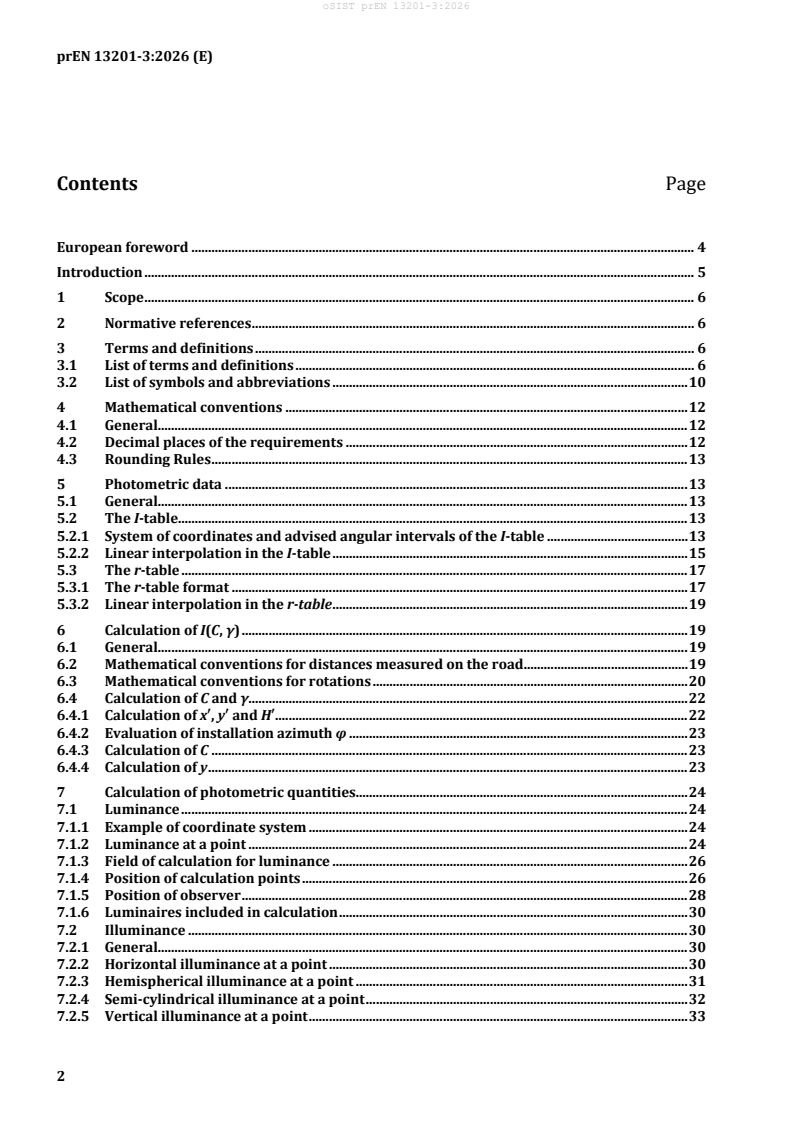
Contents Page
European foreword . 4
Introduction . 5
1 Scope . 6
2 Normative references . 6
3 Terms and definitions . 6
3.1 List of terms and definitions . 6
3.2 List of symbols and abbreviations . 10
4 Mathematical conventions . 12
4.1 General. 12
4.2 Decimal places of the requirements . 12
4.3 Rounding Rules . 13
5 Photometric data . 13
5.1 General. 13
5.2 The I-table. 13
5.2.1 System of coordinates and advised angular intervals of the I-table . 13
5.2.2 Linear interpolation in the I-table . 15
5.3 The r-table . 17
5.3.1 The r-table format . 17
5.3.2 Linear interpolation in the r-table . 19
6 Calculation of I(C, γ) . 19
6.1 General. 19
6.2 Mathematical conventions for distances measured on the road . 19
6.3 Mathematical conventions for rotations . 20
6.4 Calculation of C and γ . 22
6.4.1 Calculation of x′, y′ and H′ . 22
6.4.2 Evaluation of installation azimuth φ . 23
6.4.3 Calculation of C . 23
6.4.4 Calculation of y . 23
7 Calculation of photometric quantities. 24
7.1 Luminance . 24
7.1.1 Example of coordinate system . 24
7.1.2 Luminance at a point . 24
7.1.3 Field of calculation for luminance . 26
7.1.4 Position of calculation points . 26
7.1.5 Position of observer . 28
7.1.6 Luminaires included in calculation . 30
7.2 Illuminance . 30
7.2.1 General. 30
7.2.2 Horizontal illuminance at a point . 30
7.2.3 Hemispherical illuminance at a point . 31
7.2.4 Semi-cylindrical illuminance at a point . 32
7.2.5 Vertical illuminance at a point . 33
7.2.6 Field of calculation for illuminance . 34
7.2.7 Position of calculation points . 34
7.2.8 Luminaires included in calculation . 35
7.2.9 Illuminance on areas of irregular shape . 35
8 Calculation of quality characteristics . 35
8.1 General . 35
8.2 Average luminance. 35
8.3 Overall uniformity . 36
8.4 Longitudinal uniformity . 36
8.5 Threshold increment f . 36
TI
8.5.1 Definition and conventional hypotheses . 36
8.5.2 Threshold Increment calculation process . 38
8.5.3 Threshold increment calculation for C and P lighting classes . 39
8.6 Edge Illuminance Ratio R . 40
EI
9 Ancillary data . 43
Annex A (informative) Extended r-table format for low mounting height luminaire . 44
Bibliography . 46
European foreword
This document (prEN 13201-3:2026) has been prepared by Technical Committee CEN/TC 169 “Light
and lighting”, the secretariat of which is held by DIN.
This document is currently submitted to the CEN Enquiry.
This document will supersede EN 13201-3:2015.
This document includes the following significant technical changes with respect to EN 13201-3:2015:
— The number of decimal digits for the presentation of quality characteristics has been updated (4.2),
— The former Annex A (Mathematical information technology conventions and flow chart diagrams)
was deleted except for Figure A.1 which is included in Clause 7,
— Additional information to better aid understanding when calculating edge illuminance ratio R
EI,
—- Update of the Symbols and abbreviations section,
— Improved alignment with CIE 140,
— Correction to Table 3.
Introduction
The calculation methods described in EN 13201-3 enable road lighting quality characteristics to be
calculated by agreed procedures so that results obtained from different designers will have a uniform
basis.
1 Scope
This document specifies the conventions and mathematical procedures to be adopted in calculating the
photometric performance of road lighting installations designed in accordance with the parameters
described in EN 13201-2 to ensure that every lighting calculation is based on the same mathematical
principles.
The design procedure of a lighting installation also requires the knowledge of the parameters involved
in the described model, their tolerances and variability. These aspects are not considered in this
document but a procedure to analyse their contribution in the expected results is suggested in
EN 13201-4 and it can also be used in the design phase.
2 Normative references
The following documents are referred to in the text in such a way that some or all of their content
constitutes requirements of this document. For dated references, only the edition cited applies. For
undated references, the latest edition of the referenced document (including any amendments) applies.
EN 13032-1, Light and lighting — Measurement and presentation of photometric data of lamps and
luminaires — Part 1: Measurement and file format
EN 13201-2, Road lighting - Part 2: Performance requirements
EN 12665, Light and lighting - Basic terms and criteria for specifying lighting requirements
3 Terms and definitions
3.1 List of terms and definitions
For the purposes of this document, the terms and definitions given in EN 12665 and the following apply.
ISO and IEC maintain terminology databases for use in standardization at the following addresses:
— ISO Online browsing platform: available at https://www.iso.org/obp/
— IEC Electropedia: available at https://www.electropedia.org/
3.1.1
vertical photometric angle
γ
angle between the light path and the downward vertical axis both passing through the luminaire
photometric centre
Note 1 to entry: Unit ° (degree).
Note 2 to entry: The direction γ = 0 is therefore oriented to the nadir.
Note 3 to entry: See Figure 1.
3.1.2
azimuth
C
angle between the vertical half plane passing through the light path and the reference half plane
Note 1 to entry: I.e. the vertical half plane passing through the second axis of a luminaire, when the luminaire is at
its tilt during measurement.
Note 2 to entry: Unit ° (degree).
Note 3 to entry: See Figure 1.
3.1.3
angle of incidence
ε
angle between the light path at a point on a surface and the normal to the surface
Note 1 to entry: Unit ° (degree).
Note 2 to entry: See Figure 4, Figure 13 and Figure 14.
3.1.4
angle of deviation
β
angle between the oriented vertical planes through the observer to the point of observation and from
the point of observation through the luminaire (with respect to luminance coefficient)
Note 1 to entry: Unit ° (degree).
Note 2 to entry: See Figure 4.
3.1.5
luminance coefficient
q
quotient of the luminance of a surface element in a given direction by the illuminance on the surface
element
–1
Note 1 to entry: Unit sr .
Note 2 to entry:
L
q=
E
(1)
where
–1
q is the luminance coefficient, in reciprocal steradians (sr );
–2
L is the luminance, in candelas per square metre (cd·m );
E is the illuminance, in lux (lx).
3.1.6
reduced luminance coefficient
r
luminance coefficient of a surface element multiplied by the cube of the cosine of the angle of incidence
of the light on the surface element
–1
Note 1 to entry: Unit sr .
Note 2 to entry: This can be expressed by the formula:
r = q cos ε (refer to CIE 066) (2)
where
q is the luminance coefficient, in reciprocal steradians;
ε is the angle of incidence, in degree.
Note 3 to entry: The angle of observation, α in Figure 4, affects the value of r. In accordance with the requirements
specified in EN 13201-2, consider this angle fixed at 1° and this value is adopted for the calculation described in
this standard, r is reasonably constant for values of α between 0,5° and 1,5°.
3.1.7
tilt during measurement
θ
m
angle between a defined datum axis on a luminaire and the horizontal when the luminaire is mounted
for photometric measurement
Note 1 to entry: Unit ° (degree).
Note 2 to entry: See Figure 7.
Note 3 to entry: The defined datum axis can be any feature of the luminaire, but generally for a side-mounted
luminaire it lies in the mouth of the luminaire canopy, in line with the spigot axis. Another commonly used feature
is the spigot entry axis.
3.1.8
tilt for calculation
δ
difference in angle between the tilt in application and the tilt during measurement of a luminaire
Note 1 to entry: Unit ° (degree).
Note 2 to entry: See Figure 7.
3.1.9
tilt in application
θ
f
angle between a defined datum axis on a luminaire and the horizontal when the luminaire is mounted
for field use
Note 1 to entry: Unit ° (degree).
Note 2 to entry: See Figure 7.
Note 3 to entry: The defined datum axis can be any feature of the luminaire but generally for a side-mounted
luminaire it lies in the mouth of the luminaire canopy, in line with the spigot axis. Another commonly used feature
is the spigot entry axis.
3.1.10
orientation
v
angle a chosen reference direction makes with the C = 0°, γ = 90° measurement direction of a luminaire
when the first photometric axis of the luminaire is vertical
Note 1 to entry: Unit ° (degree).
Note 2 to entry: When the road is straight the reference direction is longitudinal.
Note 3 to entry: See Figure 6, which illustrates the sign conventions.
3.1.11
rotation
ψ
angle the first photometric axis of a luminaire makes with the nadir of the luminaire in the plane C = 0°,
C = 180°, when the tilt during measurement is zero
Note 1 to entry: Unit ° (degree).
Note 2 to entry: See Figure 6, which illustrates the sign conventions.
3.1.12
first photometric axis (of a luminaire when measured in the (C, γ) coordinate system)
axis through the photometric centre of a luminaire and perpendicular to the plane which is
representative of the main light emitting area
Note 1 to entry: The polar axis of the (C, γ) coordinate system does not necessarily coincide with the first axis of
the luminaire if the luminaire is tilted during measurement.
3.1.13
longitudinal direction
direction parallel to the axis of the road
3.1.14
transverse direction
direction at right angles to the axis of the road
Note 1 to entry: On a curved road the transverse direction is that of the radius of curvature at the point of interest
on the road.
3.1.15
installation azimuth
φ
angle a chosen reference direction (which is longitudinal for a straight road) makes with the vertical
plane through a given point on the road surface and the photometric centre of a luminaire, when the
luminaire is at its tilt during measurement
Note 1 to entry: Unit (degree).
Note 2 to entry: See Figure 4.
3.2 List of symbols and abbreviations
Table 1 — Symbols and abbreviations
Quantity
Symbol Name or description Unit
A Age of observer y
y
C °(degree
Photometric azimuth angle (Figure 1)
)
D Spacing between calculation points in the longitudinal direction (see Figure 10 m
and Figure 15)
D Spacing between calculation points in the transverse direction (see Figure 10 m
and Figure 15)
lx
E Generic symbol used for average illuminance
lx
E
Initial average horizontal illuminance of the lit surface (see 8.5.3)
hi
E Horizontal illuminance at a point lx
h
E Hemispherical illuminance at a point lx
hs
E Semi-cylindrical illuminance at a point lx
sc
E Vertical illuminance at a point lx
v
f Overall maintenance factor –
M
f Threshold increment %
TI
H Mounting height of a luminaire m
I(C, y) Luminous intensity table in the C, y system. Also named I-table cd
j, m Integers indicating the row or column of a table –
–2
Generic symbol used for average luminance cd·m
L
–2
cd·m
L
Initial average horizontal luminance of the lit surface (see 8.5.3)
i
–2
L Equivalent veiling luminance cd·m
v
–2
L Luminance at a point cd·m
N Number of calculation points in the longitudinal direction of a grid (see –
Figure 10 and Figure 15)
Quantity
Symbol Name or description Unit
N Number of calculation points in the transverse direction of a grid (see Figure 10 –
and Figure 15)
n Number of luminaires considered in the calculation –
lu
–1
Q Luminance coefficient sr
–1
Q Average luminance coefficient sr
–1
R Reduced luminance coefficient sr
–1
r(tan ε, sr
Reduced luminance coefficient table. Also named r-table
β)
R Edge illuminance ratio –
EI
S Spacing between luminaires m
W Width of driving lane m
L
Wr Width of relevant area or of carriageway m
W Width of strip m
S
x Abscissa in (x, y) coordinate system (Figure 5) m
y Ordinate in (x, y) coordinate system (Figure 5) m
α °(degree
Angle of observation of road surface (Figure 4)
)
α angle between the normal to the flat surface of the semicylinder and the vertical °(degree
k
plane containing the light path (Figure 13) or angle between the normal to the )
selected vertical plane and the vertical plane containing the light path
(Figure 14)
β °(degree
Angle of deviation (Figure 4)
)
R Average diffuse reflection factor of a surface (See 8.5.3) –
γ °(degree
Photometric elevation angle (Figure 1)
)
δ °(degree
Luminaire tilt for calculation (Figure 6 and Figure 7)
)
ε °(degree
Angle of incidence (Figure 4)
)
ε Angle of incidence for semicylindrical and vertical illuminance (Figure 13 and °(degree
k
Figure 14) )
θ °(degree
f
Luminaire tilt in application (Figure 7)
)
θ °(degree
m
Luminaire tilt during measurement (Figure 7)
)
Quantity
Symbol Name or description Unit
th
θ Angle between the line of sight and the centre of the k luminaire (See 8.5 in the
k
formulae)
ν °(degree
Orientation of luminaire (Figure 6)
)
φ °(degree
Installation azimuth (Figure 4)
)
ψ °(degree
Rotation of luminaire (Figure 6)
)
4 Mathematical conventions
4.1 General
The basic conventions made in the mathematical procedures described in this standard are:
a) the luminaire is regarded as a point source;
b) light reflected from the surrounds and inter-reflected light is disregarded;
c) obstruction to the light from luminaires by trees and other objects is disregarded;
d) the atmospheric absorption is zero;
e) the road surface is flat and level and has uniform reflecting properties over the area considered;
f) the evaluation in I-tables and r-tables shall be obtained by linear interpolation.
In case of continuous lines of luminaires, generally at low mounting height, it is advisable to check
whether the distance between the optical centre of each luminaire to the nearest point of the grid of
calculation is greater than or equal to five times the length of the luminous area of a single luminaire. If
this is not the case it might be necessary to simulate near-field photometry by fragmenting the
luminaire into virtual point light sources of the same light distribution as the entire luminaire. The
luminous flux of each virtual light source is an equal proportion of the total luminous flux for the
luminaire.
4.2 Decimal places of the requirements
The calculation results shall be presented in the form and with at least the number of digits given in the
tables of requirements of EN 13201-2, shown in Table 2.
Table 2 — Number of decimal digits of the lighting requirements depending on value
value U U f R
L o I TI EI E
< 10 2 2 2 2 2 2
10 to 50 1 - - 1 - 1
> 50 0 - - 0 - 0
4.3 Rounding Rules
Calculations should be carried out using a specific number of decimal places within software to enable
consistency of results between software, as detailed below. Quality figures should be rounded using
conventional mathematical methods to the number of decimal places as in Table 2. Cutting values
should not be used.
If software is used to demonstrate compliance with values from EN 13201-2 then such comparison of
values should be made before any rounding occurs.
For the calculations made according to this report, a luminous intensity table (I-table) prepared in
accordance with CIE 121-1996 (CIE 1996) is required. The coordinate system used for road lighting
luminaires is generally the (C.γ) system, shown in Figure 1, although the (B,p) coordinate system is used
in some countries and is commonly used for floodlights. The formulae quoted in this document are
related to the (C, γ) coordinate system. The luminous intensity I is generally expressed in candelas. If
–1
values are reported in relative luminous intensities, expressed in candelas per kilolumen (cd·klm ),
they have to be converted to (absolute) luminous the installed light sources expressed in kilolumen
(klm) before proceeding to the calculation process.
5 Photometric data
5.1 General
Photometric data for the light distribution of the luminaires used in the lighting installation are needed
for calculating the lighting quality characteristics in this standard. These data are in the form of an
intensity table (I-table) which gives the distribution of luminous intensity emitted by the luminaire in
all relevant directions. When luminance calculations are to be made, photometric data for the light
reflecting properties of the road surface are required in the form of an r- table.
Interpolation is needed in using both these tables to enable values to be estimated for directions
between the tabulated angles.
5.2 The I-table
5.2.1 System of coordinates and advised angular intervals of the I-table
For calculations made in accordance with this standard, an intensity table (I-table) that describes the
behaviour of the luminaire with the required accuracy by the aim of calculation shall be used. This I-
table shall be prepared in accordance with EN 13032-1. The coordinate system used for road lighting
luminaires is the C-planes system, shown in Figure 1. For floodlight installations, the intensity
distribution measured in the B-planes system may be accepted if the calculation program can transfer
the intensity values in the C-planes system. In Figure 1, the luminaire is shown at its tilt during
measurement.
Luminous intensity shall be expressed in candelas.
The luminous flux used in calculation shall be declared in the calculation report.
Unless specific conditions are mentioned in the calculation report, the luminous flux used shall be that
of the light source mentioned in the data sheet of the luminaire.
–1
If the luminous intensity table is given in candelas per kilolumen (cd·klm ), its values shall be
converted in candelas, considering the luminous flux of all the light sources in the luminaire.
Key
1 luminaire at tilt during measurement
2 longitudinal direction
3 vertical direction
4 direction of luminous intensity
Figure 1 — Orientation of (C, γ) coordinate system in relation to longitudinal direction of
carriageway
Maximum angular intervals stipulated in this standard have been selected to give acceptable levels of
interpolation accuracy.
In the (C, γ) system of coordinates, luminous intensities shall be provided at the angular intervals stated
below.
For all luminaires the angular intervals in vertical planes (γ) shall at most be 2,5° from 0° to 180°. In
azimuth the intervals shall be varied according to the symmetry of the light distribution from the
luminaire as follows:
a) luminaires with no symmetry: the intervals shall at most be 5°, starting at 0°, when the luminaire is
at its tilt during measurement, and ending at 355°;
b) luminaires with nominal symmetry about the C = 270° − 90° plane: the intervals shall at most be 5°,
starting at 270°, when the luminaire is at its tilt during measurement, and ending at 90°;
c) luminaires with nominal symmetry about the C = 270° − 90° and C = 0°− 180° planes: the intervals
shall at most be 5°, starting at 0°, when the luminaire is at its tilt during measurement, and ending
at 90°;
d) luminaires with nominally the same light distribution in all C-planes: only one representative set of
measurements in a vertical (C-plane) is needed.
Where standards for specific luminaire typologies exist and prescribe improved angular intervals these
shall be applied.
The angular intervals stated above shall be reduced in case of a great gradient variation of consecutive
luminous intensities.
NOTE In that case, it is the role of photometric laboratories to provide the I-table with relevant reduced
angular intervals defined from the angles included in the photometric file.
5.2.2 Linear interpolation in the I-table
To estimate the luminous intensity I(C, γ) in the direction (C, γ), it is necessary to interpolate between
four values of luminous intensity lying closest to the direction, see Figure 2 and Figure 3.
Figure 2 — Angles required for linear interpolation of luminous intensity
Figure 3 — Angles required for linear interpolation of luminous intensity
(from Figure 2 but showing intensity on z-axis in perspective)
For this purpose, the following formulae or mathematically equivalent formulae shall be used:
Interpolation on C angles
IC,,γγ− IC
( ) ( ) CC−
j mj
m
=
C − C
IC ,,γγ− IC
m1+ m
( ) ( )
m+1 j mj
(3)
where
I(C , γ ) indicates the intensity in column number m and row number j of the I-table, and so on
m j
for the other similar symbols;
C is the azimuth, measured about the first photometric axis;
γ is the vertical angle measured from the first photometric axis;
j, m, m+1 are integers indicating the number of the column or row in the I-table.
From which:
CC−
m
IC, γ=IC, γ+ ⋅ IC, γγ− IC,
( ) ( ) ( ) ( )
( )
j mj m+1 j mj
C − C
m1+ m
(4)
Similarly:
IC, γγ− IC,
( ) ( ) CC−
j1++m j1
m
=
C − C
IC, γγ− IC,
m1+ m
( ) ( )
m++1 j1 m j1+
(5)
From which:
CC−
m
IC, γ= IC, γ+ ⋅ IC, γγ− IC,
( ) ( ) ( ( ) ( ))
j1+ m j1+ m++1 j1 m j1+
C − C
m1+ m
(6)
At last, interpolation on γ:
IC, γγ− IC,
( ) γγ−
( )
j
j
=
γγ−
IC, γγ− IC,
j1+ j
( ) ( )
j1+ j
(7)
From which, finally:
γγ−
j
IC, γγ=IC, +⋅ IC, γ− IC, γ
( )
( ) ( ) ( )
( )
j j1+ j
γγ−
j1+ j
(8)
In these formulae interpolation is first carried out in the C half planes, and then in the γ cones. If desired
this procedure can be reversed (that is, the interpolation is first carried out in the γ cones followed by
the C half planes) and the same result obtained.
5.3 The r-table
5.3.1 The r-table format
Road surface reflection data shall be expressed in terms of the reduced luminance coefficient at the
angular intervals and in the directions given in Table 3 for the angles β and ε indicated in Figure 4.
Generally in r-tables the values are given multiplied by the factor 10 . In this case, for calculation
purpose, they shall be divided by 10 .
Table 3 gives the minimum number of angular directions at which the reduced luminance coefficient
shall be specified for luminaires placed at heights, above the road surface, higher than 2 m.
For luminaires of the lighting installation placed at heights, above the road surface, less than or equal to
2 m, Annex A suggests the extended set of angular directions for r values.
Key
H mounting height of the luminaire
P observed point
PN normal at P to the road surface
Q photometric centre of the luminaire
QT vertical passing through the photometric centre of the luminaire
ST longitudinal direction
Oh geometrical projection of the observer’s eye to the ground
f and y scalar components of the vector TP (evaluation of tan φ)
β angle between the oriented traces of vertical planes in the horizontal plane of the road surface:
− vertical plane passing through the point of observation and containing P
− vertical plane containing P and passing through the luminaire.
ε angle of light incidence at P
α angle of observation
φ installation azimuth
1 luminaire
2 light path
3 observer (O is the position of the eye of the observer)
Figure 4 — Angular relationships for luminaire at tilt during measurement,
observer, and point of observation
Table 3 — Angular intervals and directions to be used in collecting road surface reflection data
tan ε β in degrees
0 2 5 10 15 20 25 30 35 40 45 60 75 90 105 120 135 150 165 180
0 X X X X X X X X X X X X X X X X X X X X
0,25 X X X X X X X X X X X X X X X X X X X X
0,5 X X X X X X X X X X X X X X X X X X X X
0,75 X X X X X X X X X X X X X X X X X X X X
1 X X X X X X X X X X X X X X X X X X X X
1,25 X X X X X X X X X X X X X X X X X X X X
1,5 X X X X X X X X X X X X X X X X X X X X
1,75 X X X X X X X X X X X X X X X X X X X X
2 X X X X X X X X X X X X X X X X X X X X
2,5 X X X X X X X X X X X X X X X X X X X X
3 X X X X X X X X X X X X X X X X X X X X
3,5 X X X X X X X X X X X X X X X X X X X X
4 X X X X X X X X X X X X X X X X X X X X
4,5 X X X X X X X X X X X X X X X X X X X X
5 X X X X X X X X X X X X X X X X X X X X
5,5 X X X X X X X X X X
6 X X X X X X X X X
6,5 X X X X X X X X
7 X X X X X X X X
7,5 X X X X X X X
8 X X X X X X X
5 X X X X X X X
9 X X X X X X
9,5 X X X X X X
10 X X X X X X
10,5 X X X X X X
11 X X X X X X
11,5 X X X X X
12 X X X X X
An X in Table 3 indicates the required r-value that shall be known.
NOTE In Table 3, blank cells indicate directions that are not used for calculation, therefore the knowledge of r
of these directions is not relevant in this document.
5.3.2 Linear interpolation in the r-table
When a value of r is required for values of tan ε and β lying between those given in the r-table, the linear
interpolation shall be retained.
The mathematical procedure is similar to that described for the I-table in 5.2.2 with tan ε replacing C
half plane angles and β replacing γ angles.
Again, in these formulae, interpolation can be first carried out in the tan ε values and then in the β half
planes. If desired this procedure can be reversed (that is the interpolation is first carried out in the β
half planes followed by tan ε values) and the same result obtained.
6 Calculation of I(C, γ)
6.1 General
To determine the luminous intensity from a luminaire to a point it is necessary to find the vertical
photometric angle γ and photometric azimuth C of the light path to the point. To do this, account shall
be taken of the tilt in application in relation to the tilt during measurement, the orientation, and
rotation of the luminaire. For this purpose it is necessary to establish mathematical sign conventions for
measuring distances on the road and for rotations about axes. The system used is a right-handed
Cartesian coordinate system. The corrections for turning movements do not allow for any change in the
luminous flux of the light source due to turning movements.
6.2 Mathematical conventions for distances measured on the road
A (x, y) rectangular coordinate system is used (Figure 5). The abscissa is aligned with the reference
direction, which, for a straight road, lies in the longitudinal direction. Then:
x = x − x (9)
LP P L
y = y − y (10)
LP P L
where
(x , y ) are the coordinates of the calculation point;
P P
(x , y ) are the coordinates of the luminaire.
L L
Key
1 edge of carriageway
2 calculation point
3 luminaire
Figure 5 — (x, y) coordinate system for locating luminaire in plan
NOTE In order to obtain positive x and y coordinates for all grid points, it is advisable to place the origin in
the low left corner of the calculation field. (see Figure 8).
6.3 Mathematical conventions for rotations
Figure 6 shows the axes of rotation in relation to the (x, y, z) right-handed coordinate system. In this
system rotation angles are positive when pointing the right thumb along the third axis in the positive
direction, the fingers curl in the direction leading from the first axis toward the second one (right hand
rule).
Axis I is fixed in space, axis II and axis III can be turned about axis I.
Key
1 axis III
2 longitudinal direction
3 axis II
4 axis I: first photometric axis
Figure 6 — Axes of rotation in relation to the (x, y) coordinate system
Figure 7 shows the relation of tilt for calculation to tilt during measurement and tilt in application. From
this it is evident that:
δ = θ − θ (11)
f m
where
δ is the tilt in degree for calculation;
θ is the tilt in degree in application;
f
is the tilt in degree during measurement.
θm
Key
Δ tilt for calculation
θ tilt in application
f
θ tilt during measurement
m
1 horizontal
Figure 7 — Tilt during measurement, tilt in application, tilt for calculation
6.4 Calculation of C and γ
NOTE These can be determined in four stages:
6.4.1 Calculation of x′, y′ and H′
x′ = x(cos ν cos ψ − sin ν sin δ sin ψ) + y(sin ν cosψ + cos ν sin δ sin ψ) + H cos δ sin ψ (12)
y′ = −x sin ν cos δ + y cos ν cos δ − H sin δ (13)
H ′ = −x(sin ν sin δ cos ψ + cos y sin ψ) − y(sin ν sin ψ − cos ν sin δ cos ψ) + H cos δ cos ψ (14)
where
x and y are the longitudinal and transverse distances between the calculation point and the nadir
of the luminaire in Figure 5;
H is the height of the luminaire above the calculation point;
ν, δ and ψ are the orientation, tilt for calculation, and rotation.
NOTE x′, y′ and H′ are used in the calculation of C and γ when the luminaire has been turned through ν, δ, and
ψ. They correspond to x, y and H in the unturned coordinate system and for calculation purposes can be regarded
as intermediate variables (see Figure 6).
Caution shall be paid in Formulae (12), (13) and (14) to the value of H which is currently the mounting
height of the luminaire to the road surface for horizontal or hemispherical illuminance and road
luminance evaluations.
For the calculation of veiling luminance in f 1,5 (m) stands by default for the height of the eyes of the
TI
observer. Similarly in vertical and semicylindrical illuminance evaluations, the calculation points
considered are conventionally located at 1,5 m high from the ground. In that case H − 1,5 shall be
substituted to H in Formulae (12), (13) and (14) to define correctly the direction of luminous intensity
interpolated in the I-table.
6.4.2 Evaluation of installation azimuth φ
y
Evaluation of arctan gives:
x
y
−90° ≤ arctan ≤ 90° (15)
x
The angular quadrant in which φ lies is determined by:
For x > 0, y > 0 with 0° < φ < 90° quadrant 1 (16)
y
x
φ = arctan
For x < 0, y > 0 with 90° < φ < 180° quadrant 2 (17)
y
φ = 180° + arctan
x
For x < 0, y < 0 with 180° < φ < 270° quadrant 3 (18)
y
φ = 180° + arctan
x
For x > 0, y < 0 with 270° < φ < 360° quadrant 4 (19)
y
φ = 360° + arctan
x
6.4.3 Calculation of C
C = φ − v (20)
where
φ is the installation azimuth in degree;
v is the orientation in degree (Figure 6), obtained from the formulae in 6.4, x′ and y′ being
used in place of x and y respectively.
6.4.4 Calculation of y
2 2
′′
xy+
( ) ( )
γ= arctan
′
H
(21)
7 Calculation of photometric quantities
7.1 Luminance
7.1.1 Example of coordinate system
An example of a coordinate system is given in Figure 8.
Key
1 lane axis
2 birds eye view of section of road
3 current P grid point (xp,yp,zp)
Figure 8 — Coordinate Systems - Example of road with two lanes
7.1.2 Luminance at a point
7.1.2.1 General formula
The luminance at a point shall be determined by applying the following formula or a mathematically
equivalent formula:
n
lu
IC, γ ⋅⋅f r tanεβ,
( ) ( )
kkM
L=
∑
H
k=1
k
(22)
where
L is the maintained luminance in candelas per square metre;
k is the index of current luminaire in the summation;
n is the number of luminaires involved in the calculation;
lu
th
I (C, γ) is the luminous intensity in candela of the k luminaire being C and γ calculated as
k k k
indicated in 6.4;
f is the overall maintenance factor, depending on light source lumen maintenance factor and
M
luminaire maintenance factor;
r (tan ε, β) is the reduced luminance coefficient for the current incident light path with
k
angular coordinates (ε , β ), in reciprocal steradians (see 7.1.2.2 and Figure 4);
k k
th
H is the mounting height of k luminaire above the surface of the road, in metres.
k
NOTE It is advised not to include lamp survival factor in the overall maintenance factor in road lighting if all
failed light sources will be spot replaced.
Below is a simplified formula when luminaire type (i.e. luminaires and f are constant) and installation
M
conditions (height, tilt, etc.) are the same for all luminaires in the given lighting installation:
n
lu
I C ,, γ ⋅ rtanε β
( ) ( )
kk k k
Lf=
M
∑
H
k=1
(23)
7.1.2.2 Calculation of tan ε and β
In Formula (23) tan ε and β are the entries of the r-table r (tan ε; β).
k
tan ε and β are evaluated for each observer position and each luminaire.
From Figure 4 we can calculate:
2 2
xx− + y − y
( ) ( )
pL p L
PT
tanε
HH
(24)
where
PT is the distance on the ground of the observed point P(x ; y ) to the geometric
...