

SIST EN 14623:2005
(Main)Devices to prevent pollution by backflow of potable water - Air gaps with minimum circular overflow (verified by test or measurement) - Family A, type G
- Abstract
This European Standard specifies the characteristics and the requirements of air gaps with overflow, family A, type G for nominal flow velocity not exceeding 3 m/s. Air gaps are devices for protection of potable water in water installations from pollution. This European Standard applies to air gaps in factory assembled products and to constructed air gaps in situ, and defines the physicochemical characteristics of materials of construction used for the purpose and application to ensure compliance with this document during normal working use.
- Status
- Published
- Publication Date
- 31-Aug-2005
- Technical Committee
- IOVO - Water supply and waste water engineering
- Current Stage
- 6060 - National Implementation/Publication (Adopted Project)
- Start Date
- 01-Sep-2005
- Due Date
- 01-Sep-2005
- Completion Date
- 01-Sep-2005


SIST EN 14623:2005 is the Slovenian standard for air gaps with minimum circular overflow used to protect potable water installations from backflow pollution. It specifies the characteristics, materials, designation, verification, marking and technical documentation for family A, type G air gaps, for use in factory-assembled products and in air gaps constructed in situ. The document is aimed at manufacturers, installers, testers and buyers who need a defined backflow-protection device for water systems.
What does SIST EN 14623:2005 specify?
SIST EN 14623:2005 specifies the design and performance requirements for air gaps with overflow, family A, type G, and it ties those requirements to the normal working use of the device. The standard covers both assembled products and site-built installations, so it is relevant whether the air gap is delivered as a unit or created as part of the installation.
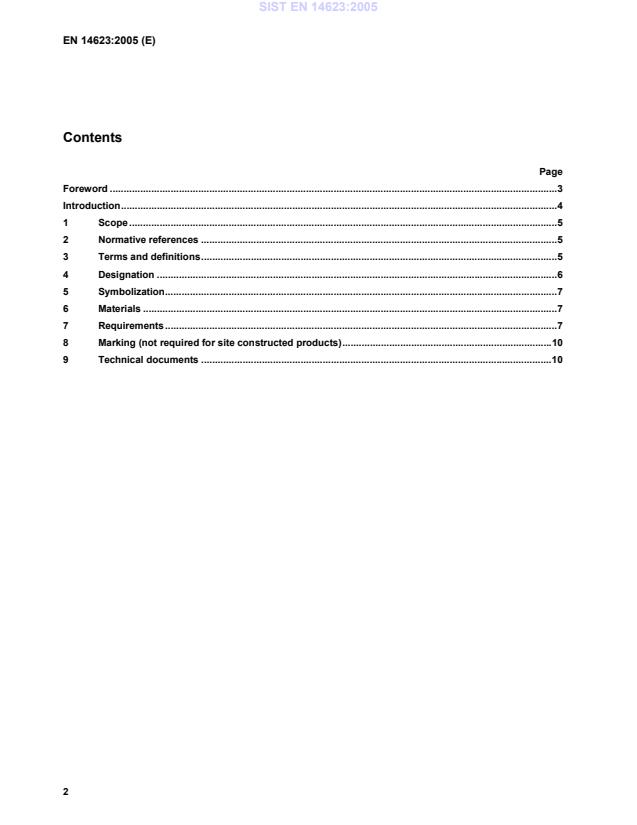
The document is organized into clauses 1 to 9:
- scope
- normative references
- terms and definitions
- designation
- symbolization
- materials
- requirements
- marking
- technical documents
For a reader, this means the standard does not only define the gap itself. It also tells the user how to name it, how to describe it in documents, what materials are acceptable, how to check it, and what must appear on the product and in the manufacturer’s paperwork.
What are the key requirements of SIST EN 14623:2005?
SIST EN 14623:2005 focuses on keeping the inlet side physically separated from the receiving vessel so that contaminated water cannot be drawn back into the potable supply. In practice, the standard is about geometry, material suitability and verification.
Design and materials
SIST EN 14623:2005 requires the manufacturer to state the materials used in technical and commercial documents. Materials in contact with drinking water must comply with applicable European standards and national acceptance criteria or restrictions, and the materials must be compatible with each other, with the supplied water and with any fluids or substances they may encounter. For buyers and specifiers, this means material choice is part of conformity, not just a construction detail.
The standard also says the protection assembly has four parts: the water inlet device, receiving vessel, overflow and air break to drain. That structure matters because each part has a separate role in preventing contact between the inlet and the potentially contaminated water.
Inlet device and overflow arrangement
SIST EN 14623:2005 requires the inlet device to be fixed securely so the air gap is maintained. The outlet of the inlet device must stay above the maximum water level, and adjustable or dismantleable joints are not permitted below the maximum operational level. If a submerged supply pipe is used, it must be corrosion resistant and pressure tested as part of the inlet device.
The overflow arrangement must provide a proper overflow path and an air break before any drain connection. For practice, this means the overflow cannot be treated as a simple pipe connection - it has to preserve the protective separation that keeps backflow from reaching the supply.
Air gap distance and verification
SIST EN 14623:2005 defines how the air gap distance is established from the inlet point to the critical water level. For single-supply arrangements, the standard allows verification either by test or, for the smaller supply sizes named in the document, by direct measurement. Table 1 gives the minimum air gap distances by pipe or valve size, so the user must match the device size to the correct minimum separation.
For multiple supplies, the standard requires the critical water level to be determined with all feed pipes operating, and no feed orifice may sit below the required air gap dimension. If the installation can see positive-pressure backflow, the inlet arrangement must also prevent contamination of the inlet orifice and control the flow so the overflow is not overloaded.
Verification, marking and documents
SIST EN 14623:2005 provides verification by test or by measurement. The test sequence checks the operating condition, observes whether the inlet contacts the water during filling, and then confirms the required air gap after the flow stops. Marking is required on appliances, except site-constructed products, and the manufacturer’s documents must include installation requirements so the air gap is not compromised, including under positive-pressure backflow conditions.
What terms does SIST EN 14623:2005 define?
- Air gap with overflow family A, type G - a permanent vertical separation between the lowest point of the inlet and the critical water level, with an overflow that can drain the maximum inflow under fault conditions.
- Spillover level - the level at which water first begins to overflow the receiving vessel when all outlets are closed.
- Critical water level - the liquid level reached after the inlet is closed from the maximum fault condition.
- Maximum operational level - the level reached in normal operation, as defined by the manufacturer.
- Maximum level - the highest water level above the spillover level under positive-pressure fault conditions with all outlets closed.
- Dimension h - the height between the spillover level and the critical level.
- Diameter of feed pipe (bore D) - the maximum internal diameter in the last metre of the supply pipe or the inlet connection size.
Who uses SIST EN 14623:2005?
SIST EN 14623:2005 is used by manufacturers of backflow-prevention devices, designers of potable water systems, installers, testing and inspection laboratories, and water suppliers. It is also relevant to quality managers and buyers who need to specify a compliant air gap for water installations and check the supporting documentation.
Which standards are used with SIST EN 14623:2005?
SIST EN 14623:2005 names EN 1717:2000 as the normative reference. EN 1717:2000 provides the general framework for protecting potable water in water installations and for devices that prevent pollution by backflow, which is why this standard uses it for terms and for the air break to drain requirement.
What does the SIST EN 14623:2005 document contain?
SIST EN 14623:2005 contains a design principle figure, a graphic symbol, and a layout figure showing the relationship between the inlet, receiving vessel, overflow and air gap. It also contains Table 1 for size-based air gap distances and procedural text for verification by test and by measurement. The document further includes designation rules, marking requirements and the technical-documentation content expected from the manufacturer.
Relations
- Effective Date
- 01-Apr-2026
- Effective Date
- 28-Jan-2026
- Effective Date
- 28-Jan-2026
- Effective Date
- 28-Jan-2026
Get Certified
Connect with accredited certification bodies for this standard

DIBt (Deutsches Institut für Bautechnik)
German Institute for Building Technology.
DIN CERTCO
DIN Group product certification.

Kiwa BDA Testing
Building and construction product certification.
Sponsored listings
Frequently Asked Questions
SIST EN 14623:2005 is a standard published by the Slovenian Institute for Standardization (SIST). Its full title is "Devices to prevent pollution by backflow of potable water - Air gaps with minimum circular overflow (verified by test or measurement) - Family A, type G". This standard covers: This European Standard specifies the characteristics and the requirements of air gaps with overflow, family A, type G for nominal flow velocity not exceeding 3 m/s. Air gaps are devices for protection of potable water in water installations from pollution. This European Standard applies to air gaps in factory assembled products and to constructed air gaps in situ, and defines the physicochemical characteristics of materials of construction used for the purpose and application to ensure compliance with this document during normal working use.
This European Standard specifies the characteristics and the requirements of air gaps with overflow, family A, type G for nominal flow velocity not exceeding 3 m/s. Air gaps are devices for protection of potable water in water installations from pollution. This European Standard applies to air gaps in factory assembled products and to constructed air gaps in situ, and defines the physicochemical characteristics of materials of construction used for the purpose and application to ensure compliance with this document during normal working use.
SIST EN 14623:2005 is classified under the following ICS (International Classification for Standards) categories: 13.060.20 - Drinking water; 91.140.60 - Water supply systems. The ICS classification helps identify the subject area and facilitates finding related standards.
SIST EN 14623:2005 has the following relationships with other standards: It is inter standard links to SIST EN 1717:2025+A1:2026, SIST EN 1717:2025, SIST EN 17962:2025, SIST EN 806-5:2012. Understanding these relationships helps ensure you are using the most current and applicable version of the standard.
SIST EN 14623:2005 is available in PDF format for immediate download after purchase. The document can be added to your cart and obtained through the secure checkout process. Digital delivery ensures instant access to the complete standard document.
Standards Content (Sample)
SLOVENSKI STANDARD
01-september-2005
Naprave za varovanje pred onesnaženjem pitne vode zaradi povratnega toka -
Prosti iztok z najmanjšim prelivom krožne oblike (preverjeno s preskusom ali
meritvijo) – Družina A, tip G
Devices to prevent pollution by backflow of potable water - Air gaps with minimum
circular overflow (verified by test or measurement) - Family A, type G
Sicherungseinrichtungen zum Schutz des Trinkwassers gegen Verschmutzung durch
Rückfließen - Freier Auslauf mit kreisförmigem Überlauf mit Mindestdurchmesser
(Nachweis durch Prüfung oder Messung) - Familie A, Typ G
Dispositifs de protection contre la pollution de l'eau potable par retour - Surverse avec
trop-plein (définie par essai de dépression) - Famille A, type G
Ta slovenski standard je istoveten z: EN 14623:2005
ICS:
13.060.20 Pitna voda Drinking water
91.140.60 Sistemi za oskrbo z vodo Water supply systems
2003-01.Slovenski inštitut za standardizacijo. Razmnoževanje celote ali delov tega standarda ni dovoljeno.
EUROPEAN STANDARD
EN 14623
NORME EUROPÉENNE
EUROPÄISCHE NORM
May 2005
ICS 13.060.20; 91.140.60
English version
Devices to prevent pollution by backflow of potable water - Air
gaps with minimum circular overflow (verified by test or
measurement) - Family A, type G
Dispositifs de protection contre la pollution de l'eau potable Sicherungseinrichtungen zum Schutz des Trinkwassers
par retour - Surverse avec trop plein (définie par essai de gegen Verschmutzung durch Rückfließen - Freier Auslauf
dépression) - Famille A, type G mit kreisförmigem Überlauf mit Mindestdurchmesser
(Nachweis durch Prüfung oder Messung) - Familie A, Typ
G
This European Standard was approved by CEN on 25 March 2005.
CEN members are bound to comply with the CEN/CENELEC Internal Regulations which stipulate the conditions for giving this European
Standard the status of a national standard without any alteration. Up-to-date lists and bibliographical references concerning such national
standards may be obtained on application to the Central Secretariat or to any CEN member.
This European Standard exists in three official versions (English, French, German). A version in any other language made by translation
under the responsibility of a CEN member into its own language and notified to the Central Secretariat has the same status as the official
versions.
CEN members are the national standards bodies of Austria, Belgium, Cyprus, Czech Republic, Denmark, Estonia, Finland, France,
Germany, Greece, Hungary, Iceland, Ireland, Italy, Latvia, Lithuania, Luxembourg, Malta, Netherlands, Norway, Poland, Portugal, Slovakia,
Slovenia, Spain, Sweden, Switzerland and United Kingdom.
EUROPEAN COMMITTEE FOR STANDARDIZATION
COMITÉ EUROPÉEN DE NORMALISATION
EUROPÄISCHES KOMITEE FÜR NORMUNG
Management Centre: rue de Stassart, 36 B-1050 Brussels
© 2005 CEN All rights of exploitation in any form and by any means reserved Ref. No. EN 14623:2005: E
worldwide for CEN national Members.
Contents
Page
Foreword .3
Introduction.4
1 Scope .5
2 Normative references .5
3 Terms and definitions.5
4 Designation .6
5 Symbolization.7
6 Materials .7
7 Requirements .7
8 Marking (not required for site constructed products).10
9 Technical documents .10
Foreword
This European Standard (EN 14623:2005) has been prepared by Technical Committee CEN/TC 164 "Water
supply", the secretariat of which is held by AFNOR.
This European Standard shall be given the status of a national standard, either by publication of an identical text or
by endorsement, at the latest by November 2005, and conflicting national standards shall be withdrawn at the latest
by November 2005.
According to the CEN/CENELEC Internal Regulations, the national standards organizations of the following
countries are bound to implement this European Standard: Austria, Belgium, Cyprus, Czech Republic, Denmark,
Estonia, Finland, France, Germany, Greece, Hungary, Iceland, Ireland, Italy, Latvia, Lithuania, Luxembourg, Malta,
Netherlands, Norway, Poland, Portugal, Slovakia, Slovenia, Spain, Sweden, Switzerland and United Kingdom.
Introduction
In respect of potential adverse effects on the quality of water intended for human consumption, caused by the
product covered by this European Standard:
a) this European Standard provides no information as to whether the produce may be used without restriction in
any of the Member state of the EU or EFTA;
b) it should be noted that, while awaiting the adoption of verifiable European criteria, existing national regulations
concerning the use and/or the characteristics of this product remain in force.
1 Scope
This European Standard specifies the characteristics and the requirements of air gaps with overflow, family A,
type G for nominal flow velocity not exceeding 3 m/s. Air gaps are devices for protection of potable water in water
installations from pollution. This European Standard applies to air gaps in factory assembled products and to
constructed air gaps in situ, and defines the physicochemical characteristics of materials of construction used for
the purpose and application to ensure compliance with this document during normal working use.
2 Normative references
The following referenced documents are indispensable for the application of this document. For dated references,
only the edition cited applies. For undated references, the latest edition of the referenced document (including any
amendments) applies.
EN 1717:2000, Protection against pollution of potable water in water installations and general requirements of
devices to prevent pollution by backflow.
3 Terms and definitions
For the purposes of this European Standard, the terms and definitions of EN 1717:2000 and the following apply.
3.1
air gap with overflow family A, type G
permanent and vertical distance between the lowest point of the feed orifice and the critical water level having an
overflow capable of draining the maximum inflow of water under fault condition
NOTE See Figure 1 for the design principle.
Figure 1 — Design principle
3.2
spillover level
leve
...