

SIST EN ISO 13937-4:2000
(Main)Textiles - Tear properties of fabrics - Part 4: Determination of tear force of tongue-shaped test specimens (Double tear test) (ISO 13937-4:2000)
- Abstract
This Part of EN ISO 13937 describes a double-tear method known as the tongue test, using a test specimen with cuts shaped to form a tongue. The tear force measured is the force required to propagate the previously started double tears when the force is applied parallel to the cuts and the fabric tears in the direction of the applied force.
- Status
- Published
- Publication Date
- 30-Jun-2000
- Technical Committee
- ITEK - Textile and textile products
- Current Stage
- 6060 - National Implementation/Publication (Adopted Project)
- Start Date
- 01-Jul-2000
- Due Date
- 01-Jul-2000
- Completion Date
- 01-Jul-2000

SIST EN ISO 13937-4:2000 is a SIST-published standard for textile fabrics. It specifies the double-tear method, also called the tongue test, for measuring the tear force needed to continue a tear in a fabric specimen with a tongue-shaped cut. It is written for laboratories, manufacturers, and anyone who needs a defined way to compare tear resistance in fabrics.
What does SIST EN ISO 13937-4:2000 specify?
SIST EN ISO 13937-4:2000 specifies one tear test method for textile fabrics: the double-tear method using a tongue-shaped test specimen. The measured tear force is the force needed to propagate tears that have already been started, with the load applied parallel to the cuts.
In practice, that means the standard is used when a fabric has to be tested in a controlled and repeatable way, so results from different labs or suppliers can be compared on the same basis. The document is focused on this single method and on the meaning of the measured tear force.
What are the key requirements of SIST EN ISO 13937-4:2000?
SIST EN ISO 13937-4:2000 centers on the tongue test for tear properties of fabrics. The main technical point is not general fabric strength, but the force needed to keep a tear moving once it has been started.
Use a tongue-shaped test specimen. The specimen is cut so that a tongue is formed. In practice, the cut geometry is what creates the double-tear condition and makes the result specific to this method.
Start with previously initiated tears. The test measures propagation of tears that have already been started. This matters because the result reflects tear growth behavior, not the force needed to initiate the tear.
Apply force parallel to the cuts. The force is applied in line with the cuts in the specimen. That alignment is important because the tear must develop in the direction of the applied load.
Measure the tear force needed to propagate the double tears. The reported value is the force required to keep both tears advancing. For users, this gives a controlled measure of tear resistance that can be compared across fabrics.
Observe tearing in the direction of the applied force. The fabric tears as the force continues along the load direction. This defines the method and helps ensure that test results are tied to the intended tear mode.
Use the method for textile fabrics. The standard is aimed at textile fabrics, so it is relevant when evaluating woven or other fabric constructions where tear behavior is part of product performance. For buyers and quality teams, this helps link test results to fabric selection and acceptance.
What terms does SIST EN ISO 13937-4:2000 define?
Tear force is the force needed to continue a tear in the fabric specimen.
Tongue-shaped test specimen is a specimen cut so that a tongue is formed for the double-tear test.
Double tear test is the tear test method used in this part, where two tears are propagated at the same time.
Previously started double tears are the tears that are already initiated before the measured propagation stage begins.
Fabric means the textile material being evaluated for tear properties.
Who uses SIST EN ISO 13937-4:2000?
SIST EN ISO 13937-4:2000 is used by textile testing laboratories, fabric manufacturers, quality managers, buyers, and product developers. They use it to measure and compare tear behavior when selecting materials, checking incoming fabric, or documenting product performance.
It is also relevant in specifications and procurement where tear resistance needs to be verified with a standard method rather than by informal inspection.
What does the SIST EN ISO 13937-4:2000 document contain?
SIST EN ISO 13937-4:2000 contains the description of the double-tear, or tongue, test for fabrics and the wording that defines the measured tear force. The publication also presents the standard identification data and multilingual front matter shown in the document.
Its technical content is centered on how the tear force is determined for a tongue-shaped specimen, so users can apply the same method in testing and reporting. The document serves as a reference for laboratory work, product evaluation, and comparison of fabric tear properties.
Relations
- Effective Date
- 28-Jan-2026
- Effective Date
- 22-Dec-2008
Get Certified
Connect with accredited certification bodies for this standard

Control Union Certifications
Global certification for agriculture and sustainability.

Hohenstein Institut
Textile testing and certification.

Bureau Veritas Bangladesh
Bureau Veritas certification services in Bangladesh.
Sponsored listings
Frequently Asked Questions
SIST EN ISO 13937-4:2000 is a standard published by the Slovenian Institute for Standardization (SIST). Its full title is "Textiles - Tear properties of fabrics - Part 4: Determination of tear force of tongue-shaped test specimens (Double tear test) (ISO 13937-4:2000)". This standard covers: This Part of EN ISO 13937 describes a double-tear method known as the tongue test, using a test specimen with cuts shaped to form a tongue. The tear force measured is the force required to propagate the previously started double tears when the force is applied parallel to the cuts and the fabric tears in the direction of the applied force.
This Part of EN ISO 13937 describes a double-tear method known as the tongue test, using a test specimen with cuts shaped to form a tongue. The tear force measured is the force required to propagate the previously started double tears when the force is applied parallel to the cuts and the fabric tears in the direction of the applied force.
SIST EN ISO 13937-4:2000 is classified under the following ICS (International Classification for Standards) categories: 59.080.30 - Textile fabrics. The ICS classification helps identify the subject area and facilitates finding related standards.
SIST EN ISO 13937-4:2000 has the following relationships with other standards: It is inter standard links to SIST EN 4863:2023; is excused to SIST EN ISO 13937-1:2000. Understanding these relationships helps ensure you are using the most current and applicable version of the standard.
SIST EN ISO 13937-4:2000 is available in PDF format for immediate download after purchase. The document can be added to your cart and obtained through the secure checkout process. Digital delivery ensures instant access to the complete standard document.
Standards Content (Sample)
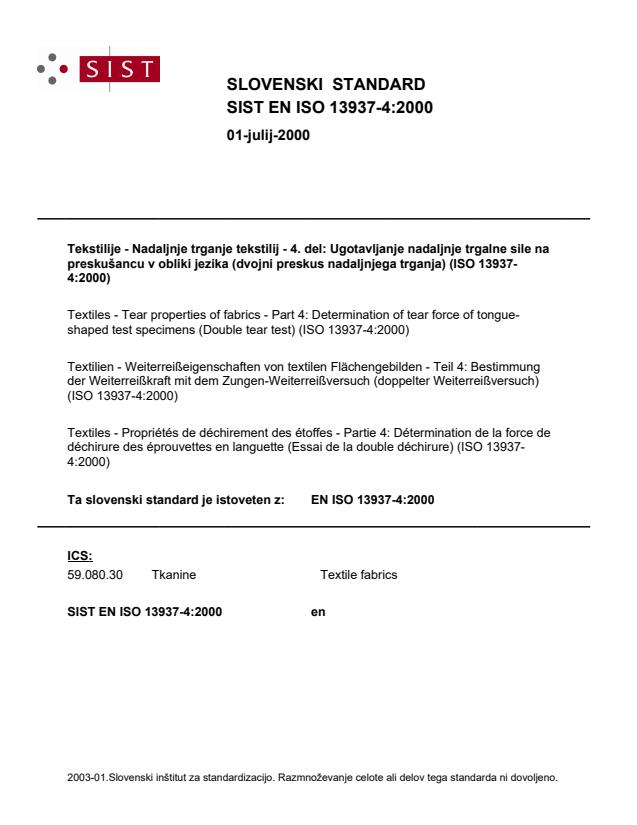
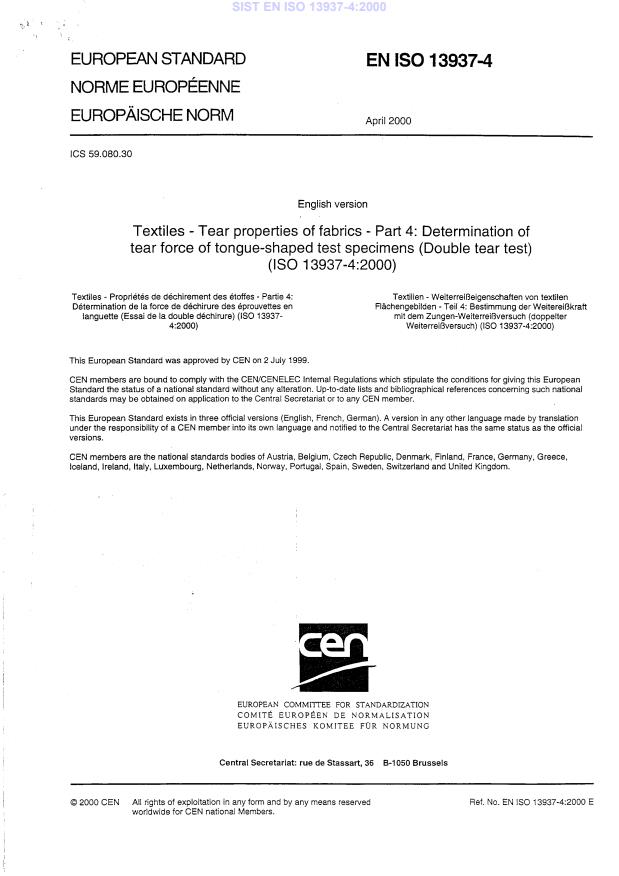
2003-01.Slovenski inštitut za standardizacijo. Razmnoževanje celote ali delov tega standarda ni dovoljeno.Tekstilije - Nadaljnje trganje tekstilij - 4. del: Ugotavljanje nadaljnje trgalne sile na preskušancu v obliki jezika (dvojni preskus nadaljnjega trganja) (ISO 13937-4:2000)Textilien - Weiterreißeigenschaften von textilen Flächengebilden - Teil 4: Bestimmung der Weiterreißkraft mit dem Zungen-Weiterreißversuch (doppelter Weiterreißversuch) (ISO 13937-4:2000)Textiles - Propriétés de déchirement des étoffes - Partie 4: Détermination de la force de déchirure des éprouvettes en languette (Essai de la double déchirure) (ISO 13937-4:2000)Textiles - Tear properties of fabrics - Part 4: Determination of tear force of tongue-s
...