

SIST IEC 60839-5-1:2024
(Main)Alarm and electronic security systems - Part 5-1: Alarm transmission systems - General requirements
General Information
- Abstract
IEC 60839-5-1:2014 specifies the requirements for the performance, reliability, resilience and security of alarm transmission systems and ensures their suitability for use with different types of alarm systems and annunciation equipment. This standard specifies the requirements for alarm transmission systems providing alarm transmission between an alarm system at supervised premises and annunciation equipment at an alarm receiving centre. It applies to transmission systems for all types of alarm messages such as fire, intrusion, access control, social alarm, etc. This edition includes the following significant technical changes with respect to the previous edition published 24 years ago: techniques and constraints have been widely changed since that time, which has been reflected in this new edition.
- Status
- Published
- Publication Date
- 02-Jul-2024
- Technical Committee
- EAL - Alarm systems
- Current Stage
- 6060 - National Implementation/Publication (Adopted Project)
- Start Date
- 21-Jun-2024
- Due Date
- 26-Aug-2024
- Completion Date
- 03-Jul-2024

Overview
SIST IEC 60839-5-1:2024 sets out the general requirements for alarm transmission systems (ATS) within alarm and electronic security environments. Developed by the Slovenian Institute for Standardization (SIST), this standard is based on the international IEC 60839-5-1:2014 edition. It focuses on ensuring the performance, reliability, resilience, and security of ATS, providing compatibility with various alarm types and annunciation equipment. Alarm transmission systems under this standard cover a range of scenarios, transferring alarm messages between supervised premises and alarm receiving centres (ARC). Updated to reflect significant changes in transmission techniques and industry requirements, this edition supersedes the previous 2002 version.
Key Topics
- Alarm Transmission System Definitions: Clear terminology for ATS components such as Supervised Premises Transceiver (SPT), Receiving Centre Transceiver (RCT), Annunciation Equipment (AE), and Alarm Transmission Path (ATP).
- Performance and Reliability: Requirements for maintaining continuous and effective alarm transmission, including system uptime (availability), redundancy, and timely delivery of alarm signals.
- Security and Resilience: Guidelines for authentication, encryption, and prevention of tampering or substitution in the transmission of alarm signals.
- System Categories and Configuration: Description of multiple system categories (single-path, dual-path, and custom) to meet different application needs and risk levels.
- ATS Compliance: Alignment with local, national, and international telecommunication and data transmission regulations.
- Documentation and Verification: Methods for performance verification, fault reporting, and maintaining records for compliance and system evaluation.
Applications
Alarm and electronic security system providers, alarm receiving center operators, fire and emergency services, telecommunication network operators, internet service providers, insurance companies, and manufacturers directly benefit from implementing SIST IEC 60839-5-1:2024. Typical applications include:
- Fire alarm systems: Ensuring prompt alarm transmission from premises to centralized monitoring for rapid response.
- Intrusion detection systems: Reliable and secure signalling for unauthorized access incidents.
- Access control and social alarm systems: Reliable communication of critical events, such as medical or security emergencies.
- Custom or high-risk environments: Ability to define custom ATS categories for specialized applications with bespoke requirements.
Implementing this standard ensures that all types of alarms-fire, intrusion, fault, status, and social alarms-are transmitted securely, promptly, and with verified reliability, helping end-users meet stringent industry and insurance requirements.
Related Standards
Organizations seeking comprehensive compliance should consider these related standards:
- EN 50136-1 – Alarm systems - Alarm transmission systems and equipment - General requirements.
- SIST IEC 60839-5-2 – Alarm transmission systems - Requirements for supervised premises transceiver (SPT).
- SIST IEC 60839-5-3 – Requirements for receiving centre transceiver (RCT).
- CLC/TS 50136-7 – Application guidelines for alarm transmission systems.
These standards complement SIST IEC 60839-5-1 by providing detailed specifications for subcomponents, operational guidelines, and integration requirements for holistic electronic security systems.
Practical Value
By following SIST IEC 60839-5-1:2024, security providers can:
- Enhance the integrity and resilience of alarm communications.
- Achieve regulatory compliance and compatibility with a wide range of transmission technologies.
- Reduce risk of message loss due to failures, faults, or malicious interference.
- Satisfy insurance and legal obligations for performance and documentation.
- Support flexible configurations and scalability in complex or evolving security infrastructures.
This standard is essential for any organization involved in the design, operation, or monitoring of alarm transmission systems, ensuring high standards of security, reliability, and performance.
Relations
- Effective Date
- 01-Sep-2014
- Effective Date
- 10-Feb-2026
Get Certified
Connect with accredited certification bodies for this standard

CIS Institut d.o.o.
Personal Protective Equipment (PPE) certification body. Notified Body NB-2890 for EU Regulation 2016/425 PPE.

Kiwa BDA Testing
Building and construction product certification.
Kmetijski inštitut Slovenije
Agricultural Institute of Slovenia. Soil testing, plant health, agricultural product analysis.
Sponsored listings
Frequently Asked Questions
SIST IEC 60839-5-1:2024 is a standard published by the Slovenian Institute for Standardization (SIST). Its full title is "Alarm and electronic security systems - Part 5-1: Alarm transmission systems - General requirements". This standard covers: IEC 60839-5-1:2014 specifies the requirements for the performance, reliability, resilience and security of alarm transmission systems and ensures their suitability for use with different types of alarm systems and annunciation equipment. This standard specifies the requirements for alarm transmission systems providing alarm transmission between an alarm system at supervised premises and annunciation equipment at an alarm receiving centre. It applies to transmission systems for all types of alarm messages such as fire, intrusion, access control, social alarm, etc. This edition includes the following significant technical changes with respect to the previous edition published 24 years ago: techniques and constraints have been widely changed since that time, which has been reflected in this new edition.
IEC 60839-5-1:2014 specifies the requirements for the performance, reliability, resilience and security of alarm transmission systems and ensures their suitability for use with different types of alarm systems and annunciation equipment. This standard specifies the requirements for alarm transmission systems providing alarm transmission between an alarm system at supervised premises and annunciation equipment at an alarm receiving centre. It applies to transmission systems for all types of alarm messages such as fire, intrusion, access control, social alarm, etc. This edition includes the following significant technical changes with respect to the previous edition published 24 years ago: techniques and constraints have been widely changed since that time, which has been reflected in this new edition.
SIST IEC 60839-5-1:2024 is classified under the following ICS (International Classification for Standards) categories: 01 - GENERALITIES. TERMINOLOGY. STANDARDIZATION. DOCUMENTATION; 13.320 - Alarm and warning systems. The ICS classification helps identify the subject area and facilitates finding related standards.
SIST IEC 60839-5-1:2024 has the following relationships with other standards: It is inter standard links to SIST IEC 60839-5-1:2002, SIST EN IEC 62820-3-2:2018. Understanding these relationships helps ensure you are using the most current and applicable version of the standard.
SIST IEC 60839-5-1:2024 is associated with the following European legislation: EU Directives/Regulations: 2007-01-2231. When a standard is cited in the Official Journal of the European Union, products manufactured in conformity with it benefit from a presumption of conformity with the essential requirements of the corresponding EU directive or regulation.
SIST IEC 60839-5-1:2024 is available in PDF format for immediate download after purchase. The document can be added to your cart and obtained through the secure checkout process. Digital delivery ensures instant access to the complete standard document.
Standards Content (Sample)
SLOVENSKI STANDARD
01-september-2024
Nadomešča:
SIST IEC 60839-5-1:2002
Alarmni in elektronski varnostni sistemi - 5-1. del: Alarmni prenosni sistemi -
Splošne zahteve (IEC 60839-5-1:2014)
Alarm and electronic security systems - Part 5-1: Alarm transmission systems - General
requirements
Systèmes d'alarme et de sécurité électroniques - Partie 5-1: Systèmes de transmission
d'alarme - Exigences générales
Ta slovenski standard je istoveten z: IEC 60839-5-1:2014
ICS:
13.320 Alarmni in opozorilni sistemi Alarm and warning systems
2003-01.Slovenski inštitut za standardizacijo. Razmnoževanje celote ali delov tega standarda ni dovoljeno.
IEC 60839-5-1 ®
Edition 2.0 2014-07
INTERNATIONAL
STANDARD
NORME
INTERNATIONALE
Alarm and electronic security systems –
Part 5-1: Alarm transmission systems – General requirements
Systèmes d’alarme et de sécurité électroniques –
Partie 5-1: Systèmes de transmission d’alarme – Exigences générales
INTERNATIONAL
ELECTROTECHNICAL
COMMISSION
COMMISSION
ELECTROTECHNIQUE
PRICE CODE
INTERNATIONALE
CODE PRIX W
ICS 13.320 ISBN 978-2-8322-1789-4
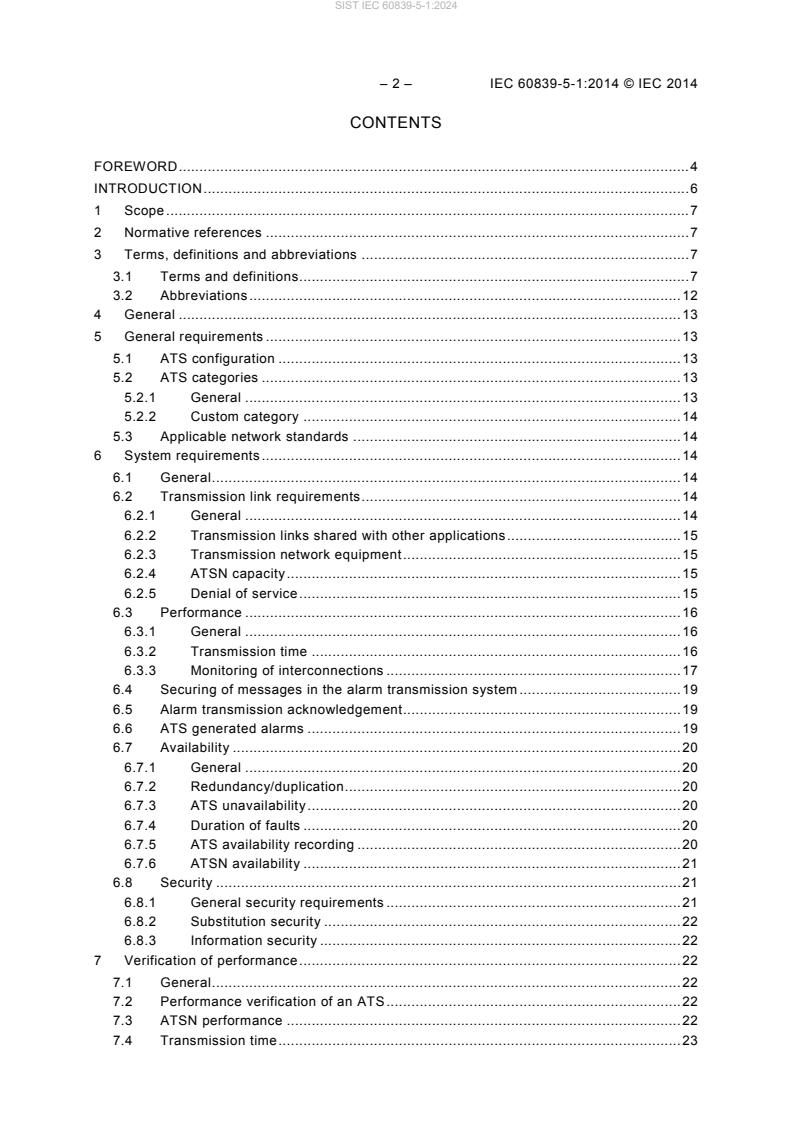
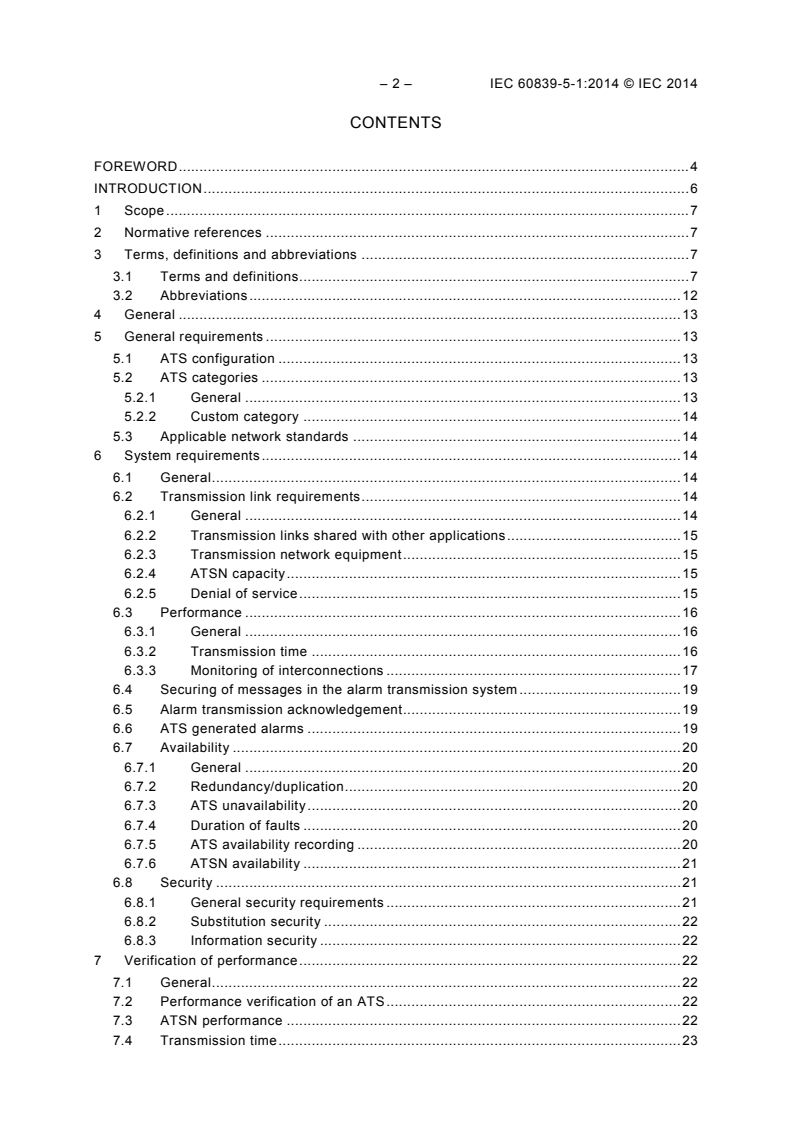
– 2 – IEC 60839-5-1:2014 © IEC 2014
CONTENTS
FOREWORD . 4
INTRODUCTION . 6
1 Scope . 7
2 Normative references . 7
3 Terms, definitions and abbreviations . 7
3.1 Terms and definitions . 7
3.2 Abbreviations . 12
4 General . 13
5 General requirements . 13
5.1 ATS configuration . 13
5.2 ATS categories . 13
5.2.1 General . 13
5.2.2 Custom category . 14
5.3 Applicable network standards . 14
6 System requirements . 14
6.1 General . 14
6.2 Transmission link requirements . 14
6.2.1 General . 14
6.2.2 Transmission links shared with other applications . 15
6.2.3 Transmission network equipment . 15
6.2.4 ATSN capacity . 15
6.2.5 Denial of service . 15
6.3 Performance . 16
6.3.1 General . 16
6.3.2 Transmission time . 16
6.3.3 Monitoring of interconnections . 17
6.4 Securing of messages in the alarm transmission system . 19
6.5 Alarm transmission acknowledgement . 19
6.6 ATS generated alarms . 19
6.7 Availability . 20
6.7.1 General . 20
6.7.2 Redundancy/duplication . 20
6.7.3 ATS unavailability . 20
6.7.4 Duration of faults . 20
6.7.5 ATS availability recording . 20
6.7.6 ATSN availability . 21
6.8 Security . 21
6.8.1 General security requirements . 21
6.8.2 Substitution security . 22
6.8.3 Information security . 22
7 Verification of performance . 22
7.1 General . 22
7.2 Performance verification of an ATS . 22
7.3 ATSN performance . 22
7.4 Transmission time . 23
7.5 Verification interval . 23
7.6 Availability . 23
7.6.1 Records . 23
7.6.2 Inspection of records . 24
7.6.3 Calculations . 24
8 Documentation . 25
Annex A (informative) ATS configurations examples . 27
Annex B (informative) Availability examples . 29
Annex C (informative) Verification of performance . 30
C.1 General . 30
C.2 Set-up configuration . 30
C.3 System evaluation and functional verification . 30
C.4 Functional verification . 31
Annex D (normative) Classes for category C . 32
Bibliography . 34
Figure 1 – Logical representation of an ATS . 26
Figure A.1 – Example of a simple single path alarm transmission system . 27
Figure A.2 – Example of a simple dual path alarm transmission system . 27
Figure A.3 – Example of a dual path alarm transmission system . 28
Figure C.1 – Block diagram . 30
Table 1 – ATS configuration . 14
Table 2 – Transmission time . 17
Table 3 – Maximum reporting time . 18
Table 4 – RCT to AE alarm reporting . 19
Table 5 – SPT to AS alarm reporting . 19
Table 6 – ATS availability recording . 21
Table 7 – ATSN availability . 21
Table 8 – SPT substitution security requirements . 22
Table 9 – Information security requirements . 22
Table C.1 – Verification results table . 31
Table D.1 – Transmission time classification . 32
Table D.2 – Transmission time, maximum values . 32
Table D.3 – Reporting time classification . 32
Table D.4 – Availability classification . 32
Table D.5 – Substitution security . 32
Table D.6 – Information security . 33
– 4 – IEC 60839-5-1:2014 © IEC 2014
INTERNATIONAL ELECTROTECHNICAL COMMISSION
____________
ALARM AND ELECTRONIC SECURITY SYSTEMS –
Part 5-1: Alarm transmission systems –
General requirements
FOREWORD
1) The International Electrotechnical Commission (IEC) is a worldwide organization for standardization comprising
all national electrotechnical committees (IEC National Committees). The object of IEC is to promote
international co-operation on all questions concerning standardization in the electrical and electronic fields. To
this end and in addition to other activities, IEC publishes International Standards, Technical Specifications,
Technical Reports, Publicly Available Specifications (PAS) and Guides (hereafter referred to as “IEC
Publication(s)”). Their preparation is entrusted to technical committees; any IEC National Committee interested
in the subject dealt with may participate in this preparatory work. International, governmental and non-
governmental organizations liaising with the IEC also participate in this preparation. IEC collaborates closely
with the International Organization for Standardization (ISO) in accordance with conditions determined by
agreement between the two organizations.
2) The formal decisions or agreements of IEC on technical matters express, as nearly as possible, an international
consensus of opinion on the relevant subjects since each technical committee has representation from all
interested IEC National Committees.
3) IEC Publications have the form of recommendations for international use and are accepted by IEC National
Committees in that sense. While all reasonable efforts are made to ensure that the technical content of IEC
Publications is accurate, IEC cannot be held responsible for the way in which they are used or for any
misinterpretation by any end user.
4) In order to promote international uniformity, IEC National Committees undertake to apply IEC Publications
transparently to the maximum extent possible in their national and regional publications. Any divergence
between any IEC Publication and the corresponding national or regional publication shall be clearly indicated in
the latter.
5) IEC itself does not provide any attestation of conformity. Independent certification bodies provide conformity
assessment services and, in some areas, access to IEC marks of conformity. IEC is not responsible for any
services carried out by independent certification bodies.
6) All users should ensure that they have the latest edition of this publication.
7) No liability shall attach to IEC or its directors, employees, servants or agents including individual experts and
members of its technical committees and IEC National Committees for any personal injury, property damage or
other damage of any nature whatsoever, whether direct or indirect, or for costs (including legal fees) and
expenses arising out of the publication, use of, or reliance upon, this IEC Publication or any other IEC
Publications.
8) Attention is drawn to the Normative references cited in this publication. Use of the referenced publications is
indispensable for the correct application of this publication.
9) Attention is drawn to the possibility that some of the elements of this IEC Publication may be the subject of
patent rights. IEC shall not be held responsible for identifying any or all such patent rights.
International Standard IEC 60839-5-1 has been prepared by IEC technical committee 79:
Alarm and electronic security systems.
This international standard is based on EN 50136-1:2012.
This second edition cancels and replaces the first edition published 1991. This edition
constitutes a technical revision.
This edition includes the following significant technical changes with respect to the previous
edition:
a) The previous version was published 24 years ago, techniques and constraints have been
widely changed since that time. Although covering the same subject the contents of the
new IEC 60839-5-1 are widely different and there is no constructive issues in trying to find
similarities and differences between both versions.
The text of this standard is based on the following documents:
FDIS Report on voting
79/479/FDIS 79/490/RVD
Full information on the voting for the approval of this standard can be found in the report on
voting indicated in the above table.
This publication has been drafted in accordance with the ISO/IEC Directives, Part 2.
A list of all parts in the IEC 60839 series, published under the general title Alarm and
electronic security systems, can be found on the IEC website.
Future standards in this series will carry the new general title as cited above. Titles of existing
standards in this series will be updated at the time of the next edition.
The committee has decided that the contents of this publication will remain unchanged until
the stability date indicated on the IEC web site under "http://webstore.iec.ch" in the data
related to the specific publication. At this date, the publication will be
• reconfirmed,
• withdrawn,
• replaced by a revised edition, or
• amended.
– 6 – IEC 60839-5-1:2014 © IEC 2014
INTRODUCTION
The object of this part of IEC 60839 is to specify the general requirements for the
performance, reliability, resilience and security of alarm transmission systems and to ensure
their suitability for use with different types of alarm systems and annunciation equipment.
An alarm transmission system may use any type of transmission network.
When the ATS functions are integrated into an alarm system or annunciation equipment the
requirements of this standard apply.
The intended users of this standard include alarm transmission service providers, alarm
receiving centre operators, fire departments, insurance companies, telecommunication
network operators, internet service providers, equipment manufacturers, alarm companies,
end users and others.
The IEC 60839-5 series consists of the following parts, under the general title Alarm and
electronic security systems:
– Part 5-1: Alarm transmission systems – General requirements;
– Part 5-2: Alarm transmission systems – Requirements for supervised premises transceiver
(SPT);
– Part 5-3: Alarm transmission systems – Requirements for receiving centre transceiver
(RCT);
– Part 5-4 : (under evaluation);
– Part 5-5 : (under evaluation);
– Part 5-6 : (under evaluation);
– Part 5-7: (place holder).
_______________
1 The former IEC 60839-5 series (1991) is being reviewed by an ad-hoc group set-up at the TC 79 meeting in
Milano in October 2013. This ad-hoc group is in charge of evaluating the relevance / obsolescence of all parts
of IEC 60839-5 series. The result of this analysis can be found in 79/462/DC and 79/477/INF that recommend to:
– keep IEC 60839-5-1 and IEC 60839-5-2 to receive, under identical titles, updated contents, such as the
present document;
– withdraw IEC 60839-5-4, IEC 60839-5-5 and IEC 60839-5-6 developed in 1991 that have now no relevance.
ALARM AND ELECTRONIC SECURITY SYSTEMS –
Part 5-1: Alarm transmission systems –
General requirements
1 Scope
This part of IEC 60839 specifies the requirements for the performance, reliability, resilience
and security of alarm transmission systems and ensures their suitability for use with different
types of alarm systems and annunciation equipment.
An alarm transmission system may use any type of transmission network. When the ATS
functions are integrated into an alarm system or annunciation equipment the requirements of
this standard apply.
This standard specifies the requirements for alarm transmission systems providing alarm
transmission between an alarm system at supervised premises and annunciation equipment at
an alarm receiving centre.
This standard applies to transmission systems for all types of alarm messages such as fire,
intrusion, access control, social alarm, etc. Different types of alarm systems may in addition to
alarm messages also send other types of messages, e.g. fault messages and status
messages. These messages are also considered to be alarm messages in the context of this
standard. The term alarm is used in this broad sense throughout the document.
Additional alarm transmission requirements of specific types of alarm systems are given in the
relevant standards. The intended users of this standard include alarm transmission service
providers, alarm receiving centre operators, fire departments, insurance companies,
telecommunication network operators, internet service providers, equipment manufacturers,
alarm companies, end users and others.
2 Normative references
The following documents, in whole or in part, are normatively referenced in this document and
are indispensable for its application. For dated references, only the edition cited applies. For
undated references, the latest edition of the referenced document (including any amendments)
applies.
None.
3 Terms, definitions and abbreviations
3.1 Terms and definitions
For the purposes of this document, the following terms and definitions apply.
NOTE The definitions below are read in conjunction with Figure 1.
3.1.1
alarm condition
condition of an alarm system (AS), or part thereof, which results from the response of the
system, or part thereof, to the presence of a hazard
– 8 – IEC 60839-5-1:2014 © IEC 2014
3.1.2
alarm receiving centre
ARC
continuously manned centre to which information concerning the status of one or more alarm
systems (ASs) is reported
Note 1 to entry: This note applies to the French language only.
3.1.3
alarm system
AS
electrical installation, which responds to the manual or automatic detection of the presence of
a hazard
Note 1 to entry: The AS is not part of the alarm transmission system (ATS).
Note 2 to entry: This note applies to the French language only.
3.1.4
alarm transmission equipment
ATE
collective term to describe a supervised premises transceiver (SPT), a monitoring centre
transceiver (MCT) and a receiving centre transceiver (RCT)
Note 1 to entry: This note applies to the French language only.
3.1.5
alarm transmission path
ATP
route an alarm message travels between an individual AS and its associated AE
Note 1 to entry: The ATP starts at the interface between the AS and the supervised premises transceiver (SPT)
and ends at the interface between the receiving centre transceiver (RCT) and the AE. For notification and
surveillance purposes the reverse direction may also be used.
Note 2 to entry: This note applies to the French language only.
3.1.6
alarm transmission service network
ATSN
group of alarm transmission systems (ATSs) of the same category
Note 1 to entry: An ATSN consists of one or more ATSs of the same category, functioning under supervision of
the same management and monitoring centre.
Note 2 to entry: This note applies to the French language only.
3.1.7
alarm transmission service provider
ATSP
person or entity that is responsible for design, operation and the verification of the
performance of one or more alarm transmission service networks (ATSNs)
Note 1 to entry: The ATSP may take responsibility for the ATS provision and performance monitoring of one or
more ATSN as the design authority, through contracts with customers, ARCs, transmission network operators, etc.
Note 2 to entry: This note applies to the French language only.
3.1.8
alarm transmission system
ATS
alarm transmission equipment (ATE) and networks used to transfer information concerned
with the state of one or more alarm systems (ASs) at supervised premises to one or more
annunciation equipments (AEs) of one or more alarm receiving centres (ARCs)
Note 1 to entry: An ATS may consist of more than one alarm transmission path (ATP).
Note 2 to entry: This note applies to the French language only.
3.1.9
alarm transmission system category
ATS category
set of parameters that define the performance requirements of an alarm transmission system
Note 1 to entry: A category defines minimum ATS requirements.
Note 2 to entry: The alarm system application should specify the appropriate ATS category.
Note 3 to entry: Where resilience and reliability are considered important for the alarm system application, the
use of a dual path ATS is recommended.
3.1.10
alarm transmission system management system
ATS management system
part of the ATS that is used to manage alarm transmission equipment, supervise alarm
transmission equipment and networks and may help to keep the ATS in operation
Note 1 to entry: The management system may also be used to collect data about the ATS availability.
3.1.11
alarm transmission system monitoring centre
ATS monitoring centre
centre in which the status and performance of one or more ATS is monitored
Note 1 to entry: A monitoring centre may be a separate centre or part of an ARC.
Note 2 to entry: A monitoring centre may be the place where monitoring centre transceivers (MCTs) are located.
Note 3 to entry: A monitoring centre may be the place where a management system is located.
3.1.12
annunciation equipment
AE
equipment located at an alarm receiving centre (ARC) which secures and displays the alarm
status, or the changed alarm status of alarm systems (ASs) in response to the receipt of
incoming alarms before sending a confirmation
Note 1 to entry: The AE is not part of the alarm transmission system (ATS).
Note 2 to entry: This note applies to the French language only.
3.1.13
authentication
exchange of a code to identify that a supervised premises transceiver (SPT) has not been
substituted by a similar equipment without this code, or that the information message
transmitted has not been modified
3.1.14
availability, general
percentage of time a system or parts of a system are functioning in accordance with the
requirements of this standard
3.1.15
diverse technology
technology used in transmission paths in such a way that a single point of failure, or
tampering of a single point, cannot cause both alarm transmission paths (ATPs) of a dual path
system to fail simultaneously
– 10 – IEC 60839-5-1:2014 © IEC 2014
3.1.16
dual path ATS
dual path alarm transmission system
ATS consisting of one primary alarm transmission path (ATP) and one secondary ATP using
diverse technology, having two transmission network interfaces at the supervised premises
transceiver (SPT), to connect one or more alarm systems (ASs) of one supervised premises
to one or more annunciation equipments (AEs) of one or more alarm receiving centres (ARCs)
3.1.17
encryption
systematic encoding of a bit stream before transmission, so that the information contained in
the bit stream cannot be deciphered by an unauthorised party
3.1.18
fault condition
condition of a system which prevents a system or part thereof from functioning normally
3.1.19
fault message
fault signal
message or signal generated as a result of a fault condition
3.1.20
hashing technique
use of a mathematical transformation that takes an input and returns a fixed-size string, which
is called the hash value
Note 1 to entry: The hash value is used to detect any alteration of the input and therefore verify the contents in an
easy way.
3.1.21
message
series of transmitted signals which include identification, function data and the various means
for providing their own integrity, immunity and proper reception
3.1.22
monitoring centre
centre in which the status of one or more alarm transmission service networks (ATSNs) is
monitored
3.1.23
monitoring centre transceiver
MCT
alarm transmission equipment (ATE) within the alarm transmission system (ATS) that enables
monitoring and management information regarding the status of alarm transmission
equipment and networks
Note 1 to entry: The monitoring centre transceiver may be located at the alarm receiving centre or at a separate
centre.
Note 2 to entry: This note applies to the French language only.
3.1.24
multiple path alarm transmission system
multiple path ATS
ATS where more than one independent alarm transmission paths (ATPs) are combined to
connect one or more alarm systems (ASs) of one supervised premises to one or more
annunciation equipments (AEs) of one or more alarm receiving centres (ARCs)
3.1.25
network equipment on site
equipment that is part of the alarm transmission path (ATP), but is not considered to be alarm
transmission equipment (ATE)
3.1.26
packet switched network
PSN
transmission network that uses packet switching
Note 1 to entry: Messages are broken into packets, which are addressed individually and routed through the
network, possibly using different routes. At the end node the packets are re-assembled to be converted back to the
original message.
Note 2 to entry: The most prominent example of a packet switched data network is the Internet, making use of the
Internet protocol suite, which is specified by the Internet Engineering Task Force (IETF) in so called requests for
comments (RFCs).
Note 3 to entry: This note applies to the French language only.
3.1.27
peer review
evaluation of work by one or more people of similar competence to the producers of the work
(peers).
Note 1 to entry: In this standard the definition applies to cryptographic algorithms, it means there is published
evidence that the cryptographic community has confirmed the robustness of the algorithm against attack.
3.1.28
receiving centre transceiver
RCT
alarm transmission equipment (ATE) at the alarm receiving centre (ARC) including the
interface to one or more annunciation equipments (AEs) and the interface to one or more
transmission networks and which is part of one or more alarm transmission paths (ATPs)
Note 1 to entry: In some systems this transceiver may be able to indicate changes of the status of an alarm
system (AS) and to store log-files. This may be needed to increase the alarm transmission system (ATS)
availability in case of AE failure.
Note 2 to entry: This note applies to the French language only.
3.1.29
reporting time
period from the time a fault occurs in the alarm transmission system (ATS) until the fault
information is reported to the receiving centre transceiver (RCT), the alarm system (AS) at the
supervised premises and the monitoring centre transceiver (MCT) (if provided)
3.1.30
secured message
message which cannot be lost (e.g. in the case of power failure) and which can be retrieved
3.1.31
signalling security
method(s) used to prevent or detect deliberate attempts to interfere with the transmission of
an alarm by blocking or substitution
3.1.32
single path alarm transmission system
single path ATS
ATS that consists of one alarm transmission path (ATP) to connect one or more alarm
systems (ASs) of one supervised premises to one or more annunciation equipments (AEs) of
one or more alarm receiving centre (ARCs)
– 12 – IEC 60839-5-1:2014 © IEC 2014
3.1.33
supervised premises transceiver
SPT
alarm transmission equipment (ATE) at the supervised premises including the interface to the
alarm system (AS) and the interface to one or more transmission networks and which is part
of one or more alarm transmission paths (ATPs)
Note 1 to entry: This note applies to the French language only.
3.1.34
system capacity
maximum number of alarm systems (ASs) that can be connected to an alarm transmission
service network (ATSN)
3.1.35
transmission link
part of a transmission network used to carry one or more alarm transmission paths (ATPs)
Note 1 to entry: An ATP can be established by switching together transmission links in several ways (in parallel,
in series and in combinations thereof).
Note 2 to entry: A transmission link can carry several ATPs or sections of ATPs.
3.1.36
transmission network
network between two or more items of alarm transmission equipment (ATE)
Note 1 to entry: Where the network is provided by a common carrier (e.g. a public telephone network operator)
the network may include items of general transmission equipment, which may not be covered by the requirements
of IEC 60839-5-2, e.g. public telephone network operator equipment, mobile telephone operator equipment, ADSL
modems, SDSL modems, Routers, Ethernet switches, Ethernet hubs, Firewalls and network wiring.
3.1.37
transmission time
time from when a change of state occurs or an alarm message is presented for transmission
at the supervised premises transceiver (SPT) interface to the alarm system (AS) until the time
that the new state or message is reported at the receiving centre transceiver (RCT) interface
to the annunciation equipment (AE)
3.2 Abbreviations
For the purposes of this document, the following abbreviations apply. The following
abbreviations apply to the entire IEC 60839 series.
ADSL Asymmetric digital subscriber line
AE Annunciation equipment
ARC Alarm receiving centre
AS Alarm system
ATE Alarm transmission equipment
ATP Alarm transmission path
ATS Alarm transmission system
ATSN Alarm transmission service network
ATSP Alarm transmission service provider
DSL Digital subscriber line
DTMF Dual tone multi frequency
GSM Global system mobile
ISO International Standardisation Organisation
ISDN Integrated service digital network
MCT Monitoring centre transceiver
OSI Open systems interconnection
PSN Packet switched network
PSTN Public switched telephone network
RCT Receiving centre transceiver
SPT Supervised premises transceiver
SDSL Symmetric digital subscriber line
4 General
(void)
5 General requirements
5.1 ATS configuration
The logical configuration of an ATS shall be as shown in Figure 1. The main function of an
ATS is to provide a reliable and secure transmission network from the interface of the AS to
the SPT to the interface of the RCT to the AE for the transmission of alarms.
Depending upon the required reliability and resilience of the ATS and the operational features
of the ARC, various ATS configurations may be used, including the use of more than one ATP
between an AS and one or more RCTs connected to one or more AEs. Each ATP shall have
its own transmission network interface at the SPT.
NOTE 1 For example an SPT can use a fixed line network and a radio network.
Selection of the category of ATS used for an AS shall be determined by the required reliability
and security for the associated application. Reference should be made to the category of ATS
required and the options that may be selected.
NOTE 2 Examples of different ATS configurations are indicated in Annex A, Figures A.1 to A.3.
5.2 ATS categories
5.2.1 General
An alarm transmission system shall be selected from one of ten categories described by this
standard. An ATS shall be allocated a category which will determine its performance and
resilience.
Categories SP1 to SP6 are based on single ATP ATSs.
Categories DP1 to DP4 add resilience by requiring alternate ATPs.
– 14 – IEC 60839-5-1:2014 © IEC 2014
Table 1 – ATS configuration
SP1 SP2 SP3 SP4 SP5 SP6 DP1 DP2 DP3 DP4
SPT primary network interface M M M M M M M M M M
SPT alternative network interface Op Op Op Op Op Op M M M M
Alternative RCT Op Op Op Op Op Op M M M M
RCT primary network interface M M M M M M M M M M
RCT alternative network interface Op Op Op Op Op Op M M M M
Key
M = Mandatory
Op = Optional
5.2.2 Custom category
5.2.2.1 General
Where an application cannot be satisfied by any of the categories of this standard a new
custom category, category C, shall be defined within an application specific standard using
parameters from the classes defined in Annex D.
Where a custom category is used reference shall be made to the tables in Annex D instead of
the category tables, Table 1 to Table 9. All other requirements of this standard shall apply.
5.2.2.2 Documentation
Where there is a requirement for a custom category C, it shall include the rationale for the
choice of a custom category and there shall be sufficient documentation for the verification of
performance.
A statement shall be made referring to the requirements listed in Tables 1, 4, 5 and 6.
5.3 Applicable network standards
Equipment and systems shall meet local, national and international requirements and
regulations for attachment to, establishment and termination of, connection and transmission
via public telephone and data networks and/or the regulations for transmission via the use of
radio, power distribution systems or cable TV distribution systems.
6 System requirements
6.1 General
The ATS shall provide communication between one or more ASs at one supervised premises
and one or more AEs of one or more ARCs.
6.2 Transmission link requirements
6.2.1 General
An ATP may include permanent dedicated links, permanent virtual links or switched links
which may use equipment that is not covered by the requirements of IEC 60839-5-2 and
IEC 60839-5-3 or may be affected by other applications sharing the transmission links.
An ATP may include:
– a transmission link that is shared with non-alarm data applications,
– a transmission link that carries other ATPs,
– equipment from a third party transmission network provider, which is not located at either
the supervised premises or the alarm receiving centre and is not classified as ATE,
– equipment from a third party which is located at the supervised premises but is not
classified as ATE.
The performance (reliability) of an ATS may be affected by:
– unwanted, malformed or otherwise malicious incoming data at the interfaces of the SPT or
RCT,
– transmission network congestion as a result of transmission link sharing,
– transmission network unavailability due to equipment failure and/or maintenance.
6.2.2 Transmission links shared with other applications
Transmission links shared with other applications shall be arranged such that operation and
maintenance does not prevent the ATS from meeting the requirements of this standard.
6.2.3 Transmission network equipment
Transmission equipment that is connected between the transmission network interface of the
SPT and the transmission network interface of the RCT and/or MCT is not subject to the
requirements of IEC 60839-5-2 and IEC 60839-5-3.
NOTE 1 Examples of SPT integrated network interfaces include analogue modems, DTMF transceivers, ISDN
terminal adapters, Ethernet modules, and GSM radio modules. No technologies are excluded.
NOTE 2 Equipment at the supervised premises will be subject to the application guidelines provided within
CLC/TS 50136-7.
NOTE 3 Local network interface failures can be detected and reported by the SPT to the RCT using the remaining
operational transmission path; however interface monitoring cannot be used to provide confirmation that a
transmission path is operational.
6.2.4 ATSN capacity
The ATSP shall provide a statement regarding the number of ASs that can be connected to
the ATSN that will ensure compliance with the requirements of Table 2.
Any single ATP shall continue to meet the requirements of the appropriate transmission time
and the maximum transmission time of Table 2:
a) at a rate equivalent to one such message per minute from each of a number of ASs
representing at least 0,1 % of the system capacity, and
b) at a rate of at least 2 alarms per minute at the RCT interface to the AE.
The evaluation shall be done when the ATSN is in a normal condition with the stipulated rate
of messages.
6.2.5 Denial of service
The ATS shall protect itself against Denial of Service (DoS) attacks from the transmission
network.
Any form of incoming data or signal received from a transmission network shall not prevent
the ATP from performing as specified, unless the amount of incoming data leads to
congestion of the transmission link. ATP performance deterioration is not allowed when there
is enough remaining network capacity to carry ATP signalling.
Any malicious data received by a transmission network interface, shall not affect the operation
of the ATE (SPT, RCT or MCT) or the operation of any other transmission network interface.
– 16 – IEC 60839-5-1:2014 © IEC 2014
This applies even if the malicious data rate reaches the capacity of a single interface,
rendering the interface itself inoperable.
If the performance of the ATS is affected by a DoS attack, a fault signal shall be generated
according to the monitoring and fault reporting requirements of the applicable category.
NOTE 1 This requirement is intended to emphasize the need to protect against attacks where malicious data or
signalling is used to interfere with the operation of the ATE. These attacks can be performed either by malicious
signalling designed to impair the ATE or by overloading the communications with large amounts of data.
NOTE 2 DoS attacks can be present in any network, e.g. IP networks, PSTN networks. Examples of such attacks
are: devices deliberately overloading the IP network, automatic dialling facilities to overload parts of PSTN
networks, jamming devices to interfere with radio communications, etc.
6.3 Performance
6.3.1 General
For the categorisation of the ATS the following parameters are used:
– transmission time; average, 95 % and maximum;
– reporting time;
– monitoring of interconnections;
– ATSN availability.
6.3.2 Transmission time
The arithmetic mean of the alarm transmission time and 95 % of the measurements of the
transmission time shall not exceed the values specified in Table 2 for the appropriate
category.
Any transmission time exceeding the maximum acceptable transmission time of Table 2 for a
specific system shall, for each incident, be classified as a transmission system fault in
accordance with NOTE 7.
The time is measured from the time when a change of state occurs or an alarm message is
presented for transmission at the SPT interface to the AS until the time that the new state or
message is reported at the RCT interface to the AE.
The transmission time applies to all changes of state or message that are transmitted from the
AS through the SPT interface to the ATS.
NOTE 1 Where the SPT interface to the AS is not accessible the measurement can be made from a more
accessible point before the SPT interface to the AS and an appropriate correction applied to the result.
NOTE 2 Where the RCT interface to the AE is not accessible, or where it is more convenient, the measurement
can be made to a point after the RCT interface to the AE and an appropriate correction applied to the result.
NOTE 3 Times within the AS and within the AE will be specified in other standards.
NOTE 4 For most ATS(s) there exists a direct relation between the classification of Tables 2 and 3.
NOTE 5 The transmission time includes the time to establish a connection.
Table 2 – Transmission time
Transmission time SP1 SP2 SP3 SP4 SP5 SP6 DP1 DP2 DP3 DP4
Arithmetic mean of all
120 s 60 s 20 s 20 s 10 s 10 s 60 s 20 s 20 s 10 s
transmissions
95 % of all transmissions 240 s 90 s 30 s 30 s 15 s 15 s 90 s 30 s 30 s 15 s
Maximum acceptable
480 s 120 s 60 s 60 s 30 s 30 s 120 s 60 s 60 s 30 s
transmission time
Where the transmission time cannot be measured directly then it is acceptable that the round-
trip time may be measured. In this case the round-trip time shall meet the same requirements
as the transmission time for the appropriate category in Tables 2 and 3.
NOTE 6 The transmission
...
IEC 60839-5-1 ®
Edition 2.0 2014-07
INTERNATIONAL
STANDARD
NORME
INTERNATIONALE
Alarm and electronic security systems –
Part 5-1: Alarm transmission systems – General requirements
Systèmes d’alarme et de sécurité électroniques –
Partie 5-1: Systèmes de transmission d’alarme – Exigences générales
All rights reserved. Unless otherwise specified, no part of this publication may be reproduced or utilized in any form
or by any means, electronic or mechanical, including photocopying and microfilm, without permission in writing from
either IEC or IEC's member National Committee in the country of the requester. If you have any questions about IEC
copyright or have an enquiry about obtaining additional rights to this publication, please contact the address below or
your local IEC member National Committee for further information.
Droits de reproduction réservés. Sauf indication contraire, aucune partie de cette publication ne peut être reproduite
ni utilisée sous quelque forme que ce soit et par aucun procédé, électronique ou mécanique, y compris la photocopie
et les microfilms, sans l'accord écrit de l'IEC ou du Comité national de l'IEC du pays du demandeur. Si vous avez des
questions sur le copyright de l'IEC ou si vous désirez obtenir des droits supplémentaires sur cette publication, utilisez
les coordonnées ci-après ou contactez le Comité national de l'IEC de votre pays de résidence.
IEC Central Office Tel.: +41 22 919 02 11
3, rue de Varembé Fax: +41 22 919 03 00
CH-1211 Geneva 20 info@iec.ch
Switzerland www.iec.ch
About the IEC
The International Electrotechnical Commission (IEC) is the leading global organization that prepares and publishes
International Standards for all electrical, electronic and related technologies.
About IEC publications
The technical content of IEC publications is kept under constant review by the IEC. Please make sure that you have the
latest edition, a corrigenda or an amendment might have been published.
IEC Catalogue - webstore.iec.ch/catalogue Electropedia - www.electropedia.org
The stand-alone application for consulting the entire The world's leading online dictionary of electronic and
bibliographical information on IEC International Standards, electrical terms containing more than 30 000 terms and
Technical Specifications, Technical Reports and other definitions in English and French, with equivalent terms in 14
documents. Available for PC, Mac OS, Android Tablets and additional languages. Also known as the International
iPad. Electrotechnical Vocabulary (IEV) online.
IEC publications search - www.iec.ch/searchpub IEC Glossary - std.iec.ch/glossary
The advanced search enables to find IEC publications by a More than 55 000 electrotechnical terminology entries in
variety of criteria (reference number, text, technical English and French extracted from the Terms and Definitions
committee,…). It also gives information on projects, replaced clause of IEC publications issued since 2002. Some entries
and withdrawn publications. have been collected from earlier publications of IEC TC 37,
77, 86 and CISPR.
IEC Just Published - webstore.iec.ch/justpublished
Stay up to date on all new IEC publications. Just Published IEC Customer Service Centre - webstore.iec.ch/csc
details all new publications released. Available online and If you wish to give us your feedback on this publication or
also once a month by email. need further assistance, please contact the Customer Service
Centre: csc@iec.ch.
A propos de l'IEC
La Commission Electrotechnique Internationale (IEC) est la première organisation mondiale qui élabore et publie des
Normes internationales pour tout ce qui a trait à l'électricité, à l'électronique et aux technologies apparentées.
A propos des publications IEC
Le contenu technique des publications IEC est constamment revu. Veuillez vous assurer que vous possédez l’édition la
plus récente, un corrigendum ou amendement peut avoir été publié.
Catalogue IEC - webstore.iec.ch/catalogue Electropedia - www.electropedia.org
Application autonome pour consulter tous les renseignements
Le premier dictionnaire en ligne de termes électroniques et
bibliographiques sur les Normes internationales,
électriques. Il contient plus de 30 000 termes et définitions en
Spécifications techniques, Rapports techniques et autres
anglais et en français, ainsi que les termes équivalents dans
documents de l'IEC. Disponible pour PC, Mac OS, tablettes
14 langues additionnelles. Egalement appelé Vocabulaire
Android et iPad.
Electrotechnique International (IEV) en ligne.
Recherche de publications IEC - www.iec.ch/searchpub
Glossaire IEC - std.iec.ch/glossary
Plus de 55 000 entrées terminologiques électrotechniques, en
La recherche avancée permet de trouver des publications IEC
en utilisant différents critères (numéro de référence, texte, anglais et en français, extraites des articles Termes et
comité d’études,…). Elle donne aussi des informations sur les Définitions des publications IEC parues depuis 2002. Plus
projets et les publications remplacées ou retirées. certaines entrées antérieures extraites des publications des
CE 37, 77, 86 et CISPR de l'IEC.
IEC Just Published - webstore.iec.ch/justpublished
Service Clients - webstore.iec.ch/csc
Restez informé sur les nouvelles publications IEC. Just
Published détaille les nouvelles publications parues. Si vous désirez nous donner des commentaires sur cette
Disponible en ligne et aussi une fois par mois par email. publication ou si vous avez des questions contactez-nous:
csc@iec.ch.
IEC 60839-5-1 ®
Edition 2.0 2014-07
INTERNATIONAL
STANDARD
NORME
INTERNATIONALE
Alarm and electronic security systems –
Part 5-1: Alarm transmission systems – General requirements
Systèmes d’alarme et de sécurité électroniques –
Partie 5-1: Systèmes de transmission d’alarme – Exigences générales
INTERNATIONAL
ELECTROTECHNICAL
COMMISSION
COMMISSION
ELECTROTECHNIQUE
PRICE CODE
INTERNATIONALE
CODE PRIX W
ICS 13.320 ISBN 978-2-8322-1789-4
– 2 – IEC 60839-5-1:2014 © IEC 2014
CONTENTS
FOREWORD . 4
INTRODUCTION . 6
1 Scope . 7
2 Normative references . 7
3 Terms, definitions and abbreviations . 7
3.1 Terms and definitions . 7
3.2 Abbreviations . 12
4 General . 13
5 General requirements . 13
5.1 ATS configuration . 13
5.2 ATS categories . 13
5.2.1 General . 13
5.2.2 Custom category . 14
5.3 Applicable network standards . 14
6 System requirements . 14
6.1 General . 14
6.2 Transmission link requirements . 14
6.2.1 General . 14
6.2.2 Transmission links shared with other applications . 15
6.2.3 Transmission network equipment . 15
6.2.4 ATSN capacity . 15
6.2.5 Denial of service . 15
6.3 Performance . 16
6.3.1 General . 16
6.3.2 Transmission time . 16
6.3.3 Monitoring of interconnections . 17
6.4 Securing of messages in the alarm transmission system . 19
6.5 Alarm transmission acknowledgement . 19
6.6 ATS generated alarms . 19
6.7 Availability . 20
6.7.1 General . 20
6.7.2 Redundancy/duplication . 20
6.7.3 ATS unavailability . 20
6.7.4 Duration of faults . 20
6.7.5 ATS availability recording . 20
6.7.6 ATSN availability . 21
6.8 Security . 21
6.8.1 General security requirements . 21
6.8.2 Substitution security . 22
6.8.3 Information security . 22
7 Verification of performance . 22
7.1 General . 22
7.2 Performance verification of an ATS . 22
7.3 ATSN performance . 22
7.4 Transmission time . 23
7.5 Verification interval . 23
7.6 Availability . 23
7.6.1 Records . 23
7.6.2 Inspection of records . 24
7.6.3 Calculations . 24
8 Documentation . 25
Annex A (informative) ATS configurations examples . 27
Annex B (informative) Availability examples . 29
Annex C (informative) Verification of performance . 30
C.1 General . 30
C.2 Set-up configuration . 30
C.3 System evaluation and functional verification . 30
C.4 Functional verification . 31
Annex D (normative) Classes for category C . 32
Bibliography . 34
Figure 1 – Logical representation of an ATS . 26
Figure A.1 – Example of a simple single path alarm transmission system . 27
Figure A.2 – Example of a simple dual path alarm transmission system . 27
Figure A.3 – Example of a dual path alarm transmission system . 28
Figure C.1 – Block diagram . 30
Table 1 – ATS configuration . 14
Table 2 – Transmission time . 17
Table 3 – Maximum reporting time . 18
Table 4 – RCT to AE alarm reporting . 19
Table 5 – SPT to AS alarm reporting . 19
Table 6 – ATS availability recording . 21
Table 7 – ATSN availability . 21
Table 8 – SPT substitution security requirements . 22
Table 9 – Information security requirements . 22
Table C.1 – Verification results table . 31
Table D.1 – Transmission time classification . 32
Table D.2 – Transmission time, maximum values . 32
Table D.3 – Reporting time classification . 32
Table D.4 – Availability classification . 32
Table D.5 – Substitution security . 32
Table D.6 – Information security . 33
– 4 – IEC 60839-5-1:2014 © IEC 2014
INTERNATIONAL ELECTROTECHNICAL COMMISSION
____________
ALARM AND ELECTRONIC SECURITY SYSTEMS –
Part 5-1: Alarm transmission systems –
General requirements
FOREWORD
1) The International Electrotechnical Commission (IEC) is a worldwide organization for standardization comprising
all national electrotechnical committees (IEC National Committees). The object of IEC is to promote
international co-operation on all questions concerning standardization in the electrical and electronic fields. To
this end and in addition to other activities, IEC publishes International Standards, Technical Specifications,
Technical Reports, Publicly Available Specifications (PAS) and Guides (hereafter referred to as “IEC
Publication(s)”). Their preparation is entrusted to technical committees; any IEC National Committee interested
in the subject dealt with may participate in this preparatory work. International, governmental and non-
governmental organizations liaising with the IEC also participate in this preparation. IEC collaborates closely
with the International Organization for Standardization (ISO) in accordance with conditions determined by
agreement between the two organizations.
2) The formal decisions or agreements of IEC on technical matters express, as nearly as possible, an international
consensus of opinion on the relevant subjects since each technical committee has representation from all
interested IEC National Committees.
3) IEC Publications have the form of recommendations for international use and are accepted by IEC National
Committees in that sense. While all reasonable efforts are made to ensure that the technical content of IEC
Publications is accurate, IEC cannot be held responsible for the way in which they are used or for any
misinterpretation by any end user.
4) In order to promote international uniformity, IEC National Committees undertake to apply IEC Publications
transparently to the maximum extent possible in their national and regional publications. Any divergence
between any IEC Publication and the corresponding national or regional publication shall be clearly indicated in
the latter.
5) IEC itself does not provide any attestation of conformity. Independent certification bodies provide conformity
assessment services and, in some areas, access to IEC marks of conformity. IEC is not responsible for any
services carried out by independent certification bodies.
6) All users should ensure that they have the latest edition of this publication.
7) No liability shall attach to IEC or its directors, employees, servants or agents including individual experts and
members of its technical committees and IEC National Committees for any personal injury, property damage or
other damage of any nature whatsoever, whether direct or indirect, or for costs (including legal fees) and
expenses arising out of the publication, use of, or reliance upon, this IEC Publication or any other IEC
Publications.
8) Attention is drawn to the Normative references cited in this publication. Use of the referenced publications is
indispensable for the correct application of this publication.
9) Attention is drawn to the possibility that some of the elements of this IEC Publication may be the subject of
patent rights. IEC shall not be held responsible for identifying any or all such patent rights.
International Standard IEC 60839-5-1 has been prepared by IEC technical committee 79:
Alarm and electronic security systems.
This international standard is based on EN 50136-1:2012.
This second edition cancels and replaces the first edition published 1991. This edition
constitutes a technical revision.
This edition includes the following significant technical changes with respect to the previous
edition:
a) The previous version was published 24 years ago, techniques and constraints have been
widely changed since that time. Although covering the same subject the contents of the
new IEC 60839-5-1 are widely different and there is no constructive issues in trying to find
similarities and differences between both versions.
The text of this standard is based on the following documents:
FDIS Report on voting
79/479/FDIS 79/490/RVD
Full information on the voting for the approval of this standard can be found in the report on
voting indicated in the above table.
This publication has been drafted in accordance with the ISO/IEC Directives, Part 2.
A list of all parts in the IEC 60839 series, published under the general title Alarm and
electronic security systems, can be found on the IEC website.
Future standards in this series will carry the new general title as cited above. Titles of existing
standards in this series will be updated at the time of the next edition.
The committee has decided that the contents of this publication will remain unchanged until
the stability date indicated on the IEC web site under "http://webstore.iec.ch" in the data
related to the specific publication. At this date, the publication will be
• reconfirmed,
• withdrawn,
• replaced by a revised edition, or
• amended.
– 6 – IEC 60839-5-1:2014 © IEC 2014
INTRODUCTION
The object of this part of IEC 60839 is to specify the general requirements for the
performance, reliability, resilience and security of alarm transmission systems and to ensure
their suitability for use with different types of alarm systems and annunciation equipment.
An alarm transmission system may use any type of transmission network.
When the ATS functions are integrated into an alarm system or annunciation equipment the
requirements of this standard apply.
The intended users of this standard include alarm transmission service providers, alarm
receiving centre operators, fire departments, insurance companies, telecommunication
network operators, internet service providers, equipment manufacturers, alarm companies,
end users and others.
The IEC 60839-5 series consists of the following parts, under the general title Alarm and
electronic security systems:
– Part 5-1: Alarm transmission systems – General requirements;
– Part 5-2: Alarm transmission systems – Requirements for supervised premises transceiver
(SPT);
– Part 5-3: Alarm transmission systems – Requirements for receiving centre transceiver
(RCT);
– Part 5-4 : (under evaluation);
– Part 5-5 : (under evaluation);
– Part 5-6 : (under evaluation);
– Part 5-7: (place holder).
_______________
1 The former IEC 60839-5 series (1991) is being reviewed by an ad-hoc group set-up at the TC 79 meeting in
Milano in October 2013. This ad-hoc group is in charge of evaluating the relevance / obsolescence of all parts
of IEC 60839-5 series. The result of this analysis can be found in 79/462/DC and 79/477/INF that recommend to:
– keep IEC 60839-5-1 and IEC 60839-5-2 to receive, under identical titles, updated contents, such as the
present document;
– withdraw IEC 60839-5-4, IEC 60839-5-5 and IEC 60839-5-6 developed in 1991 that have now no relevance.
ALARM AND ELECTRONIC SECURITY SYSTEMS –
Part 5-1: Alarm transmission systems –
General requirements
1 Scope
This part of IEC 60839 specifies the requirements for the performance, reliability, resilience
and security of alarm transmission systems and ensures their suitability for use with different
types of alarm systems and annunciation equipment.
An alarm transmission system may use any type of transmission network. When the ATS
functions are integrated into an alarm system or annunciation equipment the requirements of
this standard apply.
This standard specifies the requirements for alarm transmission systems providing alarm
transmission between an alarm system at supervised premises and annunciation equipment at
an alarm receiving centre.
This standard applies to transmission systems for all types of alarm messages such as fire,
intrusion, access control, social alarm, etc. Different types of alarm systems may in addition to
alarm messages also send other types of messages, e.g. fault messages and status
messages. These messages are also considered to be alarm messages in the context of this
standard. The term alarm is used in this broad sense throughout the document.
Additional alarm transmission requirements of specific types of alarm systems are given in the
relevant standards. The intended users of this standard include alarm transmission service
providers, alarm receiving centre operators, fire departments, insurance companies,
telecommunication network operators, internet service providers, equipment manufacturers,
alarm companies, end users and others.
2 Normative references
The following documents, in whole or in part, are normatively referenced in this document and
are indispensable for its application. For dated references, only the edition cited applies. For
undated references, the latest edition of the referenced document (including any amendments)
applies.
None.
3 Terms, definitions and abbreviations
3.1 Terms and definitions
For the purposes of this document, the following terms and definitions apply.
NOTE The definitions below are read in conjunction with Figure 1.
3.1.1
alarm condition
condition of an alarm system (AS), or part thereof, which results from the response of the
system, or part thereof, to the presence of a hazard
– 8 – IEC 60839-5-1:2014 © IEC 2014
3.1.2
alarm receiving centre
ARC
continuously manned centre to which information concerning the status of one or more alarm
systems (ASs) is reported
Note 1 to entry: This note applies to the French language only.
3.1.3
alarm system
AS
electrical installation, which responds to the manual or automatic detection of the presence of
a hazard
Note 1 to entry: The AS is not part of the alarm transmission system (ATS).
Note 2 to entry: This note applies to the French language only.
3.1.4
alarm transmission equipment
ATE
collective term to describe a supervised premises transceiver (SPT), a monitoring centre
transceiver (MCT) and a receiving centre transceiver (RCT)
Note 1 to entry: This note applies to the French language only.
3.1.5
alarm transmission path
ATP
route an alarm message travels between an individual AS and its associated AE
Note 1 to entry: The ATP starts at the interface between the AS and the supervised premises transceiver (SPT)
and ends at the interface between the receiving centre transceiver (RCT) and the AE. For notification and
surveillance purposes the reverse direction may also be used.
Note 2 to entry: This note applies to the French language only.
3.1.6
alarm transmission service network
ATSN
group of alarm transmission systems (ATSs) of the same category
Note 1 to entry: An ATSN consists of one or more ATSs of the same category, functioning under supervision of
the same management and monitoring centre.
Note 2 to entry: This note applies to the French language only.
3.1.7
alarm transmission service provider
ATSP
person or entity that is responsible for design, operation and the verification of the
performance of one or more alarm transmission service networks (ATSNs)
Note 1 to entry: The ATSP may take responsibility for the ATS provision and performance monitoring of one or
more ATSN as the design authority, through contracts with customers, ARCs, transmission network operators, etc.
Note 2 to entry: This note applies to the French language only.
3.1.8
alarm transmission system
ATS
alarm transmission equipment (ATE) and networks used to transfer information concerned
with the state of one or more alarm systems (ASs) at supervised premises to one or more
annunciation equipments (AEs) of one or more alarm receiving centres (ARCs)
Note 1 to entry: An ATS may consist of more than one alarm transmission path (ATP).
Note 2 to entry: This note applies to the French language only.
3.1.9
alarm transmission system category
ATS category
set of parameters that define the performance requirements of an alarm transmission system
Note 1 to entry: A category defines minimum ATS requirements.
Note 2 to entry: The alarm system application should specify the appropriate ATS category.
Note 3 to entry: Where resilience and reliability are considered important for the alarm system application, the
use of a dual path ATS is recommended.
3.1.10
alarm transmission system management system
ATS management system
part of the ATS that is used to manage alarm transmission equipment, supervise alarm
transmission equipment and networks and may help to keep the ATS in operation
Note 1 to entry: The management system may also be used to collect data about the ATS availability.
3.1.11
alarm transmission system monitoring centre
ATS monitoring centre
centre in which the status and performance of one or more ATS is monitored
Note 1 to entry: A monitoring centre may be a separate centre or part of an ARC.
Note 2 to entry: A monitoring centre may be the place where monitoring centre transceivers (MCTs) are located.
Note 3 to entry: A monitoring centre may be the place where a management system is located.
3.1.12
annunciation equipment
AE
equipment located at an alarm receiving centre (ARC) which secures and displays the alarm
status, or the changed alarm status of alarm systems (ASs) in response to the receipt of
incoming alarms before sending a confirmation
Note 1 to entry: The AE is not part of the alarm transmission system (ATS).
Note 2 to entry: This note applies to the French language only.
3.1.13
authentication
exchange of a code to identify that a supervised premises transceiver (SPT) has not been
substituted by a similar equipment without this code, or that the information message
transmitted has not been modified
3.1.14
availability, general
percentage of time a system or parts of a system are functioning in accordance with the
requirements of this standard
3.1.15
diverse technology
technology used in transmission paths in such a way that a single point of failure, or
tampering of a single point, cannot cause both alarm transmission paths (ATPs) of a dual path
system to fail simultaneously
– 10 – IEC 60839-5-1:2014 © IEC 2014
3.1.16
dual path ATS
dual path alarm transmission system
ATS consisting of one primary alarm transmission path (ATP) and one secondary ATP using
diverse technology, having two transmission network interfaces at the supervised premises
transceiver (SPT), to connect one or more alarm systems (ASs) of one supervised premises
to one or more annunciation equipments (AEs) of one or more alarm receiving centres (ARCs)
3.1.17
encryption
systematic encoding of a bit stream before transmission, so that the information contained in
the bit stream cannot be deciphered by an unauthorised party
3.1.18
fault condition
condition of a system which prevents a system or part thereof from functioning normally
3.1.19
fault message
fault signal
message or signal generated as a result of a fault condition
3.1.20
hashing technique
use of a mathematical transformation that takes an input and returns a fixed-size string, which
is called the hash value
Note 1 to entry: The hash value is used to detect any alteration of the input and therefore verify the contents in an
easy way.
3.1.21
message
series of transmitted signals which include identification, function data and the various means
for providing their own integrity, immunity and proper reception
3.1.22
monitoring centre
centre in which the status of one or more alarm transmission service networks (ATSNs) is
monitored
3.1.23
monitoring centre transceiver
MCT
alarm transmission equipment (ATE) within the alarm transmission system (ATS) that enables
monitoring and management information regarding the status of alarm transmission
equipment and networks
Note 1 to entry: The monitoring centre transceiver may be located at the alarm receiving centre or at a separate
centre.
Note 2 to entry: This note applies to the French language only.
3.1.24
multiple path alarm transmission system
multiple path ATS
ATS where more than one independent alarm transmission paths (ATPs) are combined to
connect one or more alarm systems (ASs) of one supervised premises to one or more
annunciation equipments (AEs) of one or more alarm receiving centres (ARCs)
3.1.25
network equipment on site
equipment that is part of the alarm transmission path (ATP), but is not considered to be alarm
transmission equipment (ATE)
3.1.26
packet switched network
PSN
transmission network that uses packet switching
Note 1 to entry: Messages are broken into packets, which are addressed individually and routed through the
network, possibly using different routes. At the end node the packets are re-assembled to be converted back to the
original message.
Note 2 to entry: The most prominent example of a packet switched data network is the Internet, making use of the
Internet protocol suite, which is specified by the Internet Engineering Task Force (IETF) in so called requests for
comments (RFCs).
Note 3 to entry: This note applies to the French language only.
3.1.27
peer review
evaluation of work by one or more people of similar competence to the producers of the work
(peers).
Note 1 to entry: In this standard the definition applies to cryptographic algorithms, it means there is published
evidence that the cryptographic community has confirmed the robustness of the algorithm against attack.
3.1.28
receiving centre transceiver
RCT
alarm transmission equipment (ATE) at the alarm receiving centre (ARC) including the
interface to one or more annunciation equipments (AEs) and the interface to one or more
transmission networks and which is part of one or more alarm transmission paths (ATPs)
Note 1 to entry: In some systems this transceiver may be able to indicate changes of the status of an alarm
system (AS) and to store log-files. This may be needed to increase the alarm transmission system (ATS)
availability in case of AE failure.
Note 2 to entry: This note applies to the French language only.
3.1.29
reporting time
period from the time a fault occurs in the alarm transmission system (ATS) until the fault
information is reported to the receiving centre transceiver (RCT), the alarm system (AS) at the
supervised premises and the monitoring centre transceiver (MCT) (if provided)
3.1.30
secured message
message which cannot be lost (e.g. in the case of power failure) and which can be retrieved
3.1.31
signalling security
method(s) used to prevent or detect deliberate attempts to interfere with the transmission of
an alarm by blocking or substitution
3.1.32
single path alarm transmission system
single path ATS
ATS that consists of one alarm transmission path (ATP) to connect one or more alarm
systems (ASs) of one supervised premises to one or more annunciation equipments (AEs) of
one or more alarm receiving centre (ARCs)
– 12 – IEC 60839-5-1:2014 © IEC 2014
3.1.33
supervised premises transceiver
SPT
alarm transmission equipment (ATE) at the supervised premises including the interface to the
alarm system (AS) and the interface to one or more transmission networks and which is part
of one or more alarm transmission paths (ATPs)
Note 1 to entry: This note applies to the French language only.
3.1.34
system capacity
maximum number of alarm systems (ASs) that can be connected to an alarm transmission
service network (ATSN)
3.1.35
transmission link
part of a transmission network used to carry one or more alarm transmission paths (ATPs)
Note 1 to entry: An ATP can be established by switching together transmission links in several ways (in parallel,
in series and in combinations thereof).
Note 2 to entry: A transmission link can carry several ATPs or sections of ATPs.
3.1.36
transmission network
network between two or more items of alarm transmission equipment (ATE)
Note 1 to entry: Where the network is provided by a common carrier (e.g. a public telephone network operator)
the network may include items of general transmission equipment, which may not be covered by the requirements
of IEC 60839-5-2, e.g. public telephone network operator equipment, mobile telephone operator equipment, ADSL
modems, SDSL modems, Routers, Ethernet switches, Ethernet hubs, Firewalls and network wiring.
3.1.37
transmission time
time from when a change of state occurs or an alarm message is presented for transmission
at the supervised premises transceiver (SPT) interface to the alarm system (AS) until the time
that the new state or message is reported at the receiving centre transceiver (RCT) interface
to the annunciation equipment (AE)
3.2 Abbreviations
For the purposes of this document, the following abbreviations apply. The following
abbreviations apply to the entire IEC 60839 series.
ADSL Asymmetric digital subscriber line
AE Annunciation equipment
ARC Alarm receiving centre
AS Alarm system
ATE Alarm transmission equipment
ATP Alarm transmission path
ATS Alarm transmission system
ATSN Alarm transmission service network
ATSP Alarm transmission service provider
DSL Digital subscriber line
DTMF Dual tone multi frequency
GSM Global system mobile
ISO International Standardisation Organisation
ISDN Integrated service digital network
MCT Monitoring centre transceiver
OSI Open systems interconnection
PSN Packet switched network
PSTN Public switched telephone network
RCT Receiving centre transceiver
SPT Supervised premises transceiver
SDSL Symmetric digital subscriber line
4 General
(void)
5 General requirements
5.1 ATS configuration
The logical configuration of an ATS shall be as shown in Figure 1. The main function of an
ATS is to provide a reliable and secure transmission network from the interface of the AS to
the SPT to the interface of the RCT to the AE for the transmission of alarms.
Depending upon the required reliability and resilience of the ATS and the operational features
of the ARC, various ATS configurations may be used, including the use of more than one ATP
between an AS and one or more RCTs connected to one or more AEs. Each ATP shall have
its own transmission network interface at the SPT.
NOTE 1 For example an SPT can use a fixed line network and a radio network.
Selection of the category of ATS used for an AS shall be determined by the required reliability
and security for the associated application. Reference should be made to the category of ATS
required and the options that may be selected.
NOTE 2 Examples of different ATS configurations are indicated in Annex A, Figures A.1 to A.3.
5.2 ATS categories
5.2.1 General
An alarm transmission system shall be selected from one of ten categories described by this
standard. An ATS shall be allocated a category which will determine its performance and
resilience.
Categories SP1 to SP6 are based on single ATP ATSs.
Categories DP1 to DP4 add resilience by requiring alternate ATPs.
– 14 – IEC 60839-5-1:2014 © IEC 2014
Table 1 – ATS configuration
SP1 SP2 SP3 SP4 SP5 SP6 DP1 DP2 DP3 DP4
SPT primary network interface M M M M M M M M M M
SPT alternative network interface Op Op Op Op Op Op M M M M
Alternative RCT Op Op Op Op Op Op M M M M
RCT primary network interface M M M M M M M M M M
RCT alternative network interface Op Op Op Op Op Op M M M M
Key
M = Mandatory
Op = Optional
5.2.2 Custom category
5.2.2.1 General
Where an application cannot be satisfied by any of the categories of this standard a new
custom category, category C, shall be defined within an application specific standard using
parameters from the classes defined in Annex D.
Where a custom category is used reference shall be made to the tables in Annex D instead of
the category tables, Table 1 to Table 9. All other requirements of this standard shall apply.
5.2.2.2 Documentation
Where there is a requirement for a custom category C, it shall include the rationale for the
choice of a custom category and there shall be sufficient documentation for the verification of
performance.
A statement shall be made referring to the requirements listed in Tables 1, 4, 5 and 6.
5.3 Applicable network standards
Equipment and systems shall meet local, national and international requirements and
regulations for attachment to, establishment and termination of, connection and transmission
via public telephone and data networks and/or the regulations for transmission via the use of
radio, power distribution systems or cable TV distribution systems.
6 System requirements
6.1 General
The ATS shall provide communication between one or more ASs at one supervised premises
and one or more AEs of one or more ARCs.
6.2 Transmission link requirements
6.2.1 General
An ATP may include permanent dedicated links, permanent virtual links or switched links
which may use equipment that is not covered by the requirements of IEC 60839-5-2 and
IEC 60839-5-3 or may be affected by other applications sharing the transmission links.
An ATP may include:
– a transmission link that is shared with non-alarm data applications,
– a transmission link that carries other ATPs,
– equipment from a third party transmission network provider, which is not located at either
the supervised premises or the alarm receiving centre and is not classified as ATE,
– equipment from a third party which is located at the supervised premises but is not
classified as ATE.
The performance (reliability) of an ATS may be affected by:
– unwanted, malformed or otherwise malicious incoming data at the interfaces of the SPT or
RCT,
– transmission network congestion as a result of transmission link sharing,
– transmission network unavailability due to equipment failure and/or maintenance.
6.2.2 Transmission links shared with other applications
Transmission links shared with other applications shall be arranged such that operation and
maintenance does not prevent the ATS from meeting the requirements of this standard.
6.2.3 Transmission network equipment
Transmission equipment that is connected between the transmission network interface of the
SPT and the transmission network interface of the RCT and/or MCT is not subject to the
requirements of IEC 60839-5-2 and IEC 60839-5-3.
NOTE 1 Examples of SPT integrated network interfaces include analogue modems, DTMF transceivers, ISDN
terminal adapters, Ethernet modules, and GSM radio modules. No technologies are excluded.
NOTE 2 Equipment at the supervised premises will be subject to the application guidelines provided within
CLC/TS 50136-7.
NOTE 3 Local network interface failures can be detected and reported by the SPT to the RCT using the remaining
operational transmission path; however interface monitoring cannot be used to provide confirmation that a
transmission path is operational.
6.2.4 ATSN capacity
The ATSP shall provide a statement regarding the number of ASs that can be connected to
the ATSN that will ensure compliance with the
...