

ASTM D8530/D8530M-23
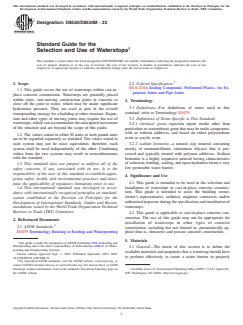
(Guide)Standard Guide for the Selection and Use of Waterstops
General Information
- Abstract
SIGNIFICANCE AND USE
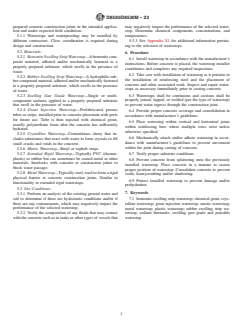
4.1 This guide is intended to be used in the selection and installation of waterstops in cast-in-place concrete construction. This guide is intended to assist the building owner, owner’s representative, architect, engineer, contractor, and/or authorized inspector during the specification and installation of waterstops.
4.2 This guide is applicable to cast-in-place concrete construction. The use of this guide may not be appropriate for installation of waterstops in other types of concrete construction, including but not limited to, pneumatically applied (that is, shotcrete) and precast concrete construction.
SCOPE
1.1 This guide covers the use of waterstops within cast-in-place concrete construction. Waterstops are generally placed within static, non-moving construction joints in concrete to close off the joint to water, which may be under significant hydrostatic pressure. They are used as part of the overall waterproofing strategy for a building or other structure. Expansion and other types of moving joints may require the use of waterstops, which can accommodate the anticipated movement of the structure and are beyond the scope of this guide.
1.2 The values stated in either SI units or inch-pound units are to be regarded separately as standard. The values stated in each system may not be exact equivalents: therefore, each system shall be used independently of the other. Combining values from the two systems may result in nonconformance with the standard.
1.3 This standard does not purport to address all of the safety concerns, if any, associated with its use. It is the responsibility of the user of this standard to establish appropriate safety, health, and environmental practices and determine the applicability of regulatory limitations prior to use.
1.4 This international standard was developed in accordance with internationally recognized principles on standardization established in the Decision on Principles for the Development of International Standards, Guides and Recommendations issued by the World Trade Organization Technical Barriers to Trade (TBT) Committee.
- Status
- Published
- Publication Date
- 31-Aug-2023
- Technical Committee
- D08 - Roofing and Waterproofing
- Drafting Committee
- D08.22 - Waterproofing and Dampproofing Systems

Overview
ASTM D8530/D8530M-23: Standard Guide for the Selection and Use of Waterstops provides comprehensive guidance for selecting and installing waterstops in cast-in-place concrete construction. Developed by ASTM International, this guide is essential for building owners, engineers, architects, contractors, and inspectors involved in concrete waterproofing projects. Waterstops are a vital component in creating water-tight joints within concrete structures, especially where high hydrostatic pressures are expected. This standard addresses the use of waterstops for static, non-moving joints and emphasizes their role in an integrated waterproofing strategy.
Key Topics
Types of Waterstops:
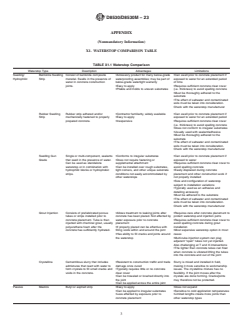
The guide details various types of waterstops, including:- Bentonite swelling strips
- Rubber swelling strips
- Swelling gun grade waterstops
- Grout injection waterstops
- Crystalline waterstops
- Mastic waterstops
- Extruded rigid waterstops (usually PVC or rubber)
- Metal waterstops (commonly steel)
Material Selection:
Materials are specified based on their performance characteristics-such as swelling capacity, physical barrier formation, or chemical compatibility-with the project’s environmental conditions.Installation Considerations:
- Alignment and securement within construction joints
- Joint continuity, proper joining, lapping, or welding as appropriate
- Coordination with reinforcing steel layout
- Protection of waterstops prior to and during concrete placement
- Adherence to manufacturer’s recommendations
Site and Environmental Factors:
- Assessment of groundwater, soil contaminants, and hydrostatic pressures
- Verification of compatibility with fluids expected to contact the joints (e.g., in tanks)
- Importance of substrate preparation and inspection prior to installation
Applications
ASTM D8530/D8530M-23 applies specifically to cast-in-place concrete construction. Typical applications include:
- Below-grade waterproofing: Basements, tunnels, and retaining walls where groundwater intrusion is a concern.
- Water-retaining and water-excluding structures: Tanks, reservoirs, sewage treatment plants, and swimming pools.
- Civil infrastructure: Bridges, dams, and foundations exposed to variable water tables or moisture loads.
- High hydrostatic pressure environments: Situations requiring robust prevention of water ingress through static construction joints.
This guide is not intended for installations in pneumatically applied (shotcrete) or precast concrete, nor for joints designed to accommodate significant movement.
Related Standards
- ASTM D1079: Terminology Relating to Roofing and Waterproofing
- SS-S-210A: Federal Specification for Sealing Compound, Preformed Plastic, for Expansion and Pipe Joints
Other key references include relevant manufacturer guidelines and installation instructions, which should always be consulted for project-specific details.
Practical Value
The ASTM D8530/D8530M-23 standard equips industry professionals with the knowledge to choose appropriate waterstop types, taking into account site conditions, exposure risks, and expected service life. Following this guide helps ensure effective water barrier performance, minimizes the potential for leaks, and supports long-term durability of concrete structures. The standard also underscores the importance of coordination between multiple trades to achieve proper installation and optimal waterproofing results.
By adhering to this recognized ASTM guide, project stakeholders can enhance quality assurance, comply with international best practices, and deliver reliable, water-tight concrete construction.
Relations
- Effective Date
- 01-May-2020
- Effective Date
- 15-Dec-2018
- Effective Date
- 15-Dec-2018
- Effective Date
- 01-Feb-2016
- Effective Date
- 01-Mar-2013
- Effective Date
- 01-Mar-2013
- Effective Date
- 01-Sep-2010
- Effective Date
- 01-Jul-2009
- Effective Date
- 01-Feb-2008
- Effective Date
- 01-Jan-2008
- Effective Date
- 01-Jun-2007
- Effective Date
- 15-Jan-2007
- Effective Date
- 01-Aug-2006
- Effective Date
- 15-Sep-2005
- Refers
ASTM D1079-05 - Standard Terminology Relating to Roofing, Waterproofing, and Bituminous Materials - Effective Date
- 01-Mar-2005
Frequently Asked Questions
ASTM D8530/D8530M-23 is a guide published by ASTM International. Its full title is "Standard Guide for the Selection and Use of Waterstops". This standard covers: SIGNIFICANCE AND USE 4.1 This guide is intended to be used in the selection and installation of waterstops in cast-in-place concrete construction. This guide is intended to assist the building owner, owner’s representative, architect, engineer, contractor, and/or authorized inspector during the specification and installation of waterstops. 4.2 This guide is applicable to cast-in-place concrete construction. The use of this guide may not be appropriate for installation of waterstops in other types of concrete construction, including but not limited to, pneumatically applied (that is, shotcrete) and precast concrete construction. SCOPE 1.1 This guide covers the use of waterstops within cast-in-place concrete construction. Waterstops are generally placed within static, non-moving construction joints in concrete to close off the joint to water, which may be under significant hydrostatic pressure. They are used as part of the overall waterproofing strategy for a building or other structure. Expansion and other types of moving joints may require the use of waterstops, which can accommodate the anticipated movement of the structure and are beyond the scope of this guide. 1.2 The values stated in either SI units or inch-pound units are to be regarded separately as standard. The values stated in each system may not be exact equivalents: therefore, each system shall be used independently of the other. Combining values from the two systems may result in nonconformance with the standard. 1.3 This standard does not purport to address all of the safety concerns, if any, associated with its use. It is the responsibility of the user of this standard to establish appropriate safety, health, and environmental practices and determine the applicability of regulatory limitations prior to use. 1.4 This international standard was developed in accordance with internationally recognized principles on standardization established in the Decision on Principles for the Development of International Standards, Guides and Recommendations issued by the World Trade Organization Technical Barriers to Trade (TBT) Committee.
SIGNIFICANCE AND USE 4.1 This guide is intended to be used in the selection and installation of waterstops in cast-in-place concrete construction. This guide is intended to assist the building owner, owner’s representative, architect, engineer, contractor, and/or authorized inspector during the specification and installation of waterstops. 4.2 This guide is applicable to cast-in-place concrete construction. The use of this guide may not be appropriate for installation of waterstops in other types of concrete construction, including but not limited to, pneumatically applied (that is, shotcrete) and precast concrete construction. SCOPE 1.1 This guide covers the use of waterstops within cast-in-place concrete construction. Waterstops are generally placed within static, non-moving construction joints in concrete to close off the joint to water, which may be under significant hydrostatic pressure. They are used as part of the overall waterproofing strategy for a building or other structure. Expansion and other types of moving joints may require the use of waterstops, which can accommodate the anticipated movement of the structure and are beyond the scope of this guide. 1.2 The values stated in either SI units or inch-pound units are to be regarded separately as standard. The values stated in each system may not be exact equivalents: therefore, each system shall be used independently of the other. Combining values from the two systems may result in nonconformance with the standard. 1.3 This standard does not purport to address all of the safety concerns, if any, associated with its use. It is the responsibility of the user of this standard to establish appropriate safety, health, and environmental practices and determine the applicability of regulatory limitations prior to use. 1.4 This international standard was developed in accordance with internationally recognized principles on standardization established in the Decision on Principles for the Development of International Standards, Guides and Recommendations issued by the World Trade Organization Technical Barriers to Trade (TBT) Committee.
ASTM D8530/D8530M-23 has the following relationships with other standards: It is inter standard links to ASTM D1079-20, ASTM D1079-18, ASTM D1079-18e1, ASTM D1079-16, ASTM D1079-13e1, ASTM D1079-13, ASTM D1079-10, ASTM D1079-09, ASTM D1079-08a, ASTM D1079-08, ASTM D1079-07a, ASTM D1079-07, ASTM D1079-06, ASTM D1079-05a, ASTM D1079-05. Understanding these relationships helps ensure you are using the most current and applicable version of the standard.
ASTM D8530/D8530M-23 is available in PDF format for immediate download after purchase. The document can be added to your cart and obtained through the secure checkout process. Digital delivery ensures instant access to the complete standard document.
Standards Content (Sample)
This international standard was developed in accordance with internationally recognized principles on standardization established in the Decision on Principles for the
Development of International Standards, Guides and Recommendations issued by the World Trade Organization Technical Barriers to Trade (TBT) Committee.
Designation: D8530/D8530M − 23
Standard Guide for the
Selection and Use of Waterstops
This standard is issued under the fixed designation D8530/D8530M; the number immediately following the designation indicates the
year of original adoption or, in the case of revision, the year of last revision. A number in parentheses indicates the year of last
reapproval. A superscript epsilon (´) indicates an editorial change since the last revision or reapproval.
1. Scope 2.2 Federal Specification:
SS-S-210A Sealing Compound, Preformed Plastic, for Ex-
1.1 This guide covers the use of waterstops within cast-in-
pansion Joints and Pipe Joints
place concrete construction. Waterstops are generally placed
within static, non-moving construction joints in concrete to
3. Terminology
close off the joint to water, which may be under significant
3.1 Definitions—For definitions of terms used in this
hydrostatic pressure. They are used as part of the overall
standard, refer to Terminology D1079.
waterproofing strategy for a building or other structure. Expan-
sion and other types of moving joints may require the use of
3.2 Definitions of Terms Specific to This Standard:
waterstops, which can accommodate the anticipated movement
3.2.1 chemical grout—injection repair media other than
of the structure and are beyond the scope of this guide.
particulate or cementitious grout that may be multi-component,
with or without additives, and based on either polyurethane
1.2 The values stated in either SI units or inch-pound units
resin or acrylic resin.
are to be regarded separately as standard. The values stated in
each system may not be exact equivalents: therefore, each 3.2.2 sodium bentonite—a natural clay mineral consisting
system shall be used independently of the other. Combining mostly of montmorillonite (aluminum silicate) that is pro-
values from the two systems may result in nonconformance cessed and typically treated with polymer additives. Sodium
with the standard. bentonite is a highly expansive mineral having characteristics
of cohesion, binding, sealing, and upon hydration forms a very
1.3 This standard does not purport to address all of the
low permeable water barrier.
safety concerns, if any, associated with its use. It is the
responsibility of the user of this standard to establish appro-
4. Significance and Use
priate safety, health, and environmental practices and deter-
4.1 This guide is intended to be used in the selection and
mine the applicability of regulatory limitations prior to use.
installation of waterstops in cast-in-place concrete construc-
1.4 This international standard was developed in accor-
tion. This guide is intended to assist the building owner,
dance with internationally recognized principles on standard-
owner’s representative, architect, engineer, contractor, and/or
ization established in the Decision on Principles for the
authorized inspector during the specification and installation of
Development of International Standards, Guides and Recom-
waterstops.
mendations issued by the World Trade Organization Technical
Barriers to Trade (TBT) Committee.
4.2 This guide is applicable to cast-in-place concrete con-
struction. The use of this guide may not be appropriate for
2. Referenced Documents
installation of waterstops in other types of concrete
2.1 ASTM Standards:
construction, including but not limited to, pneumatically ap-
D1079 Terminology Relating to Roofing and Waterproofing
plied (that is, shotcrete) and precast concrete construction.
5. Materials
This guide is under the jurisdiction of ASTM Committee D08 on Roofing and
Waterproofing and is the direct responsibility of Subcommittee D08.22 on Water-
5.1 General—The intent of this section is to define the
proofing and Dampproofing Systems.
available materials and properties that a waterstop should have
Current edition approved Sept. 1, 2023. Published September 2023. DOI:
to perform effectively to create a water barrier in properly
10.1520/D8530_D8530M-23.
For referenced ASTM standards, visit the ASTM website, www.astm.org, or
contact ASTM Customer Service at service@astm.org. For Annual Book of ASTM
Standards volume information, refer to the standard’s Document Summary page on Available from U.S. Government Publishing Office (GPO), 732 N. Capitol St.,
the ASTM website. NW, Washington, DC 20401, http://www.gpo.gov.
Copyright © ASTM International, 100 Barr Harbor Drive, PO Box C700, West Conshohocken, PA 19428-2959. United States
D8530/D8530M − 23
prepared concrete construction joints in the intended applica- may negatively impact the performance of the selected water-
tion and under expected field conditions. stop. Determine chemical components, concentrations, and
temperatures.
5.1.1 Waterstops and waterproofing may be installed by
different contractors. Close coordination is required during 5.3.3 See Appendix X1 for additional information pertain-
ing to the selection of waterstops.
design and construction.
5.2 Materials:
6. Procedure
5.2.1 Bentonite Swelling Strip Waterstop—A bentonite com-
6.1 Install waterstop in accordance with the manufacturer’s
posite material, adhered and/or mechanically fastened to a
instructions. Before concrete is placed, the waterstop installer
properly prepared substrate, which swells in the presence of
coordinates and completes any required inspections.
water.
6.2 Take care with installation of waterstop as it pertains to
5.2.2 Rubber Swelling Strip Waterstop—A hydrophilic rub-
the installation of reinforcing steel and the placement of
ber compound material, adhered and/or mechanically fastened
concrete and other associated work. Inspect and repair water-
to a properly prepared substrate, which swells in the presence
stops as necessary immediately prior to casting concrete.
of water.
5.2.3 Swelling Gun Grade Waterstop—Single or multi- 6.3 Waterstops shall be continuous and sections shall be
properly joined, lapped, or welded (per the type of waterstop)
component sealants, applied to a properly prepared substrate
that swell in the presence of water. to prevent water ingress through the construction joint.
5.2.4 Grout Injection Waterstop—Prefabricated porous
6.4 Provide proper concrete coverage and consolidation in
tubes or strips, installed prior to concrete placement with ports
accordance with manufacturer’s guidelines.
for future use. Tube is then injected with chemical grout,
6.5 Place waterstop within vertical and horizontal joints
usually polyurethane foam after the concrete has sufficiently
within reinforcing bars where multiple rows exist unless
hydrated.
otherwise specified.
5.2.5 Crystalline Waterstop—Cementitious slurry that in-
6.6 Mechanically attach and/or adhere waterstop in accor-
cludes admixtures that react with water to form crystals to fill
dance with manufacturer’s guidelines to prevent movement
small cracks and voids in the concrete.
within the joint during casting of concrete.
5.2.6 Mastic Waterstop—Butyl or asphalt strips.
5.2.7 Extruded Rigid Waterstop—Typically PVC (thermo- 6.7 Verify proper substrate conditions.
plastic) or rubber but can sometimes be coated metal or other
6.8 Prevent concrete from splattering onto the previously
materials. Interlocks with concrete at construction joints to
installed waterstop. Place concrete in a manner to secure
block water passage.
proper position of waterstop. Consolidate concrete to prevent
5.2.8 Metal Waterstop—Typically steel, used to form a rigid
voids, honeycombing and/or shadowing.
physical barrier at concrete construction joints. Similar in
6.9 Protect installed waterstop to prevent damage and/or
functionality to extruded rigid waterstops.
prehydration.
5.3 Site Conditions:
7. Keywords
5.3.1 Perform an analysis of the existing ground water and
soil to determine if there are hydrostatic conditions and/or if
7.1 bentonite swelling strip waterstop; chemical grout; crys-
there are any contaminants, which may negatively impact the talline waterstop; grout injection waterstop; mastic waterstop;
performance of the selected waterstop.
metal waterstop; plastic waterstop; rubber swelling strip wa-
5.3.2 Verify the composition of any fluids that may contact terstop; sodium bentonite; swelling gun grade and pourable
with the
...