

ASTM C1029-20
(Specification)Standard Specification for Spray-Applied Rigid Cellular Polyurethane Thermal Insulation
General Information
- Abstract
ABSTRACT
This specification covers the types and physical properties of spray applied rigid cellular polyurethane intended for use as thermal insulation. Spray-applied rigid-cellular polyurethane thermal insulation shall be classified into four type: Type I; Type II; Type III; and Type IV. Spray-applied rigid-cellular polyurethane thermal insulation shall be produced by the catalyzed chemical reaction of polyisocyanates with polyhydroxyl compounds and by the catalyzed polymerization of polyisocyanates. The following test methods shall be performed: thermal resistance; compressive strength; water vapor permeability; water absorption; tensile strength; response to thermal and humid aging; closed cell content; and surface burning characteristics.
SCOPE
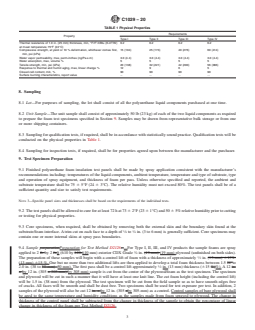
1.1 This specification covers the types and physical properties of spray applied rigid cellular polyurethane intended for use as thermal insulation. The operating temperatures of the surfaces to which the insulation is applied shall not be lower than −22°F (−30°C) or greater than +225°F (+107°C). For specific applications, the actual temperature limits shall be as agreed upon between the manufacturer and the purchaser.
1.2 The values stated in inch-pound units are to be regarded as standard. The values given in parentheses are mathematical conversions to SI units that are provided for information only and are not considered standard.
1.3 This standard does not purport to address all of the safety concerns, if any, associated with its use. It is the responsibility of the user of this standard to establish appropriate safety, health, and environmental practices and determine the applicability of regulatory limitations prior to use.
1.4 This international standard was developed in accordance with internationally recognized principles on standardization established in the Decision on Principles for the Development of International Standards, Guides and Recommendations issued by the World Trade Organization Technical Barriers to Trade (TBT) Committee.
- Status
- Published
- Publication Date
- 30-Nov-2020
- Technical Committee
- C16 - Thermal Insulation
- Drafting Committee
- C16.22 - Organic and Nonhomogeneous Inorganic Thermal Insulations
Buy Documents

ASTM C1029-20 - Standard Specification for Spray-Applied Rigid Cellular Polyurethane Thermal Insulation
REDLINE ASTM C1029-20 - Standard Specification for Spray-Applied Rigid Cellular Polyurethane Thermal Insulation
Overview
ASTM C1029-20 is the standard specification established by ASTM International for spray-applied rigid cellular polyurethane thermal insulation. This specification defines the essential types, physical properties, and performance criteria of polyurethane foam insulation applied by spraying, and it is designed to ensure quality, reliability, and consistency for thermal insulation applications. The specification covers polyurethane insulation that functions effectively within operating temperature ranges from -22°F (-30°C) to +225°F (+107°C), making it suitable for a broad variety of residential, commercial, and industrial uses.
Spray-applied rigid cellular polyurethane thermal insulation is produced through the catalyzed chemical reaction of polyisocyanates and polyhydroxyl compounds, resulting in a closed-cell foam with high insulation properties. This material is valued for its ability to form a seamless, monolithic insulation layer directly onto various substrates.
Key Topics
Classification: The standard classifies spray-applied rigid polyurethane insulation into four types based on compressive strength:
- Type I: Minimum 15 psi (104 kPa)
- Type II: Minimum 25 psi (173 kPa)
- Type III: Minimum 40 psi (276 kPa)
- Type IV: Minimum 60 psi (414 kPa)
Physical Properties and Requirements:
- Thermal resistance: All types require a minimum thermal resistance to ensure energy efficiency.
- Compressive strength, tensile strength, and water absorption: Specified for each type to guarantee structural integrity and durability.
- Water vapor permeability: Limited for all types to reduce moisture intrusion.
- Closed cell content: Minimum 90% across all types, providing superior insulating performance and resistance to water absorption.
- Surface burning characteristics: Each product’s fire performance must be tested and reported.
Testing Methods:
- The standard references specific ASTM methods for testing physical properties, including compressive properties (ASTM C165), thermal performance (ASTM C518, C177), water absorption (ASTM D2842), tensile strength (ASTM D1623), and more.
Safety and Application Considerations:
- User responsibility for proper safety, health, and environmental practices.
- Attention to building and fire codes, as polyurethane foam is combustible when exposed to ignition sources.
Applications
Spray-applied rigid cellular polyurethane insulation specified by ASTM C1029-20 is widely used in:
- Building envelopes: Insulating exterior walls, roofs, and foundations to improve energy efficiency and reduce heat loss.
- Industrial facilities: Thermal insulation for piping, tanks, and vessels operating within the specified temperature range.
- Cold storage and freezers: Creating highly efficient thermal barriers to maintain low internal temperatures.
- Air sealing and moisture control: Providing continuous air barriers and reducing vapor transmission in new and retrofit construction.
- Monolithic insulation systems: Forming seamless, continuous insulation layers that eliminate gaps and thermal bridges.
The material can be applied to a variety of substrates and is valued for its ability to conform to complex geometries, enhancing its use in challenging installation environments.
Related Standards
For those specifying, testing, or installing polyurethane spray foam insulation, the following ASTM standards are often referenced alongside ASTM C1029-20:
- ASTM C165: Standard Test Method for Measuring Compressive Properties of Thermal Insulations
- ASTM C518: Steady-State Thermal Transmission Properties by Means of the Heat Flow Meter Apparatus
- ASTM C177: Thermal Transmission Properties by Means of the Guarded-Hot-Plate Apparatus
- ASTM D1623: Tensile and Tensile Adhesion Properties of Rigid Cellular Plastics
- ASTM D2842: Water Absorption of Rigid Cellular Plastics
- ASTM E84: Surface Burning Characteristics of Building Materials
- ASTM E96: Water Vapor Transmission of Materials
Consulting these related standards ensures comprehensive product evaluation and compliance with industry best practices for spray-applied polyurethane thermal insulation.
Relations
- Effective Date
- 15-Apr-2024
- Effective Date
- 01-Mar-2024
- Effective Date
- 01-Mar-2024
- Effective Date
- 01-Feb-2024
- Effective Date
- 01-Dec-2023
- Effective Date
- 15-Nov-2023
- Effective Date
- 01-Nov-2023
- Effective Date
- 01-Nov-2023
- Effective Date
- 01-Sep-2023
- Effective Date
- 01-Jan-2020
- Effective Date
- 01-Sep-2019
- Effective Date
- 01-Aug-2019
- Effective Date
- 01-Jul-2019
- Effective Date
- 01-May-2019
- Effective Date
- 15-Apr-2019
Buy Documents
ASTM C1029-20 - Standard Specification for Spray-Applied Rigid Cellular Polyurethane Thermal Insulation
REDLINE ASTM C1029-20 - Standard Specification for Spray-Applied Rigid Cellular Polyurethane Thermal Insulation
Get Certified
Connect with accredited certification bodies for this standard

DIN CERTCO
DIN Group product certification.

Smithers Quality Assessments
US management systems and product certification.
Sponsored listings
Frequently Asked Questions
ASTM C1029-20 is a technical specification published by ASTM International. Its full title is "Standard Specification for Spray-Applied Rigid Cellular Polyurethane Thermal Insulation". This standard covers: ABSTRACT This specification covers the types and physical properties of spray applied rigid cellular polyurethane intended for use as thermal insulation. Spray-applied rigid-cellular polyurethane thermal insulation shall be classified into four type: Type I; Type II; Type III; and Type IV. Spray-applied rigid-cellular polyurethane thermal insulation shall be produced by the catalyzed chemical reaction of polyisocyanates with polyhydroxyl compounds and by the catalyzed polymerization of polyisocyanates. The following test methods shall be performed: thermal resistance; compressive strength; water vapor permeability; water absorption; tensile strength; response to thermal and humid aging; closed cell content; and surface burning characteristics. SCOPE 1.1 This specification covers the types and physical properties of spray applied rigid cellular polyurethane intended for use as thermal insulation. The operating temperatures of the surfaces to which the insulation is applied shall not be lower than −22°F (−30°C) or greater than +225°F (+107°C). For specific applications, the actual temperature limits shall be as agreed upon between the manufacturer and the purchaser. 1.2 The values stated in inch-pound units are to be regarded as standard. The values given in parentheses are mathematical conversions to SI units that are provided for information only and are not considered standard. 1.3 This standard does not purport to address all of the safety concerns, if any, associated with its use. It is the responsibility of the user of this standard to establish appropriate safety, health, and environmental practices and determine the applicability of regulatory limitations prior to use. 1.4 This international standard was developed in accordance with internationally recognized principles on standardization established in the Decision on Principles for the Development of International Standards, Guides and Recommendations issued by the World Trade Organization Technical Barriers to Trade (TBT) Committee.
ABSTRACT This specification covers the types and physical properties of spray applied rigid cellular polyurethane intended for use as thermal insulation. Spray-applied rigid-cellular polyurethane thermal insulation shall be classified into four type: Type I; Type II; Type III; and Type IV. Spray-applied rigid-cellular polyurethane thermal insulation shall be produced by the catalyzed chemical reaction of polyisocyanates with polyhydroxyl compounds and by the catalyzed polymerization of polyisocyanates. The following test methods shall be performed: thermal resistance; compressive strength; water vapor permeability; water absorption; tensile strength; response to thermal and humid aging; closed cell content; and surface burning characteristics. SCOPE 1.1 This specification covers the types and physical properties of spray applied rigid cellular polyurethane intended for use as thermal insulation. The operating temperatures of the surfaces to which the insulation is applied shall not be lower than −22°F (−30°C) or greater than +225°F (+107°C). For specific applications, the actual temperature limits shall be as agreed upon between the manufacturer and the purchaser. 1.2 The values stated in inch-pound units are to be regarded as standard. The values given in parentheses are mathematical conversions to SI units that are provided for information only and are not considered standard. 1.3 This standard does not purport to address all of the safety concerns, if any, associated with its use. It is the responsibility of the user of this standard to establish appropriate safety, health, and environmental practices and determine the applicability of regulatory limitations prior to use. 1.4 This international standard was developed in accordance with internationally recognized principles on standardization established in the Decision on Principles for the Development of International Standards, Guides and Recommendations issued by the World Trade Organization Technical Barriers to Trade (TBT) Committee.
ASTM C1029-20 is classified under the following ICS (International Classification for Standards) categories: 83.100 - Cellular materials. The ICS classification helps identify the subject area and facilitates finding related standards.
ASTM C1029-20 has the following relationships with other standards: It is inter standard links to ASTM C168-24, ASTM C1363-24, ASTM E96/E96M-24, ASTM D883-24, ASTM E84-23d, ASTM E96/E96M-23, ASTM D883-23, ASTM C1303/C1303M-23, ASTM E84-23c, ASTM D883-20, ASTM C1363-19, ASTM D883-19c, ASTM E84-19b, ASTM D2842-19, ASTM E84-19a. Understanding these relationships helps ensure you are using the most current and applicable version of the standard.
ASTM C1029-20 is available in PDF format for immediate download after purchase. The document can be added to your cart and obtained through the secure checkout process. Digital delivery ensures instant access to the complete standard document.
Standards Content (Sample)
This international standard was developed in accordance with internationally recognized principles on standardization established in the Decision on Principles for the
Development of International Standards, Guides and Recommendations issued by the World Trade Organization Technical Barriers to Trade (TBT) Committee.
Designation: C1029 −20
Standard Specification for
Spray-Applied Rigid Cellular Polyurethane Thermal
Insulation
This standard is issued under the fixed designation C1029; the number immediately following the designation indicates the year of
original adoption or, in the case of revision, the year of last revision.Anumber in parentheses indicates the year of last reapproval.A
superscript epsilon (´) indicates an editorial change since the last revision or reapproval.
This standard has been approved for use by agencies of the U.S. Department of Defense.
1. Scope the Guarded-Hot-Plate Apparatus
C518Test Method for Steady-State Thermal Transmission
1.1 This specification covers the types and physical proper-
Properties by Means of the Heat Flow Meter Apparatus
ties of spray applied rigid cellular polyurethane intended for
C1303/C1303MTest Method for Predicting Long-Term
use as thermal insulation. The operating temperatures of the
Thermal Resistance of Closed-Cell Foam Insulation
surfaces to which the insulation is applied shall not be lower
C1363Test Method for Thermal Performance of Building
than−22°F (−30°C) or greater than+225°F (+107°C). For
Materials and Envelope Assemblies by Means of a Hot
specific applications, the actual temperature limits shall be as
Box Apparatus
agreed upon between the manufacturer and the purchaser.
D883Terminology Relating to Plastics
1.2 The values stated in inch-pound units are to be regarded
D1621Test Method for Compressive Properties of Rigid
as standard. The values given in parentheses are mathematical
Cellular Plastics
conversions to SI units that are provided for information only
D1622/D1622MTest Method forApparent Density of Rigid
and are not considered standard.
Cellular Plastics
1.3 This standard does not purport to address all of the
D1623Test Method for Tensile and TensileAdhesion Prop-
safety concerns, if any, associated with its use. It is the
erties of Rigid Cellular Plastics
responsibility of the user of this standard to establish appro-
D2126Test Method for Response of Rigid Cellular Plastics
priate safety, health, and environmental practices and deter-
to Thermal and Humid Aging
mine the applicability of regulatory limitations prior to use.
D2842Test Method for Water Absorption of Rigid Cellular
1.4 This international standard was developed in accor-
Plastics
dance with internationally recognized principles on standard-
D6226TestMethodforOpenCellContentofRigidCellular
ization established in the Decision on Principles for the
Plastics
Development of International Standards, Guides and Recom-
E84Test Method for Surface Burning Characteristics of
mendations issued by the World Trade Organization Technical
Building Materials
Barriers to Trade (TBT) Committee.
E96/E96MTest Methods for Water Vapor Transmission of
Materials
2. Referenced Documents
2.1 ASTM Standards:
3. Terminology
C165TestMethodforMeasuringCompressivePropertiesof
3.1 Definitions:For definitions of terms used in this
Thermal Insulations
specification, refer to Terminologies C168 and D883.
C168Terminology Relating to Thermal Insulation
C177Test Method for Steady-State Heat Flux Measure-
4. Classification
ments and Thermal Transmission Properties by Means of
4.1 Spray-applied rigid-cellular polyurethane thermal insu-
lation covered by this specification is classified into four types
This specification is under the jurisdiction of ASTM Committee C16 on
as follows:
Thermal Insulation and is the direct responsibility of Subcommittee C16.22 on
Organic and Nonhomogeneous Inorganic Thermal Insulations.
4.1.1 Type I—Compressive strength 15 psi (104 kPa) mini-
Current edition approved Dec. 1, 2020. Published January 2021. Originally
mum.
approved in 1985. Last previous edition approved in 2015 as C1029–15. DOI:
10.1520/C1029-20. 4.1.2 Type II—Compressive strength 25 psi (173 kPa) mini-
For referenced ASTM standards, visit the ASTM website, www.astm.org, or
mum.
contact ASTM Customer Service at service@astm.org. For Annual Book of ASTM
4.1.3 Type III—Compressive strength 40 psi (276 kPa)
Standards volume information, refer to the standard’s Document Summary page on
the ASTM website. minimum.
Copyright © ASTM International, 100 Barr Harbor Drive, PO Box C700, West Conshohocken, PA 19428-2959. United States
C1029 − 20
4.1.4 Type IV—Compressive strength 60 psi (414 kPa) 8.3 Sampling for qualification tests, if required, shall be in
minimum. accordance with statistically sound practice. Qualification tests
will be conducted on the physical properties in Table 1.
5. Ordering Information
8.4 Sampling for inspection tests, if required, shall be for
5.1 Orders for materials purchased under this specification
properties agreed upon between the manufacturer and the
shall include the following:
purchaser.
5.1.1 ASTM designation, year of issue, and title.
5.1.2 Type (see 4.1).
9. Test Specimen Preparation
5.1.3 R value or thickness required (see 10.1).
9.1 Finished polyurethane foam insulation test panels shall
5.1.4 Sampling, if different (see Section 8).
be made by spray application consistent with the manufactur-
5.1.5 If a certificate of compliance is required (see 13.1).
er’s recommendations including: temperatures of the liquid
5.1.6 If packaging is other than specified (see 14.1).
components, ambient temperature, temperature and type of
5.1.7 If marking is other than specified (see 14.4).
substrate,typeandoperationofsprayequipment,andthickness
of foam per pass. Unless otherwise specified and reported, the
6. Materials and Manufacture
ambient and substrate temperature shall be 75 6 5°F (24 6
6.1 Spray-applied rigid-cellular polyurethane thermal insu-
3°C). The relative humidity must not exceed 80%. The test
lation is produced by the catalyzed chemical reaction of
panels shall be of a sufficient quantity and size to satisfy test
polyisocyanates with polyhydroxyl compounds, with the addi-
requirements.
tion of other compounds such as stabilizers and blowing
NOTE 3—Specific panel sizes and thicknesses shall be based on the
agents.
requirements of the individual tests.
6.2 The materials shall be capable of being mixed and
9.2 The test panels shall be allowed to cure for at least 72 h
applied using commercial polyurethane spray equipment.
at 73 6 2°F (23 6 1°C) and 50 6 5% relative humidity prior
NOTE1—Thethermalinsulationshallbeformeddirectlyonthesurface
to cutting or testing for physical properties.
to be sprayed, unless agreed upon by the purchaser and the manufacturer.
9.3 Core specimens, when required, shall be obtained by
removingboththeexternalskinandtheboundaryskinfoundat
7. Physical Requirements
the substrate/foam interface.Atrim cut on each face to a depth
7.1 Polyurethane thermal insulation shall have the limiting
1 1
of ⁄8 to ⁄4 in. (3 to 6 mm) is generally sufficient. Core
property values as shown in Table 1.
specimensmaycontainoneormoreinternalskinsatspraypass
7.2 Other physical properties shall be required, as agreed
boundaries.
upon by the purchaser and the manufacturer
9.4 Sample Preparation for Test Method D2126—For Type
NOTE2—Densityisnotarequirementofthisspecification,butifagreed I,II,III,andIVproductsthesamplefoamsaresprayappliedto
upon by the purchaser and the manufacturer shall be determined in 3
2by2ft(610by610mm)exteriorCDXGrade ⁄4in.(19mm)
accordance with Test Method D1622/D1622M for point-of-manufacture
plywood (unfinished on both sides). The preparation of these
quality control.
samples will begin with a control lift of foam with a thickness
ofapproximately ⁄2in.(13mm) 615%.Onebutnomorethan
8. Sampling
two additional lifts are then applied to develop a total foam
8.1 Lot—For purposes of sampling, the lot shall consist of
thickness between 1.5 to 2.0 in. (38 to 50 mm). The first pass
all the polyurethane liquid components purchased at one time.
shall be a control lift approximately ⁄2 in. (13 mm) thickness
8.2 Unit Sample—The unit sample shall consist of approxi- (615 %).A12 by 12 in. (305 by 305 mm) sample is cut from
mately 50 lb (23 kg) of each of the two liquid components as the center of the plywood/foam as the test specimen. The
required to prepare the foam test specimens specified in specimenandplywoodwillbecutinsuchamannerthatitwill
Section 9. Samples may be drawn from representative bulk have at least one knit line. The cut foam height (including the
storage or from one or more shipping containers. controllift)willbe1.5in.(38mm)fromtheplywood.Thetest
TABLE 1 Physical Properties
Requirements
Property
Type I Type II Type III Type IV
2 2
Thermal resistance of 1.0 in. (25 mm) thickness, min, °F·ft ·h/Btu (K·m /W) 6.2 6.2 6.2 6.2
at mean temperature 75°F (24°C)
Compressive strength, at yield or 10 % deformation, whichever comes first,
...
This document is not an ASTM standard and is intended only to provide the user of an ASTM standard an indication of what changes have been made to the previous version. Because
it may not be technically possible to adequately depict all changes accurately, ASTM recommends that users consult prior editions as appropriate. In all cases only the current version
of the standard as published by ASTM is to be considered the official document.
Designation: C1029 − 15 C1029 − 20
Standard Specification for
Spray-Applied Rigid Cellular Polyurethane Thermal
Insulation
This standard is issued under the fixed designation C1029; the number immediately following the designation indicates the year of
original adoption or, in the case of revision, the year of last revision. A number in parentheses indicates the year of last reapproval. A
superscript epsilon (´) indicates an editorial change since the last revision or reapproval.
This standard has been approved for use by agencies of the U.S. Department of Defense.
1. Scope
1.1 This specification covers the types and physical properties of spray applied rigid cellular polyurethane intended for use as
thermal insulation. The operating temperatures of the surfaces to which the insulation is applied shall not be lower than −22°F
(−30°C) or greater than +225°F (+107°C). For specific applications, the actual temperature limits shall be as agreed upon between
the manufacturer and the purchaser.
1.2 The values stated in inch-pound units are to be regarded as standard. The values given in parentheses are mathematical
conversions to SI units that are provided for information only and are not considered standard.
1.3 This standard does not purport to address all of the safety concerns, if any, associated with its use. It is the responsibility
of the user of this standard to establish appropriate safety safety, health, and healthenvironmental practices and determine the
applicability of regulatory limitations prior to use.
1.4 This international standard was developed in accordance with internationally recognized principles on standardization
established in the Decision on Principles for the Development of International Standards, Guides and Recommendations issued
by the World Trade Organization Technical Barriers to Trade (TBT) Committee.
2. Referenced Documents
2.1 ASTM Standards:
C165 Test Method for Measuring Compressive Properties of Thermal Insulations
C168 Terminology Relating to Thermal Insulation
C177 Test Method for Steady-State Heat Flux Measurements and Thermal Transmission Properties by Means of the
Guarded-Hot-Plate Apparatus
C518 Test Method for Steady-State Thermal Transmission Properties by Means of the Heat Flow Meter Apparatus
C1303/C1303M Test Method for Predicting Long-Term Thermal Resistance of Closed-Cell Foam Insulation
C1363 Test Method for Thermal Performance of Building Materials and Envelope Assemblies by Means of a Hot Box Apparatus
D883 Terminology Relating to Plastics
D1621 Test Method for Compressive Properties of Rigid Cellular Plastics
D1622/D1622M Test Method for Apparent Density of Rigid Cellular Plastics
D1623 Test Method for Tensile and Tensile Adhesion Properties of Rigid Cellular Plastics
This specification is under the jurisdiction of ASTM Committee C16 on Thermal Insulation and is the direct responsibility of Subcommittee C16.22 on Organic and
Nonhomogeneous Inorganic Thermal Insulations.
Current edition approved May 15, 2015Dec. 1, 2020. Published September 2015January 2021. Originally approved in 1985. Last previous edition approved in 20132015
as C1029 – 13.C1029 – 15. DOI: 10.1520/C1029-15.10.1520/C1029-20.
For referenced ASTM standards, visit the ASTM website, www.astm.org, or contact ASTM Customer Service at service@astm.org. For Annual Book of ASTM Standards
volume information, refer to the standard’s Document Summary page on the ASTM website.
Copyright © ASTM International, 100 Barr Harbor Drive, PO Box C700, West Conshohocken, PA 19428-2959. United States
C1029 − 20
D2126 Test Method for Response of Rigid Cellular Plastics to Thermal and Humid Aging
D2842 Test Method for Water Absorption of Rigid Cellular Plastics
D6226 Test Method for Open Cell Content of Rigid Cellular Plastics
E84 Test Method for Surface Burning Characteristics of Building Materials
E96/E96M Test Methods for Water Vapor Transmission of Materials
3. Terminology
3.1 Definitions:For definitions of terms used in this specification, refer to Terminologies C168 and D883.
4. Classification
4.1 Spray-applied rigid-cellular polyurethane thermal insulation covered by this specification is classified into four types as
follows:
4.1.1 Type I—Compressive strength 15 psi (104 kPa) minimum.
4.1.2 Type II—Compressive strength 25 psi (173 kPa) minimum.
4.1.3 Type III—Compressive strength 40 psi (276 kPa) minimum.
4.1.4 Type IV—Compressive strength 60 psi (414 kPa) minimum.
5. Ordering Information
5.1 Orders for materials purchased under this specification shall include the following:
5.1.1 ASTM designation, year of issue, and title.
5.1.2 Type (see 4.1).
5.1.3 R value or thickness required (see 10.1).
5.1.4 Sampling, if different (see Section 8).
5.1.5 If a certificate of compliance is required (see 13.1).
5.1.6 If packaging is other than specified (see 14.1).
5.1.7 If marking is other than specified (see 14.4).
6. Materials and Manufacture
6.1 Spray-applied rigid-cellular polyurethane thermal insulation is produced by the catalyzed chemical reaction of polyisocyanates
with polyhydroxyl compounds, with the addition of other compounds such as stabilizers and blowing agents.
6.2 The materials shall be capable of being mixed and applied using commercial polyurethane spray equipment.
NOTE 1—The thermal insulation shall be formed directly on the surface to be sprayed, unless agreed upon by the purchaser and the manufacturer.
7. Physical Requirements
7.1 Polyurethane thermal insulation shall have the limiting property values as shown in Table 1.
7.2 Other physical properties shall be required, as agreed upon by the purchaser and the manufacturer
NOTE 2—Density is not a requirement of this specification, but if agreed upon by the purchaser and the manufacturer shall be determined in accordance
with Test Method D1622/D1622M for point-of-manufacture quality control.
C1029 − 20
TABLE 1 Physical Properties
Requirements
Property
Type I Type II Type III Type IV
2 2
Thermal resistance of 1.0 in. (25 mm) thickness, min, °F·ft ·h/Btu (K·m /W) 6.2 6.2 6.2 6.2
at mean temperature 75°F (24°C)
Compressive strength, at yield or 10 % deformation, whichever comes first, 15 (104) 25 (173) 40 (276) 60 (414)
min, psi (kPa)
Water vapor permeability, max, perm-inches (ng/Pa·s·m) 3.0 (4.4) 3.0 (4.4) 3.0 (4.4) 3.0 (4.4)
Water absorption, max, volume % 5 5 5 5
Tensile strength, min, psi (kPa) 20 (138) 32 (221) 42 (290) 56 (386)
Response to thermal and humid aging, max, linear change % 12 9 6 5
Closed cell content, min, % 90 90 90 90
Surface burning characteristics, report value . . . .
8. Sampling
8.1 Lot—For purposes of sampling, the lot shall consist of all the polyurethane liquid components purchased at one time.
8.2 Unit Sample—The unit sample shall consist of approximately 50 lb (23 kg) of each of the two liquid components as required
to prepare the foam test specimens specified in Section 9. Samples may be drawn from representative bulk storage or from one
or more shipping containers.
8.3 Sampling for qualification tests, if required, shall be in accordance with statistically sound practice. Qualification tests will be
conducted on the physical properties in Table 1.
8.4 Sampling for inspection tests, if required, shall be for properties agreed upon between the manufacturer and the purchaser.
9. Test Specimen Preparation
9.1 Finished polyurethane foam insulation test panels shall be made by spray application consistent with the manufacturer’s
recommendations including: temperatures of the liquid components, ambient temperature, temperature and type of substrate, type
and operation of spray equipment, and thickness of foam per pass. Unless otherwise specified and reported, the ambient and
substrate temperature shall be 75 6 5°F (24 6 3°C). The relative humidity must not exceed 80%. The test panels shall be of a
sufficient quantity and size to satisfy test requirements.
NOTE 3—Specific panel sizes and thicknesses shall be based on the requirements of the individual tests.
9.2 The test panels shall be allowed to cure for at least 72 h at 73 6 2°F (23 6 1°C) and 50 6 5% relative humidity prior to cutting
or testing for physical properties.
9.3 Core specimens, when required, shall be obtained by removing both the external skin and the boundary skin found at the
1 1
substrate/foam interface. A trim cut on each face to a depth of ⁄8 to ⁄4 in. (3 to 6 mm) is generally sufficient. Core specimens may
contain one or more internal skins at spray pass boundaries.
9.4 Sample preparationPreparation for Test Method D2126: —For Type I, II, III, and IV products the sample foams are spray
applied to 2 ft. by 2 ft.ft (610 by 610-610 mm) exterior CDX Grade ⁄4 in. (19-mm) (19 mm) plywood (unfinished on both sides).
The preparation of these samples will begin with a control lift of foam with a thickness of approximately ⁄2 in. (13-mm) 615%.
(13 mm) 615 %. One
...