

ASTM D6481-24
(Test Method)Standard Test Method for Determination of Phosphorus, Sulfur, Calcium, and Zinc in Lubrication Oils by Energy Dispersive X-ray Fluorescence Spectroscopy
General Information
- Abstract
SIGNIFICANCE AND USE
5.1 Some oils are formulated with organo-metallic additives, which act, for example, as detergents, antioxidants, and antiwear agents. Some of these additives contain one or more of these elements: calcium, phosphorus, sulfur, and zinc. This test method provides a means of determining the concentrations of these elements, which in turn provides an indication of the additive content of these oils.
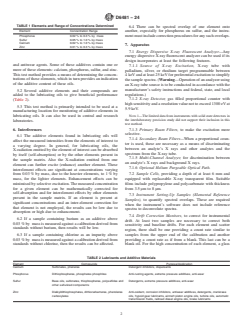
5.2 Several additive elements and their compounds are added to the lubricating oils to give beneficial performance (Table 2).
5.3 This test method is primarily intended to be used at a manufacturing location for monitoring of additive elements in lubricating oils. It can also be used in central and research laboratories.
SCOPE
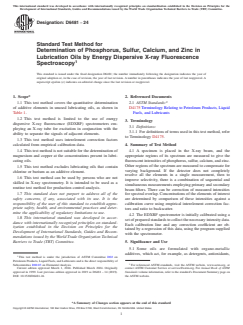
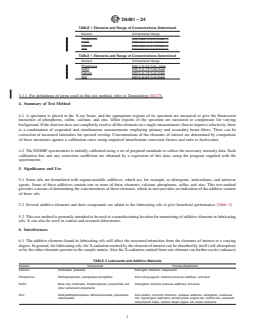
1.1 This test method covers the quantitative determination of additive elements in unused lubricating oils, as shown in Table 1.
1.2 This test method is limited to the use of energy dispersive X-ray fluorescence (EDXRF) spectrometers employing an X-ray tube for excitation in conjunction with the ability to separate the signals of adjacent elements.
1.3 This test method uses interelement correction factors calculated from empirical calibration data.
1.4 This test method is not suitable for the determination of magnesium and copper at the concentrations present in lubricating oils.
1.5 This test method excludes lubricating oils that contain chlorine or barium as an additive element.
1.6 This test method can be used by persons who are not skilled in X-ray spectrometry. It is intended to be used as a routine test method for production control analysis.
1.7 This standard does not purport to address all of the safety concerns, if any, associated with its use. It is the responsibility of the user of this standard to establish appropriate safety, health, and environmental practices and determine the applicability of regulatory limitations to use.
1.8 This international standard was developed in accordance with internationally recognized principles on standardization established in the Decision on Principles for the Development of International Standards, Guides and Recommendations issued by the World Trade Organization Technical Barriers to Trade (TBT) Committee.
- Status
- Published
- Publication Date
- 29-Feb-2024
- Technical Committee
- D02 - Petroleum Products, Liquid Fuels, and Lubricants
- Drafting Committee
- D02.03 - Elemental Analysis
Buy Documents
ASTM D6481-24 - Standard Test Method for Determination of Phosphorus, Sulfur, Calcium, and Zinc in Lubrication Oils by Energy Dispersive X-ray Fluorescence Spectroscopy
REDLINE ASTM D6481-24 - Standard Test Method for Determination of Phosphorus, Sulfur, Calcium, and Zinc in Lubrication Oils by Energy Dispersive X-ray Fluorescence Spectroscopy
Overview
ASTM D6481-24 is the standard test method for the quantitative determination of phosphorus, sulfur, calcium, and zinc in unused lubrication oils using energy dispersive X-ray fluorescence (EDXRF) spectroscopy. Developed by ASTM International, this method provides a reliable process for monitoring the additive content in lubricating oils, which is critical for ensuring oil performance and equipment protection. The method is widely adopted in manufacturing, quality control, and research laboratories due to its efficiency and suitability for routine analysis.
Key Topics
Scope and Applicability:
- Applicable to unused lubricating oils, excluding those containing magnesium, copper, chlorine, or barium as additive elements.
- Focuses on detecting phosphorus, sulfur, calcium, and zinc within specified concentration ranges.
- Utilizes EDXRF spectrometers equipped with an X-ray tube and suitable detectors for element analysis.
Significance of Test Method:
- Oils often contain organo-metallic additives-such as detergents, antioxidants, and antiwear agents-incorporating these elements.
- Measuring phosphorus, sulfur, calcium, and zinc indicates the additive levels essential for oil performance, oxidation stability, wear protection, and acid neutralization.
- The test method supports ongoing production quality control and R&D validation.
Analytical Principle:
- A sample is irradiated with X-rays, producing element-specific fluorescence signals.
- The resulting spectra are analyzed, and additive element concentrations are determined using empirical calibration curves with interelement correction factors.
- The method is user-friendly and does not require in-depth X-ray spectrometry expertise.
Quality Control and Precision:
- Regular use of QC samples ensures reliable data and ongoing instrument calibration.
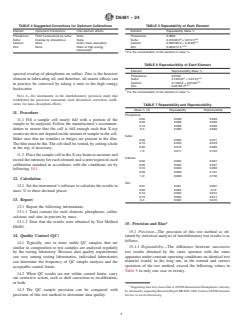
- The test method features documented repeatability and reproducibility estimates for each element analyzed.
Applications
Manufacturing Quality Assurance:
- Used routinely in lubricant production facilities to verify that additive package concentrations meet desired specifications.
- Enables fast screening of incoming base stocks and finished oil blends.
Research and Product Development:
- Supports formulation studies and stability testing by accurately quantifying key additive elements in trial blends.
Central and Contract Laboratories:
- Offers a rapid, non-destructive testing option for customers in oil blending and refining, delivering consistent results across large sample volumes.
Instrument Compatibility:
- Optimized for laboratories operating EDXRF spectrometers with X-ray tube excitation, supporting a streamlined workflow for multi-element analysis.
Related Standards
- ASTM D4175: Terminology Relating to Petroleum Products, Liquid Fuels, and Lubricants
- Methods for analysis of oil and additive content, such as other ASTM D02 Committee standards on elemental analysis
- International standards aligned with WTO principles, supporting global trade and compliance
Practical Value
Implementing ASTM D6481-24 ensures reliable and efficient determination of phosphorus, sulfur, calcium, and zinc in lubrication oils, critical for:
- Maintaining product quality and performance
- Meeting regulatory and customer requirements
- Optimizing additive usage in oil blending operations
- Enhancing laboratory productivity with a standardized, easy-to-use method
Using this standard, organizations can achieve confident decision-making in lubricant quality control, research, and supply chain validation. For laboratories and manufacturers, adherence to ASTM D6481-24 underpins consistent product integrity and supports international best practices in oil analysis.
Relations
- Effective Date
- 01-Mar-2024
- Effective Date
- 01-Mar-2024
- Effective Date
- 01-Mar-2024
- Effective Date
- 01-Mar-2024
- Effective Date
- 01-Mar-2024
Buy Documents
ASTM D6481-24 - Standard Test Method for Determination of Phosphorus, Sulfur, Calcium, and Zinc in Lubrication Oils by Energy Dispersive X-ray Fluorescence Spectroscopy
REDLINE ASTM D6481-24 - Standard Test Method for Determination of Phosphorus, Sulfur, Calcium, and Zinc in Lubrication Oils by Energy Dispersive X-ray Fluorescence Spectroscopy
Get Certified
Connect with accredited certification bodies for this standard

Element Materials Technology
Materials testing and product certification.

ABS Group Brazil
ABS Group certification services in Brazil.

ABS Quality Evaluations Inc.
American Bureau of Shipping quality certification.
Sponsored listings
Frequently Asked Questions
ASTM D6481-24 is a standard published by ASTM International. Its full title is "Standard Test Method for Determination of Phosphorus, Sulfur, Calcium, and Zinc in Lubrication Oils by Energy Dispersive X-ray Fluorescence Spectroscopy". This standard covers: SIGNIFICANCE AND USE 5.1 Some oils are formulated with organo-metallic additives, which act, for example, as detergents, antioxidants, and antiwear agents. Some of these additives contain one or more of these elements: calcium, phosphorus, sulfur, and zinc. This test method provides a means of determining the concentrations of these elements, which in turn provides an indication of the additive content of these oils. 5.2 Several additive elements and their compounds are added to the lubricating oils to give beneficial performance (Table 2). 5.3 This test method is primarily intended to be used at a manufacturing location for monitoring of additive elements in lubricating oils. It can also be used in central and research laboratories. SCOPE 1.1 This test method covers the quantitative determination of additive elements in unused lubricating oils, as shown in Table 1. 1.2 This test method is limited to the use of energy dispersive X-ray fluorescence (EDXRF) spectrometers employing an X-ray tube for excitation in conjunction with the ability to separate the signals of adjacent elements. 1.3 This test method uses interelement correction factors calculated from empirical calibration data. 1.4 This test method is not suitable for the determination of magnesium and copper at the concentrations present in lubricating oils. 1.5 This test method excludes lubricating oils that contain chlorine or barium as an additive element. 1.6 This test method can be used by persons who are not skilled in X-ray spectrometry. It is intended to be used as a routine test method for production control analysis. 1.7 This standard does not purport to address all of the safety concerns, if any, associated with its use. It is the responsibility of the user of this standard to establish appropriate safety, health, and environmental practices and determine the applicability of regulatory limitations to use. 1.8 This international standard was developed in accordance with internationally recognized principles on standardization established in the Decision on Principles for the Development of International Standards, Guides and Recommendations issued by the World Trade Organization Technical Barriers to Trade (TBT) Committee.
SIGNIFICANCE AND USE 5.1 Some oils are formulated with organo-metallic additives, which act, for example, as detergents, antioxidants, and antiwear agents. Some of these additives contain one or more of these elements: calcium, phosphorus, sulfur, and zinc. This test method provides a means of determining the concentrations of these elements, which in turn provides an indication of the additive content of these oils. 5.2 Several additive elements and their compounds are added to the lubricating oils to give beneficial performance (Table 2). 5.3 This test method is primarily intended to be used at a manufacturing location for monitoring of additive elements in lubricating oils. It can also be used in central and research laboratories. SCOPE 1.1 This test method covers the quantitative determination of additive elements in unused lubricating oils, as shown in Table 1. 1.2 This test method is limited to the use of energy dispersive X-ray fluorescence (EDXRF) spectrometers employing an X-ray tube for excitation in conjunction with the ability to separate the signals of adjacent elements. 1.3 This test method uses interelement correction factors calculated from empirical calibration data. 1.4 This test method is not suitable for the determination of magnesium and copper at the concentrations present in lubricating oils. 1.5 This test method excludes lubricating oils that contain chlorine or barium as an additive element. 1.6 This test method can be used by persons who are not skilled in X-ray spectrometry. It is intended to be used as a routine test method for production control analysis. 1.7 This standard does not purport to address all of the safety concerns, if any, associated with its use. It is the responsibility of the user of this standard to establish appropriate safety, health, and environmental practices and determine the applicability of regulatory limitations to use. 1.8 This international standard was developed in accordance with internationally recognized principles on standardization established in the Decision on Principles for the Development of International Standards, Guides and Recommendations issued by the World Trade Organization Technical Barriers to Trade (TBT) Committee.
ASTM D6481-24 is classified under the following ICS (International Classification for Standards) categories: 75.100 - Lubricants, industrial oils and related products. The ICS classification helps identify the subject area and facilitates finding related standards.
ASTM D6481-24 has the following relationships with other standards: It is inter standard links to ASTM D6481-14(2019), ASTM D6074-15(2022), ASTM D7455-19, ASTM D7578-20, ASTM D7343-20. Understanding these relationships helps ensure you are using the most current and applicable version of the standard.
ASTM D6481-24 is available in PDF format for immediate download after purchase. The document can be added to your cart and obtained through the secure checkout process. Digital delivery ensures instant access to the complete standard document.
Standards Content (Sample)
This international standard was developed in accordance with internationally recognized principles on standardization established in the Decision on Principles for the
Development of International Standards, Guides and Recommendations issued by the World Trade Organization Technical Barriers to Trade (TBT) Committee.
Designation: D6481 − 24
Standard Test Method for
Determination of Phosphorus, Sulfur, Calcium, and Zinc in
Lubrication Oils by Energy Dispersive X-ray Fluorescence
Spectroscopy
This standard is issued under the fixed designation D6481; the number immediately following the designation indicates the year of
original adoption or, in the case of revision, the year of last revision. A number in parentheses indicates the year of last reapproval. A
superscript epsilon (´) indicates an editorial change since the last revision or reapproval.
1. Scope* 2. Referenced Documents
1.1 This test method covers the quantitative determination 2.1 ASTM Standards:
of additive elements in unused lubricating oils, as shown in D4175 Terminology Relating to Petroleum Products, Liquid
Table 1. Fuels, and Lubricants
1.2 This test method is limited to the use of energy
3. Terminology
dispersive X-ray fluorescence (EDXRF) spectrometers em-
3.1 Definitions:
ploying an X-ray tube for excitation in conjunction with the
3.1.1 For definitions of terms used in this test method, refer
ability to separate the signals of adjacent elements.
to Terminology D4175.
1.3 This test method uses interelement correction factors
calculated from empirical calibration data.
4. Summary of Test Method
1.4 This test method is not suitable for the determination of 4.1 A specimen is placed in the X-ray beam, and the
magnesium and copper at the concentrations present in lubri-
appropriate regions of its spectrum are measured to give the
cating oils. fluorescent intensities of phosphorus, sulfur, calcium, and zinc.
Other regions of the spectrum are measured to compensate for
1.5 This test method excludes lubricating oils that contain
varying background. If the detector does not completely
chlorine or barium as an additive element.
resolve all the elements in a single measurement, then to
1.6 This test method can be used by persons who are not
improve selectivity, there is a combination of sequential and
skilled in X-ray spectrometry. It is intended to be used as a
simultaneous measurements employing primary and secondary
routine test method for production control analysis.
beam filters. There can be correction of measured intensities
1.7 This standard does not purport to address all of the
for spectral overlap. Concentrations of the elements of interest
safety concerns, if any, associated with its use. It is the
are determined by comparison of these intensities against a
responsibility of the user of this standard to establish appro-
calibration curve using empirical interelement correction fac-
priate safety, health, and environmental practices and deter-
tors and ratio to backscatter.
mine the applicability of regulatory limitations to use.
4.2 The EDXRF spectrometer is initially calibrated using a
1.8 This international standard was developed in accor-
set of prepared standards to collect the necessary intensity data.
dance with internationally recognized principles on standard-
Each calibration line and any correction coefficient are ob-
ization established in the Decision on Principles for the
tained by a regression of this data, using the program supplied
Development of International Standards, Guides and Recom-
with the spectrometer.
mendations issued by the World Trade Organization Technical
Barriers to Trade (TBT) Committee.
5. Significance and Use
5.1 Some oils are formulated with organo-metallic
additives, which act, for example, as detergents, antioxidants,
This test method is under the jurisdiction of ASTM Committee D02 on
Petroleum Products, Liquid Fuels, and Lubricants and is the direct responsibility of
Subcommittee D02.03 on Elemental Analysis. For referenced ASTM standards, visit the ASTM website, www.astm.org, or
Current edition approved March 1, 2024. Published March 2024. Originally contact ASTM Customer Service at service@astm.org. For Annual Book of ASTM
approved in 1999. Last previous edition approved in 2019 as D6481 – 14 (2019). Standards volume information, refer to the standard’s Document Summary page on
DOI: 10.1520/D6481-24. the ASTM website.
*A Summary of Changes section appears at the end of this standard
Copyright © ASTM International, 100 Barr Harbor Drive, PO Box C700, West Conshohocken, PA 19428-2959. United States
D6481 − 24
TABLE 1 Elements and Range of Concentrations Determined
6.4 There can be spectral overlap of one element onto
Element Concentration Range another, especially for phosphorus on sulfur, and the instru-
Phosphorus 0.02 % to 0.3 % by mass ment must include correction procedures for any such overlaps.
Sulfur 0.05 % to 1.0 % by mass
Calcium 0.02 % to 1.0 % by mass
7. Apparatus
Zinc 0.01 % to 0.3 % by mass
7.1 Energy Dispersive X-ray Fluorescent Analyzer—Any
energy dispersive X-ray fluorescent analyzer can be used if its
design incorporates at least the following features.
and antiwear agents. Some of these additives contain one or
7.1.1 Source of X-ray Excitation, X-ray tube with
more of these elements: calcium, phosphorus, sulfur, and zinc.
palladium, silver, or rhodium target programmable between
This test method provides a means of determining the concen-
4 keV and at least 25 keV for preferential excitation to simplify
trations of these elements, which in turn provides an indication
the sample spectra. (Warning—Operation of an analyzer using
of the additive content of these oils.
an X-ray tube source is to be conducted in accordance with the
manufacturer’s safety instructions and federal, state, and local
5.2 Several additive elements and their compounds are
regulations.)
added to the lubricating oils to give beneficial performance
7.1.2 X-ray Detector, gas filled proportional counter with
(Table 2).
high sensitivity and a resolution value not to exceed 1300 eV at
5.3 This test method is primarily intended to be used at a
5.9 keV.
manufacturing location for monitoring of additive elements in
NOTE 1—The limited data from instruments with solid state detectors in
lubricating oils. It can also be used in central and research
the interlaboratory precision study did not support their inclusion in this
laboratories.
test method.
6. Interferences 7.1.3 Primary Beam Filters, to make the excitation more
selective.
6.1 The additive elements found in lubricating oils will
7.1.4 Secondary Beam Filters—When a proportional coun-
affect the measured intensities from the elements of interest to
ter is used, these are necessary as a means of discriminating
a varying degree. In general, for lubricating oils, the
between an analyte’s X rays and other analytes and the
X-radiation emitted by the element of interest can be absorbed
spectrum from the X-ray tube.
by itself (self-absorption) or by the other elements present in
7.1.5 Multi-Channel Analyzer, for discrimination between
the sample matrix. Also the X-radiation emitted from one
an analyte’s X rays and background X rays.
element can further excite (enhance) another element. These
7.1.6 Optional Helium Purgeable Optical Path.
interelement effects are significant at concentrations varying
from 0.03 % by mass, due to the heavier elements, to 1 % by 7.2 Sample Cells, providing a depth of at least 6 mm and
mass, for the lighter elements. Enhancement effects can be equipped with replaceable X-ray transparent film. Suitable
minimised by selective excitation. The measured concentration films include polypropylene and polycarbonate with thickness
from 3.5 μm to 8 μm.
for a given element can be mathematically corrected for
self-absorption and for interelement effects by other elements
7.3 Instrument Setting-Up Samples (Elemental Reference
present in the sample matrix. If an element is present at
Samples), to quantify spectral overlaps. These are required
significant concentrations and an inter-element correction for
when the instrument’s software does not include reference
that element is not employed, the results can be low due to
spectra to deconvolute spectra.
absorption or high due to enhancement.
7.4 Drift Correction Monitors, to correct for instrumental
6.2 If a sample containing barium as an additive above
drift. At least two samples are necessary to correct both
0.03 % by mass is measured against a calibration derived from
sensitivity and baseline drifts. For each element and scatter
standards without barium, then results will be low.
region, there shall be one providing a count rate similar to
6.3 If a sample containing chlorine as an impurity above samples from the upper end of the calibration and another
0.03 % by mass is measured against a calibration derived from providing a count rate as if from a blank. This last can be a
standards without chlorine, then the results can be affected. blank oil. For the high concentration of each element, a glass
TABLE 2 Lubricants and Additive Materials
Element Compounds Purpose/Application
Calcium Sulfonates, phenates Detergent inhibitors, dispersants
Phosphorus Dithiophosphates, phosphates phosphites Anti-rusting agents, extreme pressure additives, anti-wear
Sulfur Base oils, sulfonates, thiophosphates, polysulfides and Detergents, extreme pressure additives, anti-wear
other sulfurized components
Zinc Dialkyldithiophosphates, dithiocarbamates, phenolates Anti-oxidant, corrosion inhibitors, antiwear additives, detergents, crankcase
carboxylates oils, hypoid gear lubricants, aircraft piston engine oils, turbine oils, automatic
transmission fluids, railroad diesel engine oils, brake lubricants
D6481 − 24
TABLE 3 Recommended Concentrations for Standards
disk, XRF fusion bead, or pressed pellet have all been found to
(all values mass %)
be satisfactory. They can be the same samples as in 7.3.
Standard Calcium Phosphorus Sulfur Zinc
1 0 0 0 0
8. Reagents and Materials
2 0.005 0.005 0.050 0.05
8.1 Reagent grade chemicals shall be used in all tests.
3 0.600 0 0 0
4 0 0.300 0 0
Unless otherwise indicated, it is intended that all reagents
5 1.00 0 1.00 0
conform to the specifications of the Committee on Analytical
6 0 0 0 0.300
Reagents of the American Chemical Society where such 7 0.005 0.250 0.800 0.300
8 0.500 0.150 0.500 0.150
specifications are available. Other grades can be used, pro-
9 0.010 0.200 0.100 0.250
vided it is first ascertained that the reagent is of sufficiently
10 0.050 0.010 0.400 0.075
high purity to permit its use without lessening the accuracy of 11 0.100 0.150 0.200 0.200
12 0.200 0.200 0.800 0.100
the determination.
13 0.400 0.005 0.800 0.300
14 0.600 0.100 0.500 0.050
8.2 Helium, at least 99.5 % purity, for the optical path of the
15 0.800 0.010 0.050 0.100
spectrometer.
16 1.00 0.300 1.00 0.150
17 0.400 0.050 0.600 0.250
8.3 Diluent Solvent, a suitable solvent free of metals,
phosphorus, and chlorine, and containing less than 10 ppm of
sulfur (for example, deodorized kerosene, white oil, or mineral
10. Calibration
oil).
10.1 Spectrometer Settings—Follow the manufacturer’s
8.4 Calibration Standard Materials:
recommendations, and set up a series of measurement
8.4.1 Certified concentration solutions, of liquid organo-
conditions
...
This document is not an ASTM standard and is intended only to provide the user of an ASTM standard an indication of what changes have been made to the previous version. Because
it may not be technically possible to adequately depict all changes accurately, ASTM recommends that users consult prior editions as appropriate. In all cases only the current version
of the standard as published by ASTM is to be considered the official document.
Designation: D6481 − 14 (Reapproved 2019) D6481 − 24
Standard Test Method for
Determination of Phosphorus, Sulfur, Calcium, and Zinc in
Lubrication Oils by Energy Dispersive X-ray Fluorescence
Spectroscopy
This standard is issued under the fixed designation D6481; the number immediately following the designation indicates the year of
original adoption or, in the case of revision, the year of last revision. A number in parentheses indicates the year of last reapproval. A
superscript epsilon (´) indicates an editorial change since the last revision or reapproval.
1. Scope Scope*
1.1 This test method covers the quantitative determination of additive elements in unused lubricating oils, as shown in Table 1.
1.2 This test method is limited to the use of energy dispersive X-ray fluorescence (EDXRF) spectrometers employing an X-ray
tube for excitation in conjunction with the ability to separate the signals of adjacent elements.
1.3 This test method uses interelement correction factors calculated from empirical calibration data.
1.4 This test method is not suitable for the determination of magnesium and copper at the concentrations present in lubricating
oils.
1.5 This test method excludes lubricating oils that contain chlorine or barium as an additive element.
1.6 This test method can be used by persons who are not skilled in X-ray spectrometry. It is intended to be used as a routine test
method for production control analysis.
1.7 This standard does not purport to address all of the safety concerns, if any, associated with its use. It is the responsibility
of the user of this standard to establish appropriate safety, health, and environmental practices and determine the applicability of
regulatory limitations to use.
1.8 This international standard was developed in accordance with internationally recognized principles on standardization
established in the Decision on Principles for the Development of International Standards, Guides and Recommendations issued
by the World Trade Organization Technical Barriers to Trade (TBT) Committee.
2. Referenced Documents
2.1 ASTM Standards:
D4175 Terminology Relating to Petroleum Products, Liquid Fuels, and Lubricants
3. Terminology
3.1 Definitions:
This test method is under the jurisdiction of ASTM Committee D02 on Petroleum Products, Liquid Fuels, and Lubricants and is the direct responsibility of Subcommittee
D02.03 on Elemental Analysis.
Current edition approved May 1, 2019March 1, 2024. Published July 2019March 2024. Originally approved in 1999. Last previous edition approved in 20142019 as
D6481 – 14.D6481 – 14 (2019). DOI: 10.1520/D6481-14R19.10.1520/D6481-24.
For referenced ASTM standards, visit the ASTM website, www.astm.org, or contact ASTM Customer Service at service@astm.org. For Annual Book of ASTM Standards
volume information, refer to the standard’s Document Summary page on the ASTM website.
*A Summary of Changes section appears at the end of this standard
Copyright © ASTM International, 100 Barr Harbor Drive, PO Box C700, West Conshohocken, PA 19428-2959. United States
D6481 − 24
TABLE 1 Elements and Range of Concentrations Determined
Element Concentration Range
Phosphorus 0.02 mass % to 0.3 mass %
Sulfur 0.05 mass % to 1.0 mass %
Calcium 0.02 mass % to 1.0 mass %
Zinc 0.01 mass % to 0.3 mass %
TABLE 1 Elements and Range of Concentrations Determined
Element Concentration Range
Phosphorus 0.02 % to 0.3 % by mass
Sulfur 0.05 % to 1.0 % by mass
Calcium 0.02 % to 1.0 % by mass
Zinc 0.01 % to 0.3 % by mass
3.1.1 For definitions of terms used in this test method, refer to Terminology D4175.
4. Summary of Test Method
4.1 A specimen is placed in the X-ray beam, and the appropriate regions of its spectrum are measured to give the fluorescent
intensities of phosphorus, sulfur, calcium, and zinc. Other regions of the spectrum are measured to compensate for varying
background. If the detector does not completely resolve all the elements in a single measurement, then to improve selectivity, there
is a combination of sequential and simultaneous measurements employing primary and secondary beam filters. There can be
correction of measured intensities for spectral overlap. Concentrations of the elements of interest are determined by comparison
of these intensities against a calibration curve using empirical interelement correction factors and ratio to backscatter.
4.2 The EDXRF spectrometer is initially calibrated using a set of prepared standards to collect the necessary intensity data. Each
calibration line and any correction coefficient are obtained by a regression of this data, using the program supplied with the
spectrometer.
5. Significance and Use
5.1 Some oils are formulated with organo-metallic additives, which act, for example, as detergents, antioxidants, and antiwear
agents. Some of these additives contain one or more of these elements: calcium, phosphorus, sulfur, and zinc. This test method
provides a means of determining the concentrations of these elements, which in turn provides an indication of the additive content
of these oils.
5.2 Several additive elements and their compounds are added to the lubricating oils to give beneficial performance (Table 2).
5.3 This test method is primarily intended to be used at a manufacturing location for monitoring of additive elements in lubricating
oils. It can also be used in central and research laboratories.
6. Interferences
6.1 The additive elements found in lubricating oils will affect the measured intensities from the elements of interest to a varying
degree. In general, for lubricating oils, the X-radiation emitted by the element of interest can be absorbed by itself (self-absorption)
or by the other elements present in the sample matrix. Also the X-radiation emitted from one element can further excite (enhance)
TABLE 2 Lubricants and Additive Materials
Element Compounds Purpose/Application
Calcium Sulfonates, phenates Detergent inhibitors, dispersants
Phosphorus Dithiophosphates, phosphates phosphites Anti-rusting agents, extreme pressure additives, anti-wear
Sulfur Base oils, sulfonates, thiophosphates, polysulfides and Detergents, extreme pressure additives, anti-wear
other sulfurized components
Zinc Dialkyldithiophosphates, dithiocarbamates, phenolates Anti-oxidant, corrosion inhibitors, antiwear additives, detergents, crankcase
carboxylates oils, hypoid gear lubricants, aircraft piston engine oils, turbine oils, automatic
transmission fluids, railroad diesel engine oils, brake lubricants
D6481 − 24
another element. These interelement effects are significant at concentrations varying from 0.03 mass %,0.03 % by mass, due to the
heavier elements, to 1 mass %, 1 % by mass, for the lighter elements. Enhancement effects can be minimised by selective
excitation. The measured concentration for a given element can be mathematically corrected for self-absorption and for
interelement effects by other elements present in the sample matrix. If an element is present at significant concentrations and an
inter-element correction for that element is not employed, the results can be low due to absorption or high due to enhancement.
6.2 If a sample containing barium as an additive above 0.03 % by mass is measured against a calibration derived from standards
without barium, then results will be low.
6.3 If a sample containing chlorine as an impurity above 0.03 % by mass is measured against a calibration derived from standards
without chlorine, then the results can be affected.
6.4 There can be spectral overlap of one element onto another, especially for phosphorus on sulfur, and the instrument must
include correction procedures for any such overlaps.
7. Apparatus
7.1 Energy Dispersive X-ray Fluorescent Analyzer—Any energy dispersive X-ray fluorescent analyzer can be used if its design
incorporates at least the following features.
7.1.1 Source of X-ray Excitation, X-ray tube with palladium, silver, or rhodium target programmable between 4 keV and at least
25 keV for preferential excitation to simplify the sample spectra. (Warning—Operation of an analyzer using an X-ray tube source
is to be conducted in accordance with the manufacturer’s safety instructions and federal, state, and local regulations.)
7.1.2 X-ray Detector, gas filled proportional counter with high sensitivity and a resolution value not to exceed 1300 eV at 5.9 keV.
NOTE 1—The limited data from instruments with solid state detectors in the interlaboratory precision study did not support their inclusion in this test
method.
7.1.3 Primary Beam Filters, to make the excitation more selective.
7.1.4 Secondary Beam Filters—When a proportional counter is used, these are necessary as a means of discriminating between
an analyte’s X rays and other analytes and the spectrum from the X-ray tube.
7.1.5 Multi-Channel Analyzer, for discrimination between an analyte’s X rays and background X rays.
7.1.6 Optional Helium Purgeable Optical Path.
7.2 Sample Cells, providing a depth of at least 6 mm and equipped with replaceable X-ray transparent film. Suitable films include
polypropylene and polycarbonate with thickness from 3.5 μm to 8 μm.
7.3 Instrument Setting-Up Samples (Elemental Reference Samples), to quantify spectral overlaps. These are required when the
instrument’s software does not include reference spectra to deconvolute spectra.
7.4 Drift Correction Monitors, to correct for instrumental drift. At least two samples are necessary to correct both sensitivity and
baseline drifts. For each element and scatter region, there shall be one providing a count rate similar to samples from the upper
end of the calibration and another providing a count rate as if from a blank. This last can be a blank oil. For the high concentration
of each element, a glass disk, XRF fusion bead, or pressed pellet have all been found to be satisfactory. They can be the same
samples as in 5.37.3.
8. Reagents and Materials
8.1 Reagent grade chemicals shall be used in all tests. Unless otherwise indicated, it is intended that all reagents conform to the
D6481 − 24
specifications of the Committee on Analytical Reagents of the American Chemical Society where such specifications are available.
Other grades can be used, provided it is first ascertained that the reagent is of sufficiently high purity to permit its use without
lessening the accuracy of the determination.
8.2 Helium, at least 99.5 % purity, for the optical path of the spectrometer.
8.3 Diluent Solvent, a suitable solvent free of metals, phosphorus, and chlorine, and containing less than 10 ppm of sulfur (for
example, deodorized kerosene, white oil, or mineral oil).
8.4 Calibration Standard Materials:
8.4.1 Certified concentration solutions, of liquid organo-metallic salts, each containing calcium or zinc, or both. The solutions
shall be sulfur free or the certificate shall state the concentration of sulfur. Alternatively, the following standard materials can be
used.
8.4.1.1 Calcium 2-Ethylhexanoate, approximately 12.3 % by mass calcium, with a certified value.
8.4.1.2 Zinc Cyclohexanebutyrate, approximately 16.2 % by mass zinc, with a certified value.
8.4.2 Bis(2-Ethylhexyl)Hydrogen Phosphate, 97 % purity (9.62 % by mass phosphorus).
...