


ASTM D8145-23a
(Practice)Standard Practice for Sampling of Green Petroleum Coke
Standard Practice for Sampling of Green Petroleum Coke
SCOPE
1.1 This practice primarily references Practice D2234/D2234M and applies its sampling principles to green petroleum coke. Green petroleum coke is typically more homogeneous than coal and this practice provides specific guidance for the application of D05.05 coal standards to the sampling of green petroleum coke.
1.1.1 Practice D2234/D2234M references the four conditions of collecting sample increments: Condition A (Stopped Belt Cut), Condition B (Full-stream Cut), Condition C (Part-stream Cut), and Condition D (Stationary Sampling). This practice directs the user to the appropriate coal standard to apply to each condition, as well as key considerations.
1.2 This standard does not purport to address all of the safety concerns, if any, associated with its use. It is the responsibility of the user of this standard to establish appropriate safety, health, and environmental practices and determine the applicability of regulatory limitations prior to use.
1.3 This international standard was developed in accordance with internationally recognized principles on standardization established in the Decision on Principles for the Development of International Standards, Guides and Recommendations issued by the World Trade Organization Technical Barriers to Trade (TBT) Committee.
General Information
- Status
- Published
- Publication Date
- 30-Sep-2023
- Technical Committee
- D02 - Petroleum Products, Liquid Fuels, and Lubricants
- Drafting Committee
- D02.05 - Properties of Fuels, Petroleum Coke and Carbon Material
Relations
- Effective Date
- 01-Oct-2023
- Effective Date
- 01-Mar-2024
- Refers
ASTM D4175-23a - Standard Terminology Relating to Petroleum Products, Liquid Fuels, and Lubricants - Effective Date
- 15-Dec-2023
- Refers
ASTM D4175-23 - Standard Terminology Relating to Petroleum Products, Liquid Fuels, and Lubricants - Effective Date
- 01-Jul-2023
- Refers
ASTM D4175-23e1 - Standard Terminology Relating to Petroleum Products, Liquid Fuels, and Lubricants - Effective Date
- 01-Jul-2023
- Effective Date
- 01-Apr-2022
- Effective Date
- 01-Apr-2022
- Effective Date
- 01-Sep-2015
- Effective Date
- 01-Oct-2023
- Referred By
ASTM D4057-22 - Standard Practice for Manual Sampling of Petroleum and Petroleum Products - Effective Date
- 01-Oct-2023
Overview
ASTM D8145-23a: Standard Practice for Sampling of Green Petroleum Coke provides comprehensive practices for the sampling of green petroleum coke, a byproduct commonly used as a solid mineral fuel or as a component in anode production. This standard adapts and clarifies the application of established coal sampling methods to green petroleum coke, acknowledging its distinct characteristics and industry requirements. Adherence to this standard ensures precise, consistent, and representative sampling-crucial for quality control, regulatory compliance, and trade evaluations in the petroleum coke industry.
Key Topics
- Sampling Procedures: The standard references the established ASTM D2234/D2234M Practice for Gross Sampling of Coal, modifying its methodologies for the relatively homogeneous nature of green petroleum coke.
- Sampling Conditions: D8145-23a specifies four primary sampling conditions:
- Condition A: Stopped Belt Cut
- Condition B: Full-stream Cut
- Condition C: Part-stream Cut
- Condition D: Stationary Sampling
- Probability vs Nonprobability Sampling:
- Conditions A and B result in probability samples, providing better statistical reliability.
- Conditions C and D are considered judgment or nonprobability samples, where human judgment guides increment collection.
- Equipment Guidance: Practical directions are included for applying mechanical samplers (e.g., cross-belt and falling-stream samplers) and manual sampling techniques.
- Sample Size and Increments: The practice outlines how to determine appropriate quantities and number of increments based on lot size and material characteristics, referencing calculations from D2234/D2234M.
- Representative Sampling: Emphasizes methods to capture a sample that accurately reflects the particle size distribution and composition of the consignment.
Applications
The ASTM D8145-23a standard is essential across various sectors handling green petroleum coke, supporting consistent product quality and facilitating compliance with industry regulations:
- Quality Control: Accurate sampling enables reliable laboratory analyses for key parameters, such as moisture content and size distribution, impacting process control and product valuation.
- Commercial Transactions: Representative samples support fair trade, dispute resolution, and price negotiations by ensuring all parties reference a standardized sampling approach.
- Regulatory Compliance: Provides procedures aligned with international trade and environmental guidelines, helping organizations meet documentation and reporting requirements.
- Operational Efficiency: Offers clear, actionable instructions for both manual and mechanical sampling, usable at different stages-conveyer belts, stockpiles, railcars, barges, or ship holds.
- Environmental and Safety Assessments: Reliable samples inform environmental impact evaluations and ensure that safety considerations regarding sampling practices and materials handling are adequately addressed.
Related Standards
Several ASTM standards and guides complement D8145-23a for green petroleum coke and related materials sampling:
- ASTM D2234/D2234M: Collection of a Gross Sample of Coal
- ASTM D2013/D2013M: Preparation of Coal Samples for Analysis
- ASTM D346: Collection and Preparation of Coke Samples for Laboratory Analysis
- ASTM D7430: Mechanical Sampling of Coal
- ASTM D6609: Guide for Part-Stream Sampling of Coal
- ASTM D6883: Manual Sampling of Stationary Coal
- ASTM D5709: Sieve Analysis of Petroleum Coke
- ASTM D121, D4175, E456: Terminology relating to coal, petroleum products, and quality/statistics
ASTM D8145-23a ensures sampling of green petroleum coke is systematic, statistically sound, and harmonized with best practices in the coal and coke industries, supporting quality, consistency, and traceability throughout the supply chain.
Buy Documents

ASTM D8145-23a - Standard Practice for Sampling of Green Petroleum Coke
REDLINE ASTM D8145-23a - Standard Practice for Sampling of Green Petroleum Coke
Get Certified
Connect with accredited certification bodies for this standard

Bureau Veritas Chile
Bureau Veritas certification services in Chile.
Bureau Veritas Peru
Bureau Veritas certification services in Peru.
BVQI Peru
Bureau Veritas certification in Peru.
Sponsored listings
Frequently Asked Questions
ASTM D8145-23a is a standard published by ASTM International. Its full title is "Standard Practice for Sampling of Green Petroleum Coke". This standard covers: SCOPE 1.1 This practice primarily references Practice D2234/D2234M and applies its sampling principles to green petroleum coke. Green petroleum coke is typically more homogeneous than coal and this practice provides specific guidance for the application of D05.05 coal standards to the sampling of green petroleum coke. 1.1.1 Practice D2234/D2234M references the four conditions of collecting sample increments: Condition A (Stopped Belt Cut), Condition B (Full-stream Cut), Condition C (Part-stream Cut), and Condition D (Stationary Sampling). This practice directs the user to the appropriate coal standard to apply to each condition, as well as key considerations. 1.2 This standard does not purport to address all of the safety concerns, if any, associated with its use. It is the responsibility of the user of this standard to establish appropriate safety, health, and environmental practices and determine the applicability of regulatory limitations prior to use. 1.3 This international standard was developed in accordance with internationally recognized principles on standardization established in the Decision on Principles for the Development of International Standards, Guides and Recommendations issued by the World Trade Organization Technical Barriers to Trade (TBT) Committee.
SCOPE 1.1 This practice primarily references Practice D2234/D2234M and applies its sampling principles to green petroleum coke. Green petroleum coke is typically more homogeneous than coal and this practice provides specific guidance for the application of D05.05 coal standards to the sampling of green petroleum coke. 1.1.1 Practice D2234/D2234M references the four conditions of collecting sample increments: Condition A (Stopped Belt Cut), Condition B (Full-stream Cut), Condition C (Part-stream Cut), and Condition D (Stationary Sampling). This practice directs the user to the appropriate coal standard to apply to each condition, as well as key considerations. 1.2 This standard does not purport to address all of the safety concerns, if any, associated with its use. It is the responsibility of the user of this standard to establish appropriate safety, health, and environmental practices and determine the applicability of regulatory limitations prior to use. 1.3 This international standard was developed in accordance with internationally recognized principles on standardization established in the Decision on Principles for the Development of International Standards, Guides and Recommendations issued by the World Trade Organization Technical Barriers to Trade (TBT) Committee.
ASTM D8145-23a is classified under the following ICS (International Classification for Standards) categories: 73.040 - Coals. The ICS classification helps identify the subject area and facilitates finding related standards.
ASTM D8145-23a has the following relationships with other standards: It is inter standard links to ASTM D8145-23, ASTM D121-15(2024), ASTM D4175-23a, ASTM D4175-23, ASTM D4175-23e1, ASTM E456-13a(2022), ASTM E456-13a(2022)e1, ASTM D121-15, ASTM D5709-22, ASTM D4057-22. Understanding these relationships helps ensure you are using the most current and applicable version of the standard.
ASTM D8145-23a is available in PDF format for immediate download after purchase. The document can be added to your cart and obtained through the secure checkout process. Digital delivery ensures instant access to the complete standard document.
Standards Content (Sample)
This international standard was developed in accordance with internationally recognized principles on standardization established in the Decision on Principles for the
Development of International Standards, Guides and Recommendations issued by the World Trade Organization Technical Barriers to Trade (TBT) Committee.
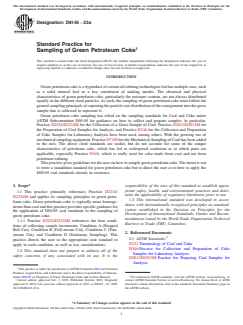
Designation: D8145 − 23a
Standard Practice for
Sampling of Green Petroleum Coke
This standard is issued under the fixed designation D8145; the number immediately following the designation indicates the year of
original adoption or, in the case of revision, the year of last revision. A number in parentheses indicates the year of last reapproval. A
superscript epsilon (´) indicates an editorial change since the last revision or reapproval.
INTRODUCTION
Green petroleum coke is a byproduct of certain oil refining technologies but has multiple uses, such
as a solid mineral fuel or a key constituent of making anodes. The chemical and physical
characteristics of green petroleum coke, particularly the moisture content, are not always distributed
equally in the different sized particles. As such, the sampling of green petroleum coke must follow the
general sampling principals of capturing the particle size distribution of the consignment into the gross
sample that is collected to represent it.
Green petroleum coke sampling has relied on the sampling standards for Coal and Coke under
ASTM Subcommittee D05.05 for guidance on how to collect and prepare samples, in particular,
Practice D2234/D2234M for the Collection of a Gross Sample of Coal, Practice D2013/D2013M for
the Preparation of Coal Samples for Analysis, and Practice D346 for the Collection and Preparation
of Coke Samples for Laboratory Analysis have been used, among others. With the growing use of
mechanical sampling equipment, Practice D7430 for the Mechanical Sampling of Coal has been added
to the mix. The above cited standards are useful, but do not account for some of the unique
characteristics of petroleum coke, which has led to widespread confusion as to which parts are
applicable, especially Practice D346, which is really used for coke made from coal and not from
petroleum refining.
This practice gives guidelines for the user on how to sample green petroleum coke. The intent is not
to write a standalone standard for green petroleum coke but to direct the user as to how to apply the
D05.05 coal standards already in existence.
1. Scope* responsibility of the user of this standard to establish appro-
priate safety, health, and environmental practices and deter-
1.1 This practice primarily references Practice D2234/
mine the applicability of regulatory limitations prior to use.
D2234M and applies its sampling principles to green petro-
1.3 This international standard was developed in accor-
leum coke. Green petroleum coke is typically more homoge-
dance with internationally recognized principles on standard-
neous than coal and this practice provides specific guidance for
ization established in the Decision on Principles for the
the application of D05.05 coal standards to the sampling of
Development of International Standards, Guides and Recom-
green petroleum coke.
mendations issued by the World Trade Organization Technical
1.1.1 Practice D2234/D2234M references the four condi-
Barriers to Trade (TBT) Committee.
tions of collecting sample increments: Condition A (Stopped
Belt Cut), Condition B (Full-stream Cut), Condition C (Part-
2. Referenced Documents
stream Cut), and Condition D (Stationary Sampling). This
2.1 ASTM Standards:
practice directs the user to the appropriate coal standard to
D121 Terminology of Coal and Coke
apply to each condition, as well as key considerations.
D346 Practice for Collection and Preparation of Coke
1.2 This standard does not purport to address all of the
Samples for Laboratory Analysis
safety concerns, if any, associated with its use. It is the
D2013/D2013M Practice for Preparing Coal Samples for
Analysis
This practice is under the jurisdiction of ASTM Committee D02 on Petroleum
Products, Liquid Fuels, and Lubricants and is the direct responsibility of Subcom-
mittee D02.05 on Properties of Fuels, Petroleum Coke and Carbon Material. For referenced ASTM standards, visit the ASTM website, www.astm.org, or
Current edition approved Oct. 1, 2023. Published October 2023. Originally contact ASTM Customer Service at service@astm.org. For Annual Book of ASTM
approved in 2018. Last previous edition approved in 2023 as D8145 – 23. DOI: Standards volume information, refer to the standard’s Document Summary page on
10.1520/D8145-23A. the ASTM website.
*A Summary of Changes section appears at the end of this standard
Copyright © ASTM International, 100 Barr Harbor Drive, PO Box C700, West Conshohocken, PA 19428-2959. United States
D8145 − 23a
D2234/D2234M Practice for Collection of a Gross Sample 3.2.7 probability sample, n—a sample collected using a
of Coal sampling process such that at each stage of the process, a
D4175 Terminology Relating to Petroleum Products, Liquid specified non-zero probability of being selected for the sample
Fuels, and Lubricants can be attached to every sampling unit in the lot to be sampled.
D5709 Test Method for Sieve Analysis of Petroleum Coke 3.2.7.1 Discussion—Given adequate information about the
D6609 Guide for Part-Stream Sampling of Coal sample results obtained using probability sampling, the prob-
D6883 Practice for Manual Sampling of Stationary Coal ability distribution of sampling errors can be estimated.
from Railroad Cars, Barges, Trucks, or Stockpiles
3.2.8 sample, n—a quantity of material taken from a larger
D7430 Practice for Mechanical Sampling of Coal
quantity for the purpose of estimating properties or composi-
E456 Terminology Relating to Quality and Statistics
tion of the larger quantity.
3.2.9 size consist, n—the particle size distribution of a
3. Terminology
consignment of green petroleum coke.
3.1 Definitions:
3.1.1 For definitions of terms used in this practice, refer to
4. Summary of Practice
Terminologies D121 and D4175.
4.1 This practice applies the requirements of Practice
3.2 Definitions of Terms Specific to This Standard:
D2234/D2234M to the sampling of green petroleum coke.
3.2.1 cross-belt sampler, n—a single sampling machine or
Practice D2234/D2234M is an umbrella standard which defines
component of a mechanical sampling system designed to
four different conditions of sample increment collection. This
extract an increment directly from a conveyor belt surface by
practice delineates which ASTM standard to use based on the
sweeping a sampling device (cutter) through the material on
condition of sampling available.
the conveyor.
4.1.1 Conditions of Increment Collection—The conditions
3.2.2 falling-stream sampler, n—a single sampling machine
under which individual increments are collected are the con-
or component of a mechanical sampling system designed to
ditions of the main body of green relative to the portion
extract an increment from a falling stream of green petroleum
withdrawn. Four conditions are recognized:
coke at the discharge end of a conveyor or chute by moving a
4.1.1.1 Condition A (Stopped-belt Cut), in which a loaded
sampling device (cutter) through the falling stream of material.
conveyor belt is stopped, and a full cross-section cut with
3.2.3 increment, n—a small portion of a lot collected by one parallel sides is removed from the green petroleum coke
operation of a sampling device and normally combined with
stream. The distance between the parallel faces shall not be less
other increments from the lot to make a gross sample. than three times the normal top size of the green petroleum
coke.
3.2.4 judgment sampling, n—a procedure whereby enu-
4.1.1.2 Condition B (Full-stream Cut), in which a full
merators select a few items of the population, based on visual,
cross-section cut is removed from a moving stream of green
positional, or other cues that are believed to be related to the
petroleum coke.
variable of interest, so that the selected items appear to match
4.1.1.3 Condition C (Part-stream Cut), in which a portion,
the population.
not a full cross-section, is removed from a moving stream of
3.2.4.1 Discussion—In the case of sampling green petro-
green petroleum coke.
leum coke, this statistical terminology from Terminology E456
4.1.1.4 Condition D (Stationary Coal Sampling), in which a
is stating that the enumerator (human sampler) selects items
portion of green petroleum coke is collected from a pile, a rail
from the population (c
...
This document is not an ASTM standard and is intended only to provide the user of an ASTM standard an indication of what changes have been made to the previous version. Because
it may not be technically possible to adequately depict all changes accurately, ASTM recommends that users consult prior editions as appropriate. In all cases only the current version
of the standard as published by ASTM is to be considered the official document.
Designation: D8145 − 23 D8145 − 23a
Standard Practice for
Sampling of Green Petroleum Coke
This standard is issued under the fixed designation D8145; the number immediately following the designation indicates the year of
original adoption or, in the case of revision, the year of last revision. A number in parentheses indicates the year of last reapproval. A
superscript epsilon (´) indicates an editorial change since the last revision or reapproval.
INTRODUCTION
Green petroleum coke is a byproduct of certain oil refining technologies but has multiple uses, such
as a solid mineral fuel or a key constituent of making anodes. The chemical and physical
characteristics of green petroleum coke, particularly the moisture content, are not always distributed
equally in the different sized particles. As such, the sampling of green petroleum coke must follow the
general sampling principals of capturing the particle size distribution of the consignment into the gross
sample that is collected to represent it.
Green petroleum coke sampling has relied on the sampling standards for Coal and Coke under
ASTM Subcommittee D05.05 for guidance on how to collect and prepare samples, in particular,
Practice D2234/D2234M for the Collection of a Gross Sample of Coal, Practice D2013/D2013M for
the Preparation of Coal Samples for Analysis, and Practice D346 for the Collection and Preparation
of Coke Samples for Laboratory Analysis have been used, among others. With the growing use of
mechanical sampling equipment, Practice D7430 for the Mechanical Sampling of Coal has been added
to the mix. The above cited standards are useful, but do not account for some of the unique
characteristics of petroleum coke, which has led to widespread confusion as to which parts are
applicable, especially Practice D346, which is really used for coke made from coal and not from
petroleum refining.
This practice gives guidelines for the user on how to sample green petroleum coke. The intent is not
to write a standalone standard for green petroleum coke but to direct the user as to how to apply the
D05.05 coal standards already in existence.
1. Scope*
1.1 This practice primarily references Practice D2234/D2234M and applies its sampling principles to green petroleum coke. Green
petroleum coke is typically more homogeneous than coal and this practice provides specific guidance for the application of D05.05
coal standards to the sampling of green petroleum coke.
1.1.1 Practice D2234/D2234M references the four conditions of collecting sample increments: Condition A (Stopped Belt Cut),
Condition B (Full-stream Cut), Condition C (Part-stream Cut), and Condition D (Stationary Sampling). This practice directs the
user to the appropriate coal standard to apply to each condition, as well as key considerations.
1.2 This standard does not purport to address all of the safety concerns, if any, associated with its use. It is the responsibility
of the user of this standard to establish appropriate safety, health, and environmental practices and determine the applicability of
regulatory limitations prior to use.
This practice is under the jurisdiction of ASTM Committee D02 on Petroleum Products, Liquid Fuels, and Lubricants and is the direct responsibility of Subcommittee
D02.05 on Properties of Fuels, Petroleum Coke and Carbon Material.
Current edition approved July 1, 2023Oct. 1, 2023. Published October 2023. Originally approved in 2018. Last previous edition approved in 20182023 as
D8145 – 18.D8145 – 23. DOI: 10.1520/D8145-23.10.1520/D8145-23A.
*A Summary of Changes section appears at the end of this standard
Copyright © ASTM International, 100 Barr Harbor Drive, PO Box C700, West Conshohocken, PA 19428-2959. United States
D8145 − 23a
1.3 This international standard was developed in accordance with internationally recognized principles on standardization
established in the Decision on Principles for the Development of International Standards, Guides and Recommendations issued
by the World Trade Organization Technical Barriers to Trade (TBT) Committee.
2. Referenced Documents
2.1 ASTM Standards:
D121 Terminology of Coal and Coke
D346 Practice for Collection and Preparation of Coke Samples for Laboratory Analysis
D2013/D2013M Practice for Preparing Coal Samples for Analysis
D2234/D2234M Practice for Collection of a Gross Sample of Coal
D4175 Terminology Relating to Petroleum Products, Liquid Fuels, and Lubricants
D5709 Test Method for Sieve Analysis of Petroleum Coke
D6609 Guide for Part-Stream Sampling of Coal
D6883 Practice for Manual Sampling of Stationary Coal from Railroad Cars, Barges, Trucks, or Stockpiles
D7430 Practice for Mechanical Sampling of Coal
E456 Terminology Relating to Quality and Statistics
3. Terminology
3.1 Definitions:
3.1.1 For definitions of terms used in this practice, refer to Terminologies D121 and D4175.
3.2 Definitions of Terms Specific to This Standard:
3.2.1 cross-belt sampler, n—a single sampling machine or component of a mechanical sampling system designed to extract an
increment directly from a conveyor belt surface by sweeping a sampling device (cutter) through the material on the conveyor.
3.2.2 falling-stream sampler, n—a single sampling machine or component of a mechanical sampling system designed to extract
an increment from a falling stream of green petroleum coke at the discharge end of a conveyor or chute by moving a sampling
device (cutter) through the falling stream of material.
3.2.3 increment, n—a small portion of a lot collected by one operation of a sampling device and normally combined with other
increments from the lot to make a gross sample.
3.2.4 judgment sampling, n—a procedure whereby enumerators select a few items of the population, based on visual, positional,
or other cues that are believed to be related to the variable of interest, so that the selected items appear to match the population.
3.2.4.1 Discussion—
In the case of sampling green petroleum coke, this statistical terminology from Terminology E456 is stating that the enumerator
(human sampler) selects items from the population (collects sample increments) based on various cues (time/tonnage, at transfer
point, etc.) so that the items (sample increments) appear to match the population (representative sample). The key dynamic here
is that the sampler is attempting to collect a representative sample using their best judgment as to when and how to collect
increments when, (a) so many particles in the consignment have a zero chance of being selected; and (b) there is no sure way to
overcome particle size segregation in the material.
3.2.5 mechanical sampling system, n—a single machine or series of interconnected machines whose purpose is to extract
mechanically, or process (divide and reduce), or a combination thereof, a sample of green petroleum coke.
3.2.6 nonprobability sample, n—a sample of which the sampling units have not been selected in a manner that satisfies the
minimum requirements of probability sampling.
3.2.6.1 Discussion—
No meaningful statistical inference can be made with data obtained by a nonprobability sample. No meaningful statement can be
made concerning the precision, standard error, or bias of the sample.
For referenced ASTM standards, visit the ASTM website, www.astm.org, or contact ASTM Customer Service at service@astm.org. For Annual Book of ASTM Standards
volume information, refer to the standard’s Document Summary page on the ASTM website.
D8145 − 23a
3.2.7 probability sample, n—a sample collected using a sampling process such that at each stage of the process, a specified
non-zero probability of being selected for the sample can be attached to every sampling unit in the lot to be sampled.
3.2.7.1 Discussion—
Given adequate information about the sample results obtained using probability sampling, the probability distribution of sampling
errors can be estimated.
3.2.8 sample, n—a quantity of material taken from a larger quantity for the purpose of estimating properties or composition of the
larger quantity.
3.2.9 size consist, n—the particle size distribution of a consignment of green petroleum coke.
4. Summary of Practice
4.1 This practice applies
...
Questions, Comments and Discussion
Ask us and Technical Secretary will try to provide an answer. You can facilitate discussion about the standard in here.
Loading comments...