

ASTM D7846-21
(Practice)Standard Practice for Reporting Uniaxial Strength Data and Estimating Weibull Distribution Parameters for Advanced Graphites
General Information
- Abstract
SIGNIFICANCE AND USE
5.1 Two- and three-parameter formulations exist for the Weibull distribution. This practice is restricted to the two-parameter formulation. An objective of this practice is to obtain point estimates of the unknown Weibull distribution parameters by using well-defined functions that incorporate the failure data. These functions are referred to as estimators. It is desirable that an estimator be consistent and efficient. In addition, the estimator should produce unique, unbiased estimates of the distribution parameters (6). Different types of estimators exist, such as moment estimators, least-squares estimators, and maximum likelihood estimators. This practice details the use of maximum likelihood estimators.
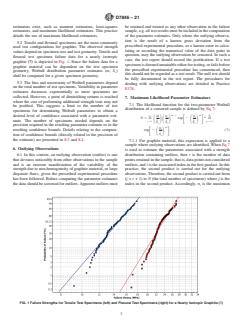
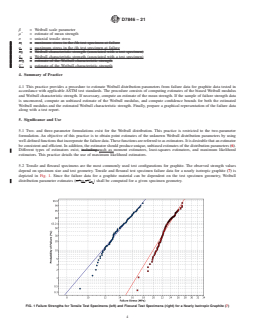
5.2 Tensile and flexural specimens are the most commonly used test configurations for graphite. The observed strength values depend on specimen size and test geometry. Tensile and flexural test specimen failure data for a nearly isotropic graphite (7) is depicted in Fig. 1. Since the failure data for a graphite material can be dependent on the test specimen geometry, Weibull distribution parameter estimates (m, Sc) shall be computed for a given specimen geometry.
FIG. 1 Failure Strengths for Tensile Test Specimens (left) and Flexural Test Specimens (right) for a Nearly Isotropic Graphite (7)
5.3 The bias and uncertainty of Weibull parameters depend on the total number of test specimens. Variability in parameter estimates decreases exponentially as more specimens are collected. However, a point of diminishing returns is reached where the cost of performing additional strength tests may not be justified. This suggests a limit to the number of test specimens for determining Weibull parameters to obtain a desired level of confidence associated with a parameter estimate. The number of specimens needed depends on the precision required in the resulting parameter estimate or in the resulting confidence bounds. Details relating to the computation of confidence bo...
SCOPE
1.1 This practice covers the reporting of uniaxial strength data for graphite and the estimation of probability distribution parameters for both censored and uncensored data. The failure strength of graphite materials is treated as a continuous random variable. Typically, a number of test specimens are failed in accordance with the following standards: Test Methods C565, C651, C695, C749, Practice C781 or Guide D7775. The load at which each specimen fails is recorded. The resulting failure stresses are used to obtain parameter estimates associated with the underlying population distribution. This practice is limited to failure strengths that can be characterized by the two-parameter Weibull distribution. Furthermore, this practice is restricted to test specimens (primarily tensile and flexural) that are primarily subjected to uniaxial stress states.
1.2 Measurements of the strength at failure are taken for various reasons: a comparison of the relative quality of two materials, the prediction of the probability of failure for a structure of interest, or to establish limit loads in an application. This practice provides a procedure for estimating the distribution parameters that are needed for estimating load limits for a particular level of probability of failure.
1.3 This international standard was developed in accordance with internationally recognized principles on standardization established in the Decision on Principles for the Development of International Standards, Guides and Recommendations issued by the World Trade Organization Technical Barriers to Trade (TBT) Committee.
- Status
- Published
- Publication Date
- 30-Nov-2021
- Technical Committee
- D02 - Petroleum Products, Liquid Fuels, and Lubricants
- Drafting Committee
- D02.F0 - Manufactured Carbon and Graphite Products
Buy Documents
ASTM D7846-21 - Standard Practice for Reporting Uniaxial Strength Data and Estimating Weibull Distribution Parameters for Advanced Graphites
REDLINE ASTM D7846-21 - Standard Practice for Reporting Uniaxial Strength Data and Estimating Weibull Distribution Parameters for Advanced Graphites
Overview
ASTM D7846-21 - "Standard Practice for Reporting Uniaxial Strength Data and Estimating Weibull Distribution Parameters for Advanced Graphites" - provides standardized procedures for reporting failure strength data and statistically characterizing the strength distribution of graphite materials. Targeting industrial and research applications, this ASTM standard focuses on the estimation of the two-parameter Weibull distribution parameters using maximum likelihood methods. The practice primarily covers uniaxial tensile and flexural specimens, ensuring accurate, consistent, and unbiased reporting and interpretation of graphite mechanical test results.
Key Topics
Uniaxial Strength Data Reporting
- Defines procedures for reporting failure strengths of graphite samples subjected to uniaxial stress, using standardized test methods such as ASTM C565, C651, C695, and C749.
- Addresses data reporting for both censored (with outliers or incomplete data) and uncensored datasets.
Weibull Distribution Parameter Estimation
- Focuses exclusively on the two-parameter Weibull model, describing strength variability in advanced graphite materials.
- Utilizes maximum likelihood estimators to ensure robust, consistent, and unbiased parameter estimates for shape (Weibull modulus, m) and scale (characteristic strength, Sₑ) parameters.
Bias Correction and Confidence Bounds
- Accounts for statistical bias in modulation estimates, providing unbiasing factors based on sample size.
- Outlines systematic approaches for constructing confidence intervals around parameter estimates, improving the reliability and transparency of statistical interpretations.
Treatment of Outliers
- Provides guidance on identifying and documenting outlying data points, with strict criteria for data exclusion to maintain objectivity and traceability.
Applications
Material Selection and Quality Assurance
- Allows direct comparison of strength quality between graphite materials by standardizing how failure data are analyzed and reported.
- Supports the establishment of design limits, ensuring a quantifiable level of structural reliability in applications such as nuclear reactor components, high-temperature insulation, or electrodes.
Risk Assessment and Structural Analysis
- Weibull probability modeling offers a statistical foundation for predicting failure probabilities, aiding safety assessments for advanced graphite structures.
- The ability to set limiting loads for desired probabilities of failure is essential for engineering design, qualification, and certification.
Research and Development
- Enables R&D labs to share reproducible, comparable strength data using unified statistical approaches.
- Supports the evaluation of processing techniques, treatments, or service environments by tracking changes in Weibull parameters.
Test Method Integration
- Aligns with several established ASTM graphite test methods, streamlining the integration of Weibull statistical analysis into a wide range of mechanical testing programs.
Related Standards
- ASTM C565: Tension Testing of Carbon and Graphite Materials
- ASTM C651: Flexural Strength of Manufactured Carbon and Graphite by Four-Point Loading
- ASTM C695: Compressive Strength of Carbon and Graphite
- ASTM C749: Tensile Stress-Strain of Carbon and Graphite
- ASTM C781: Testing Graphite Materials for Gas-Cooled Nuclear Reactor Components
- ASTM D7775: Measurements on Small Graphite Specimens
- ASTM E178: Dealing with Outlying Observations
- ASTM E456: Terminology Relating to Quality and Statistics
These related standards provide foundational test methods, terminology, and statistical protocols that underpin ASTM D7846-21’s procedures for graphite strength data analysis and Weibull parameter estimation.
Keywords: ASTM D7846-21, graphite, uniaxial strength, Weibull distribution, maximum likelihood estimation, material strength reporting, mechanical testing, confidence bounds, statistical analysis, advanced graphites.
Relations
- Refers
ASTM D4175-23a - Standard Terminology Relating to Petroleum Products, Liquid Fuels, and Lubricants - Effective Date
- 15-Dec-2023
- Refers
ASTM D4175-23e1 - Standard Terminology Relating to Petroleum Products, Liquid Fuels, and Lubricants - Effective Date
- 01-Jul-2023
- Effective Date
- 01-Apr-2022
- Effective Date
- 01-Jun-2020
- Effective Date
- 01-May-2020
- Effective Date
- 01-May-2020
- Effective Date
- 01-Nov-2019
- Effective Date
- 01-Oct-2018
- Effective Date
- 01-Oct-2017
- Effective Date
- 01-Oct-2017
- Effective Date
- 01-Jun-2016
- Effective Date
- 01-Oct-2015
- Effective Date
- 01-Oct-2015
- Effective Date
- 01-Jun-2015
- Effective Date
- 01-Jun-2015
Buy Documents
ASTM D7846-21 - Standard Practice for Reporting Uniaxial Strength Data and Estimating Weibull Distribution Parameters for Advanced Graphites
REDLINE ASTM D7846-21 - Standard Practice for Reporting Uniaxial Strength Data and Estimating Weibull Distribution Parameters for Advanced Graphites
Get Certified
Connect with accredited certification bodies for this standard

ECOCERT
Organic and sustainability certification.

Bureau Veritas Chile
Bureau Veritas certification services in Chile.
Bureau Veritas Peru
Bureau Veritas certification services in Peru.
Sponsored listings
Frequently Asked Questions
ASTM D7846-21 is a standard published by ASTM International. Its full title is "Standard Practice for Reporting Uniaxial Strength Data and Estimating Weibull Distribution Parameters for Advanced Graphites". This standard covers: SIGNIFICANCE AND USE 5.1 Two- and three-parameter formulations exist for the Weibull distribution. This practice is restricted to the two-parameter formulation. An objective of this practice is to obtain point estimates of the unknown Weibull distribution parameters by using well-defined functions that incorporate the failure data. These functions are referred to as estimators. It is desirable that an estimator be consistent and efficient. In addition, the estimator should produce unique, unbiased estimates of the distribution parameters (6). Different types of estimators exist, such as moment estimators, least-squares estimators, and maximum likelihood estimators. This practice details the use of maximum likelihood estimators. 5.2 Tensile and flexural specimens are the most commonly used test configurations for graphite. The observed strength values depend on specimen size and test geometry. Tensile and flexural test specimen failure data for a nearly isotropic graphite (7) is depicted in Fig. 1. Since the failure data for a graphite material can be dependent on the test specimen geometry, Weibull distribution parameter estimates (m, Sc) shall be computed for a given specimen geometry. FIG. 1 Failure Strengths for Tensile Test Specimens (left) and Flexural Test Specimens (right) for a Nearly Isotropic Graphite (7) 5.3 The bias and uncertainty of Weibull parameters depend on the total number of test specimens. Variability in parameter estimates decreases exponentially as more specimens are collected. However, a point of diminishing returns is reached where the cost of performing additional strength tests may not be justified. This suggests a limit to the number of test specimens for determining Weibull parameters to obtain a desired level of confidence associated with a parameter estimate. The number of specimens needed depends on the precision required in the resulting parameter estimate or in the resulting confidence bounds. Details relating to the computation of confidence bo... SCOPE 1.1 This practice covers the reporting of uniaxial strength data for graphite and the estimation of probability distribution parameters for both censored and uncensored data. The failure strength of graphite materials is treated as a continuous random variable. Typically, a number of test specimens are failed in accordance with the following standards: Test Methods C565, C651, C695, C749, Practice C781 or Guide D7775. The load at which each specimen fails is recorded. The resulting failure stresses are used to obtain parameter estimates associated with the underlying population distribution. This practice is limited to failure strengths that can be characterized by the two-parameter Weibull distribution. Furthermore, this practice is restricted to test specimens (primarily tensile and flexural) that are primarily subjected to uniaxial stress states. 1.2 Measurements of the strength at failure are taken for various reasons: a comparison of the relative quality of two materials, the prediction of the probability of failure for a structure of interest, or to establish limit loads in an application. This practice provides a procedure for estimating the distribution parameters that are needed for estimating load limits for a particular level of probability of failure. 1.3 This international standard was developed in accordance with internationally recognized principles on standardization established in the Decision on Principles for the Development of International Standards, Guides and Recommendations issued by the World Trade Organization Technical Barriers to Trade (TBT) Committee.
SIGNIFICANCE AND USE 5.1 Two- and three-parameter formulations exist for the Weibull distribution. This practice is restricted to the two-parameter formulation. An objective of this practice is to obtain point estimates of the unknown Weibull distribution parameters by using well-defined functions that incorporate the failure data. These functions are referred to as estimators. It is desirable that an estimator be consistent and efficient. In addition, the estimator should produce unique, unbiased estimates of the distribution parameters (6). Different types of estimators exist, such as moment estimators, least-squares estimators, and maximum likelihood estimators. This practice details the use of maximum likelihood estimators. 5.2 Tensile and flexural specimens are the most commonly used test configurations for graphite. The observed strength values depend on specimen size and test geometry. Tensile and flexural test specimen failure data for a nearly isotropic graphite (7) is depicted in Fig. 1. Since the failure data for a graphite material can be dependent on the test specimen geometry, Weibull distribution parameter estimates (m, Sc) shall be computed for a given specimen geometry. FIG. 1 Failure Strengths for Tensile Test Specimens (left) and Flexural Test Specimens (right) for a Nearly Isotropic Graphite (7) 5.3 The bias and uncertainty of Weibull parameters depend on the total number of test specimens. Variability in parameter estimates decreases exponentially as more specimens are collected. However, a point of diminishing returns is reached where the cost of performing additional strength tests may not be justified. This suggests a limit to the number of test specimens for determining Weibull parameters to obtain a desired level of confidence associated with a parameter estimate. The number of specimens needed depends on the precision required in the resulting parameter estimate or in the resulting confidence bounds. Details relating to the computation of confidence bo... SCOPE 1.1 This practice covers the reporting of uniaxial strength data for graphite and the estimation of probability distribution parameters for both censored and uncensored data. The failure strength of graphite materials is treated as a continuous random variable. Typically, a number of test specimens are failed in accordance with the following standards: Test Methods C565, C651, C695, C749, Practice C781 or Guide D7775. The load at which each specimen fails is recorded. The resulting failure stresses are used to obtain parameter estimates associated with the underlying population distribution. This practice is limited to failure strengths that can be characterized by the two-parameter Weibull distribution. Furthermore, this practice is restricted to test specimens (primarily tensile and flexural) that are primarily subjected to uniaxial stress states. 1.2 Measurements of the strength at failure are taken for various reasons: a comparison of the relative quality of two materials, the prediction of the probability of failure for a structure of interest, or to establish limit loads in an application. This practice provides a procedure for estimating the distribution parameters that are needed for estimating load limits for a particular level of probability of failure. 1.3 This international standard was developed in accordance with internationally recognized principles on standardization established in the Decision on Principles for the Development of International Standards, Guides and Recommendations issued by the World Trade Organization Technical Barriers to Trade (TBT) Committee.
ASTM D7846-21 is classified under the following ICS (International Classification for Standards) categories: 71.060.10 - Chemical elements; 73.040 - Coals. The ICS classification helps identify the subject area and facilitates finding related standards.
ASTM D7846-21 has the following relationships with other standards: It is inter standard links to ASTM D4175-23a, ASTM D4175-23e1, ASTM E456-13a(2022)e1, ASTM C781-20, ASTM C749-15(2020), ASTM C651-20, ASTM C781-19, ASTM C781-18, ASTM E456-13A(2017)e3, ASTM E456-13A(2017)e1, ASTM E178-16, ASTM C749-15, ASTM C651-15, ASTM C695-15, ASTM D7775-11(2015). Understanding these relationships helps ensure you are using the most current and applicable version of the standard.
ASTM D7846-21 is available in PDF format for immediate download after purchase. The document can be added to your cart and obtained through the secure checkout process. Digital delivery ensures instant access to the complete standard document.
Standards Content (Sample)
This international standard was developed in accordance with internationally recognized principles on standardization established in the Decision on Principles for the
Development of International Standards, Guides and Recommendations issued by the World Trade Organization Technical Barriers to Trade (TBT) Committee.
Designation: D7846 − 21
Standard Practice for
Reporting Uniaxial Strength Data and Estimating Weibull
Distribution Parameters for Advanced Graphites
This standard is issued under the fixed designation D7846; the number immediately following the designation indicates the year of
original adoption or, in the case of revision, the year of last revision. A number in parentheses indicates the year of last reapproval. A
superscript epsilon (´) indicates an editorial change since the last revision or reapproval.
1. Scope* Graphite Mechanical Materials
C651 Test Method for Flexural Strength of Manufactured
1.1 This practice covers the reporting of uniaxial strength
CarbonandGraphiteArticlesUsingFour-PointLoadingat
data for graphite and the estimation of probability distribution
Room Temperature
parameters for both censored and uncensored data. The failure
C695 Test Method for Compressive Strength of Carbon and
strengthofgraphitematerialsistreatedasacontinuousrandom
Graphite
variable. Typically, a number of test specimens are failed in
C749 Test Method for Tensile Stress-Strain of Carbon and
accordance with the following standards: Test Methods C565,
Graphite
C651,C695,C749,PracticeC781orGuideD7775.Theloadat
C781 PracticeforTestingGraphiteMaterialsforGas-Cooled
which each specimen fails is recorded. The resulting failure
Nuclear Reactor Components
stresses are used to obtain parameter estimates associated with
D4175 Terminology Relating to Petroleum Products, Liquid
the underlying population distribution. This practice is limited
Fuels, and Lubricants
to failure strengths that can be characterized by the two-
D7775 Guide for Measurements on Small Graphite Speci-
parameter Weibull distribution. Furthermore, this practice is
mens
restricted to test specimens (primarily tensile and flexural) that
E6 Terminology Relating to Methods of Mechanical Testing
are primarily subjected to uniaxial stress states.
E178 Practice for Dealing With Outlying Observations
1.2 Measurements of the strength at failure are taken for
E456 Terminology Relating to Quality and Statistics
various reasons: a comparison of the relative quality of two
materials, the prediction of the probability of failure for a
3. Terminology
structure of interest, or to establish limit loads in an applica-
3.1 Proper use of the following terms and equations will
tion. This practice provides a procedure for estimating the
alleviate misunderstanding in the presentation of data and in
distribution parameters that are needed for estimating load
the calculation of strength distribution parameters.
limits for a particular level of probability of failure.
3.2 Definitions:
1.3 This international standard was developed in accor-
dance with internationally recognized principles on standard- 3.2.1 estimator, n—awell-definedfunctionthatisdependent
ization established in the Decision on Principles for the
ontheobservationsinasample.Theresultingvalueforagiven
Development of International Standards, Guides and Recom- sample may be an estimate of a distribution parameter (a point
mendations issued by the World Trade Organization Technical
estimate) associated with the underlying population. The arith-
Barriers to Trade (TBT) Committee. metic average of a sample is, for example, an estimator of the
distribution mean.
2. Referenced Documents
3.2.2 population, n—the totality of valid observations (per-
2.1 ASTM Standards:
formed in a manner that is compliant with the appropriate test
C565 Test Methods for Tension Testing of Carbon and
standards) about which inferences are made.
3.2.3 population mean, n—the average of all potential
measurements in a given population weighted by their relative
This practice is under the jurisdiction ofASTM Committee D02 on Petroleum
Products, Liquid Fuels, and Lubricants and is the direct responsibility of Subcom-
frequencies in the population.
mittee D02.F0 on Manufactured Carbon and Graphite Products.
3.2.4 probability density function, n—the function f(x) is a
Current edition approved Dec. 1, 2021. Published February 2022. Originally
approved in 2012. Last previous edition approved in 2016 as D7846 – 16. DOI:
probabilitydensityfunctionforthecontinuousrandomvariable
10.1520/D7846-21.
X if:
For referenced ASTM standards, visit the ASTM website, www.astm.org, or
contact ASTM Customer Service at service@astm.org. For Annual Book of ASTM
f x $0 (1)
~ !
Standards volume information, refer to the standard’s Document Summary page on
the ASTM website. and
*A Summary of Changes section appears at the end of this standard
Copyright © ASTM International, 100 Barr Harbor Drive, PO Box C700, West Conshohocken, PA 19428-2959. United States
D7846 − 21
`
S = the Weibull characteristic strength.
c
f x dx 51 (2)
* ~ !
2`
3.2.9.2 Discussion—The Weibull characteristic strength de-
pends on the uniaxial test specimen (tensile, compression and
The probability that the random variable X assumes a
flexural) and may change with specimen geometry. In addition,
value between a and b is given by:
the Weibull characteristic strength has units of stress and
b
should be reported using units of MPa or GPa.
Pr a , X , b 5 f x dx (3)
~ ! * ~ !
3.3 For definitions of other statistical terms, terms related to
a
mechanical testing, and terms related to graphite used in this
3.2.5 sample, n—a collection of measurements or observa-
practice, refer to Terminologies D4175, E6, and E456,orto
tions taken from a specified population.
appropriate textbooks on statistics (1-5).
3.2.6 skewness, n—a term relating to the asymmetry of a
probability density function. The distribution of failure 3.4 Nomenclature:
strength for graphite is not symmetric with respect to the
F(x) = cumulative distribution function
maximum value of the distribution function; one tail is longer
f(x) = probability density function
than the other.
+ = likelihood function
3.2.7 statistical bias, n—inherent to most estimates, this is a
m = Weibull modulus
typeofconsistentnumericaloffsetinanestimaterelativetothe
mˆ = estimate of the Weibull modulus
trueunderlyingvalue.Themagnitudeofthebiaserrortypically
mˆ = unbiased estimate of the Weibull modulus
U
decreases as the sample size increases.
N = number of specimens in a sample
P = probability of failure
3.2.8 unbiased estimator, n—an estimator that has been
f
t = intermediate quantity used in calculation of confi-
corrected for statistical bias error.
dence bounds
3.2.9 Weibull distribution, n—the continuous random vari-
X = random variable
able X has a two-parameter Weibull distribution if the prob-
x = realization of a random variable X
ability density function is given by:
β = Weibull scale parameter
m21 m
m x x µˆ = estimate of mean strength
f~x! 5 □ exp 2 □ ; x.0 (4)
S DS D F S D G
σ = uniaxial tensile stress
S β β
c
σ = maximum stress in the ith test specimen at failure
i
f x 50; x# 0
~ ! S = Weibull characteristic strength (associated with a test
c
specimen)
and the cumulative distribution function is given by:
ˆ
S = estimate of the Weibull characteristic strength
c
m
x
F x 5 1 2 exp 2 □ ; x.0 (5)
~ ! F S D G
4. Summary of Practice
β
4.1 This practice provides a procedure to estimate Weibull
or
distribution parameters from failure data for graphite data
tested in accordance with applicableASTM test standards.The
F~x! 50; x# 0
procedure consists of computing estimates of the biased
where:
Weibull modulus and Weibull characteristic strength. If
m = Weibull modulus (or the shape parameter) (m > 0), and
necessary, compute an estimate of the mean strength. If the
β = scale parameter (> 0).
sample of failure strength data is uncensored, compute an
unbiased estimate of the Weibull modulus, and compute
3.2.9.1 Discussion—The random variable representing uni-
confidence bounds for both the estimatedWeibull modulus and
axial tensile strength of graphite will assume only positive
the estimatedWeibull characteristic strength. Finally, prepare a
values, and the distribution is asymmetrical about the popula-
graphical representation of the failure data along with a test
tion mean. These characteristics rule out the use of the normal
report.
distribution (as well as others) and favor the use of theWeibull
and similar skewed distributions. If the random variable
5. Significance and Use
representing uniaxial tensile strength of a graphite is charac-
5.1 Two- and three-parameter formulations exist for the
terized by Eq 4, and Eq 5, then the probability that the tested
Weibull distribution. This practice is restricted to the two-
graphite will fail under an applied uniaxial tensile stress, σ,is
parameterformulation.Anobjectiveofthispracticeistoobtain
given by the cumulative distribution function:
point estimates of the unknown Weibull distribution param-
m
σ
eters by using well-defined functions that incorporate the
P 5 1 2 exp 2 □ ; σ.0 (6)
F S D G
f
S
c
failure data. These functions are referred to as estimators. It is
desirable that an estimator be consistent and efficient. In
and
addition, the estimator should produce unique, unbiased esti-
P 50; σ# 0 mates of the distribution parameters (6). Different types of
f
where:
The boldface numbers in parentheses refer to the list of references at the end of
P = the probability of failure, and
f
this standard.
D7846 − 21
estimators exist, such as moment estimators, least-squares be retained and treated as any other observation in the failure
estimators, and maximum likelihood estimators. This practice sample,e.g.alltestresultsmustbeincludedinthecomputation
details the use of maximum likelihood estimators. of the parameter estimates. Only where the outlying observa-
tion is the result of a known gross deviation from the
5.2 Tensile and flexural specimens are the most commonly
prescribed experimental procedure, or a known error in calcu-
used test configurations for graphite. The observed strength
lating or recording the numerical value of the data point in
values depend on specimen size and test geometry.Tensile and
question, may the outlying observation be censored. In such a
flexural test specimen failure data for a nearly isotropic
case, the test report should record the justification. If a test
graphite (7) is depicted in Fig. 1. Since the failure data for a
specimenisdeemedunsuitableeitherfortesting,orfailsbefore
graphite material can be dependent on the test specimen
the prescribed experimental procedure has commenced, then
geometry, Weibull distribution parameter estimates (m, S )
c
this should not be regarded as a test result.The null test should
shall be computed for a given specimen geometry.
be fully documented in the test report. The procedures for
5.3 The bias and uncertainty of Weibull parameters depend
dealing with outlying observations are detailed in Practice
on the total number of test specimens. Variability in parameter
E178.
estimates decreases exponentially as more specimens are
collected. However, a point of diminishing returns is reached
7. Maximum Likelihood Parameter Estimators
where the cost of performing additional strength tests may not
7.1 The likelihood function for the two-parameter Weibull
be justified. This suggests a limit to the number of test
distribution of a censored sample is defined by Eq 7:
specimens for determining Weibull parameters to obtain a
r mˆ 21 mˆ N
mˆ σ σ
desired level of confidence associated with a parameter esti-
i i
+ 5 Π □ exp 2 □ * Π
S DS D F S D G
mate. The number of specimens needed depends on the ˆ ˆ ˆ
i51 j5r11
S S S
c c c
precision required in the resulting parameter estimate or in the
mˆ
σ
j
resulting confidence bounds. Details relating to the computa-
exp 2 □ . (7)
F S D G
ˆ
S
c
tion of confidence bounds (directly related to the precision of
the estimate) are presented in 8.3 and 8.4.
7.1.1 For graphite material, this expression is applied to a
sample where outlying observations are identified. When Eq 7
6. Outlying Observations
is used to estimate the parameters associated with a strength
6.1 In this context, an outlying observation (outlier) is one distribution containing outliers, then r is the number of data
that deviates noticeably from other observations in the sample pointsretainedinthesample,thatis,datapointsnotconsidered
and is an extreme manifestation of the variability of the outliers,and iistheassociatedindexinthefirstproduct.Inthis
strength due to non-homogeneity of graphite material, or large practice, the second product is carried out for the outlying
disparate flaws, given the prescribed experimental procedure observations.Therefore, the second product is carried out from
has been followed. Before computing the parameter estimates (j = r+1)to N (the total number of specimens) where j is the
the data should be screened for outliers.Apparent outliers must index in the second product. Accordingly, σ is the maximum
i
FIG. 1 Failure Strengths for Tensile Test Specimens (left) and Flexural Test Specimens (right) for a Nearly Isotropic Graphite (7)
D7846 − 21
stress in the ith test specimen at failure. The parameter estimates (the Weibull modulus m and the characteristic
estimates (theWeibull modulus and the characteristic strength) strength S ) are determined by taking the partial derivatives of
c
are determined by taking the partial derivatives of the loga- the logarithm of the likelihood function given by Eq 8 with
ˆ
rithm of the likelihood function with respect to m and S , then respect to mˆ and S , then equating the resulting expressions to
c c
equating the resulting expressions to zero. Finally, the likeli-
zero.ThesystemofequationsobtainedisgivenbyEq9andEq
hood function for the two-parameter Weibull distribution for a 10, where r=N.
sample free of outlying observations is defined by the expres-
7.5 An objective of this practice is the consistent statistical
sion:
representation of strength data. To this end, the following
N ~mˆ 2 1! mˆ
mˆ σ σ
i i
procedure is the recommended graphical representation of
+ 5 Π □ exp 2 □ (8)
S DS D F S D G
ˆ ˆ ˆ
i51
S S S strengthdata.Beginbyrankingthestrengthdataobtainedfrom
c c c
laboratory testing in ascending order, and assign to each a
where r was taken equal to N in Eq 7.
ranked probability of failure P according to the estimator:
f
7.2 TheWeibull modulus (m) and the characteristic strength
i 2 0.5
P ~x ! 5 (11)
(S ) are determined by taking the partial derivatives of the
f i
c
N
logarithm of the likelihood function with respect to m and S
c
where:
then equating the resulting expressions to zero. Replacing σ
i
with x, the system of equations obtained by differentiating the N = number of specimens, and
i
i = the ith datum.
log likelihood function for a censored sample is given by:
r r 21
Compute the natural logarithm of the ith failure stress, and
mˆ
x ln x ln x
~ ! ~ !
( i i ( i
the natural logarithm of the natural logarithm of [1/(1 – P)]
i51 i51
f
mˆ 5 2 (9)
r
r (that is, the double logarithm of the quantity in brackets),
mˆ
3 4
x
i
(
where P is associated with the ith failure stress.
i51 f
and
7.6 Create a graph representing the data as shown in Fig. 2.
r
mˆ Plot ln{ln[1/1(1 – P)]} as the ordinate, and ln
...
This document is not an ASTM standard and is intended only to provide the user of an ASTM standard an indication of what changes have been made to the previous version. Because
it may not be technically possible to adequately depict all changes accurately, ASTM recommends that users consult prior editions as appropriate. In all cases only the current version
of the standard as published by ASTM is to be considered the official document.
Designation: D7846 − 16 D7846 − 21
Standard Practice for
Reporting Uniaxial Strength Data and Estimating Weibull
Distribution Parameters for Advanced Graphites
This standard is issued under the fixed designation D7846; the number immediately following the designation indicates the year of
original adoption or, in the case of revision, the year of last revision. A number in parentheses indicates the year of last reapproval. A
superscript epsilon (´) indicates an editorial change since the last revision or reapproval.
1. Scope*
1.1 This practice covers the reporting of uniaxial strength data for graphite and the estimation of probability distribution
parameters for both censored and uncensored data. The failure strength of graphite materials is treated as a continuous random
variable. Typically, a number of test specimens are failed in accordance with the following standards: Test Methods C565, C651,
C695, C749, Practice C781 or Guide D7775. The load at which each specimen fails is recorded. The resulting failure stresses are
used to obtain parameter estimates associated with the underlying population distribution. This practice is limited to failure
strengths that can be characterized by the two-parameter Weibull distribution. Furthermore, this practice is restricted to test
specimens (primarily tensile and flexural) that are primarily subjected to uniaxial stress states.
1.2 Measurements of the strength at failure are taken for various reasons: a comparison of the relative quality of two materials,
the prediction of the probability of failure for a structure of interest, or to establish limit loads in an application. This practice
provides a procedure for estimating the distribution parameters that are needed for estimating load limits for a particular level of
probability of failure.
1.3 This international standard was developed in accordance with internationally recognized principles on standardization
established in the Decision on Principles for the Development of International Standards, Guides and Recommendations issued
by the World Trade Organization Technical Barriers to Trade (TBT) Committee.
2. Referenced Documents
2.1 ASTM Standards:
C565 Test Methods for Tension Testing of Carbon and Graphite Mechanical Materials
C651 Test Method for Flexural Strength of Manufactured Carbon and Graphite Articles Using Four-Point Loading at Room
Temperature
C695 Test Method for Compressive Strength of Carbon and Graphite
C749 Test Method for Tensile Stress-Strain of Carbon and Graphite
C781 Practice for Testing Graphite Materials for Gas-Cooled Nuclear Reactor Components
D4175 Terminology Relating to Petroleum Products, Liquid Fuels, and Lubricants
D7775 Guide for Measurements on Small Graphite Specimens
E6 Terminology Relating to Methods of Mechanical Testing
E178 Practice for Dealing With Outlying Observations
E456 Terminology Relating to Quality and Statistics
This practice is under the jurisdiction of ASTM Committee D02 on Petroleum Products, Liquid Fuels, and Lubricants and is the direct responsibility of Subcommittee
D02.F0 on Manufactured Carbon and Graphite Products.
Current edition approved Jan. 1, 2016Dec. 1, 2021. Published February 2016February 2022. Originally approved in 2012. Last previous edition approved in 20122016
as D7846 – 12.D7846 – 16. DOI: 10.1520/D7846-16.10.1520/D7846-21.
For referenced ASTM standards, visit the ASTM website, www.astm.org, or contact ASTM Customer Service at service@astm.org. For Annual Book of ASTM Standards
volume information, refer to the standard’s Document Summary page on the ASTM website.
*A Summary of Changes section appears at the end of this standard
Copyright © ASTM International, 100 Barr Harbor Drive, PO Box C700, West Conshohocken, PA 19428-2959. United States
D7846 − 21
3. Terminology
3.1 Proper use of the following terms and equations will alleviate misunderstanding in the presentation of data and in the
calculation of strength distribution parameters.
3.2 Definitions:
3.2.1 estimator, n—a well-defined function that is dependent on the observations in a sample. The resulting value for a given
sample may be an estimate of a distribution parameter (a point estimate) associated with the underlying population. The arithmetic
average of a sample is, for example, an estimator of the distribution mean.
3.2.2 population, n—the totality of valid observations (performed in a manner that is compliant with the appropriate test standards)
about which inferences are made.
3.2.3 population mean, n—the average of all potential measurements in a given population weighted by their relative frequencies
in the population.
3.2.4 probability density function, n—the function f(x) is a probability density function for the continuous random variable X if:
f~x! $ 0 (1)
and
`
f x dx 5 1 (2)
* ~ !
2`
The probability that the random variable X assumes a value between a and b is given by:
b
Pr~a , X , b! 5 f~x! dx (3)
*
a
3.2.5 sample, n—a collection of measurements or observations taken from a specified population.
3.2.6 skewness, n—a term relating to the asymmetry of a probability density function. The distribution of failure strength for
graphite is not symmetric with respect to the maximum value of the distribution function; one tail is longer than the other.
3.2.7 statistical bias, n—inherent to most estimates, this is a type of consistent numerical offset in an estimate relative to the true
underlying value. The magnitude of the bias error typically decreases as the sample size increases.
3.2.8 unbiased estimator, n—an estimator that has been corrected for statistical bias error.
3.2.9 Weibull distribution, n—the continuous random variable X has a two-parameter Weibull distribution if the probability density
function is given by:
m21 m
m x x
f~x! 5 □ exp 2 □ x.0 (4)
S DS D F S D G
β β β
m21 m
m x x
f~x! 5 □ exp 2 □ ; x.0 (4)
S DS D F S D G
S β β
c
f~x! 5 0; x # 0
f x 5 0 x # 0 (5)
~ !
and the cumulative distribution function is given by:
m
x
F x 5 12 exp 2 □ x.0 (5)
~ ! F S D G
β
m
x
F~x! 5 12 exp 2 □ ; x.0 (5)
F S D G
β
or
D7846 − 21
F x 5 0; x # 0
~ !
or
F x 5 0 x # 0 (7)
~ !
where:
m = Weibull modulus (or the shape parameter) (> 0), and
m = Weibull modulus (or the shape parameter) (m > 0), and
β = scale parameter (> 0).
3.2.9.1 Discussion—
The random variable representing uniaxial tensile strength of graphite will assume only positive values, and the distribution is
asymmetrical about the population mean. These characteristics rule out the use of the normal distribution (as well as others) and
favor the use of the Weibull and similar skewed distributions. If the random variable representing uniaxial tensile strength of a
graphite is characterized by Eq 4, and Eq 5, Eq 6, and Eq 7, then the probability that the tested graphite will fail under an applied
uniaxial tensile stress, σ, is given by the cumulative distribution function:
m
σ
P 5 12 exp 2 □ for σ.0 (6)
F S D G
f
σ
θ
m
σ
P 5 12 exp 2 □ ; σ.0 (6)
F S D G
f
S
c
and
P 5 0; σ # 0
f
and
P 5 0 for σ # 0 (9)
f
where:
P = the probability of failure, and
f
σ = the Weibull characteristic strength.
θ
S = the Weibull characteristic strength.
c
3.2.9.2 Discussion—
The Weibull characteristic strength depends on the uniaxial test specimen (tensile, compression and flexural) and may change with
specimen geometry. In addition, the Weibull characteristic strength has units of stress and should be reported using units of MPa
or GPa.
3.3 For definitions of other statistical terms, terms related to mechanical testing, and terms related to graphite used in this practice,
refer to Terminologies D4175, E6, and E456, or to appropriate textbooks on statistics (1-5).
3.4 Nomenclature:
F(x) = cumulative distribution function
f(x) = probability density function
+ = likelihood function
m = Weibull modulus
mˆ = estimate of the Weibull modulus
mˆ = unbiased estimate of the Weibull modulus
U
N = number of specimens in a sample
P = probability of failure
f
t = intermediate quantity used in calculation of confidence bounds
X = random variable
x = realization of a random variable X
The boldface numbers in parentheses refer to the list of references at the end of this standard.
D7846 − 21
β = Weibull scale parameter
μˆ = estimate of mean strength
σ = uniaxial tensile stress
σ = maximum stress in the Ith test specimen at failure
i
σ = maximum stress in the ith test specimen at failure
i
σ = Weibull characteristic strength (associated with a test specimen)
θ
S = Weibull characteristic strength (associated with a test specimen)
c
σˆ = estimate of the Weibull characteristic strength
θ
Sˆ = estimate of the Weibull characteristic strength
c
4. Summary of Practice
4.1 This practice provides a procedure to estimate Weibull distribution parameters from failure data for graphite data tested in
accordance with applicable ASTM test standards. The procedure consists of computing estimates of the biased Weibull modulus
and Weibull characteristic strength. If necessary, compute an estimate of the mean strength. If the sample of failure strength data
is uncensored, compute an unbiased estimate of the Weibull modulus, and compute confidence bounds for both the estimated
Weibull modulus and the estimated Weibull characteristic strength. Finally, prepare a graphical representation of the failure data
along with a test report.
5. Significance and Use
5.1 Two- and three-parameter formulations exist for the Weibull distribution. This practice is restricted to the two-parameter
formulation. An objective of this practice is to obtain point estimates of the unknown Weibull distribution parameters by using
well-defined functions that incorporate the failure data. These functions are referred to as estimators. It is desirable that an estimator
be consistent and efficient. In addition, the estimator should produce unique, unbiased estimates of the distribution parameters (6).
Different types of estimators exist, including such as moment estimators, least-squares estimators, and maximum likelihood
estimators. This practice details the use of maximum likelihood estimators.
5.2 Tensile and flexural specimens are the most commonly used test configurations for graphite. The observed strength values
depend on specimen size and test geometry. Tensile and flexural test specimen failure data for a nearly isotropic graphite (7) is
depicted in Fig. 1. Since the failure data for a graphite material can be dependent on the test specimen geometry, Weibull
distribution parameter estimates (mˆ,m,σˆS ) shall be computed for a given specimen geometry.
θc
FIG. 1 Failure Strengths for Tensile Test Specimens (left) and Flexural Test Specimens (right) for a Nearly Isotropic Graphite (7)
D7846 − 21
5.3 Many factors affect the estimates of the distribution parameters. The The bias and uncertainty of Weibull parameters depend
on the total number of test specimens plays a significant role. Initially, the uncertainty associated with specimens. Variability in
parameter estimates decreases significantly as the number of test specimens increases. exponentially as more specimens are
collected. However, a point of diminishing returns is reached where the cost of performing additional strength tests may not be
justified. This suggests a limit to the number of test specimens for determining Weibull parameters to obtain a desired level of
confidence associated with a parameter estimate. The number of specimens needed depends on the precision required in the
resulting parameter estimate or in the resulting confidence bounds. Details relating to the computation of confidence bounds
(directly related to the precision of the estimate) are presented in 8.3 and 8.4.
6. Outlying Observations
6.1 Before computing the parameter estimates, the data should be screened for outlying observations (outliers). Provided the
experimentalist has followed the prescribed experimental procedure, all test results must be included in the computation of the
parameter estimates. Given the experimentalist has followed the prescribed experimental procedure, the data may include apparent
outliers. However, apparent outliers must be retained and treated as any other observation in the failure sample. In this context,
an outlying observation (outlier) is one that deviates significantlynoticeably from other observations in the sample and is an
extreme manifestation of the variability of the strength due to non-homogeneity of graphite material, or large disparate flaws, given
the prescribed experimental procedure has been followed. Before computing the parameter estimates the data should be screened
for outliers. Apparent outliers must be retained and treated as any other observation in the failure sample, e.g. all test results must
be included in the computation of the parameter estimates. Only where the outlying observation is the result of a known gross
deviation from the prescribed experimental procedure, or a known error in calculating or recording the numerical value of the data
point in question, may the outlying observation be censored. In such a case, the test report should record the justification. If a test
specimen is deemed unsuitable either for testing, or fails before the prescribed experimental procedure has commenced, then this
should not be regarded as a test result. However, the The null test should be fully documented in the test report. The procedures
for dealing with outlying observations are detailed in Practice E178.
7. Maximum Likelihood Parameter Estimators
7.1 The likelihood function for the two-parameter Weibull distribution of a censored sample is defined by theEq 7 expression (8):
r mˆ 21 mˆ N
mˆ σ σ
i i
+ 5 Π □ exp 2 □ Π
H S DS D F S D GJ
σˆ σˆ σˆ
i51 θ θ θ j5r11
mˆ
σ
j
exp 2 □ (7)
F S D G
σˆ
θ
r mˆ 21 mˆ N
mˆ σ σ
i i
+ 5 Π □ exp 2 □ * Π
S D F S D G
S D
ˆ ˆ
ˆ
i51 j5r11
S S
S
c c
c
mˆ
σ
j
exp 2 □ . (7)
F S D G
ˆ
S
c
7.1.1 For graphite material, this expression is applied to a sample where outlying observations are identified under the conditions
given in Section identified. 6. When Eq 107 is used to estimate the parameters associated with a strength distribution containing
outliers, then r is the number of data points retained in the sample, that is, data points not considered outliers, and i is the associated
index in the first product. In this practice, the second product is carried out for the outlying observations. Therefore, the second
product is carried out from (j = r + 1) to N (the total number of specimens) where j is the index in the second summation.product.
Accordingly, σ is the maximum stress in the ith test specimen at failure. The parameter estimates (the Weibull modulus mˆand the
i
characteristic strengthstrength) σˆ ) are determined by taking the partial derivatives of the logarithm of the likelihood function with
θ
respect to mˆm and σˆS , then equating the resulting expressions to zero. Finally, the likelihood function for the two-parameter
θc
Weibull distribution for a sample free of outlying observations is defined by the expression:
N mˆ 21 mˆ
mˆ σ σ
i i
+ 5 Π □ exp 2 □ (8)
S DS D F S D G
σˆ σˆ σˆ
i51 θ θ θ
N ~mˆ 2 1! mˆ
mˆ σ σ
i i
+ 5 Π □ exp 2 □ (8)
S DS D F S D G
ˆ ˆ ˆ
i51
S S S
c c c
where r was taken equal to N in Eq 107.
D7846 − 21
7.2 The Weibull modulus (m) and the characteristic strength (S ) are determined by taking the partial derivatives of the logarithm
c
of the likelihood function with respect to m and S then equating the resulting expressions to zero. Replacing σ with x , the system
c i i
of equations obtained by differentiating the log likelihood function for a censored sample is given by by:(9):
(12)
r r 21
mˆ
x ln x ln x
~ ! ~ !
i i i
( (
i51 i51
mˆ 5 2 (9)
r
r
mˆ
3 4
x
( i
i51
and
N 1⁄mˆ
mˆ
σˆ 5 Σ σ ! □ (10)
F ~ G
θ S i D
r
i51
r
mˆ
Σ ~x !
i
mˆ
i51
ˆ
F G
S 5 □ (10)
c
r
where:
r = the total number of observations (N) minus the number of outlying observations in a censored sample.
7.3 For a censored sample First, Eq 129 is solved first for mˆ. Subsequently, σˆ is computed from Eq 13. Obtaining a closed form
θ
solution of Eq 129 for mˆ is not possible. This expression must be solved numerically. Subsequently, Sˆ is computed from Eq 10.
c
7.4 When a sample does not require censoring Eq 118 is used for the likelihood function. For uncensored data, the parameter
estimates (the Weibull modulus mˆm and the characteristic strength σˆS ) are determined by taking the partial derivatives of the
θc
logarithm of the likelihood function given by Eq 118 with respect to mˆ and Sˆ , then equating the resulting expressions to zero.
θc
The system of equations obtained is given by Eq 9 and Eq 10, where (r9): = N.
(14)
and
N 1⁄mˆ
mˆ
σˆ 5 Σ ~σ ! □ (15)
F G
θ S i D
N
i51
For an uncensored sample Eq 14 is solved first for mˆ. Subsequently σˆ is computed from Eq 15. Obtaining a closed form
θ
solution of Eq 14 for mˆ is not possible. This expression must be solved numerically.
7.5 An objective of this practice is the consistent statistical representation of strength data. To this end, the following procedure
is the recommended graphical representation of strength data. Begin by ranking the strength data obtained from laboratory testing
in ascending order, and assign to each a ranked probability of failure P according to the estimator:
f
i 2 0.5
P σ 5 (11)
~ !
f i
N
i 2 0.5
P x 5 (11)
~ !
f i
N
where:
N = number of specimens, and
i = the ith datum.
Compute the natural logarithm of the ith failure stress, and the natural logarithm of the natural logarithm of [1/(1 – P )] (that
f
is, the double logarithm of the quantity in brackets), where P is associated with the ith failure stress.
f
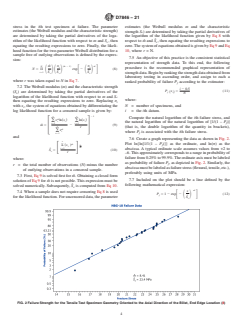
7.6 Create a graph representing the data as shown in Fig. 2. Plot ln{ln[1/1(1 – P )]} as the ordinate, and ln(σ) as the abscissa. A
f
typical ordinate scale assumes values from +2 to –6. This approximately corresponds to a range in probability of failure from
0.25% to 99.9%. The ordinate axis must be labeled as probability of failure P , as depicted in Fig. 2. Similarly, the abscissa must
f
be labeled as failure stress (flexural, tensile, etc.), preferably using units of MPa.
D7846 − 21
FIG. 2 Failure Strength for the Tensile Test Specimen Geometry Oriented to the Axial Direction of the Billet, End Edge Location (108)
7.7 Included on the plot should be a line defined by the following mathematical expression:
mˆ
σ
P 5 12 exp 2 □ (12)
F S D G
f
σˆ
θ
mˆ
x
P 5 12 exp 2 □ (12)
f
F S D G
ˆ
S
c
The slope of the line, which is the estimate of the Weibull modulus (mˆ,), and the characteristic strength (Sˆ ) should be
θc
explicitly identified, as shown in Fig. 2. The estimate of the characteristic strength corresponds to a P of 63.2%, or a value of zero
f
for ln{ln[1/(1 - P )]}. A test report (that is, a data sheet) that contains information regarding the type of material characterized, the
f
test procedure (preferably designating an appropriate standard), the number of failed specimens with the failure load and method
of calculating the failure stress, the maximum likelihood estimates of the Weibull parameters, the unbiasing factor, and the
information that allows the construction of 90% confidence bounds should be prepared. This data sheet should accompany the
graph to provide a complete representation of the failure data. Ins
...