

ASTM D1120-22
(Test Method)Standard Test Method for Boiling Point of Engine Coolants
General Information
- Abstract
ABSTRACT
This test method establishes the standard procedures for the determination of the equilibrium boiling point of engine coolants. The equilibrium boiling point indicates the temperature at which the sample will start to boil in a cooling system under equilibrium conditions at atmospheric pressure. This method requires the use of the following apparatuses: round-bottom, short-neck, heat-resistant glass flask; water-cooled, reflux, glass-tube type condenser; grit No. 8 boiling stones of silicon carbide grains; partial immersion thermometer; and electric heating mantle as heat source. Specified amounts of the sample shall be boiled under equilibrium conditions at atmospheric pressure in the flask. The temperature of the liquid corrected for barometric pressure shall be the boiling point.
SCOPE
1.1 This test method covers the determination of the equilibrium boiling point of engine coolants. The equilibrium boiling point indicates the temperature at which the sample will start to boil in a cooling system under equilibrium conditions at atmospheric pressure.
Note 1: Engine coolants may also be marketed in a ready-to-use form (prediluted). This test procedure is applicable to diluted solutions as well as to concentrates.
Note 2: The procedure for obtaining a representative test sample of a coolant solution that contains an antileak additive is found in Practice D1176.
1.2 The values stated in SI units are to be regarded as standard. The values given in parentheses after SI units are provided for information only and are not considered standard.
1.3 This standard does not purport to address all of the safety concerns, if any, associated with its use. It is the responsibility of the user of this standard to establish appropriate safety, health, and environmental practices and determine the applicability of regulatory limitations prior to use.
1.4 This international standard was developed in accordance with internationally recognized principles on standardization established in the Decision on Principles for the Development of International Standards, Guides and Recommendations issued by the World Trade Organization Technical Barriers to Trade (TBT) Committee.
- Status
- Published
- Publication Date
- 31-Aug-2022
- Technical Committee
- D15 - Engine Coolants and Related Fluids
- Drafting Committee
- D15.03 - Physical Properties


Overview
ASTM D1120-22, titled "Standard Test Method for Boiling Point of Engine Coolants," is a comprehensive standard developed by ASTM International. This test method specifies reliable laboratory procedures for determining the equilibrium boiling point of engine coolants-an essential performance characteristic for automotive, industrial, and heavy-duty cooling systems. The stated boiling point reflects the temperature at which a coolant begins to boil under equilibrium conditions at atmospheric pressure, directly impacting vehicle engine protection, safety, and efficiency.
Key Topics
- Equilibrium Boiling Point Determination: The standard outlines procedures for accurately measuring the boiling point of both concentrated and diluted engine coolants by simulating real-world conditions within a controlled laboratory environment.
- Applicable Sample Types: ASTM D1120-22 applies to both conventional coolant concentrates and premixed (prediluted) formulations, ensuring broad coverage across the automotive and industrial coolant marketplace.
- Apparatus and Equipment: Required equipment includes:
- 100-mL round-bottom, short-neck, heat-resistant glass flask
- Water-cooled reflux condenser
- Silicon carbide boiling stones (grit No. 8 or equivalent)
- ASTM partial immersion thermometer or suitable calibrated thermocouple
- Electric heating mantle as a heat source
- Sample Preparation and Handling: Guidelines are provided to ensure representative test samples, including steps for mixing, temperature conditioning, and handling coolants with antileak additives.
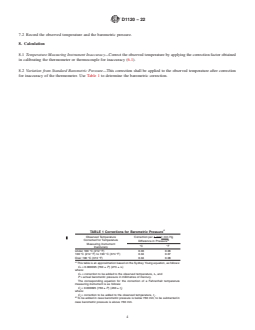
- Measurement Corrections: The observed boiling point temperature must be corrected for both instrument calibration errors and variations in barometric pressure to standardize results.
- Precision and Reporting: Defined reproducibility for results at key temperature ranges, and clear reporting requirements for tested boiling points.
Applications
- Quality Control: Automotive coolant manufacturers and laboratories utilize ASTM D1120-22 to verify product specifications comply with industry and regulatory requirements, supporting consistent product quality.
- Coolant Formulation Evaluation: R&D teams use this method to compare the performance and boiling point stability of new coolant formulations, including those with antifreeze or special additives.
- Regulatory and Safety Compliance: Compliance with ASTM D1120-22 is often cited in OEM (Original Equipment Manufacturer) specifications and regulatory documentation, particularly where engine warranty and safety are concerned.
- Fleet and Aftermarket Testing: Maintenance professionals in automotive, trucking, and heavy-equipment industries rely on this test method to routinely analyze coolant condition in service and to verify coolant suitability for specific operational environments.
Related Standards
- ASTM D1176 – Practice for Sampling and Preparing Aqueous Solutions of Engine Coolants or Antirusts for Testing Purposes: Details proper procedures for obtaining coolant samples, including those containing antileak additives.
- ASTM E1 – Specification for ASTM Liquid-in-Glass Thermometers: Defines requirements for thermometers used in boiling point measurements.
- ASTM E230/E230M – Specification for Temperature-Electromotive Force (emf) Tables for Standardized Thermocouples: Provides essential calibration and accuracy information for non-mercury thermocouple devices.
Practical Value
By following ASTM D1120-22, laboratories and engineers can consistently and accurately determine the boiling point of engine coolants, helping to ensure optimal thermal protection and engine performance. Adherence to this standard supports marketplace trust, reduces risk of engine overheating, and aligns products with globally recognized quality and safety expectations.
Keywords: ASTM D1120-22, engine coolant boiling point, equilibrium boiling point test, coolant performance testing, automotive standards, quality control, laboratory methods, ASTM standards, coolant sample preparation.
Relations
- Effective Date
- 01-Nov-2023
- Effective Date
- 01-May-2023
- Effective Date
- 01-Oct-2019
- Effective Date
- 01-Apr-2014
- Effective Date
- 01-May-2013
- Effective Date
- 15-May-2011
- Effective Date
- 15-May-2011
- Effective Date
- 01-Apr-2008
- Effective Date
- 01-Nov-2007
- Effective Date
- 01-Nov-2005
- Effective Date
- 01-Nov-2003
- Effective Date
- 10-May-2003
- Effective Date
- 10-Oct-2001
- Effective Date
- 10-Oct-2001
- Effective Date
- 10-Oct-2001
Get Certified
Connect with accredited certification bodies for this standard

ECOCERT
Organic and sustainability certification.

Eurofins Food Testing Global
Global leader in food, environment, and pharmaceutical product testing.

Intertek Bangladesh
Intertek certification and testing services in Bangladesh.
Sponsored listings
Frequently Asked Questions
ASTM D1120-22 is a standard published by ASTM International. Its full title is "Standard Test Method for Boiling Point of Engine Coolants". This standard covers: ABSTRACT This test method establishes the standard procedures for the determination of the equilibrium boiling point of engine coolants. The equilibrium boiling point indicates the temperature at which the sample will start to boil in a cooling system under equilibrium conditions at atmospheric pressure. This method requires the use of the following apparatuses: round-bottom, short-neck, heat-resistant glass flask; water-cooled, reflux, glass-tube type condenser; grit No. 8 boiling stones of silicon carbide grains; partial immersion thermometer; and electric heating mantle as heat source. Specified amounts of the sample shall be boiled under equilibrium conditions at atmospheric pressure in the flask. The temperature of the liquid corrected for barometric pressure shall be the boiling point. SCOPE 1.1 This test method covers the determination of the equilibrium boiling point of engine coolants. The equilibrium boiling point indicates the temperature at which the sample will start to boil in a cooling system under equilibrium conditions at atmospheric pressure. Note 1: Engine coolants may also be marketed in a ready-to-use form (prediluted). This test procedure is applicable to diluted solutions as well as to concentrates. Note 2: The procedure for obtaining a representative test sample of a coolant solution that contains an antileak additive is found in Practice D1176. 1.2 The values stated in SI units are to be regarded as standard. The values given in parentheses after SI units are provided for information only and are not considered standard. 1.3 This standard does not purport to address all of the safety concerns, if any, associated with its use. It is the responsibility of the user of this standard to establish appropriate safety, health, and environmental practices and determine the applicability of regulatory limitations prior to use. 1.4 This international standard was developed in accordance with internationally recognized principles on standardization established in the Decision on Principles for the Development of International Standards, Guides and Recommendations issued by the World Trade Organization Technical Barriers to Trade (TBT) Committee.
ABSTRACT This test method establishes the standard procedures for the determination of the equilibrium boiling point of engine coolants. The equilibrium boiling point indicates the temperature at which the sample will start to boil in a cooling system under equilibrium conditions at atmospheric pressure. This method requires the use of the following apparatuses: round-bottom, short-neck, heat-resistant glass flask; water-cooled, reflux, glass-tube type condenser; grit No. 8 boiling stones of silicon carbide grains; partial immersion thermometer; and electric heating mantle as heat source. Specified amounts of the sample shall be boiled under equilibrium conditions at atmospheric pressure in the flask. The temperature of the liquid corrected for barometric pressure shall be the boiling point. SCOPE 1.1 This test method covers the determination of the equilibrium boiling point of engine coolants. The equilibrium boiling point indicates the temperature at which the sample will start to boil in a cooling system under equilibrium conditions at atmospheric pressure. Note 1: Engine coolants may also be marketed in a ready-to-use form (prediluted). This test procedure is applicable to diluted solutions as well as to concentrates. Note 2: The procedure for obtaining a representative test sample of a coolant solution that contains an antileak additive is found in Practice D1176. 1.2 The values stated in SI units are to be regarded as standard. The values given in parentheses after SI units are provided for information only and are not considered standard. 1.3 This standard does not purport to address all of the safety concerns, if any, associated with its use. It is the responsibility of the user of this standard to establish appropriate safety, health, and environmental practices and determine the applicability of regulatory limitations prior to use. 1.4 This international standard was developed in accordance with internationally recognized principles on standardization established in the Decision on Principles for the Development of International Standards, Guides and Recommendations issued by the World Trade Organization Technical Barriers to Trade (TBT) Committee.
ASTM D1120-22 is classified under the following ICS (International Classification for Standards) categories: 71.100.45 - Refrigerants and antifreezes. The ICS classification helps identify the subject area and facilitates finding related standards.
ASTM D1120-22 has the following relationships with other standards: It is inter standard links to ASTM E230/E230M-23a, ASTM E230/E230M-23, ASTM D1176-14(2019), ASTM D1176-14, ASTM E1-13, ASTM E230/E230M-11e1, ASTM E230/E230M-11, ASTM D1176-98(2008), ASTM E1-07, ASTM E1-05, ASTM E1-03a, ASTM E1-03, ASTM E1-01, ASTM E1-98e1, ASTM E1-98. Understanding these relationships helps ensure you are using the most current and applicable version of the standard.
ASTM D1120-22 is available in PDF format for immediate download after purchase. The document can be added to your cart and obtained through the secure checkout process. Digital delivery ensures instant access to the complete standard document.
Standards Content (Sample)
This international standard was developed in accordance with internationally recognized principles on standardization established in the Decision on Principles for the
Development of International Standards, Guides and Recommendations issued by the World Trade Organization Technical Barriers to Trade (TBT) Committee.
Designation: D1120 − 22
Standard Test Method for
Boiling Point of Engine Coolants
This standard is issued under the fixed designation D1120; the number immediately following the designation indicates the year of
original adoption or, in the case of revision, the year of last revision.Anumber in parentheses indicates the year of last reapproval.A
superscript epsilon (´) indicates an editorial change since the last revision or reapproval.
This standard has been approved for use by agencies of the U.S. Department of Defense.
1. Scope* E230/E230MSpecification for Temperature-Electromotive
Force (emf) Tables for Standardized Thermocouples
1.1 This test method covers the determination of the equi-
librium boiling point of engine coolants. The equilibrium
3. Summary of Test Method
boilingpointindicatesthetemperatureatwhichthesamplewill
starttoboilinacoolingsystemunderequilibriumconditionsat
3.1 Sixty millilitres (two ounces) of the sample are boiled
atmospheric pressure.
under equilibrium conditions at atmospheric pressure in a
NOTE 1—Engine coolants may also be marketed in a ready-to-use form 100mL flask. The temperature of the liquid corrected for
(prediluted). This test procedure is applicable to diluted solutions as well
barometric pressure is the boiling point.
as to concentrates.
NOTE 2—The procedure for obtaining a representative test sample of a
4. Apparatus (see Fig. 1)
coolant solution that contains an antileak additive is found in Practice
D1176.
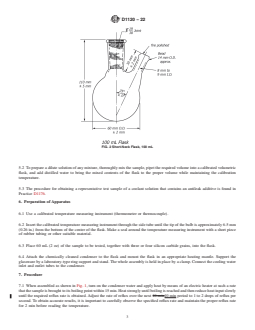
4.1 Flask—A 100 mL round-bottom, short-neck, heat-
1.2 The values stated in SI units are to be regarded as
resistant glass flask having a neck with a ⁄38 standard-taper,
standard. The values given in parentheses after SI units are
female ground-glass joint and a 10mm (0.4in.) outside diam-
provided for information only and are not considered standard.
eter side-entering tube, so located as to permit the end of the
1.3 This standard does not purport to address all of the
thermometerdevicetobedirectlycenteredintheflaskapproxi-
safety concerns, if any, associated with its use. It is the
mately 6.5 mm (0.26 in.) from the bottom. The flask is shown
responsibility of the user of this standard to establish appro-
in Fig. 2.
priate safety, health, and environmental practices and deter-
mine the applicability of regulatory limitations prior to use. 4.2 Condenser—Thecondensershallbeofthewater-cooled,
1.4 This international standard was developed in accor-
reflux, glass-tube type, having a condenser jacket 200 mm
dance with internationally recognized principles on standard-
(7.9in.) in length. The bottom end of the condenser shall have
ization established in the Decision on Principles for the
a ⁄38 standard-taper, drip-tip, male ground-glass joint.
Development of International Standards, Guides and Recom-
4.3 Boiling Stones—Three or four silicon carbide grains,
mendations issued by the World Trade Organization Technical
grit No. 8 or other suitable inert chips, shall be used for each
Barriers to Trade (TBT) Committee.
determination. For samples exhibiting heavy foam, more
boiling chips may be added.
2. Referenced Documents
2.1 ASTM Standards:
4.4 Temperature Measuring Instrument (Environmentally
D1176Practice for Sampling and Preparing Aqueous Solu-
Safe Thermometer or Thermocouple)—An ASTM Partial Im-
tionsofEngineCoolantsorAntirustsforTestingPurposes
mersion Thermometer, having a range from−5°C to 300°C
E1Specification for ASTM Liquid-in-Glass Thermometers
(20°F to 580°F) and conforming to the requirements for
Thermometer 2C or 2F, as prescribed in Specification E1,or
some other suitable non-mercury containing temperature mea-
This test method is under the jurisdiction ofASTM Committee D15 on Engine
suring device, such as a thermocouple, capable of operating in
Coolants and Related Fluids and is the direct responsibility of Subcommittee
the same temperature range and having equal or better accu-
D15.03 on Physical Properties.
Current edition approved Sept. 1, 2022. Published September 2022. Originally racyassummarizedinSpecificationE230/E230M.SeeSection
approved in 1950 as D1120–50T. Last previous edition approved in 2017 as
10, Precision and Bias.
D1120-17. DOI: 10.1520/D1120-22.
For referenced ASTM standards, visit the ASTM website, www.astm.org, or
4.5 HeatSource—Asuitableelectricheatingmantleshallbe
contact ASTM Customer Service at service@astm.org. For Annual Book of ASTM
used, such that sufficient heat can be obtained to comply with
Standards volume information, refer to the standard’s Document Summary page on
the ASTM website. the heating and refluxing rates specified in Section 7.
*A Summary of Changes section appears at the end of this standard
Copyright © ASTM International, 100 Barr Harbor Drive, PO Box C700, West Conshohocken, PA 19428-2959. United States
D1120 − 22
5.1.1 Allow material as received in the original container to
come to room temperature 20°C (68°F) but not below 20°C
minimum).
5.1.2 Shakethecontainertomixanymaterialthatmayhave
separated.
5.1.3 Immediately remove desired sample for test require-
ment.
5.2 To prepare a dilute solution of any mixture, thoroughly
mix the sample, pipet the required volume into a calibrated
volumetric flask, and add distilled water to bring the mixed
contents of the flask to the proper volume while maintaining
the calibration temperature.
5.3 Theprocedureforobtainingarepresentativetestsample
of a coolant solution that contains an antileak additive is found
in Practice D1176.
6. Preparation of Apparatus
6.1 Use a calibrated temperature measuring instrument
(thermometer or thermocouple).
6.2 Insert the calibrated temperatu
...
This document is not an ASTM standard and is intended only to provide the user of an ASTM standard an indication of what changes have been made to the previous version. Because
it may not be technically possible to adequately depict all changes accurately, ASTM recommends that users consult prior editions as appropriate. In all cases only the current version
of the standard as published by ASTM is to be considered the official document.
Designation: D1120 − 17 D1120 − 22
Standard Test Method for
Boiling Point of Engine Coolants
This standard is issued under the fixed designation D1120; the number immediately following the designation indicates the year of
original adoption or, in the case of revision, the year of last revision. A number in parentheses indicates the year of last reapproval. A
superscript epsilon (´) indicates an editorial change since the last revision or reapproval.
This standard has been approved for use by agencies of the U.S. Department of Defense.
1. Scope*
1.1 This test method covers the determination of the equilibrium boiling point of engine coolants. The equilibrium boiling point
indicates the temperature at which the sample will start to boil in a cooling system under equilibrium conditions at atmospheric
pressure.
NOTE 1—Engine coolants may also be marketed in a ready-to-use form (prediluted). This test procedure is applicable to diluted solutions as well as to
concentrates.
NOTE 2—The procedure for obtaining a representative test sample of a coolant solution that contains an antileak additive is found in Practice D1176.
1.2 The values stated in SI units are to be regarded as standard. The values given in parentheses are for information only.after SI
units are provided for information only and are not considered standard.
1.3 This standard does not purport to address all of the safety concerns, if any, associated with its use. It is the responsibility
of the user of this standard to establish appropriate safety safety, health, and healthenvironmental practices and determine the
applicability of regulatory limitations prior to use.
1.4 This international standard was developed in accordance with internationally recognized principles on standardization
established in the Decision on Principles for the Development of International Standards, Guides and Recommendations issued
by the World Trade Organization Technical Barriers to Trade (TBT) Committee.
2. Referenced Documents
2.1 ASTM Standards:
D1176 Practice for Sampling and Preparing Aqueous Solutions of Engine Coolants or Antirusts for Testing Purposes
E1 Specification for ASTM Liquid-in-Glass Thermometers
E230/E230M Specification for Temperature-Electromotive Force (emf) Tables for Standardized Thermocouples
3. Summary of Test Method
3.1 Sixty millilitres (two ounces) of the sample are boiled under equilibrium conditions at atmospheric pressure in a
100-mL100 mL flask. The temperature of the liquid corrected for barometric pressure is the boiling point.
This test method is under the jurisdiction of ASTM Committee D15 on Engine Coolants and Related Fluids and is the direct responsibility of Subcommittee D15.03 on
Physical Properties.
Current edition approved April 1, 2017Sept. 1, 2022. Published April 2017September 2022. Originally approved in 1950 as D1120 – 50 T. Last previous edition approved
in 20162017 as D1120-16.-17. DOI: 10.1520/D1120-17.10.1520/D1120-22.
For referenced ASTM standards, visit the ASTM website, www.astm.org, or contact ASTM Customer Service at service@astm.org. For Annual Book of ASTM Standards
volume information, refer to the standard’s Document Summary page on the ASTM website.
*A Summary of Changes section appears at the end of this standard
Copyright © ASTM International, 100 Barr Harbor Drive, PO Box C700, West Conshohocken, PA 19428-2959. United States
D1120 − 22
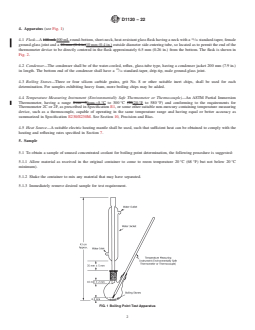
4. Apparatus (see Fig. 1)
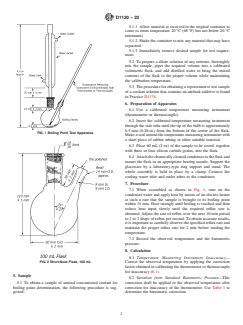
4.1 Flask—A 100-mL100 mL round-bottom, short-neck, heat-resistant glass flask having a neck with a ⁄38 standard-taper, female
ground-glass joint and a 10-mm (0.4-in)10 mm (0.4 in.) outside diameter side-entering tube, so located as to permit the end of the
thermometer device to be directly centered in the flask approximately 6.5 mm (0.26 in.) from the bottom. The flask is shown in
Fig. 2.
4.2 Condenser—The condenser shall be of the water-cooled, reflux, glass-tube type, having a condenser jacket 200 mm (7.9 in.)
in length. The bottom end of the condenser shall have a ⁄38 standard-taper, drip-tip, male ground-glass joint.
4.3 Boiling Stones—Three or four silicon carbide grains, grit No. 8 or other suitable inert chips, shall be used for each
determination. For samples exhibiting heavy foam, more boiling chips may be added.
4.4 Temperature Measuring Instrument (Environmentally Safe Thermometer or Thermocouple)—An ASTM Partial Immersion
Thermometer, having a range from −5from −5 °C to 300 °C (20(20 °F to 580 °F) and conforming to the requirements for
Thermometer 2C or 2F, as prescribed in Specification E1, or some other suitable non-mercury containing temperature measuring
device, such as a thermocouple, capable of operating in the same temperature range and having equal or better accuracy as
summarized in Specification E230/E230M. See Section 10, Precision and Bias.
4.5 Heat Source—A suitable electric heating mantle shall be used, such that sufficient heat can be obtained to comply with the
heating and refluxing rates specified in Section 7.
5. Sample
5.1 To obtain a sample of unused concentrated coolant for boiling point determination, the following procedure is suggested:
5.1.1 Allow material as received in the original container to come to room temperature 20 °C (68 °F) but not below 20 °C
minimum).
5.1.2 Shake the container to mix any material that may have separated.
5.1.3 Immediately remove desired sample for test requirement.
FIG. 1 Boiling Point Test Apparatus
D1120 − 22
FIG. 2 Short-Neck Flask, 100 mL
5.2 To prepare a dilute solution of any mixture, thoroughly mix the sample, pipet the required volume into a calibrated volumetric
flask, and add distilled water to bring the mixed contents of the flask to the proper volume while maintaining the calibration
temperature.
5.3 The procedure for obtaining a representative test sample of a coolant solution that contains an antileak additive is found
...