

ASTM D5828-97(2023)
(Test Method)Standard Test Method for Compatibility of Supplemental Coolant Additives (SCAs) and Engine Coolant Concentrates
General Information
- Abstract
SIGNIFICANCE AND USE
5.1 This test was developed to mimic the formation of insolubles observed in some heavy-duty diesel cooling systems during the mid 1980s. It measures the compatibility of SCA and coolant concentrate solutions according to their tendency to form insolubles in service.3 Such insoluble materials may accumulate within a cooling system, restrict heat transfer through radiator cores, and contribute to the damage of components such as water pumps.
SCOPE
1.1 This test method covers determination of the compatibility of commercial SCA and commercial ethylene and propylene glycol engine coolant concentrates. This test method focuses on the solubility of specific chemical species formed in the engine coolant. The short duration of the test (24 h), among other restrictions, makes the test method of limited use for sorting out a variety of chemical compatibility problems in which a component of the SCA may react with a component of the coolant additive package. The test as currently written also does not deal with the issue of hard water compatibility, in which a component of the coolant or SCA additive package reacts with the hardness (Ca and Mg) to form a precipitate.
1.2 The values stated in SI units are to be regarded as standard. The values given in parentheses are mathematical conversions to inch-pound units that are provided for information only and are not considered standard.
1.3 This standard does not purport to address all of the safety concerns, if any, associated with its use. It is the responsibility of the user of this standard to establish appropriate safety, health, and environmental practices and determine the applicability of regulatory limitations prior to use.
1.4 This international standard was developed in accordance with internationally recognized principles on standardization established in the Decision on Principles for the Development of International Standards, Guides and Recommendations issued by the World Trade Organization Technical Barriers to Trade (TBT) Committee.
- Status
- Published
- Publication Date
- 31-Aug-2023
- Technical Committee
- D15 - Engine Coolants and Related Fluids
- Drafting Committee
- D15.11 - Heavy Duty Coolants
Overview
ASTM D5828-97(2023) - Standard Test Method for Compatibility of Supplemental Coolant Additives (SCAs) and Engine Coolant Concentrates is an internationally recognized standard developed by ASTM International. This test method evaluates the compatibility of commercial supplemental coolant additives (SCAs) and ethylene/propylene glycol-based engine coolant concentrates. It specifically addresses the tendency of these mixtures to form insoluble materials under controlled laboratory conditions, which can be a significant concern in heavy-duty diesel engine cooling systems.
By simulating conditions known to cause insoluble formation in actual service, this standard provides a valuable tool for manufacturers, formulators, and users of engine coolants to assess product performance and prevent operational problems.
Key Topics
- Supplemental Coolant Additives (SCAs): SCAs enhance engine coolant performance, especially in heavy-duty diesel engines, by providing added protection against issues such as cavitation corrosion.
- Engine Coolant Concentrates: Undiluted ethylene or propylene glycol solutions, typically with additives, are the basis for engine cooling in a wide range of vehicle applications.
- Compatibility Testing: The method assesses solubility interactions between SCAs and coolant concentrates by evaluating the quantity of insoluble materials formed after a 24-hour heat exposure.
- Test Procedure Highlights:
- Preparation of test and reference mixtures per specified ratios.
- Controlled heating and subsequent centrifugation of samples.
- Volumetric measurement of insoluble content.
- Evaluation Metrics: The ratio of insoluble volume in test mixtures to that in reference mixtures helps determine compatibility.
- Limitations: The test focuses on SCA and coolant concentrate interactions and does not evaluate hard water compatibility or every possible combination of formulation chemistries.
Applications
- Heavy-Duty Diesel Engines: Essential for systems with replaceable cylinder liner sleeves, where particular SCAs are required for enhanced protection.
- Coolant Manufacturers: Useful for developing and qualifying new coolant and additive formulations that must remain stable and free from excessive precipitate formation under operational conditions.
- Fleet Maintenance Operations: Provides confidence in product selection and mitigation of risks such as heat exchanger fouling, reduced heat transfer efficiency, and component wear or failure.
- Quality Control Laboratories: Allows consistent, comparative testing of product batches to ensure ongoing compatibility and performance.
- R&D and Formulation Development: Supports innovation while maintaining compliance with performance and compatibility standards for commercial engine coolants.
Related Standards
- ASTM D1193: Specification for reagent water - ensures purity in testing protocols.
- ASTM D1796: Test method for water and sediment in fuel oils - provides guidance on laboratory centrifuge procedures.
- ASTM D3585: Specification for ASTM reference fluid for coolant tests - defines standard reference materials for benchmark comparison.
- ASTM E691: Practice for conducting interlaboratory studies for test method precision.
- World Trade Organization TBT Committee Principles: This standard aligns with international guidelines for transparency and technical regulation in trade.
By adhering to ASTM D5828, stakeholders in the engine coolant industry can reliably assess product compatibility, safeguard cooling systems from harmful insoluble deposits, and support compliance with globally recognized quality benchmarks. This contributes to longer engine life, reduced maintenance costs, and optimal thermal management in demanding operating environments.
Relations
- Effective Date
- 01-Mar-2024
- Effective Date
- 01-Jan-2020
- Effective Date
- 01-May-2013
- Effective Date
- 01-May-2013
- Effective Date
- 01-Nov-2011
- Effective Date
- 15-Apr-2009
- Effective Date
- 01-Oct-2008
- Effective Date
- 01-Oct-2008
- Effective Date
- 01-Mar-2006
- Effective Date
- 01-Nov-2005
- Effective Date
- 01-Dec-2004
- Effective Date
- 10-Dec-2002
- Effective Date
- 10-May-1999
- Effective Date
- 10-Feb-1999
- Effective Date
- 10-Feb-1999
Get Certified
Connect with accredited certification bodies for this standard

ECOCERT
Organic and sustainability certification.

Eurofins Food Testing Global
Global leader in food, environment, and pharmaceutical product testing.

Intertek Bangladesh
Intertek certification and testing services in Bangladesh.
Sponsored listings
Frequently Asked Questions
ASTM D5828-97(2023) is a standard published by ASTM International. Its full title is "Standard Test Method for Compatibility of Supplemental Coolant Additives (SCAs) and Engine Coolant Concentrates". This standard covers: SIGNIFICANCE AND USE 5.1 This test was developed to mimic the formation of insolubles observed in some heavy-duty diesel cooling systems during the mid 1980s. It measures the compatibility of SCA and coolant concentrate solutions according to their tendency to form insolubles in service.3 Such insoluble materials may accumulate within a cooling system, restrict heat transfer through radiator cores, and contribute to the damage of components such as water pumps. SCOPE 1.1 This test method covers determination of the compatibility of commercial SCA and commercial ethylene and propylene glycol engine coolant concentrates. This test method focuses on the solubility of specific chemical species formed in the engine coolant. The short duration of the test (24 h), among other restrictions, makes the test method of limited use for sorting out a variety of chemical compatibility problems in which a component of the SCA may react with a component of the coolant additive package. The test as currently written also does not deal with the issue of hard water compatibility, in which a component of the coolant or SCA additive package reacts with the hardness (Ca and Mg) to form a precipitate. 1.2 The values stated in SI units are to be regarded as standard. The values given in parentheses are mathematical conversions to inch-pound units that are provided for information only and are not considered standard. 1.3 This standard does not purport to address all of the safety concerns, if any, associated with its use. It is the responsibility of the user of this standard to establish appropriate safety, health, and environmental practices and determine the applicability of regulatory limitations prior to use. 1.4 This international standard was developed in accordance with internationally recognized principles on standardization established in the Decision on Principles for the Development of International Standards, Guides and Recommendations issued by the World Trade Organization Technical Barriers to Trade (TBT) Committee.
SIGNIFICANCE AND USE 5.1 This test was developed to mimic the formation of insolubles observed in some heavy-duty diesel cooling systems during the mid 1980s. It measures the compatibility of SCA and coolant concentrate solutions according to their tendency to form insolubles in service.3 Such insoluble materials may accumulate within a cooling system, restrict heat transfer through radiator cores, and contribute to the damage of components such as water pumps. SCOPE 1.1 This test method covers determination of the compatibility of commercial SCA and commercial ethylene and propylene glycol engine coolant concentrates. This test method focuses on the solubility of specific chemical species formed in the engine coolant. The short duration of the test (24 h), among other restrictions, makes the test method of limited use for sorting out a variety of chemical compatibility problems in which a component of the SCA may react with a component of the coolant additive package. The test as currently written also does not deal with the issue of hard water compatibility, in which a component of the coolant or SCA additive package reacts with the hardness (Ca and Mg) to form a precipitate. 1.2 The values stated in SI units are to be regarded as standard. The values given in parentheses are mathematical conversions to inch-pound units that are provided for information only and are not considered standard. 1.3 This standard does not purport to address all of the safety concerns, if any, associated with its use. It is the responsibility of the user of this standard to establish appropriate safety, health, and environmental practices and determine the applicability of regulatory limitations prior to use. 1.4 This international standard was developed in accordance with internationally recognized principles on standardization established in the Decision on Principles for the Development of International Standards, Guides and Recommendations issued by the World Trade Organization Technical Barriers to Trade (TBT) Committee.
ASTM D5828-97(2023) is classified under the following ICS (International Classification for Standards) categories: 71.100.45 - Refrigerants and antifreezes. The ICS classification helps identify the subject area and facilitates finding related standards.
ASTM D5828-97(2023) has the following relationships with other standards: It is inter standard links to ASTM D3585-24, ASTM D3585-08(2020), ASTM D3585-08(2013), ASTM E691-13, ASTM E691-11, ASTM D1796-04(2009), ASTM E691-08, ASTM D3585-08, ASTM D1193-06, ASTM E691-05, ASTM D1796-04, ASTM D1796-97(2002), ASTM E691-99, ASTM D1193-99e1, ASTM D1193-99. Understanding these relationships helps ensure you are using the most current and applicable version of the standard.
ASTM D5828-97(2023) is available in PDF format for immediate download after purchase. The document can be added to your cart and obtained through the secure checkout process. Digital delivery ensures instant access to the complete standard document.
Standards Content (Sample)
This international standard was developed in accordance with internationally recognized principles on standardization established in the Decision on Principles for the
Development of International Standards, Guides and Recommendations issued by the World Trade Organization Technical Barriers to Trade (TBT) Committee.
Designation: D5828 − 97 (Reapproved 2023)
Standard Test Method for
Compatibility of Supplemental Coolant Additives (SCAs) and
Engine Coolant Concentrates
This standard is issued under the fixed designation D5828; the number immediately following the designation indicates the year of
original adoption or, in the case of revision, the year of last revision. A number in parentheses indicates the year of last reapproval. A
superscript epsilon (´) indicates an editorial change since the last revision or reapproval.
INTRODUCTION
Supplemental coolant additives (SCAs) are used to impart special properties, usually resistance to
cavitation corrosion, to engine coolants used in diesel engines with replaceable cylinder liner sleeves.
Engines with this design require additives that are not normally found in commercial engine coolant
concentrates.
1. Scope 2. Referenced Documents
1.1 This test method covers determination of the compat- 2.1 ASTM Standards:
ibility of commercial SCA and commercial ethylene and E691 Practice for Conducting an Interlaboratory Study to
propylene glycol engine coolant concentrates. This test method Determine the Precision of a Test Method
focuses on the solubility of specific chemical species formed in D1193 Specification for Reagent Water
the engine coolant. The short duration of the test (24 h), among D1796 Test Method for Water and Sediment in Fuel Oils by
other restrictions, makes the test method of limited use for the Centrifuge Method (Laboratory Procedure)
sorting out a variety of chemical compatibility problems in D3585 Specification for ASTM Reference Fluid for Coolant
which a component of the SCA may react with a component of Tests
the coolant additive package. The test as currently written also
3. Terminology
does not deal with the issue of hard water compatibility, in
which a component of the coolant or SCA additive package 3.1 Definitions of Terms Specific to This Standard:
reacts with the hardness (Ca and Mg) to form a precipitate.
3.1.1 engine coolant concentrate—an undiluted ethylene or
propylene glycol containing additives and only a small amount
1.2 The values stated in SI units are to be regarded as
of water, usually less than 5 %.
standard. The values given in parentheses are mathematical
3.1.2 reference engine coolant concentrate—a standard ma-
conversions to inch-pound units that are provided for informa-
tion only and are not considered standard. terial prepared according to the formulary given in Annex A2
of this test method. This material should not be confused with
1.3 This standard does not purport to address all of the
reference coolant in accordance with Specification D3585.
safety concerns, if any, associated with its use. It is the
3.1.3 reference supplemental coolant additive (SCA)—a
responsibility of the user of this standard to establish appro-
priate safety, health, and environmental practices and deter- standard SCA prepared according to the formulary given in
Annex A1 of this test method.
mine the applicability of regulatory limitations prior to use.
1.4 This international standard was developed in accor-
3.1.4 supplemental coolant additive—a liquid or solid ma-
dance with internationally recognized principles on standard-
terial that is added to a coolant at a specified concentration.
ization established in the Decision on Principles for the
Development of International Standards, Guides and Recom- 4. Summary of Test Method
mendations issued by the World Trade Organization Technical
4.1 A mixture of engine coolant concentrate and deionized
Barriers to Trade (TBT) Committee.
water containing approximately twice the recommended con-
centration of SCA is heated to 88 °C (190 °F) for 24 h. The
solution is centrifuged after returning to ambient temperature,
This test method is under the jurisdiction of ASTM Committee D15 on Engine
Coolants and Related Fluids and is the direct responsibility of Subcommittee D15.11
on Heavy Duty Coolants. For referenced ASTM standards, visit the ASTM website, www.astm.org, or
Current edition approved Sept. 1, 2023. Published September 2023. Originally contact ASTM Customer Service at service@astm.org. For Annual Book of ASTM
approved in 1995. Last previous edition approved in 2018 as D5828 – 97 (2018). Standards volume information, refer to the standard’s Document Summary page on
DOI: 10.1520/D5828–97R23. the ASTM website.
Copyright © ASTM International, 100 Barr Harbor Drive, PO Box C700, West Conshohocken, PA 19428-2959. United States
D5828 − 97 (2023)
and the amount of insoluble material is determined volumetri- 7.2 Coolant Concentrate, and SCA for evaluation.
cally and compared to the amount of insolubles obtained with
7.3 Reference SCA, and coolant concentrate solutions (see
a mixture of standard reference SCA and reference engine
Annex A1 and Annex A2).
coolant.
7.4 Deionized Water, in accordance with Specification
5. Significance and Use
D1193.
5.1 This test was developed to mimic the formation of
7.5 Nichrome Wire, or stainless steel wire.
insolubles observed in some heavy-duty diesel cooling systems
7.6 Filter Paper, Whatman No. 4 or equivalent.
during the mid 1980s. It measures the compatibility of SCA
and coolant concentrate solutions according to their tendency
7.7 Plastic Containers, to store solutions. Polyethylene or
to form insolubles in service. Such insoluble materials may
polypropylene containers with screw caps are satisfactory.
accumulate within a cooling system, restrict heat transfer
7.8 Acetone. Warning—Acetone is flammable.
through radiator cores, and contribute to the damage of
components such as water pumps.
7.9 Isopropyl Alcohol.
6. Apparatus
8. Procedure
6.1 Two-pan General Laboratory Balance, 1 kg to 2 kg
8.1 Compatibility testing of SCA shall be conducted using a
capacity.
ratio of 60 parts of coolant concentrate to 40 parts of a
6.2 Centrifuge Tube, 100 mL capacity in accordance with
water-SCA mixture. The level of SCA in the total 60:40
Test Method D1796.
mixture will be approximately twice the SCA manufacturer’s
recommended concentration.
6.3 Centrifuge, capable of maintaining 500 rcf, with trun-
nions and specimen holders suitable for the tube described in
8.2 Fill a 100 mL centrifuge tube to the 60 mL mark with
6.2.
coolant concentrate.
6.4 Constant Temperature Oil Bath, or equivalent, capable
8.3 Determine the volume of water to be added based on the
of maintaining the test temperature at 88 °C (190 °F), within
physical state and the recommended concentration of SCA to
61 °C (2 °F).
be evaluated. Add this volume of water to the centrifuge tube
6.5 Condenser Tube, glass, approximately 5 mm outside
using a graduated cylinder. For example, if the SCA is a liquid
diameter by 3 mm inside diameter by 300 mm long.
to be added at the recommended concentration of 3 % by
volume, twice the recommended concentration is 6 % or 6 mL.
6.6 Rubber Stoppers, to fit the centrifuge tube with a single
The volume of water to be added is 34 mL. This is 100 mL
hole for the glass condenser tube.
(volume of the centrifuge tube) less 60 mL (volume of coolant
6.7 Rubber Stoppers, as above but without a hole.
concentrate required) less 6 mL (volume of SCA required).
6.8 Graduated Cylinder, 100 mL capacity to deliver.
NOTE 1—Using hard water will greatly influence the amount of solubles
6.9 Pipette, to deliver volumes from 1 mL to 10 mL in 1 mL
formed. Testing the purity of the water with a conductivity meter is
recommended.
increments.
NOTE 2—If the SCA is a solid, prepare a sufficient volume of a
6.10 Analytical Balance, for preparing reference materials
concentrated solution of the SCA in deionized water.
and capable of weighing within an accuracy of 60.2 mg or
8.4 Pipette the required volume of SCA into the mixture of
better.
coolant concentrate and water. The sequence of mixing must be
7. Reagents and Materials as follows: coolant concentrate, water, SCA solution. Cap with
a solid rubber stopper and agitate thoroughly.
7.1 Purity of Reagents—Regent grade chemicals shall be
used in all tests. Unless otherwise indicated, it is intended that
NOTE 3—Glycol and water mixtures exhibit a volume contraction due
all reagents conform to the specifications of the Committee on
to the partial molal volume effect. The final volume of the mixture should
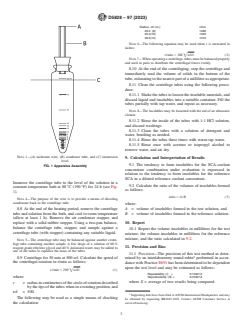
be less than 100 mL, as indicated in Fig. 1.
Analytical Reagents of the American Chemical Society where
such specifications are available. Other grades may be used,
8.5 In a similar manner, add 60 mL of reference coolant
provided it is first ascertained that the reagent is of sufficiently
concentrate, 34 mL of deionized water, and 6 mL of reference
high purity to permit its use without lessening the accuracy of
SCA solution to a second 100 mL centrifuge tube, and agitate
the determination.
thoroughly. The reference coolant must be used within 30 days
of preparation. Discard and prepare a new reference if any
insoluble material is observed.
Hercamp and Hudgens, “Silicate Gelation in Heavy-Duty Engine Cooling
Systems,” Paper No. 852327, Society of Automotive Engineers, December 1985.
8.6 Replace the rubber stoppers with clean air condensers
ACS Reagent Chemicals, Specifications and Procedures for Reagents and
prepared by inserting a 300 mm (12 in.) length of glass tubing
Standard-Grade Reference Materials, American Chemical Society, Washington,
through a prope
...