

ASTM D2383-19
(Test Method)Standard Test Method for Testing Plasticizer Compatibility in Poly(Vinyl Chloride) (PVC) Compounds Under Humid Conditions
General Information
- Abstract
SIGNIFICANCE AND USE
5.1 This test method provides an accelerated method for determining the stability of plasticized PVC compounds with respect to plasticizer compatibility under humid conditions.
5.2 The temperatures and humidity employed in this test can represent actual use conditions, but are intended primarily for rating materials.
SCOPE
1.1 This test method defines the conditions for the exposure and qualitative evaluation of plasticized poly(vinyl chloride) (PVC) compounds for plasticizer compatibility under humid conditions. Change in appearance is used for judging compatibility.
1.2 The text of this test method references notes and footnotes that provide explanatory material. These notes and footnotes (excluding those in tables and figures) shall not be considered as requirements of this test method.
1.3 The values stated in SI units are to be regarded as standard.
1.4 This standard does not purport to address all of the safety concerns, if any, associated with its use. It is the responsibility of the user of this standard to establish appropriate safety, health, and environmental practices and determine the applicability of regulatory limitations prior to use.
Note 1: There is no known ISO equivalent to this test method.
1.5 This international standard was developed in accordance with internationally recognized principles on standardization established in the Decision on Principles for the Development of International Standards, Guides and Recommendations issued by the World Trade Organization Technical Barriers to Trade (TBT) Committee.
- Status
- Published
- Publication Date
- 31-Jul-2019
- Technical Committee
- D20 - Plastics
- Drafting Committee
- D20.15 - Thermoplastic Materials
Buy Documents
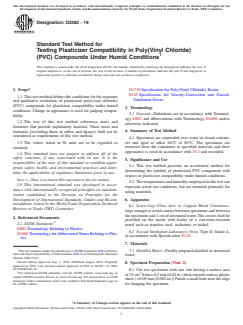


ASTM D2383-19 - Standard Test Method for Testing Plasticizer Compatibility in Poly(Vinyl Chloride) (PVC) Compounds Under Humid Conditions
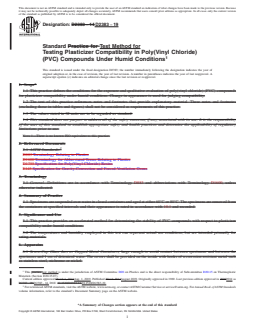
REDLINE ASTM D2383-19 - Standard Test Method for Testing Plasticizer Compatibility in Poly(Vinyl Chloride) (PVC) Compounds Under Humid Conditions
Overview
ASTM D2383-19 is the Standard Test Method for Testing Plasticizer Compatibility in Poly(Vinyl Chloride) (PVC) Compounds Under Humid Conditions. Published by ASTM International, this standard provides a controlled, accelerated procedure to evaluate the compatibility and stability of plasticizers within PVC compounds exposed to high-humidity environments. The test method focuses on qualitative analysis based on observable changes in sample appearance, which are used as the primary indicator for plasticizer compatibility or potential failure.
Plasticizer compatibility is critical for manufacturers and end-users of PVC products, as incompatibility can lead to undesirable properties such as exudation, surface tackiness, and visual degradation under humid conditions. By following ASTM D2383-19, laboratories and quality control teams can efficiently compare material performance and ensure reliable product durability.
Key Topics
- Plasticizer Compatibility in PVC: Ensures that chosen plasticizers remain well integrated in the PVC matrix, avoiding migration or separation during product use, particularly in environments with high humidity.
- Accelerated Testing Conditions: Utilizes specific temperature (typically 60°C or 80°C) and high humidity (specimens suspended over water) to simulate challenging field conditions and stress the material for quicker assessment.
- Qualitative Appearance Ratings: Assessment is based on surface appearance post-exposure, with gradations from no exudation (dry) to slight (tacky), moderate (greasy), or heavy (wet) exudation.
- Sample Preparation and Handling: Details standardized specimen preparation to ensure reliable, reproducible, and comparable results across different test runs and laboratories.
- Reporting Results: Requires documentation of test conditions, duration, and visual/tactile ratings for each inspection interval to enable tracking and comparison across product formulations.
Applications
The ASTM D2383-19 test method is widely used in the PVC compounding and converting industry for:
- Quality Control: Verification of plasticizer compatibility in finished PVC products such as cables, flooring, wall coverings, hoses, and automotive components.
- Research and Development: Comparison of new or alternative plasticizers, resins, or stabilizer systems for their resistance to migration and exudation under humid conditions.
- Material Specification: Providing manufacturers and end-users with a practical basis for specifying PVC compound compositions suitable for applications where exposure to humidity is likely.
- Failure Analysis: Diagnostic evaluation of products showing field failures related to plasticizer migration, supporting troubleshooting and formulation optimization.
The method is essential for ensuring long-term performance of plasticized PVC in real-world conditions where high humidity can accelerate material degradation.
Related Standards
Organizations utilizing ASTM D2383-19 often reference additional ASTM and related standards to ensure comprehensive evaluation of plasticized PVC, such as:
- ASTM D883: Terminology Relating to Plastics
- ASTM D1600: Terminology for Abbreviated Terms Relating to Plastics
- ASTM D1755: Specification for Poly(Vinyl Chloride) Resins
- ASTM E145: Specification for Gravity-Convection and Forced-Ventilation Ovens
There is currently no known ISO equivalent to ASTM D2383-19, highlighting its unique value for industries reliant on PVC materials.
Keywords: ASTM D2383, plasticizer compatibility, polyvinyl chloride, PVC, humid conditions, accelerated test, plasticizer migration, quality control, material specification, ASTM standards.
Relations
- Effective Date
- 01-Aug-2019
- Effective Date
- 01-Feb-2024
- Effective Date
- 01-Nov-2023
- Effective Date
- 01-Jan-2020
- Effective Date
- 01-Aug-2019
- Effective Date
- 15-Apr-2019
- Effective Date
- 01-Mar-2019
- Effective Date
- 01-Feb-2019
- Effective Date
- 01-Dec-2018
- Effective Date
- 01-Nov-2018
- Refers
ASTM D1600-18 - Standard Terminology for Abbreviated Terms Relating to Plastics (Withdrawn 2024) - Effective Date
- 01-Jan-2018
- Effective Date
- 15-Aug-2017
- Effective Date
- 01-Feb-2014
- Effective Date
- 15-Apr-2013
- Effective Date
- 15-Nov-2012
Buy Documents
ASTM D2383-19 - Standard Test Method for Testing Plasticizer Compatibility in Poly(Vinyl Chloride) (PVC) Compounds Under Humid Conditions
REDLINE ASTM D2383-19 - Standard Test Method for Testing Plasticizer Compatibility in Poly(Vinyl Chloride) (PVC) Compounds Under Humid Conditions
Get Certified
Connect with accredited certification bodies for this standard

DIN CERTCO
DIN Group product certification.

Smithers Quality Assessments
US management systems and product certification.
Sponsored listings
Frequently Asked Questions
ASTM D2383-19 is a standard published by ASTM International. Its full title is "Standard Test Method for Testing Plasticizer Compatibility in Poly(Vinyl Chloride) (PVC) Compounds Under Humid Conditions". This standard covers: SIGNIFICANCE AND USE 5.1 This test method provides an accelerated method for determining the stability of plasticized PVC compounds with respect to plasticizer compatibility under humid conditions. 5.2 The temperatures and humidity employed in this test can represent actual use conditions, but are intended primarily for rating materials. SCOPE 1.1 This test method defines the conditions for the exposure and qualitative evaluation of plasticized poly(vinyl chloride) (PVC) compounds for plasticizer compatibility under humid conditions. Change in appearance is used for judging compatibility. 1.2 The text of this test method references notes and footnotes that provide explanatory material. These notes and footnotes (excluding those in tables and figures) shall not be considered as requirements of this test method. 1.3 The values stated in SI units are to be regarded as standard. 1.4 This standard does not purport to address all of the safety concerns, if any, associated with its use. It is the responsibility of the user of this standard to establish appropriate safety, health, and environmental practices and determine the applicability of regulatory limitations prior to use. Note 1: There is no known ISO equivalent to this test method. 1.5 This international standard was developed in accordance with internationally recognized principles on standardization established in the Decision on Principles for the Development of International Standards, Guides and Recommendations issued by the World Trade Organization Technical Barriers to Trade (TBT) Committee.
SIGNIFICANCE AND USE 5.1 This test method provides an accelerated method for determining the stability of plasticized PVC compounds with respect to plasticizer compatibility under humid conditions. 5.2 The temperatures and humidity employed in this test can represent actual use conditions, but are intended primarily for rating materials. SCOPE 1.1 This test method defines the conditions for the exposure and qualitative evaluation of plasticized poly(vinyl chloride) (PVC) compounds for plasticizer compatibility under humid conditions. Change in appearance is used for judging compatibility. 1.2 The text of this test method references notes and footnotes that provide explanatory material. These notes and footnotes (excluding those in tables and figures) shall not be considered as requirements of this test method. 1.3 The values stated in SI units are to be regarded as standard. 1.4 This standard does not purport to address all of the safety concerns, if any, associated with its use. It is the responsibility of the user of this standard to establish appropriate safety, health, and environmental practices and determine the applicability of regulatory limitations prior to use. Note 1: There is no known ISO equivalent to this test method. 1.5 This international standard was developed in accordance with internationally recognized principles on standardization established in the Decision on Principles for the Development of International Standards, Guides and Recommendations issued by the World Trade Organization Technical Barriers to Trade (TBT) Committee.
ASTM D2383-19 is classified under the following ICS (International Classification for Standards) categories: 83.040.30 - Auxiliary materials and additives for plastics. The ICS classification helps identify the subject area and facilitates finding related standards.
ASTM D2383-19 has the following relationships with other standards: It is inter standard links to ASTM D2383-14, ASTM D883-24, ASTM D883-23, ASTM D883-20, ASTM D883-19c, ASTM D883-19a, ASTM E145-19, ASTM D883-19, ASTM D883-18a, ASTM D883-18, ASTM D1600-18, ASTM D883-17, ASTM D1600-14, ASTM D1600-13, ASTM D883-12e1. Understanding these relationships helps ensure you are using the most current and applicable version of the standard.
ASTM D2383-19 is available in PDF format for immediate download after purchase. The document can be added to your cart and obtained through the secure checkout process. Digital delivery ensures instant access to the complete standard document.
Standards Content (Sample)
This international standard was developed in accordance with internationally recognized principles on standardization established in the Decision on Principles for the
Development of International Standards, Guides and Recommendations issued by the World Trade Organization Technical Barriers to Trade (TBT) Committee.
Designation: D2383 − 19
Standard Test Method for
Testing Plasticizer Compatibility in Poly(Vinyl Chloride)
(PVC) Compounds Under Humid Conditions
This standard is issued under the fixed designation D2383; the number immediately following the designation indicates the year of
original adoption or, in the case of revision, the year of last revision. A number in parentheses indicates the year of last reapproval. A
superscript epsilon (´) indicates an editorial change since the last revision or reapproval.
1. Scope* D1755 Specification for Poly(Vinyl Chloride) Resins
E145 Specification for Gravity-Convection and Forced-
1.1 This test method defines the conditions for the exposure
Ventilation Ovens
and qualitative evaluation of plasticized poly(vinyl chloride)
(PVC) compounds for plasticizer compatibility under humid
3. Terminology
conditions. Change in appearance is used for judging compat-
3.1 General—Definitions are in accordance with Terminol-
ibility.
ogy D883 and abbreviations with Terminology D1600, unless
1.2 The text of this test method references notes and
otherwise indicated.
footnotes that provide explanatory material. These notes and
4. Summary of Test Method
footnotes (excluding those in tables and figures) shall not be
considered as requirements of this test method.
4.1 Specimens are suspended over water in closed contain-
ers and aged at either 60°C or 80°C. The specimens are
1.3 The values stated in SI units are to be regarded as
removed from the containers at specified intervals and their
standard.
appearance is rated in accordance with 10.1 and recorded.
1.4 This standard does not purport to address all of the
safety concerns, if any, associated with its use. It is the
5. Significance and Use
responsibility of the user of this standard to establish appro-
5.1 This test method provides an accelerated method for
priate safety, health, and environmental practices and deter-
determining the stability of plasticized PVC compounds with
mine the applicability of regulatory limitations prior to use.
respect to plasticizer compatibility under humid conditions.
NOTE 1—There is no known ISO equivalent to this test method.
5.2 Thetemperaturesandhumidityemployedinthistestcan
1.5 This international standard was developed in accor-
represent actual use conditions, but are intended primarily for
dance with internationally recognized principles on standard-
rating materials.
ization established in the Decision on Principles for the
Development of International Standards, Guides and Recom- 6. Apparatus
mendations issued by the World Trade Organization Technical
6.1 Screw-Cap Glass Jars or Capped Metal Containers,
Barriers to Trade (TBT) Committee.
large enough to avoid contact between specimens and between
the specimens and 1 cm of deionized water.The covers shall be
2. Referenced Documents
provided on the inside with hooks of a corrosion-resistant
2.1 ASTM Standards:
metal such as stainless steel, nichrome, or nickel.
D883 Terminology Relating to Plastics
6.2 Forced-Ventilation Laboratory Oven, Type II, Grade A,
D1600 Terminology forAbbreviatedTerms Relating to Plas-
in accordance with Specification E145.
tics
7. Materials
This test method is under the jurisdiction ofASTM Committee D20 on Plastics 7.1 Distilled Water—Freshly prepared distilled or deionized
and is the direct responsibility of Subcommittee D20.15 on Thermoplastic Materials
water.
(Section D20.15.07).
Current edition approved Aug. 1, 2019. Published August 2019. Originally
8. Specimen Preparation (Note 2)
approved in 1969. Last previous edition approved in 2014 as D2383 - 14. DOI:
10.1520/D2383-19.
8.1 Cut test specimens with one side having a surface area
For referenced ASTM standards, visit the ASTM website, www.astm.org, or 2
of25cm froma0.5mm(0.02in.)thicksmoothsurfaceplastic
contact ASTM Customer Service at service@astm.org. For Annual Book of ASTM
sheet (60.05 mm (0.002 in.)) Punch a small hole near the edge
Standards volume information, refer to the standard’s Document Summary page on
the ASTM website. for hangin
...
This document is not an ASTM standard and is intended only to provide the user of an ASTM standard an indication of what changes have been made to the previous version. Because
it may not be technically possible to adequately depict all changes accurately, ASTM recommends that users consult prior editions as appropriate. In all cases only the current version
of the standard as published by ASTM is to be considered the official document.
Designation: D2383 − 14 D2383 − 19
Standard Practice for Test Method for
Testing Plasticizer Compatibility in Poly(Vinyl Chloride)
(PVC) Compounds Under Humid Conditions
This standard is issued under the fixed designation D2383; the number immediately following the designation indicates the year of
original adoption or, in the case of revision, the year of last revision. A number in parentheses indicates the year of last reapproval. A
superscript epsilon (´) indicates an editorial change since the last revision or reapproval.
1. Scope*
1.1 This practice defines the conditions for the exposure and qualitative evaluation of poly(vinyl chloride) (PVC) compounds
for plasticizer compatibility under humid conditions. Change in appearance is used for judging compatibility.
1.2 The text of this practice references notes and footnotes that provide explanatory material. These notes and footnotes
(excluding those in tables and figures) shall not be considered as requirements of this practice.
1.3 The values stated in SI units are to be regarded as standard.
1.4 This standard does not purport to address all of the safety concerns, if any, associated with its use. It is the responsibility
of the user of this standard to establish appropriate safety and health practices and determine the applicability of regulatory
limitations prior to use.
NOTE 1—There is no known ISO equivalent to this practice.
2. Referenced Documents
2.1 ASTM Standards:
D883 Terminology Relating to Plastics
D1600 Terminology for Abbreviated Terms Relating to Plastics
D1755 Specification for Poly(Vinyl Chloride) Resins
E145 Specification for Gravity-Convection and Forced-Ventilation Ovens
3. Terminology
3.1 General—Definitions are in accordance with Terminology D883 and abbreviations with Terminology D1600, unless
otherwise indicated.
4. Summary of Practice
4.1 Specimens are suspended over water in closed containers and aged at either 60°C or 80°C. The specimens are removed from
the containers at specified intervals and their appearance is rated in accordance with 10.1 and recorded.
5. Significance and Use
5.1 This practice provides an accelerated method for determining the stability of PVC compounds with respect to plasticizer
compatibility under humid conditions.
5.2 The temperatures and humidity employed in this test can represent actual use conditions, but are intended primarily for
rating materials.
6. Apparatus
6.1 Screw-Cap Glass Jars or Capped Metal Containers, large enough to avoid contact between specimens and between the
specimens and 1 cm of deionized water. The covers shall be provided on the inside with hooks of a corrosion-resistant metal such
as stainless steel, nichrome or nickel.
This practice test method is under the jurisdiction of ASTM Committee D20 on Plastics and is the direct responsibility of Subcommittee D20.15 on Thermoplastic
Materials (Section D20.15.07).
Current edition approved March 1, 2014Aug. 1, 2019. Published March 2014August 2019. Originally approved in 1969. Last previous edition approved in 20092014 as
D2383 - 09.D2383 - 14. DOI: 10.1520/D2383-14.10.1520/D2383-19.
For referenced ASTM standards, visit the ASTM website, www.astm.org, or contact ASTM Customer Service at service@astm.org. For Annual Book of ASTM Standards
volume information, refer to the standard’s Document Summary page on the ASTM website.
*A Summary of Changes section appears at the end of this standard
Copyright © ASTM International, 100 Barr Harbor Drive, PO Box C700, West Conshohocken, PA 19428-2959. United States
D2383 − 19
6.2 Forced-Ventilation Laboratory Oven, Type II, Grade A, in accordance with Specification E145.
7. Materials
7.1 Distilled Water—Freshly prepared distilled or deionized water.
8. Specimen Preparation (Note 2)
8.1 Cut test specimens with one side having a surface area of 25 cm from a 0.5-mm (0.02-in.) thick smooth surface plastic sheet
(60.05 mm (0.002-in.)) Punch a small hole near the edge for hanging the specimen.
D2383 − 19
NOTE 2—For use as a control in testing the relative performance of plasticizers, the following clear formulation may be employed.
Parts
General-Purpose PVC Resin:
Type GP 40000 as defined in Specification D1755. 100
Plasticizer:
Di-2-ethylhexyl phthalate 50
Stabilizer:
Weatherable BaZn 1
NOTE 3—The test compound suggested in Note 2 will not exude under either test temperature specified in 9.2.
9. Procedure
9.1 Suspend the specimens from hooks over 1-1.3 cm of distilled water in closed containers so that they do not touch the water
layer, sides of the container, or each other.
9.2 Place the containers in the circulating-air oven (see 6.2) at either 60 6 1°C or 80 6 1°C, depending upon which temperature
is specified in the applicable material specification. Put covers on loosely until the containers come to temperature equilibrium,
then tighten covers.
9.3 Remove the containers from the oven at specified intervals. Under normal inspection, the intervals for plasticized PVC are:
9.3.1 At 60°C, once a week for a total of 4 weeks.
9.3.2 At 80°C, 1, 3, 7, 10, and 14 days.
9.4 After allowing to dry, examine the specimens for evidence of exudation and record their appearance.
9.5 Replace the specimens in the original containers and continue the test for the specified period of time.
10. Ratings
10.1 The following visual and tactile ratings are used for judging plasticizer compatibility:
10.1.1 None (Dry)—No evidence of exudation.
10.1.2 Slight (Tacky)—Slight exudation resulting in a sticky specimen surface.
10.1.3 Moderate (Greasy)—Thin film of exuded plasticizer covers specimen surface. The film will appear to be greasy, oily, or
waxy.
10.1.4 Heavy (Wet)—Droplets of exuded plasticizer accumulated on specimen surface.
NOTE 4—The specimen may be blistered.
11. Report
11.1 The report shall include the following:
11.1.1 Sample identification,
11.1.2 Temperature of test, and
11.1.3 Rating and appearance of the specimen at the end of each test interval.
12. Precision and Bias
12.1 No precision and bias data are available due to subjective nature of determining the test results.
13. Keywords
13.1 compatibility; plasticizer; poly(vinyl chloride) (PVC)
D2383 − 19
SUMMARY OF CHANGES
Committee D20 has identified the location of selected changes to this standard since the last issue (D2383 - 09)
that may impact the use of this standard. (March 1, 2014)
(1) Removed permissive language from 10.1.3.
(2) Moved second sentence of 10.1.4 to Note 4.
ASTM International takes no position respecting the validity of any patent rights asserted in connection with any item mentioned
in this standard. Users of this standard are expressly advised that determination of the validity of any such patent rights, and the risk
of infringement of such rights, are entirely their own responsibility.
This standard is subject to revision at any time by the responsible technical committee and must be reviewed every five years and
if not revised, either reapproved or withdrawn. Your comments are invited either for revision of this standard or for additional standards
and should be addressed to ASTM International Headquarters. Your comments will receive careful consideration at a meeting of the
responsible technical committee, which you may attend. If you feel that your comments have not received a fair hearing you should
make your views known to the
...