

ASTM D202-23
(Test Method)Standard Test Methods for Sampling and Testing Untreated Paper Used for Electrical Insulation
General Information
- Abstract
SIGNIFICANCE AND USE
8.1 In the buyer-seller relationship it is necessary that an understanding exists as to the expected nominal characteristics of the product, and the magnitude of permissible departure from the nominal values. Also, it is necessary that an agreement be reached as to how many units of a lot can fall outside of the specification limits without rejection of the lot. It is this latter subject that is addressed by this test method.
SCOPE
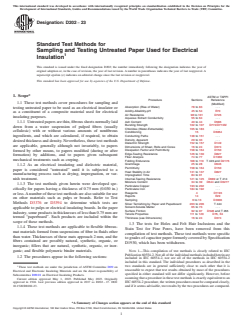
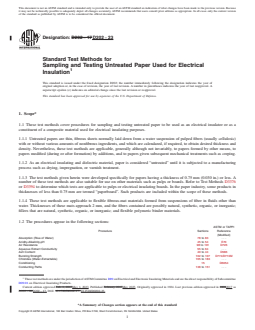
1.1 These test methods cover procedures for sampling and testing untreated paper to be used as an electrical insulator or as a constituent of a composite material used for electrical insulating purposes.
1.1.1 Untreated papers are thin, fibrous sheets normally laid down from a water suspension of pulped fibers (usually cellulosic) with or without various amounts of nonfibrous ingredients, and which are calendared, if required, to obtain desired thickness and density. Nevertheless, these test methods are applicable, generally although not invariably, to papers formed by other means, to papers modified (during or after formation) by additions, and to papers given subsequent mechanical treatments such as creping.
1.1.2 As an electrical insulating and dielectric material, paper is considered “untreated” until it is subjected to a manufacturing process such as drying, impregnation, or varnish treatment.
1.1.3 The test methods given herein were developed specifically for papers having a thickness of 0.75 mm (0.030 in.) or less. A number of these test methods are also suitable for use on other materials such as pulps or boards. Refer to Test Methods D3376 or D3394 to determine which tests are applicable to pulps or electrical insulating boards. In the paper industry, some products in thicknesses of less than 0.75 mm are termed “paperboard”. Such products are included within the scope of these methods.
1.1.4 These test methods are applicable to flexible fibrous-mat materials formed from suspensions of fiber in fluids other than water. Thicknesses of these mats approach 2 mm, and the fibers contained are possibly natural, synthetic, organic, or inorganic; fillers that are natural, synthetic, organic, or inorganic; and flexible polymeric binder materials.
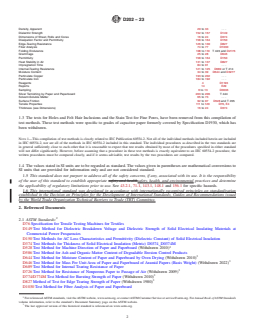
1.2 The procedures appear in the following sections:
Procedure
Sections
ASTM or TAPPI Reference
(Modified)
Absorption (Rise of Water)
78 to 83
. . .
Acidity-Alkalinity-pH
45 to 54
E70
Air Resistance
98 to 101
D726
Aqueous Extract Conductivity
55 to 64
. . .
Ash Content
40 to 44
D586
Bursting Strength
102 to 107
D774/D774M
Chlorides (Water-Extractable)
165 to 183
. . .
Conditioning
15
D6054
Conducting Paths
138 to 151
. . .
Density, Apparent
29 to 33
. . .
Dielectric Strength
152 to 157
D149
Dimensions of Sheet, Rolls and Cores
16 to 24
D374
Dissipation Factor and Permittivity
158 to 164
D150
Edge-Tearing Resistance
126 to 130
D827
Fiber Analysis
74 to 77
D1030
Folding Endurance
108 to 110
T 423 and D2176
Grammage
25 to 28
D646
Permittivity
158 to 164
D150
Heat Stability in Air
131 to 137
D827
Impregnation Time
84 to 91
. . .
Internal-Tearing Resistance
121 to 125
D689 or T 414
Moisture Content
34 to 39
D644 and D3277
Particulate Copper
193 to 202
. . .
Particulate Iron
184 to 192
. . .
Reagents
4
D1193
Reports
14
E29
Sampling
6 to 13
D3636
Silver Tarnishing by Paper and Paperboard
203 to 206
T 444
Solvent-Soluble Matter
65 to 73
. . .
Surface Friction
92 to 97
D528 and T 455
Tensile Properties
111 to 120
D76, E4
Thickness (see Dimensions)
16 to 24
D374
1.3 The tests for Holes and Felt Hair Inclusions and the Stain Test for Fine Pores, have been removed from this compilation of t...
- Status
- Published
- Publication Date
- 30-Apr-2023
- Technical Committee
- D09 - Electrical and Electronic Insulating Materials
- Drafting Committee
- D09.01 - Electrical Insulating Products
Buy Documents
ASTM D202-23 - Standard Test Methods for Sampling and Testing Untreated Paper Used for Electrical Insulation
REDLINE ASTM D202-23 - Standard Test Methods for Sampling and Testing Untreated Paper Used for Electrical Insulation
Overview
ASTM D202-23 – Standard Test Methods for Sampling and Testing Untreated Paper Used for Electrical Insulation – provides comprehensive procedures for evaluating the properties and quality of untreated paper intended for use as electrical insulation or as a component in composite insulating materials. Published by ASTM International, this standard ensures consistent assessment of the physical, mechanical, chemical, and electrical characteristics crucial to the performance of insulating paper in various electrical applications.
ASTM D202-23 is widely recognized for supporting quality assurance in buyer-seller relationships, helping both parties agree on acceptable levels of product conformity and sampling procedures. It addresses a broad range of untreated paper types, including cellulosic pulped-fiber papers, modified or mechanically treated papers, and thin paperboards for electrical insulation.
Key Topics
This standard covers essential methods for measuring and analyzing a wide range of properties associated with untreated paper for insulation, including:
- Sampling and Lot Acceptance: Procedures for determining sample sizes and acceptance criteria, including guidance on Acceptable Quality Levels (AQLs).
- Physical Properties: Methods for measuring thickness, density, grammage (weight per unit area), sheet and roll dimensions, and squareness.
- Mechanical Properties: Procedures to evaluate tensile strength, bursting strength, folding endurance, edge- and internal-tearing resistance.
- Chemical Properties: Determination of ash content, moisture content, pH (acidity-alkalinity), presence of chlorides, particulates (copper, iron), and solvent-soluble substances.
- Electrical Properties: Assessment of dielectric strength, dissipation factor, permittivity, and aqueous extract conductivity.
- Other Functional Tests: Surface friction, air resistance, absorption, impregnation time, and fiber analysis.
- Reporting and Conditioning: Standardized methods for reporting results, sample conditioning prior to testing, and calculation procedures.
These methods are primarily intended for papers up to 0.75 mm thick, but some are suitable for flexible fibrous mats up to 2 mm, pulps, and thin paperboard.
Applications
ASTM D202-23 is vital for stakeholders across the electrical, electronics, and materials manufacturing industries. Typical applications include:
- Quality Control in Manufacturing: Ensuring each lot of insulating paper meets predetermined specifications before acceptance, shipment, and use.
- Material Procurement: Supporting transparent, standardized transactions between suppliers and users by defining agreed-upon property values, tolerances, and test procedures.
- Product Development: Assisting engineers and materials scientists in the selection and verification of insulating papers for cables, transformers, motors, and electronic devices.
- Composite Insulating Materials: Evaluating untreated papers as components within multi-layer composites for enhanced electrical insulation.
- Standards Compliance: Ensuring products conform to industry and regulatory requirements for electrical insulation.
The standard’s procedures can be tailored by agreement between buyer and seller for specific needs, providing flexibility while maintaining technical rigor.
Related Standards
ASTM D202-23 references several related standards and industry practices, including:
- ASTM D149 – Dielectric Breakdown Voltage and Dielectric Strength of Solid Electrical Insulating Materials
- ASTM D150 – AC Loss Characteristics and Permittivity of Solid Electrical Insulation
- ASTM D646 – Mass Per Unit Area of Paper and Paperboard
- ASTM D374 – Thickness of Solid Electrical Insulation
- ASTM D3636 – Sampling and Judging Quality of Solid Electrical Insulating Materials
- ASTM D3376 / D3394 – Sampling and Testing of Pulps and Electrical Insulating Boards
- TAPPI Standards (T 414, T 423, etc.) – Industry-specific test procedures for paper and paperboard
- IEC 60554-2 – Specification for Cellulosic Papers for Electrical Purposes: Methods of Test
Alignment with these standards helps ensure global compatibility and regulatory acceptance of insulation products.
By implementing ASTM D202-23, organizations benefit from enhanced product reliability, consistent quality, and streamlined procurement processes in the electrical insulation sector.
Relations
- Effective Date
- 01-Mar-2024
- Effective Date
- 01-Mar-2024
- Effective Date
- 01-Jan-2024
- Effective Date
- 15-Dec-2023
- Effective Date
- 01-Jan-2020
- Effective Date
- 01-May-2019
- Effective Date
- 01-Apr-2019
- Effective Date
- 01-Nov-2018
- Effective Date
- 01-Nov-2015
- Effective Date
- 01-Jun-2015
- Effective Date
- 01-Nov-2014
- Effective Date
- 01-Nov-2014
- Effective Date
- 01-Jun-2014
- Effective Date
- 01-May-2014
- Effective Date
- 01-Nov-2013
Buy Documents
ASTM D202-23 - Standard Test Methods for Sampling and Testing Untreated Paper Used for Electrical Insulation
REDLINE ASTM D202-23 - Standard Test Methods for Sampling and Testing Untreated Paper Used for Electrical Insulation
Get Certified
Connect with accredited certification bodies for this standard

IMQ S.p.A. (Certification)
Italian electrical product certification.

SLG Prüf- und Zertifizierungs GmbH
German testing and certification body.

UL Solutions
Global safety science company with testing, inspection and certification.
Sponsored listings
Frequently Asked Questions
ASTM D202-23 is a standard published by ASTM International. Its full title is "Standard Test Methods for Sampling and Testing Untreated Paper Used for Electrical Insulation". This standard covers: SIGNIFICANCE AND USE 8.1 In the buyer-seller relationship it is necessary that an understanding exists as to the expected nominal characteristics of the product, and the magnitude of permissible departure from the nominal values. Also, it is necessary that an agreement be reached as to how many units of a lot can fall outside of the specification limits without rejection of the lot. It is this latter subject that is addressed by this test method. SCOPE 1.1 These test methods cover procedures for sampling and testing untreated paper to be used as an electrical insulator or as a constituent of a composite material used for electrical insulating purposes. 1.1.1 Untreated papers are thin, fibrous sheets normally laid down from a water suspension of pulped fibers (usually cellulosic) with or without various amounts of nonfibrous ingredients, and which are calendared, if required, to obtain desired thickness and density. Nevertheless, these test methods are applicable, generally although not invariably, to papers formed by other means, to papers modified (during or after formation) by additions, and to papers given subsequent mechanical treatments such as creping. 1.1.2 As an electrical insulating and dielectric material, paper is considered “untreated” until it is subjected to a manufacturing process such as drying, impregnation, or varnish treatment. 1.1.3 The test methods given herein were developed specifically for papers having a thickness of 0.75 mm (0.030 in.) or less. A number of these test methods are also suitable for use on other materials such as pulps or boards. Refer to Test Methods D3376 or D3394 to determine which tests are applicable to pulps or electrical insulating boards. In the paper industry, some products in thicknesses of less than 0.75 mm are termed “paperboard”. Such products are included within the scope of these methods. 1.1.4 These test methods are applicable to flexible fibrous-mat materials formed from suspensions of fiber in fluids other than water. Thicknesses of these mats approach 2 mm, and the fibers contained are possibly natural, synthetic, organic, or inorganic; fillers that are natural, synthetic, organic, or inorganic; and flexible polymeric binder materials. 1.2 The procedures appear in the following sections: Procedure Sections ASTM or TAPPI Reference (Modified) Absorption (Rise of Water) 78 to 83 . . . Acidity-Alkalinity-pH 45 to 54 E70 Air Resistance 98 to 101 D726 Aqueous Extract Conductivity 55 to 64 . . . Ash Content 40 to 44 D586 Bursting Strength 102 to 107 D774/D774M Chlorides (Water-Extractable) 165 to 183 . . . Conditioning 15 D6054 Conducting Paths 138 to 151 . . . Density, Apparent 29 to 33 . . . Dielectric Strength 152 to 157 D149 Dimensions of Sheet, Rolls and Cores 16 to 24 D374 Dissipation Factor and Permittivity 158 to 164 D150 Edge-Tearing Resistance 126 to 130 D827 Fiber Analysis 74 to 77 D1030 Folding Endurance 108 to 110 T 423 and D2176 Grammage 25 to 28 D646 Permittivity 158 to 164 D150 Heat Stability in Air 131 to 137 D827 Impregnation Time 84 to 91 . . . Internal-Tearing Resistance 121 to 125 D689 or T 414 Moisture Content 34 to 39 D644 and D3277 Particulate Copper 193 to 202 . . . Particulate Iron 184 to 192 . . . Reagents 4 D1193 Reports 14 E29 Sampling 6 to 13 D3636 Silver Tarnishing by Paper and Paperboard 203 to 206 T 444 Solvent-Soluble Matter 65 to 73 . . . Surface Friction 92 to 97 D528 and T 455 Tensile Properties 111 to 120 D76, E4 Thickness (see Dimensions) 16 to 24 D374 1.3 The tests for Holes and Felt Hair Inclusions and the Stain Test for Fine Pores, have been removed from this compilation of t...
SIGNIFICANCE AND USE 8.1 In the buyer-seller relationship it is necessary that an understanding exists as to the expected nominal characteristics of the product, and the magnitude of permissible departure from the nominal values. Also, it is necessary that an agreement be reached as to how many units of a lot can fall outside of the specification limits without rejection of the lot. It is this latter subject that is addressed by this test method. SCOPE 1.1 These test methods cover procedures for sampling and testing untreated paper to be used as an electrical insulator or as a constituent of a composite material used for electrical insulating purposes. 1.1.1 Untreated papers are thin, fibrous sheets normally laid down from a water suspension of pulped fibers (usually cellulosic) with or without various amounts of nonfibrous ingredients, and which are calendared, if required, to obtain desired thickness and density. Nevertheless, these test methods are applicable, generally although not invariably, to papers formed by other means, to papers modified (during or after formation) by additions, and to papers given subsequent mechanical treatments such as creping. 1.1.2 As an electrical insulating and dielectric material, paper is considered “untreated” until it is subjected to a manufacturing process such as drying, impregnation, or varnish treatment. 1.1.3 The test methods given herein were developed specifically for papers having a thickness of 0.75 mm (0.030 in.) or less. A number of these test methods are also suitable for use on other materials such as pulps or boards. Refer to Test Methods D3376 or D3394 to determine which tests are applicable to pulps or electrical insulating boards. In the paper industry, some products in thicknesses of less than 0.75 mm are termed “paperboard”. Such products are included within the scope of these methods. 1.1.4 These test methods are applicable to flexible fibrous-mat materials formed from suspensions of fiber in fluids other than water. Thicknesses of these mats approach 2 mm, and the fibers contained are possibly natural, synthetic, organic, or inorganic; fillers that are natural, synthetic, organic, or inorganic; and flexible polymeric binder materials. 1.2 The procedures appear in the following sections: Procedure Sections ASTM or TAPPI Reference (Modified) Absorption (Rise of Water) 78 to 83 . . . Acidity-Alkalinity-pH 45 to 54 E70 Air Resistance 98 to 101 D726 Aqueous Extract Conductivity 55 to 64 . . . Ash Content 40 to 44 D586 Bursting Strength 102 to 107 D774/D774M Chlorides (Water-Extractable) 165 to 183 . . . Conditioning 15 D6054 Conducting Paths 138 to 151 . . . Density, Apparent 29 to 33 . . . Dielectric Strength 152 to 157 D149 Dimensions of Sheet, Rolls and Cores 16 to 24 D374 Dissipation Factor and Permittivity 158 to 164 D150 Edge-Tearing Resistance 126 to 130 D827 Fiber Analysis 74 to 77 D1030 Folding Endurance 108 to 110 T 423 and D2176 Grammage 25 to 28 D646 Permittivity 158 to 164 D150 Heat Stability in Air 131 to 137 D827 Impregnation Time 84 to 91 . . . Internal-Tearing Resistance 121 to 125 D689 or T 414 Moisture Content 34 to 39 D644 and D3277 Particulate Copper 193 to 202 . . . Particulate Iron 184 to 192 . . . Reagents 4 D1193 Reports 14 E29 Sampling 6 to 13 D3636 Silver Tarnishing by Paper and Paperboard 203 to 206 T 444 Solvent-Soluble Matter 65 to 73 . . . Surface Friction 92 to 97 D528 and T 455 Tensile Properties 111 to 120 D76, E4 Thickness (see Dimensions) 16 to 24 D374 1.3 The tests for Holes and Felt Hair Inclusions and the Stain Test for Fine Pores, have been removed from this compilation of t...
ASTM D202-23 is classified under the following ICS (International Classification for Standards) categories: 29.035.10 - Paper and board insulating materials. The ICS classification helps identify the subject area and facilitates finding related standards.
ASTM D202-23 has the following relationships with other standards: It is inter standard links to ASTM D689-17(2024), ASTM D1711-24, ASTM E70-24, ASTM D586-23, ASTM D149-20, ASTM D586-19, ASTM D3636-19, ASTM D3376-18, ASTM D1711-15, ASTM E70-07(2015), ASTM D3376-14, ASTM D1711-14a, ASTM E4-14, ASTM D1711-14, ASTM D1711-13. Understanding these relationships helps ensure you are using the most current and applicable version of the standard.
ASTM D202-23 is available in PDF format for immediate download after purchase. The document can be added to your cart and obtained through the secure checkout process. Digital delivery ensures instant access to the complete standard document.
Standards Content (Sample)
This international standard was developed in accordance with internationally recognized principles on standardization established in the Decision on Principles for the
Development of International Standards, Guides and Recommendations issued by the World Trade Organization Technical Barriers to Trade (TBT) Committee.
Designation: D202 − 23
Standard Test Methods for
Sampling and Testing Untreated Paper Used for Electrical
Insulation
This standard is issued under the fixed designation D202; the number immediately following the designation indicates the year of
original adoption or, in the case of revision, the year of last revision. A number in parentheses indicates the year of last reapproval. A
superscript epsilon (´) indicates an editorial change since the last revision or reapproval.
This standard has been approved for use by agencies of the U.S. Department of Defense.
1. Scope*
ASTM or TAPPI
Procedure Sections Reference
1.1 These test methods cover procedures for sampling and
(Modified)
Absorption (Rise of Water) 78 to 83 . . .
testing untreated paper to be used as an electrical insulator or
Acidity-Alkalinity-pH 45 to 54 E70
as a constituent of a composite material used for electrical
Air Resistance 98 to 101 D726
insulating purposes.
Aqueous Extract Conductivity 55 to 64 . . .
1.1.1 Untreated papers are thin, fibrous sheets normally laid Ash Content 40 to 44 D586
Bursting Strength 102 to 107 D774/D774M
down from a water suspension of pulped fibers (usually
Chlorides (Water-Extractable) 165 to 183 . . .
cellulosic) with or without various amounts of nonfibrous
Conditioning 15 D6054
Conducting Paths 138 to 151 . . .
ingredients, and which are calendared, if required, to obtain
Density, Apparent 29 to 33 . . .
desired thickness and density. Nevertheless, these test methods
Dielectric Strength 152 to 157 D149
are applicable, generally although not invariably, to papers
Dimensions of Sheet, Rolls and Cores 16 to 24 D374
Dissipation Factor and Permittivity 158 to 164 D150
formed by other means, to papers modified (during or after
Edge-Tearing Resistance 126 to 130 D827
formation) by additions, and to papers given subsequent
Fiber Analysis 74 to 77 D1030
mechanical treatments such as creping.
Folding Endurance 108 to 110 T 423 and D2176
Grammage 25 to 28 D646
1.1.2 As an electrical insulating and dielectric material,
Permittivity 158 to 164 D150
paper is considered “untreated” until it is subjected to a
Heat Stability in Air 131 to 137 D827
manufacturing process such as drying, impregnation, or var-
Impregnation Time 84 to 91 . . .
Internal-Tearing Resistance 121 to 125 D689 or T 414
nish treatment.
Moisture Content 34 to 39 D644 and D3277
1.1.3 The test methods given herein were developed spe-
Particulate Copper 193 to 202 . . .
cifically for papers having a thickness of 0.75 mm (0.030 in.)
Particulate Iron 184 to 192 . . .
Reagents 4 D1193
or less. A number of these test methods are also suitable for use
Reports 14 E29
on other materials such as pulps or boards. Refer to Test
Sampling 6 to 13 D3636
Methods D3376 or D3394 to determine which tests are
Silver Tarnishing by Paper and Paperboard 203 to 206 T 444
Solvent-Soluble Matter 65 to 73 . . .
applicable to pulps or electrical insulating boards. In the paper
Surface Friction 92 to 97 D528 and T 455
industry, some products in thicknesses of less than 0.75 mm are
Tensile Properties 111 to 120 D76, E4
termed “paperboard”. Such products are included within the
Thickness (see Dimensions) 16 to 24 D374
scope of these methods.
1.3 The tests for Holes and Felt Hair Inclusions and the
1.1.4 These test methods are applicable to flexible fibrous-
Stain Test for Fine Pores, have been removed from this
mat materials formed from suspensions of fiber in fluids other
compilation of test methods. These test methods were specific
than water. Thicknesses of these mats approach 2 mm, and the
to grades of capacitor paper formerly covered by Specification
fibers contained are possibly natural, synthetic, organic, or
D1930, which has been withdrawn.
inorganic; fillers that are natural, synthetic, organic, or inor-
NOTE 1—This compilation of test methods is closely related to IEC
ganic; and flexible polymeric binder materials.
Publication 60554-2. Not all of the individual methods included herein are
1.2 The procedures appear in the following sections:
included in IEC 60554-2, nor are all of the methods in IEC 60554-2
included in this standard. The individual procedures as described in the
1 two standards are in general sufficiently close to each other that it is
These test methods are under the jurisdiction of ASTM Committee D09 on
reasonable to expect that test results obtained by most of the procedures
Electrical and Electronic Insulating Materials and are the direct responsibility of
specified in either standard will not differ significantly. However, before
Subcommittee D09.01 on Electrical Insulating Products.
assuming that a procedure in these test methods is exactly equivalent to an
Current edition approved May 1, 2023. Published May 2023. Originally
IEC 60554-2 procedure, the written procedures must be compared closely,
approved in 1924. Last previous edition approved in 2017 as D202 – 17. DOI:
10.1520/D0202-23. and if it seems advisable, test results by the two procedures are compared.
*A Summary of Changes section appears at the end of this standard
Copyright © ASTM International, 100 Barr Harbor Drive, PO Box C700, West Conshohocken, PA 19428-2959. United States
D202 − 23
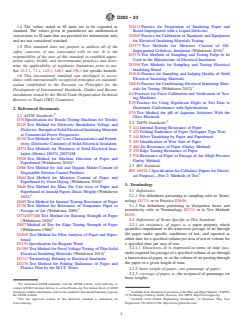
1.4 The values stated in SI units are to be regarded as D2413 Practice for Preparation of Insulating Paper and
standard. The values given in parentheses are mathematical Board Impregnated with a Liquid Dielectric
conversions to SI units that are provided for information only D2865 Practice for Calibration of Standards and Equipment
and are not considered standard. for Electrical Insulating Materials Testing
D3277 Test Methods for Moisture Content of Oil-
1.5 This standard does not purport to address all of the
Impregnated Cellulosic Insulation (Withdrawn 2010)
safety concerns, if any, associated with its use. It is the
D3376 Test Methods of Sampling and Testing Pulps to be
responsibility of the user of this standard to establish appro-
Used in the Manufacture of Electrical Insulation
priate safety, health, and environmental practices and deter-
D3394 Test Methods for Sampling and Testing Electrical
mine the applicability of regulatory limitations prior to use.
Insulating Board
See 43.2.1, 71.1, 143.1, 148.1 and 156.1 for specific hazards.
D3636 Practice for Sampling and Judging Quality of Solid
1.6 This international standard was developed in accor-
Electrical Insulating Materials
dance with internationally recognized principles on standard-
D6054 Practice for Conditioning Electrical Insulating Mate-
ization established in the Decision on Principles for the
rials for Testing (Withdrawn 2012)
Development of International Standards, Guides and Recom-
E4 Practices for Force Calibration and Verification of Test-
mendations issued by the World Trade Organization Technical
ing Machines
Barriers to Trade (TBT) Committee.
E29 Practice for Using Significant Digits in Test Data to
Determine Conformance with Specifications
2. Referenced Documents
E70 Test Method for pH of Aqueous Solutions With the
2.1 ASTM Standards:
Glass Electrode
D76 Specification for Tensile Testing Machines for Textiles
2.2 TAPPI Standards:
D149 Test Method for Dielectric Breakdown Voltage and
T 414 Internal Tearing Resistance of Paper
Dielectric Strength of Solid Electrical Insulating Materials
T 423 Folding Endurance of Paper (Schopper Type Test)
at Commercial Power Frequencies
T 444 Silver Tarnishing by Paper and Paperboard
D150 Test Methods for AC Loss Characteristics and Permit-
T 455 Identification of Wire Side of Paper
tivity (Dielectric Constant) of Solid Electrical Insulation
T 460 Air Resistance of Paper (Gurley Method)
D374 Test Methods for Thickness of Solid Electrical Insu-
T 470 Edge Tearing Resistance of Paper
lation (Metric) D0374_D0374M
T 536 Resistance of Paper to Passage of Air (High Pressure
D528 Test Method for Machine Direction of Paper and
Gurley Method)
Paperboard (Withdrawn 2010)
2.3 IEC Standard:
D586 Test Method for Ash and Organic Matter Content of
IEC 60554-2 Specification for Cellulosic Papers for Electri-
Degradable Erosion Control Products
cal Purposes—Part 2: Methods of Test
D644 Test Method for Moisture Content of Paper and
Paperboard by Oven Drying (Withdrawn 2010)
3. Terminology
D646 Test Method for Mass Per Unit Area of Paper and
3.1 Definitions:
Paperboard of Aramid Papers (Basis Weight) (Withdrawn
3.1.1 For definitions pertaining to sampling refer to Termi-
2022)
nology D1711 or to Practice D3636.
D689 Test Method for Internal Tearing Resistance of Paper
3.1.2 For definitions pertaining to dissipation factor and
D726 Test Method for Resistance of Nonporous Paper to
permittivity refer to Terminology D1711 or to Test Methods
Passage of Air (Withdrawn 2009)
D150.
D774/D774M Test Method for Bursting Strength of Paper
3.2 Definitions of Terms Specific to This Standard:
(Withdrawn 2010)
3.2.1 air resistance, of paper, n—a paper property which
D827 Method of Test for Edge Tearing Strength of Paper
quantifies impediment to the transverse passage of air through
(Withdrawn 1980)
the paper under specific conditions of test, and reported as
D1030 Test Method for Fiber Analysis of Paper and Paper-
either time for a specified volume per area of test or volume for
board
a specified time per area of test.
D1193 Specification for Reagent Water
3.2.1.1 Discussion—It is expressed in terms of time (sec-
D1389 Test Method for Proof-Voltage Testing of Thin Solid
onds) required for passage of a specified volume of air through
Electrical Insulating Materials (Withdrawn 2013)
a known area of paper, or, as the volume of air passing through
D1711 Terminology Relating to Electrical Insulation
the paper in a given length of time.
D2176 Test Method for Folding Endurance of Paper and
Plastics Film by the M.I.T. Tester
3.2.2 basis weight of paper—see grammage of paper.
3.2.3 coverage of paper, n—the reciprocal of grammage (or
basis weight).
For referenced ASTM standards, visit the ASTM website, www.astm.org, or
contact ASTM Customer Service at service@astm.org. For Annual Book of ASTM
Standards volume information, refer to the standard’s Document Summary page on Available from Technical Association of the Pulp and Paper Industry (TAPPI),
the ASTM website. 15 Technology Parkway South, Norcross, GA 30092, http://www.tappi.org.
3 5
The last approved version of this historical standard is referenced on Available from Global Engineering Documents, 15 Inverness Way, East
www.astm.org. Englewood, CO 80112-5704, http://www.global.ihs.com.
D202 − 23
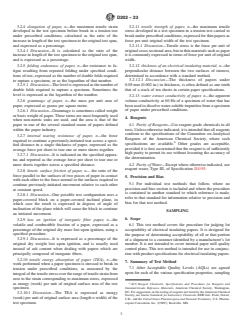
3.2.4 elongation of paper, n—the maximum tensile strain 3.2.11 tensile strength of paper, n—the maximum tensile
developed in the test specimen before break in a tension test stress developed in a test specimen in a tension test carried to
under prescribed conditions, calculated as the ratio of the break under prescribed conditions, expressed for thin papers as
increase in length of the test specimen to the original test span, force per unit original width of the test specimen.
and expressed as a percentage. 3.2.11.1 Discussion—Tensile stress is the force per unit of
3.2.4.1 Discussion—It is calculated as the ratio of the original cross-sectional area, but in thin materials such as paper
increase in length of the test specimen to the original test span, it is commonly expressed in terms of force per unit of original
and is expressed as a percentage. width.
3.2.12 thickness of an electrical insulating material, n—the
3.2.5 folding endurance of paper, n—the resistance to fa-
tigue resulting from repeated folding under specified condi- perpendicular distance between the two surfaces of interest,
tions of test, expressed as the number of double folds required determined in accordance with a standard method.
to rupture a specimen, or as the logarithm of that number. 3.2.12.1 Discussion—The thickness of papers under
0.05 mm (0.002 in.) in thickness, is often defined as one tenth
3.2.5.1 Discussion—The level is expressed as the number of
double folds required to rupture a specimen. Sometimes the that of a stack of ten sheets in certain paper specifications.
level is expressed as the logarithm of the number.
3.2.13 water extract conductivity of paper, n—the apparent
volume conductivity at 60 Hz of a specimen of water that has
3.2.6 grammage of paper, n—the mass per unit area of
been used to dissolve water-soluble impurities from a specimen
paper, expressed as grams per square metre.
of paper under prescribed conditions.
3.2.6.1 Discussion—Grammage is sometimes called weight
or basis weight of paper. These terms are most frequently used
4. Reagents
when non-metric units are used, and the area is that of the
4.1 Purity of Reagents—Use reagent grade chemicals in all
paper in one of the several standard reams of papers defined
within the paper industry. tests. Unless otherwise indicated, it is intended that all reagents
conform to the specifications of the Committee on Analytical
3.2.7 internal tearing resistance of paper, n—the force
Reagents of the American Chemical Society, where such
required to continue a previously-initiated tear across a speci-
specifications are available. Other grades are acceptable,
fied distance in a single thickness of paper, expressed as the
provided it is first ascertained that the reagent is of sufficiently
average force per sheet to tear one or more sheets together.
high purity to permit its use without lessening the accuracy of
3.2.7.1 Discussion—It is indicated on the specified appara-
the determination.
tus and reported as the average force per sheet to tear one or
more sheets together across a specified distance. 4.2 Purity of Water—Except where otherwise indicated, use
reagent water, Type III, of Specification D1193.
3.2.8 kinetic surface friction of paper, n— the ratio of the
force parallel to the surfaces of two pieces of paper in contact
5. Precision and Bias
with each other to the force normal to the surfaces required to
5.1 For individual test methods that follow, where no
continue previously-initiated movement relative to each other
precision and bias section is included and where the procedure
at constant speed.
is contained in another standard to which reference is made,
3.2.8.1 Discussion—One possible test configuration uses a
refer to that standard for information relative to precision and
paper-covered block on a paper-covered inclined plane, in
bias for that test method.
which case the result is expressed in degrees of angle of
inclination of the plane which will cause the block to continue
SAMPLING
an initiated movement.
6. Scope
3.2.9 loss on ignition of inorganic fiber paper, n—the
volatile and combustible fraction of a paper, expressed as a
6.1 This test method covers the procedure for judging lot
percentage of the original dry mass lost upon ignition, using a
acceptability of electrical insulating papers. It is designed for
specified procedure.
the purpose of determining acceptability of all or that portion
3.2.9.1 Discussion—It is expressed as a percentage of the
of a shipment to a customer identified by a manufacturer’s lot
original dry weight lost upon ignition, and is usually used
number. It is not intended to cover internal paper mill quality
instead of ash content when dealing with papers which are
control plans. This test method is intended for use in conjunc-
principally composed of inorganic fibers.
tion with product specifications for electrical insulating papers.
3.2.10 tensile energy absorption of paper (TEA), n—the
7. Summary of Test Method
work performed when a paper specimen is stressed to break in
7.1 After Acceptable Quality Levels (AQLs) are agreed
tension under prescribed conditions, as measured by the
upon for each of the various specification properties, sampling
integral of the tensile stress over the range of tensile strain from
zero to the strain corresponding to maximum stress, expressed
as energy (work) per unit of original surface area of the test
ACS Reagent Chemicals, Specifications and Procedures for Reagents and
Standard-Grade Reference Materials, American Chemical Society, Washington,
specimen.
DC. For suggestions on the testing of reagents not listed by the American Chemical
3.2.10.1 Discussion—The TEA is expressed as energy
Society, see Analar Standards for Laboratory Chemicals, BDH Ltd., Poole, Dorset,
(work) per unit of original surface area (length × width) of the
U.K., and the United States Pharmacopeia and National Formulary, U.S. Pharma-
test specimen. copeial Convention, Inc. (USPC), Rockville, MD.
D202 − 23
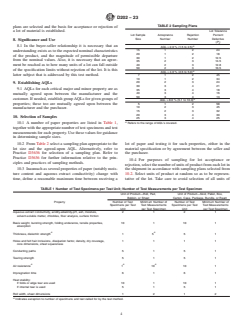
TABLE 2 Sampling Plans
plans are selected and the basis for acceptance or rejection of
a lot of material is established. Lot Tolerance
Lot Sample Acceptance Rejection Percent
Size Number Number Defective
8. Significance and Use
(P )
t
A
8.1 In the buyer-seller relationship it is necessary that an
AQL = 2.0 % (1.5 to 2.5)
15 1 2 24
understanding exists as to the expected nominal characteristics
20 1 2 18
of the product, and the magnitude of permissible departure
30 1 2 12.5
from the nominal values. Also, it is necessary that an agree-
35 2 3 14.5
40 2 3 12.8
ment be reached as to how many units of a lot can fall outside
50 2 3 10.5
of the specification limits without rejection of the lot. It is this
A
AQL = 4.0 % (2.6 to 5.0)
latter subject that is addressed by this test method.
7 1 2 45
10 1 2 34
20 2 3 24
9. Establishing AQLs
30 3 4 21
9.1 AQLs for each critical major and minor property are as
35 3 4 18
40 3 4 16
mutually agreed upon between the manufacturer and the
50 3 4 13
customer. If needed, establish group AQLs for given groups of A
AQL = 8.0 % (5.1 to 10.0)
properties; these too are mutually agreed upon between the
5 1 2 58
10 2 3 45
manufacturer and the purchaser.
15 2 3 32
20 3 4 30
10. Selection of Samples
25 3 4 25
A
10.1 A number of paper properties are listed in Table 1,
Refers to the range of AQL’s covered.
together with the appropriate number of test specimens and test
measurements for each property. Use these values for guidance
in determining sample sizes.
10.2 From Table 2 select a sampling plan appropriate to the lot of paper and testing it for such properties, either in the
lot size and the agreed-upon AQL. Alternatively, refer to material specification or by agreement between the seller and
Practice D3636 for selection of a sampling plan. Refer to the purchaser.
Practice D3636 for further information relative to the prin-
10.4 For purposes of sampling for lot acceptance or
ciples and practices of sampling methods.
rejection, select the number of units of product from each lot in
10.3 Inasmuch as several properties of paper (notably mois- the shipment in accordance with sampling plans selected from
ture content and aqueous extract conductivity) change with 10.2. Select units of product at random so as to be represen-
time, define a reasonable maximum time between receiving a tative of the lot. Take care to avoid selection of all units of
TABLE 1 Number of Test Specimens per Test Unit; Number of Test Measurements per Test Specimen
Unit of Product—Roll, Pad, Unit of Product—Skid, Pallet, Box,
Bobbin, or Sheet Carton, Case, Package, Bundle, or Ream
Property Number of Test Minimum Number of Number of Test Minimum Number of
Specimens per Test Test Measurements Specimens per Test Test Measurements
Unit per Test Specimen Unit per Test Specimen
Aqueous extract conductivity, acidity-alkalinity-pH, ash, moisture, 2 1 2 1
solvent-soluble matter, chlorides, fiber analysis, surface friction
Basis weight, bursting strength, folding endurance, tensile properties, 10 1 10 1
absorption
A A
Thickness, dielectric strength 1 5 5 1
Holes and felt hair inclusions, dissipation factor, density, dry coverage, 1 1 1 1
core dimensions, sheet squareness
Conducting paths 5 1 5 1
Tearing strength 5 1 5 1
A A A
Air resistance 1 10 10 1
Impregnation time 6 1 6 1
Heat stability:
If folds or edge tear are used 10 1 10 1
If internal tear is used 5 1 5 1
Roll width, sheet dimensions 1 2 1 2
A
Indicates exception to number of specimens and test called for by the test method.
D202 − 23
product from the top or bottom, one side or the other, or from 14.1.5 Indication of the variance in test measurements such
any specific location in the lot. as range, standard deviation, σ, and so forth.
10.5 If more than one lot sample size is used, first determine 14.2 Report the test results either as calculated or observed
those properties measured from the smaller sample, after which values rounded to the nearest unit in the last right-hand place
this sample is included as part of the larger sample. of figures used in the material specification to express the
tolerances. (See the rounding Method of Practice E29.)
10.6 Selecting Test Unit from Unit of Product:
10.6.1 For units of product consisting of rolls 380 mm
CONDITIONING
2 2
(15 in.) or more in width, take a test unit at least 0.5 m (5 ft )
in area, cut across the entire width of the roll.
15. Conditioning
10.6.2 Cut test specimens from this area such that they
15.1 Condition samples in air at 50 % 6 2 % relative
represent the entire width of the roll.
humidity at a temperature of 23 °C 6 2 °C (73.4 °F 6 3.6 °F).
10.6.3 If the paper is available in rolls less than 380 mm in
Hold the samples in the conditioned air for not less than 4 h
width, take a test unit at least 1.25 m (4 ft) in length and cut test
prior to the tests, and support them so as to allow a free
specimens so as to be representative of the full width of the
circulation around each sample. (See Practice D6054).
roll.
15.2 Make the following physical tests in the conditioned
10.6.4 When the unit of product is defined as a sheet, take
atmosphere: thickness, basis weight, tensile strength, stretch
the test unit from the sheet so that the entire width and length
under tension, internal tearing resistance, bursting strength,
of the sheet are represented.
folding endurance, absorption, air resistance, impregnation
10.6.5 Where the unit is defined as a skid, pallet, box,
time, dimensions, surface friction, and edge-tearing resistance.
carton, case, package, bundle, or ream and contains paper in
the following forms:
15.3 For work of such precision that the hysteresis in the
10.6.5.1 Sheet Form—Take the test unit in such a way that
equilibrium moisture content leads to appreciable error, ap-
each test specimen is cut at random from the sheet and each
proach the moisture content equilibrium under standard con-
sheet is taken at random throughout the unit of product in order
ditions from a drier state, following the preconditioning pro-
that the test unit is representative of the unit of product
visions in Practice D6054.
(wherever applicable). Exclude the first 12 mm ( ⁄2 in.) of paper
DIMENSIONS OF SHEETS, ROLLS, AND CORES
from the top or bottom (or ends) from the sampling.
10.6.5.2 Roll, Pad, or Bobbin Form—Select the test unit at
16. Scope
random from the rolls that make up the unit of product. (Do not
include the first few turns of each roll as part of the test unit.)
16.1 These test methods cover procedures for the determi-
nation of dimensions of sheets of electrical insulating paper;
11. Identification of Lot Sample Pieces
rolls of electrical insulating paper; and cores upon which rolls
of paper are wound.
11.1 Mark each unit of product of the sample so that it can
be identified at any time.
16.2 The length of any sheet is the dimension measured in
the machine direction of the paper, and the width of the sheet
12. Lot Disposition
is the dimension measured in the cross-machine direction. The
thickness of any sheet is as defined in Terminology D1711.
12.1 If the lot sample fails to meet the requirements for
acceptability, the entire lot is subject to rejection.
17. Summary of Test Method
17.1 Thickness Measurements:
13. Waiver of Requirements
17.1.1 Three types of micrometers are suitabable for use for
13.1 It is the customer’s choice to waive requirements with
these measurements; machinist’s micrometer with ratchet,
respect to the sampling plans, conducting of tests, applicable
dead-weight dial micrometer, or motor-operated micrometer.
property specified limits, or lot rejection.
17.1.2 Measurements are made in prescribed manners, us-
ing the micrometer designated for a particular case. The use of
REPORTS
a machinist’s micrometer is not recommended except for
screening or rough measurements to be later confirmed by the
14. Report
more accurate instruments designated herein.
14.1 At the completion of testing, report the test results of
17.2 Sheet Length and Width, and Roll and Core
the paper properties with identifying units on a report form that
Dimensions—Steel scales, vernier calipers, or go-no-go gauges
includes the following:
are used with conventional techniques to determine the width,
14.1.1 Identification of the paper sampled and tested by lot
length, and squareness of sheets, the width and diameter of
number, type, grade, and so forth,
rolls, and the inside and outside diameters of cores.
14.1.2 Dates of testing,
14.1.3 Location of the testing laboratory and the person
18. Significance and Use
responsible for the testing,
14.1.4 Remarks indicating test method or procedure used 18.1 Accurate determination of thickness is important both
and the deviation, if any, from the standard test procedures, and for acceptance tests and for design purpose. The number of
D202 − 23
layers of paper required for a certain overall thickness of 19.2.4 Gauges—A set of two gauges (“go” and “no-go”) for
insulation depends on this dimension. Since apparent density is each size core. Each gauge in a set shall have a diameter within
a function of weight per unit area and thickness, the latter must 60.005 mm (0.0002 in.) of the specified maximum or mini-
be known in order to calculate apparent density. Thickness mum diameter.
enters into the calculation of dielectric strength, resistivity, and
20. Sampling
other electrical properties.
20.1 Sample in accordance with Sections 6 – 13.
18.2 Essentially all paper is purchased with the other
dimensions of the sheet or roll specified, with tolerances on
21. Test Specimens
these dimensions. Compliance with these requirements is
21.1 Take test specimens of sheets from the original
usually necessary for trouble-free use of the paper in manu-
samples, conditioned flat in accordance with Section 15.
facturing operations.
21.2 For papers over 0.051 mm (0.002 in.) in nominal
18.3 The dimensions of rolls and of the roll cores determine
thickness use a single sheet as a test specimen for thickness
the weight that must be handled, and if the roll will physically
measurements.
fit on the payoff stand of the equipment on which it will be
further processed.
21.3 For papers 0.051 mm (0.002 in.) and under in nominal
thickness, the specimen for thickness measurements are made
19. Apparatus
on a single sheet or a stack of ten sheets as mutually agreed
19.1 Thickness:
upon between the purchaser and the supplier.
19.1.1 Determine the thickness using any one of the follow-
NOTE 3—In selecting the options given in 21.2 and 21.3, several factors
ing apparatus:
are hereby given for consideration: (1) Greater reliability of micrometer
19.1.1.1 Method A—Machinist’s Micrometer with ratchet or
measurements is achieved when measurements are made on stack speci-
equivalent, as described in the Apparatus Section of Test
mens. (2) The thickness of a ten-sheet stack of paper does not necessarily
bear a constant relationship to the thickness of a single sheet. (3)
Methods D374.
Variations in a single-sheet thickness are largely hidden in stack measure-
19.1.1.2 Method C—Dead-Weight Dial Micrometer, as de-
ments. (4) Differences between measurements are greater on single-sheet
scribed in the Apparatus Section of Test Methods D374. This
specimens than on stack specimens.
apparatus is not to be used for papers under 0.05 mm
21.4 Use a single sheet as the test specimen for length,
(0.002 in.) in nominal thickness.
width, and squareness of sheets.
19.1.1.3 Method D—Motor-operated Micrometer, conform-
ing to the following requirements. The apparatus shall be a
21.5 For paper in roll form, use the entire roll as a specimen.
dead-weight (not spring-) actuated, dial-type, motor-operated It is not necessary to condition this specimen prior to dimen-
micrometer. It shall conform to the apparatus described in the
sion measurements.
Apparatus Section (Method B) of Test Methods D374, except
22. Procedure
that the capacity shall exceed 0.8 mm (0.03 in.). Design the
motor-operating mechanism that controls the lowering of the
22.1 Thickness:
presser foot to ensure that the loading on the specimen created
22.1.1 Requirements Applicable to all Methods:
by the falling presser foot is below the loading created by a
22.1.1.1 The procedure for using any micrometer requires
free-falling presser foot dropped from a height of 0.008 mm
the presser foot and anvil surfaces be clean during
(0.0003 in.) above the specimen surface.
measurements, that proper calibration operations are
performed, including the construction of a calibration curve if
NOTE 2—For example, any free-falling body dropped from a height of
necessary; and that dial-type micrometers be mounted on a
0.008 mm will attain a maximum theoretical velocity of approximately
12 mm ⁄s (0.5 in./s). A presser foot dropping at a controlled velocity of 0.8
solid level surface free of excessive vibration.
to 1.5 mm/s (0.03 to 0.06 in./s) will create a loading equivalent to the
22.1.1.2 When the width of the sample permits, make all
loading produced by a free-falling pressor foot dropped from heights of
measurements with edges of the presser foot and the anvil at
0.000028 mm to 0.000119 mm (0.000001 in. to 0.000005 in.).
least 6 mm (0.25 in.) away from the edges of the specimen.
19.1.2 Calibrate micrometers in accordance with the Cali-
22.1.1.3 Take a specified number of measurements (mutu-
bration Section of Test Methods D374.
ally agreed upon between the purchaser and the supplier) at
19.2 Other Measurements: regular intervals across the entire width of each specimen,
19.2.1 Scale—A machinist’s precision steel scale of suitable preferably in a line that is at right angles to the machine
length graduated to read within the accuracy specified for the direction of the paper. In all cases make at least five such
sheet or roll size tolerances. A similar scale of suitable length measurements. Apply the deviations for the parts of the scale
is also required to measure diagonals of sheets. corresponding to the paper thickness measured as corrections
19.2.2 Calipers—A machinist’s vernier caliper of suitable to the thickness reading.
size graduated to read within the degree of accuracy specified 22.1.1.4 When using multiple-sheet test specimens, do not
for the inside diameter tolerances of the core. place the presser foot closer than 20 mm (0.75 in.) from any
19.2.3 The measuring scales and calipers shall be graduated folded edge of the stack.
so that half of the specified tolerance can be read directly, that 22.1.2 Method A—Determine the thickness in accordance
is, if the tolerance is 1.0 mm (or ⁄32 in.) then the scale shall be with the Procedure Section of Test Methods D374.
graduated to at least 0.5 mm (or ⁄64 in.). 22.1.3 Method C:
D202 − 23
22.1.3.1 Place the specimen between the contact surfaces 23.1.1 Thickness:
and lower the presser foot onto the specimen at a location
23.1.1.1 Report the average, the minimum, and the maxi-
outside of the area to be measured. This will indicate the
mum of the individual readings for single-sheet specimens.
approximate thickness so that the conditions set forth herein
23.1.1.2 For multiple-sheet test specimens, divide the mi-
can be maintained.
crometer readings by the number of sheets in the specimen
22.1.3.2 Raise the presser foot, move the specimen to the
stack and use the resulting quotient as the individual “single
measurement position, and lower the presser foot to
sheet” thickness. In all cases where multiple-sheet stacks are
0.0075 mm (0.0003 in.) above the thickness obtained on the
used report the number of sheets in the stack.
first determination; then let the presser foot drop.
23.1.2 Sheet Size, reported as the average of the measure-
22.1.3.3 For each succeeding measurement raise the presser
ments in each dimension.
foot, move the specimen to the next measurement location, and
23.1.3 Squareness, reported as the difference in the lengths
lower the presser foot to 0.0075 mm above the thickness
of the diagonals divided by the shorter length.
obtained on the first determination before letting the presser
23.1.4 Roll Dimensions:
foot drop.
23.1.4.1 Roll Width, reported as the average of the measure-
22.1.3.4 An alternative technique is to lower the presser foot
ments for each specimen and,
at some velocity less than 13 mm/s (0.5 in./s) onto the surface
23.1.4.2 Roll Diameter, reported as the average of the
of the paper specimen.
measurements for each specimen.
22.1.3.5 When making thickness measurements, maintain
23.1.5 Core Dimensions:
the presser foot dead weight loading on the test specimen for at
least 2 s, but not more than 4 s before taking the reading. 23.1.5.1 Number of cores that were within the limits of the
go-no-go gauges and the number that exceeded the limits of the
NOTE 4—The procedure described in 22.1.3 minimizes small errors
go-no-go gauges,
present when the presser foot is lowered slowly onto the specimen.
NOTE 5—When measuring the thickness of noticeably compressible
23.1.5.2 Measured inside diameters of cores not within the
papers, it is advisable that the purchaser and the supplier fix the exact time,
limits for inside diameter (if specified) and,
within the above limits, that the pressure is applied to the test specimen.
23.1.5.3 Average outside diameter of cores (if specified).
22.1.4 Method D—Using the motor-operated micrometer,
follow the procedures described in 22.1.3. Place the specimens
24. Precision and Bias
between the presser foot and the anvil and obtain thickness
24.1 Precision—This test method has been in use for many
readings. When making thickness measurements, maintain the
years, but no statement for precision has been made, and no
deadweight loading on the test specimen for at least 2 s but not
activity is planned to develop such a statement.
more than 4 s before taking a reading.
24.2 Bias—A statement of bias cannot be made because of
NOTE 6—When measuring the thickness of noticeably compressible
papers, it is advisable that the purchaser and the supplier fix the exact time,
the lack of a standard reference material.
within the above limits, that the proper pressure is applied to the test
specimen as well as the exact velocity of the fall of the presser foot.
GRAMMAGE (WEIGHT PER UNIT AREA) AND DRY
COVERAGE
22.2 Length and Width of Sheets—Measure the length and
width of the specimen to the nearest appropriate unit. Make
25. Scope
two measurements in each dimension.
22.3 Squareness of Sheets—Measure the lengths of both 25.1 This test method covers the determination of the
diagonals of the sheet. weight (or mass) per unit area of paper.
22.4 Roll Dimensions:
25.2 The weight per unit area is reported in any of several
22.4.1 Measure the width of the specimen to the nearest
units, such as grams per square metre, pounds per square foot
appropriate unit. Make at least two measurements.
(or per 1000 square feet), or pounds per ream. For most paper
22.4.2 Measure the outside diameter of the specimen at least
products these are the more customary units. Test Method
two points on each end of the roll.
D646 provides conversion factors for calculating results in
these units.
22.5 Core Dimensions:
22.5.1 Measure the inside core diameter at each end with
26. Summary of Test Method
go-no-go gauges to determine whether the core meets the
minimum and maximum specified diameters. Measure cores
26.1 The area of several sheets of paper is determined from
having diameters outside of the specified limits at least two
linear measurements and the mass (commonly called “weight”)
points on each end with an inside feeler gauge or the vernier
is determined by weighing. The grammage is calculated from
calipers.
the ratio of the mass to the area.
22.5.2 Measure the outside core diameter at least two points
on each end with the vernier calipers.
27. Significance and Use
23. Calculation and Report
27.1 Knowledge of the grammage is useful in the selection
23.1 Report in accordance with Section 14, and include the of materials for economical design purposes, product
following information, as applicable: specification, and routine area calculations.
D202 − 23
28. Procedure 33. Precision and Bias
33.1 Precision—The precision of this test method has not
28.1 Grammage—Determine the grammage in accordance
been determined. However, it is dependent upon the precision
with Test Method D646, except sample the material in accor-
with which the four separate measurements entering into the
dance with Sections 6 – 13 of these test methods. Report the
calculations are made, and upon the atmospheric conditions,
results in grams per square metre, or as otherwise specified.
particularly the relative humidity, in which the specimens are
28.2 Dry Coverage—Proceed as in 28.1, cutting the speci-
conditioned prior to test.
men to the prescribed dimensions after conditioning in accor-
33.2 Bias—A statement of bias is not practicable because of
dance with Section 15, and then drying the specimens to
lack of a standard reference material.
constant weight using the techniques described in Test Method
D644. Calculate the coverage as square metres per gram of
MOISTURE CONTENT
oven-dry weight.
NOTE 7—Commercially, coverage is expressed as square inches per 34. Scope
pound of oven-dry weight. Multiply square metres per gram of oven-dry
34.1 This test method covers two procedures for determin-
weight by 703 × 10 to convert to commercially used units.
ing the mass percent of moisture in paper. The oven-drying
APPARENT DENSITY
procedure is used for most applications, and the solvent-
extraction procedure is for oil-impregnated samples.
29. Scope
35. Summary of Test Method
29.1 This test method covers procedures for measuring and
calculating the apparent density of paper. Two test methods for 35.1 Oven-Drying Procedure—Specimens of paper are
calculating and reporting the density are described.
weighed initially and after oven drying to equilibrium weight.
The moisture content is calculated as a percentage of the initial
29.2 See also the procedures given in Section 163, relating
weight.
density to dissipation factor and permittivity.
35.2 Solvent-Extraction Procedure—Water is extracted
from the specimen using an organic solvent. The water content
30. Summary of Test Method
of the solvent is then determined using the Karl Fischer
30.1 The volume and the weight of the test specimen are
titration procedure.
determined and used to calculate the density of the specimen in
grams per cubic centimetre. Either the conditioned weight or
36. Significance and Use
the oven-dried weight of the specimen is used, as specified.
36.1 A knowledge of moisture content is necessary to
calculate, to a dry basis, analytical results obtained from
31. Significance and Use
conditioned specimens. The moisture content affects cost when
31.1 The apparent density of untreated paper used for
purchasing papers, and is important in the design of electrical
electrical insulating purposes describes the weight-to-volume
insulating systems, since it affects properties such as shrinkage
ratio of the paper, the weight and volume being determined
characteristics. Moisture content has a significant effect on
according to certain prescribed conditions. A knowledge of this
many of the physical, electrical, and thermal aging properties
property is useful in the design of electrical insulating systems
of insulating papers, including runability on processing equip-
and in determining the economic aspects of paper use. Many
ment.
physical and electrical properties of paper are related to
36.2 For applications involving paper in manufacturing,
apparent density.
fabricating, and converting operations, use the oven-drying
procedure (Procedure A). This includes virtually all specifica-
32. Procedure
tion and quality control, and many research situations.
32.1 Procedure A, Wet-Wet Density—Prepare three rectan-
36.3 In some cases, for paper impregnated with insulating
gular test specimens, of such size that the width and length can
fluid, or subjected to a drying operation, the solvent-extraction
be measured to within 6 1 %. Condition the specimens in
procedure (Procedure B) is applicable. In most cases this will
accordance with Section 15. Measure the thickness, length, and
be in research or trouble-shooting applications.
width in accordance with Sections 16 – 24. Determine the
weight and calculate the density. The average density of the
37. Sampling and Preparation of Test Specimens
three specimens is the test result.
37.1 Sample in accordance with Sections 6 – 13 of these test
NOTE 8—If the dimensions are measured in inches, multiply the
methods.
calculated volume in cubic inches by 16.387 to obtain cubic centimetres.
37.2 Use procedures for sampling and specimen preparation
32.2 Procedure B, Wet-Dry Density—The technique for
such that exposure of the test material to the open air, and
obtaining wet-dry apparent density is identical with that
resultant changes in moisture content, are minimized.
described in 32.1, except obtain the weight of the specimens
after drying to a constant weight in an oven at 105 °C 6 3 °C 37.3 Prepare test specimens as specified in Test Method
as in Test Method D644. D644 or Test Method D3277, as applicable.
D202 − 23
38. Procedures 43.2 Procedure B:
43.2.1 Warning—Perform this test in an exhausted fume
38.1 Procedure A—Determine the moisture content in ac-
hood. Avoid inhaling any of the products of combustion.
cordance with Test Method D644.
43.2.2 Cut a specimen approximately 100 mm by 150 mm
38.2 Procedure B—Determine the moisture content in ac-
(4 in. by 6 in.). Oven dry the specimen to constant weight at
cordance with Method D3277, using Method A or Method B of
100 °C 6 5 °C. Record the oven dry weight (W ) to the
od
that method, as applicable.
nearest milligram.
43.2.3 Burn off the volatile matter over a Meker-type burner
39. Report
in such a manner as to avoid melting the inorganic fibers and
39.1 Report the moisture content as a percentage of the
thus entrapping volatiles. A properly ignited residue appears
initial weight of the specimen, or, in the case of oil-
white with no trace of carbon residue.
impregnated materials, in accordance with Test Method
43.2.4 After burning off the volatiles, cool the specimen and
D3277.
immediately weigh it to the nearest milligram. This is the ash
weight (W ).
39.2 Report in accordance with Section 14, and the report
a
43.2.5 Calculate the percent loss on ignition:
section of Test Method D644 or Test Method D3277, as
applicable.
% loss on ignition 5 W 2 W /W × 100 (1)
~ !
od a od
ASH CONTENT 43.2.6 Report the loss on ignition to the nearest 0.1 %, in
accordance with Section 14.
40. Scope
44. Precision and Bias
40.1 This test method covers two procedures: Procedure A
for the determination of the noncombustible portion of paper,
44.1 For the precision and bias of Procedure A, refer to Test
usually applied to cellulosic papers which have a small amount
Method D586.
of residue after combustion; and Procedure B for the determi-
44.2 The precision of Procedure B has not been determined,
nation of loss on ignition of papers having high percentages of
and no activity is planned to determine its precision.
inorganic material and which do not entirely lose their physical
integrity during ignition. 44.3 Procedure B has no bias because the loss on ignition is
defined in terms of this test method.
41. Summary of Test Methods
41.1 Procedure A—The weighed, oven-dried specimen is
ignited at a constant temperature in a covered crucible to
constant weight. The weight of the noncombustible residue is
determined and expressed as a percentage of the original
oven-dried weight.
41.2 Procedure B—A gas burner is used to burn off volatile
matter from an oven-dried specimen held in the burner flame.
The we
...
This document is not an ASTM standard and is intended only to provide the user of an ASTM standard an indication of what changes have been made to the previous version. Because
it may not be technically possible to adequately depict all changes accurately, ASTM recommends that users consult prior editions as appropriate. In all cases only the current version
of the standard as published by ASTM is to be considered the official document.
Designation: D202 − 17 D202 − 23
Standard Test Methods for
Sampling and Testing Untreated Paper Used for Electrical
Insulation
This standard is issued under the fixed designation D202; the number immediately following the designation indicates the year of
original adoption or, in the case of revision, the year of last revision. A number in parentheses indicates the year of last reapproval. A
superscript epsilon (´) indicates an editorial change since the last revision or reapproval.
This standard has been approved for use by agencies of the U.S. Department of Defense.
1. Scope*
1.1 These test methods cover procedures for sampling and testing untreated paper to be used as an electrical insulator or as a
constituent of a composite material used for electrical insulating purposes.
1.1.1 Untreated papers are thin, fibrous sheets normally laid down from a water suspension of pulped fibers (usually cellulosic)
with or without various amounts of nonfibrous ingredients, and which are calendared, if required, to obtain desired thickness and
density. Nevertheless, these test methods are applicable, generally although not invariably, to papers formed by other means, to
papers modified (during or after formation) by additions, and to papers given subsequent mechanical treatments such as creping.
1.1.2 As an electrical insulating and dielectric material, paper is considered “untreated” until it is subjected to a manufacturing
process such as drying, impregnation, or varnish treatment.
1.1.3 The test methods given herein were developed specifically for papers having a thickness of 0.75 mm (0.030 in.) or less. A
number of these test methods are also suitable for use on other materials such as pulps or boards. Refer to Test Methods D3376
or D3394 to determine which tests are applicable to pulps or electrical insulating boards. In the paper industry, some products in
thicknesses of less than 0.75 mm are termed “paperboard”. Such products are included within the scope of these methods.
1.1.4 These test methods are applicable to flexible fibrous-mat materials formed from suspensions of fiber in fluids other than
water. Thicknesses of these mats approach 2 mm, and the fibers contained are possibly natural, synthetic, organic, or inorganic;
fillers that are natural, synthetic, organic, or inorganic; and flexible polymeric binder materials.
1.2 The procedures appear in the following sections:
ASTM or TAPPI
Procedure Sections Reference
(Modified)
Absorption (Rise of Water) 78 to 83 . . .
Acidity-Alkalinity-pH 45 to 54 E70
Air Resistance 98 to 101 D726
Aqueous Extract Conductivity 55 to 64 . . .
Ash Content 40 to 44 D586
Bursting Strength 102 to 107 D774/D774M
Chlorides (Water-Extractable) 165 to 183 . . .
Conditioning 15 D6054
Conducting Paths 138 to 151 . . .
These test methods are under the jurisdiction of ASTM Committee D09 on Electrical and Electronic Insulating Materials and are the direct responsibility of Subcommittee
D09.01 on Electrical Insulating Products.
Current edition approved Feb. 1, 2017May 1, 2023. Published February 2017May 2023. Originally approved in 1924. Last previous edition approved in 20082017 as
D202 – 08.D202 – 17. DOI: 10.1520/D0202-17. 10.1520/D0202-23.
*A Summary of Changes section appears at the end of this standard
Copyright © ASTM International, 100 Barr Harbor Drive, PO Box C700, West Conshohocken, PA 19428-2959. United States
D202 − 23
Density, Apparent 29 to 33 . . .
Dielectric Strength 152 to 157 D149
Dimensions of Sheet, Rolls and Cores 16 to 24 D374
Dissipation Factor and Permittivity 158 to 164 D150
Edge-Tearing Resistance 126 to 130 D827
Fiber Analysis 74 to 77 D1030
Folding Endurance 108 to 110 T 423 and D2176
Grammage 25 to 28 D646
Permittivity 158 to 164 D150
Heat Stability in Air 131 to 137 D827
Impregnation Time 84 to 91 . . .
Internal-Tearing Resistance 121 to 125 D689 or T 414
Moisture Content 34 to 39 D644 and D3277
Particulate Copper 193 to 202 . . .
Particulate Iron 184 to 192 . . .
Reagents 4 D1193
Reports 14 E29
Sampling 6 to 13 D3636
Silver Tarnishing by Paper and Paperboard 203 to 206 T 444
Solvent-Soluble Matter 65 to 73 . . .
Surface Friction 92 to 97 D528 and T 455
Tensile Properties 111 to 120 D76, E4
Thickness (see Dimensions) 16 to 24 D374
1.3 The tests for Holes and Felt Hair Inclusions and the Stain Test for Fine Pores, have been removed from this compilation of
test methods. These test methods were specific to grades of capacitor paper formerly covered by Specification D1930, which has
been withdrawn.
NOTE 1—This compilation of test methods is closely related to IEC Publication 60554-2. Not all of the individual methods included herein are included
in IEC 60554-2, nor are all of the methods in IEC 60554-2 included in this standard. The individual procedures as described in the two standards are
in general sufficiently close to each other that it is reasonable to expect that test results obtained by most of the procedures specified in either standard
will not differ significantly. However, before assuming that a procedure in these test methods is exactly equivalent to an IEC 60554-2 procedure, the
written procedures must be compared closely, and if it seems advisable, test results by the two procedures are compared.
1.4 The values stated in SI units are to be regarded as standard. The values given in parentheses are mathematical conversions to
SI units that are provided for information only and are not considered standard.
1.5 This standard does not purport to address all of the safety concerns, if any, associated with its use. It is the responsibility
of the user of this standard to establish appropriate safety and healthsafety, health, and environmental practices and determine
the applicability of regulatory limitations prior to use. See 43.2.1, 71.1, 143.1, 148.1 and 156.1 for specific hazards.
1.6 This international standard was developed in accordance with internationally recognized principles on standardization
established in the Decision on Principles for the Development of International Standards, Guides and Recommendations issued
by the World Trade Organization Technical Barriers to Trade (TBT) Committee.
2. Referenced Documents
2.1 ASTM Standards:
D76 Specification for Tensile Testing Machines for Textiles
D149 Test Method for Dielectric Breakdown Voltage and Dielectric Strength of Solid Electrical Insulating Materials at
Commercial Power Frequencies
D150 Test Methods for AC Loss Characteristics and Permittivity (Dielectric Constant) of Solid Electrical Insulation
D374 Test Methods for Thickness of Solid Electrical Insulation (Metric) D0374_D0374M
D528 Test Method for Machine Direction of Paper and Paperboard (Withdrawn 2010)
D586 Test Method for Ash and Organic Matter Content of Degradable Erosion Control Products
D644 Test Method for Moisture Content of Paper and Paperboard by Oven Drying (Withdrawn 2010)
D646 Test Method for Mass Per Unit Area of Paper and Paperboard of Aramid Papers (Basis Weight) (Withdrawn 2022)
D689 Test Method for Internal Tearing Resistance of Paper
D726 Test Method for Resistance of Nonporous Paper to Passage of Air (Withdrawn 2009)
D774/D774M Test Method for Bursting Strength of Paper (Withdrawn 2010)
D827 Method of Test for Edge Tearing Strength of Paper (Withdrawn 1980)
D1030 Test Method for Fiber Analysis of Paper and Paperboard
For referenced ASTM standards, visit the ASTM website, www.astm.org, or contact ASTM Customer Service at service@astm.org. For Annual Book of ASTM Standards
volume information, refer to the standard’s Document Summary page on the ASTM website.
The last approved version of this historical standard is referenced on www.astm.org.
D202 − 23
D1193 Specification for Reagent Water
D1389 Test Method for Proof-Voltage Testing of Thin Solid Electrical Insulating Materials (Withdrawn 2013)
D1711 Terminology Relating to Electrical Insulation
D2176 Test Method for Folding Endurance of Paper and Plastics Film by the M.I.T. Tester
D2413 Practice for Preparation of Insulating Paper and Board Impregnated with a Liquid Dielectric
D2865 Practice for Calibration of Standards and Equipment for Electrical Insulating Materials Testing
D3277 Test Methods for Moisture Content of Oil-Impregnated Cellulosic Insulation (Withdrawn 2010)
D3376 Test Methods of Sampling and Testing Pulps to be Used in the Manufacture of Electrical Insulation
D3394 Test Methods for Sampling and Testing Electrical Insulating Board
D3636 Practice for Sampling and Judging Quality of Solid Electrical Insulating Materials
D6054 Practice for Conditioning Electrical Insulating Materials for Testing (Withdrawn 2012)
E4 Practices for Force Calibration and Verification of Testing Machines
E29 Practice for Using Significant Digits in Test Data to Determine Conformance with Specifications
E70 Test Method for pH of Aqueous Solutions With the Glass Electrode
2.2 TAPPI Standards:
T 414 Internal Tearing Resistance of Paper
T 423 Folding Endurance of Paper (Schopper Type Test)
T 444 Silver Tarnishing by Paper and Paperboard
T 455 Identification of Wire Side of Paper
T 460 Air Resistance of Paper (Gurley Method)
T 470 Edge Tearing Resistance of Paper
T 536 Resistance of Paper to Passage of Air (High Pressure Gurley Method)
2.3 IEC Standard:
IEC 60554-2 Specification for Cellulosic Papers for Electrical Purposes—Part 2: Methods of Test
3. Terminology
3.1 Definitions:
3.1.1 For definitions pertaining to sampling refer to Terminology D1711 or to Practice D3636.
3.1.2 For definitions pertaining to dissipation factor and permittivity refer to Terminology D1711 or to Test Methods D150.
3.2 Definitions of Terms Specific to This Standard:
3.2.1 air resistance, of paper, n—a paper property which quantifies impediment to the transverse passage of air through the paper
under specific conditions of test, and reported as either time for a specified volume per area of test or volume for a specified time
per area of test.
3.2.1.1 Discussion—
It is expressed in terms of time (seconds) required for passage of a specified volume of air through a known area of paper, or, as
the volume of air passing through the paper in a given length of time.
3.2.2 ash content of paper, n—the solid residue remaining after combustion of the paper under specified conditions, expressed as
a percentage of the dry mass of the original specimen.
3.2.2 basis weight of paper—see grammage of paper.
3.2.4 bursting strength of paper, n—the hydrostatic pressure required to produce rupture of a circular area of the material under
specified test procedures.
3.2.3 coverage of paper, n—the reciprocal of grammage (or basis weight).
3.2.4 elongation of paper, n—the maximum tensile strain developed in the test specimen before break in a tension test under
prescribed conditions, calculated as the ratio of the increase in length of the test specimen to the original test span, and expressed
as a percentage.
Available from Technical Association of the Pulp and Paper Industry (TAPPI), 15 Technology Parkway South, Norcross, GA 30092, http://www.tappi.org.
Available from Global Engineering Documents, 15 Inverness Way, East Englewood, CO 80112-5704, http://www.global.ihs.com.
D202 − 23
3.2.4.1 Discussion—
It is calculated as the ratio of the increase in length of the test specimen to the original test span, and is expressed as a percentage.
3.2.5 folding endurance of paper, n—the resistance to fatigue resulting from repeated folding under specified conditions of test,
expressed as the number of double folds required to rupture a specimen, or as the logarithm of that number.
3.2.5.1 Discussion—
The level is expressed as the number of double folds required to rupture a specimen. Sometimes the level is expressed as the
logarithm of the number.
3.2.6 grammage of paper, n—the mass per unit area of paper, expressed as grams per square metre.
3.2.6.1 Discussion—
Grammage is sometimes called weight or basis weight of paper. These terms are most frequently used when non-metric units are
used, and the area is that of the paper in one of the several standard reams of papers defined within the paper industry.
3.2.9 impregnation time of paper, n—the time in seconds required for a liquid of specified composition and viscosity to penetrate
completely from one face of a sheet of paper to the other under certain prescribed conditions.
3.2.7 internal tearing resistance of paper, n—the force required to continue a previously-initiated tear across a specified distance
in a single thickness of paper, expressed as the average force per sheet to tear one or more sheets together.
3.2.7.1 Discussion—
It is indicated on the specified apparatus and reported as the average force per sheet to tear one or more sheets together across a
specified distance.
3.2.8 kinetic surface friction of paper, n— the ratio of the force parallel to the surfaces of two pieces of paper in contact with each
other to the force normal to the surfaces required to continue previously-initiated movement relative to each other at constant
speed.
3.2.8.1 Discussion—
One possible test configuration uses a paper-covered block on a paper-covered inclined plane, in which case the result is expressed
in degrees of angle of inclination of the plane which will cause the block to continue an initiated movement.
3.2.9 loss on ignition of inorganic fiber paper, n—the volatile and combustible fraction of a paper, expressed as a percentage of
the original dry mass lost upon ignition, using a specified procedure.
3.2.9.1 Discussion—
It is expressed as a percentage of the original dry weight lost upon ignition, and is usually used instead of ash content when dealing
with papers which are principally composed of inorganic fibers.
3.2.13 solvent-soluble material in paper, n— the mass of material that can be extracted from a dry specimen by a specified solvent
under prescribed conditions, expressed as a percentage of the original dry mass.
3.2.10 tensile energy absorption of paper (TEA), n—the work performed when a paper specimen is stressed to break in tension
under prescribed conditions, as measured by the integral of the tensile stress over the range of tensile strain from zero to the strain
corresponding to maximum stress, expressed as energy (work) per unit of original surface area of the test specimen.
3.2.10.1 Discussion—
The TEA is expressed as energy (work) per unit of original surface area (length × width) of the test specimen.
3.2.11 tensile strength of paper, n—the maximum tensile stress developed in a test specimen in a tension test carried to break under
prescribed conditions, expressed for thin papers as force per unit original width of the test specimen.
3.2.11.1 Discussion—
Tensile stress is the force per unit of original cross-sectional area, but in thin materials such as paper it is commonly expressed
in terms of force per unit of original width.
3.2.12 thickness of an electrical insulating material, n—the perpendicular distance between the two surfaces of interest,
determined in accordance with a standard method.
3.2.12.1 Discussion—
The thickness of papers under 0.05 mm (0.002 in.) in thickness, is often defined as one tenth that of a stack of ten sheets in certain
paper specifications.
D202 − 23
3.2.13 water extract conductivity of paper, n—the apparent volume conductivity at 60 Hz of a specimen of water that has been
used to dissolve water-soluble impurities from a specimen of paper under prescribed conditions.
4. Reagents
4.1 Purity of Reagents—Use reagent grade chemicals in all tests. Unless otherwise indicated, it is intended that all reagents
conform to the specifications of the Committee on Analytical Reagents of the American Chemical Society, where such
specifications are available. Other grades are acceptable, provided it is first ascertained that the reagent is of sufficiently high
purity to permit its use without lessening the accuracy of the determination.
4.2 Purity of Water—Except where otherwise indicated, use reagent water, Type III, of Specification D1193.
5. Precision and Bias
5.1 For individual test methods that follow, where no precision and bias section is included and where the procedure is contained
in another standard to which reference is made, refer to that standard for information relative to precision and bias for that test
method.
SAMPLING
6. Scope
6.1 This test method covers the procedure for judging lot acceptability of electrical insulating papers. It is designed for the purpose
of determining acceptability of all or that portion of a shipment to a customer identified by a manufacturer’s lot number. It is not
intended to cover internal paper mill quality control plans. This test method is intended for use in conjunction with product
specifications for electrical insulating papers.
6. Scope
6.1 This test method covers the procedure for judging lot acceptability of electrical insulating papers. It is designed for the purpose
of determining acceptability of all or that portion of a shipment to a customer identified by a manufacturer’s lot number. It is not
intended to cover internal paper mill quality control plans. This test method is intended for use in conjunction with product
specifications for electrical insulating papers.
7. Summary of Test Method
7.1 After Acceptable Quality Levels (AQLs) are agreed upon for each of the various specification properties, sampling plans are
selected and the basis for acceptance or rejection of a lot of material is established.
8. Significance and Use
8.1 In the buyer-seller relationship it is necessary that an understanding exists as to the expected nominal characteristics of the
product, and the magnitude of permissible departure from the nominal values. Also, it is necessary that an agreement be reached
as to how many units of a lot can fall outside of the specification limits without rejection of the lot. It is this latter subject that is
addressed by this test method.
9. Establishing AQLs
9.1 AQLs for each critical major and minor property are as mutually agreed upon between the manufacturer and the customer. If
needed, establish group AQLs for given groups of properties; these too are mutually agreed upon between the manufacturer and
the purchaser.
“Reagent Chemicals, ACS Reagent Chemicals, Specifications and Procedures for Reagents and Standard-Grade Reference Materials, American Chemical Society PO
Box 182426, Columbus, OH 43218-2426.” Society, Washington, DC. For suggestions on the testing of reagents not listed by the American Chemical Society, see “Reagent
Chemicals and Standards,” byAnalar Standards for Laboratory Chemicals, Joseph Rosin, D. Van Nostrand Co., Inc.,BDH Ltd., Poole, Dorset, U.K., and the New York, NY,
and the “UnitedUnited States Pharmacopeia and National Formulary, States Pharmacopeia.” U.S. Pharmacopeial Convention, Inc. (USPC), Rockville, MD.
D202 − 23
10. Selection of Samples
10.1 A number of paper properties are listed in Table 1, together with the appropriate number of test specimens and test
measurements for each property. Use these values for guidance in determining sample sizes.
10.2 From Table 2 select a sampling plan appropriate to the lot size and the agreed-upon AQL. Alternatively, refer to Practice
D3636 for selection of a sampling plan. Refer to Practice D3636 for further information relative to the principles and practices of
sampling methods.
10.3 Inasmuch as several properties of paper (notably moisture content and aqueous extract conductivity) change with time, define
a reasonable maximum time between receiving a lot of paper and testing it for such properties, either in the material specification
or by agreement between the seller and the purchaser.
10.4 For purposes of sampling for lot acceptance or rejection, select the number of units of product from each lot in the shipment
in accordance with sampling plans selected from 10.2. Select units of product at random so as to be representative of the lot. Take
care to avoid selection of all units of product from the top or bottom, one side or the other, or from any specific location in the
lot.
10.5 If more than one lot sample size is used, first determine those properties measured from the smaller sample, after which this
sample is included as part of the larger sample.
10.6 Selecting Test Unit from Unit of Product:
2 2
10.6.1 For units of product consisting of rolls 380 mm (15 in.) or more in width, take a test unit at least 0.5 m (5 ft ) in area, cut
across the entire width of the roll.
10.6.2 Cut test specimens from this area such that they represent the entire width of the roll.
10.6.3 If the paper is available in rolls less than 380 mm in width, take a test unit at least 1.25 m (4 ft) in length and cut test
specimens so as to be representative of the full width of the roll.
TABLE 1 Number of Test Specimens per Test Unit; Number of Test Measurements per Test Specimen
Unit of Product—Roll, Pad, Unit of Product—Skid, Pallet, Box,
Bobbin, or Sheet Carton, Case, Package, Bundle, or Ream
Property Number of Test Minimum Number of Number of Test Minimum Number of
Specimens per Test Test Measurements Specimens per Test Test Measurements
Unit per Test Specimen Unit per Test Specimen
Aqueous extract conductivity, acidity-alkalinity-pH, ash, moisture, 2 1 2 1
solvent-soluble matter, chlorides, fiber analysis, surface friction
Basis weight, bursting strength, folding endurance, tensile properties, 10 1 10 1
absorption
A A
Thickness, dielectric strength 1 5 5 1
Holes and felt hair inclusions, dissipation factor, density, dry coverage, 1 1 1 1
core dimensions, sheet squareness
Conducting paths 5 1 5 1
Tearing strength 5 1 5 1
A A A
Air resistance 1 10 10 1
Impregnation time 6 1 6 1
Heat stability:
If folds or edge tear are used 10 1 10 1
If internal tear is used 5 1 5 1
Roll width, sheet dimensions 1 2 1 2
A
Indicates exception to number of specimens and test called for by the test method.
D202 − 23
TABLE 2 Sampling Plans
Lot Tolerance
Lot Sample Acceptance Rejection Percent
Size Number Number Defective
(P )
t
A
AQL = 2.0 % (1.5 to 2.5)
15 1 2 24
20 1 2 18
30 1 2 12.5
35 2 3 14.5
40 2 3 12.8
50 2 3 10.5
A
AQL = 4.0 % (2.6 to 5.0)
7 1 2 45
10 1 2 34
20 2 3 24
30 3 4 21
35 3 4 18
40 3 4 16
50 3 4 13
A
AQL = 8.0 % (5.1 to 10.0)
5 1 2 58
10 2 3 45
15 2 3 32
20 3 4 30
25 3 4 25
A
Refers to the range of AQL’s covered.
10.6.4 When the unit of product is defined as a sheet, take the test unit from the sheet so that the entire width and length of the
sheet are represented.
10.6.5 Where the unit is defined as a skid, pallet, box, carton, case, package, bundle, or ream and contains paper in the following
forms:
10.6.5.1 Sheet Form—Take the test unit in such a way that each test specimen is cut at random from the sheet and each sheet is
taken at random throughout the unit of product in order that the test unit is representative of the unit of product (wherever
applicable). Exclude the first 12 mm ( ⁄2 in.) of paper from the top or bottom (or ends) from the sampling.
10.6.5.2 Roll, Pad, or Bobbin Form—Select the test unit at random from the rolls that make up the unit of product. (Do not include
the first few turns of each roll as part of the test unit.)
11. Identification of Lot Sample Pieces
11.1 Mark each unit of product of the sample so that it can be identified at any time.
12. Lot Disposition
12.1 If the lot sample fails to meet the requirements for acceptability, the entire lot is subject to rejection.
13. Waiver of Requirements
13.1 It is the customer’s choice to waive requirements with respect to the sampling plans, conducting of tests, applicable property
specified limits, or lot rejection.
REPORTS
14. Report
14.1 At the completion of testing, report the test results of the paper properties with identifying units on a report form that includes
the following:
D202 − 23
14.1.1 Identification of the paper sampled and tested by lot number, type, grade, and so forth,
14.1.2 Dates of testing,
14.1.3 Location of the testing laboratory and the person responsible for the testing,
14.1.4 Remarks indicating test method or procedure used and the deviation, if any, from the standard test procedures, and
14.1.5 Indication of the variance in test measurements such as range, standard deviation, σ, and so forth.
14.2 Report the test results either as calculated or observed values rounded to the nearest unit in the last right-hand place of figures
used in the material specification to express the tolerances. (See the rounding Method of Practice E29.)
CONDITIONING
15. Conditioning
15.1 Condition samples in air at 50 6 50 % 6 2 % relative humidity at a temperature of 23 6 2°C (73.4 6 3.6°F).23 °C 6 2 °C
(73.4 °F 6 3.6 °F). Hold the samples in the conditioned air for not less than 4 h prior to the tests, and support them so as to allow
a free circulation around each sample. (See Practice D6054).
15.2 Make the following physical tests in the conditioned atmosphere: thickness, basis weight, tensile strength, stretch under
tension, internal tearing resistance, bursting strength, folding endurance, absorption, air resistance, impregnation time, dimensions,
surface friction, and edge-tearing resistance.
15.3 For work of such precision that the hysteresis in the equilibrium moisture content leads to appreciable error, approach the
moisture content equilibrium under standard conditions from a drier state, following the preconditioning provisions in Practice
D6054.
DIMENSIONS OF SHEETS, ROLLS, AND CORES
16. Scope
16.1 These test methods cover procedures for the determination of dimensions of sheets of electrical insulating paper; rolls of
electrical insulating paper; and cores upon which rolls of paper are wound.
16.2 The length of any sheet is the dimension measured in the machine direction of the paper, and the width of the sheet is the
dimension measured in the cross-machine direction. The thickness of any sheet is as defined in Terminology D1711.
16. Scope
16.1 These test methods cover procedures for the determination of dimensions of sheets of electrical insulating paper; rolls of
electrical insulating paper; and cores upon which rolls of paper are wound.
16.2 The length of any sheet is the dimension measured in the machine direction of the paper, and the width of the sheet is the
dimension measured in the cross-machine direction. The thickness of any sheet is as defined in Terminology D1711.
17. Summary of Test Method
17.1 Thickness Measurements:
17.1.1 Three types of micrometers are suitabable for use for these measurements; machinist’s micrometer with ratchet,
dead-weight dial micrometer, or motor-operated micrometer.
D202 − 23
17.1.2 Measurements are made in prescribed manners, using the micrometer designated for a particular case. The use of a
machinist’s micrometer is not recommended except for screening or rough measurements to be later confirmed by the more
accurate instruments designated herein.
17.2 Sheet Length and Width, and Roll and Core Dimensions—Steel scales, vernier calipers, or go-no-go gauges are used with
conventional techniques to determine the width, length, and squareness of sheets, the width and diameter of rolls, and the inside
and outside diameters of cores.
18. Significance and Use
18.1 Accurate determination of thickness is important both for acceptance tests and for design purpose. The number of layers of
paper required for a certain overall thickness of insulation depends on this dimension. Since apparent density is a function of
weight per unit area and thickness, the latter must be known in order to calculate apparent density. Thickness enters into the
calculation of dielectric strength, resistivity, and other electrical properties.
18.2 Essentially all paper is purchased with the other dimensions of the sheet or roll specified, with tolerances on these dimensions.
Compliance with these requirements is usually necessary for trouble-free use of the paper in manufacturing operations.
18.3 The dimensions of rolls and of the roll cores determine the weight that must be handled, and if the roll will physically fit
on the payoff stand of the equipment on which it will be further processed.
19. Apparatus
19.1 Thickness:
19.1.1 Determine the thickness using any one of the following apparatus:
19.1.1.1 Method A—Machinist’s Micrometer with ratchet or equivalent, as described in the Apparatus Section of Test Methods
D374.
19.1.1.2 Method C—Dead-Weight Dial Micrometer, as described in the Apparatus Section of Test Methods D374. This apparatus
is not to be used for papers under 0.05 mm (0.002 in.) in nominal thickness.
19.1.1.3 Method D—Motor-operated Micrometer, conforming to the following requirements. The apparatus shall be a dead-weight
(not spring-) actuated, dial-type, motor-operated micrometer. It shall conform to the apparatus described in the Apparatus Section
(Method B) of Test Methods D374, except that the capacity shall exceed 0.8 mm (0.03 in.). Design the motor-operating mechanism
that controls the lowering of the presser foot to ensure that the loading on the specimen created by the falling presser foot is below
the loading created by a free-falling presser foot dropped from a height of 0.008 mm (0.0003 in.) above the specimen surface.
NOTE 2—For example, any free-falling body dropped from a height of 0.008 mm will attain a maximum theoretical velocity of approximately 12 mm ⁄s
(0.5 in./s). A presser foot dropping at a controlled velocity of 0.8 to 1.5 mm/s (0.03 to 0.06 in./s) will create a loading equivalent to the loading produced
by a free-falling pressor foot dropped from heights of 0.000028 to 0.000119 mm (0.000001 to 0.000005 in.).0.000028 mm to 0.000119 mm (0.000001 in.
to 0.000005 in.).
19.1.2 Calibrate micrometers in accordance with the Calibration Section of Test Methods D374.
19.2 Other Measurements:
19.2.1 Scale—A machinist’s precision steel scale of suitable length graduated to read within the accuracy specified for the sheet
or roll size tolerances. A similar scale of suitable length is also required to measure diagonals of sheets.
19.2.2 Calipers—A machinist’s vernier caliper of suitable size graduated to read within the degree of accuracy specified for the
inside diameter tolerances of the core.
19.2.3 The measuring scales and calipers shall be graduated so that half of the specified tolerance can be read directly, that is, if
1 1
the tolerance is 1.0 mm (or ⁄32 in.) then the scale shall be graduated to at least 0.5 mm (or ⁄64 in.).
D202 − 23
19.2.4 Gauges—A set of two gauges (“go” and “no-go”) for each size core. Each gauge in a set shall have a diameter within
60.005 mm (0.0002 in.) of the specified maximum or minimum diameter.
20. Sampling
20.1 Sample in accordance with Sections 6 – 13.
21. Test Specimens
21.1 Take test specimens of sheets from the original samples, conditioned flat in accordance with Section 15.
21.2 For papers over 0.051 mm (0.002 in.) in nominal thickness use a single sheet as a test specimen for thickness measurements.
21.3 For papers 0.051 mm (0.002 in.) and under in nominal thickness, the specimen for thickness measurements are made on a
single sheet or a stack of ten sheets as mutually agreed upon between the purchaser and the supplier.
NOTE 3—In selecting the options given in 21.2 and 21.3, several factors are hereby given for consideration: (1) Greater reliability of micrometer
measurements is achieved when measurements are made on stack specimens. (2) The thickness of a ten-sheet stack of paper does not necessarily bear
a constant relationship to the thickness of a single sheet. (3) Variations in a single-sheet thickness are largely hidden in stack measurements. (4)
Differences between measurements are greater on single-sheet specimens than on stack specimens.
21.4 Use a single sheet as the test specimen for length, width, and squareness of sheets.
21.5 For paper in roll form, use the entire roll as a specimen. It is not necessary to condition this specimen prior to dimension
measurements.
22. Procedure
22.1 Thickness:
22.1.1 Requirements Applicable to all Methods:
22.1.1.1 The procedure for using any micrometer requires the presser foot and anvil surfaces be clean during measurements, that
proper calibration operations are performed, including the construction of a calibration curve if necessary; and that dial-type
micrometers be mounted on a solid level surface free of excessive vibration.
22.1.1.2 When the width of the sample permits, make all measurements with edges of the presser foot and the anvil at least 6 mm
(0.25 in.) away from the edges of the specimen.
22.1.1.3 Take a specified number of measurements (mutually agreed upon between the purchaser and the supplier) at regular
intervals across the entire width of each specimen, preferably in a line that is at right angles to the machine direction of the paper.
In all cases make at least five such measurements. Apply the deviations for the parts of the scale corresponding to the paper
thickness measured as corrections to the thickness reading.
22.1.1.4 When using multiple-sheet test specimens, do not place the presser foot closer than 20 mm (0.75 in.) from any folded
edge of the stack.
22.1.2 Method A—Determine the thickness in accordance with the Procedure Section of Test Methods D374.
22.1.3 Method C:
22.1.3.1 Place the specimen between the contact surfaces and lower the presser foot onto the specimen at a location outside of
the area to be measured. This will indicate the approximate thickness so that the conditions set forth herein can be maintained.
22.1.3.2 Raise the presser foot, move the specimen to the measurement position, and lower the presser foot to 0.0075 mm (0.0003
in.) above the thickness obtained on the first determination; then let the presser foot drop.
D202 − 23
22.1.3.3 For each succeeding measurement raise the presser foot, move the specimen to the next measurement location, and lower
the presser foot to 0.0075 mm above the thickness obtained on the first determination before letting the presser foot drop.
22.1.3.4 An alternative technique is to lower the presser foot at some velocity less than 13 mm/s (0.5 in./s) onto the surface of
the paper specimen.
22.1.3.5 When making thickness measurements, maintain the presser foot dead weight loading on the test specimen for at least
2 s, but not more than 4 s before taking the reading.
NOTE 4—The procedure described in 22.1.3 minimizes small errors present when the presser foot is lowered slowly onto the specimen.
NOTE 5—When measuring the thickness of noticeably compressible papers, it is advisable that the purchaser and the supplier fix the exact time, within
the above limits, that the pressure is applied to the test specimen.
22.1.4 Method D—Using the motor-operated micrometer, follow the procedures described in 22.1.3. Place the specimens between
the presser foot and the anvil and obtain thickness readings. When making thickness measurements, maintain the deadweight
loading on the test specimen for at least 2 s but not more than 4 s before taking a reading.
NOTE 6—When measuring the thickness of noticeably compressible papers, it is advisable that the purchaser and the supplier fix the exact time, within
the above limits, that the proper pressure is applied to the test specimen as well as the exact velocity of the fall of the presser foot.
22.2 Length and Width of Sheets—Measure the length and width of the specimen to the nearest appropriate unit. Make two
measurements in each dimension.
22.3 Squareness of Sheets—Measure the lengths of both diagonals of the sheet.
22.4 Roll Dimensions:
22.4.1 Measure the width of the specimen to the nearest appropriate unit. Make at least two measurements.
22.4.2 Measure the outside diameter of the specimen at least two points on each end of the roll.
22.5 Core Dimensions:
22.5.1 Measure the inside core diameter at each end with go-no-go gauges to determine whether the core meets the minimum and
maximum specified diameters. Measure cores having diameters outside of the specified limits at least two points on each end with
an inside feeler gauge or the vernier calipers.
22.5.2 Measure the outside core diameter at least two points on each end with the vernier calipers.
23. Calculation and Report
23.1 Report in accordance with Section 14, and include the following information, as applicable:
23.1.1 Thickness:
23.1.1.1 Report the average, the minimum, and the maximum of the individual readings for single-sheet specimens.
23.1.1.2 For multiple-sheet test specimens, divide the micrometer readings by the number of sheets in the specimen stack and use
the resulting quotient as the individual “single sheet” thickness. In all cases where multiple-sheet stacks are used report the number
of sheets in the stack.
23.1.2 Sheet Size, reported as the average of the measurements in each dimension.
23.1.3 Squareness, reported as the difference in the lengths of the diagonals divided by the shorter length.
D202 − 23
23.1.4 Roll Dimensions:
23.1.4.1 Roll Width, reported as the average of the measurements for each specimen and,
23.1.4.2 Roll Diameter, reported as the average of the measurements for each specimen.
23.1.5 Core Dimensions:
23.1.5.1 Number of cores that were within the limits of the go-no-go gauges and the number that exceeded the limits of the
go-no-go gauges,
23.1.5.2 Measured inside diameters of cores not within the limits for inside diameter (if specified) and,
23.1.5.3 Average outside diameter of cores (if specified).
24. Precision and Bias
24.1 Precision—This test method has been in use for many years, but no statement for precision has been made, and no activity
is planned to develop such a statement.
24.2 Bias—A statement of bias cannot be made because of the lack of a standard reference material.
GRAMMAGE (WEIGHT PER UNIT AREA) AND DRY COVERAGE
25. Scope
25.1 This test method covers the determination of the weight (or mass) per unit area of paper.
25.2 The weight per unit area is reported in any of several units, such as grams per square metre, pounds per square foot (or per
1000 square feet), or pounds per ream. For most paper products these are the more customary units. Test Method D646 provides
conversion factors for calculating results in these units.
25. Scope
25.1 This test method covers the determination of the weight (or mass) per unit area of paper.
25.2 The weight per unit area is reported in any of several units, such as grams per square metre, pounds per square foot (or per
1000 square feet), or pounds per ream. For most paper products these are the more customary units. Test Method D646 provides
conversion factors for calculating results in these units.
26. Summary of Test Method
26.1 The area of several sheets of paper is determined from linear measurements and the mass (commonly called “weight”) is
determined by weighing. The grammage is calculated from the ratio of the mass to the area.
27. Significance and Use
27.1 Knowledge of the grammage is useful in the selection of materials for economical design purposes, product specification, and
routine area calculations.
28. Procedure
28.1 Grammage—Determine the grammage in accordance with Test Method D646, except sample the material in accordance with
Sections 6 – 13 of these test methods. Report the results in grams per square metre, or as otherwise specified.
D202 − 23
28.2 Dry Coverage—Proceed as in 28.1, cutting the specimen to the prescribed dimensions after conditioning in accordance with
Section 15, and then drying the specimens to constant weight using the techniques described in Test Method D644. Calculate the
coverage as square metres per gram of oven-dry weight.
NOTE 7—Commercially, coverage is expressed as square inches per pound of oven-dry weight. Multiply square metres per gram of oven-dry weight by
703 × 10 to convert to commercially used units.
APPARENT DENSITY
29. Scope
29.1 This test method covers procedures for measuring and calculating the apparent density of paper. Two test methods for
calculating and reporting the density are described.
29.2 See also the procedures given in Section 163, relating density to dissipation factor and permittivity.
29. Scope
29.1 This test method covers procedures for measuring and calculating the apparent density of paper. Two test methods for
calculating and reporting the density are described.
29.2 See also the procedures given in Section 163, relating density to dissipation factor and permittivity.
30. Summary of Test Method
30.1 The volume and the weight of the test specimen are determined and used to calculate the density of the specimen in grams
per cubic centimetre. Either the conditioned weight or the oven-dried weight of the specimen is used, as specified.
31. Significance and Use
31.1 The apparent density of untreated paper used for electrical insulating purposes describes the weight-to-volume ratio of the
paper, the weight and volume being determined according to certain prescribed conditions. A knowledge of this property is useful
in the design of electrical insulating systems and in determining the economic aspects of paper use. Many physical and electrical
properties of paper are related to apparent density.
32. Procedure
32.1 Procedure A, Wet-Wet Density—Prepare three rectangular test specimens, of such size that the width and length can be
measured to within 6 1 %. Condition the specimens in accordance with Section 15. Measure the thickness, length, and width in
accordance with Sections 16 – 24. Determine the weight and calculate the density. The average density of the three specimens is
the test result.
NOTE 8—If the dimensions are measured in inches, multiply the calculated volume in cubic inches by 16.387 to obtain cubic centimetres.
32.2 Procedure B, Wet-Dry Density—The technique for obtaining wet-dry apparent density is identical with that described in 32.1,
except obtain the weight of the specimens after drying to a constant weight in an oven at 105 6 3°C105 °C 6 3 °C as in Test
Method D644.
33. Precision and Bias
33.1 Precision—The precision of this test method has not been determined. However, it is dependent upon the precision with
which the four separate measurements entering into the calculations are made, and upon the atmospheric conditions, particularly
the relative humidity, in which the specimens are conditioned prior to test.
D202 − 23
33.2 Bias—A statement of bias is not practicable because of lack of a standard reference material.
MOISTURE CONTENT
34. Scope
34.1 This test method covers two procedures for determining the mass percent of moisture in paper. The oven-drying procedure
is used for most applications, and the solvent-extraction procedure is for oil-impregnated samples.
34. Scope
34.1 This test method covers two procedures for determining the mass percent of moisture in paper. The oven-drying procedure
is used for most applications, and the solvent-extraction procedure is for oil-impregnated samples.
35. Summary of Test Method
35.1 Oven-Drying Procedure—Specimens of paper are weighed initially and after oven drying to equilibrium weight. The
moisture content is calculated as a percentage of the initial weight.
35.2 Solvent-Extraction Procedure—Water is extracted from the specimen using an organic solvent. The water content of the
solvent is then determined using the Karl Fischer titration procedure.
36. Significance and Use
36.1 A knowledge of moisture content is necessary to calculate, to a dry basis, analytical results obtained from conditioned
specimens. The moisture content affects cost when purchasing papers, and is important in the design of electrical insulating
systems, since it affects properties such as shrinkage characteristics. Moisture content has a significant effect on many of the
physical, electrical, and thermal aging properties of insulating papers, including runability on processing equipment.
36.2 For applications involv
...