

ASTM C686-17(2023)
(Test Method)Standard Test Method for Parting Strength of Mineral Fiber Batt- and Blanket-Type Insulation
General Information
- Abstract
SIGNIFICANCE AND USE
3.1 Tensile strength is a fundamental property associated with mineral fiber manufacture since it is influenced by the type of fiber, the deposition of fiber, the type and the amount of bonding agent, and the method of curing the resin to form a bonded insulation product. The test is an indication of product integrity and the ability of the product to be successfully handled and applied in the field.
SCOPE
1.1 This test method covers evaluation of strength in tension on mineral fiber batt- and blanket-type insulation products. It is useful for determining the comparative tensile properties of these products, specimens of which cannot be held by the more conventional clamp-type grips. This is a quality control method, and the results shall not be used for design purposes. It is not suitable for board-type products.
1.2 The values stated in inch-pound units are to be regarded as standard. The values given in parentheses are mathematical conversions to SI units that are provided for information only and are not considered standard.
1.3 This standard does not purport to address all of the safety concerns, if any, associated with its use. It is the responsibility of the user of this standard to establish appropriate safety, health, and environmental practices and determine the applicability of regulatory limitations prior to use.
1.4 This international standard was developed in accordance with internationally recognized principles on standardization established in the Decision on Principles for the Development of International Standards, Guides and Recommendations issued by the World Trade Organization Technical Barriers to Trade (TBT) Committee.
- Status
- Published
- Publication Date
- 28-Feb-2023
- Technical Committee
- C16 - Thermal Insulation
- Drafting Committee
- C16.32 - Mechanical Properties

Overview
ASTM C686-17(2023): Standard Test Method for Parting Strength of Mineral Fiber Batt- and Blanket-Type Insulation establishes a standardized procedure to evaluate the tensile (parting) strength of mineral fiber insulation products, specifically batt- and blanket-type insulation. This test method is designed for use in quality control environments and provides a comparative measure of product integrity, reflecting the manufacturing process, fiber composition, bonding agent properties, and curing process. The standard does not apply to board-type insulation products and is not intended for use in design calculations.
Key Topics
Tensile Strength Measurement
The test method quantifies the tensile or parting strength of mineral fiber insulation, a crucial indicator of how well the material's fibers are bonded and the product’s ability to withstand handling and installation without damage.Specimen Preparation
The standard outlines how specimens should be cut from the full thickness of the product using a die, ensuring uniformity for testing. Damaged or delaminated samples are excluded.Test Apparatus and Procedure
A constant rate of traverse tension test unit with post-type grips is used, capable of measuring forces with high accuracy. Specimens are conditioned under controlled temperature and humidity, and the maximum load required to part the specimen is recorded.Quality Control Focus
Results are intended for product comparison and manufacturing quality assurance, not for structural design use.Machine and Cross-Machine Testing
The method requires testing in both the machine and cross-machine directions unless the product’s orientation cannot be determined, in which case the longest and shortest specimen dimensions are used.Reporting Requirements
Detailed documentation of specimen thickness, density, measured loads, calculated parting strengths, and average values is required to ensure transparency and reproducibility.
Applications
Insulation Product Manufacturing
ASTM C686 is widely used by manufacturers of mineral fiber batt and blanket insulation to monitor and control product quality during production. Ensuring consistent tensile strength helps prevent product failure during handling, shipping, and installation.Quality Assurance and Comparison
The method enables quality assurance teams to compare the tensile properties of insulation products from different batches or suppliers, supporting decision-making and process improvement.Material Research and Development
Research laboratories and product developers use the standard to evaluate how modifications in fiber type, bonding agent, or curing processes affect the final product integrity.Regulatory Compliance
Adoption of ASTM C686 demonstrates alignment with internationally recognized standardization principles, facilitating trade and regulatory acceptance where adherence to ASTM International and WTO-TBT requirements is valued.
Related Standards
ASTM C167
Test Methods for Thickness and Density of Blanket or Batt Thermal Insulations: Used alongside ASTM C686 for accurate reporting of sample dimensions and density.ASTM E171
Practice for Conditioning and Testing Flexible Barrier Packaging: Specifies environmental conditions for specimen conditioning prior to testing.ASTM E691
Practice for Conducting an Interlaboratory Study to Determine the Precision of a Test Method: Provides guidelines on precision evaluation and round robin studies applicable to ASTM C686.
Summary
ASTM C686-17(2023) is a critical standard for assessing the parting strength of mineral fiber batt- and blanket-type insulation. It ensures that only robust, high-quality insulation products enter the market, enabling confidence in material performance during transport, storage, and application. By following a recognized and precise methodology, the standard supports manufacturers, quality assurance professionals, and regulatory bodies in achieving consistent insulation product quality and international compliance.
Keywords: ASTM C686, mineral fiber insulation, batt insulation, blanket insulation, parting strength, tensile strength, quality control, insulation testing, ASTM standards.
Relations
- Effective Date
- 01-Sep-2015
- Effective Date
- 01-May-2013
- Effective Date
- 01-Nov-2011
- Effective Date
- 01-Apr-2009
- Effective Date
- 01-Oct-2008
- Effective Date
- 01-Apr-2007
- Effective Date
- 01-Nov-2005
- Effective Date
- 10-Apr-2003
- Effective Date
- 10-May-1999
- Effective Date
- 15-Nov-1994
Get Certified
Connect with accredited certification bodies for this standard

DNV
DNV is an independent assurance and risk management provider.

Lloyd's Register
Lloyd's Register is a global professional services organisation specialising in engineering and technology.
DNV Energy Systems
Energy and renewable energy certification.
Sponsored listings
Frequently Asked Questions
ASTM C686-17(2023) is a standard published by ASTM International. Its full title is "Standard Test Method for Parting Strength of Mineral Fiber Batt- and Blanket-Type Insulation". This standard covers: SIGNIFICANCE AND USE 3.1 Tensile strength is a fundamental property associated with mineral fiber manufacture since it is influenced by the type of fiber, the deposition of fiber, the type and the amount of bonding agent, and the method of curing the resin to form a bonded insulation product. The test is an indication of product integrity and the ability of the product to be successfully handled and applied in the field. SCOPE 1.1 This test method covers evaluation of strength in tension on mineral fiber batt- and blanket-type insulation products. It is useful for determining the comparative tensile properties of these products, specimens of which cannot be held by the more conventional clamp-type grips. This is a quality control method, and the results shall not be used for design purposes. It is not suitable for board-type products. 1.2 The values stated in inch-pound units are to be regarded as standard. The values given in parentheses are mathematical conversions to SI units that are provided for information only and are not considered standard. 1.3 This standard does not purport to address all of the safety concerns, if any, associated with its use. It is the responsibility of the user of this standard to establish appropriate safety, health, and environmental practices and determine the applicability of regulatory limitations prior to use. 1.4 This international standard was developed in accordance with internationally recognized principles on standardization established in the Decision on Principles for the Development of International Standards, Guides and Recommendations issued by the World Trade Organization Technical Barriers to Trade (TBT) Committee.
SIGNIFICANCE AND USE 3.1 Tensile strength is a fundamental property associated with mineral fiber manufacture since it is influenced by the type of fiber, the deposition of fiber, the type and the amount of bonding agent, and the method of curing the resin to form a bonded insulation product. The test is an indication of product integrity and the ability of the product to be successfully handled and applied in the field. SCOPE 1.1 This test method covers evaluation of strength in tension on mineral fiber batt- and blanket-type insulation products. It is useful for determining the comparative tensile properties of these products, specimens of which cannot be held by the more conventional clamp-type grips. This is a quality control method, and the results shall not be used for design purposes. It is not suitable for board-type products. 1.2 The values stated in inch-pound units are to be regarded as standard. The values given in parentheses are mathematical conversions to SI units that are provided for information only and are not considered standard. 1.3 This standard does not purport to address all of the safety concerns, if any, associated with its use. It is the responsibility of the user of this standard to establish appropriate safety, health, and environmental practices and determine the applicability of regulatory limitations prior to use. 1.4 This international standard was developed in accordance with internationally recognized principles on standardization established in the Decision on Principles for the Development of International Standards, Guides and Recommendations issued by the World Trade Organization Technical Barriers to Trade (TBT) Committee.
ASTM C686-17(2023) is classified under the following ICS (International Classification for Standards) categories: 27.220 - Heat recovery. Thermal insulation. The ICS classification helps identify the subject area and facilitates finding related standards.
ASTM C686-17(2023) has the following relationships with other standards: It is inter standard links to ASTM C167-15, ASTM E691-13, ASTM E691-11, ASTM C167-09, ASTM E691-08, ASTM E171-94(2007), ASTM E691-05, ASTM C167-98(2003), ASTM E691-99, ASTM E171-94(2002). Understanding these relationships helps ensure you are using the most current and applicable version of the standard.
ASTM C686-17(2023) is available in PDF format for immediate download after purchase. The document can be added to your cart and obtained through the secure checkout process. Digital delivery ensures instant access to the complete standard document.
Standards Content (Sample)
This international standard was developed in accordance with internationally recognized principles on standardization established in the Decision on Principles for the
Development of International Standards, Guides and Recommendations issued by the World Trade Organization Technical Barriers to Trade (TBT) Committee.
Designation: C686 − 17 (Reapproved 2023)
Standard Test Method for
Parting Strength of Mineral Fiber Batt- and Blanket-Type
Insulation
This standard is issued under the fixed designation C686; the number immediately following the designation indicates the year of
original adoption or, in the case of revision, the year of last revision. A number in parentheses indicates the year of last reapproval. A
superscript epsilon (´) indicates an editorial change since the last revision or reapproval.
1. Scope 3. Significance and Use
1.1 This test method covers evaluation of strength in tension 3.1 Tensile strength is a fundamental property associated
on mineral fiber batt- and blanket-type insulation products. It is with mineral fiber manufacture since it is influenced by the
useful for determining the comparative tensile properties of type of fiber, the deposition of fiber, the type and the amount of
these products, specimens of which cannot be held by the more bonding agent, and the method of curing the resin to form a
conventional clamp-type grips. This is a quality control bonded insulation product. The test is an indication of product
method, and the results shall not be used for design purposes. integrity and the ability of the product to be successfully
It is not suitable for board-type products. handled and applied in the field.
1.2 The values stated in inch-pound units are to be regarded
4. Apparatus
as standard. The values given in parentheses are mathematical
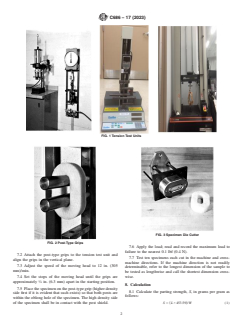
4.1 Constant Rate of Traverse Tension Test Unit of 50-lbf
conversions to SI units that are provided for information only
(223-N) capacity calibrated in increments of 0.1 lbf (0.4 N) and
and are not considered standard.
having a moving head speed of 12 in. (305 mm)/min or
1.3 This standard does not purport to address all of the
equivalent (see Fig. 1).
safety concerns, if any, associated with its use. It is the
4.2 Post-Type Grips with 1-in. (25.4-mm) diameter rods
responsibility of the user of this standard to establish appro-
priate safety, health, and environmental practices and deter- (see Fig. 2).
mine the applicability of regulatory limitations prior to use.
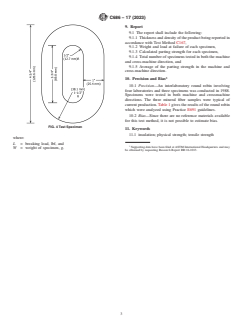
4.3 Die for cutting specimens (see Fig. 3). The O-ring
1.4 This international standard was developed in accor-
specimen dimensions are 3 by 4.75 in. (76 by 120.6 mm) in
dance with internationally recognized principles on standard-
outside diameter, and 1 by 2.75 in. (25 by 69.8 mm) in inside
ization established in the Decision on Principles for the
diameter (see Fig. 4).
Development of International Standards, Guides and Recom-
4.4 Balance to weigh to an accuracy of 0.01 g.
mendations issued by the World Trade Organization Technical
Barriers to Trade (TBT) Committee.
5. Test Specimen
2. Referenced Documents
5.1 The test specimen shall consist of the entire O-ring cut
2 from the full thickness of the product to be tested.
2.1 ASTM Standards:
C167 Test Methods for Thickness and Density of Blanket or
5.2 Specimens shall not be cut from a product that varies in
Batt Thermal Insulations thickness 65 % from normal when tested in accordance with
E171 Practice for Conditioning and Testing Flexible Barrier
Test Method C167.
Packaging
5.3 No specimen shall be tested that exhibits any obvious
E691 Practice for Conducting an Interlaboratory Study to
damage in the insulation or that shows delamination within the
Determine the Precision of a Test Method
insulation thickness.
6. Conditioning
This test method is under the jurisdiction of ASTM Committee C16 on Thermal
Insulation and is the direct responsibility of Subcommittee C16.32 on Mechanical
6.1 Condition the specimens for 1 h in a room maintained at
Properties.
atmospheric conditions of 73.4 6 1.8°F (23 6 1°C) and 50 6
Current edition approved March 1, 2023. Published March 2023. Originally
2 % relative humidity in accordance with Specification E171.
approved in 1971. Last previous edition approved in 2017 as C686 – 17. DOI:
10.1520/C0686-17R23.
For referenced ASTM standards, visit the ASTM website, www.astm.org, or 7. Procedure
contact ASTM Customer Service at service@astm.org. For Annual Book of ASTM
7.1 Weigh each specimen to the nearest 0.01 g and record
Standards volume information, refer to the standard’s Document Summary page on
the ASTM website. the weight.
Copyright © ASTM International, 100 Barr Harbor Drive
...