

ASTM C667-17(2022)
(Specification)Standard Specification for Prefabricated Reflective Insulation Systems for Equipment and Pipe Operating at Temperatures above Ambient Air
General Information
- Abstract
ABSTRACT
This specification covers the standard for all metal prefabricated, reflective insulation systems for equipment and piping operating at temperatures above ambient in air proposed for use in nuclear power-generating plants and industrial plants. The insulation unit is a rigid, self-contained, prefabricated metal construction made of an inner and outer casing arranged to form a rigid assembly with separated air spaces between the inner and outer casing and the individual reflective liners. The reflective insulation described herein is limited to systems of insulating units, designed to fit the equipment or piping to be insulated. The units shall be manufactured from metals that are in accordance with the thermal, physical, and chemical requirements not only of the insulation as unit, but also as an assembly of units forming the insulation system.
SCOPE
1.1 This specification covers the requirements for all metal prefabricated, reflective insulation systems for equipment and piping operating in air at temperatures above ambient. Typical applications are in nuclear power-generating plants and industrial plants.
1.2 Reflective insulation is thermal insulation that reduces radiant heat transfer across spaces by the use of surfaces of high reflectance and low emittance.
1.3 The values stated in inch-pound units are to be regarded as standard. The values given in parentheses are mathematical conversions to SI units that are provided for information only and are not considered standard.
1.4 This standard does not purport to address all of the safety concerns, if any, associated with its use. It is the responsibility of the user of this standard to establish appropriate safety, health, and environmental practices and determine the applicability of regulatory limitations prior to use.
1.5 This international standard was developed in accordance with internationally recognized principles on standardization established in the Decision on Principles for the Development of International Standards, Guides and Recommendations issued by the World Trade Organization Technical Barriers to Trade (TBT) Committee.
- Status
- Published
- Publication Date
- 31-Aug-2022
- Technical Committee
- C16 - Thermal Insulation
- Drafting Committee
- C16.40 - Insulation Systems
Overview
ASTM C667-17(2022) is the standard specification published by ASTM International for prefabricated, all-metal reflective insulation systems used with equipment and piping operating at temperatures above ambient air. This document specifically addresses applications in nuclear power plants and industrial facilities where robust thermal insulation is required. The standard defines the requirements for design, manufacture, performance, and installation of metallic reflective insulation systems, which are engineered to minimize radiant heat loss and withstand demanding operating environments. These insulation units are characterized by rigid, self-contained construction with integrated air spaces and reflective liners.
Key Topics
- Reflective Insulation Design: Defines the structure and function of prefabricated metal insulation systems, including inner and outer metal casing, separated airspaces, and integrated reflective liners to reduce heat transfer.
- Performance Requirements: Outlines criteria for thermal resistance, maximum allowable heat loss, material integrity under high temperatures, and compatibility with operational and environmental stresses.
- Material Specifications: Requires use of metals that meet defined thermal, physical, and chemical standards suitable for high-temperature operation and long service life.
- Installation and Maintenance: Provides guidance for proper installation, removal, and reinstallation, ensuring ease of maintenance and inspection with minimal disturbance.
- Testing and Inspection: References ASTM test methods for evaluating emittance, thermal conductance, and resistance to external loads, ensuring reliable product performance.
- Product Marking and Documentation: Mandates clear identification, correlation with assembly drawings, and documentation for traceability and quality assurance.
- Safety Considerations: Emphasizes the importance of compliance with health, safety, and environmental practices as well as regulatory requirements.
Applications
Reflective insulation systems specified in ASTM C667-17(2022) are crucial in environments where superior thermal performance and durability are required. Key applications include:
- Nuclear Power-Generating Plants: Protects critical pipework and equipment from excessive heat loss, ensuring energy efficiency and operational safety in high-risk environments.
- Industrial Plants: Used on process piping, vessels, pumps, and equipment operating above ambient temperatures, supporting efficient operation and personnel protection.
- Custom-Fit Installations: Units are engineered and manufactured to precisely fit equipment or piping arrangements, including provisions for expansion, movement, and accessibility for inspection or maintenance.
The systems are designed for easy removal and reinstallation, addressing the maintenance needs typical in large-scale industrial systems. The robust construction and thermal properties also aid in personnel protection by limiting surface temperatures and external heat exposure.
Related Standards
ASTM C667-17(2022) references several related ASTM standards that support its requirements:
- ASTM C168: Terminology relating to thermal insulation.
- ASTM C335: Test method for steady-state heat transfer of pipe insulation.
- ASTM C411: Test method for hot-surface performance of high-temperature thermal insulation.
- ASTM C835: Test method for hemispherical emittance of surfaces up to 1400°C.
- ASTM C1045: Practice for calculating thermal transmission properties under steady-state conditions.
- ASTM C1058: Practice for selecting temperatures for evaluating thermal insulation properties.
- ASTM C1371: Test method for determination of emittance of materials near room temperature.
By following ASTM C667-17(2022), manufacturers, engineers, and facility managers can ensure that metallic reflective insulation systems provide reliable, efficient, and maintainable thermal protection for critical equipment and piping in high-temperature operations. This standard is essential for ensuring safety, energy efficiency, and system integrity in sectors where insulation performance is vital.
Relations
- Effective Date
- 15-Apr-2024
- Effective Date
- 01-Mar-2020
- Effective Date
- 01-Apr-2019
- Effective Date
- 01-Mar-2019
- Effective Date
- 15-Apr-2018
- Effective Date
- 01-Oct-2017
- Effective Date
- 01-Jun-2017
- Effective Date
- 15-Oct-2015
- Effective Date
- 01-Jun-2015
- Effective Date
- 01-Sep-2013
- Effective Date
- 01-Sep-2013
- Effective Date
- 01-Apr-2013
- Effective Date
- 01-May-2011
- Effective Date
- 01-Nov-2010
- Effective Date
- 01-Jan-2010
Get Certified
Connect with accredited certification bodies for this standard

DNV
DNV is an independent assurance and risk management provider.

Lloyd's Register
Lloyd's Register is a global professional services organisation specialising in engineering and technology.
DNV Energy Systems
Energy and renewable energy certification.
Sponsored listings
Frequently Asked Questions
ASTM C667-17(2022) is a technical specification published by ASTM International. Its full title is "Standard Specification for Prefabricated Reflective Insulation Systems for Equipment and Pipe Operating at Temperatures above Ambient Air". This standard covers: ABSTRACT This specification covers the standard for all metal prefabricated, reflective insulation systems for equipment and piping operating at temperatures above ambient in air proposed for use in nuclear power-generating plants and industrial plants. The insulation unit is a rigid, self-contained, prefabricated metal construction made of an inner and outer casing arranged to form a rigid assembly with separated air spaces between the inner and outer casing and the individual reflective liners. The reflective insulation described herein is limited to systems of insulating units, designed to fit the equipment or piping to be insulated. The units shall be manufactured from metals that are in accordance with the thermal, physical, and chemical requirements not only of the insulation as unit, but also as an assembly of units forming the insulation system. SCOPE 1.1 This specification covers the requirements for all metal prefabricated, reflective insulation systems for equipment and piping operating in air at temperatures above ambient. Typical applications are in nuclear power-generating plants and industrial plants. 1.2 Reflective insulation is thermal insulation that reduces radiant heat transfer across spaces by the use of surfaces of high reflectance and low emittance. 1.3 The values stated in inch-pound units are to be regarded as standard. The values given in parentheses are mathematical conversions to SI units that are provided for information only and are not considered standard. 1.4 This standard does not purport to address all of the safety concerns, if any, associated with its use. It is the responsibility of the user of this standard to establish appropriate safety, health, and environmental practices and determine the applicability of regulatory limitations prior to use. 1.5 This international standard was developed in accordance with internationally recognized principles on standardization established in the Decision on Principles for the Development of International Standards, Guides and Recommendations issued by the World Trade Organization Technical Barriers to Trade (TBT) Committee.
ABSTRACT This specification covers the standard for all metal prefabricated, reflective insulation systems for equipment and piping operating at temperatures above ambient in air proposed for use in nuclear power-generating plants and industrial plants. The insulation unit is a rigid, self-contained, prefabricated metal construction made of an inner and outer casing arranged to form a rigid assembly with separated air spaces between the inner and outer casing and the individual reflective liners. The reflective insulation described herein is limited to systems of insulating units, designed to fit the equipment or piping to be insulated. The units shall be manufactured from metals that are in accordance with the thermal, physical, and chemical requirements not only of the insulation as unit, but also as an assembly of units forming the insulation system. SCOPE 1.1 This specification covers the requirements for all metal prefabricated, reflective insulation systems for equipment and piping operating in air at temperatures above ambient. Typical applications are in nuclear power-generating plants and industrial plants. 1.2 Reflective insulation is thermal insulation that reduces radiant heat transfer across spaces by the use of surfaces of high reflectance and low emittance. 1.3 The values stated in inch-pound units are to be regarded as standard. The values given in parentheses are mathematical conversions to SI units that are provided for information only and are not considered standard. 1.4 This standard does not purport to address all of the safety concerns, if any, associated with its use. It is the responsibility of the user of this standard to establish appropriate safety, health, and environmental practices and determine the applicability of regulatory limitations prior to use. 1.5 This international standard was developed in accordance with internationally recognized principles on standardization established in the Decision on Principles for the Development of International Standards, Guides and Recommendations issued by the World Trade Organization Technical Barriers to Trade (TBT) Committee.
ASTM C667-17(2022) is classified under the following ICS (International Classification for Standards) categories: 27.220 - Heat recovery. Thermal insulation. The ICS classification helps identify the subject area and facilitates finding related standards.
ASTM C667-17(2022) has the following relationships with other standards: It is inter standard links to ASTM C168-24, ASTM C835-06(2020), ASTM C1045-19, ASTM C411-19, ASTM C168-18, ASTM C411-17, ASTM C168-17, ASTM C168-15a, ASTM C168-15, ASTM C1045-07(2013), ASTM C835-06(2013)e1, ASTM C168-13, ASTM C411-11, ASTM C1371-04a(2010)e1, ASTM C168-10. Understanding these relationships helps ensure you are using the most current and applicable version of the standard.
ASTM C667-17(2022) is available in PDF format for immediate download after purchase. The document can be added to your cart and obtained through the secure checkout process. Digital delivery ensures instant access to the complete standard document.
Standards Content (Sample)
This international standard was developed in accordance with internationally recognized principles on standardization established in the Decision on Principles for the
Development of International Standards, Guides and Recommendations issued by the World Trade Organization Technical Barriers to Trade (TBT) Committee.
Designation:C667 −17 (Reapproved 2022)
Standard Specification for
Prefabricated Reflective Insulation Systems for Equipment
and Pipe Operating at Temperatures above Ambient Air
This standard is issued under the fixed designation C667; the number immediately following the designation indicates the year of
original adoption or, in the case of revision, the year of last revision. A number in parentheses indicates the year of last reapproval. A
superscript epsilon (´) indicates an editorial change since the last revision or reapproval.
1. Scope C835 Test Method for Total Hemispherical Emittance of
Surfaces up to 1400°C
1.1 This specification covers the requirements for all metal
C854 Test Method for Resistance to External Loads on
prefabricated, reflective insulation systems for equipment and
Metal Reflective Pipe Insulation (Withdrawn 1997)
piping operating in air at temperatures above ambient. Typical
C1045 Practice for Calculating Thermal Transmission Prop-
applications are in nuclear power-generating plants and indus-
erties Under Steady-State Conditions
trial plants.
C1058 Practice for Selecting Temperatures for Evaluating
1.2 Reflective insulation is thermal insulation that reduces
and Reporting Thermal Properties of Thermal Insulation
radiant heat transfer across spaces by the use of surfaces of
C1061 Test Method for Thermal Transmission Properties of
high reflectance and low emittance.
Non-Homogeneous Insulation Panels Installed Vertically
1.3 The values stated in inch-pound units are to be regarded (Withdrawn 1995)
C1371 Test Method for Determination of Emittance of
as standard. The values given in parentheses are mathematical
conversions to SI units that are provided for information only Materials Near Room Temperature Using Portable Emis-
someters
and are not considered standard.
1.4 This standard does not purport to address all of the
3. Terminology
safety concerns, if any, associated with its use. It is the
3.1 Definitions:
responsibility of the user of this standard to establish appro-
3.1.1 Terms relating to thermal insulation materials and
priate safety, health, and environmental practices and deter-
testing are in accordance with Terminology C168.
mine the applicability of regulatory limitations prior to use.
3.2 Definitions of Terms Specific to This Standard:
1.5 This international standard was developed in accor-
3.2.1 convection stops, n—seals used to reduce convection
dance with internationally recognized principles on standard-
losses.
ization established in the Decision on Principles for the
3.2.2 end supports, n—structural members placed at the end
Development of International Standards, Guides and Recom-
of a unit of insulation and fastened to both the inner and outer
mendations issued by the World Trade Organization Technical
case.
Barriers to Trade (TBT) Committee.
3.2.2.1 Discussion—The primary purpose of the end sup-
2. Referenced Documents
ports is to increase the structural integrity of the unit.
2.1 ASTM Standards:
3.2.3 inner case, n—the innermost sheet of the unit of
C168 Terminology Relating to Thermal Insulation
insulation (closest to the hot surface).
C335 Test Method for Steady-State Heat Transfer Properties
3.2.3.1 Discussion—The inner case may perform structural
of Pipe Insulation
functions in addition to its thermal functions.
C411 Test Method for Hot-Surface Performance of High-
3.2.4 insulation assembly, n—an assembly of insulation
Temperature Thermal Insulation
units arranged and secured together in a prescribed order that
comprises the complete insulation for a vessel, pump, pipeline,
or other component for a single design objective.
This specification is under the jurisdiction of ASTM Committee C16 on
Thermal Insulation and is the direct responsibility of Subcommittee C16.40 on
3.2.5 insulation system, n—a collection of insulation
Insulation Systems.
assemblies, that when secured together in a prescribed order,
Current edition approved Sept. 1, 2022. Published October 2022. Originally
approved in 1992. Last previous edition approved in 2017 as C667 – 17. DOI: comprises the complete insulation for a vessel, pump, pipeline,
10.1520/C0667-17R22.
or other component for a single design objective.
For referenced ASTM standards, visit the ASTM website, www.astm.org, or
contact ASTM Customer Service at service@astm.org. For Annual Book of ASTM
Standards volume information, refer to the standard’s Document Summary page on The last approved version of this historical standard is referenced on
the ASTM website. www.astm.org.
Copyright © ASTM International, 100 Barr Harbor Drive, PO Box C700, West Conshohocken, PA 19428-2959. United States
C667−17 (2022)
3.2.6 lap straps, n—strips that overlap a longitudinal or 4.1.1 Service requirements including operating hot surface
circumferential joint in the insulation which aligns adjacent temperature, expected ambient temperatures, and ambient air
insulation units and may also serve to restrict air infiltration velocities,
and convection losses and to shed external falling water.
4.1.2 Expected service life and any special environmental
3.2.6.1 Discussion—The lap straps may be integral with one
exposures,
piece of the outer case or separate strips secured to it.
4.1.3 Permitted average thermal conductance based on hot
pipe temperature and insulation cold surface temperature,
3.2.7 outer case, n—the outermost sheet or the unit of
insulation (farthest from the hot surface). It usually performs 4.1.4 Personnel exposure surface temperature limitations,
structural functions in addition to its thermal functions.
4.1.5 Expected seismic, loading, and vibration exposures,
4.1.6 Purchaser’s systems and equipment drawings,
3.2.8 penetrations, n—openings in a unit of insulation from
the cold surface through to the hot surface. 4.1.7 Limits, if any, on size, maximum thickness, weight, or
number of insulation units requiring removal for inspection,
3.2.9 reflective liners, n—those reflective sheets or foil
4.1.8 Location of components or maintenance, or both, and
interposed between the inner and outer case to reflect radiant
systems requiring removal of units for inspections,
energy, to minimize emission of radiant energy, and to restrict
4.1.9 Any unusual operating or test conditions, and
internal convection.
4.1.10 Cleanliness level required.
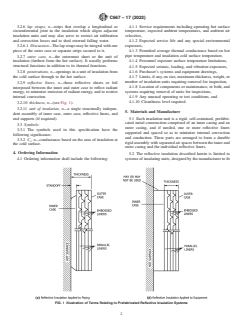
3.2.10 thickness, n—(see Fig. 1).
3.2.11 unit of insulation, n—a single structurally indepen-
5. Materials and Manufacture
dent assembly of inner case, outer case, reflective liners, and
5.1 Each insulation unit is a rigid, self-contained, prefabri-
end supports (if required).
cated metal construction comprised of an inner casing and an
3.3 Symbols:
outer casing, and if needed, one or more reflective liners
3.3.1 The symbols used in this specification have the
supported and spaced so as to minimize internal convection
following significance:
and conduction. These parts are arranged to form a durable
3.3.2 C,n—conductance based on the area of insulation at
c
rigid assembly with separated air spaces between the inner and
the cold surface.
outer casing and the individual reflective liners.
4. Ordering Information
5.2 The reflective insulation described herein is limited to
4.1 Ordering information shall include the following: systems of insulating units, designed by the manufacturer to fit
FIG. 1 Illustration of Terms Relating to Prefabricated Reflective Insulation Systems
C667−17 (2022)
A
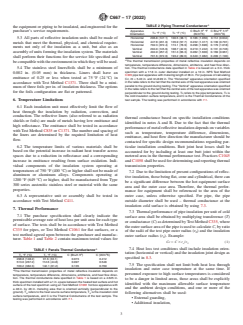
TABLE 2 Piping Thermal Conductance
the equipment or piping to be insulated, and engineered for the
2 2
Apparatus C Btu/h ft °F CBtu/°Fhft
purchaser’s service requirements.
T °F (°C) T °F (°C)
0 2 2 2
Orientation (W/m K) (W/m K)
5.3 All parts of reflective insulation units shall be made of Horizontal 296.8 (147.1) 100.5 (38.1) 0.186 (1.056) 0.112 (0.634)
Horizontal 447.8 (231.0) 135.9 (57.7) 0.232 (1.317) 0.139 (0.791)
metals that meet the thermal, physical, and chemical require-
Horizontal 702.3 (372.4) 174.1 (78.9) 0.298 (1.696) 0.179 (1.018)
ments not only of the insulation as a unit, but also as an
Vertical 294.0 (145.6) 108.7 (42.6) 0.219 (1.242) 0.131 (0.746)
assembly of units forming the insulation system. The materials Vertical 494.9 (257.2) 151.3 (66.3) 0.282 (1.600) 0.169 (0.961)
Vertical 701.6 (372.0) 193.2 (89.6) 0.349 (1.982) 0.209 (1.190)
shall perform their functions for the service life specified and
A
The thermal transmission properties of metal reflective insulation depends on
becompatiblewiththeenvironmentinwhichtheywillbeused.
temperature, temperature difference, dimensions, emittance, and heat flow direc-
5.4 The stainless steel liners/foils shall be a minimum of tion. The thermal conductance data specified in Table 2 is based ona3in. thick
specimen with a 17.8 in. outer diameter installed on a 10 in. NPS Test Method
0.002 in. (0.05 mm) in thickness. Liners shall have an
C335 pipe test apparatus with metering length of 36 in. For purposes of calculating
emittance of 0.25 or less when tested at 75 °F (24 °C) in
Cc, r0 = 5.40 in. and r2=8.99 in. The “Horizontal” apparatus orientation specified
in the table refers to the fact that the central axis of the test apparatus was oriented
accordance with Test Method C1371. There shall be a mini-
parallel to the ground during testing. The “Vertical” apparatus orientation specified
mum of three foils per in. of insulation thickness. The options
in the table refers to the fact that the central axis of the test apparatus was oriented
for the foils configuration are flat or patterned.
perpendicular to the ground during testing. T refers to the pipe temperature, T is
0 2
the cold insulation surface temperature, and C is the Thermal Conductance of the
test sample. The testing was performed in accordance with 7.1.
6. Temperature Limitations
6.1 Each insulation unit must effectively limit the flow of
heat through the insulation by radiation, convection, and
conduction. The reflective liners (also referred to as radiation
thermal conductance based on specific installation conditions
shields or foils) are made of metals having low emittance and
identified in notes A and B. Due to the fact that the thermal
high reflectance. The emittance shall be tested in accordance
performanceofmetalreflectiveinsulationdependsonvariables
with Test Method C835 or C1371. The number and spacing of
such as temperature, temperature difference, dimensions,
the liners are determined by the required limitation of heat
emittance, and heat flow direction the manufacturer should be
flow.
contacted for specific design recommendations regarding par-
6.2 The temperature limits of various materials shall be ticular installation conditions. Butt joint heat losses shall be
based on the potential increase in radiant heat transfer across
accounted for by including at least one butt joint within the
spaces due to a reduction in reflectance and a corresponding metered area in the thermal performance test. Practices C1045
increase in emittance resulting from surface oxidation. Indi-
and C1058 shall be used for determining and reporting thermal
vidual components of the insulation system operating at transmission properties.
temperatures of 750 °F (400 °C) or higher shall not be made of
7.2 Due to the limitation of present configurations of reflec-
aluminum or aluminum alloys. Components operating at
tive insulation, those being flat, cone and cylindrical, there can
1200 °F (649 °C) or higher, shall be manufactured from Type
be a significant difference between the hot equipment surface
300 series austenitic stainless steel or material with the same
area and the outer case area. Therefore, the thermal perfor-
properties.
mance for equipment shall be referenced to the area of the
6.3 A representative unit or assembly shall be tested in
outer case, unless otherwise specified. For pipe, the pipe
accordance with Test Method C411. outside diameter shall be used – thermal conductance at the
insulation cold surface is obtained by using 7.3.
7. Thermal Performance
7.3 Thermal performance of pipe insulation per unit of cold
7.1 The purchase specification shall clearly indicate the
surface area shall be obtained by multiplying transference (T)
permissible average rate of heat loss per unit area for each type
orconductance(C)asdeterminedbyTestMethodC335,where
of surface. The tests shall be in accordance with Test Method
theoutersurfaceareaofthepipeisusedtocalculate C,byratio
C335 for pipes, or Test Method C1061 for flat surfaces, or a
of the radii of the test pipe outer radius (r ) and the insulation
test method agreed upon between the purchaser and manufac-
outer surface radius (r ). Example:
turer. Table 1 and Table 2 contain maximum tested values for
Cc 5 C 3r /r (1)
o 2
7.4 Heat loss test conditions shall include insulation orien-
A
TABLE 1 Panels Thermal Conductance
tation (horizontal or vertical) and the insulation joint design as
2 2
T °F (°C) T °F (°C) C (Btu/h ft ) C (W/m K)
0 2
specified in 8.3.
298.8 (148.2) 91.6 (33.1) 0.073 0.412
513.0 (267.2) 112.6 (44.8) 0.097 0.548
7.5 The specification shall not limit both heat loss through
720.2 (382.3) 142.1 (61.2) 0.135 0.769
insulation and outer case temperature at the same time. If
A
The thermal transmission properties of metal reflective insulation depends on
personnel exposure to high surface temperatures is considered
temperature, temperature diff
...