

ASTM C1289-23a
(Specification)Standard Specification for Faced Rigid Cellular Polyisocyanurate Thermal Insulation Board
General Information
- Abstract
ABSTRACT
This specification covers the general requirements for faced thermal insulation boards composed of rigid cellular polyisocyanurate surfaced with other materials. This standard is intended to apply to rigid cellular polyurethane-modified polyisocyanurate thermal insulation board products that are commercially acceptable as nonstructural panels useful in building construction. The materials are classified as follows: Types I, II, III, IV, and V. Under Type I are Classes 1 and 2. Under Type II are Classes 1, 2, and 3. Under Type II Class 1 are Grades 1, 2, and 3. Rigid polyisocyanurate thermal insulation boards shall be based upon the reaction of an isocyanate with a polyol, or the reaction of an isocyanate with itself, or both, using a catalyst and blowing agents to form a rigid closed-cell-structured polyisocyanurate foam. The insulation foam core shall be homogeneous and of uniform density. The following test methods shall be performed to conform to the specified requirements: conditioning; thermal resistance; compressive strength; dimensional stability; flexural strength; tensile strength perpendicular to board surface; water absorption; and water vapor transmission.
SCOPE
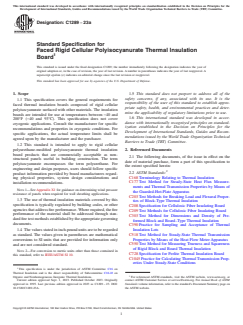
1.1 This specification covers the general requirements for faced thermal insulation boards composed of rigid cellular polyisocyanurate surfaced with other materials. The insulation boards are intended for use at temperatures between −40 and 200°F (−40 and 93°C). This specification does not cover cryogenic applications. Consult the manufacturer for specific recommendations and properties in cryogenic conditions. For specific applications, the actual temperature limits shall be agreed upon by the manufacturer and the purchaser.
1.2 This standard is intended to apply to rigid cellular polyurethane-modified polyisocyanurate thermal insulation board products that are commercially acceptable as non-structural panels useful in building construction. The term polyisocyanurate encompasses the term polyurethane. For engineering and design purposes, users should follow specific product information provided by board manufacturers regarding physical properties, system design considerations and installation recommendations.
Note 1: See Appendix X1 for guidance on determining wind pressure resistance of panels when required for wall sheathing applications.
1.3 The use of thermal insulation materials covered by this specification is typically regulated by building codes, or other agencies that address fire performance. Where required, the fire performance of the material shall be addressed through standard fire test methods established by the appropriate governing documents.
1.4 The values stated in inch-pound units are to be regarded as standard. The values given in parentheses are mathematical conversions to SI units that are provided for information only and are not considered standard.
Note 2: For conversion to metric units other than those contained in this standard, refer to IEEE/ASTM SI 10.
1.5 This standard does not purport to address all of the safety concerns, if any, associated with its use. It is the responsibility of the user of this standard to establish appropriate safety, health, and environmental practices and determine the applicability of regulatory limitations prior to use.
1.6 This international standard was developed in accordance with internationally recognized principles on standardization established in the Decision on Principles for the Development of International Standards, Guides and Recommendations issued by the World Trade Organization Technical Barriers to Trade (TBT) Committee.
- Status
- Published
- Publication Date
- 31-Aug-2023
- Technical Committee
- C16 - Thermal Insulation
- Drafting Committee
- C16.22 - Organic and Nonhomogeneous Inorganic Thermal Insulations
Buy Documents
ASTM C1289-23a - Standard Specification for Faced Rigid Cellular Polyisocyanurate Thermal Insulation Board
REDLINE ASTM C1289-23a - Standard Specification for Faced Rigid Cellular Polyisocyanurate Thermal Insulation Board
Overview
ASTM C1289-23a - Standard Specification for Faced Rigid Cellular Polyisocyanurate Thermal Insulation Board outlines the requirements for rigid cellular polyisocyanurate (polyiso) insulation boards that are surfaced with various facers. These boards are used as non-structural thermal insulation panels, primarily in building construction, and offer superior thermal resistance within temperatures ranging from −40°F to 200°F (−40°C to 93°C). This international standard ensures product quality, performance consistency, and compliance with building codes.
Key Topics
Classification: The standard covers several types, classes, and grades of polyisocyanurate thermal insulation boards. These are based on the core composition and the surfacing (facer) materials:
- Type I: Aluminum foil facers (with Class 1 - non-reinforced or Class 2 - reinforced core foam).
- Type II: Cellulosic or glass fiber mat facers, subdivided by surface reinforcement and compressive strength.
- Types III, IV, V, VII: Include perlite, cellulosic fiber, oriented strand board (OSB), plywood, or glass mat faced gypsum as one or both facers.
Material and Manufacturing:
- Boards are produced by reacting isocyanate with polyol (and sometimes with itself), using catalysts and blowing agents to create a closed-cell rigid foam core.
- Facers, such as aluminum foil, glass fiber mats, perlite board, cellulosic fiber board, OSB, plywood, and gypsum, are bonded to the foam during or after manufacturing.
Physical and Thermal Properties:
- Thermal Resistance (R-value): Boards must meet minimum R-values specified in the standard, conditioned at 75°F (24°C), with optional reporting at 40°F (4°C) and 110°F (43°C).
- Mechanical Properties: Requirements for compressive strength, flexural strength, tensile strength, dimensional stability, and water absorption are specified.
- Fire Performance: Materials are combustible and their fire performance must adhere to governing local codes and fire testing standards.
Dimensions and Tolerances:
- Product dimensions, thickness tolerances, edge types (straight or shiplap), and flatness are specified to ensure product uniformity and compatibility during installation.
Testing and Inspection:
- Detailed procedures for sampling, conditioning, and testing ensure that insulation boards meet key performance criteria.
- Compliance is verified by inspection and supported by manufacturer or third-party certification.
Applications
Building Envelopes:
- Used in roofs, walls, and sheathings for commercial and residential construction to enhance energy efficiency.
- Suitable for installation over other structural boards or within multilayer insulation systems.
Thermal Performance:
- Polyisocyanurate boards offer high insulation value per inch, helping to achieve demanding energy codes and sustainable building certifications.
Versatile Facers:
- Products can be tailored for specific applications by selecting appropriate facer materials (aluminum, glass fiber, OSB, gypsum, etc.), providing compatibility with different installation environments and moisture conditions.
Regulatory Compliance:
- Products designed per ASTM C1289-23a facilitate easier approval under local building codes by meeting rigorous material, safety, and labeling standards.
Related Standards
- ASTM C168: Terminology relating to thermal insulation.
- ASTM C177, C518, C1114, C1363: Methods for measuring thermal transmission and performance.
- ASTM C203, C209, D1621, D1623, D2126: Test methods for physical and mechanical properties (flexural, tensile, compressive strength, and aging).
- ASTM E84, E96/E96M: Fire performance and water vapor transmission testing.
- ASHRAE Handbook - Fundamentals: Reference for R-values and thermal properties of building materials.
By specifying the requirements for polyisocyanurate insulation, ASTM C1289-23a supports quality, safety, and energy efficiency in the construction industry. The standard is essential for manufacturers, specifiers, contractors, and regulatory bodies focused on thermal insulation solutions.
Relations
- Effective Date
- 01-Sep-2023
- Effective Date
- 15-Apr-2024
- Refers
ASTM C1177/C1177M-24 - Standard Specification for Glass Mat Gypsum Substrate for Use as Sheathing - Effective Date
- 01-Apr-2024
- Effective Date
- 01-Mar-2024
- Effective Date
- 01-Mar-2024
- Effective Date
- 01-Mar-2024
- Effective Date
- 01-Dec-2023
- Effective Date
- 15-Nov-2023
- Effective Date
- 01-Nov-2023
- Effective Date
- 01-Sep-2023
- Effective Date
- 01-Aug-2023
- Effective Date
- 15-Oct-2022
- Effective Date
- 01-May-2022
- Effective Date
- 01-Sep-2019
- Effective Date
- 01-Sep-2019
Buy Documents
ASTM C1289-23a - Standard Specification for Faced Rigid Cellular Polyisocyanurate Thermal Insulation Board
REDLINE ASTM C1289-23a - Standard Specification for Faced Rigid Cellular Polyisocyanurate Thermal Insulation Board
Get Certified
Connect with accredited certification bodies for this standard

DNV
DNV is an independent assurance and risk management provider.

Lloyd's Register
Lloyd's Register is a global professional services organisation specialising in engineering and technology.
DNV Energy Systems
Energy and renewable energy certification.
Sponsored listings
Frequently Asked Questions
ASTM C1289-23a is a technical specification published by ASTM International. Its full title is "Standard Specification for Faced Rigid Cellular Polyisocyanurate Thermal Insulation Board". This standard covers: ABSTRACT This specification covers the general requirements for faced thermal insulation boards composed of rigid cellular polyisocyanurate surfaced with other materials. This standard is intended to apply to rigid cellular polyurethane-modified polyisocyanurate thermal insulation board products that are commercially acceptable as nonstructural panels useful in building construction. The materials are classified as follows: Types I, II, III, IV, and V. Under Type I are Classes 1 and 2. Under Type II are Classes 1, 2, and 3. Under Type II Class 1 are Grades 1, 2, and 3. Rigid polyisocyanurate thermal insulation boards shall be based upon the reaction of an isocyanate with a polyol, or the reaction of an isocyanate with itself, or both, using a catalyst and blowing agents to form a rigid closed-cell-structured polyisocyanurate foam. The insulation foam core shall be homogeneous and of uniform density. The following test methods shall be performed to conform to the specified requirements: conditioning; thermal resistance; compressive strength; dimensional stability; flexural strength; tensile strength perpendicular to board surface; water absorption; and water vapor transmission. SCOPE 1.1 This specification covers the general requirements for faced thermal insulation boards composed of rigid cellular polyisocyanurate surfaced with other materials. The insulation boards are intended for use at temperatures between −40 and 200°F (−40 and 93°C). This specification does not cover cryogenic applications. Consult the manufacturer for specific recommendations and properties in cryogenic conditions. For specific applications, the actual temperature limits shall be agreed upon by the manufacturer and the purchaser. 1.2 This standard is intended to apply to rigid cellular polyurethane-modified polyisocyanurate thermal insulation board products that are commercially acceptable as non-structural panels useful in building construction. The term polyisocyanurate encompasses the term polyurethane. For engineering and design purposes, users should follow specific product information provided by board manufacturers regarding physical properties, system design considerations and installation recommendations. Note 1: See Appendix X1 for guidance on determining wind pressure resistance of panels when required for wall sheathing applications. 1.3 The use of thermal insulation materials covered by this specification is typically regulated by building codes, or other agencies that address fire performance. Where required, the fire performance of the material shall be addressed through standard fire test methods established by the appropriate governing documents. 1.4 The values stated in inch-pound units are to be regarded as standard. The values given in parentheses are mathematical conversions to SI units that are provided for information only and are not considered standard. Note 2: For conversion to metric units other than those contained in this standard, refer to IEEE/ASTM SI 10. 1.5 This standard does not purport to address all of the safety concerns, if any, associated with its use. It is the responsibility of the user of this standard to establish appropriate safety, health, and environmental practices and determine the applicability of regulatory limitations prior to use. 1.6 This international standard was developed in accordance with internationally recognized principles on standardization established in the Decision on Principles for the Development of International Standards, Guides and Recommendations issued by the World Trade Organization Technical Barriers to Trade (TBT) Committee.
ABSTRACT This specification covers the general requirements for faced thermal insulation boards composed of rigid cellular polyisocyanurate surfaced with other materials. This standard is intended to apply to rigid cellular polyurethane-modified polyisocyanurate thermal insulation board products that are commercially acceptable as nonstructural panels useful in building construction. The materials are classified as follows: Types I, II, III, IV, and V. Under Type I are Classes 1 and 2. Under Type II are Classes 1, 2, and 3. Under Type II Class 1 are Grades 1, 2, and 3. Rigid polyisocyanurate thermal insulation boards shall be based upon the reaction of an isocyanate with a polyol, or the reaction of an isocyanate with itself, or both, using a catalyst and blowing agents to form a rigid closed-cell-structured polyisocyanurate foam. The insulation foam core shall be homogeneous and of uniform density. The following test methods shall be performed to conform to the specified requirements: conditioning; thermal resistance; compressive strength; dimensional stability; flexural strength; tensile strength perpendicular to board surface; water absorption; and water vapor transmission. SCOPE 1.1 This specification covers the general requirements for faced thermal insulation boards composed of rigid cellular polyisocyanurate surfaced with other materials. The insulation boards are intended for use at temperatures between −40 and 200°F (−40 and 93°C). This specification does not cover cryogenic applications. Consult the manufacturer for specific recommendations and properties in cryogenic conditions. For specific applications, the actual temperature limits shall be agreed upon by the manufacturer and the purchaser. 1.2 This standard is intended to apply to rigid cellular polyurethane-modified polyisocyanurate thermal insulation board products that are commercially acceptable as non-structural panels useful in building construction. The term polyisocyanurate encompasses the term polyurethane. For engineering and design purposes, users should follow specific product information provided by board manufacturers regarding physical properties, system design considerations and installation recommendations. Note 1: See Appendix X1 for guidance on determining wind pressure resistance of panels when required for wall sheathing applications. 1.3 The use of thermal insulation materials covered by this specification is typically regulated by building codes, or other agencies that address fire performance. Where required, the fire performance of the material shall be addressed through standard fire test methods established by the appropriate governing documents. 1.4 The values stated in inch-pound units are to be regarded as standard. The values given in parentheses are mathematical conversions to SI units that are provided for information only and are not considered standard. Note 2: For conversion to metric units other than those contained in this standard, refer to IEEE/ASTM SI 10. 1.5 This standard does not purport to address all of the safety concerns, if any, associated with its use. It is the responsibility of the user of this standard to establish appropriate safety, health, and environmental practices and determine the applicability of regulatory limitations prior to use. 1.6 This international standard was developed in accordance with internationally recognized principles on standardization established in the Decision on Principles for the Development of International Standards, Guides and Recommendations issued by the World Trade Organization Technical Barriers to Trade (TBT) Committee.
ASTM C1289-23a is classified under the following ICS (International Classification for Standards) categories: 27.220 - Heat recovery. Thermal insulation. The ICS classification helps identify the subject area and facilitates finding related standards.
ASTM C1289-23a has the following relationships with other standards: It is inter standard links to ASTM C1289-23, ASTM C168-24, ASTM C1177/C1177M-24, ASTM C390-08(2024), ASTM C1363-24, ASTM E96/E96M-24, ASTM E84-23d, ASTM E96/E96M-23, ASTM C1303/C1303M-23, ASTM E84-23c, ASTM E84-23b, ASTM E96/E96M-22ae1, ASTM C168-22, ASTM C1363-19, ASTM C390-08(2019). Understanding these relationships helps ensure you are using the most current and applicable version of the standard.
ASTM C1289-23a is available in PDF format for immediate download after purchase. The document can be added to your cart and obtained through the secure checkout process. Digital delivery ensures instant access to the complete standard document.
Standards Content (Sample)
This international standard was developed in accordance with internationally recognized principles on standardization established in the Decision on Principles for the
Development of International Standards, Guides and Recommendations issued by the World Trade Organization Technical Barriers to Trade (TBT) Committee.
Designation: C1289 − 23a
Standard Specification for
Faced Rigid Cellular Polyisocyanurate Thermal Insulation
Board
This standard is issued under the fixed designation C1289; the number immediately following the designation indicates the year of
original adoption or, in the case of revision, the year of last revision. A number in parentheses indicates the year of last reapproval. A
superscript epsilon (´) indicates an editorial change since the last revision or reapproval.
This standard has been approved for use by agencies of the U.S. Department of Defense.
1. Scope 1.5 This standard does not purport to address all of the
safety concerns, if any, associated with its use. It is the
1.1 This specification covers the general requirements for
responsibility of the user of this standard to establish appro-
faced thermal insulation boards composed of rigid cellular
priate safety, health, and environmental practices and deter-
polyisocyanurate surfaced with other materials. The insulation
mine the applicability of regulatory limitations prior to use.
boards are intended for use at temperatures between −40 and
1.6 This international standard was developed in accor-
200°F (−40 and 93°C). This specification does not cover
dance with internationally recognized principles on standard-
cryogenic applications. Consult the manufacturer for specific
ization established in the Decision on Principles for the
recommendations and properties in cryogenic conditions. For
Development of International Standards, Guides and Recom-
specific applications, the actual temperature limits shall be
mendations issued by the World Trade Organization Technical
agreed upon by the manufacturer and the purchaser.
Barriers to Trade (TBT) Committee.
1.2 This standard is intended to apply to rigid cellular
polyurethane-modified polyisocyanurate thermal insulation
2. Referenced Documents
board products that are commercially acceptable as non-
2.1 The following documents, of the issue in effect on the
structural panels useful in building construction. The term
date of material purchase, form a part of this specification to
polyisocyanurate encompasses the term polyurethane. For
the extent specified herein:
engineering and design purposes, users should follow specific
2.2 ASTM Standards:
product information provided by board manufacturers regard-
C168 Terminology Relating to Thermal Insulation
ing physical properties, system design considerations and
C177 Test Method for Steady-State Heat Flux Measure-
installation recommendations.
ments and Thermal Transmission Properties by Means of
NOTE 1—See Appendix X1 for guidance on determining wind pressure
the Guarded-Hot-Plate Apparatus
resistance of panels when required for wall sheathing applications.
C203 Test Methods for Breaking Load and Flexural Proper-
1.3 The use of thermal insulation materials covered by this
ties of Block-Type Thermal Insulation
specification is typically regulated by building codes, or other
C208 Specification for Cellulosic Fiber Insulating Board
agencies that address fire performance. Where required, the fire
C209 Test Methods for Cellulosic Fiber Insulating Board
performance of the material shall be addressed through stan-
C303 Test Method for Dimensions and Density of Pre-
dard fire test methods established by the appropriate governing
formed Block and Board–Type Thermal Insulation
documents.
C390 Practice for Sampling and Acceptance of Thermal
Insulation Lots
1.4 The values stated in inch-pound units are to be regarded
as standard. The values given in parentheses are mathematical C518 Test Method for Steady-State Thermal Transmission
Properties by Means of the Heat Flow Meter Apparatus
conversions to SI units that are provided for information only
and are not considered standard. C550 Test Method for Measuring Trueness and Squareness
of Rigid Block and Board Thermal Insulation
NOTE 2—For conversion to metric units other than those contained in
C728 Specification for Perlite Thermal Insulation Board
this standard, refer to IEEE/ASTM SI 10.
C1045 Practice for Calculating Thermal Transmission Prop-
erties Under Steady-State Conditions
This specification is under the jurisdiction of ASTM Committee C16 on
Thermal Insulation and is the direct responsibility of Subcommittee C16.22 on
Organic and Nonhomogeneous Inorganic Thermal Insulations. For referenced ASTM standards, visit the ASTM website, www.astm.org, or
Current edition approved Sept. 1, 2023. Published October 2023. Originally contact ASTM Customer Service at service@astm.org. For Annual Book of ASTM
approved in 1995. Last previous edition approved in 2023 as C1289 – 23. DOI: Standards volume information, refer to the standard’s Document Summary page on
10.1520/C1289-23A. the ASTM website.
Copyright © ASTM International, 100 Barr Harbor Drive, PO Box C700, West Conshohocken, PA 19428-2959. United States
C1289 − 23a
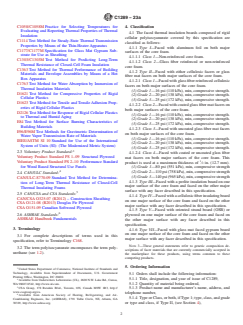
C1058/C1058M Practice for Selecting Temperatures for 4. Classification
Evaluating and Reporting Thermal Properties of Thermal
4.1 The faced thermal insulation boards composed of rigid
Insulation
cellular polyisocyanurate covered by this specification are
C1114 Test Method for Steady-State Thermal Transmission
classified as follows:
Properties by Means of the Thin-Heater Apparatus
4.1.1 Type I—Faced with aluminum foil on both major
C1177/C1177M Specification for Glass Mat Gypsum Sub-
surfaces of the core foam.
strate for Use as Sheathing
4.1.1.1 Class 1—Non-reinforced core foam.
C1303/C1303M Test Method for Predicting Long-Term
4.1.1.2 Class 2—Glass fiber reinforced or non-reinforced
Thermal Resistance of Closed-Cell Foam Insulation
core foam.
C1363 Test Method for Thermal Performance of Building
4.1.2 Type II—Faced with either cellulosic facers or glass
Materials and Envelope Assemblies by Means of a Hot
fiber mat facers on both major surfaces of the core foam.
Box Apparatus
4.1.2.1 Class 1—Faced with glass fiber reinforced cellulosic
C1763 Test Method for Water Absorption by Immersion of
facers on both major surfaces of the core foam.
Thermal Insulation Materials
(1) Grade 1—16 psi (110 kPa), min, compressive strength.
D1621 Test Method for Compressive Properties of Rigid
(2) Grade 2—20 psi (138 kPa), min, compressive strength.
Cellular Plastics
(3) Grade 3—25 psi (172 kPa), min, compressive strength.
D1623 Test Method for Tensile and Tensile Adhesion Prop-
4.1.2.2 Class 2—Faced with coated glass fiber mat facers on
erties of Rigid Cellular Plastics
both major surfaces of the core foam.
D2126 Test Method for Response of Rigid Cellular Plastics
(1) Grade 1—16 psi (110 kPa), min, compressive strength.
to Thermal and Humid Aging
(2) Grade 2—20 psi (138 kPa), min, compressive strength.
E84 Test Method for Surface Burning Characteristics of
(3) Grade 3—25 psi (172 kPa), min, compressive strength.
Building Materials
4.1.2.3 Class 3—Faced with uncoated glass fiber mat facers
E96/E96M Test Methods for Gravimetric Determination of
on both major surfaces of the core foam.
Water Vapor Transmission Rate of Materials
(1) Grade 1—16 psi (110 kPa), min, compressive strength.
IEEE/ASTM SI 10 Standard for Use of the International
(2) Grade 2—20 psi (138 kPa), min, compressive strength.
System of Units (SI): (The Modernized Metric System)
(3) Grade 3—25 psi (172 kPa), min, compressive strength.
2.3 Voluntary Product Standard:
4.1.2.4 Class 4—Faced with coated or uncoated glass fiber
Voluntary Product Standard PS 1–09 Structural Plywood
mat facers on both major surfaces of the core foam. This
Voluntary Product Standard PS 2–10 Performance Standard
product is used at a maximum thickness of ⁄2 in. (12.7 mm).
for Wood Based Structural Use Panels
(1) Grade 1—80 psi (551 kPa), min, compressive strength
(2) Grade 2—110 psi (758 kPa), min, compressive strength
2.4 CAN/ULC Standard:
(3) Grade 3—140 psi (965 kPa), min, compressive strength
CAN/ULC-S770-09 Standard Test Method for Determina-
4.1.3 Type III—Faced with a perlite insulation board on one
tion of Long-Term Thermal Resistance of Closed-Cell
major surface of the core foam and faced on the other major
Thermal Insulating Foams
surface with any facer described in this specification.
2.5 CAN/CSA and CSA Standards:
4.1.4 Type IV—Faced with a cellulosic fiber insulating board
CAN/CSA O325-07 (R2012) – Construction Sheathing
on one major surface of the core foam and faced on the other
CSA O121-08 (R2013) Douglas Fir Plywood
major surface with any facer described in this specification.
CSA O151-09 Canadian Softwood Plywood
4.1.5 Type V—Faced with oriented strand board (OSB) or
2.6 ASHRAE Standards:
plywood on one major surface of the core foam and faced on
ASHRAE Handbook Fundamentals
the other major surface with any facer described in this
specification.
3. Terminology
4.1.6 Type VII—Faced with glass mat faced gypsum board
on one major surface of the core foam and faced on the other
3.1 For complete descriptions of terms used in this
major surface with any facer described in this specification.
specification, refer to Terminology C168.
NOTE 3—These general statements refer to generic composition de-
3.2 The term polyisocyanurate encompasses the term poly-
scriptions of facer materials that are currently commercially accepted in
urethane (see 1.2).
the marketplace for these products, using terms common to these
competing products.
5. Ordering Information
United States Department of Commerce, National Institute of Standards and
Technology, Available from Superintendent of Documents, U.S. Government
5.1 Orders shall include the following information:
Printing Office, Washington, DC 20402.
5.1.1 Title, designation, and year of issue of C1289,
Available from Underwriters Laboratories (UL), 2600 N.W. Lake Rd., Camas,
5.1.2 Quantity of material being ordered,
WA 98607-8542, http://www.ul.com.
CSA Group, 178 Rexdale Blvd., Toronto, ON, Canada M9W 1R3, http://
5.1.3 Product name and manufacturer’s name, address, and
www.csagroup.org/ca.
telephone number,
Available from American Society of Heating, Refrigerating, and Air-
5.1.4 Type or Class, or both, if Type 1; type, class, and grade
Conditioning Engineers, Inc. (ASHRAE), 1791 Tullie Circle, NE, Atlanta, GA
30329, http://www.ashrae.org. or type and class, if Type II, (see Section 4),
C1289 − 23a
5.1.5 R-value and specific thickness, as required (see 7.2), nate with a polyol, or the reaction of an isocyanate with itself,
5.1.6 Tolerance if other than specified (see 8.1), or both, using a catalyst and blowing agents to form a rigid
5.1.7 Size(s) required (see 8.6),
closed-cell-structured polyisocyanurate foam. The insulation
5.1.8 Type of edge (see 8.3 and 8.4), foam core shall be homogeneous and of uniform density.
5.1.9 Sampling, if different (see 10.1),
6.2 Facer Materials—The facers incorporated into the faced
5.1.10 If a certificate of compliance is required (see 10.2,
thermal insulation board for this specification shall be applied
10.3, 10.4, Table 1 and Table 2),
in the manufacturing process (on-line in the foaming process or
5.1.11 If packaging is other than specified (see 13.1), and
off-line adhered to the facer) and shall be as follows:
5.1.12 If marking is other than specified (see 13.2).
6.2.1 Aluminum Foil—Aluminum foil is plain or coated
6. Materials and Manufacture
aluminum foil, or foil laminated to a supporting membrane.
6.1 Cellular Material—Rigid polyisocyanurate thermal in- 6.2.2 Glass Fiber Reinforced Cellulosic Facer—This facer
sulation boards shall be based upon the reaction of an isocya- shall consist of cellulosic fibers containing glass fibers.
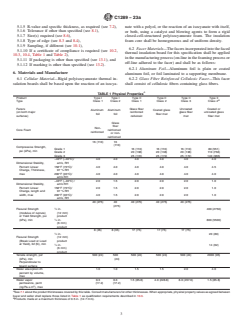
A
TABLE 1 Physical Properties
Product Type I Type I Type II Type II Type II Type II
B
Type Class 1 Class 2 Class 1 Class 2 Class 3 Class 4
Facers Glass fiber Uncoated Coated or
Aluminum Aluminum Coated glass
(on both major reinforced glass fiber uncoated glass
foil foil fiber mat
surfaces) cellulosic mat fiber mat
Glass
fiber
Non-
Core Foam reinforced
reinforced
or non-
reinforced
16 (110) 16
(110)
Compressive Strength,
Grade 1 16 (110) 16 (110) 16 (110) 80 (551)
psi (kPa), min
Grade 2 20 (138) 20 (138) 20 (138) 110 (758)
Grade 3 25 (172) 25 (172) 25 (172) 140 (965)
−40°F (−40°C)/ 4.0 4.0 4.0 4.0 4.0 4.0
Dimensional Stability, amb, RH
Percent Linear 158°F (70°C)/ 4.0 4.0 4.0 4.0 4.0 4.5
Change, Thickness, 97 % RH
max 200°F (93°C)/ 4.0 4.0 4.0 4.0 4.0 4.0
amb RH
−40°F (−40°C) / 2.0 1.5 2.0 2.0 2.0 1.0
Dimensional Stability, amb RH
Percent Linear 158°F (70°C)/ 2.0 1.5 2.0 2.0 2.0 1.0
Change, length and 97 % RH
width, max 200°F (93°C)/ 4.0 1.5 2.0 2.0 2.0 1.0
amb, RH
40 (275) 40 40 (275) 40 (275) 40 (275)
(275)
Flexural Strength ⁄2 in. 400 (2750)
(modulus of rupture) (12 mm)
or Yield Strength, psi product
(kPa), min ⁄4 in. 800 (5500)
(6 mm)
product
8 (35) 8 (35) 17 (75) 17 (75) 17 (75)
⁄2 in. 20 (89)
Flexural Strength (12 mm)
(Break Load or Load product
at Yield), lbf (N), min ⁄4 in. 14 (62)
(6 mm)
product
Tensile strength, psf 500 (24) 500 500 (24) 500 (24) 500 (24) 2000 (95)
(kPa), min (24)
Perpendicular to
board surface
Water absorption 2h 1.0 1.0 1.5 1.5 2.0 4.0
percent by volume,
max
Water vapor 0.3 0.3 1.5 (85.8) 4.0 (228.8) 8.0 (457.6) 1.5 (85.8)
permeance, perm (17.2) (17.2)
(ng/Pa·s·m ), max
A
See 7.1 about the product thicknesses covered by this table. Consult manufacturers for other thicknesses. When appropriate, physical property values as agreed between
buyer and seller shall replace those listed in Table 1 as qualification requirements described in 10.3.
B
Products made at a maximum thickness of 0.5 in. (12.7 mm).
C1289 − 23a
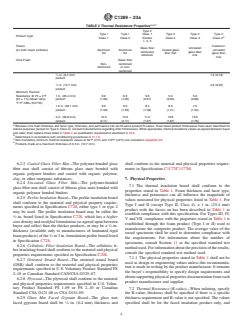
A,B,C
TABLE 2 Thermal Resistance Properties
Type II
Type I Type I Class 1 Type II Type II Type II
Product Type
D
Class 1 Class 2 Grades Class 2 Class 3 Class 4
1, 2, 3
Facers Coated or
Glass fiber Uncoated
(on both major surfaces) Aluminum Aluminum Coated glass uncoated
reinforced glass fiber
foil foil fiber mat glass fiber
cellulosic mat
mat
Core Foam Glass fiber
Non- reinforced
reinforced or non-
reinforced
⁄4 in. (6.4 mm) 1.0 (0.18)
product
⁄2 in. (12.7 mm) 2.0 (0.35)
product
Minimum Thermal
Resistance @ 75 ± 2°F 1 in. (25.4 mm) 6.0 6.0 5.6 5.3 5.0
(24 ± 1°C) Mean temp. product (1.06) (1.06) (0.97) (0.93) (0.88)
2 2
°F ft h/Btu (Km /W)
1.5 in. (38.1 mm) 9.0 9.0 8.4 8.0 7.5
product (1.59) (1.59) (1.48) (1.41) (1.32)
2 in. (50.8 mm) 12.0 12.0 11.2 10.6 10.0
product (2.11) (2.11) (1.97) (1.87) (1.76)
A
Because core foam thickness and facer type, thickness, and permeance can all influence product R-values, three faced product thicknesses have been described for
referee purposes (except for Type II, Class 4). Consult manufacturers regarding other thicknesses. When appropriate, thermal resistance values as agreed between buyer
and seller shall replace those listed in Table 2 as qualification requirements described in 10.3.
B
Determined in accordance with conditioning procedures in 11.1.2.
C
Non-mandatory minimum thermal resistance values at 40°F (4°C) and 110°F (43°C) are included in Appendix X2.
D
Products made at a maximum thickness of 0.5 in. (12.7 mm).
6.2.3 Coated Glass Fiber Mat—The polymer-bonded glass shall conform to the material and physical properties require-
fiber mat shall consist of fibrous glass mats bonded with ments in Specification C1177/C1177M.
organic polymer binders and coated with organic polymer,
clay, or other inorganic substances. 7. Physical Properties
6.2.4 Uncoated Glass Fiber Mat—The polymer-bonded
7.1 The thermal insulation board shall conform to the
glass fiber mat shall consist of fibrous glass mats bonded with
properties stated in Table 1. Foam thickness and facer type,
organic polymer bonded binders.
thickness and permeance can all influence the magnitude of
6.2.5 Perlite Insulation Board—The perlite insulation board
values measured for physical properties listed in Table 1. For
shall conform to the material and physical property require-
Type I and II (except Type II, Class 4), a 1 in. (25.4 mm)
ments specified in Specification C728, either type 1 or type 2
product with the facers on has been described in Table 1 to
may be used. The perlite insulation board may be either the
establish compliance with this specification. For Types III, IV,
⁄2-in. board listed in Specification C728, which has a higher
V and VII, compliance with the properties stated in Table 1 is
core density and modified formulation (as agreed upon between
established through the foam product (Type I or II) used to
buyer and seller) than the thicker products, or may be a ⁄2-in.
manufacture the composite product. The average value of the
thickness (available only to manufacturers of laminated rigid
tested specimens shall be used to determine compliance with
foam products) of the ⁄4 to 3 in. formulation perlite board listed
the requirements. For information about the number of
in Specification C728.
specimens, consult Section 11 or the specified standard test
6.2.6 Cellulosic Fiber Insulation Board—The cellulosic fi-
method used. For information about the precision of the results,
ber insulating board shall conform to the material and physical
consult the specified standard test method used.
properties requirements specified in Specification C208.
7.1.1 The physical properties stated in Table 1 shall not be
6.2.7 Oriented Strand Board—The oriented strand board
used as design or engineering values unless this recommenda-
(OSB) shall conform to the material and physical properties
tion is made in writing by the product manufacturer. It remains
requirements specified in U.S. Voluntary Product Standard PS
the buyer’s responsibility to specify design requirements and
2–10 or Canadian Standard CAN/CSA O325–07.
obtain supporting physical properties documentation from each
6.2.8 Plywood—The plywood shall conform to the material
product manufacturer and supplier.
and physical properties requirements specified in U.S. Volun-
tary Product Standard PS 1-09 or PS 2–10 or Canadian 7.2 Thermal Resistance (R-value)—When ordering, specify
Standard CSA O121-08 or CSA O151-09. the R-value; thickness shall be specified if there is a specific
6.2.9 Glass Mat Faced Gypsum Board—The glass mat thickness requirement and R-value is not specified. The values
faced gypsum board shall be ⁄4 in. (6.4 mm) thickness and specified shall be for the faced insulation product only, and
----------------------
...
This document is not an ASTM standard and is intended only to provide the user of an ASTM standard an indication of what changes have been made to the previous version. Because
it may not be technically possible to adequately depict all changes accurately, ASTM recommends that users consult prior editions as appropriate. In all cases only the current version
of the standard as published by ASTM is to be considered the official document.
Designation: C1289 − 23 C1289 − 23a
Standard Specification for
Faced Rigid Cellular Polyisocyanurate Thermal Insulation
Board
This standard is issued under the fixed designation C1289; the number immediately following the designation indicates the year of
original adoption or, in the case of revision, the year of last revision. A number in parentheses indicates the year of last reapproval. A
superscript epsilon (´) indicates an editorial change since the last revision or reapproval.
This standard has been approved for use by agencies of the U.S. Department of Defense.
1. Scope
1.1 This specification covers the general requirements for faced thermal insulation boards composed of rigid cellular
polyisocyanurate surfaced with other materials. The insulation boards are intended for use at temperatures between −40 and 200°F
(−40 and 93°C). This specification does not cover cryogenic applications. Consult the manufacturer for specific recommendations
and properties in cryogenic conditions. For specific applications, the actual temperature limits shall be agreed upon by the
manufacturer and the purchaser.
1.2 This standard is intended to apply to rigid cellular polyurethane-modified polyisocyanurate thermal insulation board products
that are commercially acceptable as non-structural panels useful in building construction. The term polyisocyanurate encompasses
the term polyurethane. For engineering and design purposes, users should follow specific product information provided by board
manufacturers regarding physical properties, system design considerations and installation recommendations.
NOTE 1—See Appendix X1 for guidance on determining wind pressure resistance of panels when required for wall sheathing applications.
1.3 The use of thermal insulation materials covered by this specification is typically regulated by building codes, or other agencies
that address fire performance. Where required, the fire performance of the material shall be addressed through standard fire test
methods established by the appropriate governing documents.
1.4 The values stated in inch-pound units are to be regarded as standard. The values given in parentheses are mathematical
conversions to SI units that are provided for information only and are not considered standard.
NOTE 2—For conversion to metric units other than those contained in this standard, refer to IEEE/ASTM SI 10.
1.5 This standard does not purport to address all of the safety concerns, if any, associated with its use. It is the responsibility
of the user of this standard to establish appropriate safety, health, and environmental practices and determine the applicability of
regulatory limitations prior to use.
1.6 This international standard was developed in accordance with internationally recognized principles on standardization
established in the Decision on Principles for the Development of International Standards, Guides and Recommendations issued
by the World Trade Organization Technical Barriers to Trade (TBT) Committee.
This specification is under the jurisdiction of ASTM Committee C16 on Thermal Insulation and is the direct responsibility of Subcommittee C16.22 on Organic and
Nonhomogeneous Inorganic Thermal Insulations.
Current edition approved May 1, 2023Sept. 1, 2023. Published May 2023October 2023. Originally approved in 1995. Last previous edition approved in 20222023 as
C1289 – 22a.C1289 – 23. DOI: 10.1520/C1289-23.10.1520/C1289-23A.
Copyright © ASTM International, 100 Barr Harbor Drive, PO Box C700, West Conshohocken, PA 19428-2959. United States
C1289 − 23a
2. Referenced Documents
2.1 The following documents, of the issue in effect on the date of material purchase, form a part of this specification to the extent
specified herein:
2.2 ASTM Standards:
C168 Terminology Relating to Thermal Insulation
C177 Test Method for Steady-State Heat Flux Measurements and Thermal Transmission Properties by Means of the
Guarded-Hot-Plate Apparatus
C203 Test Methods for Breaking Load and Flexural Properties of Block-Type Thermal Insulation
C208 Specification for Cellulosic Fiber Insulating Board
C209 Test Methods for Cellulosic Fiber Insulating Board
C303 Test Method for Dimensions and Density of Preformed Block and Board–Type Thermal Insulation
C390 Practice for Sampling and Acceptance of Thermal Insulation Lots
C518 Test Method for Steady-State Thermal Transmission Properties by Means of the Heat Flow Meter Apparatus
C550 Test Method for Measuring Trueness and Squareness of Rigid Block and Board Thermal Insulation
C728 Specification for Perlite Thermal Insulation Board
C1045 Practice for Calculating Thermal Transmission Properties Under Steady-State Conditions
C1058/C1058M Practice for Selecting Temperatures for Evaluating and Reporting Thermal Properties of Thermal Insulation
C1114 Test Method for Steady-State Thermal Transmission Properties by Means of the Thin-Heater Apparatus
C1177/C1177M Specification for Glass Mat Gypsum Substrate for Use as Sheathing
C1303/C1303M Test Method for Predicting Long-Term Thermal Resistance of Closed-Cell Foam Insulation
C1363 Test Method for Thermal Performance of Building Materials and Envelope Assemblies by Means of a Hot Box Apparatus
C1763 Test Method for Water Absorption by Immersion of Thermal Insulation Materials
D1621 Test Method for Compressive Properties of Rigid Cellular Plastics
D1623 Test Method for Tensile and Tensile Adhesion Properties of Rigid Cellular Plastics
D2126 Test Method for Response of Rigid Cellular Plastics to Thermal and Humid Aging
E84 Test Method for Surface Burning Characteristics of Building Materials
E96/E96M Test Methods for Gravimetric Determination of Water Vapor Transmission Rate of Materials
IEEE/ASTM SI 10 Standard for Use of the International System of Units (SI): (The Modernized Metric System)
2.3 Voluntary Product Standard:
Voluntary Product Standard PS 1–09 Structural Plywood
Voluntary Product Standard PS 2–10 Performance Standard for Wood Based Structural Use Panels
2.4 CAN/ULC Standard:
CAN/ULC-S770-09 Standard Test Method for Determination of Long-Term Thermal Resistance of Closed-Cell Thermal
Insulating Foams
2.5 CAN/CSA and CSA Standards:
CAN/CSA O325-07 (R2012) – Construction Sheathing
CSA O121-08 (R2013) Douglas Fir Plywood
CSA O151-09 Canadian Softwood Plywood
2.6 ASHRAE Standards:
ASHRAE Handbook Fundamentals
3. Terminology
3.1 For complete descriptions of terms used in this specification, refer to Terminology C168.
3.2 The term polyisocyanurate encompasses the term polyurethane (see 1.2).
For referenced ASTM standards, visit the ASTM website, www.astm.org, or contact ASTM Customer Service at service@astm.org. For Annual Book of ASTM Standards
volume information, refer to the standard’s Document Summary page on the ASTM website.
United States Department of Commerce, National Institute of Standards and Technology, Available from Superintendent of Documents, U.S. Government Printing Office,
Washington, DC 20402.
Available from Underwriters Laboratories (UL), 2600 N.W. Lake Rd., Camas, WA 98607-8542, http://www.ul.com.
CSA Group, 178 Rexdale Blvd., Toronto, ON, Canada M9W 1R3, http://www.csagroup.org/ca.
Available from American Society of Heating, Refrigerating, and Air-Conditioning Engineers, Inc. (ASHRAE), 1791 Tullie Circle, NE, Atlanta, GA 30329,
http://www.ashrae.org.
C1289 − 23a
4. Classification
4.1 The faced thermal insulation boards composed of rigid cellular polyisocyanurate covered by this specification are classified
as follows:
4.1.1 Type I—Faced with aluminum foil on both major surfaces of the core foam.
4.1.1.1 Class 1—Non-reinforced core foam.
4.1.1.2 Class 2—Glass fiber reinforced or non-reinforced core foam.
4.1.2 Type II—Faced with either cellulosic facers or glass fiber mat facers on both major surfaces of the core foam.
4.1.2.1 Class 1—Faced with glass fiber reinforced cellulosic facers on both major surfaces of the core foam.
(1) Grade 1—16 psi (110 kPa), min, compressive strength.
(2) Grade 2—20 psi (138 kPa), min, compressive strength.
(3) Grade 3—25 psi (172 kPa), min, compressive strength.
4.1.2.2 Class 2—Faced with coated glass fiber mat facers on both major surfaces of the core foam.
(1) Grade 1—16 psi (110 kPa), min, compressive strength.
(2) Grade 2—20 psi (138 kPa), min, compressive strength.
(3) Grade 3—25 psi (172 kPa), min, compressive strength.
4.1.2.3 Class 3—Faced with uncoated glass fiber mat facers on both major surfaces of the core foam.
(1) Grade 1—16 psi (110 kPa), min, compressive strength.
(2) Grade 2—20 psi (138 kPa), min, compressive strength.
(3) Grade 3—25 psi (172 kPa), min, compressive strength.
4.1.2.4 Class 4—Faced with coated or uncoated glass fiber mat facers on both major surfaces of the core foam. This product is
used at a maximum thickness of ⁄2 in. (12.7 mm).
(1) Grade 1—80 psi (551 kPa), min, compressive strength
(2) Grade 2—110 psi (758 kPa), min, compressive strength
(3) Grade 3—140 psi (965 kPa), min, compressive strength
4.1.3 Type III—Faced with a perlite insulation board on one major surface of the core foam and faced on the other major surface
with any facer described in this specification.
4.1.4 Type IV—Faced with a cellulosic fiber insulating board on one major surface of the core foam and faced on the other major
surface with any facer described in this specification.
4.1.5 Type V—Faced with oriented strand board (OSB) or plywood on one major surface of the core foam and faced on the other
major surface with any facer described in this specification.
4.1.6 Type VII—Faced with glass mat faced gypsum board on one major surface of the core foam and faced on the other major
surface with any facer described in this specification.
NOTE 3—These general statements refer to generic composition descriptions of facer materials that are currently commercially accepted in the marketplace
for these products, using terms common to these competing products.
5. Ordering Information
5.1 Orders shall include the following information:
5.1.1 Title, designation, and year of issue of C1289,
5.1.2 Quantity of material being ordered,
5.1.3 Product name and manufacturer’s name, address, and telephone number,
C1289 − 23a
5.1.4 Type or Class, or both, if Type 1; type, class, and grade or type and class, if Type II, (see Section 4),
5.1.5 R-value and specific thickness, as required (see 7.2),
5.1.6 Tolerance if other than specified (see 8.1),
5.1.7 Size(s) required (see 8.6),
5.1.8 Type of edge (see 8.3 and 8.4),
5.1.9 Sampling, if different (see 10.1),
5.1.10 If a certificate of compliance is required (see 10.2, 10.3, 10.4, Table 1 and Table 2),
5.1.11 If packaging is other than specified (see 13.1), and
5.1.12 If marking is other than specified (see 13.2).
6. Materials and Manufacture
6.1 Cellular Material—Rigid polyisocyanurate thermal insulation boards shall be based upon the reaction of an isocyanate with
a polyol, or the reaction of an isocyanate with itself, or both, using a catalyst and blowing agents to form a rigid
closed-cell-structured polyisocyanurate foam. The insulation foam core shall be homogeneous and of uniform density.
6.2 Facer Materials—The facers incorporated into the faced thermal insulation board for this specification shall be applied in the
manufacturing process (on-line in the foaming process or off-line adhered to the facer) and shall be as follows:
6.2.1 Aluminum Foil—Aluminum foil is plain or coated aluminum foil, or foil laminated to a supporting membrane.
6.2.2 Glass Fiber Reinforced Cellulosic Facer—This facer shall consist of cellulosic fibers containing glass fibers.
6.2.3 Coated Glass Fiber Mat—The polymer-bonded glass fiber mat shall consist of fibrous glass mats bonded with organic
polymer binders and coated with organic polymer, clay, or other inorganic substances.
6.2.4 Uncoated Glass Fiber Mat—The polymer-bonded glass fiber mat shall consist of fibrous glass mats bonded with organic
polymer bonded binders.
6.2.5 Perlite Insulation Board—The perlite insulation board shall conform to the material and physical property requirements
specified in Specification C728, either type 1 or type 2 may be used. The perlite insulation board may be either the ⁄2-in. board
listed in Specification C728, which has a higher core density and modified formulation (as agreed upon between buyer and seller)
than the thicker products, or may be a ⁄2-in. thickness (available only to manufacturers of laminated rigid foam products) of the
⁄4 to 3 in. formulation perlite board listed in Specification C728.
6.2.6 Cellulosic Fiber Insulation Board—The cellulosic fiber insulating board shall conform to the material and physical
properties requirements specified in Specification C208.
6.2.7 Oriented Strand Board—The oriented strand board (OSB) shall conform to the material and physical properties requirements
specified in U.S. Voluntary Product Standard PS 2–10 or Canadian Standard CAN/CSA O325–07.
6.2.8 Plywood—The plywood shall conform to the material and physical properties requirements specified in U.S. Voluntary
Product Standard PS 1-09 or PS 2–10 or Canadian Standard CSA O121-08 or CSA O151-09.
6.2.9 Glass Mat Faced Gypsum Board—The glass mat faced gypsum board shall be ⁄4 in. (6.4 mm) thickness and shall conform
to the material and physical properties requirements in Specification C1177/C1177M.
C1289 − 23a
A
TABLE 1 Physical Properties
Product Type I Type I Type II Type II Type II Type II
B
Type Class 1 Class 2 Class 1 Class 2 Class 3 Class 4
Facers Glass fiber Uncoated Coated or
Aluminum Aluminum Coated glass
(on both major reinforced glass fiber uncoated glass
foil foil fiber mat
surfaces) cellulosic mat fiber mat
Glass
fiber
Non-
Core Foam reinforced
reinforced
or non-
reinforced
16 (110) 16
(110)
Compressive Strength,
Grade 1 16 (110) 16 (110) 16 (110) 80 (551)
psi (kPa), min
Grade 2 20 (138) 20 (138) 20 (138) 110 (758)
Grade 3 25 (172) 25 (172) 25 (172) 140 (965)
−40°F (−40°C)/ 4.0 4.0 4.0 4.0 4.0 4.0
Dimensional Stability, amb, RH
Percent Linear 158°F (70°C)/ 4.0 4.0 4.0 4.0 4.0 4.5
Change, Thickness, 97 % RH
max 200°F (93°C)/ 4.0 4.0 4.0 4.0 4.0 4.0
amb RH
−40°F (−40°C) / 2.0 1.5 2.0 2.0 2.0 1.0
Dimensional Stability, amb RH
Percent Linear 158°F (70°C)/ 2.0 1.5 2.0 2.0 2.0 1.0
Change, length and 97 % RH
width, max 200°F (93°C)/ 4.0 1.5 2.0 2.0 2.0 1.0
amb, RH
40 (275) 40 40 (275) 40 (275) 40 (275)
(275)
Flexural Strength ⁄2 in. 400 (2750)
(modulus of rupture) (12 mm)
or Yield Strength, psi product
(kPa), min ⁄4 in. 800 (5500)
(6 mm)
product
8 (35) 8 (35) 17 (75) 17 (75) 17 (75)
⁄2 in. 20 (89)
Flexural Strength (12 mm)
(Break Load or Load product
at Yield), lbf (N), min ⁄4 in. 14 (62)
(6 mm)
product
Tensile strength, psf 500 (24) 500 500 (24) 500 (24) 500 (24) 2000 (95)
(kPa), min (24)
Perpendicular to
board surface
Water absorption 2h 1.0 1.0 1.5 1.5 2.0 4.0
percent by volume,
max
Water vapor 0.3 0.3 1.5 (85.8) 4.0 (228.8) 8.0 (457.6) 1.5 (85.8)
permeance, perm (17.2) (17.2)
(ng/Pa·s·m ), max
A
See 7.1 about the product thicknesses covered by this table. Consult manufacturers for other thicknesses. When appropriate, physical property values as agreed between
buyer and seller shall replace those listed in Table 1 as qualification requirements described in 10.3.
B
Products made at a maximum thickness of 0.5 in. (12.7 mm).
7. Physical Properties
7.1 The thermal insulation board shall conform to the properties stated in Table 1. Foam thickness and facer type, thickness and
permeance can all influence the magnitude of values measured for physical properties listed in Table 1. For Type I and II (except
Type II, Class 4), a 1 in. (25.4 mm) product with the facers on has been described in Table 1 to establish compliance with this
specification. For Types III, IV, V and VII, compliance with the properties stated in Table 1 is established through the foam product
(Type I or II) used to manufacture the composite product. The average value of the tested specimens shall be used to determine
compliance with the requirements. For information about the number of specimens, consult Section 11 or the specified standard
test method used. For information about the precision of the results, consult the specified standard test method used.
7.1.1 The physical properties stated in Table 1 shall not be used as design or engineering values unless this recommendation is
C1289 − 23a
A,B,C
TABLE 2 Thermal Resistance Properties
Type II
Type I Type I Class 1 Type II Type II Type II
Product Type
D
Class 1 Class 2 Grades Class 2 Class 3 Class 4
1, 2, 3
Facers Coated or
Glass fiber Uncoated
(on both major surfaces) Aluminum Aluminum Coated glass uncoated
reinforced glass fiber
foil foil fiber mat glass fiber
cellulosic mat
mat
Core Foam Glass fiber
Non- reinforced
reinforced or non-
reinforced
⁄4 in. (6.4 mm) 1.0 (0.18)
product
⁄2 in. (12.7 mm) 2.0 (0.35)
product
Minimum Thermal
Resistance @ 75 ± 2°F 1 in. (25.4 mm) 6.0 6.0 5.6 5.3 5.0
(24 ± 1°C) Mean temp. product (1.06) (1.06) (0.97) (0.93) (0.88)
2 2
°F ft h/Btu (Km /W)
1.5 in. (38.1 mm) 9.0 9.0 8.4 8.0 7.5
product (1.59) (1.59) (1.48) (1.41) (1.32)
2 in. (50.8 mm) 12.0 12.0 11.2 10.6 10.0
product (2.11) (2.11) (1.97) (1.87) (1.76)
A
Because core foam thickness and facer type, thickness, and permeance can all influence product R-values, three faced product thicknesses have been described for
referee purposes (except for Type II, Class 4). Consult manufacturers regarding other thicknesses. When appropriate, thermal resistance values as agreed between buyer
and seller shall replace those listed in Table 2 as qualification requirements described in 10.3.
B
Determined in accordance with conditioning procedures in 11.1.2.
C
Non-mandatory minimum thermal resistance values at 40°F (4°C) and 110°F (43°C) are included in Appendix X2.
D
Products made at a maximum thickness of 0.5 in. (12.7 mm).
made in writing by the product manufacturer. It remains the buyer’s responsibility to specify design requirements and obtain
supporting physical properties documentation from each product manufacturer and supplier.
7.2 Thermal Resistance (R-value)—When ordering, specify the R-value; thickness shall be specified if there is a specific thic
...