


ASTM D5588-97(2017)
(Test Method)Standard Test Method for Determination of the Microbial Condition of Paint, Paint Raw Materials, and Plant Areas
Standard Test Method for Determination of the Microbial Condition of Paint, Paint Raw Materials, and Plant Areas
SIGNIFICANCE AND USE
3.1 Spoilage of paint in the container is often related to the use of contaminated raw materials, water (particularly recycled washwater), vessels, piping, and equipment in the manufacturing plant. There is a need for a simple method to determine the presence or absence of microorganisms in plants that manufacture paints and coatings. Such a determination enables the manufacturer to establish the point of contamination (that is, raw materials or problem housekeeping areas in the plant) to help in solving the spoilage problem.
Note 1: Some contamination in plant areas is to be expected, since microorganisms are ubiquitous and cannot generally be eliminated practically (it is what an in-can preservative is supposed to control). Excessive levels of contamination or contaminated raw materials can exceed the capability of the preservative. If you have excessive contamination in the plant, there are methods for decontamination including steam, preservatives, bleach, etc. These should be discussed with your biocide supplier and used with care. Recovery of spoiled or contaminated products is often not feasible, so an adequate level of the appropriate biocide in conjunction with good plant housekeeping practices are essential. Your biocide supplier can also help here.
3.2 This test method may be used by persons without basic microbiological training, but some training on aseptic techniques would be recommended.
Note 2: The reliability of the results obtained from this test method is extremely dependent on the techniques employed. Improper techniques can result in a sterile sample appearing to be contaminated, and even worse, a contaminated sample appearing to be sterile (see also 5.1). It is recommended that you consult with your biocide supplier, raw material supplier, or an independent testing laboratory to confirm questionable results.
SCOPE
1.1 This test method covers a procedure for the determination of the microbial condition (contamination or sterility) of raw materials used in the manufacture of paint, and the microbial condition of paint and paint manufacturing areas.
1.2 The values in SI units are to be regarded as the standard. The values given in parentheses are for information only.
1.3 This standard does not purport to address all of the safety concerns, if any, associated with its use. It is the responsibility of the user of this standard to establish appropriate safety and health practices and determine the applicability of regulatory limitations prior to use.
1.4 This international standard was developed in accordance with internationally recognized principles on standardization established in the Decision on Principles for the Development of International Standards, Guides and Recommendations issued by the World Trade Organization Technical Barriers to Trade (TBT) Committee.
General Information
Buy Standard
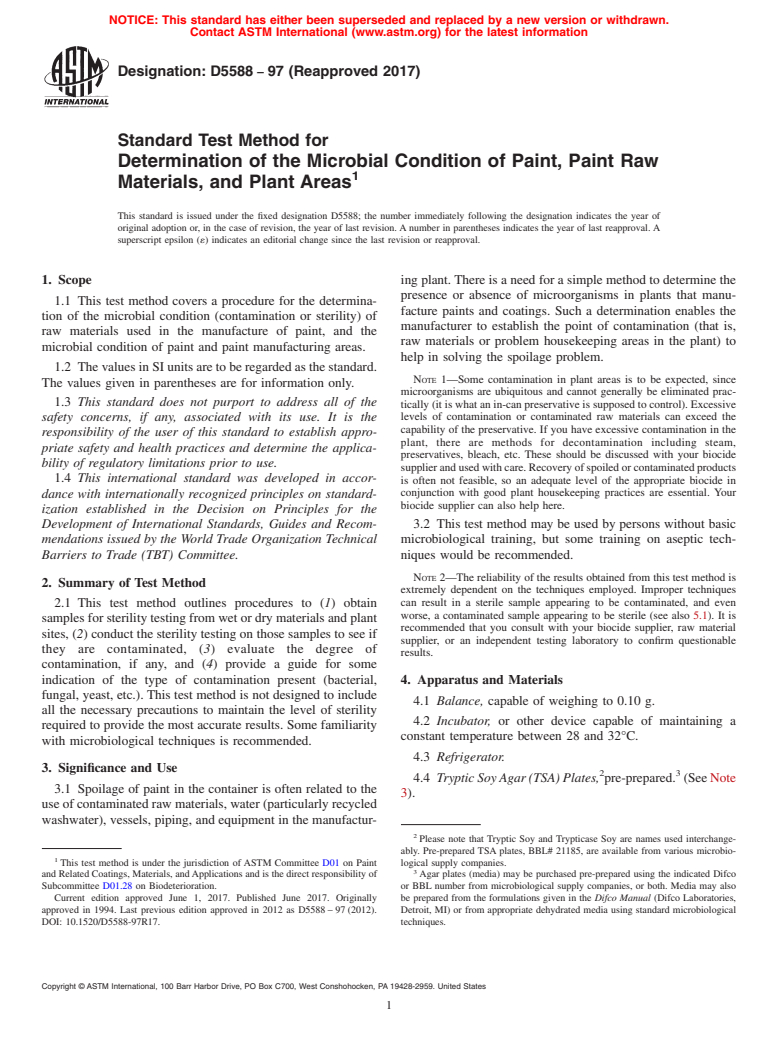
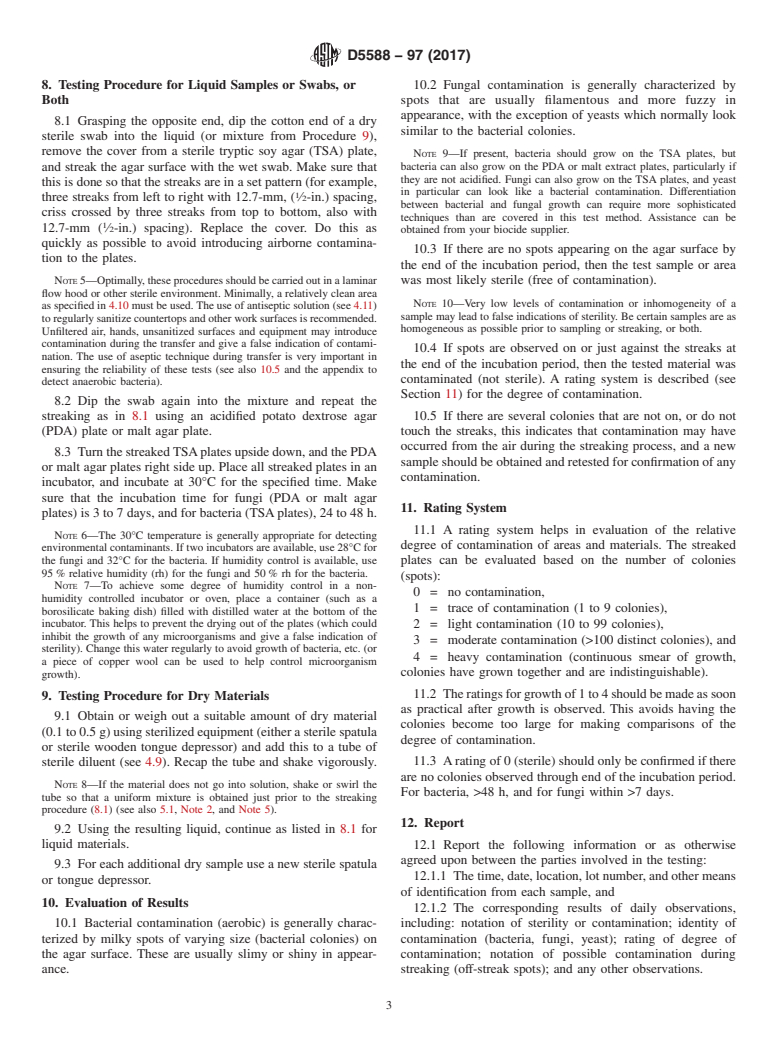
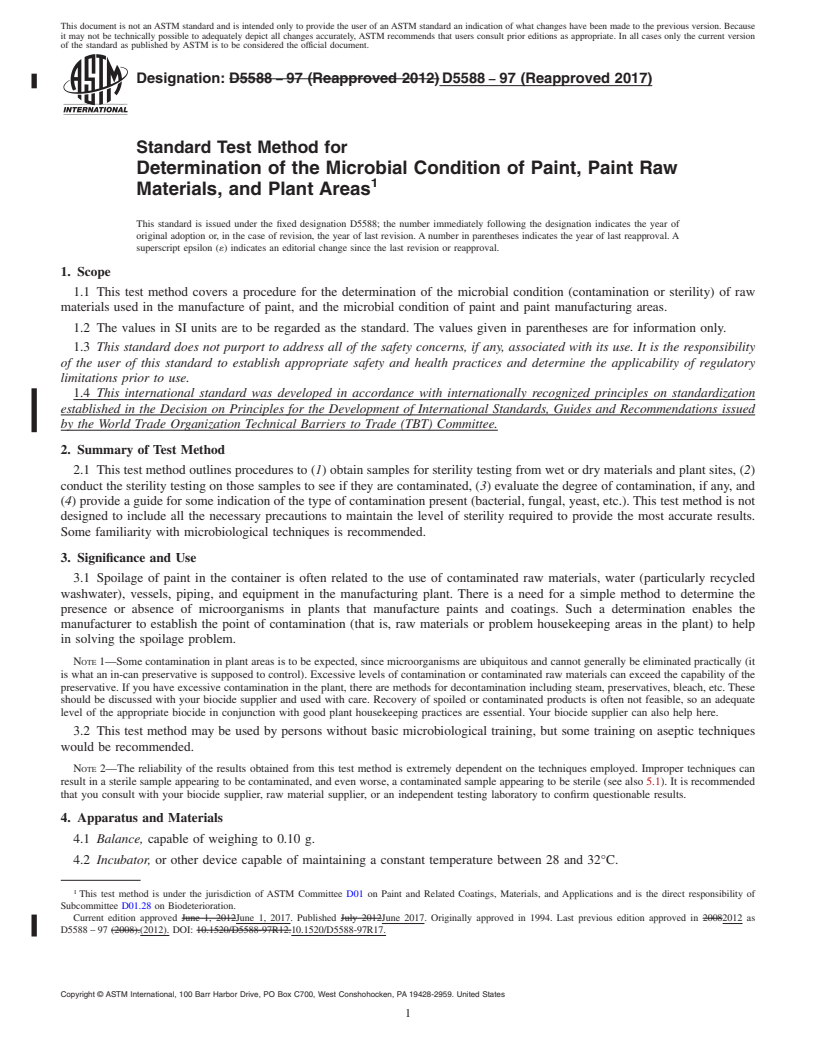
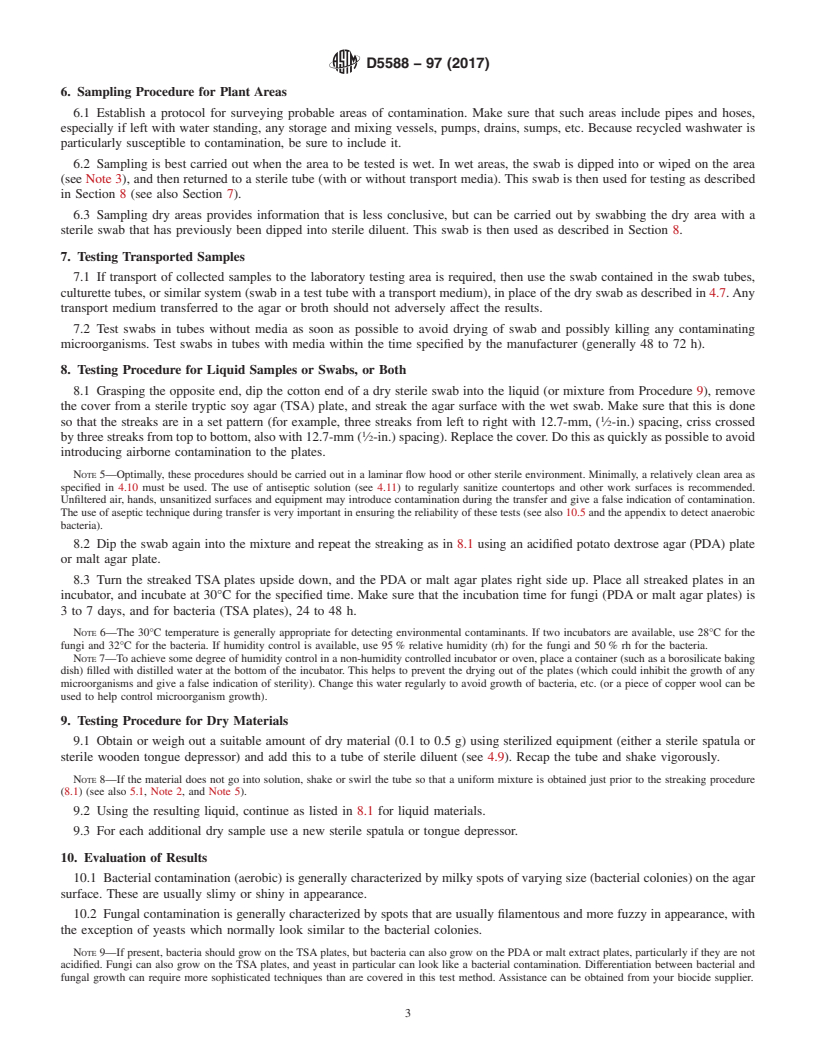
Standards Content (Sample)
NOTICE: This standard has either been superseded and replaced by a new version or withdrawn.
Contact ASTM International (www.astm.org) for the latest information
Designation: D5588 − 97 (Reapproved 2017)
Standard Test Method for
Determination of the Microbial Condition of Paint, Paint Raw
Materials, and Plant Areas
This standard is issued under the fixed designation D5588; the number immediately following the designation indicates the year of
original adoption or, in the case of revision, the year of last revision. A number in parentheses indicates the year of last reapproval. A
superscript epsilon (´) indicates an editorial change since the last revision or reapproval.
1. Scope ing plant. There is a need for a simple method to determine the
presence or absence of microorganisms in plants that manu-
1.1 This test method covers a procedure for the determina-
facture paints and coatings. Such a determination enables the
tion of the microbial condition (contamination or sterility) of
manufacturer to establish the point of contamination (that is,
raw materials used in the manufacture of paint, and the
raw materials or problem housekeeping areas in the plant) to
microbial condition of paint and paint manufacturing areas.
help in solving the spoilage problem.
1.2 The values in SI units are to be regarded as the standard.
NOTE 1—Some contamination in plant areas is to be expected, since
The values given in parentheses are for information only.
microorganisms are ubiquitous and cannot generally be eliminated prac-
1.3 This standard does not purport to address all of the
tically (it is what an in-can preservative is supposed to control). Excessive
levels of contamination or contaminated raw materials can exceed the
safety concerns, if any, associated with its use. It is the
capability of the preservative. If you have excessive contamination in the
responsibility of the user of this standard to establish appro-
plant, there are methods for decontamination including steam,
priate safety and health practices and determine the applica-
preservatives, bleach, etc. These should be discussed with your biocide
bility of regulatory limitations prior to use.
supplierandusedwithcare.Recoveryofspoiledorcontaminatedproducts
1.4 This international standard was developed in accor-
is often not feasible, so an adequate level of the appropriate biocide in
conjunction with good plant housekeeping practices are essential. Your
dance with internationally recognized principles on standard-
biocide supplier can also help here.
ization established in the Decision on Principles for the
Development of International Standards, Guides and Recom- 3.2 This test method may be used by persons without basic
mendations issued by the World Trade Organization Technical microbiological training, but some training on aseptic tech-
Barriers to Trade (TBT) Committee. niques would be recommended.
NOTE 2—The reliability of the results obtained from this test method is
2. Summary of Test Method
extremely dependent on the techniques employed. Improper techniques
can result in a sterile sample appearing to be contaminated, and even
2.1 This test method outlines procedures to (1) obtain
worse, a contaminated sample appearing to be sterile (see also 5.1). It is
samples for sterility testing from wet or dry materials and plant
recommended that you consult with your biocide supplier, raw material
sites, (2) conduct the sterility testing on those samples to see if
supplier, or an independent testing laboratory to confirm questionable
they are contaminated, (3) evaluate the degree of
results.
contamination, if any, and (4) provide a guide for some
indication of the type of contamination present (bacterial, 4. Apparatus and Materials
fungal, yeast, etc.). This test method is not designed to include
4.1 Balance, capable of weighing to 0.10 g.
all the necessary precautions to maintain the level of sterility
4.2 Incubator, or other device capable of maintaining a
required to provide the most accurate results. Some familiarity
constant temperature between 28 and 32°C.
with microbiological techniques is recommended.
4.3 Refrigerator.
3. Significance and Use
2 3
4.4 TrypticSoyAgar(TSA)Plates, pre-prepared. (SeeNote
3.1 Spoilage of paint in the container is often related to the
3).
use of contaminated raw materials, water (particularly recycled
washwater), vessels, piping, and equipment in the manufactur-
Please note that Tryptic Soy and Trypticase Soy are names used interchange-
ably. Pre-prepared TSA plates, BBL# 21185, are available from various microbio-
This test method is under the jurisdiction of ASTM Committee D01 on Paint logical supply companies.
and Related Coatings, Materials, andApplications and is the direct responsibility of Agar plates (media) may be purchased pre-prepared using the indicated Difco
Subcommittee D01.28 on Biodeterioration. or BBL number from microbiological supply companies, or both. Media may also
Current edition approved June 1, 2017. Published June 2017. Originally be prepared from the formulations given in the Difco Manual (Difco Laboratories,
approved in 1994. Last previous edition approved in 2012 as D5588 – 97 (2012). Detroit, MI) or from appropriate dehydrated media using standard microbiological
DOI: 10.1520/D5588-97R17. techniques.
Copyright © ASTM International, 100 Barr Harbor Drive, PO Box C700, West Conshohocken, PA 19428-2959. United States
D5588 − 97 (2017)
4.5 Potato Dextrose Agar (PDA) Plates, or Malt Agar 5.4 Liquid materials may be sampled as outlined in Section
Plates, acidified to pH 3.5 with lactic acid, pre-prepared. 6. Alternately, a sterilized container may be used to transport
the liquid sample to the sterile testing area. Be sure that no
NOTE 3—If preparing plates, Tryptic Soy Agar media with TTC
non-sterile items contact the liquid sample during sampling,
(triphenyltetrazolium chloride) indicator dye may also be used. In general,
the TTC helps visualize contamination, but it has been reported on handling, and movement to the testing area (for example, use
occasion to inhibit the growth of some bacteria. Interferences from
sterile pipet, etc. for transfer of material to container, etc.).
pigments in materials being tested may make the color change difficult to
see. If self-prepared plates are used with the TTC indicator, 0.01 % TTC 5.5 Dry materials may be sampled as in 6.3 or 9.1.To
indicator should be used and it must be added after autoclaving.
sample unopened, dry raw materials in bags, wipe a large area
of the outside of the bag clean with a clean rag or paper towel.
4.6 Lactic Acid.
Using a clean knife, cut open the bag within the cleaned area.
4.7 Sterile Swabs in tubes, pre-prepared.
Sample as in 9.1, or using a sterile tongue depressor or sterile
4.8 SwabTubes,CulturetteTubes, or a similar system (swab
spatula, scoop 10 to 15 g into a sterile plastic bag, close and
in a test tube with a transport medium) , all sterile, pre-
seal bag for transport to sterile testing area.
prepared can be used if transport of collected samples to the
NOTE 4—To decrease the chances of inadvertent contamination, a
laboratory testing area is required.
suggestion would be to carefully wipe the area of the bag to be cut, and
4.9 Sterile Diluent (9 mL) in tubes, pre-prepared (0.85 %
the knife used for cutting it, with isopropyl alcohol. Warning: Exercise
saline or other suitable diluent). These can be prepared from
care to avoid skin contact, since the isopropyl alcohol could carry
hazardous materials through the skin. Also, avoid excess alcohol that
sterile tubes and sterile saline solution then stored in a
could affect test results.
refrigerator.
5.6 When testing open containers of raw materials, vats,
4.10 Laminar Flow Hood, Sterile Room, or at least a
drums, etc., there is no need to sterile equipment surfaces (see
laboratory testing area that is relatively clean, free of blowing
Section 6). However, be aware that any contamination ob-
dust and dirt, etc., which can be used for streaking plates.
served may have been introduced after opening. Samples taken
4.11 Antiseptic Solution, to help maintain sterility of testing
from equipment surfaces that show contamination do not
area surfaces (4.10) (For example, 70 % ethanol solution.).
necessarily mean that the material contained or being manu-
4.12 Plastic or Rubber Laboratory Gloves, optional, steril-
factured inside is also contaminated.
ized.
6. Sampling Procedure for Plant Areas
4.13 Facial Mask, optional.
4.14 Sterile Spatulas or Sterile Tongue Depressors, 150-
6.1 Establish a protocol for surveying probable areas of
mm, (6-in.) individually wrapped. contamination. Make sure that such areas include pipes and
hoses, especially if left with water standing, any storage and
4.15 Plastic Bag, sterile.
mixing vessels, pumps, drains, sumps, etc. Because recycled
washwater is particularly susceptible to contamination, be sure
5. General Sampling Guidelines
to include it.
5.1 Take all reasonable precautions to avoid microbial
contamination while obtaining samples. You may choose to
6.2 Sampling is best carried out when the area to be tested
wear a facial mask and sterilized gloves. (Warning—Do not
is wet. In wet areas, the swab is dipped into or wiped on the
touch the swab anywhere near the cotton tip, or near parts of
area (see Note 3), and then returned to a sterile tube (with or
the swab which could be immersed in the test sample.
without transport media). This swab is then used for testing as
Microorganisms from the skin, clothing, and even air if
described in Section 8 (see also Section 7).
exposed too long, can contaminate the sample. If the swab has
6.3 Sampling dry areas provides information that is less
a cap, do not touch any part of the swab except that cap.
conclusive, but can be carried out by swabbing the dry area
Confirm suspicious results with additional testing.)
with a sterile swab that has previously been dipped into sterile
5.2 Use a new sterile swab, tongue depressor or spatula for
diluent. This swab is then used as described in Section 8.
each sample. Do not reuse any sampling devices. If using
gloves, dispose after use.
7. Testing Transported Samples
5.3 When taking samples, be sure to minimize the time
7.1 Iftransportofcollectedsamplestothelaboratorytesting
sterile items are exposed to the air to avoid false contamination
area is required, then use the swab contained in the swab tubes,
results.
culturette tubes, or similar system (swab in a test tube with a
transportmedium),inplaceofthedryswabasdescribedin4.7.
Any transport medium transferred to the agar or broth should
Pre-prepared plates available are Difco # 4360-22-0, or BBL # 96272. These
pre-prepared plates are not acidified to pH 3.5, but may be used (see also Footnote
not adversely affect the results.
3).
Pre-prepared plates available are Difco # 4265-22-6. These are not acidified,
7.2 Test swabs in tubes without media as soon as possible to
but may be used (see also Footnote 3).
avoid drying of swab and possibly killing any contaminating
Available from microbiological supply companies. Swab tubes or culturette
microorganisms. Test swabs in tubes with media within the
tubes 9345 with Amies medium were used.
Sterile plastic packs are available from microbiological supply companies. time specified by the manufacturer (generally 48 to 72 h).
D5588 − 97 (2017)
8. Testing Procedure for Liquid Samples or Swabs, or 10.2 Fungal contamination is generally characterized by
Both spots that are usually filamentous and more fuzzy in
appearance, with the exception of yeasts which normally look
8.1 Grasping the opposite end, dip the cotton end of a dry
similar to the bacterial colonies.
sterile swab into the liquid (or mixture from Procedure 9),
remove the cover from a sterile tryptic soy agar (TSA) plate,
NOTE 9—If present, bacteria should grow on the TSA plates, but
bacteria can also grow on the PDA or malt extract plates, particularly if
and streak the agar surface with the wet swab. Make sure that
they are not acidified. Fungi can also grow on the TSA plates, and yeast
this is done so that the streaks are in a set pattern (for example,
in particular can look like a bacterial contamination. Differentiation
three streaks from left to right with 12.7-mm, ( ⁄2-in.) spacing,
between bacterial and fungal growth can require more sophisticated
criss crossed by three streaks from top to bottom, also with
techniques than are covered in this test method. Assistance can be
12.7-mm ( ⁄2-in.) spacing). Replace the cover. Do this as
obtained from your biocide supplier.
quickly as possible to avoid introducing airborne contamina-
10.3 If there are no spots appearing on the agar surface by
tion to the plates.
the end of the incubation period, then the test sample or area
NOTE5—Optimally,theseproceduresshouldbecarriedoutinalaminar was most likely sterile (free of contamination).
flow hood or other sterile environment. Minimally, a relatively clean area
NOTE 10—Very low levels of contamination or inhomogeneity of a
as specified in 4.10 must be used. The use of antiseptic solution (see 4.11)
sample may lead to false indications of sterility. Be certain samples are as
toregularlysanitizecountertopsandotherworksurfacesisrecommended.
homogeneous as possible prior to sampling or streaking, or both.
Unfiltered air, hands, unsanitized surfaces and equipment may introduce
contamination during the transfer and give a false indication of contami-
10.4 If spots are observed on or just against the streaks at
nation. The use of aseptic technique during transfer is very important in
the end of the incubation period, then the tested material was
ensuring the reliability of these tests (see also 10.5 and the appendix to
contaminated (not sterile). A rating system is described (see
detect anaerobic bacteria).
Section 11) for the degree of contamination.
8.2 Dip the swab again into the mixture and repeat the
streaking as in 8.1 using an acidified potato dextrose agar 10.5 If there are several colonies that are not on, or do not
(PDA) plate or malt agar plate. touch the streaks, this indicates that contamination may have
occurred from the air during the streaking process, and a new
8.3 Turn the streakedTSAplates upside down, and the PDA
sample should be obtained and retested for confirmation of any
or malt agar plates right side up. Place all streaked plates in an
contamination.
incubator, and incubate at 30°C for the specified time. Make
sure that the incubation time for fungi (PDA or malt agar
11. Rating System
plates) is 3 to 7 days, and for bacteria (TSAplates), 24 to 48 h.
11.1 A rating system helps in evaluation of the relative
NOTE 6—The 30°C temperature is generally appropriate for detecting
degree of contamination of areas and materials. The streaked
environmental contaminants. If two incubators are available, us
...
This document is not an ASTM standard and is intended only to provide the user of an ASTM standard an indication of what changes have been made to the previous version. Because
it may not be technically possible to adequately depict all changes accurately, ASTM recommends that users consult prior editions as appropriate. In all cases only the current version
of the standard as published by ASTM is to be considered the official document.
Designation: D5588 − 97 (Reapproved 2012) D5588 − 97 (Reapproved 2017)
Standard Test Method for
Determination of the Microbial Condition of Paint, Paint Raw
Materials, and Plant Areas
This standard is issued under the fixed designation D5588; the number immediately following the designation indicates the year of
original adoption or, in the case of revision, the year of last revision. A number in parentheses indicates the year of last reapproval. A
superscript epsilon (´) indicates an editorial change since the last revision or reapproval.
1. Scope
1.1 This test method covers a procedure for the determination of the microbial condition (contamination or sterility) of raw
materials used in the manufacture of paint, and the microbial condition of paint and paint manufacturing areas.
1.2 The values in SI units are to be regarded as the standard. The values given in parentheses are for information only.
1.3 This standard does not purport to address all of the safety concerns, if any, associated with its use. It is the responsibility
of the user of this standard to establish appropriate safety and health practices and determine the applicability of regulatory
limitations prior to use.
1.4 This international standard was developed in accordance with internationally recognized principles on standardization
established in the Decision on Principles for the Development of International Standards, Guides and Recommendations issued
by the World Trade Organization Technical Barriers to Trade (TBT) Committee.
2. Summary of Test Method
2.1 This test method outlines procedures to (1) obtain samples for sterility testing from wet or dry materials and plant sites, (2)
conduct the sterility testing on those samples to see if they are contaminated, (3) evaluate the degree of contamination, if any, and
(4) provide a guide for some indication of the type of contamination present (bacterial, fungal, yeast, etc.). This test method is not
designed to include all the necessary precautions to maintain the level of sterility required to provide the most accurate results.
Some familiarity with microbiological techniques is recommended.
3. Significance and Use
3.1 Spoilage of paint in the container is often related to the use of contaminated raw materials, water (particularly recycled
washwater), vessels, piping, and equipment in the manufacturing plant. There is a need for a simple method to determine the
presence or absence of microorganisms in plants that manufacture paints and coatings. Such a determination enables the
manufacturer to establish the point of contamination (that is, raw materials or problem housekeeping areas in the plant) to help
in solving the spoilage problem.
NOTE 1—Some contamination in plant areas is to be expected, since microorganisms are ubiquitous and cannot generally be eliminated practically (it
is what an in-can preservative is supposed to control). Excessive levels of contamination or contaminated raw materials can exceed the capability of the
preservative. If you have excessive contamination in the plant, there are methods for decontamination including steam, preservatives, bleach, etc. These
should be discussed with your biocide supplier and used with care. Recovery of spoiled or contaminated products is often not feasible, so an adequate
level of the appropriate biocide in conjunction with good plant housekeeping practices are essential. Your biocide supplier can also help here.
3.2 This test method may be used by persons without basic microbiological training, but some training on aseptic techniques
would be recommended.
NOTE 2—The reliability of the results obtained from this test method is extremely dependent on the techniques employed. Improper techniques can
result in a sterile sample appearing to be contaminated, and even worse, a contaminated sample appearing to be sterile (see also 5.1). It is recommended
that you consult with your biocide supplier, raw material supplier, or an independent testing laboratory to confirm questionable results.
4. Apparatus and Materials
4.1 Balance, capable of weighing to 0.10 g.
4.2 Incubator, or other device capable of maintaining a constant temperature between 28 and 32°C.
This test method is under the jurisdiction of ASTM Committee D01 on Paint and Related Coatings, Materials, and Applications and is the direct responsibility of
Subcommittee D01.28 on Biodeterioration.
Current edition approved June 1, 2012June 1, 2017. Published July 2012June 2017. Originally approved in 1994. Last previous edition approved in 20082012 as
D5588 – 97 (2008).(2012). DOI: 10.1520/D5588-97R12.10.1520/D5588-97R17.
Copyright © ASTM International, 100 Barr Harbor Drive, PO Box C700, West Conshohocken, PA 19428-2959. United States
D5588 − 97 (2017)
4.3 Refrigerator.
2 3
4.4 Tryptic Soy Agar (TSA) Plates, pre-prepared. (See Note 3).
4 5
4.5 Potato Dextrose Agar (PDA) Plates, or Malt Agar Plates, acidified to pH 3.5 with lactic acid, pre-prepared.
NOTE 3—If preparing plates, Tryptic Soy Agar media with TTC (triphenyltetrazolium chloride) indicator dye may also be used. In general, the TTC
helps visualize contamination, but it has been reported on occasion to inhibit the growth of some bacteria. Interferences from pigments in materials being
tested may make the color change difficult to see. If self-prepared plates are used with the TTC indicator, 0.01 % TTC indicator should be used and it
must be added after autoclaving.
4.6 Lactic Acid.
4.7 Sterile Swabs in tubes, pre-prepared.
4.8 Swab tubes,Tubes, Culturette Tubes, or a similar system (swab in a test tube with a transport medium) , all sterile,
pre-prepared can be used if transport of collected samples to the laboratory testing area is required.
4.9 Sterile Diluent (9 mL) in tubes, pre-prepared (0.85 % saline or other suitable diluent). These can be prepared from sterile
tubes and sterile saline solution then stored in a refrigerator.
4.10 Laminar Flow Hood, Sterile Room, or at least a laboratory testing area that is relatively clean, free of blowing dust and
dirt, etc., which can be used for streaking plates.
4.11 Antiseptic Solution, to help maintain sterility of testing area surfaces (4.10) (For example, 70 % ethanol solution.).
4.12 Plastic or Rubber Laboratory Gloves, optional, sterilized.
4.13 Facial Mask, optional.
4.14 Sterile Spatulas or Sterile Tongue Depressors, 150-mm, (6-in.) individually wrapped.
4.15 Plastic Bag, sterile.
5. General Sampling Guidelines
5.1 Take all reasonable precautions to avoid microbial contamination while obtaining samples. You may choose to wear a facial
mask and sterilized gloves. (Warning—Do not touch the swab anywhere near the cotton tip, or near parts of the swab which could
be immersed in the test sample. Microorganisms from the skin, clothing, and even air if exposed too long, can contaminate the
sample. If the swab has a cap, do not touch any part of the swab except that cap. Confirm suspicious results with additional testing.)
5.2 Use a new sterile swab, tongue depressor or spatula for each sample. Do not reuse any sampling devices. If using gloves,
dispose after use.
5.3 When taking samples, be sure to minimize the time sterile items are exposed to the air to avoid false contamination results.
5.4 Liquid materials may be sampled as outlined in Section 6. Alternately, a sterilized container may be used to transport the
liquid sample to the sterile testing area. Be sure that no non-sterile items contact the liquid sample during sampling, handling, and
movement to the testing area (for example, use sterile pipet, etc. for transfer of material to container, etc.).
5.5 Dry materials may be sampled as in 6.3 or 9.1. To sample unopened, dry raw materials in bags, wipe a large area of the
outside of the bag clean with a clean rag or paper towel. Using a clean knife, cut open the bag within the cleaned area. Sample
as in 9.1, or using a sterile tongue depressor or sterile spatula, scoop 10 to 15 g into a sterile plastic bag, close and seal bag for
transport to sterile testing area.
NOTE 4—To decrease the chances of inadvertent contamination, a suggestion would be to carefully wipe the area of the bag to be cut, and the knife
used for cutting it, with isopropyl alcohol. Warning: Exercise care to avoid skin contact, since the isopropyl alcohol could carry hazardous materials
through the skin. Also, avoid excess alcohol that could affect test results.
5.6 When testing open containers of raw materials, vats, drums, etc., there is no need to sterile equipment surfaces (see Section
6). However, be aware that any contamination observed may have been introduced after opening. Samples taken from equipment
surfaces that show contamination do not necessarily mean that the material contained or being manufactured inside is also
contaminated.
Please note that Tryptic Soy and Trypticase Soy are names used interchangeably. Pre-prepared TSA plates, BBL# 21185, are available from various microbiological
supply companies.
Agar plates (media) may be purchased pre-prepared using the indicated Difco or BBL number from microbiological supply companies, or both. Media may also be
prepared from the formulations given in the Difco Manual (Difco Laboratories, Detroit, MI) or from appropriate dehydrated media using standard microbiological techniques.
Pre-prepared plates available are Difco # 4360-22-0, or BBL # 96272. These pre-prepared plates are not acidified to pH 3.5, but may be used (see also Footnote 3).
Pre-prepared plates available are Difco # 4265-22-6. These are not acidified, but may be used (see also Footnote 3).
Available from microbiological supply companies. Swab tubes or culturette tubes 9345 with Amies medium were used.
Sterile plastic packs are available from microbiological supply companies.
D5588 − 97 (2017)
6. Sampling Procedure for Plant Areas
6.1 Establish a protocol for surveying probable areas of contamination. Make sure that such areas include pipes and hoses,
especially if left with water standing, any storage and mixing vessels, pumps, drains, sumps, etc. Because recycled washwater is
particularly susceptible to contamination, be sure to include it.
6.2 Sampling is best carried out when the area to be tested is wet. In wet areas, the swab is dipped into or wiped on the area
(see Note 3), and then returned to a sterile tube (with or without transport media). This swab is then used for testing as described
in Section 8 (see also Section 7).
6.3 Sampling dry areas provides information that is less conclusive, but can be carried out by swabbing the dry area with a
sterile swab that has previously been dipped into sterile diluent. This swab is then used as described in Section 8.
7. Testing Transported Samples
7.1 If transport of collected samples to the laboratory testing area is required, then use the swab contained in the swab tubes,
culturette tubes, or similar system (swab in a test tube with a transport medium), in place of the dry swab as described in 4.7. Any
transport medium transferred to the agar or broth should not adversely affect the results.
7.2 Test swabs in tubes without media as soon as possible to avoid drying of swab and possibly killing any contaminating
microorganisms. Test swabs in tubes with media within the time specified by the manufacturer (generally 48 to 72 h).
8. Testing Procedure for Liquid Samples or Swabs, or Both
8.1 Grasping the opposite end, dip the cotton end of a dry sterile swab into the liquid (or mixture from Procedure 9), remove
the cover from a sterile tryptic soy agar (TSA) plate, and streak the agar surface with the wet swab. Make sure that this is done
so that the streaks are in a set pattern (for example, three streaks from left to right with 12.7-mm, ( ⁄2-in.) spacing, criss crossed
by three streaks from top to bottom, also with 12.7-mm ( ⁄2-in.) spacing). Replace the cover. Do this as quickly as possible to avoid
introducing airborne contamination to the plates.
NOTE 5—Optimally, these procedures should be carried out in a laminar flow hood or other sterile environment. Minimally, a relatively clean area as
specified in 4.10 must be used. The use of antiseptic solution (see 4.11) to regularly sanitize countertops and other work surfaces is recommended.
Unfiltered air, hands, unsanitized surfaces and equipment may introduce contamination during the transfer and give a false indication of contamination.
The use of aseptic technique during transfer is very important in ensuring the reliability of these tests (see also 10.5 and the appendix to detect anaerobic
bacteria).
8.2 Dip the swab again into the mixture and repeat the streaking as in 8.1 using an acidified potato dextrose agar (PDA) plate
or malt agar plate.
8.3 Turn the streaked TSA plates upside down, and the PDA or malt agar plates right side up. Place all streaked plates in an
incubator, and incubate at 30°C for the specified time. Make sure that the incubation time for fungi (PDA or malt agar plates) is
3 to 7 days, and for bacteria (TSA plates), 24 to 48 h.
NOTE 6—The 30°C temperature is generally appropriate for detecting environmental contaminants. If two incubators are available, use 28°C for the
fungi and 32°C for the bacteria. If humidity control is available, use 95 % relative humidity (rh) for the fungi and 50 % rh for the bacteria.
NOTE 7—To achieve some degree of humidity control in a non-humidity controlled incubator or oven, place a container (such as a borosilicate baking
dish) filled with distilled water at the bottom of the incubator. This helps to prevent the drying out of the plates (which could inhibit the growth of any
microorganisms and give a false indication of sterility). Change this water regularly to avoid growth of bacteria, etc. (or a piece of copper wool can be
used to help control microorganism growth).
9. Testing Procedure for Dry Materials
9.1 Obtain or weigh out a suitable amount of dry material (0.1 to 0.5 g) using sterilized equipment (either a sterile spatula or
sterile wooden tongue depressor) and add this to a tube of sterile diluent (see 4.9). Recap the tube and shake vigorously.
NOTE 8—If the material does not go into solution, shake or swirl the tube so that a uniform mixture is obtained just prior to the streaking procedure
(8.1) (see also 5.1, Note 2, and Note 5).
9.2 Using the resulting liquid, continue as listed in 8.1 for liquid materials.
9.3 For each additional dry sample use a new steri
...
Questions, Comments and Discussion
Ask us and Technical Secretary will try to provide an answer. You can facilitate discussion about the standard in here.