

ASTM E2495-18
(Practice)Standard Practice for Prioritizing Asset Resources in Acquisition, Utilization, and Disposition
General Information
- Abstract
SIGNIFICANCE AND USE
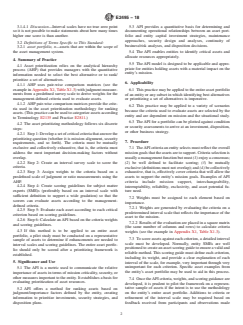
5.1 The API is a metric used to communicate the relative importance of assets in terms of mission criticality, security, or other measures important to the entity. It establishes a basis for evaluating prioritization of asset resources.
5.2 API offers a method for ranking assets based on judgment/importance factors defined by the entity, creating information to prioritize investments, security strategies, and disposition plans.
5.3 API provides a quantitative basis for determining and documenting operational relationships between an asset portfolio and entity capital investment strategies, maintenance approaches, security design and analyses, continuity of business/risk analyses, and disposition decisions.
5.4 The API enables entities to identify critical assets and allocate resources appropriately.
5.5 The API model is designed to be applicable and appropriate for entities holding assets with a material impact on the entity’s mission.
SCOPE
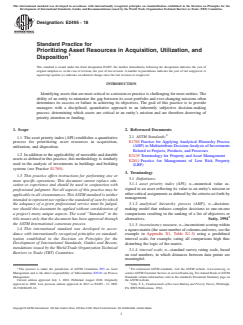
1.1 The asset priority index (API) establishes a quantitative process for prioritizing asset resources in acquisition, utilization, and disposition.
1.2 In addition to the applicability of moveable and durable assets as defined in this practice, this methodology is similarly used in the analysis of investments in buildings and building systems (see Practice E1765).
1.3 This practice offers instructions for performing one or more specific operations. This document cannot replace education or experience and should be used in conjunction with professional judgment. Not all aspects of this practice may be applicable in all circumstances. This ASTM standard is neither intended to represent nor replace the standard of care by which the adequacy of a given professional service must be judged, nor should this document be applied without consideration of a project’s many unique aspects. The word “Standard” in the title means only that the document has been approved through the ASTM International consensus process.
1.4 This international standard was developed in accordance with internationally recognized principles on standardization established in the Decision on Principles for the Development of International Standards, Guides and Recommendations issued by the World Trade Organization Technical Barriers to Trade (TBT) Committee.
- Status
- Published
- Publication Date
- 30-Jun-2018
- Technical Committee
- E53 - Asset Management
- Drafting Committee
- E53.01 - Process Management
Buy Documents
ASTM E2495-18 - Standard Practice for Prioritizing Asset Resources in Acquisition, Utilization, and Disposition
REDLINE ASTM E2495-18 - Standard Practice for Prioritizing Asset Resources in Acquisition, Utilization, and Disposition
Overview
ASTM E2495-18: Standard Practice for Prioritizing Asset Resources in Acquisition, Utilization, and Disposition establishes a systematic, quantitative approach for assigning priority to assets within an organization. The process utilizes the Asset Priority Index (API) as a key metric to support informed decision-making concerning acquisition, resource allocation, maintenance, and disposition of assets. Developed under the ASTM International framework, this standard is applicable to a broad range of industries responsible for managing portfolios of tangible assets-such as equipment, buildings, and infrastructure-with significant impact on mission objectives or business continuity.
By implementing API methodology, organizations can rank assets based on customized, mission-critical factors, ensuring that investments and resource allocations align with strategic priorities and risk assessments.
Key Topics
Asset Priority Index (API):
The centerpiece of ASTM E2495-18, the API is a numerical assessment that communicates the relative importance of an asset in terms of mission criticality, security, and other organizational priorities.Analytical Hierarchy Process (AHP):
This structured decision-making model uses pairwise comparisons and interval scales to objectively rank asset criteria and calculate the API. It breaks down complex prioritization into manageable, quantitative steps.Criteria Development and Weighting:
The standard guides organizations to define critical evaluation criteria (e.g., mission support, reliability, future needs), assign appropriate weights using consensus-based management input, and develop tailored scoring systems for reliable asset assessment.Documentation and Justification:
ASTM E2495-18 enables clear documentation of the decision logic connecting assets to investment strategies, maintenance schedules, security design, risk analysis, and disposal plans.Portfolio-Wide Applicability:
Whether focusing on specific asset subgroups or the entire asset portfolio, the API approach ensures consistent and scalable prioritization based on the organization's individual criteria and goals.
Applications
Strategic Capital Investment:
Organizations leverage API results to guide investments, ensuring that capital is directed toward assets with the highest value to mission accomplishment and operational resilience.Maintenance and Resource Allocation:
By identifying assets most essential to business continuity, the API helps maintenance planners prioritize schedules, budgeting, and staffing, optimizing operational uptime and resource utilization.Acquisition and Disposition Decisions:
When considering new asset purchases or disposition of existing assets, the API provides a clear, quantitative foundation for justifying decisions and ensuring alignment with organizational priorities.Security and Risk Management:
The method assists in evaluating asset vulnerabilities and directing security enhancements toward those deemed most critical, supporting compliance and risk mitigation strategies.Multi-Asset Analysis:
ASTM E2495-18 is suitable for a range of asset types, including movables, durables, buildings, and building systems, enabling comprehensive portfolio risk and opportunity assessment.
Related Standards
- ASTM E1765: Practice for Applying Analytical Hierarchy Process (AHP) to Multiattribute Decision Analysis of Investments Related to Projects, Products, and Processes.
- ASTM E2135: Terminology for Property and Asset Management.
- ASTM E2811: Practice for Management of Low Risk Property (LRP).
Practical Value
By adopting ASTM E2495-18, organizations benefit from:
Enhanced Decision-Making:
Move from subjective asset prioritization to data-driven, transparent processes.Resource Optimization:
Focus funding, time, and effort where it makes the greatest difference to mission success.Risk Management:
Proactively identify and protect critical assets, supporting business continuity and regulatory compliance.Strategic Alignment:
Ensure asset-related decisions consistently support broader business goals and objectives.
ASTM E2495-18 is a vital tool for modern asset management strategies, empowering businesses to achieve higher efficiency and resilience across their asset portfolios.
Relations
- Effective Date
- 01-Jul-2018
- Effective Date
- 01-Nov-2017
- Effective Date
- 01-May-2017
- Effective Date
- 01-Mar-2016
- Effective Date
- 01-May-2011
- Effective Date
- 01-Mar-2011
- Effective Date
- 15-Oct-2010
- Effective Date
- 15-Oct-2010
- Effective Date
- 15-Oct-2010
- Effective Date
- 01-Jul-2010
- Effective Date
- 15-Jun-2007
- Effective Date
- 15-Jun-2007
- Effective Date
- 01-Apr-2007
- Effective Date
- 01-Apr-2007
- Effective Date
- 15-Feb-2006
Buy Documents
ASTM E2495-18 - Standard Practice for Prioritizing Asset Resources in Acquisition, Utilization, and Disposition
REDLINE ASTM E2495-18 - Standard Practice for Prioritizing Asset Resources in Acquisition, Utilization, and Disposition
Get Certified
Connect with accredited certification bodies for this standard

BSI Group
BSI (British Standards Institution) is the business standards company that helps organizations make excellence a habit.

Bureau Veritas
Bureau Veritas is a world leader in laboratory testing, inspection and certification services.

DNV
DNV is an independent assurance and risk management provider.
Sponsored listings
Frequently Asked Questions
ASTM E2495-18 is a standard published by ASTM International. Its full title is "Standard Practice for Prioritizing Asset Resources in Acquisition, Utilization, and Disposition". This standard covers: SIGNIFICANCE AND USE 5.1 The API is a metric used to communicate the relative importance of assets in terms of mission criticality, security, or other measures important to the entity. It establishes a basis for evaluating prioritization of asset resources. 5.2 API offers a method for ranking assets based on judgment/importance factors defined by the entity, creating information to prioritize investments, security strategies, and disposition plans. 5.3 API provides a quantitative basis for determining and documenting operational relationships between an asset portfolio and entity capital investment strategies, maintenance approaches, security design and analyses, continuity of business/risk analyses, and disposition decisions. 5.4 The API enables entities to identify critical assets and allocate resources appropriately. 5.5 The API model is designed to be applicable and appropriate for entities holding assets with a material impact on the entity’s mission. SCOPE 1.1 The asset priority index (API) establishes a quantitative process for prioritizing asset resources in acquisition, utilization, and disposition. 1.2 In addition to the applicability of moveable and durable assets as defined in this practice, this methodology is similarly used in the analysis of investments in buildings and building systems (see Practice E1765). 1.3 This practice offers instructions for performing one or more specific operations. This document cannot replace education or experience and should be used in conjunction with professional judgment. Not all aspects of this practice may be applicable in all circumstances. This ASTM standard is neither intended to represent nor replace the standard of care by which the adequacy of a given professional service must be judged, nor should this document be applied without consideration of a project’s many unique aspects. The word “Standard” in the title means only that the document has been approved through the ASTM International consensus process. 1.4 This international standard was developed in accordance with internationally recognized principles on standardization established in the Decision on Principles for the Development of International Standards, Guides and Recommendations issued by the World Trade Organization Technical Barriers to Trade (TBT) Committee.
SIGNIFICANCE AND USE 5.1 The API is a metric used to communicate the relative importance of assets in terms of mission criticality, security, or other measures important to the entity. It establishes a basis for evaluating prioritization of asset resources. 5.2 API offers a method for ranking assets based on judgment/importance factors defined by the entity, creating information to prioritize investments, security strategies, and disposition plans. 5.3 API provides a quantitative basis for determining and documenting operational relationships between an asset portfolio and entity capital investment strategies, maintenance approaches, security design and analyses, continuity of business/risk analyses, and disposition decisions. 5.4 The API enables entities to identify critical assets and allocate resources appropriately. 5.5 The API model is designed to be applicable and appropriate for entities holding assets with a material impact on the entity’s mission. SCOPE 1.1 The asset priority index (API) establishes a quantitative process for prioritizing asset resources in acquisition, utilization, and disposition. 1.2 In addition to the applicability of moveable and durable assets as defined in this practice, this methodology is similarly used in the analysis of investments in buildings and building systems (see Practice E1765). 1.3 This practice offers instructions for performing one or more specific operations. This document cannot replace education or experience and should be used in conjunction with professional judgment. Not all aspects of this practice may be applicable in all circumstances. This ASTM standard is neither intended to represent nor replace the standard of care by which the adequacy of a given professional service must be judged, nor should this document be applied without consideration of a project’s many unique aspects. The word “Standard” in the title means only that the document has been approved through the ASTM International consensus process. 1.4 This international standard was developed in accordance with internationally recognized principles on standardization established in the Decision on Principles for the Development of International Standards, Guides and Recommendations issued by the World Trade Organization Technical Barriers to Trade (TBT) Committee.
ASTM E2495-18 is classified under the following ICS (International Classification for Standards) categories: 03.100.01 - Company organization and management in general. The ICS classification helps identify the subject area and facilitates finding related standards.
ASTM E2495-18 has the following relationships with other standards: It is inter standard links to ASTM E2495-13, ASTM E2811-17, ASTM E2135-10a(2017), ASTM E1765-16, ASTM E1765-11, ASTM E2811-11, ASTM E2135-10a, ASTM E2135-10ae2, ASTM E2135-10ae1, ASTM E2135-10, ASTM E2135-07, ASTM E2135-07e1, ASTM E1765-07e1, ASTM E1765-07, ASTM E2135-06. Understanding these relationships helps ensure you are using the most current and applicable version of the standard.
ASTM E2495-18 is available in PDF format for immediate download after purchase. The document can be added to your cart and obtained through the secure checkout process. Digital delivery ensures instant access to the complete standard document.
Standards Content (Sample)
This international standard was developed in accordance with internationally recognized principles on standardization established in the Decision on Principles for the
Development of International Standards, Guides and Recommendations issued by the World Trade Organization Technical Barriers to Trade (TBT) Committee.
Designation: E2495 − 18
Standard Practice for
Prioritizing Asset Resources in Acquisition, Utilization, and
Disposition
This standard is issued under the fixed designation E2495; the number immediately following the designation indicates the year of
original adoption or, in the case of revision, the year of last revision. A number in parentheses indicates the year of last reapproval. A
superscript epsilon (´) indicates an editorial change since the last revision or reapproval.
INTRODUCTION
Identifying assets that are most critical to a mission or practice is challenging for most entities. The
ability of an entity to minimize the gap between its asset portfolio and ever-changing missions often
determines its success or failure in achieving its objectives. The goal of this practice is to provide
managers with a disciplined, quantitative approach to an inherently subjective decision-making
process: determining which assets are critical to an entity’s mission and are therefore deserving of
priority attention or funding.
1. Scope 2. Referenced Documents
2.1 ASTM Standards:
1.1 The asset priority index (API) establishes a quantitative
E1765 Practice for Applying Analytical Hierarchy Process
process for prioritizing asset resources in acquisition,
(AHP) to Multiattribute DecisionAnalysis of Investments
utilization, and disposition.
Related to Projects, Products, and Processes
1.2 In addition to the applicability of moveable and durable
E2135 Terminology for Property and Asset Management
assets as defined in this practice, this methodology is similarly
E2811 Practice for Management of Low Risk Property
used in the analysis of investments in buildings and building
(LRP)
systems (see Practice E1765).
3. Terminology
1.3 This practice offers instructions for performing one or
3.1 Definitions:
more specific operations. This document cannot replace edu-
3.1.1 asset priority index (API), n—numerical value as-
cation or experience and should be used in conjunction with
signed to an asset reflecting its value to an entity’s mission or
professional judgment. Not all aspects of this practice may be
other critical assignments as defined by the criteria set forth by
applicable in all circumstances. This ASTM standard is neither
management.
intended to represent nor replace the standard of care by which
the adequacy of a given professional service must be judged, 3.1.2 analytical hierarchy process (AHP), n—decision-
nor should this document be applied without consideration of making model that reduces complex decisions to one-on-one
a project’s many unique aspects. The word “Standard” in the comparisons resulting in the ranking of a list of objectives or
title means only that the document has been approved through alternatives. Satty, 1994
the ASTM International consensus process.
3.1.3 inconsistency measure, n—inconsistent scoring within
1.4 This international standard was developed in accor-
asquarematrix(thesamenumberofcolumnsandrows,seethe
dance with internationally recognized principles on standard- example in Appendix X1, Table X1.3) using a predefined
ization established in the Decision on Principles for the
interval scale, for example, rating all comparisons high thus
Development of International Standards, Guides and Recom-
disturbing the logic of the matrix.
mendations issued by the World Trade Organization Technical
3.1.4 interval scale, n—standard survey rating scale, based
Barriers to Trade (TBT) Committee.
on real numbers, in which distances between data points are
meaningful.
1 2
This practice is under the jurisdiction of ASTM Committee E53 on Asset For referenced ASTM standards, visit the ASTM website, www.astm.org, or
Management and is the direct responsibility of Subcommittee E53.01 on Process contact ASTM Customer Service at service@astm.org. For Annual Book of ASTM
Management. Standards volume information, refer to the standard’s Document Summary page on
Current edition approved July 1, 2018. Published August 2018. Originally the ASTM website.
approved in 2006. Last previous edition approved in 2013 as E2495 – 13. DOI: Satty,T.L., Fundamentals of Decision Making and Priority Theory,Pittsburgh,
10.1520/E2495-18. PA: RWS Publications, 1994.
Copyright © ASTM International, 100 Barr Harbor Drive, PO Box C700, West Conshohocken, PA 19428-2959. United States
E2495 − 18
3.1.4.1 Discussion—Interval scales have no true zero point 5.3 API provides a quantitative basis for determining and
so it is not possible to make statements about how many times documenting operational relationships between an asset port-
higher one score is than another. folio and entity capital investment strategies, maintenance
approaches, security design and analyses, continuity of
3.2 Definitions of Terms Specific to This Standard:
business/risk analyses, and disposition decisions.
3.2.1 asset portfolio, n—assets that are within the scope of
the asset management system. 5.4 The API enables entities to identify critical assets and
allocate resources appropriately.
4. Summary of Practice
5.5 The API model is designed to be applicable and appro-
4.1 Asset prioritization relies on the analytical hierarchy
priate for entities holding assets with a material impact on the
process (AHP) that provides managers with the quantitative
entity’s mission.
information needed to select the best alternative or to rank/
prioritize a set of alternatives.
6. Applicability
4.1.1 AHP uses pair-wise comparison matrices (see the
example in Appendix X1, Table X1.3) with judgment measure-
6.1 This practice may be applied to the entire asset portfolio
ments from a predefined survey scale to derive weights for the
of an entity or any subset in which identifying best alternatives
management-defined criteria used to evaluate assets.
or prioritizing a set of alternatives is imperative.
4.1.2 AHP pair-wise comparison matrices provide the crite-
6.2 This practice may be applied to a variety of scenarios
ria used in the asset prioritization methodology for ranking
because the criteria used to evaluate assets are selected by the
assets.(Thispracticecanbeusedtocategorizeassetsaccording
entity and are dependent on mission and the situational study.
to Terminology E2135 and Practice E2811.)
6.3 TheAPI for a portfolio can be plotted against condition
4.2 The asset prioritizing methodology follows six discrete
or security assessments to arrive at an investment, disposition,
steps:
or other business strategy.
4.2.1 Step1:Developasetofcriticalcriteriathatanswerthe
prioritizing question (whether it is mission alignment, security
7. Procedure
requirements, and so forth). The criteria must be mutually
exclusive and collectively exhaustive, that is, the criteria must 7.1 TheAPI criteria an entity selects must reflect the overall
address the most important decision-making factors without mission goals that the assets are to support. Criteria selection is
overlap.
usuallyamanagementfunctionbutmust (1)enjoyaconsensus;
4.2.2 Step 2: Create an interval survey scale to score the (2) be well defined to facilitate scoring; (3) be mutually
criteria.
exclusive(definitionsmustnotoverlap);and (4)becollectively
4.2.3 Step 3: Assign weights to the criteria based on a exhaustive, that is, effectively cover criteria that will allow the
predefined scale of judgment or ratio measurements using the
assets to support the entity’s mission goals. Examples of API
AHP. criteria include mission support, interchangeability,
4.2.4 Step 4: Create scoring guidelines for subject matter
interruptability, reliability, exclusivity, and asset potential fu-
experts (SME)s (preferably based on an interval scale with ture need.
sufficient definition to support a wide gradation) so that the
7.2 Weights must be assigned to each element based on
scorers can evaluate assets according to the management-
importance.
defined criteria.
7.2.1 Weights are generated by evaluating the criteria on a
4.2.5 Step 5: Evaluate each asset according to each critical
predetermined interval scale that reflects the importance of the
criterion based on scoring guidelines.
asset to the mission.
4.2.6 Step 6: Calculate anAPI based on the criteria weights
7.2.2 Results of the evaluation are placed in a square matrix
and scoring guidelines.
(the same number of columns and rows) to calculate criteria
4.3 If this method is to be applied to an entire asset
weights (see the example in Appendix X1, Table X1.3).
portfolio, a pilot study must be conducted on a representative
7.3 To score assets against each criterion, a detailed interval
sample of assets to determine if enhancements are needed to
scale must be developed. Normally, entity SMEs are well
interval scales and scoring guidelines. The entire asset portfo-
positionedtocreateanassetscoringguidetoensureavalidand
lio should only be scored after a prioritizing framework is
reliable method. This scoring guide must define each criterion,
established.
including its weight, and provide a clear explanation of each
5. Significance and Use
interval of the scale, for example, very important through very
unimportant for each criterion. Specific asset examples from
5.1 The API is a metric used to communicate the relative
the entity’s asset portfolio may be used to aid in this process.
importance of assets in terms of mission criticality, security, or
other measures important to the entity. It establishes a basis for
7.4 Once theAPI criteria, weights, and scoring guidance are
evaluating prioritization of asset resources.
developed, it is prudent to pilot the framework on a represen-
5.2 API offers a method for ranking assets based on tative sample of assets if the intent is to use the methodology
judgment/importance factors defined by the entity, creating on the entity’s entire asset portfolio. Additions to criteria or
information to prioritize investments, security strategies, and refinement of the interval scale may be required based on
disposition plans. feedback received from participants and observations made
E2495 − 18
during the scoring session pilots because many factors affect- 8.2 Devise an interval scale for weighing the criteria pro-
ing the analysis can arise such as geographic or security viding a definitive range that indicates a degree of difference
considerations. between the intervals (such as “absolutely important” through
“unimportant”) (see Table X1.5).
7.5 Management must decide on the correct population to
8.3 Calculate weights for each pair-wise comparison using
designate as scorers. In some instances, only SMEs are an
the AHP (see Table X1.3).
appropriate choice. In other instances, other stakeholders may
be assigned as scorers. Once the API criteria framework
8.4 Devise criterion-unique interval scales to provide
(criteria, weights, and scoring guidance) has been finalized,
SMEs/stakeholders who are scoring assets a definitive range
SMEs or other stakeholders score the entity’s assets and
that indicate a degree of difference between the intervals (such
determinetheirAPI.Thepreferredmethodistohaveallscorers
as “very high” through “very low”) (see Table X1.7, Table
physically present and to score assets one by one against each
X1.9, and Table X1.10).
API criterion. This method typically returns lower inconsis-
8.5 Evaluate each asset against each criterion using the
tency measures and tends to receive higher credibility through-
interval scale and criterion-unique interval scales (see Table
out the entity.
X1.5, Table X1.7, Table X1.9, and Table X1.10).
7.6 For simple studies with a small number of comparisons,
8.6 API for each asset is calculated and equals the sum of
the example in Appendix X1 will assist in understanding how
the products of the criteria weights and the asset item rank per
to calculate AHP. For larger more sophisticated studies, there
criterion (see Table X1.10).
are many AHP heuristic software packages available to assist
8.7 The resulting rank provides quantitative information to
with the calculations. The mathematical variations on this
use in process decision making.
technique are numerous.
9. Keywords
8. Analytical Measures
9.1 AHP; analytical hierarchy process; API; asset manage-
8.1 Create a definitive list of criteria to evaluate assets ment; asset portfolio; asset priority; assets; equipment; equip-
against a project or entity mission (see Table X1.3). ment management; property; tangible assets
APPENDIXES
(Nonmandatory Information)
X1. EXAMPLE 1: IDENTIFYING CAPITAL ASSETS THAT SUPPORT THE CORE/PRIORITY MISSIONS OF AN ENTITY
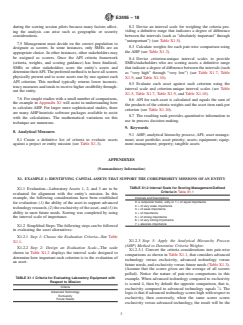
TABLE X1.2 Interval Scale for Scoring Management-Defined
X1.1 Evaluation—Laboratory Assets 1, 2, and 3 are to be
Criteria in Table X1.1
evaluated for alignment with the entity’s mission. In this
Intervals and Descriptions
example, the following considerations have been established
In a reciprocal matrix, unity or 1 = of equal importance
for evaluation: (1) the ability of the asset to support advanced
2 = of very weak importance
technology research, (2) the exclusivity of the asset, and (3) its
3 = of weak importance
ability to meet future needs. Scoring was completed by using
4 = of importance
5 = of strong importance
the interval scale of importance.
6 = of very strong importance
7 = absolute importance
X1.2 Simplified Steps: The following steps can be followed
in evaluating the asset alternatives:
X1.2.1 Step 1: Choose the Evaluation Criteria—See Table
X1.2.3 Step 3: Apply the Analytical Hierarchy Process
X1.1.
(AHP) Method to Determine Criteria Weights:
X1.2.2 Step 2: Design an Evaluation Scale—The scale
X1.2.3.1 Convert the criteria considerations into pair-wise
shown in Table X1.2 displays the interval scale designed to
comparisons as shown in Table X1.1, that considers advanced
determine how important each criterion is to the evaluation of
technology versus exclusivity, advanced technology versus
an asset.
future needs, and exclusivity versus future needs (Table X1.3).
(Assume that the scores given are the average of all scorers
polled). Notice the nature of pair-wise comparisons in this
TABLE X1.1 Criteria for Evaluating Laboratory Equipment with
example. When advanced technology compared to exclusivity
Respect to Mission
is scored 4, then by default the opposite comparison, that is,
Criteria 1
exclusivity compared to advanced technology equals ⁄4. The
Advanced Technology
logic is that if advanced technology scores high with respect to
Exclusivity
exclusivity, then conversely, when the same scorer scores
Future Needs
exclusivity versus advanced technology, the result will be the
E2495 − 18
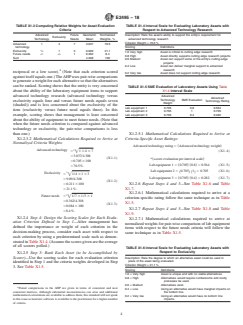
TABLE X1.3 Computing Relative Weights for Asset Evaluation TABLE X1.4 Interval Scale for Evaluating Laboratory Assets with
Criteria Respect to Advanced Technology Research
Advanced Future Geometric Normalized Description: Rate the asset’s ability to support the entity’s requirement for
Exclusivity
Technology Needs Mean Weights, % advanced technology research
Criterion Weight = 70.5 %
Advanced 1 4 7 3.037 70.5
technology Scoring Definitions
Exclusivity ⁄4 1 3 0.909 21.1
1.0 Very high Asset is critical to cutting edge research
1 1
Future needs ⁄7 ⁄3 1 0.362 8.4
0.8 High Asset directly supports cutting edge research projects
Sum 4.308 100
0.6 Medium Asset can support some of the entity’s cutting-edge
projects
0.4 Low Asset can deliver marginal support to advanced
research
reciprocal or a low score). (Note that each criterion scored
0.2 Very low Asset does not support cutting edge research
againstitselfequalsone.)TheAHPusespair-wisecomparisons
to generate a weight for each alternative so that the alternatives
can be ranked. Scoring shows that the entity is very concerned
TABLE X1.5 SME Evaluation of Laboratory Assets Using Table
X1.4 Interval Scale
about the ability of the laboratory equipment items to support
advanced technology research (advanced technology versus
Advanced
Advanced
Technology SME Evaluation
exclusivity equals four and versus future needs equals seven
Technology Rating
Weight
(shaded)) and is less concerned about the exclusivity of the
Lab equipment 1 0.705 0.8 0.564
item (exclusivity versus future need equals three). In this
Lab equipment 2 0.705 1 0.705
example, scoring shows that management is least concerned
Lab equipment 3 0.705 0.4 0.282
about the ability of equipment to meet future needs. (Note that
when the future needs criterion is compared against advanced
technology or exclusivity, the pair-wise comparisons is less
than one.)
X1.2.5.1 Mathematical Calculations Required to Arrive at
X1.2.3.2 Mathematical Calculations Required to Arrive at
Criteria-Specific Asset Ratings:
Normalized Criteria Weights:
Advanced technology rating 5 Advanced technology weight
~ !
Advanced technology
5 =1 34 37 (X1.4)
53.037/4.308
(X1.1)
*~scorer evaluation per interval scale!
50.705 3100
Lab equipment 1 5 0.705 0.8 5 0.564 (X1.5)
~ !~ !
570.5%.
Lab equipment 2 5 0.705 1 5 0.705 (X1.6)
~ !~ !
Exclusivity
5 =1/4 31 33
Lab equipment 3 5 ~0.705!~0.4! 5 0.282 (X1.7)
59.09/4.308
(X1.2)
50.211 3100 X1.2.6 Repeat Steps 4 and 5—See Table X1.6 and Table
X1.7.
521.1%.
X1.2.6.1 Mathematical calculations required to arrive at a
Future needs
5 =1/7 31/3 31
criterion-spe
...
This document is not an ASTM standard and is intended only to provide the user of an ASTM standard an indication of what changes have been made to the previous version. Because
it may not be technically possible to adequately depict all changes accurately, ASTM recommends that users consult prior editions as appropriate. In all cases only the current version
of the standard as published by ASTM is to be considered the official document.
Designation: E2495 − 13 E2495 − 18
Standard Practice for
Prioritizing Asset Resources in Acquisition, Utilization, and
Disposition
This standard is issued under the fixed designation E2495; the number immediately following the designation indicates the year of
original adoption or, in the case of revision, the year of last revision. A number in parentheses indicates the year of last reapproval. A
superscript epsilon (´) indicates an editorial change since the last revision or reapproval.
INTRODUCTION
Identifying assets that are most critical to a mission or practice is challenging for most business
entities. The ability of a business an entity to minimize the gap between its asset portfolio and
ever-changing organizational missions often determines its success or failure in achieving designedits
objectives. The goal of this practice is to provide managers with a disciplined, quantitative approach
to an inherently subjective decision-making process: determining which assets are critical to an
entity’s designated mission and are therefore deserving of priority attention or funding.
1. Scope
1.1 The asset priority index (API) establishes aquantitativee a quantitative process for prioritizing asset resources in acquisition,
utilization, and disposition to provide entities with a proven methodology to prioritize asset resources.disposition.
1.2 The API is a metric used to communicate the relative importance of equipment in terms of mission criticality, security, or
other measures important to the business entity. It offers a method for ranking assets based on judgment/importance factors defined
by the organization, creating information to justify compelling arguments for investment, security strategies, and disposition plans.
1.3 The API also provides a quantitative basis for determining and documenting operational relationships between an asset
portfolio and business objectives capital investment strategies, maintenance approaches, security design and analyses, continuity
of business/risk analyses, and disposition decisions.
1.4 The API enables management to identify critical assets and allocate resources appropriately.
1.5 The API model is designed to be applicable and appropriate for entities holding equipment with a material impact on the
entity’s mission.
1.2 In addition to the applicability of moveable and durable assets as defined in this practice, this methodology is similarly used
in the analysis of investments in buildings and building systems (see Practice E1765).
1.3 This practice offers instructions for performing one or more specific operations. This document cannot replace education
or experience and should be used in conjunction with professional judgment. Not all aspects of this practice may be applicable
in all circumstances. This ASTM standard is neither intended to represent ornor replace the standard of care by which the adequacy
of a given professional service must be judged, nor should this document be applied without consideration of a project’s many
unique aspects. The word “Standard” in the title means only that the document has been approved through the ASTM International
consensus process.
1.4 This international standard was developed in accordance with internationally recognized principles on standardization
established in the Decision on Principles for the Development of International Standards, Guides and Recommendations issued
by the World Trade Organization Technical Barriers to Trade (TBT) Committee.
2. Referenced Documents
2.1 ASTM Standards:
This practice is under the jurisdiction of ASTM Committee E53 on Asset Management and is the direct responsibility of Subcommittee E53.01 on Process Management.
Current edition approved Jan. 1, 2013July 1, 2018. Published February 2013August 2018. Originally approved in 2006. Last previous edition approved in 20072013 as
E2495 – 07.E2495 – 13. DOI: 10.1520/E2495-13.10.1520/E2495-18.
For referenced ASTM standards, visit the ASTM website, www.astm.org, or contact ASTM Customer Service at service@astm.org. For Annual Book of ASTM Standards
volume information, refer to the standard’s Document Summary page on the ASTM website.
Copyright © ASTM International, 100 Barr Harbor Drive, PO Box C700, West Conshohocken, PA 19428-2959. United States
E2495 − 18
E1765 Practice for Applying Analytical Hierarchy Process (AHP) to Multiattribute Decision Analysis of Investments Related to
Projects, Products, and Processes
E2135 Terminology for Property and Asset Management
E2811 Practice for Management of Low Risk Property (LRP)
3. Terminology
3.1 Definitions:
3.1.1 asset portfolio, n—assets that are within the scope of the asset management system.
3.1.2 asset priority index (API), n—numerical value assigned to an asset reflecting its value to an entity’s mission or other
critical assignments as defined by the criteria set forth by management.
3.1 Definitions of Terms Specific to This Standard:Definitions:
3.1.1 asset priority index (API), n—numerical value assigned to an asset reflecting its value to an entity’s mission or other
critical assignments as defined by the criteria set forth by management.
3.1.2 analytical hierarchy process (AHP), n—decision-making model that reduces complex decisions to one on one one-on-one
comparisons resulting in the ranking of a list of objectives or alternatives. Satty, 1994
3.1.3 inconsistency measure, n—inconsistent scoring within a square matrix (the same number of columns and rows, see the
example in Appendix X1, Table X1.3) using a predefined interval scale, for example, rating all comparisons high thus disturbing
the logic of the matrix.
3.1.4 interval scale, n—standard survey rating scale, based on real numbers, in which distances between data points are
meaningful.
3.1.4.1 Discussion—
Interval scales have no true zero point so it is not possible to make statements about how many times higher one score is than
another.
3.2 Acronyms:Definitions of Terms Specific to This Standard:
AHP = Analytical Hierarchy Process
API = Asset Priority Index
ECM = Equipment Control Matrix
LRP = Low Risk Property
SME = Subject Matter Expert
3.2.1 asset portfolio, n—assets that are within the scope of the asset management system.
4. Summary of Practice
4.1 Asset prioritizingprioritization relies on the analytical hierarchy process (AHP), a proven decision-making aid, (AHP) that
provides managers with the quantitative information needed to select the best alternative or to rank/prioritize a set of alternatives.
4.1.1 AHP uses pair-wise comparison matrices (see the example in Appendix X1, Table X1.3) with judgment measurements
from a predefined survey scale to derive weights for the management-defined criteria used to evaluate assets.
4.1.2 AHP pair-wise comparison matrices provide the criteria used in the asset prioritization methodology for ranking assets.
(This practice can be used, for example, used to categorize assets according to PracticesTerminology E2135 and Practice E2811.)
4.2 The asset prioritizing methodology follows six discrete steps:
4.2.1 Step 1: Develop a set of critical criteria that answer the prioritizing question (whether it is mission alignment, security
requirements, and so forth). The criteria shallmust be mutually exclusive and collectively exhaustive, that is, the criteria shallmust
address the most important decision-making factors without overlap.
4.2.2 Step 2: Create an interval survey scale by which the criteria can be scored.to score the criteria.
4.2.3 Step 3: Assign weights to the criteria based on a predefined scale of judgment or ratio measurements using the AHP.
4.2.4 Step 4: Create scoring guidelines for subject matter experts (SME)s (preferably based on an interval scale with sufficient
definition to support a wide gradation) so that the scorers can evaluate assets per according to the management-defined criteria.
4.2.5 Step 5: Evaluate each asset according to each critical criterion based on scoring guidelines.
4.2.6 Step 6: Calculate an API based on the criteria weights and scoring guidelines.
4.3 Should the practitioner wish to apply this method to If this method is to be applied to an entire asset portfolio, a pilot study
shallmust be conducted on a representative sample of assets to determine if enhancements are needed to interval scales and scoring
guidelines. The entire asset portfolio should only be scored after a prioritizing framework is established.
Satty, T.L., T. L., Fundamentals of Decision Making and Priority Theory, Pittsburgh, PA: RWS Publications, 1994.
E2495 − 18
4.4 The API is a metric used to communicate the relative importance of equipment in terms of mission criticality, security, or
other measures important to the business entity. It establishes a basis for evaluating prioritization of asset resources.
5. Significance and Use
5.1 The API is a metric used to communicate the relative importance of equipmentassets in terms of mission criticality, security,
or other measures important to the business entity. It offersestablishes a method for ranking assets based on judgment/importance
factors defined by the organization, creating information to justify compelling arguments for investment, security strategies, and
disposition plans.basis for evaluating prioritization of asset resources.
5.2 API offers a method for ranking assets based on judgment/importance factors defined by the entity, creating information to
prioritize investments, security strategies, and disposition plans.
5.3 The API also provides a quantitative basis for determining and documenting operational relationships between an asset
portfolio and business objectives entity capital investment strategies, maintenance approaches, security design and analyses,
continuity of business/risk analyses, and disposition decisions.
5.4 It The API enables managemententities to identify critical assets and allocate resources appropriately and should therefore
be an integral process in equipment management.appropriately.
5.5 The API model is designed to be applicable and appropriate for entities holding assets with a material impact on the entity’s
mission.
6. Applicability
6.1 This practice may be applied to the entire asset portfolio of an entity or any subset in which identifying best alternatives
or prioritizing a set of alternatives is imperative.
6.2 TheThis practice may be applied to a variety of scenarios because the criteria used to evaluate assets are selected by the
organizationentity and are dependent on mission and the situational study.
6.3 The API for a portfolio can in turn be plotted against condition or security assessments to arrive at an investment,
disposition, or other business strategy.
7. Procedure
7.1 The API criteria an organizationentity selects shallmust reflect the overall mission goals that the assets are to support.
Criteria selection is usually a management function but shallmust (1) enjoy a consensus; (2) be well defined to facilitate scoring;
(3) be mutually exclusive (definitions shallmust not overlap); and (4) be collectively exhaustive, that is, effectively cover those
criteria that will allow the assets to support the entity’s mission goals. Examples of API criteria include mission support,
interchangeability, interruptability, reliability, exclusivity, and asset potential future need.
7.2 Because the importance of each criterion element is usually not equal, weights Weights must be assigned to each element
according to the input of management.based on importance.
7.2.1 Weights are generated by requiring managers to evaluate evaluating the criteria on a predetermined interval scale that
reflects the importance of the criteria.asset to the mission.
7.2.2 Results of the evaluation are placed in a square matrix (the same number of columns and rows) to calculate criteria weights
(see the example in Appendix X1, Table X1.3).
7.3 To score assets against each criterion, a detailed interval scale shallmust be developed. Normally, organizationalentity SMEs
are well positioned to create an asset scoring guide to ensure a valid and reliable method. This scoring guide shallmust define each
criterion, including its weight, and provide a clear explanation of each interval of the scale, for example, very important through
very unimportant for each criterion. Management may provide scorers with specific Specific asset examples from the
organization’sentity’s asset portfolio may be used to aid in this process.
7.4 Once the API criteria, weights, and scoring guidance are developed, it is prudent to pilot the framework on a representative
sample of assets if the intent is to use the methodology on the organization’sentity’s entire asset portfolio. Additions to criteria or
refinement of the interval scale may be required based on feedback received from participants and observations made during the
scoring session pilots because many factors affecting the analysis can arise such as geographic or security considerations.
7.5 Management shallmust decide on the correct population to designate as scorers. In some instances, only SMEs are an
appropriate choice. In other instances, other stakeholders may be assigned as scorers. Once the API criteria framework (criteria,
weights, and scoring guidance) has been finalized, SMEs or other stakeholders score the entity’s assets and determine their API.
The preferred method is to have all scorers physically present and to score assets one by one against each API criteria.criterion.
This method typically returns lower inconsistency measures and tends to receive higher credibility throughout the entity.
7.6 For simple studies with a small number of comparisons, the example in Appendix X1 will sufficeassist in understanding how
to calculate AHP. For larger more sophisticated studies, there are many AHP heuristic software packages available to assist with
the calculations. The mathematical variations on this technique are endless and numerous.
E2495 − 18
8. Analytical Measures
8.1 Management creates Create a definitive list of criteria to evaluate assets against a project or organizationalentity mission (see
Table X1.3).
8.2 The practitioner devises Devise an interval scale for weighing the criteria giving the management team providing a definitive
range that indicates a degree of difference between the intervals (such as “absolutely important” through “unimportant”) (see Table
X1.5).
8.3 Weights Calculate weights for each criterion are calculated by management’s pair-wise comparisonspair-wise comparison
using the AHP (see Table X1.3).
8.4 The practitioner devises criterion unique Devise criterion-unique interval scales to give those provide SMEs/stakeholders
who are scoring assets a definitive range that indicatesindicate a degree of difference between the intervals (such as “very high”
through “very low”) (see Table X1.7, Table X1.9, and Table X1.10).
8.5 SMEs or other stakeholders evaluate Evaluate each asset against each criterion using the interval scale and criterion-unique
interval scales (see Table X1.5, Table X1.7, Table X1.9, and Table X1.10).
8.6 API for each asset is calculated and equals the sum of the products of the criteria weights and the asset item rank per
criterion (see Table X1.10).
8.7 The resulting rank provides management with quantitative information to use in business process decision making.
9. Keywords
9.1 AHP; analytical hierarchy process; API; asset management; asset portfolio; asset priority; assets; equipment; equipment
management; property; tangible assets
APPENDIXES
(Nonmandatory Information)
X1. EXAMPLE 1: IDENTIFYING CAPITAL ASSETS THAT SUPPORT THE CORE/PRIORITY MISSIONS OF A BUSINESS AN
ENTITY
X1.1 Evaluation—Laboratory Assets 1, 2, and 3 are to be evaluated for alignment with the business entity’s mission. In this
example, management has established the following considerations have been established for evaluation: (1) the ability of the
equipment item asset to support advanced technology research, (2) the exclusivity of the item,asset, and (3) its ability to meet future
needs. Scoring was completed by using the interval scale of importance.
X1.2 Simplified Steps: The following steps can be followed in evaluating the asset alternatives:
X1.2.1 Step 1: Choose the Evaluation Criteria—See Table X1.1.
X1.2.2 Step 2: Design an Evaluation Scale—The scale shown in Table X1.2 displays the interval scale designed to determine how
important each criterion is to the evaluation of an asset.
X1.2.3 Step 3: Apply the Analytical Hierarchy Process (AHP) Method to Determine Criteria Weights:
X1.2.3.1 Management converted Convert the criteria considerations into pair-wise comparisons as shown in Table X1.1, that
considers advanced technology versus exclusivity, advanced technology versus future needs, and exclusivity versus future needs
(Table X1.3). (You can assume (Assume that the scores given are the average of all scorers polled). Notice the nature of pair-wise
comparisons in this example. When advanced technology compared to exclusivity is scored 4, then by default the opposite
TABLE X1.1 Criteria for Evaluating Laboratory Equipment with
Respect to Mission
Criteria
Criteria
Advanced Technology
Exclusivity
Future Needs
E2495 − 18
TABLE X1.2 Interval Scale for Scoring Management-Defined
Criteria in Table X1.1
Intervals and Descriptions
In a reciprocal matrix, unity or 1 = of equal importance
2 = of very weak importance
3 = of weak importance
4 = of importance
5 = of strong importance
6 = of very strong importance
7 = absolute importance
TABLE X1.3 Computing Relative Weights for Asset Evaluation
Criteria
Advanced Future Geometric Normalized
Exclusivity
Technology Needs Mean Weights, %
Advanced 1 4 7 3.037 70.5
technology
Advanced 1 4 7 3.037 70.5
technology
Exclusivity ⁄4 1 3 0.909 21.1
1 1
Future needs ⁄7 ⁄3 1 0.362 8.4
Sum 4.308 100
comparison, that is, exclusivity compared to advanced technology equals ⁄4. . The logic is that if the SME scores advanced
technology scores high with respect to exclusivity, then conversely, when the same SMEscorer scores exclusivity versus advanced
technology, the result will be the reciprocal or a low score). (Note that each criterion scored against itself equals one.) The AHP
uses pair-wise comparisons to generate a weight for each alternative so that the alternatives can be ranked. Scoring shows that
management the entity is very concerned about the ability of the laboratory equipment items to support advanced technology
research (advanced technology versus exclusivity equals four and versus future needs equals seven (shaded)) and is less concerned
about the exclusivity of the item (exclusivity versus future need equals three). In this example, scoring shows that management
is least concerned about the ability of equipment to meet future needs. (Note that when the future needs criterion is compared
against advanced technology or exclusivity, the pair-wise comparisons is less than one.)
X1.2.3.2 Mathematical Calculations Required to Arrive at Normalized Criteria Weights:
Advanced technology
=
5 13437
53.037/4.308
(X1.1)
50.705 3100
570.5 %.
Exclusivity
5 =1/43133
59.09/4.308
(X1.2)
50.211 3100
521.1 %.
Future needs
5 =1/731/331
50.362/4.308
(X1.3)
50.084 3100
58.4 %.
X1.2.4 Step 4: Design the Scoring Scales for Each Evaluation Criterion Defined in Step 1—After management has defined the
importance or weight of each criteriacriterion in the decision-making process, the subject matter experts (SMEs) consider each
asset with respect to each criterion by using a predetermined scale such as demonstrated in Table X1.4. (You can assume (Assume
the scores given are the average of all SMEsscorers polled.)
X1.2.5 Step 5: Rank Each Asset (to be Accomplished by SME)—Scorer)—Use the scoring scales for each evaluation criterion
identified in Step 1 and the criteria weights developed in Step 3. See Table X1.5.
Paired comparisons in the AHP are given in terms of consistent and near consistent matrices. Although substantial inconsistencies can arise and additional mathematical
calculations are available to address them, this standard will not speak to this issue
...