

ASTM E1699-14(2020)
(Practice)Standard Practice for Performing Value Engineering (VE)/Value Analysis (VA) of Projects, Products and Processes
General Information
- Abstract
SIGNIFICANCE AND USE
5.1 Use of this practice may increase performance in one or more areas including: cost control; resource allocation; schedule management; quality control; risk management; or safety. Perform VE/VA as early as possible in the life cycle of the focus of study, and anytime conditions change, to allow greatest flexibility and effectiveness of any recommended changes. However, VE/VA may be performed at any time during the planning, design, and implementation phases of a project, product, or process.
5.2 Most effective applications of VE/VA are early in the design phase. Changes or redirection in the design can be accommodated without extensive redesign at this point, thereby saving the owner/user/stakeholder's time and money.
5.3 Projects Related to the Construction of Buildings and Other Engineered Systems:
5.3.1 During the earliest stages of design, refer to VE/VA as value planning. Use the procedure to analyze predesign documents, for example, program documents and space planning documents. At the predesign stage, perform VE/VA to define the project's functions, and to achieve consensus on the project's direction and approach by the project team, for example, the owner, the design professional,5 the user, and the construction manager. By participating in this early VE/VA exercise, members of the project team communicate their needs to the other team members and identify those needs in the common language of functions. By expressing the project in these terms early in the design process, the project team minimizes miscommunication and redesign, which are costly in both labor expenditures and schedule delays.
5.3.2 Also perform VE/VA during schematic design (up to 15 % design completion), design development (up to 45 % design completion), and construction documents (up to 100 % design completion). Conduct VE/VA studies at several stages of design completion to define or confirm project functions, to verify technical and management approaches, to analyze sel...
SCOPE
1.1 This practice covers a procedure for defining and satisfying the functions of a project, product, or process (hereafter referred to as focus of study). Projects include construction of commercial and residential buildings and other engineered systems.2 Products include components, systems and equipment.3 Processes include procurement, materials management, work flow, fabrication and assembly, quality control, and services.
1.2 A multidisciplinary team uses the procedure to convert stakeholder constraints, needs, and desires into descriptions of functions and then relates these functions to resources.
1.3 Examples of costs are all relevant costs over a designated study period, including the costs of obtaining funds, designing, purchasing/leasing, constructing/manufacturing/installing, operating, maintaining, repairing, replacing and disposing of the particular focus of study. While not the only criteria, cost is an important basis for comparison in a VE/VA study. Therefore, accurate and comprehensive cost data is an important element of the analysis.
1.4 This is a procedure to develop alternatives that meet the functions of the focus of study. Estimate the costs for each alternative. Provide the owner/user/stakeholder with specific, technically accurate alternatives which can be implemented. The owner/user/stakeholder selects the alternative(s) that best satisfies their constraints, needs and desires.
1.5 Apply this practice to an entire focus of study, or to any subsystem/element thereof. The user/owner/stakeholder can utilize the VE/VA procedure to select the element or scope of the study.
1.6 This standard does not purport to address all of the safety concerns, if any, associated with its use. It is the responsibility of the user of this standard to establish appropriate safety, health, and environmental practices and determine the applicability of regulatory limitations prior to use.
1.7 This int...
- Status
- Published
- Publication Date
- 30-Sep-2020
- Technical Committee
- E06 - Performance of Buildings
- Drafting Committee
- E06.81 - Building Economics
Overview
ASTM E1699-14(2020), Standard Practice for Performing Value Engineering (VE)/Value Analysis (VA) of Projects, Products, and Processes, establishes a structured methodology for optimizing value in projects, products, and processes. Developed by ASTM International, this standard supports a multidisciplinary approach to analyzing functions, resources, and costs to generate technically sound, cost-effective alternatives that meet stakeholder needs. Suitable for use throughout the lifecycle of a focus of study, VE/VA is most effective when applied in early design phases but remains valuable at all stages.
Key Topics
- Value Engineering (VE) and Value Analysis (VA): Systematic procedures to improve value by clarifying essential functions and aligning them with cost-effective solutions.
- Lifecycle Approach: Applies from planning through to design, implementation, and operation to maximize flexibility and the impact of recommended improvements.
- Function Analysis: Identifies and analyzes functions using multidisciplinary teams, differentiating between essential and supporting functions for a clear understanding of requirements.
- Cost Control: Involves comprehensive cost assessment, including lifecycle costs such as design, acquisition, maintenance, operation, and end-of-life disposal.
- Risk and Performance Management: Encourages consideration of quality, safety, and risk management alongside cost and performance objectives.
- Team Collaboration: Relies on collaborative workshops where stakeholders and experts contribute diverse perspectives for robust value solutions.
Applications
ASTM E1699-14(2020) is relevant for:
- Construction and Engineering Projects: VE/VA can be utilized at various stages-predesign, schematic design, design development, and construction documents-to optimize building projects and engineered systems, reducing rework and miscommunication.
- Product Development: Applies to components, systems, and equipment. VE/VA supports selection of materials and design features that maximize function and minimize unnecessary cost.
- Process Optimization: Enhances procurement, material management, workflow, fabrication, quality control, and other process-driven operations by identifying opportunities for cost savings and process improvement.
- Stakeholder Engagement: Provides a structured process for converting stakeholder needs and constraints into actionable function-based requirements.
- Cost-Benefit Evaluation: Encourages organizations to compare alternatives based on lifecycle costs and other relevant metrics, ensuring that recommended solutions provide the best combination of cost, performance, and value.
- Ongoing Value Improvements: Suitable for application whenever there are changes in scope, requirements, technology, or market conditions, ensuring continuous improvement throughout the asset or product lifecycle.
Related Standards
Professionals using ASTM E1699-14(2020) may also consult these ASTM and industry standards to complement their value engineering efforts:
- ASTM E631 – Terminology of Building Constructions
- ASTM E833 – Terminology of Building Economics
- ASTM E917 – Practice for Measuring Life-Cycle Costs of Buildings and Building Systems
- ASTM E1369 – Guide for Selecting Techniques for Treating Uncertainty and Risk in the Economic Evaluation of Buildings and Building Systems
- ASTM E1557 – Classification for Building Elements and Related Sitework-UNIFORMAT II
- ASTM E1765 – Practice for Applying Analytical Hierarchy Process (AHP) to Multiattribute Decision Analysis
- ASTM E2013 – Practice for Constructing FAST Diagrams and Performing Function Analysis
- ASTM E2103/E2103M – Classification for Bridge Elements-UNIFORMAT II
For further guidance on value engineering, consult resources from SAVE International and the Lawrence D. Miles Value Foundation.
By following ASTM E1699-14(2020), organizations can systematically improve project, product, and process outcomes by driving function-led, cost-effective solutions that align with stakeholder needs and promote lifecycle value.
Relations
- Effective Date
- 01-Apr-2020
- Effective Date
- 01-Apr-2020
- Effective Date
- 01-Jul-2019
- Refers
ASTM E917-17 - Standard Practice for Measuring Life-Cycle Costs of Buildings and Building Systems - Effective Date
- 01-Sep-2017
- Effective Date
- 01-Mar-2016
- Effective Date
- 01-Oct-2015
- Refers
ASTM E917-15 - Standard Practice for Measuring Life-Cycle Costs of Buildings and Building Systems - Effective Date
- 01-Oct-2015
- Effective Date
- 01-Oct-2015
- Effective Date
- 01-Mar-2015
- Effective Date
- 01-Nov-2014
- Effective Date
- 01-Nov-2013
- Effective Date
- 15-Oct-2013
- Effective Date
- 01-Oct-2013
- Refers
ASTM E917-13 - Standard Practice for Measuring Life-Cycle Costs of Buildings and Building Systems - Effective Date
- 01-Sep-2013
- Effective Date
- 01-May-2013
Get Certified
Connect with accredited certification bodies for this standard

DIBt (Deutsches Institut für Bautechnik)
German Institute for Building Technology.
DIN CERTCO
DIN Group product certification.

Aboma Certification B.V.
Specialized in construction, metal, and transport sectors.
Sponsored listings
Frequently Asked Questions
ASTM E1699-14(2020) is a standard published by ASTM International. Its full title is "Standard Practice for Performing Value Engineering (VE)/Value Analysis (VA) of Projects, Products and Processes". This standard covers: SIGNIFICANCE AND USE 5.1 Use of this practice may increase performance in one or more areas including: cost control; resource allocation; schedule management; quality control; risk management; or safety. Perform VE/VA as early as possible in the life cycle of the focus of study, and anytime conditions change, to allow greatest flexibility and effectiveness of any recommended changes. However, VE/VA may be performed at any time during the planning, design, and implementation phases of a project, product, or process. 5.2 Most effective applications of VE/VA are early in the design phase. Changes or redirection in the design can be accommodated without extensive redesign at this point, thereby saving the owner/user/stakeholder's time and money. 5.3 Projects Related to the Construction of Buildings and Other Engineered Systems: 5.3.1 During the earliest stages of design, refer to VE/VA as value planning. Use the procedure to analyze predesign documents, for example, program documents and space planning documents. At the predesign stage, perform VE/VA to define the project's functions, and to achieve consensus on the project's direction and approach by the project team, for example, the owner, the design professional,5 the user, and the construction manager. By participating in this early VE/VA exercise, members of the project team communicate their needs to the other team members and identify those needs in the common language of functions. By expressing the project in these terms early in the design process, the project team minimizes miscommunication and redesign, which are costly in both labor expenditures and schedule delays. 5.3.2 Also perform VE/VA during schematic design (up to 15 % design completion), design development (up to 45 % design completion), and construction documents (up to 100 % design completion). Conduct VE/VA studies at several stages of design completion to define or confirm project functions, to verify technical and management approaches, to analyze sel... SCOPE 1.1 This practice covers a procedure for defining and satisfying the functions of a project, product, or process (hereafter referred to as focus of study). Projects include construction of commercial and residential buildings and other engineered systems.2 Products include components, systems and equipment.3 Processes include procurement, materials management, work flow, fabrication and assembly, quality control, and services. 1.2 A multidisciplinary team uses the procedure to convert stakeholder constraints, needs, and desires into descriptions of functions and then relates these functions to resources. 1.3 Examples of costs are all relevant costs over a designated study period, including the costs of obtaining funds, designing, purchasing/leasing, constructing/manufacturing/installing, operating, maintaining, repairing, replacing and disposing of the particular focus of study. While not the only criteria, cost is an important basis for comparison in a VE/VA study. Therefore, accurate and comprehensive cost data is an important element of the analysis. 1.4 This is a procedure to develop alternatives that meet the functions of the focus of study. Estimate the costs for each alternative. Provide the owner/user/stakeholder with specific, technically accurate alternatives which can be implemented. The owner/user/stakeholder selects the alternative(s) that best satisfies their constraints, needs and desires. 1.5 Apply this practice to an entire focus of study, or to any subsystem/element thereof. The user/owner/stakeholder can utilize the VE/VA procedure to select the element or scope of the study. 1.6 This standard does not purport to address all of the safety concerns, if any, associated with its use. It is the responsibility of the user of this standard to establish appropriate safety, health, and environmental practices and determine the applicability of regulatory limitations prior to use. 1.7 This int...
SIGNIFICANCE AND USE 5.1 Use of this practice may increase performance in one or more areas including: cost control; resource allocation; schedule management; quality control; risk management; or safety. Perform VE/VA as early as possible in the life cycle of the focus of study, and anytime conditions change, to allow greatest flexibility and effectiveness of any recommended changes. However, VE/VA may be performed at any time during the planning, design, and implementation phases of a project, product, or process. 5.2 Most effective applications of VE/VA are early in the design phase. Changes or redirection in the design can be accommodated without extensive redesign at this point, thereby saving the owner/user/stakeholder's time and money. 5.3 Projects Related to the Construction of Buildings and Other Engineered Systems: 5.3.1 During the earliest stages of design, refer to VE/VA as value planning. Use the procedure to analyze predesign documents, for example, program documents and space planning documents. At the predesign stage, perform VE/VA to define the project's functions, and to achieve consensus on the project's direction and approach by the project team, for example, the owner, the design professional,5 the user, and the construction manager. By participating in this early VE/VA exercise, members of the project team communicate their needs to the other team members and identify those needs in the common language of functions. By expressing the project in these terms early in the design process, the project team minimizes miscommunication and redesign, which are costly in both labor expenditures and schedule delays. 5.3.2 Also perform VE/VA during schematic design (up to 15 % design completion), design development (up to 45 % design completion), and construction documents (up to 100 % design completion). Conduct VE/VA studies at several stages of design completion to define or confirm project functions, to verify technical and management approaches, to analyze sel... SCOPE 1.1 This practice covers a procedure for defining and satisfying the functions of a project, product, or process (hereafter referred to as focus of study). Projects include construction of commercial and residential buildings and other engineered systems.2 Products include components, systems and equipment.3 Processes include procurement, materials management, work flow, fabrication and assembly, quality control, and services. 1.2 A multidisciplinary team uses the procedure to convert stakeholder constraints, needs, and desires into descriptions of functions and then relates these functions to resources. 1.3 Examples of costs are all relevant costs over a designated study period, including the costs of obtaining funds, designing, purchasing/leasing, constructing/manufacturing/installing, operating, maintaining, repairing, replacing and disposing of the particular focus of study. While not the only criteria, cost is an important basis for comparison in a VE/VA study. Therefore, accurate and comprehensive cost data is an important element of the analysis. 1.4 This is a procedure to develop alternatives that meet the functions of the focus of study. Estimate the costs for each alternative. Provide the owner/user/stakeholder with specific, technically accurate alternatives which can be implemented. The owner/user/stakeholder selects the alternative(s) that best satisfies their constraints, needs and desires. 1.5 Apply this practice to an entire focus of study, or to any subsystem/element thereof. The user/owner/stakeholder can utilize the VE/VA procedure to select the element or scope of the study. 1.6 This standard does not purport to address all of the safety concerns, if any, associated with its use. It is the responsibility of the user of this standard to establish appropriate safety, health, and environmental practices and determine the applicability of regulatory limitations prior to use. 1.7 This int...
ASTM E1699-14(2020) is classified under the following ICS (International Classification for Standards) categories: 91.040.01 - Buildings in general. The ICS classification helps identify the subject area and facilitates finding related standards.
ASTM E1699-14(2020) has the following relationships with other standards: It is inter standard links to ASTM E1557-09(2020)e1, ASTM E1369-15(2020)e1, ASTM E2103/E2103M-19, ASTM E917-17, ASTM E1765-16, ASTM E1557-09(2015), ASTM E917-15, ASTM E1369-15, ASTM E631-15, ASTM E631-14, ASTM E833-13b, ASTM E833-13a, ASTM E833-13, ASTM E917-13, ASTM E2103/E2103M-13. Understanding these relationships helps ensure you are using the most current and applicable version of the standard.
ASTM E1699-14(2020) is available in PDF format for immediate download after purchase. The document can be added to your cart and obtained through the secure checkout process. Digital delivery ensures instant access to the complete standard document.
Standards Content (Sample)
This international standard was developed in accordance with internationally recognized principles on standardization established in the Decision on Principles for the
Development of International Standards, Guides and Recommendations issued by the World Trade Organization Technical Barriers to Trade (TBT) Committee.
Designation: E1699 − 14 (Reapproved 2020)
Standard Practice for
Performing Value Engineering (VE)/Value Analysis (VA) of
Projects, Products and Processes
This standard is issued under the fixed designation E1699; the number immediately following the designation indicates the year of
original adoption or, in the case of revision, the year of last revision. A number in parentheses indicates the year of last reapproval. A
superscript epsilon (´) indicates an editorial change since the last revision or reapproval.
1. Scope The owner/user/stakeholder selects the alternative(s) that best
satisfies their constraints, needs and desires.
1.1 This practice covers a procedure for defining and
satisfying the functions of a project, product, or process 1.5 Apply this practice to an entire focus of study, or to any
(hereafter referred to as focus of study). Projects include subsystem/element thereof. The user/owner/stakeholder can
construction of commercial and residential buildings and other utilize the VE/VA procedure to select the element or scope of
engineered systems. Products include components, systems the study.
and equipment. Processes include procurement, materials
1.6 This standard does not purport to address all of the
management, work flow, fabrication and assembly, quality
safety concerns, if any, associated with its use. It is the
control, and services.
responsibility of the user of this standard to establish appro-
priate safety, health, and environmental practices and deter-
1.2 A multidisciplinary team uses the procedure to convert
mine the applicability of regulatory limitations prior to use.
stakeholder constraints, needs, and desires into descriptions of
1.7 This international standard was developed in accor-
functions and then relates these functions to resources.
dance with internationally recognized principles on standard-
1.3 Examples of costs are all relevant costs over a desig-
ization established in the Decision on Principles for the
nated study period, including the costs of obtaining funds,
Development of International Standards, Guides and Recom-
designing, purchasing/leasing, constructing/manufacturing/
mendations issued by the World Trade Organization Technical
installing, operating, maintaining, repairing, replacing and
Barriers to Trade (TBT) Committee.
disposing of the particular focus of study. While not the only
criteria, cost is an important basis for comparison in a VE/VA
2. Referenced Documents
study. Therefore, accurate and comprehensive cost data is an
2.1 ASTM Standards:
important element of the analysis.
E631 Terminology of Building Constructions
1.4 This is a procedure to develop alternatives that meet the
E833 Terminology of Building Economics
functions of the focus of study. Estimate the costs for each
E917 Practice for Measuring Life-Cycle Costs of Buildings
alternative. Provide the owner/user/stakeholder with specific,
and Building Systems
technically accurate alternatives which can be implemented.
E1369 Guide for Selecting Techniques for Treating Uncer-
tainty and Risk in the Economic Evaluation of Buildings
This practice is under the jurisdiction of ASTM Committee E06 on Perfor- and Building Systems
mance of Buildings and is the direct responsibility of Subcommittee E06.81 on
E1557 Classification for Building Elements and Related
Building Economics.
Sitework—UNIFORMAT II
Current edition approved Oct. 1, 2020. Published October 2020. Originally
E1765 Practice for Applying Analytical Hierarchy Process
approved in 1995. Last previous edition approved in 2014 as E1699 – 14. DOI:
10.1520/E1699-14R20.
(AHP) to Multiattribute DecisionAnalysis of Investments
Projects also include analytical studies that provide the technical basis for
Related to Projects, Products, and Processes
standards development or identify alternative means for achieving organizational
objectives and research and development activities that support the deployment of
new products and processes.
3 4
Typical construction-related products for each product type are: (1) For referenced ASTM standards, visit the ASTM website, www.astm.org, or
components—structural steel members; (2) systems—fire protection systems such contact ASTM Customer Service at service@astm.org. For Annual Book of ASTM
as sprinklers; and (3) equipment—motorized vehicles for excavation and Standards volume information, refer to the standard’s Document Summary page on
earthmoving, and transporting, lifting, and placing materials and components. the ASTM website.
Copyright © ASTM International, 100 Barr Harbor Drive, PO Box C700, West Conshohocken, PA 19428-2959. United States
E1699 − 14 (2020)
E2013 Practice for Constructing FAST Diagrams and Per- 5.3.1 During the earliest stages of design, refer toVE/VAas
forming Function Analysis During Value Analysis Study value planning. Use the procedure to analyze predesign
E2103/E2103M Classification for Bridge Elements— documents, for example, program documents and space plan-
UNIFORMAT II ning documents. At the predesign stage, perform VE/VA to
define the project’s functions, and to achieve consensus on the
3. Terminology
project’s direction and approach by the project team, for
example, the owner, the design professional, the user, and the
3.1 Definitions: For definitions of general terms related to
construction manager. By participating in this early VE/VA
building construction used in this practice, refer to Terminol-
exercise, members of the project team communicate their
ogy E631; and for general terms related to building economics,
needs to the other team members and identify those needs in
refer to Terminology E833.
the common language of functions. By expressing the project
3.2 Definitions of Terms Specific to This Standard:
in these terms early in the design process, the project team
3.2.1 value, n—An expression of the relationship between
minimizes miscommunication and redesign, which are costly
function and resources, where function is measured by the
in both labor expenditures and schedule delays.
performance requirements of the customer and resources are
5.3.2 Also perform VE/VA during schematic design (up to
measured in cost for materials, labor, and time required to
15 % design completion), design development (up to 45 %
accomplish that function.
design completion), and construction documents (up to 100 %
3.2.2 value engineering (VE), n—The application of value
design completion). Conduct VE/VA studies at several stages
methodology to projects, products, and processes for the
of design completion to define or confirm project functions, to
purpose of achieving the essential functions at the lowest
verify technical and management approaches, to analyze se-
life-cycle cost consistent with the required performance,
lection of equipment and materials, and to assess the project’s
reliability, quality, and safety (syn. value analysis (VA)).
economics and technical feasibility. Perform VE/VA studies
3.2.3 value methodology, n—a systematic procedure used to
concurrently with the user/owner’s design review schedules to
improve the value of a project/product/process by examining
maintain the project schedule. Through the schematic design
its functions and resources using analytical, creative, and
and design development stages, the VE/VA team analyzes the
evaluation techniques.
drawings and specifications from each technical discipline.
3.2.3.1 Discussion—The procedure, normally conducted in
During the construction documents stage, the VE/VA team
a collaborative and multi-disciplined team workshop format,
analyzes the design drawings and specifications, as well as the
includes: (1) information phase; (2) function analysis phase;
details, and equipment selection, which are more clearly
(3) creative phase; (4) evaluation phase; (5) development
defined at this later stage.
phase; and (6) presentation phase. The procedure is referred to
5.3.3 A VE/VA study performed at a 90 to 100 % design
as the job plan.
completion stage, just prior to bidding, concentrates on eco-
nomics and technical feasibility. Consider methods of
4. Summary of Practice
construction, phasing of construction, and procurement. The
4.1 This practice outlines the procedures for developing goals at this stage of design are to minimize construction costs
alternatives to a proposed design that fulfill the needs and
and the potential for claims; analyze management and admin-
requirements of the owner/user/stakeholder of the focus of istration; satisfy stakeholder needs; and review the design,
study. The practice shows how to identify the functions of the
equipment, and materials used.
focus of study; develop alternatives to fulfill its functions; and 5.3.4 During construction, analyze value analysis change
evaluate the alternatives in their ability to satisfy defined
proposals(VACP)/valueengineeringchangeproposals(VECP)
criteria. of the contractor. VACPs/VECPs reduce the cost or duration
of construction or present alternative methods of construction,
5. Significance and Use
without reducing performance or acceptance.To encourage the
contractor to propose worthwhile VACPs/VECPs, the owner
5.1 Use of this practice may increase performance in one or
and the contractor share the resultant savings when permitted
more areas including: cost control; resource allocation; sched-
by contract.
ule management; quality control; risk management; or safety.
Perform VE/VA as early as possible in the life cycle of the
5.4 Products:
focus of study, and anytime conditions change, to allow
5.4.1 Perform VE/VA during concept development to pro-
greatest flexibility and effectiveness of any recommended
vide a mechanism to analyze the essential attributes and
changes. However, VE/VA may be performed at any time
develop possible alternatives to offer the best value. Evaluate
during the planning, design, and implementation phases of a
technical requirements of each alternative to determine effects
project, product, or process.
on total performance and costs. Identify areas of high cost/
high-cost sensitivity and examine associated requirements in
5.2 Most effective applications of VE/VA are early in the
design phase. Changes or redirection in the design can be
accommodated without extensive redesign at this point,
thereby saving the owner/user/stakeholder’s time and money. This practice uses the term design professional to encompass the cognizant
technical authority for a project, product, or process.
5.3 Projects Related to the Construction of Buildings and
For federal contracts, VACP is referred to as Value Engineering Change
Other Engineered Systems: Proposal (VECP).
E1699 − 14 (2020)
relation to its contribution to effectiveness. Utilize VE/VA to 5.5.4 Encourage the contractor to propose worthwhile
constructively challenge the stated needs and recommend VACPs/VECPs that satisfy owner needs, where the owner and
alternatives and ensure that user requirements are well the contractor share the resultant savings when permitted by
founded. contract.
5.4.2 Perform VE/VA during preliminary design to analyze
5.6 The number and timing of VE/VA studies varies for
the relevance of each requirement and the specifications
every focus of study. The owner/user/stakeholder, the design
derived from it. Critically examine the cost consequences of
professional, and the value methodology expert determine the
requirements and specifications to determine whether the
best approach jointly. A complex or expensive focus of study,
resultant cost is comparable to the worth gained. Further
oradesignthatwillbeusedrepeatedly,warrantsaminimumof
analyze high-cost, low performance or high risk functions and
two VE/VA studies, performed before the design is developed
the identification of alternative ways of improving value.
and during design development.
5.4.3 Perform VE/VA during detail design to identify indi-
vidual high-cost, low performance, or high risk areas to 6. VE/VA Team
facilitate early detection of unnecessary costs in time to take
6.1 TheVE/VAStudyTeamLeader(VSTL)playsakeyrole
corrective action. Establish maintenance plans to ensure that
in the success of a VE/VA study and is responsible for
the design process incorporates logistic requirements and cost
managing all aspects of the effort. A VSTL needs training in
considerations, including reliability, maintainability, spares,
VE/VAand experience as a team member, leader, or facilitator
and obsolescence. Analyze how suppliers can help reduce
on previous studies. Seek a person with strong leadership,
costs. Look for opportunities to simplify the design for 7
management, and communications skills.
operational use—make the product easier to operate and
6.2 The size and composition of the VE/VA team depends
maintain.
on the focus of study and the stage of completion being
5.4.4 Perform VE/VAduring production to develop alterna-
reviewed.
tivedesignstomeetfunctionalneeds.ApplyVE/VAtoevaluate
and improve manufacturing processes, methods, and materials. 6.3 Ifwarranted,theVE/VAteamshouldconsideraseparate
Leverage opportunities for VE/VAwhen: recent developments VE/VA Study Team Facilitator (VSTF). The role of the VSTF
indicate a potential opportunity for performance improvement is to assist the VSTL by leading each workshop session in
orcostreduction,orboth;thefutureuseoftheproductdepends
accordance with the overall VE/VA job plan.
on significant reduction in production costs; and new manu-
6.4 Select persons of diverse backgrounds having a range of
facturing technology or new materials become available.
expertise and experience that incorporates all the knowledge
5.4.5 Perform VE/VA during operations to study the
necessary to address the issues the VE/VA team is charged to
operation, maintenance, and other logistics functions.
address.
5.4.6 Encourage the contractor to propose worthwhile
6.5 Select technical disciplines for a VE/VA team that are
VACPs/VECPs that satisfy owner needs, where the owner and
similar to the technical disciplines on the design team for the
the contractor share the resultant savings when permitted by
stageofcompletionbeingreviewed.Includeprofessionalswho
contract.
are knowledgeable in the financing, cost, management,
5.5 Processes:
procurement, implementation, and operation of similar
5.5.1 Perform VE/VA during process design to analyze the
projects/products/processes.
value of each requirement and the process steps derived from
6.6 The focus of study owner decides whether to create the
it. Critically examine the cost consequences of requirements to
VE/VA team using people involved in the focus of study, that
determine whether the resultant cost is comparable to the
is, the owner/user/stakeholder, the planner, the design
performance gained. Further analyze high-cost functions and
professional, and the implementation manager (construction
the identification of alternative ways of achieving the same
manager, production manager, or process manager), or using
result with greater value (better performance, lower cost, or
professionals who have not been involved in the design and
both).
have no preconceived ideas.
5.5.2 Perform VE/VA during process implementation.
6.7 The owner/user/stakeholder and the VSTL agree upon
VE/VAchallenges the need for data collection and test and use
the team composition.
cases. VE/VA supports the testing process by challenging the
amount of fidelity needed and determining cost effective ways
6.8 Decisions reached from the standpoint of one discipline
of conducting tests. Look for opportunities to simplify the
frequently have a major impact on the approach the designer
process design for operational use.
will take for another discipline. Thus, the multidisciplinary
5.5.3 Perform VE/VA during process operations. Apply interaction is necessary. The collective knowledge and experi-
VE/VAto evaluate and improve process flow, increase process
enceofthemultidisciplinaryteamcreatethesynergythathelps
throughput, and eliminate process bottlenecks. Leverage op- this procedure to be successful. The team is dynamic, marked
portunities for VE/VA when: recent organizational changes
indicate a potential opportunity for value improvement; initial
The VSTL should have qualifications equivalent to a SAVE International
incentives for process improvement or reduced cost, or both
(trademarked) Certified Value Specialist (CVS).
are no longer applicable; and new technology to improve
The VSTF should have qualifications equivalent to a SAVE International
productivity become available. (trademarked) Certified Value Specialist (CVS).
E1699 − 14 (2020)
by continuous productive activity which promotes positive 7.1.2.4 Evaluation phase.
change. Individual’s personalities are important to the success
7.1.2.5 Development phase.
of the VE/VA team, as well. Positive attitudes, technical
7.1.2.6 Presentation phase.
knowledge, education, and experience are important to the
7.1.3 Post-Workshop Effort:
outcome of the study.
7.1.3.1 Implementation phase.
6.9 Make final the team composition and level of participa-
7.2 Pre-Workshop Preparation Effort:
tion after receiving the study documents and knowing specifi-
7.2.1 The VE/VA team prepares for the Workshop Effort to
cally what information is available for the Workshop Effort.
ensurethateventsarecoordinated;thatappropriateinformation
7. Procedure
is available for the VE/VAteam to review; and that the design
professional and implementation manager are prepared to
7.1 A VE/VA study has three sequential periods of
presentadescriptionofthefocusofstudyonthefirstdayofthe
activity—Pre-Workshop Preparation Effort, Workshop Effort,
workshop.
and Post-Workshop Effort. Within these activities, the VE/VA
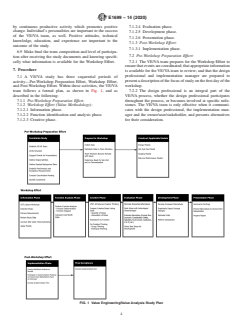
team follows a formal plan, as shown in Fig. 1, and as 7.2.2 The design professional is an integral part of the
described in the following: VE/VA process, whether the design professional participates
7.1.1 Pre-Workshop Preparation Effort. throughout the process, or becomes involved at specific mile-
7.1.2 Workshop Effort (Value Methodology): stones. The VE/VA team is only effective when it communi-
7.1.2.1 Information phase. cates with the design professional, the implementation man-
7.1.2.2 Function identification and analysis phase. ager and the owner/user/stakeholder, and presents alternatives
7.1.2.3 Creative phase. for their consideration.
FIG. 1 Value Engineering/Value Analysis Study Plan
E1699 − 14 (2020)
7.2.3 Preparing for the Workshop Effort, the VSTL coordi- 7.2.8.2 With information provided by the owner, implemen-
nates the VE/VA study sched
...