

ASTM E2103/E2103M-19
(Classification)Standard Classification for Bridge Elements—UNIFORMAT II
General Information
- Abstract
SIGNIFICANCE AND USE
4.1 This classification builds on the concepts and organizational framework first established in Classification E1557. This classification describes bridge elements that are major components of most highway, railroad, and pedestrian bridges. The elemental classification is the common thread linking activities and participants in a bridge project from initial planning through operations, maintenance, and disposal.
Note 1: As this classification refers solely to permanent, physical parts of any construction, two additional classifications, Classifications E2083 and E2168, need to be included when calculating construction cost. These standards provide for the inclusion of construction enabling, temporary, and risk mitigation cost figures. Procedures for reporting all these figures are described in Practices E1804 and E2514 and Classification E2516. While these three latter standards were primarily written for building construction, they are nonetheless appropriate and readily applied to other forms of construction as well.
4.2 The Users of Bridge UNIFORMAT II Include:
4.2.1 Financial and Investment—Typically owners, developers, bankers, lenders, accountants, and financial managers.
4.2.2 Implementation—Primarily project managers; facilities programmers; designers, including engineers; and project controls specialists, including cost planners, estimators, schedulers, specification writers, and risk analysts.
4.2.3 Facilities Management—Comprising property portfolio managers, operating staff, and maintenance staff.
4.2.4 Others—Public officials, manufacturers, educators, students, and other project stakeholders.
4.3 Apply This Classification When Undertaking the Following Work on Bridges:5
4.3.1 Financing and Investing:
4.3.1.1 Structuring costs on an elemental basis for economic evaluations (Guide E1185 and Practices E917, E964, E1057, E1074, E1121, and E1804) early in the design process helps reduce the cost of early financial analysis and ca...
SCOPE
1.1 This standard establishes a classification of bridge elements within the UNIFORMAT II family of elemental classifications. It covers most highway bridges, railroad bridges, and pedestrian bridges.
1.2 UNIFORMAT II classifications have an elemental format similar to the original UNIFORMAT2 building elemental classification. However, the title UNIFORMAT II differs from the original in that it now takes into consideration a wide range of constructed entities that collectively form the built environment.
1.3 Elements, as defined here and in other UNIFORMAT II Classifications, are major physical components that are common within constructed entities. Elements perform their given function(s), regardless of the design specification, construction method, or materials used.
1.4 This elemental classification serves as a consistent reference for analysis, evaluation, and monitoring during the feasibility, planning, and design stages when constructing bridges.
1.5 Using UNIFORMAT II elemental classifications ensures a consistency in the economic evaluation of construction projects over time and from project to project.
1.6 UNIFORMAT II classifications also enhance reporting at all stages of a constructed entity’s life cycle—from feasibility and planning through the preparation of working documents, construction, maintenance, rehabilitation, and disposal.
1.7 This classification is unsuitable for process applications or for preparing trade estimates.
1.8 The values stated in either SI units or inch-pound units are to be regarded separately as standard. The values stated in each system are not necessarily exact equivalents; therefore, each system shall be used independently of the other, and values from the two systems shall not be combined.
1.9 This standard does not purport to address all of the safety concerns, if any, associated with its use. It is the responsibility of the user of this standard to esta...
- Status
- Published
- Publication Date
- 30-Jun-2019
- Technical Committee
- E06 - Performance of Buildings
- Drafting Committee
- E06.81 - Building Economics
Overview
ASTM E2103/E2103M-19: Standard Classification for Bridge Elements-UNIFORMAT II is a comprehensive standard developed by ASTM International. It provides a structured framework for classifying the major physical components-termed "elements"-in most highway, railroad, and pedestrian bridges. Adapting the principles from UNIFORMAT II and ASTM E1557, this standard offers a consistent approach for bridge planning, design, cost estimation, and facilities management. By standardizing the terminology and classification of bridge elements, ASTM E2103/E2103M-19 supports uniformity and improves communication among stakeholders throughout a bridge project's entire life cycle.
Key Topics
Bridge Element Classification
The standard subdivides bridge elements into a hierarchical framework:
- Substructure Elements: Including piers, towers, abutments, and various foundation types.
- Superstructure Elements: Covering short and long span assemblies, such as flexural members, diaphragms, cables, truss members, and deck surfaces.
- Protection Elements: Encompassing slope walls, expansion joints, protective coatings, barriers, drainage, lighting, signage, and enclosure systems.
- Sitework Elements: Detailing site preparation, demolition, earthwork, hazardous material handling, environmental restoration, and approach construction.
Application of the Classification
The use of elemental classifications enhances:
- Cost structuring and life-cycle economic evaluations
- Design phase cost planning and control
- Reporting and facility management consistency
- Project scope descriptions and risk analyses
Integration with Other Standards
ASTM E2103/E2103M-19 works in concert with other UNIFORMAT II standards for buildings and construction, such as ASTM E1557, E2083, E2168, and reporting standards like E1804 and E2514.
Limitations
- The classification focuses on permanent bridge components.
- Excludes utilities and moveable bridge types such as drawbridges.
- Not intended for trade estimates or process-oriented applications.
Applications
Who Uses ASTM E2103/E2103M-19?
The robust elemental classification benefits a diverse range of users during various bridge project phases:
- Financial and Investment Professionals: Owners, developers, bankers, and financial managers leverage the standard for reliable project cost structuring and economic evaluations.
- Project Implementation Teams: Project managers, engineers, cost estimators, specification writers, and risk analysts use the framework for budgeting, cost modeling, value engineering workshops, and scheduling.
- Facilities Management: Asset portfolio and maintenance teams utilize the classification to develop structured maintenance records, property condition assessments, and lifecycle reporting databases.
- Public Sector and Educators: Public officials, manufacturers, educators, and students reference the standard for clear, uniform communication and project analysis.
Key Use Cases
- Early-stage cost modeling and financial planning for bridge projects
- Preparation of design and construction schedules based on elemental progression
- Consistent cost reporting and benchmarking across projects and over time
- Coding and referencing of components in CAD and Building Information Modeling (BIM) systems
- Structured documentation for facility maintenance and management
Related Standards
ASTM E2103/E2103M-19 is part of the broader UNIFORMAT II family, and commonly used in conjunction with:
- ASTM E1557 – Building Elements and Related Sitework-UNIFORMAT II
- ASTM E2083 – Building Construction Field Requirements and Office Overhead & Profit
- ASTM E2168 – Allowances, Contingency, and Reserve Sums in Estimating
- ASTM E2514 – Format of Elemental Cost Estimates and Analyses
- ASTM E2516 – Cost Estimate Classification System
- Supporting practices for economic and risk evaluation: E917, E964, E1057, E1074, E1121, E1804, and E1946
For more information or to purchase the latest version, visit ASTM International.
Keywords: ASTM E2103, UNIFORMAT II, bridge element classification, bridge cost estimating, infrastructure planning standards, bridge project lifecycle, facilities management, construction cost control, bridge substructure, bridge superstructure, bridge sitework
Relations
- Effective Date
- 01-Jul-2019
- Effective Date
- 01-Apr-2020
- Effective Date
- 01-Apr-2020
- Effective Date
- 01-Apr-2020
- Effective Date
- 01-Apr-2020
- Effective Date
- 01-Apr-2020
- Effective Date
- 01-Apr-2020
- Effective Date
- 01-Apr-2020
- Effective Date
- 01-Apr-2020
- Effective Date
- 01-Oct-2019
- Refers
ASTM E917-17 - Standard Practice for Measuring Life-Cycle Costs of Buildings and Building Systems - Effective Date
- 01-Sep-2017
- Effective Date
- 01-May-2016
- Effective Date
- 01-Mar-2016
- Effective Date
- 01-Oct-2015
- Effective Date
- 01-Oct-2015
Get Certified
Connect with accredited certification bodies for this standard

Zavod za gradbeništvo Slovenije (ZAG) - Inšpekcija
ZAG inspection body for construction products, structures, and materials.
Sponsored listings
Frequently Asked Questions
ASTM E2103/E2103M-19 is a standard published by ASTM International. Its full title is "Standard Classification for Bridge Elements—UNIFORMAT II". This standard covers: SIGNIFICANCE AND USE 4.1 This classification builds on the concepts and organizational framework first established in Classification E1557. This classification describes bridge elements that are major components of most highway, railroad, and pedestrian bridges. The elemental classification is the common thread linking activities and participants in a bridge project from initial planning through operations, maintenance, and disposal. Note 1: As this classification refers solely to permanent, physical parts of any construction, two additional classifications, Classifications E2083 and E2168, need to be included when calculating construction cost. These standards provide for the inclusion of construction enabling, temporary, and risk mitigation cost figures. Procedures for reporting all these figures are described in Practices E1804 and E2514 and Classification E2516. While these three latter standards were primarily written for building construction, they are nonetheless appropriate and readily applied to other forms of construction as well. 4.2 The Users of Bridge UNIFORMAT II Include: 4.2.1 Financial and Investment—Typically owners, developers, bankers, lenders, accountants, and financial managers. 4.2.2 Implementation—Primarily project managers; facilities programmers; designers, including engineers; and project controls specialists, including cost planners, estimators, schedulers, specification writers, and risk analysts. 4.2.3 Facilities Management—Comprising property portfolio managers, operating staff, and maintenance staff. 4.2.4 Others—Public officials, manufacturers, educators, students, and other project stakeholders. 4.3 Apply This Classification When Undertaking the Following Work on Bridges:5 4.3.1 Financing and Investing: 4.3.1.1 Structuring costs on an elemental basis for economic evaluations (Guide E1185 and Practices E917, E964, E1057, E1074, E1121, and E1804) early in the design process helps reduce the cost of early financial analysis and ca... SCOPE 1.1 This standard establishes a classification of bridge elements within the UNIFORMAT II family of elemental classifications. It covers most highway bridges, railroad bridges, and pedestrian bridges. 1.2 UNIFORMAT II classifications have an elemental format similar to the original UNIFORMAT2 building elemental classification. However, the title UNIFORMAT II differs from the original in that it now takes into consideration a wide range of constructed entities that collectively form the built environment. 1.3 Elements, as defined here and in other UNIFORMAT II Classifications, are major physical components that are common within constructed entities. Elements perform their given function(s), regardless of the design specification, construction method, or materials used. 1.4 This elemental classification serves as a consistent reference for analysis, evaluation, and monitoring during the feasibility, planning, and design stages when constructing bridges. 1.5 Using UNIFORMAT II elemental classifications ensures a consistency in the economic evaluation of construction projects over time and from project to project. 1.6 UNIFORMAT II classifications also enhance reporting at all stages of a constructed entity’s life cycle—from feasibility and planning through the preparation of working documents, construction, maintenance, rehabilitation, and disposal. 1.7 This classification is unsuitable for process applications or for preparing trade estimates. 1.8 The values stated in either SI units or inch-pound units are to be regarded separately as standard. The values stated in each system are not necessarily exact equivalents; therefore, each system shall be used independently of the other, and values from the two systems shall not be combined. 1.9 This standard does not purport to address all of the safety concerns, if any, associated with its use. It is the responsibility of the user of this standard to esta...
SIGNIFICANCE AND USE 4.1 This classification builds on the concepts and organizational framework first established in Classification E1557. This classification describes bridge elements that are major components of most highway, railroad, and pedestrian bridges. The elemental classification is the common thread linking activities and participants in a bridge project from initial planning through operations, maintenance, and disposal. Note 1: As this classification refers solely to permanent, physical parts of any construction, two additional classifications, Classifications E2083 and E2168, need to be included when calculating construction cost. These standards provide for the inclusion of construction enabling, temporary, and risk mitigation cost figures. Procedures for reporting all these figures are described in Practices E1804 and E2514 and Classification E2516. While these three latter standards were primarily written for building construction, they are nonetheless appropriate and readily applied to other forms of construction as well. 4.2 The Users of Bridge UNIFORMAT II Include: 4.2.1 Financial and Investment—Typically owners, developers, bankers, lenders, accountants, and financial managers. 4.2.2 Implementation—Primarily project managers; facilities programmers; designers, including engineers; and project controls specialists, including cost planners, estimators, schedulers, specification writers, and risk analysts. 4.2.3 Facilities Management—Comprising property portfolio managers, operating staff, and maintenance staff. 4.2.4 Others—Public officials, manufacturers, educators, students, and other project stakeholders. 4.3 Apply This Classification When Undertaking the Following Work on Bridges:5 4.3.1 Financing and Investing: 4.3.1.1 Structuring costs on an elemental basis for economic evaluations (Guide E1185 and Practices E917, E964, E1057, E1074, E1121, and E1804) early in the design process helps reduce the cost of early financial analysis and ca... SCOPE 1.1 This standard establishes a classification of bridge elements within the UNIFORMAT II family of elemental classifications. It covers most highway bridges, railroad bridges, and pedestrian bridges. 1.2 UNIFORMAT II classifications have an elemental format similar to the original UNIFORMAT2 building elemental classification. However, the title UNIFORMAT II differs from the original in that it now takes into consideration a wide range of constructed entities that collectively form the built environment. 1.3 Elements, as defined here and in other UNIFORMAT II Classifications, are major physical components that are common within constructed entities. Elements perform their given function(s), regardless of the design specification, construction method, or materials used. 1.4 This elemental classification serves as a consistent reference for analysis, evaluation, and monitoring during the feasibility, planning, and design stages when constructing bridges. 1.5 Using UNIFORMAT II elemental classifications ensures a consistency in the economic evaluation of construction projects over time and from project to project. 1.6 UNIFORMAT II classifications also enhance reporting at all stages of a constructed entity’s life cycle—from feasibility and planning through the preparation of working documents, construction, maintenance, rehabilitation, and disposal. 1.7 This classification is unsuitable for process applications or for preparing trade estimates. 1.8 The values stated in either SI units or inch-pound units are to be regarded separately as standard. The values stated in each system are not necessarily exact equivalents; therefore, each system shall be used independently of the other, and values from the two systems shall not be combined. 1.9 This standard does not purport to address all of the safety concerns, if any, associated with its use. It is the responsibility of the user of this standard to esta...
ASTM E2103/E2103M-19 is classified under the following ICS (International Classification for Standards) categories: 93.040 - Bridge construction. The ICS classification helps identify the subject area and facilitates finding related standards.
ASTM E2103/E2103M-19 has the following relationships with other standards: It is inter standard links to ASTM E2103/E2103M-13, ASTM E1074-15(2020)e1, ASTM E964-15(2020)e1, ASTM E1185-15(2020)e1, ASTM E1557-09(2020)e1, ASTM E1369-15(2020)e1, ASTM E1057-15(2020)e1, ASTM E1121-15(2020)e1, ASTM E2691-20, ASTM E2516-11(2019), ASTM E917-17, ASTM E2083-05(2016), ASTM E2691-16, ASTM E1185-15, ASTM E1369-15. Understanding these relationships helps ensure you are using the most current and applicable version of the standard.
ASTM E2103/E2103M-19 is available in PDF format for immediate download after purchase. The document can be added to your cart and obtained through the secure checkout process. Digital delivery ensures instant access to the complete standard document.
Standards Content (Sample)
This international standard was developed in accordance with internationally recognized principles on standardization established in the Decision on Principles for the
Development of International Standards, Guides and Recommendations issued by the World Trade Organization Technical Barriers to Trade (TBT) Committee.
Designation:E2103/E2103M −19
Standard Classification for
Bridge Elements—UNIFORMAT II
ThisstandardisissuedunderthefixeddesignationE2103/E2103M;thenumberimmediatelyfollowingthedesignationindicatestheyear
of original adoption or, in the case of revision, the year of last revision. A number in parentheses indicates the year of last reapproval.
A superscript epsilon (´) indicates an editorial change since the last revision or reapproval.
1. Scope each system shall be used independently of the other, and
values from the two systems shall not be combined.
1.1 This standard establishes a classification of bridge
1.9 This standard does not purport to address all of the
elements within the UNIFORMAT II family of elemental
safety concerns, if any, associated with its use. It is the
classifications. It covers most highway bridges, railroad
responsibility of the user of this standard to establish appro-
bridges, and pedestrian bridges.
priate safety, health, and environmental practices and deter-
1.2 UNIFORMAT II classifications have an elemental for-
mine the applicability of regulatory limitations prior to use.
mat similar to the original UNIFORMAT building elemental
1.10 This international standard was developed in accor-
classification. However, the title UNIFORMAT II differs from
dance with internationally recognized principles on standard-
the original in that it now takes into consideration a wide range
ization established in the Decision on Principles for the
of constructed entities that collectively form the built environ-
Development of International Standards, Guides and Recom-
ment.
mendations issued by the World Trade Organization Technical
1.3 Elements, as defined here and in other UNIFORMAT II
Barriers to Trade (TBT) Committee.
Classifications, are major physical components that are com-
mon within constructed entities. Elements perform their given
2. Referenced Documents
function(s), regardless of the design specification, construction
2.1 ASTM Standards:
method, or materials used.
E631 Terminology of Building Constructions
1.4 This elemental classification serves as a consistent
E833 Terminology of Building Economics
reference for analysis, evaluation, and monitoring during the
E917 Practice for Measuring Life-Cycle Costs of Buildings
feasibility, planning, and design stages when constructing
and Building Systems
bridges.
E964 Practice for Measuring Benefit-to-Cost and Savings-
to-Investment Ratios for Buildings and Building Systems
1.5 UsingUNIFORMATIIelementalclassificationsensures
E1057 Practice for Measuring Internal Rate of Return and
a consistency in the economic evaluation of construction
Adjusted Internal Rate of Return for Investments in
projects over time and from project to project.
Buildings and Building Systems
1.6 UNIFORMAT II classifications also enhance reporting
E1074 Practice for Measuring Net Benefits and Net Savings
at all stages of a constructed entity’s life cycle—from feasibil-
for Investments in Buildings and Building Systems
ity and planning through the preparation of working
E1121 Practice for Measuring Payback for Investments in
documents, construction, maintenance, rehabilitation, and dis-
Buildings and Building Systems
posal.
E1185 Guide for Selecting Economic Methods for Evaluat-
1.7 This classification is unsuitable for process applications
ing Investments in Buildings and Building Systems
or for preparing trade estimates.
E1369 Guide for Selecting Techniques for Treating Uncer-
tainty and Risk in the Economic Evaluation of Buildings
1.8 The values stated in either SI units or inch-pound units
and Building Systems
are to be regarded separately as standard. The values stated in
E1699 Practice for Performing Value Engineering (VE)/
each system are not necessarily exact equivalents; therefore,
Value Analysis (VA) of Projects, Products and Processes
E1804 Practice for Performing and Reporting CostAnalysis
1 During the Design Phase of a Project
This classification is under the jurisdiction of ASTM Committee E06 on
Performance of Buildings and is the direct responsibility of Subcommittee E06.81
on Building Economics.
Current edition approved July 1, 2019. Published September 2019. Originally
approved in 2000. Last previous edition approved in 2013 as E2103/E2103M–13. For referenced ASTM standards, visit the ASTM website, www.astm.org, or
DOI: 10.1520/E2103_E2103M–19. contact ASTM Customer Service at service@astm.org. For Annual Book of ASTM
The original UNIFORMAT classification was developed jointly by the General Standards volume information, refer to the standard’s Document Summary page on
Services Administration (GSA) and the American Institute of Architects (AIA). the ASTM website.
Copyright © ASTM International, 100 Barr Harbor Drive, PO Box C700, West Conshohocken, PA 19428-2959. United States
E2103/E2103M−19
E1946 Practice for Measuring Cost Risk of Buildings and 4.2.3 Facilities Management—Comprising property portfo-
Building Systems and Other Constructed Projects lio managers, operating staff, and maintenance staff.
E2013 Practice for Constructing FAST Diagrams and Per-
4.2.4 Others—Public officials, manufacturers, educators,
forming Function Analysis During Value Analysis Study students, and other project stakeholders.
E2506 Guide for Developing a Cost-Effective Risk Mitiga-
4.3 Apply This Classification When Undertaking the Fol-
tion Plan for New and Existing Constructed Facilities 5
lowing Work on Bridges:
E2691 Practice for Job Productivity Measurement
4.3.1 Financing and Investing:
2.1.1 ASTM UNIFORMAT II Classification Standards Fam-
4.3.1.1 Structuringcostsonanelementalbasisforeconomic
ily:
evaluations (Guide E1185 and Practices E917, E964, E1057,
E1557 Classification for Building Elements and Related
E1074, E1121, and E1804) early in the design process helps
Sitework—UNIFORMAT II
reduce the cost of early financial analysis and can contribute to
E2083 Classification for Building Construction Field
substantial design and operational savings before decisions
Requirements, and Office Overhead & Profit
have been made that limit options for potential savings.
E2168 Classification for Allowance, Contingency, and Re-
4.3.2 Implementing:
serve Sums in Building Construction Estimating
4.3.2.1 Cost Modeling, Cost Planning, Estimating and Con-
E2514 Practice for Presentation Format of Elemental Cost
trolling Project Time and Cost During Planning, Design, and
Estimates, Summaries, and Analyses
Construction—Use the bridge UNIFORMAT II classification
E2516 Classification for Cost Estimate Classification
to prepare budgets and to establish elemental cost plans before
,
System
design begins. Project managers and project controls special-
2.2 ASTM Adjuncts:
ists use these cost plans against which to measure and control
AdjuncttoE917PracticeforMeasuringLife-CycleCostsof
project cost, and quality, and to set design-to-cost targets.
BuildingsandBuildingSystems-IncludesExcelandPDF
4.3.2.2 Conducting Value Engineering Workshops—
Files
Conductingvalueengineeringworkshops(PracticesE1699and
E2013). Use this classification as a checklist to ensure that
3. Terminology
alternatives for all elements of significant cost in the bridge
3.1 Definitions—For definitions of general terms related to
project are analyzed in the creativity phase of the job plan.
building construction used in this classification, refer to Ter-
Also, use the elemental cost data to expedite the development
minology E631, and for general terms related to building
of cost models for bridge systems.
economics, refer to Terminology E833.
4.3.2.3 Developing Initial Project Master Schedules—Since
projects are essentially built element by element, UNIFOR-
4. Significance and Use
MAT II classifications are an appropriate basis for preparing
4.1 This classification builds on the concepts and organiza- construction schedules at the start of the design process.
Projectmanagersandprojectcontrolsspecialistsusethesetime
tionalframeworkfirstestablishedinClassificationE1557.This
classification describes bridge elements that are major compo- plans against which to measure and control project time
(Practice E2691), and to set milestone target dates.
nents of most highway, railroad, and pedestrian bridges. The
elemental classification is the common thread linking activities 4.3.2.4 Performing Risk Analyses—Simulation (Guides
and participants in a bridge project from initial planning E1369 and E2506) is one technique for developing probability
through operations, maintenance, and disposal. distributionsofbridgecostswhenevaluatingtheeconomicrisk
in undertaking a bridge project. Use individual elements and
NOTE1—Asthisclassificationreferssolelytopermanent,physicalparts
group elements in this classification for developing probability
of any construction, two additional classifications, Classifications E2083
distributions of elemental costs. From these distributions, build
and E2168, need to be included when calculating construction cost.These
standards provide for the inclusion of construction enabling, temporary,
up probability distributions of total costs to establish project
and risk mitigation cost figures. Procedures for reporting all these figures
contingencies (Practice E1946 and Classification E2168)orto
are described in Practices E1804 and E2514 and Classification E2516.
serve as inputs to an economic analysis.
While these three latter standards were primarily written for building
4.3.2.5 Structuring Preliminary Project Descriptions Dur-
construction, they are nonetheless appropriate and readily applied to other
ing the Conceptual Design Phase—This classification facili-
forms of construction as well.
tates the description of the scope of the project in a clear,
4.2 The Users of Bridge UNIFORMAT II Include:
concise, and logical sequence for presentation to the client; it
4.2.1 Financial and Investment—Typically owners,
provides the basis for the preparation of more detailed elemen-
developers, bankers, lenders, accountants, and financial man-
tal estimates during the early concept and preliminary design
agers.
4.2.2 Implementation—Primarily project managers; facili-
ties programmers; designers, including engineers; and project
controls specialists, including cost planners, estimators,
For a more comprehensive discussion of the uses of UNIFORMAT II, see
Bowen, Charette, and Marshall, UNIFORMAT II—A Recommended Classification
schedulers, specification writers, and risk analysts.
for Building Elements and Related Sitework, National Institute of Standards and
Technology Special Publication 841, Gaithersburg, MD, 1992; and Charette and
Marshall, UNIFORMAT II Elemental Classification for Building Specifications,
Available from ASTM International Headquarters. Order Adjunct No. Cost Estimating, and Cost Analysis, National Institute of Standards andTechnology
ADJE091717-EA. Original adjunct produced in 1984.Adjunct last revised in 2017. NISTIR 6389, Gaithersburg, MD, 1999.
E2103/E2103M−19
phases, and it enhances communication between designers and 5.1.1 This bridge classification is applicable to most types
clients by providing a clear statement of the designer’s intent. of highway, railroad, and pedestrian bridges crossing over
4.3.2.6 Coding and Referencing Standard Details In highways, railroads, walkways, and waterways. The classifica-
Computer-Aided Design Systems—This classification allows a tion includes slab bridges; beam/girder bridges; truss bridges;
designer, for example, to reference an assembly according to true and tied-arch bridges; cable-stayed bridges; and suspen-
this classification’s element designations and build up a data- sion bridges. The classification does not include the following
base of standard details. This is particularly appropriate to movable bridge types: draw bridges; lift bridges; and bascule
design modeling and building information modeling (BIM) bridges.
applications.
5.2 The classification is consistent with typical costing
4.3.3 Managing Facilities:
practices used at the conceptual design phase.
4.3.3.1 Recording and writing property condition assess-
ment reports in a structured way, using UNIFORMAT II 5.3 Each element has a significant impact on the cost, and it
classifications, provides for a consistent, accessible, and usually occurs frequently.
searchable database of real property inventory.
5.4 Each element performs a specific function.
4.3.4 Other Activities:
4.3.4.1 Structuring cost manuals and recording
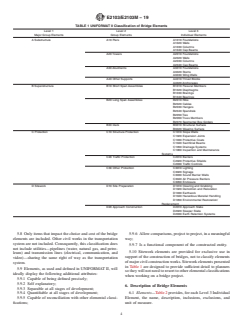
5.5 Table 1 divides the classification of bridge elements into
construction, operating, and maintenance costs in a computer
three hierarchical levels: Level 1—Major Group Elements,
database. Having a cost manual or computer database in an
Level 2—Group Elements, and Level 3—Individual Elements.
elemental format assists the preparation of an economic
The major groups are listed in the normal chronological order
analysis early in the design stage and at a reasonable cost.
of construction.
5.6 Sub-Classifications are named Sub-Elements and com-
5. Basis of Classification
prise as many hierarchical levels (Level 4 and below) as are
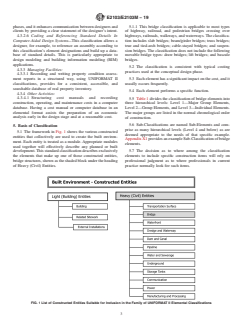
5.1 The framework in Fig. 1 shows the various constructed
deemed appropriate to the needs of that specific example.
entities that collectively are used to create the built environ-
AppendixX1providesanexampleSub-Classificationofbridge
ment. Each entity is treated as a module.Appropriate modules
elements.
used together will effectively describe any planned or built
development.Thisstandardclassificationdescribesexclusively 5.7 The decision as to where among the classification
the elements that make up one of those constructed entities, elements to include specific construction items will rely on
bridgestructures,shownastheshadedblockundertheheading professional judgment as to where professionals in current
of Heavy (Civil) Entities. practice normally look for such items.
FIG. 1List of Constructed Entities Suitable for Inclusion in the Family of UNIFORMAT II Elemental Classifications
E2103/E2103M−19
TABLE 1 UNIFORMAT II Classification of Bridge Elements
Level 1 Level 2 Level 3
Major Group Elements Group Elements Individual Elements
A Substructure A10 Piers A1010 Foundations
A1020 Walls
A1030 Columns
A1040 Cap Beams
A20 Towers A2010 Foundations
A2020 Walls
A2030 Columns
A2040 Cap Beams
A30 Abutments A3010 Foundations
A3020 Stems
A3030 Wing Walls
A40 Other Supports A4010 Thrust Blocks
A4020 Anchorages
B Superstructure B10 Short Span Assemblies B1010 Flexural Members
B1020 Diaphragms
B1030 Bracings
B1040 Bearings
B20 Long Span Assemblies B2010 Ribs
B2020 Cables
B2030 Hangers
B2040 Spandrels
B2050 Ties
B2060 Truss Members
B2070 Segmental Box Girders
B30 Deck B3010 Structural Surface
B3020 Wearing Surface
C Protection C10 Structure Protection C1010 Slope Walls
C1020 Expansion Joints
C1030 Protective Coats
C1040 Sacrificial Beams
C1050 Drainage Systems
C1060 Inspection and Maintenance
Systems
C20 Traffic Protection C2010 Barriers
C2020 Protective Shields
C2030 Traffic Controls
C30 Other Protection C3010 Lighting
C3020 Signage
C3030 Sound Barrier Walls
C3040 Air Pressure Barriers
C3050 Enclosure
D Sitework D10 Site Preparation D1010 Clearing and Grubbing
D1020 Demolition and Relocation
D1030 Earthwork
D1040 Hazardous Material Handling
D1050 Environmental Restoration/
Replacement
D20 Approach Construction D2010 Approach Slabs
D2020 Sleeper Slabs
D2030 Earth Retention Systems
5.8 Only items that impact the choice and cost of the bridge 5.9.6 Allowcomparisons,projecttoproject,inameaningful
elements are included. Other civil works in the transportation way;
system are not included. Consequently, this classification does
5.9.7 Is a functional component of the constructed entity.
not include utilities—pipelines (water, natural gas, and petro-
5.10 Sitework elements are provided for exclusive use in
leum) and transmission lines (electrical, communication, and
support of the construction of bridges, not to classify elements
video)—sharing the same right of way as the transportation
ofmajorcivilconstructionworks.Siteworkelementspresented
system.
in Table 1 are designed to provide sufficient detail to planners
5.9 Elements, as used and defined in UNIFORMAT II, will
so they will not need to resort to other elemental classifications
ideally display the following additional attributes:
when working on a bridge project.
5.9.1 Capable of being defined precisely;
5.9.2 Self explanatory;
6. Description of Bridge Elements
5.9.3 Separable at all stages of development;
5.9.4 Quantifiable at all stages of development; 6.1 Elements—Table2provides,foreachLevel3Individual
5.9.5 Capable of reconciliation with other elemental classi- Element, the name, description, inclusions, exclusions, and
fications; unit of measure.
E2103/E2103M−19
TABLE2 Continued
TABLE 2 Description of UNIFORMAT II Bridge Elements
Description Stems are usually supported on piles; they partially or
A SUBSTRUCTURE
fully retain earth behind, support the ends of the first
A10 Piers
and last spans of the bridge, and support the
A1010 Foundations
approach slab.
Description Foundations are structures that transfer the load of
Includes Bridge seat, reinforcing, concrete, and finishing
the bridge substructures to the ground. They may be
Excludes Slope wall, foundation, and anchor bolts and bearings
spread footings, piles, or drilled shafts. The type
(see Foundations, Barriers, Slope Wall, Bearings)
depends upon the soil conditions.
3 3
Unit of Measure m [yd ]orkg[lb]
Includes Excavation and backfilling
A3030 Wing Walls
Excludes
3 3
Description Wing walls (parallel, perpendicular, or angled) are
Unit of Measure m [yd ] or m [ft]
structures connected to the abutment and supported
A1020 Walls
by piles that retain the embankment below the
Description Walls are structures that support the columns; in
approach road.
addition to transferring the load from the columns to
Includes Reinforcing, concrete, and finishing
the foundation, they protect the pier against impacts
Excludes Approach slab and parapet (see Approach Slab,
from vehicles, vessels, and debris.
Barriers)
Includes
3 3
Unit of Measure m [yd ]
Excludes
3 3
A SUBSTRUCTURE
Unit of Measure m [yd ]orkg[lb]
A40 Other Supports
A1030 Columns
A4010 Thrust Blocks
Description Columns are structures that support the cap beam
Description Thrust blocks are a special substructure of a true
and transfer the load from the cap beam to the wall
arch bridge that receive loads from the ribs and
below.
transfer loads to the foundation.
Includes
Includes Structure excavation, reinforcing, concrete, and
Excludes
3 3
finishing
Unit of Measure m [yd ]orkg[lb]
Excludes Furnishing and installation of anchor bolts, bearing
A1040 Cap Beams
plates, utility relocation (see Demolition and
Description Cap beams are structures that receive and transfer
Relocation, Flexural Members)
beam loads from the deck to the bridge columns.
3 3
Unit of Measure m [yd ]
Includes Bridge seat
A4020 Anchorages
Excludes Bearings and anchor bolts (see Bearings, Flexural
Description Anchorages are a special substructure to which the
Members)
3 3
weight of the deck and supporting superstructure is
Unit of Measure m [yd ]orkg[lb]
secured via cables and steel eye bars imbedded in
A SUBSTRUCTURE
solid rock or massive concrete blocks.
A20 Towers
Includes Structure excavation, reinforcing, concrete, finishing,
A2010 Foundations
and cable support (Steel Eye Bar)
Description Foundations are structures that transfer the load of
Excludes
the bridge substructures to the ground. They may be
3 3
Unit of Measure m [yd ]
spread footings, piles, or drilled shafts. The type
B SUPERSTRUCTURE
depends upon the soil conditions.
B10 Short Span
Includes Excavation and backfilling
Assemblies
Excludes
3 3
B1010 Flexural Members
Unit of Measure m [yd ] or m [ft]
Description Flexural members are commonly known as beams
A2020 Walls
and girders that support the bridge deck. When the
Description Walls are structures that support the columns; in
depth of the girder is shallow, it is referred to as a
addition to transferring the load from the columns to
beam.
the foundation, they protect the pier against impacts
Includes Fabrication and installation of beams and girders
from vehicles, vessels, and debris.
Excludes Diaphragms, bracings, bearings (see Diaphragms,
Includes
Bracings, Bearings)
Excludes
3 3
Unit of Measure kg [lb] or m [ft]
Unit of Measure m [yd ]orkg[lb]
B1020 Diaphragms
A2030 Columns
Description Diaphragms are braces for shallow-depth beams.
Description Columns are structures that support the cap beam
Includes
and transfer the load from the cap beam to the wall
Excludes
below.
3 3
Unit of Measure kg [lb] or m [yd ]
Includes
B1030 Bracings
Excludes
3 3
Description Bracings are steel angles used to brace deep-depth
Unit of Measure m [yd ]orkg[lb]
girders.
A2040 Cap Beams
Includes Fabrication and erection of structural steel angles
Description Cap beams are structures that receive and transfer
Excludes
beam loads from the deck to the bridge columns.
Unit of Measure kg [lb]
Includes Bridge seat
B1040 Bearings
Excludes Bearings and anchor bolts (see Bearings, Flexural
Description Bearings are mechanical systems that transfer
Members)
3 3
vertical and longitudinal forces; expansion bearings
Unit of Measure m [yd ]orkg[lb]
allow rotational and longitudinal movement, whereas
A SUBSTRUCTURE
fixed bearings allow only rotational movement.
A30 Abutments
Includes Fabrication and erection of bearings and anchor bolts
A3010 Foundations
Excludes Bridge seat (see Cap Beams, Stem Abutments)
Description Foundations are structures that transfer the load of
Unit of Measure EACH
the bridge substructures to the ground. They may be
B SUPERSTRUCTURE
spread footings, piles, or drilled shafts. The type
B20 Long Span
depends upon the soil conditions.
Assemblies
Includes Excavation and backfilling
B2010 Ribs
Excludes
3 3
Description Ribs are rectangular-, square-, or circular-shaped
Unit of Measure m [yd ] or m [ft]
parts of the superstructure for arch bridges; they
A3020 Stems
receive loads from hangers and spandrels and
transfer them to the foundation.
E2103/E2103M−19
TABLE2 Continued TABLE2 Continued
Includes Description Expansion joints allow expansion and contraction of
Excludes Bracings, bearings (see Bracings, Bearings) the slab while keeping the substructure stationary.
3 3
Includes Furnishing and installation of expansion joint support
Unit of Measure kg [lb], or m [yd ], or m [ft]
B2020 Cables and expansion joint
Excludes
Description Cables, made of steel wires bound together and
draped over towers to anchors at each cable end, Unit of Measure m [ft]
receive through hangars the load from the deck. C1030 Protective Coats
Includes Fabrication and installation of cables, cable support Description Protective coats are paints, sealants, or preservatives
Excludes Anchorage (see Anchorage) that are applied to concrete surfaces of the bridge.
Unit of Measure m [ft] Includes Minor repair work, cleaning surface, and coating
B2030 Hangers Excludes Major repair work to other bridge elements
2 2
Description Hangers are rods or strands that connect the deck to Unit of Measure m [yd ]
the ribs (arch bridges) or the main cable (cable- C1040 Sacrificial Beams
stayed or suspension bridges); they receive loads Description Sacrificial beams have a lower clearance than the
from the deck and transfer loads to the ribs or main main beams to ensure that excessive-height vehicles
cable in tension. will hit the sacrificial beam before impacting the main
Includes Splices (rod), strand assembly, protection beams.
Excludes End connections (see Flexural Members and Ribs) Includes Fabrication and erection of structural steel, stiffeners,
Unit of Measure m [ft] splices, and other connections
Excludes Bracings, bearings (see Bracings, Bearings)
B2040 Spandrels
Description Spandrels are concrete or steel members that Unit of Measure kg [lb]
connect the deck to the ribs (arch bridges); they C1050 Drainage Systems
receive loads from the deck and transfer loads to the Description Drainage systems are scuppers to drain the bridge
ribs in compression. They are below the deck and deck, downspouts to carry off the water from the
above the rib. scuppers, and buried drains behind abutments and
Includes Concrete or steel members, protection adjacent to sleeper slabs.
Excludes End connections (see Flexural Members and Ribs) Includes Fabrication and installation of scuppers, drain tiles,
Unit of Measure m [ft] drain pipes, and related earthwork
B2050 Ties Excludes Structural surface (see Structural Surface)
Description A tie is a horizontal tension member that connects the Unit of Measure EACH or m [ft]
two ends of the compression ribs of an arch bridge C1060 Inspection and Maintenance Systems
and balances the horizontal thrust. Description These systems include platforms, railings, stairways,
Includes Fabrication and erection of structural steel, stiffeners, and hoist ways to facilitate inspection and
splices, and other connections maintenance.
Excludes Hangers, bearings (see Bearings, Hangers and Includes Handrails or other type of barriers
Spandrels) Excludes
2 2
Unit of Measure kg [lb]
Unit of Measure m [yd ]
B2060 Truss Members C PROTECTION
Description Truss members, connected at nodes by plates, are C20 Traffic Protection
two-dimensional structures that support the C2010 Barriers
superstructure. Description Barriers are structures designed to: withstand forces
Includes Splices and other connections due to crashes; separate the opposing traffic; and
Excludes Bracings, bearings (see Bracings, Bearings) protect bridge structures adjacent to live traffic.
3 3
Unit of Measure kg [lb], or m [yd ], or m [ft] Includes Noise wall support, or light pole support
B2070 Segmental Box Girders Excludes
3 3
Description Segmental box girders are concrete box sections with Unit of Measure m [yd ]
or without overhanging flanges. The segments are C2020 Protective Shields
precast sections which are post tensioned in the field.
Description Protective shields are barriers below the bridge deck
Includes Post tensioning to protect traffic below from falling objects.
Excludes Bracings, bearings (see Bracings, Bearings)
Includes Membranes and supports designed to catch falling
Unit of Measure m [ft] objects
B SUPERSTRUCTURE Excludes
2 2
B30 Deck Unit of Measure m [yd ]
B3010 Structural Surface C2030 Traffic Controls
Description The structural surface supports the wearing surface Primary Function Manage Traffic
and traffic. Secondary Function
Includes Reinforcing, concrete, and finishing Tertiary Function
Excludes Expansion joint assembly, parapet, barriers (see Description Traffic controls are an assembly of signals, supports,
Expansion Joints, Barriers, Drainage Systems) and conduits.
3 3
Unit of Measure m [yd ] or EACH Includes Power source and related items
B3020 Wearing Surface
Excludes
Description The wearing surface is the part of the road or rail Unit of Measure EACH
system that comes into contact with the vehicle or
C PROTECTION
train car wheels. C30 Other Protection
Includes Concrete or asphalt overlay or rails, striping, marking, C3010 Lighting
Excludes Description Lighting is illumination from fixtures that provide
2 2
Unit of Measure m [yd ] vehicle traffic direction, ship navigation direction, task
C PROTECTION lighting, and vandalism discouragement.
C10 Structure Protection Includes Fabrication and installation of mast, lights, base
C1010 Slope Walls plates, and power
Description Slope walls, made of stone, concrete, gravel, or Excludes Base support (see Barriers)
gravel with asphalt mix, support the sloped surface
Unit of Measure EACH
and protect the bridge abutment. C3020 Signage
Includes Reinforcing, concrete, and finishing
Description Signage is the provision of information through
Excludes Excavation and backfill (see Earthwork) electronic or printed message boards.
2 2
Unit of Measure m [yd ] Includes Fabrication and installation of sign and support, and
C1020 Expansion Joints power
E2103/E2103M−19
TABLE2 Continued TABLE2 Continued
Excludes Description An approach slab, supported by the bridge abutment
Unit of Measure EACH on one side and a sleeper slab or soil on the other,
provides a smooth transition between the roadway
C3030 Sound Barrier Walls
Description A sound barrier wall is a structure to mask traffic and the bridge, and spans any settlement gap
between the abutment and the roadway.
noise from the surrounding neighborhood.
Includes Wall panel, support, and connection to barrier Includes Granular fill, drain tiles, concrete, reinforcing, and
finishing
Excludes Base (see Barriers)
2 2
Unit of Measure m [yd ] Excludes Barrier and wing wall (see Barriers, Wing Walls)
2 2
Unit of Measure m [yd ]
C3040 Air Pressure Barriers
Description Air pressure barriers are structures to mitigate the D2020 Sleeper Slabs
impact of significant air pressure differentials created Description Sleeper slabs are rectangular concrete foundations
by the passing of high speed transportation vehicles. that support approach slabs.
Includes Barriers mounted on bridges to mitigate the impact of Includes Excavation and backfill, concrete, reinforcing and
air pressure differentials. finishing
Excludes Base (see Barriers) Excludes Approach slab (see Approach Slabs)
2 2 3 3
Unit of Measure m [yd ] Unit of Measure m [yd ]
C3050 Enclosure D2030 Earth Retention Systems
Description Earth retention systems are designed to support
Description An enclosure is a vertical envelope with roof to
protect pedestrians and traffic crossing over a bridge. embankments when the grades are not uniform.
Includes Its foundation and wall
Includes Structural and architectural members to contain
pedestrians and traffic with expansion joints at the Excludes Excavation and backfill (see Earthwork)
3 3 2 2
ends Unit of Measure m [yd ]orm [yd ]
Excludes
2 2
Unit of Measure m [yd ]
D SITEWORK
D10 Site Preparation
D1010 Clearing and Grubbing
Description Clearing is the removal from the construction site of
trees and abandoned utilities, and the grading and
6.2 Description—The element descriptions help you under-
leveling of the site. Grubbing is the removal of stumps
and tree roots. stand the purpose and application of the element.
Includes Tree removal, abandoned utilities, minor earthwork
Excludes Major earth work and major utility removal (see 6.3 Includes—The purpose of the element inclusions is to
Demolition and Relocation, Earthwork)
list features that make up the element.
Unit of Measure EACH or Hectare (Acre)
D1020 Demolition and Relocation
6.4 Excludes—The purpose of the element exclusions is to
Description Demolition is the complete or partial (for example,
deck or superstructure) removal of an existing bridge, list features that are not included in the element, but which are
carried out on the whole bridge at once or by
included elsewhere in this classification.
removing a portion of the deck or superstructure in
stages to maintain traffic; relocation is the removal
NOTE 2—Because this classification refers solely to permanent physical
and reinstallation of utilities.
parts of bridge constructions, references to construction enabling equip-
Includes Removal of bridge elements and disposal, relocation
of utilities such as storm sewer ment (cranes, formwork, etc.), temporary construction (cofferdams, traffic
Excludes
detours, etc.), and risk mitigation (allowances and contingencies) cost
Unit of Measure EACH
figures are omitted from the element exclusions.
D1030 Earthwork
Description Earthwork is excavation, placement, and compaction
6.5 Unit of Measure—The purpose of the unit of measure is
of material to raise the bridge profile (material is
to provide a means for calculating the magnitude, or size, of
hauled in and compacted) and to lower the bridge
profile (material is excavated and hauled away). each element in any transportation surface description; units of
Includes
...
This document is not an ASTM standard and is intended only to provide the user of an ASTM standard an indication of what changes have been made to the previous version. Because
it may not be technically possible to adequately depict all changes accurately, ASTM recommends that users consult prior editions as appropriate. In all cases only the current version
of the standard as published by ASTM is to be considered the official document.
Designation: E2103/E2103M − 13 E2103/E2103M − 19
Standard Classification for
Bridge Elements—UNIFORMAT II
This standard is issued under the fixed designation E2103/E2103M; the number immediately following the designation indicates the year
of original adoption or, in the case of revision, the year of last revision. A number in parentheses indicates the year of last reapproval.
A superscript epsilon (´) indicates an editorial change since the last revision or reapproval.
1. Scope
1.1 This standard establishes a classification of bridge elements within the UNIFORMAT II family of elemental classifications.
It covers most highway bridges, railroad bridges, and pedestrian bridges.
1.2 UNIFORMAT II classifications have an elemental format similar to the original UNIFORMAT building elemental
classification. However, the title UNIFORMAT II differs from the original in that it now takes into consideration a wide range of
constructed entities that collectively form the built environment.
1.3 Elements, as defined here and in other UNIFORMAT II Classifications, are major physical components that are common
within constructed entities. Elements perform their given function(s), regardless of the design specification, construction method,
or materials used.
1.4 This elemental classification serves as a consistent reference for analysis, evaluation, and monitoring during the feasibility,
planning, and design stages when constructing bridges.
1.5 Using UNIFORMAT II elemental classifications ensures a consistency in the economic evaluation of construction projects
over time and from project to project.
1.6 UNIFORMAT II classifications also enhance reporting at all stages of a constructed entity’s life cycle—from feasibility and
planning through the preparation of working documents, construction, maintenance, rehabilitation, and disposal.
1.7 This classification is unsuitable for process applications or for preparing trade estimates.
1.8 The values stated in either SI units or inch-pound units are to be regarded separately as standard. The values stated in each
system mayare not benecessarily exact equivalents; therefore, each system shall be used independently of the other.
Combiningother, and values from the two systems may result in non-conformance with the standard.shall not be combined.
1.9 This standard does not purport to address all of the safety concerns, if any, associated with its use. It is the responsibility
of the user of this standard to establish appropriate safety safety, health, and healthenvironmental practices and determine the
applicability of regulatory limitations prior to use.
1.10 This international standard was developed in accordance with internationally recognized principles on standardization
established in the Decision on Principles for the Development of International Standards, Guides and Recommendations issued
by the World Trade Organization Technical Barriers to Trade (TBT) Committee.
2. Referenced Documents
2.1 ASTM Standards:
E631 Terminology of Building Constructions
E833 Terminology of Building Economics
E917 Practice for Measuring Life-Cycle Costs of Buildings and Building Systems
E964 Practice for Measuring Benefit-to-Cost and Savings-to-Investment Ratios for Buildings and Building Systems
E1057 Practice for Measuring Internal Rate of Return and Adjusted Internal Rate of Return for Investments in Buildings and
Building Systems
E1074 Practice for Measuring Net Benefits and Net Savings for Investments in Buildings and Building Systems
This classification is under the jurisdiction of ASTM Committee E06 on Performance of Buildings and is the direct responsibility of Subcommittee E06.81 on Building
Economics.
Current edition approved May 1, 2013July 1, 2019. Published May 2013September 2019. Originally approved in 2000. Last previous edition approved in 20112013 as
E2103 – 11.E2103/E2103M–13. DOI: 10.1520/E2103_E2103M-13.10.1520/E2103_E2103M–19.
The original UNIFORMAT classification was developed jointly by the General Services Administration (GSA) and the American Institute of Architects (AIA).
For referenced ASTM standards, visit the ASTM website, www.astm.org, or contact ASTM Customer Service at service@astm.org. For Annual Book of ASTM Standards
volume information, refer to the standard’s Document Summary page on the ASTM website.
Copyright © ASTM International, 100 Barr Harbor Drive, PO Box C700, West Conshohocken, PA 19428-2959. United States
E2103/E2103M − 19
E1121 Practice for Measuring Payback for Investments in Buildings and Building Systems
E1185 Guide for Selecting Economic Methods for Evaluating Investments in Buildings and Building Systems
E1369 Guide for Selecting Techniques for Treating Uncertainty and Risk in the Economic Evaluation of Buildings and Building
Systems
E1699 Practice for Performing Value Engineering (VE)/Value Analysis (VA) of Projects, Products and Processes
E1804 Practice for Performing and Reporting Cost Analysis During the Design Phase of a Project
E1946 Practice for Measuring Cost Risk of Buildings and Building Systems and Other Constructed Projects
E2013 Practice for Constructing FAST Diagrams and Performing Function Analysis During Value Analysis Study
E2506 Guide for Developing a Cost-Effective Risk Mitigation Plan for New and Existing Constructed Facilities
E2691 Practice for Job Productivity Measurement
2.1.1 ASTM UNIFORMAT II Classification Standards Family:
E1557 Classification for Building Elements and Related Sitework—UNIFORMAT II
E2083 Classification for Building Construction Field Requirements, and Office Overhead & Profit
E2168 Classification for Allowance, Contingency, and Reserve Sums in Building Construction Estimating
E2514 Practice for Presentation Format of Elemental Cost Estimates, Summaries, and Analyses
,
E2516 Classification for Cost Estimate Classification System
2.2 ASTM Adjuncts:
Discount Factor Tables Adjunct to Practices E917, E964, E1057, E1074, and E1121
2.2 ASTM Adjuncts:
Adjunct to E917 Practice for Measuring Life-Cycle Costs of Buildings and Building Systems - Includes Excel and PDF Files
3. Terminology
3.1 Definitions—For definitions of general terms related to building construction used in this classification, refer to Terminology
E631, and for general terms related to building economics, refer to Terminology E833.
4. Significance and Use
4.1 This standardclassification builds on the concepts and organizational framework first established in Classification E1557.
This classification describes bridge elements that are major components of most highway, railroad, and pedestrian bridges. The
elemental classification is the common thread linking activities and participants in a bridge project from initial planning through
operations, maintenance, and disposal.
NOTE 1—As this classification refers solely to permanent, physical parts of any construction, two additional classifications, Classifications E2083 and
E2168, need to be included when calculating construction cost. These standards provide for the inclusion of construction enabling, temporary, and risk
mitigation cost figures. Procedures for reporting all these figures are described in Practices E1804 and E2514 and Classification E2516. While these three
latter standards were primarily written for building construction, they are nonetheless appropriate and readily applied to other forms of construction as
well.
4.2 The Users of Bridge UNIFORMAT II Include:
4.2.1 Financial and Investment—Typically owners, developers, bankers, lenders, accountants, and financial managers.
4.2.2 Implementation—Primarily project managers; facilities programmers; designers, including engineers; and project controls
specialists, including cost planners, estimators, schedulers, specification writers, and risk analysts.
4.2.3 Facilities Management—Comprising property portfolio managers, operating staff, and maintenance staff.
4.2.4 Others—Public officials, manufacturers, educators, students, and other project stakeholders.
4.3 Apply This Classification When Undertaking the Following Work on Bridges:
4.3.1 Financing and Investing:
4.3.1.1 Structuring costs on an elemental basis for economic evaluations (Guide E1185 and Practices E917, E964, E1057,
E1074, E1121, and E1804) early in the design process helps reduce the cost of early financial analysis and can contribute to
substantial design and operational savings before decisions have been made that limit options for potential savings.
4.3.2 Implementing:
4.3.2.1 Cost Modeling, Cost Planning, Estimating and Controlling Project Time and Cost During Planning, Design, and
Construction—Use the bridge UNIFORMAT II classification to prepare budgets and to establish elemental cost plans before design
begins. Project managers and project controls specialists use these cost plans against which to measure and control project cost,
and quality, and to set design-to-cost targets.
Available from ASTM International Headquarters. Order Adjunct No. ADJE091717-EAADJE091703. Original adjunct produced in 1984. Adjunct last revised in
1985.2017.
For a more comprehensive discussion of the uses of UNIFORMAT II, see Bowen, Charette, and Marshall, UNIFORMAT II—A Recommended Classification for Building
Elements and Related Sitework, National Institute of Standards and Technology Special Publication 841, Gaithersburg, MD, 1992; and Charette and Marshall, UNIFORMAT
II Elemental Classification for Building Specifications, Cost Estimating, and Cost Analysis, National Institute of Standards and Technology NISTIR 6389, Gaithersburg, MD,
1999.
E2103/E2103M − 19
4.3.2.2 Conducting Value Engineering Workshops—Conducting value engineering workshops (Practices E1699 and E2013).
Use this classification as a checklist to ensure that alternatives for all elements of significant cost in the bridge project are analyzed
in the creativity phase of the job plan. Also, use the elemental cost data to expedite the development of cost models for bridge
systems.
4.3.2.3 Developing Initial Project Master Schedules—Since projects are essentially built element by element, UNIFORMAT II
classifications are an appropriate basis for preparing construction schedules at the start of the design process. Project managers and
project controls specialists use these time plans against which to measure and control project time (Practice E2691), and to set
milestone target dates.
4.3.2.4 Performing Risk Analyses—Simulation (Guides E1369 and E2506) is one technique for developing probability
distributions of bridge costs when evaluating the economic risk in undertaking a bridge project. Use individual elements and group
elements in this classification for developing probability distributions of elemental costs. From these distributions, build up
probability distributions of total costs to establish project contingencies (Practices(Practice E1946 and Classification E2168) or to
serve as inputs to an economic analysis.
4.3.2.5 Structuring Preliminary Project Descriptions During the Conceptual Design Phase—This classification facilitates the
description of the scope of the project in a clear, concise, and logical sequence for presentation to the client; it provides the basis
for the preparation of more detailed elemental estimates during the early concept and preliminary design phases, and it enhances
communication between designers and clients by providing a clear statement of the designer’s intent.
4.3.2.6 Coding and Referencing Standard Details In Computer-Aided Design Systems—This classification allows a designer, for
example, to reference an assembly according to this classification’s element designations and build up a database of standard
details. This is particularly appropriate to design modeling and building information modeling (BIM) applications.
4.3.3 Managing Facilities:
4.3.3.1 Recording and writing property condition assessment reports in a structured way, using UNIFORMAT II classifications,
provides for a consistent, accessible, and searchable database of real property inventory.
4.3.4 Other Activities:
4.3.4.1 Structuring cost manuals and recording construction, operating, and maintenance costs in a computer database. Having
a cost manual or computer database in an elemental format assists the preparation of an economic analysis early in the design stage
and at a reasonable cost.
5. Basis of Classification
5.1 The framework in Fig. 1 shows the various constructed entities that collectively are used to create the built environment.
FIG. 1 List of Constructed Entities Suitable for Inclusion in the Family of UNIFORMAT II Elemental Classifications
E2103/E2103M − 19
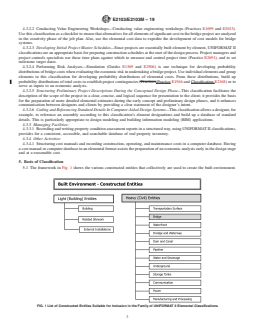
Each entity is treated as a module. Appropriate modules used together will effectively describe any planned or built development.
This standard classification describes exclusively the elements that make up one of those constructed entities, bridge structures,
shown as the shaded block under the heading of Heavy (Civil) Entities.
5.1.1 This bridge classification is applicable to most types of highway, railroad, and pedestrian bridges crossing over highways,
railroads, walkways, and waterways. The classification includes slab bridges; beam/girder bridges; truss bridges; true and tied-arch
bridges; cable-stayed bridges; and suspension bridges. The classification does not include the following movable bridge types:
draw bridges; lift bridges; and bascule bridges.
5.2 The classification is consistent with typical costing practices used at the conceptual design phase.
5.3 Each element has a significant impact on the cost, and it usually occurs frequently.
5.4 Each element performs a specific function.
5.5 Table 1 divides the classification of bridge elements into three hierarchical levels: Level 1—Major Group Elements, Level
2—Group Elements, and Level 3—Individual Elements. The major groups are listed in the normal chronological order of
construction.
5.6 Sub-Classifications are named Sub-Elements and comprise as many hierarchical levels (Level 4 and below) as are deemed
appropriate to the needs of that specific example. Appendix X1 provides an example Sub-Classification of bridge elements.
5.7 The decision as to where among the classification elements to include specific construction items will rely on professional
judgment as to where professionals in current practice normally look for such items.
E2103/E2103M − 19
TABLE 1 UNIFORMAT II Classification of Bridge Elements
Level 1 Level 2 Level 3
Major Group Elements Group Elements Individual Elements
Substructure Piers Foundations
Walls
Columns
Cap Beams
Towers Foundations
Walls
Columns
Cap Beams
Abutments Foundations
Stems
Wing Walls
Other Supports Thrust Blocks
Anchorages
Superstructure Short Span Assemblies Flexural Members
Diaphragms
Bracings
Bearings
Long Span Assemblies Ribs
Cables
Hangers
Spandrels
Ties
Truss Members
Segmental Box Girders
Deck Structural Surface
Wearing Surface
Protection Structure Protection Slope Walls
Expansion Joints
Protective Coats
Sacrificial Beams
Drainage Systems
Inspection and Maintenance Systems
Traffic Protection Barriers
Protective Shields
Traffic Controls
Other Protection Lighting
Signage
Sound Barrier Walls
Air Pressure Barriers
Enclosure
Sitework Site Preparation Clearing and Grubbing
Demolition and Relocation
Earthwork
Hazardous Material Handling
Environmental Restoration/Replacement
Approach Construction Approach Slabs
Sleeper Slabs
Earth Retention Systems
TABLE 1 UNIFORMAT II Classification of Bridge Elements
Level 1 Level 2 Level 3
Major Group Elements Group Elements Individual Elements
A Substructure A10 Piers A1010 Foundations
A1020 Walls
A1030 Columns
A1040 Cap Beams
A20 Towers A2010 Foundations
A2020 Walls
A2030 Columns
A2040 Cap Beams
A30 Abutments A3010 Foundations
A3020 Stems
A3030 Wing Walls
A40 Other Supports A4010 Thrust Blocks
A4020 Anchorages
B Superstructure B10 Short Span Assemblies B1010 Flexural Members
B1020 Diaphragms
B1030 Bracings
B1040 Bearings
B20 Long Span Assemblies B2010 Ribs
B2020 Cables
B2030 Hangers
B2040 Spandrels
E2103/E2103M − 19
Level 1 Level 2 Level 3
Major Group Elements Group Elements Individual Elements
B2050 Ties
B2060 Truss Members
B2070 Segmental Box Girders
B30 Deck B3010 Structural Surface
B3020 Wearing Surface
C Protection C10 Structure Protection C1010 Slope Walls
C1020 Expansion Joints
C1030 Protective Coats
C1040 Sacrificial Beams
C1050 Drainage Systems
C1060 Inspection and Maintenance
Systems
C20 Traffic Protection C2010 Barriers
C2020 Protective Shields
C2030 Traffic Controls
C30 Other Protection C3010 Lighting
C3020 Signage
C3030 Sound Barrier Walls
C3040 Air Pressure Barriers
C3050 Enclosure
D Sitework D10 Site Preparation D1010 Clearing and Grubbing
D1020 Demolition and Relocation
D1030 Earthwork
D1040 Hazardous Material Handling
D1050 Environmental Restoration/
Replacement
D20 Approach Construction D2010 Approach Slabs
D2020 Sleeper Slabs
D2030 Earth Retention Systems
5.8 Only items that impact the choice and cost of the bridge elements are included. Other civil works in the transportation
system are not included. Consequently, this classification does not include utilities—pipelines (water, natural gas, and petroleum)
and transmission lines (electrical, communication, and video)—sharing the same right of way as the transportation system.
5.9 Elements, as used and defined in UNIFORMAT II, will ideally display the following additional attributes:
5.9.1 Capable of being defined precisely;
5.9.2 Self explanatory;
5.9.3 Separable at all stages of development;
5.9.4 Quantifiable at all stages of development;
5.9.5 Capable of reconciliation with other elemental classifications;
5.9.6 Allow comparisons, project to project, in a meaningful way;
5.9.7 Is a functional component of the constructed entity.
5.10 Sitework elements are provided for exclusive use in support of the construction of bridges, not to classify elements of
major civil construction works. Sitework elements presented in Table 1 are designed to provide sufficient detail to planners so they
will not need to resort to other elemental classifications when working on a bridge project.
6. Description of ProjectBridge Elements
6.1 Elements and Functions—Elements—Table 2 provides, for each Level 3 Individual Element, the name, functions,
description, inclusions, exclusions, and unit of measure. The functions are classified as Primary, Secondary, and Tertiary. All three
levels of functions may be served. However, one or two functions may be the driving force behind the existence of the element,
and they are classified as Primary functions.
E2103/E2103M − 19
TABLE 2 Continued
TABLE 2 Description of UNIFORMAT II Bridge Elements
fully retain earth behind, support the ends of the first
A SUBSTRUCTURE
and last spans of the bridge, and support the
A10 Piers
approach slab.
A1010 Foundations
Includes Bridge seat, reinforcing, concrete, and finishing
Description Foundations are structures that transfer the load of
Excludes Slope wall, foundation, and anchor bolts and bearings
the bridge substructures to the ground. They may be
(see Foundations, Barriers, Slope Wall, Bearings)
spread footings, piles, or drilled shafts. The type
3 3
Unit of Measure m [yd ] or kg [lb]
depends upon the soil conditions.
A3030 Wing Walls
Includes Excavation and backfilling
Description Wing walls (parallel, perpendicular, or angled) are
Excludes
3 3
structures connected to the abutment and supported
Unit of Measure m [yd ] or m [ft]
by piles that retain the embankment below the
A1020 Walls
approach road.
Description Walls are structures that support the columns; in
Includes Reinforcing, concrete, and finishing
addition to transferring the load from the columns to
Excludes Approach slab and parapet (see Approach Slab,
the foundation, they protect the pier against impacts
Barriers)
from vehicles, vessels, and debris.
3 3
Unit of Measure m [yd ]
Includes
A SUBSTRUCTURE
Excludes
3 3
A40 Other Supports
Unit of Measure m [yd ] or kg [lb]
A4010 Thrust Blocks
A1030 Columns
Description Thrust blocks are a special substructure of a true
Description Columns are structures that support the cap beam
arch bridge that receive loads from the ribs and
and transfer the load from the cap beam to the wall
transfer loads to the foundation.
below.
Includes Structure excavation, reinforcing, concrete, and
Includes
finishing
Excludes
3 3
Excludes Furnishing and installation of anchor bolts, bearing
Unit of Measure m [yd ] or kg [lb]
plates, utility relocation (see Demolition and
A1040 Cap Beams
Relocation, Flexural Members)
Description Cap beams are structures that receive and transfer
3 3
Unit of Measure m [yd ]
beam loads from the deck to the bridge columns.
A4020 Anchorages
Includes Bridge seat
Description Anchorages are a special substructure to which the
Excludes Bearings and anchor bolts (see Bearings, Flexural
weight of the deck and supporting superstructure is
Members)
3 3
secured via cables and steel eye bars imbedded in
Unit of Measure m [yd ] or kg [lb]
solid rock or massive concrete blocks.
A SUBSTRUCTURE
Includes Structure excavation, reinforcing, concrete, finishing,
A20 Towers
and cable support (Steel Eye Bar)
A2010 Foundations
Excludes
Description Foundations are structures that transfer the load of
3 3
Unit of Measure m [yd ]
the bridge substructures to the ground. They may be
B SUPERSTRUCTURE
spread footings, piles, or drilled shafts. The type
B10 Short Span
depends upon the soil conditions.
Assemblies
Includes Excavation and backfilling
B1010 Flexural Members
Excludes
3 3
Description Flexural members are commonly known as beams
Unit of Measure m [yd ] or m [ft]
and girders that support the bridge deck. When the
A2020 Walls
depth of the girder is shallow, it is referred to as a
Description Walls are structures that support the columns; in
beam.
addition to transferring the load from the columns to
Includes Fabrication and installation of beams and girders
the foundation, they protect the pier against impacts
Excludes Diaphragms, bracings, bearings (see Diaphragms,
from vehicles, vessels, and debris.
Bracings, Bearings)
Includes
Unit of Measure kg [lb] or m [ft]
Excludes
3 3
B1020 Diaphragms
Unit of Measure m [yd ] or kg [lb]
Description Diaphragms are braces for shallow-depth beams.
A2030 Columns
Includes
Description Columns are structures that support the cap beam
Excludes
and transfer the load from the cap beam to the wall
3 3
Unit of Measure kg [lb] or m [yd ]
below.
B1030 Bracings
Includes
Description Bracings are steel angles used to brace deep-depth
Excludes
3 3
girders.
Unit of Measure m [yd ] or kg [lb]
Includes Fabrication and erection of structural steel angles
A2040 Cap Beams
Excludes
Description Cap beams are structures that receive and transfer
Unit of Measure kg [lb]
beam loads from the deck to the bridge columns.
B1040 Bearings
Includes Bridge seat
Description Bearings are mechanical systems that transfer
Excludes Bearings and anchor bolts (see Bearings, Flexural
vertical and longitudinal forces; expansion bearings
Members)
3 3
allow rotational and longitudinal movement, whereas
Unit of Measure m [yd ] or kg [lb]
fixed bearings allow only rotational movement.
A SUBSTRUCTURE
Includes Fabrication and erection of bearings and anchor bolts
A30 Abutments
Excludes Bridge seat (see Cap Beams, Stem Abutments)
A3010 Foundations
Unit of Measure EACH
Description Foundations are structures that transfer the load of
B SUPERSTRUCTURE
the bridge substructures to the ground. They may be
B20 Long Span
spread footings, piles, or drilled shafts. The type
Assemblies
depends upon the soil conditions.
B2010 Ribs
Includes Excavation and backfilling
Description Ribs are rectangular-, square-, or circular-shaped
Excludes
3 3
parts of the superstructure for arch bridges; they
Unit of Measure m [yd ] or m [ft]
receive loads from hangers and spandrels and
A3020 Stems
transfer them to the foundation.
Description Stems are usually supported on piles; they partially or
Includes
E2103/E2103M − 19
TABLE 2 Continued TABLE 2 Continued
Excludes Bracings, bearings (see Bracings, Bearings) the slab while keeping the substructure stationary.
3 3
Unit of Measure kg [lb], or m [yd ], or m [ft] Includes Furnishing and installation of expansion joint support
B2020 Cables and expansion joint
Description Cables, made of steel wires bound together and Excludes
draped over towers to anchors at each cable end, Unit of Measure m [ft]
receive through hangars the load from the deck. C1030 Protective Coats
Includes Fabrication and installation of cables, cable support Description Protective coats are paints, sealants, or preservatives
Excludes Anchorage (see Anchorage) that are applied to concrete surfaces of the bridge.
Unit of Measure m [ft] Includes Minor repair work, cleaning surface, and coating
B2030 Hangers Excludes Major repair work to other bridge elements
2 2
Description Hangers are rods or strands that connect the deck to Unit of Measure m [yd ]
the ribs (arch bridges) or the main cable (cable-
C1040 Sacrificial Beams
stayed or suspension bridges); they receive loads Description Sacrificial beams have a lower clearance than the
from the deck and transfer loads to the ribs or main
main beams to ensure that excessive-height vehicles
cable in tension. will hit the sacrificial beam before impacting the main
Includes Splices (rod), strand assembly, protection
beams.
Excludes End connections (see Flexural Members and Ribs) Includes Fabrication and erection of structural steel, stiffeners,
Unit of Measure m [ft] splices, and other connections
B2040 Spandrels Excludes Bracings, bearings (see Bracings, Bearings)
Description Spandrels are concrete or steel members that Unit of Measure kg [lb]
connect the deck to the ribs (arch bridges); they C1050 Drainage Systems
receive loads from the deck and transfer loads to the Description Drainage systems are scuppers to drain the bridge
ribs in compression. They are below the deck and deck, downspouts to carry off the water from the
above the rib. scuppers, and buried drains behind abutments and
Includes Concrete or steel members, protection adjacent to sleeper slabs.
Excludes End connections (see Flexural Members and Ribs) Includes Fabrication and installation of scuppers, drain tiles,
Unit of Measure m [ft] drain pipes, and related earthwork
B2050 Ties Excludes Structural surface (see Structural Surface)
Description A tie is a horizontal tension member that connects the Unit of Measure EACH or m [ft]
two ends of the compression ribs of an arch bridge C1060 Inspection and Maintenance Systems
and balances the horizontal thrust.
Description These systems include platforms, railings, stairways,
Includes Fabrication and erection of structural steel, stiffeners, and hoist ways to facilitate inspection and
splices, and other connections
maintenance.
Excludes Hangers, bearings (see Bearings, Hangers and Includes Handrails or other type of barriers
Spandrels)
Excludes
2 2
Unit of Measure kg [lb] Unit of Measure m [yd ]
B2060 Truss Members C PROTECTION
Description Truss members, connected at nodes by plates, are C20 Traffic Protection
two-dimensional structures that support the C2010 Barriers
superstructure. Description Barriers are structures designed to: withstand forces
Includes Splices and other connections due to crashes; separate the opposing traffic; and
Excludes Bracings, bearings (see Bracings, Bearings) protect bridge structures adjacent to live traffic.
3 3
Unit of Measure kg [lb], or m [yd ], or m [ft] Includes Noise wall support, or light pole support
B2070 Segmental Box Girders
Excludes
3 3
Description Segmental box girders are concrete box sections with Unit of Measure m [yd ]
or without overhanging flanges. The segments are
C2020 Protective Shields
precast sections which are post tensioned in the field. Description Protective shields are barriers below the bridge deck
Includes Post tensioning
to protect traffic below from falling objects.
Excludes Bracings, bearings (see Bracings, Bearings) Includes Membranes and supports designed to catch falling
Unit of Measure m [ft] objects
B SUPERSTRUCTURE Excludes
2 2
B30 Deck Unit of Measure m [yd ]
B3010 Structural Surface C2030 Traffic Controls
Description The structural surface supports the wearing surface Primary Function Manage Traffic
and traffic.
Secondary Function
Includes Reinforcing, concrete, and finishing Tertiary Function
Excludes Expansion joint assembly, parapet, barriers (see
Description Traffic controls are an assembly of signals, supports,
Expansion Joints, Barriers, Drainage Systems) and conduits.
3 3
Unit of Measure m [yd ] or EACH
Includes Power source and related items
B3020 Wearing Surface Excludes
Description The wearing surface is the part of the road or rail Unit of Measure EACH
system that comes into contact with the vehicle or C PROTECTION
train car wheels. C30 Other Protection
Includes Concrete or asphalt overlay or rails, striping, marking, C3010 Lighting
Excludes Description Lighting is illumination from fixtures that provide
2 2
Unit of Measure m [yd ]
vehicle traffic direction, ship navigation direction, task
C PROTECTION lighting, and vandalism discouragement.
C10 Structure Protection
Includes Fabrication and installation of mast, lights, base
C1010 Slope Walls plates, and power
Description Slope walls, made of stone, concrete, gravel, or
Excludes Base support (see Barriers)
gravel with asphalt mix, support the sloped surface Unit of Measure EACH
and protect the bridge abutment.
C3020 Signage
Includes Reinforcing, concrete, and finishing Description Signage is the provision of information through
Excludes Excavation and backfill (see Earthwork) electronic or printed message boards.
2 2
Unit of Measure m [yd ] Includes Fabrication and installation of sign and support, and
C1020 Expansion Joints power
Description Expansion joints allow expansion and contraction of Excludes
E2103/E2103M − 19
TABLE 2 Continued
Unit of Measure EACH
C3030 Sound Barrier Walls
Description A sound barrier wall is a structure to mask traffic
noise from the surrounding neighborhood.
Includes Wall panel, support, and connection to barrier
Excludes Base (see Barriers)
2 2
Unit of Measure m [yd ]
C3040 Air Pressure Barriers
Description Air pressure barriers are structures to mitigate the
impact of significant air pressure differentials created
by the passing of high speed transportation vehicles.
Includes Barriers mounted on bridges to mitigate the impact of
air pressure differentials.
Excludes Base (see Barriers)
2 2
Unit of Measure m [yd ]
C3050 Enclosure
Description An enclosure is a vertical envelope with roof to
protect pedestrians and traffic crossing over a bridge.
Includes Structural and architectural members to contain
pedestrians and traffic with expansion joints at the
ends
Excludes
2 2
Unit of Measure m [yd ]
D SITEWORK
D10 Site Preparation
D1010 Clearing and Grubbing
Description Clearing is the removal from the construction site of
trees and abandoned utilities, and the grading and
leveling of the site. Grubbing is the removal of stumps
and tree roots.
Includes Tree removal, abandoned utilities, minor earthwork
Excludes Major earth work and major utility removal (see
Demolition and Relocation, Earthwork)
Unit of Measure EACH or Hectare (Acre)
D1020 Demolition and Relocation
Description Demolition is the complete or partial (for example,
deck or superstructure) removal of an existing bridge,
carried out on the whole bridge at once or by
removing a portion of the deck or superstructure in
stages to maintain traffic; relocation is the removal
and reinstallation of utilities.
Includes Removal of bridge elements and disposal, relocation
of utilities such as storm sewer
Excludes
Unit of Measure EACH
D1030 Earthwork
Description Earthwork is excavation, placement, and compaction
of material to raise the bridge profile (material is
hauled in and compacted) and to lower the bridge
profile (material is excavated and hauled away).
Includes Shrinkage factor for embankment, hauling material to
or from the site
Excludes Removal of hazardous material, structure excavation
and back fill (see Demolition and Relocation,
Foundations)
3 3
Unit of Measure m [yd ]
D1040 Hazardous Material Handling
Description Hazardous material handling is the discovery,
excavation, recovery, and disposal of hazardous
materials.
Includes Excavation and disposal of material
Excludes General excavation (see Demolition and Relocation,
Earthwork)
3 3
Unit of Measure m [yd ]
D1050 Environmental Restoration/Replacement
Description Environmental restoration/replacement is the activity
of restoring or replacing elements of the environment
disturbed by construction.
Includes Restoration or replacement of wetlands
Excludes
Unit of Measure Hectare (Acre)
D SITEWORK
D20 Approach
Construction
D2010 Approach Slabs
Description An approach slab, supported by the bridge abutment
on one side and a sleeper slab or soil on the other,
E2103/E2103M − 19
TABLE 2 Continued
provides a smooth transition between the roadway
and the bridge, and spans any settlement gap
between the abutment and the roadway.
Includes Granular fill, drain tiles, concrete, reinforcing, and
finishing
Excludes Barrier and wing wall (see Barriers, Wing Walls)
2 2
Unit of Measure m [yd ]
D2020 Sleeper Slabs
Description Sleeper slabs are rectangular concrete foundations
that support approach slabs.
Includes Excavation and backfill, concrete, reinforcing and
finishing
Excludes Approach slab (see Approach Slabs)
3 3
Unit of Measure m [yd ]
D2030 Earth Retention Systems
Description Earth retention systems are designed to support
embankments when the grades are not uniform.
Includes Its foundation and wall
Excludes Excavation and backfill (see Earthwork)
3 3 2 2
Unit of Measure m [yd ] or m [yd ]
TABLE 2 Description of UNIFORMAT II Bridge Elements
SUBSTRUCTURE
Piers
Foundations
Primary Function Transfer load, Minimize settlement
Secondary Function Minimize maintenance
Tertiary Function Facilitate construction
Description Foundations are structures that transfer the load of
the bridge substructures to the ground. They may be
spread footings, piles, or drilled shafts. The type
depends upon the soil conditions.
Includes Excavation and backfilling
Excludes
3 3
Unit of Measure m [yd ] or m [ft]
Walls
Primary Function Distribute load, Protect foundation
Secondary Function Enhance appearance
Tertiary Function Expedite construction
Description Walls are structures that support the columns; in
addition to transferring the load from the columns to
the foundation, they protect the pier against impacts
from vehicles, vessels, and debris.
Includes
Excludes
3 3
Unit of Measure m [yd ] or kg [lb]
Columns
Primary Function Distribute load
Secondary Function Enhance appearance
Tertiary Function Expedite construction
Description Columns are structures that support the cap beam
and transfer the load from the cap beam to the wall
below.
Includes
Excludes
3 3
Unit of Measure m [yd ] or kg [lb]
Cap Beams
Primary Function Distribute load
Secondary Function Enhance appearance
Tertiary Function Expedite construction
Description Cap beams are structures that receive and transfer
beam loads from the deck to the bridge columns.
Includes Bridge seat
Excludes Bearings and anchor bolts (see Bearings, Flexural
Members)
3 3
Unit of Measure m [yd ] or kg [lb]
SUBSTRUCTURE
Towers
Foundations
Primary Function Transfer load, Minimize settlement
Secondary Function Minimize maintenance
Tertiary Function Facilitate construction
Description Foundations are structures that transfer the load of
E2103/E2103M − 19
TABLE 2 Continued
the bridge substructures to the ground. They may be
spread footings, piles, or drilled shafts. The type
depends upon the soil conditions.
Includes Excavation and backfilling
Excludes
3 3
Unit of Measure m [yd ] or m [ft]
Walls
Primary Function Distribute load, Protect foundation
Secondary Function Enhance appearance
Tertiary Function Expedite construction
Description Walls are structures that support the columns; in
addition to transferring the load from the columns to
the foundation, they protect the pier against impacts
from vehicles, vessels, and debris.
Includes
Excludes
3 3
Unit of Measure m [yd ] or kg [lb]
Columns
Primary Function Distribute load
Secondary Function Enhance appearance
Tertiary Function Expedite construction
Description Columns are structures that support the cap beam
and transfer the load from the cap beam to the wall
below.
Includes
Excludes
3 3
Unit of Measure m [yd ] or kg [lb]
Cap Beams
Primary Function Distribute load
Secondary Function Enhance appearance
Tertiary Function Expedite construction
Description Cap beams are structures that receive and transfer
beam loads from the deck to the bridge columns.
Includes Bridge seat
Excludes Bearings and anchor bolts (see Bearings, Flexural
Members)
3 3
Unit of Measure m [yd ] or kg [lb]
SUBSTRUCTURE
Abutments
Foundations
Primary Function Transfer load, Minimize settlement
Secondary Function Minimize maintenance
Tertiary Function Facilitate construction
Description Foundations are structures that transfer the load of
the bridge substructures to the ground. They may be
spread footings, piles, or drilled shafts. The type
depends upon the soil conditions.
Includes Excavation and backfilling
Excludes
3 3
Unit of Measure m [yd ] or m [ft]
Stems
Primary Function Distribute load, Retain earth
Secondary Function Minimize erosion
Tertiary Function Minimize settlement
Description Stems are usually supported on piles; they partially or
fully retain earth behind, support the ends of the first
and last spans of the bridge, and support the
approach slab.
Includes Bridge seat, reinforcing, concrete, and finishing
Excludes Slope wall, foundation, and anchor bolts and bearings
(see Foundations, Barriers, Slope Wall, Bearings)
3 3
Unit of Measure m [yd ] or kg [lb]
Wing Walls
Primary Function Retain earth
Secondary Function Minimize erosion
Tertiary Function Enhance appearance
Description Wing walls (parallel, perpendicular, or angled) are
structures connected to the abutment and supported
by piles that retain the embankment below the
approach road.
Includes Reinforcing, concrete, and finishing
Excludes Approach slab and parapet (see Approach Slab,
Barriers)
3 3
Unit of Measure m [yd ]
SUBSTRUCTURE
Other Supports
Thrust Blocks
E2103/E2103M − 19
TABLE 2 Continued
Primary Function Transfer load, Transfer thrust
Secondary Function Minimizes movement
Tertiary Function
Description Thrust blocks are a special substructure of a true
arch bridge that receive loads from the ribs and
transfer loads to the foundation.
Includes Structure excavation, reinforcing, concrete, and
finishing
Excludes Furnishing and installation of anchor bolts, bearing
plates, utility relocation (see Demolition and
Relocation, Flexural Members)
3 3
Unit of Measure m [yd ]
Anchorages
Primary Function Secure cable, Transfer load
Secondary Function Maintain even distribution
Tertiary Function
Description Anchorages are a special substructure to which the
weight of the deck and supporting superstructure is
secured via cables and steel eye bars imbedded in
solid rock or massive concrete blocks.
Includes Structure excavation, reinforcing, concrete, finishing,
and cable support (Steel Eye Bar)
Excludes
3 3
Unit of Measure m [yd ]
SUPERSTRUCTURE
Short Span Assemblies
Flexural Members
Primary Function Support Load
Secondary Function Minimize deflection
Tertiary Function Increase redundancy
Description Flexural members are commonly known as beams
and girders that support the bridge deck. When the
depth of the girder is shallow, it is referred to as a
beam.
Includes Fabrication and installation of beams and girders
Excludes Diaphragms, bracings, bearings (see Diaphragms,
Bracings, Bearings)
Unit of Measure kg [lb] or m [ft]
Diaphragms
Primary Function Stabilize girder, Brace girders
Secondary Function Facilitate deck reconstruction
Tertiary Function
Description Diaphragms are braces for shallow-depth beams.
Includes
Excludes
3 3
Unit of Measure kg [lb] or m [yd ]
Bracings
Primary Function Stabilize girders
Secondary Function Facilitate deck reconstruction
Tertiary Function
Description Bracings are steel angles used to brace deep-depth
girders.
Includes Fabrication and erection of structural steel angles
Excludes
Unit of Measure kg [lb]
Bearings
Primary Function Transfer load
Secondary Function Facilitate expansion and contraction
Tertiary Function Minimize maintenance
Description Bearings are mechanical systems that transfer
vertical and longitudinal forces; expansion bearings
allow rotational and longitudinal movement, whereas
fixed bearings allow only rotational movement.
Includes Fabrication and erection of bearings and anchor bolts
Excludes Bridge seat (see Cap Beams, Stem Abutments)
Unit of Measure EACH
SUPERSTRUCTURE
Long Span Assemblies
Ribs
Primary Function Transfer load
Secondary Function Facilitate inspection
Tertiary Function Enhance appearance
Description Ribs are rectangular-, square-, or circular-shaped
parts of the superstructure for arch bridges; they
receive loads from hangers and spandrels and
transfer them to the foundation.
Includes
E2103/E2103M − 19
TABLE 2 Continued
Excludes Bracings, bearings (see Bracings, Bearings)
3 3
Unit of Measure kg [lb], or m [yd ], or m [ft]
Cables
Primary Function Transfer load
Secondary Function Enhance appearance
Tertiary Function
Description Cables, made of steel wires bound together and
draped over towers to anchors at each cable end,
receive through hangars the load from the deck.
Includes Fabrication and installation of cables, cable support
Excludes Anchorage (see Anchorage)
Unit of Measure m [ft]
Hangers
Primary Function Transfer load
Secondary Function Increase vertical clearance
Tertiary Function Enhance appearance
Description Hangers are rods or strands that connect the deck to
the ribs (arch bridges) or the main cable (cable-
stayed or suspension bridges); they receive loads
from the deck and transfer loads to the ribs or main
cable in tension.
Includes Splices (rod), strand assembly, protection
Excludes End connections (see Flexural Members and Ribs)
Unit of Measure m [ft]
Spandrels
Primary Function Transfer load
Secondary Function Increase reliability
Tertiary Function Enhance appearance
Description Spandrels are concrete or steel members that
connect the deck to the ribs (arch bridges); they
receive loads from the deck and transfer loads to the
ribs in compression. They are below the deck and
above the rib.
Includes Concrete or steel members, protection
Excludes End connections (see Flexural Members and Ribs)
Unit of Measure m [ft]
Ties
Primary Function Eliminate thrust
Secondary Function
Tertiary Function
Description A tie is a horizontal tension member that connects the
two ends of the compression ribs of an arch bridge
and balances the horizontal thrust.
Includes Fabrication and erection of structural steel, stiffeners,
splices, and other connections
Excludes Hangers, bearings (see Bearings, Hangers and
Spandrels)
Unit of Measure kg [lb]
Truss Members
Primary Function Support load, Reduce weight
Secondary Function Minimize deflection
Tertiary Function
Description Truss members, connected at nodes by plates, are
two-dimensional structures that support the
superstructure.
Includes Splices and other connections
Excludes Bracings, bearings (see Bracings, Bearings)
3 3
Unit of Measure kg [lb], or m [yd ], or m [ft]
Segmental Box Girders
Primary Function Support Load
Secondary Function Minimize deflection
Tertiary Function Facilitate Construction
Description Segmental box girders are concrete box sections with
or without overhanging flanges. The segments are
precast sections which are post tensioned in the field.
Includes Post tensioning
Excludes Bracings, bearings (see Bracings, Bearings)
Unit of Measure m [ft]
SUPERSTRUCTURE
Deck
Structural Surface
Primary Function Transfer load
Secondary Function Minimize maintenance
Tertiary Function
...