


ASTM D2163-14(2019)
(Test Method)Standard Test Method for Determination of Hydrocarbons in Liquefied Petroleum (LP) Gases and Propane/Propene Mixtures by Gas Chromatography
Standard Test Method for Determination of Hydrocarbons in Liquefied Petroleum (LP) Gases and Propane/Propene Mixtures by Gas Chromatography
SIGNIFICANCE AND USE
5.1 The hydrocarbon component distribution of liquefied petroleum gases and propene mixtures is often required for end-use sale of this material. Applications such as chemical feed stocks or fuel require precise compositional data to ensure uniform quality. Trace amounts of some hydrocarbon impurities in these materials can have adverse effects on their use and processing.
5.2 The component distribution data of liquefied petroleum gases and propene mixtures can be used to calculate physical properties such as relative density, vapor pressure, and motor octane (see Practice D2598). Precision and accuracy of compositional data are extremely important when these data are used to calculate various properties of these petroleum products.
SCOPE
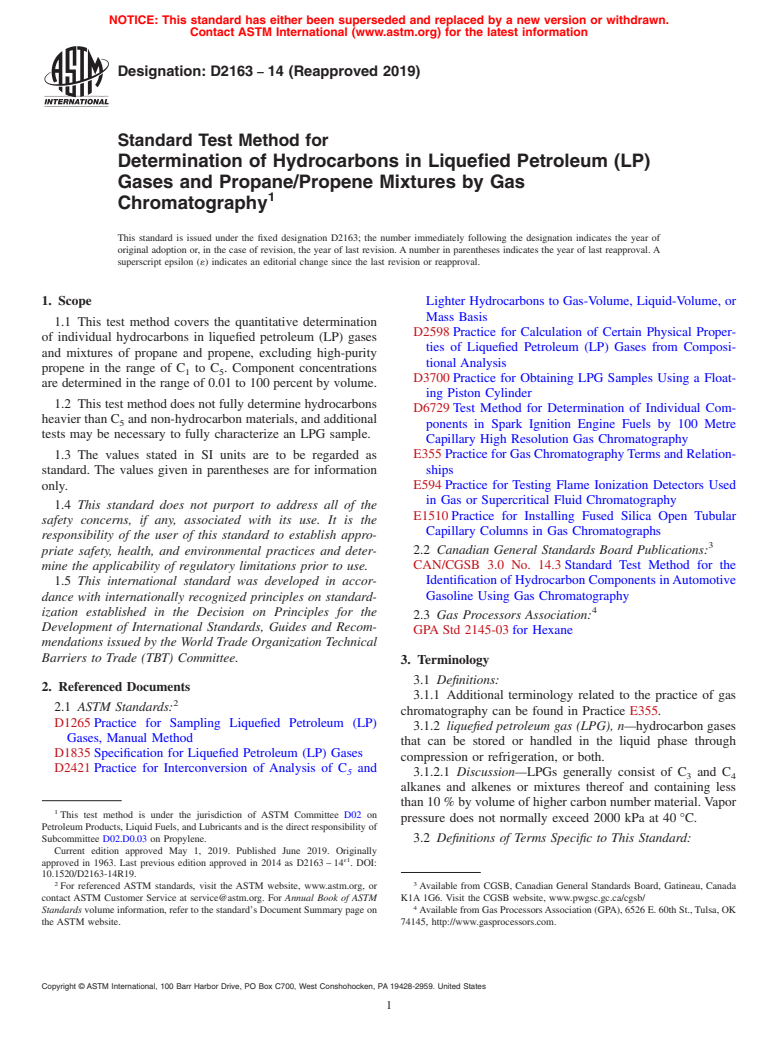
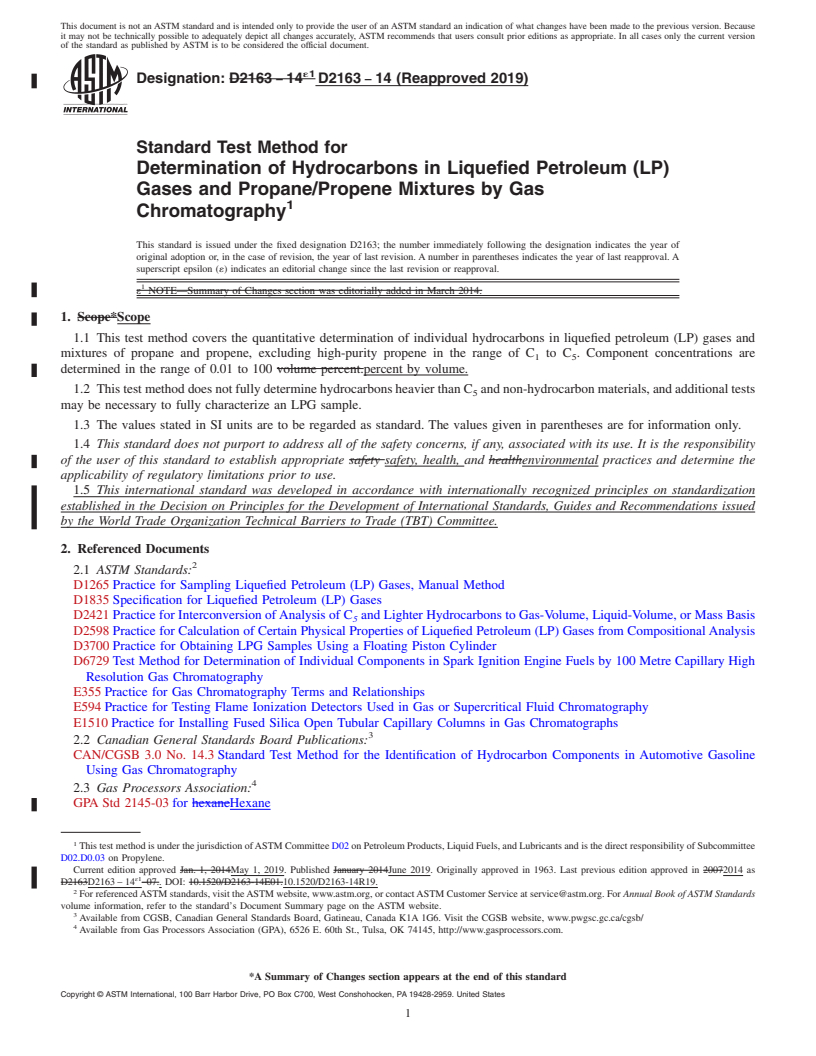
1.1 This test method covers the quantitative determination of individual hydrocarbons in liquefied petroleum (LP) gases and mixtures of propane and propene, excluding high-purity propene in the range of C1 to C5. Component concentrations are determined in the range of 0.01 to 100 percent by volume.
1.2 This test method does not fully determine hydrocarbons heavier than C5 and non-hydrocarbon materials, and additional tests may be necessary to fully characterize an LPG sample.
1.3 The values stated in SI units are to be regarded as standard. The values given in parentheses are for information only.
1.4 This standard does not purport to address all of the safety concerns, if any, associated with its use. It is the responsibility of the user of this standard to establish appropriate safety, health, and environmental practices and determine the applicability of regulatory limitations prior to use.
1.5 This international standard was developed in accordance with internationally recognized principles on standardization established in the Decision on Principles for the Development of International Standards, Guides and Recommendations issued by the World Trade Organization Technical Barriers to Trade (TBT) Committee.
General Information
Buy Standard
Standards Content (Sample)
NOTICE: This standard has either been superseded and replaced by a new version or withdrawn.
Contact ASTM International (www.astm.org) for the latest information
Designation: D2163 − 14 (Reapproved 2019)
Standard Test Method for
Determination of Hydrocarbons in Liquefied Petroleum (LP)
Gases and Propane/Propene Mixtures by Gas
Chromatography
This standard is issued under the fixed designation D2163; the number immediately following the designation indicates the year of
original adoption or, in the case of revision, the year of last revision. A number in parentheses indicates the year of last reapproval. A
superscript epsilon (´) indicates an editorial change since the last revision or reapproval.
1. Scope Lighter Hydrocarbons to Gas-Volume, Liquid-Volume, or
Mass Basis
1.1 This test method covers the quantitative determination
D2598 Practice for Calculation of Certain Physical Proper-
of individual hydrocarbons in liquefied petroleum (LP) gases
ties of Liquefied Petroleum (LP) Gases from Composi-
and mixtures of propane and propene, excluding high-purity
tional Analysis
propene in the range of C to C . Component concentrations
1 5
D3700 Practice for Obtaining LPG Samples Using a Float-
are determined in the range of 0.01 to 100 percent by volume.
ing Piston Cylinder
1.2 This test method does not fully determine hydrocarbons
D6729 Test Method for Determination of Individual Com-
heavier than C and non-hydrocarbon materials, and additional
ponents in Spark Ignition Engine Fuels by 100 Metre
tests may be necessary to fully characterize an LPG sample.
Capillary High Resolution Gas Chromatography
E355 Practice for Gas Chromatography Terms and Relation-
1.3 The values stated in SI units are to be regarded as
standard. The values given in parentheses are for information ships
E594 Practice for Testing Flame Ionization Detectors Used
only.
in Gas or Supercritical Fluid Chromatography
1.4 This standard does not purport to address all of the
E1510 Practice for Installing Fused Silica Open Tubular
safety concerns, if any, associated with its use. It is the
Capillary Columns in Gas Chromatographs
responsibility of the user of this standard to establish appro-
2.2 Canadian General Standards Board Publications:
priate safety, health, and environmental practices and deter-
CAN/CGSB 3.0 No. 14.3 Standard Test Method for the
mine the applicability of regulatory limitations prior to use.
Identification of Hydrocarbon Components in Automotive
1.5 This international standard was developed in accor-
Gasoline Using Gas Chromatography
dance with internationally recognized principles on standard-
ization established in the Decision on Principles for the
2.3 Gas Processors Association:
Development of International Standards, Guides and Recom-
GPA Std 2145-03 for Hexane
mendations issued by the World Trade Organization Technical
Barriers to Trade (TBT) Committee.
3. Terminology
3.1 Definitions:
2. Referenced Documents
3.1.1 Additional terminology related to the practice of gas
2.1 ASTM Standards:
chromatography can be found in Practice E355.
D1265 Practice for Sampling Liquefied Petroleum (LP)
3.1.2 liquefied petroleum gas (LPG), n—hydrocarbon gases
Gases, Manual Method
that can be stored or handled in the liquid phase through
D1835 Specification for Liquefied Petroleum (LP) Gases
compression or refrigeration, or both.
D2421 Practice for Interconversion of Analysis of C and
3.1.2.1 Discussion—LPGs generally consist of C and C
3 4
alkanes and alkenes or mixtures thereof and containing less
than 10 % by volume of higher carbon number material. Vapor
This test method is under the jurisdiction of ASTM Committee D02 on
pressure does not normally exceed 2000 kPa at 40 °C.
Petroleum Products, Liquid Fuels, and Lubricants and is the direct responsibility of
Subcommittee D02.D0.03 on Propylene. 3.2 Definitions of Terms Specific to This Standard:
Current edition approved May 1, 2019. Published June 2019. Originally
ɛ1
approved in 1963. Last previous edition approved in 2014 as D2163 – 14 . DOI:
10.1520/D2163-14R19.
2 3
For referenced ASTM standards, visit the ASTM website, www.astm.org, or Available from CGSB, Canadian General Standards Board, Gatineau, Canada
contact ASTM Customer Service at service@astm.org. For Annual Book of ASTM K1A 1G6. Visit the CGSB website, www.pwgsc.gc.ca/cgsb/
Standards volume information, refer to the standard’s Document Summary page on Available from Gas Processors Association (GPA), 6526 E. 60th St., Tulsa, OK
the ASTM website. 74145, http://www.gasprocessors.com.
Copyright © ASTM International, 100 Barr Harbor Drive, PO Box C700, West Conshohocken, PA 19428-2959. United States
D2163 − 14 (2019)
3.2.1 propane/propene mixtures, n—mixtures primarily 6. Apparatus
composed of propane and propene where one of these compo-
6.1 Gas Chromatograph (GC)—Any gas chromatographic
nents is usually in the concentration range of 30 % to 85 % by
instrument provided with a linear temperature programmable
mass with the other comprising the majority of the remainder.
column oven. The temperature control must be capable of
“Commercial Propane” in Specification D1835 is typically this
obtaining a retention time repeatability of 0.05 min (3 s)
sort of product mixture.
throughout the scope of this analysis.
3.2.1.1 Discussion—Other components may be present,
6.2 Detector—A flame ionization detector (FID) having a
usually at less than 10 % by mass.
sensitivity of 0.5 ppm (mole) or less for the compounds listed
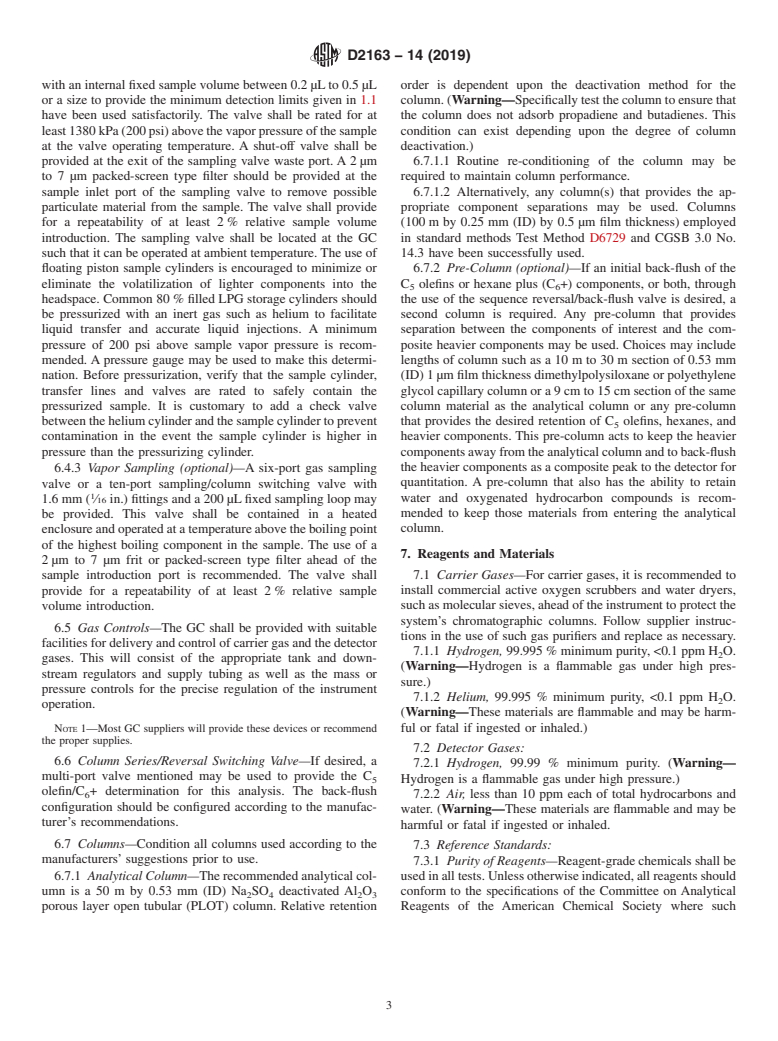
4. Summary of Test Method in Table 1 is strongly recommended (see Practice E594).
6.2.1 Other detectors may be used (alone or in series)
4.1 An LPG sample is analyzed via either liquid or gas
provided that they have sufficient response, linearity, and
sampling valves by gas chromatography and compared to
sensitivity to measure the components of interest at the
corresponding components separated under identical operating
concentration levels required.
conditions from a reference standard mixture of known com-
position or from use of pure hydrocarbons. The chromatogram 6.3 Data Acquisition—Any commercial integrator or com-
of the sample is interpreted by comparing peak retention times puterized data acquisition system may be used for display of
and areas with those obtained for the reference standard the chromatographic detector signal and peak area integration.
mixture or pure hydrocarbons. The device should be capable of calibration and reporting of
the final response corrected results.
5. Significance and Use
6.4 Sample Introduction—Whether liquid or vapor
5.1 The hydrocarbon component distribution of liquefied
sampling, the combination of valve injection size and split ratio
petroleum gases and propene mixtures is often required for
must be selected such that the required sensitivity is achieved
end-use sale of this material. Applications such as chemical
and also that no component concentration in a sample is greater
feed stocks or fuel require precise compositional data to ensure
than the detector upper linearity limit.
uniform quality. Trace amounts of some hydrocarbon impuri-
6.4.1 If capillary columns will be used, then the GC must
ties in these materials can have adverse effects on their use and
include a heated, splitting-type injector that is operated isother-
processing.
mally. Split ratios in the range of 5:1 to 200:1, with a typical
5.2 The component distribution data of liquefied petroleum value of 100:1, will be used dependent upon the sample
gases and propene mixtures can be used to calculate physical injection volume and sensitivity required. If packed columns
properties such as relative density, vapor pressure, and motor will be used, then a splitting-type injector is not required and a
octane (see Practice D2598). Precision and accuracy of com- suitable packed inlet port may be used.
positional data are extremely important when these data are 6.4.2 Liquid Sampling (recommended)—The GC should be
used to calculate various properties of these petroleum prod- equipped with a liquid sampling valve for introduction of the
ucts. sample aliquot to the splitting injector. Liquid sampling valves
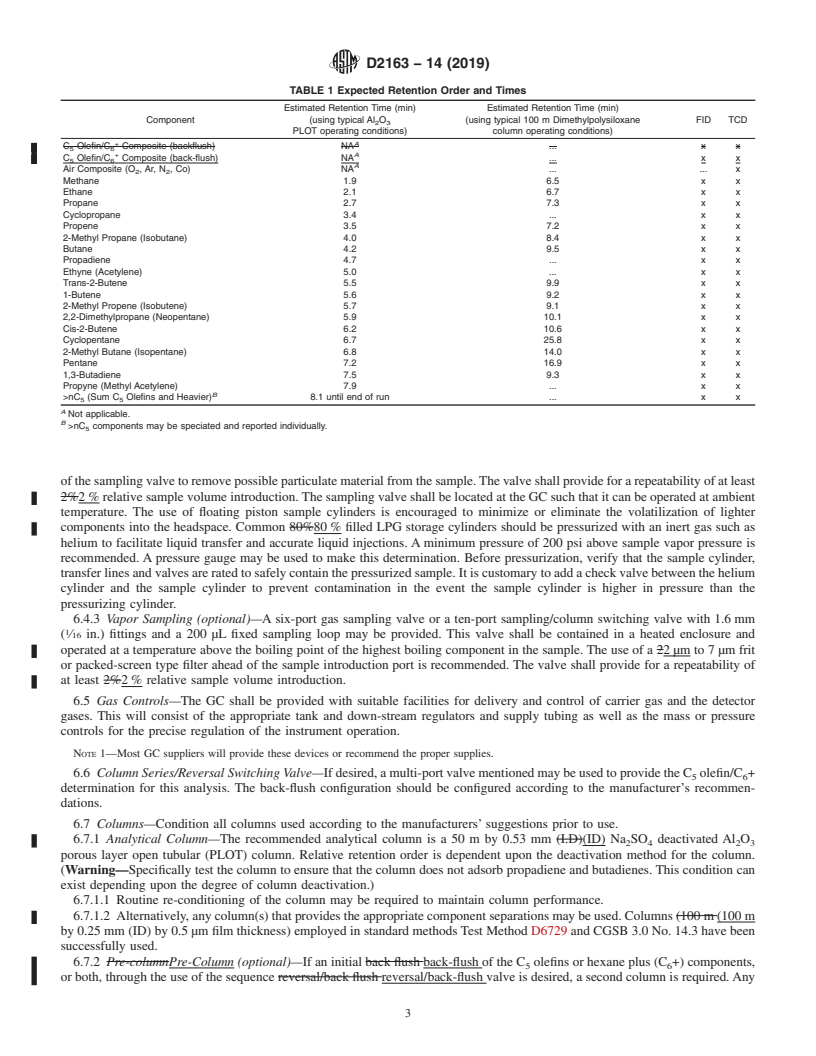
TABLE 1 Expected Retention Order and Times
Estimated Retention Time (min) Estimated Retention Time (min)
Component (using typical Al O (using typical 100 m Dimethylpolysiloxane FID TCD
2 3
PLOT operating conditions) column operating conditions)
+ A
C Olefin/C Composite (back-flush) NA . x x
5 6
A
Air Composite (O , Ar, N , Co) NA . . x
2 2
Methane 1.9 6.5 x x
Ethane 2.1 6.7 x x
Propane 2.7 7.3 x x
Cyclopropane 3.4 . x x
Propene 3.5 7.2 x x
2-Methyl Propane (Isobutane) 4.0 8.4 x x
Butane 4.2 9.5 x x
Propadiene 4.7 . x x
Ethyne (Acetylene) 5.0 . x x
Trans-2-Butene 5.5 9.9 x x
1-Butene 5.6 9.2 x x
2-Methyl Propene (Isobutene) 5.7 9.1 x x
2,2-Dimethylpropane (Neopentane) 5.9 10.1 x x
Cis-2-Butene 6.2 10.6 x x
Cyclopentane 6.7 25.8 x x
2-Methyl Butane (Isopentane) 6.8 14.0 x x
Pentane 7.2 16.9 x x
1,3-Butadiene 7.5 9.3 x x
Propyne (Methyl Acetylene) 7.9 . x x
B
>nC (Sum C Olefins and Heavier) 8.1 until end of run . x x
5 5
A
Not applicable.
B
>nC components may be speciated and reported individually.
D2163 − 14 (2019)
with an internal fixed sample volume between 0.2 µL to 0.5 µL order is dependent upon the deactivation method for the
or a size to provide the minimum detection limits given in 1.1 column. (Warning—Specifically test the column to ensure that
have been used satisfactorily. The valve shall be rated for at the column does not adsorb propadiene and butadienes. This
least 1380 kPa (200 psi) above the vapor pressure of the sample condition can exist depending upon the degree of column
at the valve operating temperature. A shut-off valve shall be deactivation.)
provided at the exit of the sampling valve waste port. A 2 µm 6.7.1.1 Routine re-conditioning of the column may be
to 7 µm packed-screen type filter should be provided at the required to maintain column performance.
sample inlet port of the sampling valve to remove possible 6.7.1.2 Alternatively, any column(s) that provides the ap-
particulate material from the sample. The valve shall provide propriate component separations may be used. Columns
for a repeatability of at least 2 % relative sample volume (100 m by 0.25 mm (ID) by 0.5 µm film thickness) employed
introduction. The sampling valve shall be located at the GC in standard methods Test Method D6729 and CGSB 3.0 No.
such that it can be operated at ambient temperature. The use of 14.3 have been successfully used.
floating piston sample cylinders is encouraged to minimize or 6.7.2 Pre-Column (optional)—If an initial back-flush of the
eliminate the volatilization of lighter components into the C olefins or hexane plus (C +) components, or both, through
5 6
headspace. Common 80 % filled LPG storage cylinders should the use of the sequence reversal/back-flush valve is desired, a
be pressurized with an inert gas such as helium to facilitate second column is required. Any pre-column that provides
liquid transfer and accurate liquid injections. A minimum separation between the components of interest and the com-
pressure of 200 psi above sample vapor pressure is recom- posite heavier components may be used. Choices may include
mended. A pressure gauge may be used to make this determi- lengths of column such as a 10 m to 30 m section of 0.53 mm
nation. Before pressurization, verify that the sample cylinder, (ID) 1 µm film thickness dimethylpolysiloxane or polyethylene
transfer lines and valves are rated to safely contain the glycol capillary column or a 9 cm to 15 cm section of the same
pressurized sample. It is customary to add a check valve column material as the analytical column or any pre-column
between the helium cylinder and the sample cylinder to prevent that provides the desired retention of C olefins, hexanes, and
contamination in the event the sample cylinder is higher in heavier components. This pre-column acts to keep the heavier
pressure than the pressurizing cylinder. components away from the analytical column and to back-flush
the heavier components as a composite peak to the detector for
6.4.3 Vapor Sampling (optional)—A six-port gas sampling
quantitation. A pre-column that also has the ability to retain
valve or a ten-port sampling/column switching valve with
water and oxygenated hydrocarbon compounds is recom-
1.6 mm ( ⁄16 in.) fittings and a 200 µL fixed sampling loop may
mended to keep those materials from entering the analytical
be provided. This valve shall be contained in a heated
column.
enclosure and operated at a temperature above the boiling point
of the highest boiling component in the sample. The use of a
7. Reagents and Materials
2 µm to 7 µm frit or packed-screen type filter ahead of the
sample introduction port is recommended. The valve shall 7.1 Carrier Gases—For carrier gases, it is recommended to
provide for a repeatability of at least 2 % relative sample install commercial active oxygen scrubbers and water dryers,
such as molecular sieves, ahead of the instrument to protect the
volume introduction.
system’s chromatographic columns. Follow supplier instruc-
6.5 Gas Controls—The GC shall be provided with suitable
tions in the use of such gas purifiers and replace as necessary.
facilities for delivery and control of carrier gas and the detector
7.1.1 Hydrogen, 99.995 % minimum purity, <0.1 ppm H O.
gases. This will consist of the appropriate tank and down-
(Warning—Hydrogen is a flammable gas under high pres-
stream regulators and supply tubing as well as the mass or
sure.)
pressure controls for the precise regulation of the instrument
7.1.2 Helium, 99.995 % minimum purity, <0.1 ppm H O.
operation.
(Warning—These materials are flammable and may be harm-
NOTE 1—Most GC suppliers will provide these devices or recommend ful or fatal if ingested or inhaled.)
the proper supplies.
7.2 Detector Gases:
6.6 Column Series/Reversal Switching Valve—If desired, a
7.2.1 Hydrogen, 99.99 % minimum purity. (Warning—
multi-port valve mentioned may be used to provide the C
5 Hydrogen is a flammable gas under high pressure.)
olefin/C + determination for this analysis. The back-flush
6 7.2.2 Air, less than 10 ppm each of total hydrocarbons and
configuration should be configured according to the manufac-
water. (Warning—These materials are flammable and may be
turer’s recommendations.
harmful or fatal if ingested or inhaled.
6.7 Columns—Condition all columns used according to the
7.3 Reference Standards:
manufacturers’ suggestions prior to use.
7.3.1 Purity of Reagents—Reagent-grade chemicals shall be
6.7.1 Analytical Column—The recommended analytical col-
used in all tests. Unless otherwise indicated, all reagents should
umn is a 50 m by 0.53 mm (ID) Na SO deactivated Al O conform to the specifications of the Committee on Analytical
2 4 2 3
porous layer op
...
This document is not an ASTM standard and is intended only to provide the user of an ASTM standard an indication of what changes have been made to the previous version. Because
it may not be technically possible to adequately depict all changes accurately, ASTM recommends that users consult prior editions as appropriate. In all cases only the current version
of the standard as published by ASTM is to be considered the official document.
´1
Designation: D2163 − 14 D2163 − 14 (Reapproved 2019)
Standard Test Method for
Determination of Hydrocarbons in Liquefied Petroleum (LP)
Gases and Propane/Propene Mixtures by Gas
Chromatography
This standard is issued under the fixed designation D2163; the number immediately following the designation indicates the year of
original adoption or, in the case of revision, the year of last revision. A number in parentheses indicates the year of last reapproval. A
superscript epsilon (´) indicates an editorial change since the last revision or reapproval.
ε NOTE—Summary of Changes section was editorially added in March 2014.
1. Scope*Scope
1.1 This test method covers the quantitative determination of individual hydrocarbons in liquefied petroleum (LP) gases and
mixtures of propane and propene, excluding high-purity propene in the range of C to C . Component concentrations are
1 5
determined in the range of 0.01 to 100 volume percent.percent by volume.
1.2 This test method does not fully determine hydrocarbons heavier than C and non-hydrocarbon materials, and additional tests
may be necessary to fully characterize an LPG sample.
1.3 The values stated in SI units are to be regarded as standard. The values given in parentheses are for information only.
1.4 This standard does not purport to address all of the safety concerns, if any, associated with its use. It is the responsibility
of the user of this standard to establish appropriate safety safety, health, and healthenvironmental practices and determine the
applicability of regulatory limitations prior to use.
1.5 This international standard was developed in accordance with internationally recognized principles on standardization
established in the Decision on Principles for the Development of International Standards, Guides and Recommendations issued
by the World Trade Organization Technical Barriers to Trade (TBT) Committee.
2. Referenced Documents
2.1 ASTM Standards:
D1265 Practice for Sampling Liquefied Petroleum (LP) Gases, Manual Method
D1835 Specification for Liquefied Petroleum (LP) Gases
D2421 Practice for Interconversion of Analysis of C and Lighter Hydrocarbons to Gas-Volume, Liquid-Volume, or Mass Basis
D2598 Practice for Calculation of Certain Physical Properties of Liquefied Petroleum (LP) Gases from Compositional Analysis
D3700 Practice for Obtaining LPG Samples Using a Floating Piston Cylinder
D6729 Test Method for Determination of Individual Components in Spark Ignition Engine Fuels by 100 Metre Capillary High
Resolution Gas Chromatography
E355 Practice for Gas Chromatography Terms and Relationships
E594 Practice for Testing Flame Ionization Detectors Used in Gas or Supercritical Fluid Chromatography
E1510 Practice for Installing Fused Silica Open Tubular Capillary Columns in Gas Chromatographs
2.2 Canadian General Standards Board Publications:
CAN/CGSB 3.0 No. 14.3 Standard Test Method for the Identification of Hydrocarbon Components in Automotive Gasoline
Using Gas Chromatography
2.3 Gas Processors Association:
GPA Std 2145-03 for hexaneHexane
This test method is under the jurisdiction of ASTM Committee D02 on Petroleum Products, Liquid Fuels, and Lubricants and is the direct responsibility of Subcommittee
D02.D0.03 on Propylene.
Current edition approved Jan. 1, 2014May 1, 2019. Published January 2014June 2019. Originally approved in 1963. Last previous edition approved in 20072014 as
ɛ1
D2163D2163 – 14 –07. DOI: 10.1520/D2163-14E01.10.1520/D2163-14R19.
For referenced ASTM standards, visit the ASTM website, www.astm.org, or contact ASTM Customer Service at service@astm.org. For Annual Book of ASTM Standards
volume information, refer to the standard’s Document Summary page on the ASTM website.
Available from CGSB, Canadian General Standards Board, Gatineau, Canada K1A 1G6. Visit the CGSB website, www.pwgsc.gc.ca/cgsb/
Available from Gas Processors Association (GPA), 6526 E. 60th St., Tulsa, OK 74145, http://www.gasprocessors.com.
*A Summary of Changes section appears at the end of this standard
Copyright © ASTM International, 100 Barr Harbor Drive, PO Box C700, West Conshohocken, PA 19428-2959. United States
D2163 − 14 (2019)
3. Terminology
3.1 Definitions:
3.1.1 Additional terminology related to the practice of gas chromatography can be found in Practice E355.
3.1.2 liquefied petroleum gas (LPG), n—hydrocarbon gases that can be stored or handled in the liquid phase through
compression or refrigeration, or both.
3.1.2.1 Discussion—
LPG’sLPGs generally consist of C and C alkanes and alkenes or mixtures thereof and containing less than 10 10 % by volume
3 4
percent of higher carbon number material. Vapor pressure does not normally exceed 2000 kPa at 40ºC.40 °C.
3.2 Definitions of Terms Specific to This Standard:
3.2.1 propane/propene mixtures, n—mixtures primarily composed of propane and propene where one of these components is
usually in the concentration range of 3030 % to 85 85 % by mass % with the other comprising the majority of the remainder.
“Commercial PropanePropane” in Specification D1835 is typically this sort of product mixture.
3.2.1.1 Discussion—
Other components may be present, usually at less than 10 mass %.% by mass.
4. Summary of Test Method
4.1 An LPG sample is analyzed via either liquid or gas sampling valves by gas chromatography and compared to corresponding
components separated under identical operating conditions from a reference standard mixture of known composition or from use
of pure hydrocarbons. The chromatogram of the sample is interpreted by comparing peak retention times and areas with those
obtained for the reference standard mixture or pure hydrocarbons.
5. Significance and Use
5.1 The hydrocarbon component distribution of liquefied petroleum gases and propene mixtures is often required for end-use
sale of this material. Applications such as chemical feed stocks or fuel require precise compositional data to ensure uniform quality.
Trace amounts of some hydrocarbon impurities in these materials can have adverse effects on their use and processing.
5.2 The component distribution data of liquefied petroleum gases and propene mixtures can be used to calculate physical
properties such as relative density, vapor pressure, and motor octane (see Practice D2598). Precision and accuracy of compositional
data are extremely important when these data are used to calculate various properties of these petroleum products.
6. Apparatus
6.1 Gas Chromatograph (GC)—Any gas chromatographic instrument provided with a linear temperature programmable column
oven. The temperature control must be capable of obtaining a retention time repeatability of 0.05 min (3 s) throughout the scope
of this analysis.
6.2 Detector—A flame ionization detector (FID) having a sensitivity of 0.5 ppm (mole) or less for the compounds listed in Table
1 is strongly recommended (see Practice E594).
6.2.1 Other detectors may be used (alone or in series) provided that they have sufficient response, linearity, and sensitivity to
measure the components of interest at the concentration levels required.
6.3 Data Acquisition—Any commercial integrator or computerized data acquisition system may be used for display of the
chromatographic detector signal and peak area integration. The device should be capable of calibration and reporting of the final
response corrected results.
6.4 Sample Introduction—Whether liquid or vapor sampling, the combination of valve injection size and split ratio must be
selected such that the required sensitivity is achieved and also that no component concentration in a sample is greater than the
detector upper linearity limit.
6.4.1 If capillary columns will be used, then the GC must include a heated splitting type heated, splitting-type injector that is
operated isothermally. Split ratios in the range of 5:1 to 200:1, with a typical value of 100:1, will be used dependent upon the
sample injection volume and sensitivity required. If packed columns will be used, then a splitting type splitting-type injector is not
required and a suitable packed inlet port may be used.
6.4.2 Liquid Sampling (recommended)—The GC should be equipped with a liquid sampling valve for introduction of the
sample aliquot to the splitting injector. Liquid sampling valves with an internal fixed sample volume between 0.20.2 μL to 0.5 μL
or a size to provide the minimum detection limits given in 1.1 have been used satisfactorily. The valve shall be rated for at least
1380 kPa (200 psi) above the vapor pressure of the sample at the valve operating temperature. A shut-off valve shall be provided
at the exit of the sampling valve waste port. A 22 μm to 7 μm packed-screen type filter should be provided at the sample inlet port
D2163 − 14 (2019)
TABLE 1 Expected Retention Order and Times
Estimated Retention Time (min) Estimated Retention Time (min)
Component (using typical Al O (using typical 100 m Dimethylpolysiloxane FID TCD
2 3
PLOT operating conditions) column operating conditions)
+ A
C Olefin/C Composite (backflush) NA . x x
5 6
+ A
C Olefin/C Composite (back-flush) NA . x x
5 6
A
Air Composite (O , Ar, N , Co) NA . . x
2 2
Methane 1.9 6.5 x x
Ethane 2.1 6.7 x x
Propane 2.7 7.3 x x
Cyclopropane 3.4 . x x
Propene 3.5 7.2 x x
2-Methyl Propane (Isobutane) 4.0 8.4 x x
Butane 4.2 9.5 x x
Propadiene 4.7 . x x
Ethyne (Acetylene) 5.0 . x x
Trans-2-Butene 5.5 9.9 x x
1-Butene 5.6 9.2 x x
2-Methyl Propene (Isobutene) 5.7 9.1 x x
2,2-Dimethylpropane (Neopentane) 5.9 10.1 x x
Cis-2-Butene 6.2 10.6 x x
Cyclopentane 6.7 25.8 x x
2-Methyl Butane (Isopentane) 6.8 14.0 x x
Pentane 7.2 16.9 x x
1,3-Butadiene 7.5 9.3 x x
Propyne (Methyl Acetylene) 7.9 . x x
B
>nC (Sum C Olefins and Heavier) 8.1 until end of run . x x
5 5
A
Not applicable.
B
>nC components may be speciated and reported individually.
of the sampling valve to remove possible particulate material from the sample. The valve shall provide for a repeatability of at least
2%2 % relative sample volume introduction. The sampling valve shall be located at the GC such that it can be operated at ambient
temperature. The use of floating piston sample cylinders is encouraged to minimize or eliminate the volatilization of lighter
components into the headspace. Common 80%80 % filled LPG storage cylinders should be pressurized with an inert gas such as
helium to facilitate liquid transfer and accurate liquid injections. A minimum pressure of 200 psi above sample vapor pressure is
recommended. A pressure gauge may be used to make this determination. Before pressurization, verify that the sample cylinder,
transfer lines and valves are rated to safely contain the pressurized sample. It is customary to add a check valve between the helium
cylinder and the sample cylinder to prevent contamination in the event the sample cylinder is higher in pressure than the
pressurizing cylinder.
6.4.3 Vapor Sampling (optional)—A six-port gas sampling valve or a ten-port sampling/column switching valve with 1.6 mm
( ⁄16 in.) fittings and a 200 μL fixed sampling loop may be provided. This valve shall be contained in a heated enclosure and
operated at a temperature above the boiling point of the highest boiling component in the sample. The use of a 22 μm to 7 μm frit
or packed-screen type filter ahead of the sample introduction port is recommended. The valve shall provide for a repeatability of
at least 2%2 % relative sample volume introduction.
6.5 Gas Controls—The GC shall be provided with suitable facilities for delivery and control of carrier gas and the detector
gases. This will consist of the appropriate tank and down-stream regulators and supply tubing as well as the mass or pressure
controls for the precise regulation of the instrument operation.
NOTE 1—Most GC suppliers will provide these devices or recommend the proper supplies.
6.6 Column Series/Reversal Switching Valve—If desired, a multi-port valve mentioned may be used to provide the C olefin/C +
5 6
determination for this analysis. The back-flush configuration should be configured according to the manufacturer’s recommen-
dations.
6.7 Columns—Condition all columns used according to the manufacturers’ suggestions prior to use.
6.7.1 Analytical Column—The recommended analytical column is a 50 m by 0.53 mm (I.D)(ID) Na SO deactivated Al O
2 4 2 3
porous layer open tubular (PLOT) column. Relative retention order is dependent upon the deactivation method for the column.
(Warning—Specifically test the column to ensure that the column does not adsorb propadiene and butadienes. This condition can
exist depending upon the degree of column deactivation.)
6.7.1.1 Routine re-conditioning of the column may be required to maintain column performance.
6.7.1.2 Alternatively, any column(s) that provides the appropriate component separations may be used. Columns (100 m (100 m
by 0.25 mm (ID) by 0.5 μm film thickness) employed in standard methods Test Method D6729 and CGSB 3.0 No. 14.3 have been
successfully used.
6.7.2 Pre-columnPre-Column (optional)—If an initial back flush back-flush of the C olefins or hexane plus (C +) components,
5 6
or both, through the use of the sequence reversal/back flush reversal/back-flush valve is desired, a second column is required. Any
D2163 − 14 (2019)
pre-column that provides separation between the components of interest and the composite heavier components may be used.
Choices may include lengths of column such as a 10 m to 30 m section of 0.53 mm (I.D.)(ID) 1 μm film thickness
dimethylpolysiloxane or polyethylene glycol capillary column or a 9 cm to 15 cm section of the same column material as the
analytical column or any pre-column that provides the desired retention of C olefins, hexanes, and heavier components. This
pre-column acts to keep the heavier components away from the analytical column and to back flush back-flush the heavier
components as a composite peak to the detector for quantitation. A pre-column that also has the ability to retain water and
oxygenated hydrocarbon compounds is recommended to keep those materials from entering the analytical column.
7. Reagents and Materials
7.1 Carrier Gases—For carrier gases, it is recommended to install commercial active oxygen scrubbers and water dryers, such
as molecular sieves, ahead of the instrument to protect the system’s chromatographic columns. Follow supplier instructions in the
use of such gas purifiers and repla
...
Questions, Comments and Discussion
Ask us and Technical Secretary will try to provide an answer. You can facilitate discussion about the standard in here.