

ASTM C1774-24
(Guide)Standard Guide for Thermal Performance Testing of Cryogenic Insulation Systems
General Information
- Abstract
SIGNIFICANCE AND USE
5.1 A key aspect in understanding the thermal performance of cryogenic insulation systems is to perform tests under representative and reproducible conditions, simulating the way that the materials are actually put together and used in service. Therefore, a large temperature differential across the insulation and a residual gas environment at some specific pressure are usually required. Added to these requirements are the complexities of thickness measurement at test condition after thermal contraction, verification of surface contact and/or mechanical loading after cooldown, and measurement of high vacuum levels within the material. Accounting for the surface contact resistance can be a particular challenge, especially for rigid materials (32). The imposition of a large differential temperature in generally low density, high surface area materials means that the composition and states of the interstitial species can have drastic changes through the thickness of the system. Even for a single component system such as a sheet of predominately closed-cell foam, the composition of the system will often include air, moisture, and blowing agents at different concentrations and physical states and morphologies throughout the material. The system, as tested under a given set of WBT, CBT, and CVP conditions, includes all of these components (not only the foam material). The CVP can be imposed by design or can vary in response to the change in boundary temperatures as well as the surface effects of the insulation materials. In order for free molecular gas conduction to occur, the mean free path of the gas molecules must be larger than the spacing between the two heat transfer surfaces. The ratio of the mean free path to the distance between surfaces is the Knudsen number (see Guide C740 for further discussion). A Knudsen number greater than 1.0 is termed the molecular flow condition while a Knudsen less than 0.01 is considered a continuum or viscous flow condition. Testing of...
SCOPE
1.1 This guide provides information for the laboratory measurement of the steady-state thermal transmission properties and heat flux of thermal insulation systems under cryogenic conditions. Thermal insulation systems may be composed of one or more materials that may be homogeneous or non-homogeneous; flat, cylindrical, or spherical; at boundary conditions from near absolute zero or 4 K up to 400 K; and in environments from high vacuum to an ambient pressure of air or residual gas. The testing approaches presented as part of this guide are distinct from, and yet complementary to, other ASTM thermal test methods including C177, C518, and C335. A key aspect of this guide is the notion of an insulation system, not an insulation material. Under the practical use environment of most cryogenic applications even a single-material system can still be a complex insulation system (1-3).2 To determine the inherent thermal properties of insulation materials, the standard test methods as cited in this guide should be consulted.
1.2 The function of most cryogenic thermal insulation systems used in these applications is to maintain large temperature differences thereby providing high levels of thermal insulating performance. The combination of warm and cold boundary temperatures can be any two temperatures in the range of near 0 K to 400 K. Cold boundary temperatures typically range from 4 K to 100 K, but can be much higher such as 300 K. Warm boundary temperatures typically range from 250 K to 400 K, but can be much lower such as 40 K. Large temperature differences up to 300 K are typical. Testing for thermal performance at large temperature differences with one boundary at cryogenic temperature is typical and representative of most applications. Thermal performance as a function of temperature can also be evaluated or calculated in accordance with Practices C1058 or C1045 when sufficient information on the temperature profile and ...
- Status
- Published
- Publication Date
- 14-Mar-2024
- Technical Committee
- C16 - Thermal Insulation
- Drafting Committee
- C16.30 - Thermal Measurement
Overview
ASTM C1774-24: Standard Guide for Thermal Performance Testing of Cryogenic Insulation Systems provides comprehensive guidance for laboratory measurement of the steady-state thermal transmission properties and heat flux of insulation systems used at cryogenic temperatures. Developed by ASTM Committee C16, this standard supports the evaluation of systems functioning in boundary conditions from near absolute zero (4 K) up to 400 K, and in environments from high vacuum to residual gas at ambient pressure. The guide emphasizes testing complete insulation systems, rather than just individual materials, under realistic and reproducible conditions that simulate actual service environments.
Cryogenic thermal insulation systems are critical in applications requiring the maintenance of large temperature differentials, providing high thermal resistance to minimize heat transfer. ASTM C1774-24 is essential for organizations aiming to achieve accurate, consistent, and meaningful thermal performance assessments of these systems, thus ensuring safety, energy efficiency, and material optimization in cryogenic service.
Key Topics
- Cryogenic Insulation Systems: Covers testing of both single- and multi-material insulation systems, including flat, cylindrical, and spherical geometries under varied environmental pressures and temperatures.
- Thermal Transmission Properties: Provides guidance on measuring effective thermal conductivity, heat flux, and overall system thermal resistance from 0 K to 400 K.
- Test Methods: Focuses on both absolute and comparative laboratory methods using boiloff calorimetry and electrical power approaches. Guidance is given for adapting methods to high vacuum, soft vacuum, and non-vacuum regimes.
- Boundary Conditions: Details the range of cold and warm boundary temperatures (CBT & WBT) relevant to cryogenic applications, and explains the impact of residual gas pressures, as well as material and system composition, on measurement outcomes.
- System Complexity: Explains the challenge of evaluating complex systems, like multilayer insulation (MLI) and heterogenous combinations, where factors such as surface contact resistance, thermal contraction, and interstitial gas composition must be considered.
- Apparatus Design: Offers criteria for designing test apparatuses and provides examples for boiloff and electrical heater methods, suitable for various specimen types and measurement needs.
- Data Quality and Safety: Emphasizes the need for accurate calibration, documented procedures, and rigorous safety practices when handling hazardous cryogens and operating specialized equipment.
Applications
ASTM C1774-24 supports a wide range of cryogenic insulation performance testing scenarios, including:
- Research and Development: Assists manufacturers and engineers in developing advanced insulation systems for liquefied gases, space hardware, and superconducting devices.
- Quality Control: Enables consistent measurement protocols for insulation materials and systems used in cryogenic storage tanks, pipelines, and process plants.
- Design Validation: Provides data for evaluating insulation effectiveness, supporting design decisions on vacuum-jacketed versus ambient pressure systems, and selection between MLI and bulk-fill solutions.
- Standards Compliance: Facilitates compliance with industry regulations and certification requirements by providing a reliable methodology for characterization and reporting of insulation systems.
- Performance Benchmarking: Supports comparative analysis of new and existing insulation technologies under standardized test conditions.
Related Standards
Several ASTM and ISO standards are referenced within C1774-24 or serve as complementary resources:
- ASTM C168: Terminology relating to thermal insulation
- ASTM C177, C335, C518: Specific methods for measuring steady-state heat flux and transmission properties
- ASTM C740: Guide for evacuated reflective insulation in cryogenic service
- ASTM C1045, C1058: Practices for calculating and reporting thermal transmission properties
- ISO 21014: Cryogenic vessels - Cryogenic insulation performance
Researchers and practitioners are encouraged to consult these related documents to ensure comprehensive understanding and accurate testing of cryogenic insulation systems.
Keywords: ASTM C1774-24, cryogenic insulation, thermal performance testing, steady-state thermal transmission, heat flux, boiloff calorimetry, multilayer insulation (MLI), vacuum insulation, effective thermal conductivity, insulation system testing, cryogenic standards, R-value, laboratory measurement, insulation system design.
Relations
- Replaces
ASTM C1774-13(2019) - Standard Guide for Thermal Performance Testing of Cryogenic Insulation Systems - Effective Date
- 15-Mar-2024
- Effective Date
- 15-Mar-2024
Get Certified
Connect with accredited certification bodies for this standard

DNV
DNV is an independent assurance and risk management provider.

Lloyd's Register
Lloyd's Register is a global professional services organisation specialising in engineering and technology.
DNV Energy Systems
Energy and renewable energy certification.
Sponsored listings
Frequently Asked Questions
ASTM C1774-24 is a guide published by ASTM International. Its full title is "Standard Guide for Thermal Performance Testing of Cryogenic Insulation Systems". This standard covers: SIGNIFICANCE AND USE 5.1 A key aspect in understanding the thermal performance of cryogenic insulation systems is to perform tests under representative and reproducible conditions, simulating the way that the materials are actually put together and used in service. Therefore, a large temperature differential across the insulation and a residual gas environment at some specific pressure are usually required. Added to these requirements are the complexities of thickness measurement at test condition after thermal contraction, verification of surface contact and/or mechanical loading after cooldown, and measurement of high vacuum levels within the material. Accounting for the surface contact resistance can be a particular challenge, especially for rigid materials (32). The imposition of a large differential temperature in generally low density, high surface area materials means that the composition and states of the interstitial species can have drastic changes through the thickness of the system. Even for a single component system such as a sheet of predominately closed-cell foam, the composition of the system will often include air, moisture, and blowing agents at different concentrations and physical states and morphologies throughout the material. The system, as tested under a given set of WBT, CBT, and CVP conditions, includes all of these components (not only the foam material). The CVP can be imposed by design or can vary in response to the change in boundary temperatures as well as the surface effects of the insulation materials. In order for free molecular gas conduction to occur, the mean free path of the gas molecules must be larger than the spacing between the two heat transfer surfaces. The ratio of the mean free path to the distance between surfaces is the Knudsen number (see Guide C740 for further discussion). A Knudsen number greater than 1.0 is termed the molecular flow condition while a Knudsen less than 0.01 is considered a continuum or viscous flow condition. Testing of... SCOPE 1.1 This guide provides information for the laboratory measurement of the steady-state thermal transmission properties and heat flux of thermal insulation systems under cryogenic conditions. Thermal insulation systems may be composed of one or more materials that may be homogeneous or non-homogeneous; flat, cylindrical, or spherical; at boundary conditions from near absolute zero or 4 K up to 400 K; and in environments from high vacuum to an ambient pressure of air or residual gas. The testing approaches presented as part of this guide are distinct from, and yet complementary to, other ASTM thermal test methods including C177, C518, and C335. A key aspect of this guide is the notion of an insulation system, not an insulation material. Under the practical use environment of most cryogenic applications even a single-material system can still be a complex insulation system (1-3).2 To determine the inherent thermal properties of insulation materials, the standard test methods as cited in this guide should be consulted. 1.2 The function of most cryogenic thermal insulation systems used in these applications is to maintain large temperature differences thereby providing high levels of thermal insulating performance. The combination of warm and cold boundary temperatures can be any two temperatures in the range of near 0 K to 400 K. Cold boundary temperatures typically range from 4 K to 100 K, but can be much higher such as 300 K. Warm boundary temperatures typically range from 250 K to 400 K, but can be much lower such as 40 K. Large temperature differences up to 300 K are typical. Testing for thermal performance at large temperature differences with one boundary at cryogenic temperature is typical and representative of most applications. Thermal performance as a function of temperature can also be evaluated or calculated in accordance with Practices C1058 or C1045 when sufficient information on the temperature profile and ...
SIGNIFICANCE AND USE 5.1 A key aspect in understanding the thermal performance of cryogenic insulation systems is to perform tests under representative and reproducible conditions, simulating the way that the materials are actually put together and used in service. Therefore, a large temperature differential across the insulation and a residual gas environment at some specific pressure are usually required. Added to these requirements are the complexities of thickness measurement at test condition after thermal contraction, verification of surface contact and/or mechanical loading after cooldown, and measurement of high vacuum levels within the material. Accounting for the surface contact resistance can be a particular challenge, especially for rigid materials (32). The imposition of a large differential temperature in generally low density, high surface area materials means that the composition and states of the interstitial species can have drastic changes through the thickness of the system. Even for a single component system such as a sheet of predominately closed-cell foam, the composition of the system will often include air, moisture, and blowing agents at different concentrations and physical states and morphologies throughout the material. The system, as tested under a given set of WBT, CBT, and CVP conditions, includes all of these components (not only the foam material). The CVP can be imposed by design or can vary in response to the change in boundary temperatures as well as the surface effects of the insulation materials. In order for free molecular gas conduction to occur, the mean free path of the gas molecules must be larger than the spacing between the two heat transfer surfaces. The ratio of the mean free path to the distance between surfaces is the Knudsen number (see Guide C740 for further discussion). A Knudsen number greater than 1.0 is termed the molecular flow condition while a Knudsen less than 0.01 is considered a continuum or viscous flow condition. Testing of... SCOPE 1.1 This guide provides information for the laboratory measurement of the steady-state thermal transmission properties and heat flux of thermal insulation systems under cryogenic conditions. Thermal insulation systems may be composed of one or more materials that may be homogeneous or non-homogeneous; flat, cylindrical, or spherical; at boundary conditions from near absolute zero or 4 K up to 400 K; and in environments from high vacuum to an ambient pressure of air or residual gas. The testing approaches presented as part of this guide are distinct from, and yet complementary to, other ASTM thermal test methods including C177, C518, and C335. A key aspect of this guide is the notion of an insulation system, not an insulation material. Under the practical use environment of most cryogenic applications even a single-material system can still be a complex insulation system (1-3).2 To determine the inherent thermal properties of insulation materials, the standard test methods as cited in this guide should be consulted. 1.2 The function of most cryogenic thermal insulation systems used in these applications is to maintain large temperature differences thereby providing high levels of thermal insulating performance. The combination of warm and cold boundary temperatures can be any two temperatures in the range of near 0 K to 400 K. Cold boundary temperatures typically range from 4 K to 100 K, but can be much higher such as 300 K. Warm boundary temperatures typically range from 250 K to 400 K, but can be much lower such as 40 K. Large temperature differences up to 300 K are typical. Testing for thermal performance at large temperature differences with one boundary at cryogenic temperature is typical and representative of most applications. Thermal performance as a function of temperature can also be evaluated or calculated in accordance with Practices C1058 or C1045 when sufficient information on the temperature profile and ...
ASTM C1774-24 is classified under the following ICS (International Classification for Standards) categories: 23.020.40 - Cryogenic vessels; 27.200 - Refrigerating technology. The ICS classification helps identify the subject area and facilitates finding related standards.
ASTM C1774-24 has the following relationships with other standards: It is inter standard links to ASTM C1774-13(2019), ASTM C1130-24. Understanding these relationships helps ensure you are using the most current and applicable version of the standard.
ASTM C1774-24 is available in PDF format for immediate download after purchase. The document can be added to your cart and obtained through the secure checkout process. Digital delivery ensures instant access to the complete standard document.
Standards Content (Sample)
This international standard was developed in accordance with internationally recognized principles on standardization established in the Decision on Principles for the
Development of International Standards, Guides and Recommendations issued by the World Trade Organization Technical Barriers to Trade (TBT) Committee.
Designation: C1774 − 24
Standard Guide for
Thermal Performance Testing of Cryogenic Insulation
Systems
This standard is issued under the fixed designation C1774; the number immediately following the designation indicates the year of
original adoption or, in the case of revision, the year of last revision. A number in parentheses indicates the year of last reapproval. A
superscript epsilon (´) indicates an editorial change since the last revision or reapproval.
1. Scope accordance with Practices C1058 or C1045 when sufficient
information on the temperature profile and physical modeling
1.1 This guide provides information for the laboratory
are available.
measurement of the steady-state thermal transmission proper-
1.3 The range of residual gas pressures for this Guide is
ties and heat flux of thermal insulation systems under cryo-
-7 +3 -5
from 10 torr to 10 torr (1.33 Pa to 133 kPa) with different
genic conditions. Thermal insulation systems may be com-
purge gases as required. Corresponding to the applications in
posed of one or more materials that may be homogeneous or
cryogenic systems, three sub-ranges of vacuum are also de-
non-homogeneous; flat, cylindrical, or spherical; at boundary
-6 -3 -4
fined: High Vacuum (HV) from <10 torr to 10 torr (1.333
conditions from near absolute zero or 4 K up to 400 K; and in
Pa to 0.133 Pa) [free molecular regime], Soft Vacuum (SV)
environments from high vacuum to an ambient pressure of air
-2
from 10 torr to 10 torr (from 1.33 Pa to 1,333 Pa) [transition
or residual gas. The testing approaches presented as part of this
regime], No Vacuum (NV) from 100 torr to 1000 torr (13.3 kPa
guide are distinct from, and yet complementary to, other
to 133 kPa) [continuum regime].
ASTM thermal test methods including C177, C518, and C335.
A key aspect of this guide is the notion of an insulation system,
1.4 Thermal performance can vary by four orders of mag-
not an insulation material. Under the practical use environment
nitude over the entire vacuum pressure range. Effective thermal
of most cryogenic applications even a single-material system
conductivities can range from 0.010 mW/m-K to 100 mW/
can still be a complex insulation system (1-3). To determine
m-K. The primary governing factor in thermal performance is
the inherent thermal properties of insulation materials, the
the pressure of the test environment. High vacuum insulation
standard test methods as cited in this guide should be con-
systems are often in the range from 0.05 mW/m-K to 2
sulted.
mW/m-K while non-vacuum systems are typically in the range
from 10 mW/m-K to 30 mW/m-K. Soft vacuum systems are
1.2 The function of most cryogenic thermal insulation
generally between these two extremes (4). Of particular de-
systems used in these applications is to maintain large tem-
mand is the very low thermal conductivity (very high thermal
perature differences thereby providing high levels of thermal
resistance) range in sub-ambient temperature environments.
insulating performance. The combination of warm and cold
For example, careful delineation of test results in the range of
boundary temperatures can be any two temperatures in the
0.01 mW/m-K to 1 mW/m-K (from R-value 14,400 to R-value
range of near 0 K to 400 K. Cold boundary temperatures
144) is required as a matter of normal engineering applications
typically range from 4 K to 100 K, but can be much higher
for many cryogenic insulation systems (5-7). The application
such as 300 K. Warm boundary temperatures typically range
of effective thermal conductivity values to multilayer insula-
from 250 K to 400 K, but can be much lower such as 40 K.
tion (MLI) systems and other combinations of diverse
Large temperature differences up to 300 K are typical. Testing
materials, because they are highly anisotropic and specialized,
for thermal performance at large temperature differences with
must be done with due caution and full provision of supporting
one boundary at cryogenic temperature is typical and repre-
technical information (8). The use of heat flux (W/m ) is, in
sentative of most applications. Thermal performance as a
general, more suitable for reporting the thermal performance of
function of temperature can also be evaluated or calculated in
MLI systems (9-11).
1.5 This guide covers different approaches for thermal
This guide is under the jurisdiction of ASTM Committee C16 on Thermal performance measurement in sub-ambient temperature envi-
Insulation and is the direct responsibility of Subcommittee C16.30 on Thermal
ronments. The test apparatuses (apparatus) are divided into two
Measurement.
categories: boiloff calorimetry and electrical power. Both
Current edition approved March 15, 2024. Published April 2024. Originally
absolute and comparative apparatuses are included.
approved in 2013. Last previous edition approved in 2019 as C1774 – 13 (2019).
DOI: 10.1520/C1774-24.
1.6 This guide sets forth the general design requirements
The boldface numbers in parentheses refer to the list of references at the end of
this standard. necessary to construct and operate a satisfactory test apparatus.
Copyright © ASTM International, 100 Barr Harbor Drive, PO Box C700, West Conshohocken, PA 19428-2959. United States
C1774 − 24
A wide variety of apparatus constructions, test conditions, and 1.12 The values stated in SI units are to be regarded as the
operating conditions are covered. Detailed designs are not standard. The values given in parentheses are for information
given but must be developed within the constraints of the only. Either SI or Imperial units may be used in the report,
general requirements. Examples of different cryogenic test unless otherwise specified.
apparatuses are found in the literature (12). These apparatuses
1.13 Safety precautions including normal handling and
include boiloff types (13-17) as well as electrical types (18-21).
usage practices for the cryogen of use. Prior to operation of the
apparatus with any potentially hazardous cryogen or fluid, a
1.7 These testing approaches are applicable to the measure-
complete review of the design, construction, and installation of
ment of a wide variety of specimens, ranging from opaque
all systems shall be conducted. Safety practices and procedures
solids to porous or transparent materials, and a wide range of
regarding handling of hazardous fluids have been extensively
environmental conditions including measurements conducted
developed and proven through many years of use. For systems
at extremes of temperature and with various gases and over a
containing hydrogen, particular attention shall be given to
range of pressures. Of particular importance is the ability to
ensure the following precautions are addressed: (1) adequate
test highly anisotropic materials and systems such as multilayer
ventilation in the test area, (2) prevention of leaks, (3)
insulation (MLI) systems (22-25). Other test methods are
elimination of ignition sources, (4) fail safe design, and (5)
limited in this regard and do not cover the testing of MLI and
redundancy provisions for fluid fill and vent lines. This
other layered systems under the extreme cryogenic and vacuum
standard does not purport to address all of the safety concerns,
conditions that are typical for these systems.
if any, associated with its use. It is the responsibility of the user
1.8 In order to ensure the level of precision and accuracy
of this standard to establish appropriate safety, health, and
expected, users applying this standard must possess a working
environmental practices and determine the applicability of
knowledge of the requirements of thermal measurements and
regulatory limitations prior to use.
testing practice and of the practical application of heat transfer
1.14 Major sections within this standard are arranged as
theory relating to thermal insulation materials and systems.
follows:
Detailed operating procedures, including design schematics
Section
and electrical drawings, should be available for each apparatus
Scope 1
to ensure that tests are in accordance with this Guide. In
Referenced Documents 2
Terminology 3
addition, automated data collecting and handling systems
Summary of Test Methods 4
connected to the apparatus must be verified as to their
Significance and Use 5
accuracy. Verification can be done by calibration and compar-
Apparatus 6
Test Specimens and Preparation 7
ing data sets, which have known results associated with them,
Procedure 8
using computer models.
Calculation of Results 9
Report 10
1.9 It is impractical to establish all details of design and
Keywords 11
construction of thermal insulation test equipment and to
Annexes
provide procedures covering all contingencies associated with
Cylindrical Boiloff Calorimeter (Absolute) Annex A1
Cylindrical Boiloff Calorimeter (Comparative) Annex A2
the measurement of heat flow, extremely delicate thermal
Flat Plate Boiloff Calorimeter (Absolute) Annex A3
balances, high vacuum, temperature measurements, and gen-
Flat Plate Boiloff Calorimeter (Comparative) Annex A4
eral testing practices. The user may also find it necessary, when Electrical Power Cryostat Apparatus (Cryogen) Annex A5
Electrical Power Cryostat Apparatus (Cryocooler) Annex A6
repairing or modifying the apparatus, to become a designer or
Appendix
builder, or both, on whom the demands for fundamental
Rationale Appendix X1
understanding and careful experimental technique are even References
greater. The test methodologies given here are for practical use
1.15 This international standard was developed in accor-
and adaptation as well as to enable future development of
dance with internationally recognized principles on standard-
improved equipment or procedures.
ization established in the Decision on Principles for the
Development of International Standards, Guides and Recom-
1.10 This guide does not specify all details necessary for the
mendations issued by the World Trade Organization Technical
operation of the apparatus. Decisions on sampling, specimen
Barriers to Trade (TBT) Committee.
selection, preconditioning, specimen mounting and
positioning, the choice of test conditions, and the evaluation of
2. Referenced Documents
test data shall follow applicable ASTM Test Methods, Guides,
2.1 ASTM Standards:
Practices or Product Specifications or governmental regula-
C167 Test Methods for Thickness and Density of Blanket or
tions. If no applicable standard exists, sound engineering
Batt Thermal Insulations
judgment that reflects accepted heat transfer principles must be
C168 Terminology Relating to Thermal Insulation
used and documented.
C177 Test Method for Steady-State Heat Flux Measure-
1.11 This guide allows a wide range of apparatus design and
ments and Thermal Transmission Properties by Means of
design accuracy to be used in order to satisfy the requirements
of specific measurement problems. Compliance with a further
For referenced ASTM standards, visit the ASTM website, www.astm.org, or
specified test method should include a report with a discussion
contact ASTM Customer Service at service@astm.org. For Annual Book of ASTM
of the significant error factors involved as well the uncertainty
Standards volume information, refer to the standard’s Document Summary page on
of each reported variable. the ASTM website.
C1774 − 24
the Guarded-Hot-Plate Apparatus particularly those at large temperature differentials that are
C335 Test Method for Steady-State Heat Transfer Properties common to most cryogenic insulation systems, are generally
of Pipe Insulation expected to be significant and non-linear in nature. For details
C518 Test Method for Steady-State Thermal Transmission on testing or analysis in the thermal characterization of a
Properties by Means of the Heat Flow Meter Apparatus specific material, Practice C1045, Section 6, Determination of
C520 Test Methods for Density of Granular Loose Fill the Thermal Conductivity Relationship for a Temperature
Insulations Range, should be consulted.
C534 Specification for Preformed Flexible Elastomeric Cel-
3.2 Definitions:
lular Thermal Insulation in Sheet and Tubular Form
3.2.1 cryogenic insulation systems—encompass a wide
C549 Specification for Perlite Loose Fill Insulation
range of material combinations and thermal performance
C552 Specification for Cellular Glass Thermal Insulation
levels. Examples of the effective thermal conductivity of
C578 Specification for Rigid, Cellular Polystyrene Thermal
different systems and the widely varying thermal performance
Insulation
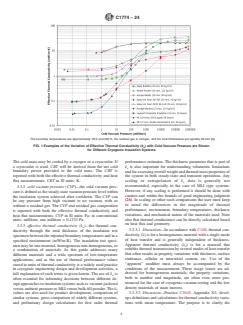
ranges are shown in Fig. 1.
C591 Specification for Unfaced Preformed Rigid Cellular
3.2.2 insulation test specimen—an insulation test specimen
Polyisocyanurate Thermal Insulation
is composed of one or more materials, homogeneous or
C680 Practice for Estimate of the Heat Gain or Loss and the
non-homogeneous, for which thermal transmission properties
Surface Temperatures of Insulated Flat, Cylindrical, and
through the thickness of the system are to be measured under
Spherical Systems by Use of Computer Programs
sub-ambient conditions.
C740 Guide for Evacuated Reflective Insulation In Cryo-
genic Service 3.2.2.1 Discussion—An insulation test specimen may con-
C870 Practice for Conditioning of Thermal Insulating Ma- sist of a single material, one type of material in several discrete
terials elements, or a number of different materials working in a
specialized design configuration. In reality, a test specimen is
C1029 Specification for Spray-Applied Rigid Cellular Poly-
urethane Thermal Insulation always a system, either a single material (with or without
inclusion of a gas) or a combination of materials in different
C1045 Practice for Calculating Thermal Transmission Prop-
erties Under Steady-State Conditions forms. Forms of insulation test specimens may be bulk-fill,
powder, blanket, layered, clam-shell, panels, monoliths, or
C1058 Practice for Selecting Temperatures for Evaluating
and Reporting Thermal Properties of Thermal Insulation other type configurations. Examples of materials include foams
(closed cell or open cell), fibrous insulation products, aerogels
C1482 Specification for Polyimide Flexible Cellular Ther-
mal and Sound Absorbing Insulation (blankets or bulk-fill or packaged), multilayer insulation
systems, clam shells of foams of cellular glass, composite
C1484 Specification for Vacuum Insulation Panels
C1594 Specification for Polyimide Rigid Cellular Thermal panels, polymeric composites, or any number of bulk-fill
materials such as perlite powder and glass bubbles.
Insulation
C1667 Test Method for Using Heat Flow Meter Apparatus to
3.2.3 multilayer insulation (MLI)—insulation systems com-
Measure the Center-of-Panel Thermal Transmission Prop-
posed of multiple radiation shields physically separated to
erties of Vacuum Insulation Panels
reduce conductive heat transfer. The radiation shields are thin
C1728 Specification for Flexible Aerogel Insulation
plastic membranes (usually polyester or polyimide films)
E230 Specification for Temperature-Electromotive Force
coated on one or both sides with a low-emittance, vapor-
(emf) Tables for Standardized Thermocouples
deposited metal (usually aluminum, gold, or silver), or thin
E408 Test Methods for Total Normal Emittance of Surfaces
metal foil membranes. Separation of the shields can be
Using Inspection-Meter Techniques
accomplished by (1) alternating thin layers of low-density,
E691 Practice for Conducting an Interlaboratory Study to
low-conductivity materials such as woven fabric net, fibrous
Determine the Precision of a Test Method
paper, powder insulation, or sliced foam spacers within the
2.2 ISO Standard:
radiation shields; (2) bonding low-density, low conductivity
ISO 21014 Cryogenic Vessels: Cryogenic Insulation Perfor-
filaments to one side of the radiation shields; (3) mechanically
mance
crinkling, dimpling, or embossing the radiation shields them-
selves; (4) attaching mechanical spacers; or (5) levitating the
3. Terminology
radiation shields with static or magnetic forces. For some
3.1 Definitions—Terminology of standards C168, C680, and techniques, the radiation shields are commonly metalized on
C1045 applies to the terms used in this standard unless
one side only to achieve minimum conductive heat transfer.
otherwise noted. Properties based on specimens tested under Guide C740 provides further information on MLI materials,
the conditions specified may not be representative of the
designs, and performance characteristics. Test Methods E408
installed performance if the end use conditions differ substan-
gives information on emissivity testing of the reflective mate-
tially from the test conditions. The temperature dependences of
rials used in constructing MLI systems.
the thermal performance of a given insulation test specimen,
3.3 Definitions of Terms Specific to This Standard:
3.3.1 cold boundary temperature (CBT)—the cold boundary
temperature is defined as the cold temperature imposed on
Available from American National Standards Institute (ANSI), 25 W. 43rd St.,
4th Floor, New York, NY 10036, http://www.ansi.org. cold-side surface of the insulation material by the cold mass.
C1774 − 24
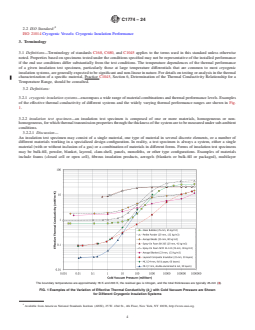
The boundary temperatures are approximately 78 K and 293 K, the residual gas is nitrogen, and the total thicknesses are typically 25-mm (3).
FIG. 1 Examples of the Variation of Effective Thermal Conductivity (k ) with Cold Vacuum Pressure are Shown
e
for Different Cryogenic Insulation Systems
The cold mass may be cooled by a cryogen or a cryocooler. If performance estimates. The thickness parameter that is part of
a cryocooler is used, CBT will be derived from the net cold k is also important for understanding volumetric limitations
e
boundary power provided to the cold mass. The CBT is and for assessing overall weight and thermal mass properties of
reported with both the effective thermal conductivity and heat the system in both steady-state and transient operations. Any
flux measurements. CBT in SI units: K.
scaling or extrapolation of k data is generally not
e
recommended, especially in the case of MLI type systems.
3.3.2 cold vacuum pressure (CVP)—the cold vacuum pres-
However, if any scaling is performed it should be done with
sure is defined as the steady-state vacuum pressure level within
caution and within the bounds of good engineering judgment
the insulation system achieved after cooldown. The CVP can
(26). In scaling or other such comparisons the user must keep
be any pressure from high vacuum to no vacuum, with or
in mind the differences in the magnitude of thermal
without a residual gas. The CVP and residual gas composition
performance, environment, boundary temperatures, thickness
is reported with both the effective thermal conductivity and
variations, and mechanical nature of the materials used. Note
heat flux measurements. CVP in SI units: Pa; in conventional
also that thermal conductance can be directly calculated based
units: millitorr; one millitorr = 0.1333 Pa.
on heat flux and geometry.
3.3.3 effective thermal conductivity (k )—the thermal con-
e
3.3.3.1 Discussion—In accordance with C168, thermal con-
ductivity through the total thickness of the insulation test
ductivity (λ) is for a homogeneous material with a single mode
specimen between the reported boundary temperatures and in a
of heat transfer and is generally independent of thickness.
specified environment (mW/m-K). The insulation test speci-
Apparent thermal conductivity (λ ) is for a material that
men may be one material, homogeneous non-homogeneous, or a
exhibits thermal transmission by several modes of heat transfer
a combination of materials. As this guide addresses many
that often results in property variations with thickness, surface
different materials and a wide spectrum of low-temperature
emittance, cellular or interstitial content, etc. Use of the
applications, and as the use of thermal performance values
“apparent” modifier must always be accompanied by the
stated in units of thermal conductivity is a widely used practice
conditions of the measurement. These usage issues are ad-
in cryogenic engineering design and development activities, a
dressed for homogeneous materials; the property variations,
full explanation of such terms is given herein. The use of k is
e
both in number and magnitude, are often even more pro-
often essential for informing decisions between different de-
nounced for the case of cryogenic-vacuum testing and the low
sign approaches to insulation systems such as vacuum-jacketed
density materials of main interest.
versus ambient pressure or MLI versus bulk-fill powder. The k
e
values are also used for product development, comparison of 3.3.3.2 Discussion—Practice C1045, Appendix X3, devel-
similar systems, gross comparison of widely different systems, ops definitions and calculations for thermal conductivity varia-
and preliminary design calculations for first order thermal tions with mean temperature. The purpose is to clarify the
C1774 − 24
differences between analysis of data at large temperature other means. The WBT could also be further developed from
differences and those taken at small temperature differences. consideration of other types of boundary conditions such as
Equations for mean thermal conductivity (λ ) and thermal convection or applied power or heat flux. The WBT is reported
m
conductivity at the mean temperature [λ(T )] are provided. with both the effective thermal conductivity and heat flux
m
However, this section points out that the practice only works measurements. WBT in SI units: K.
for thermal transmission properties that show a gradual change
3.3.11 warm vacuum pressure (WVP)—the warm vacuum
with temperature and that it may not work for the following
pressure is defined as the vacuum level within the insulation
cases: (1) onset of convection, (2) abrupt change in phase of an
system before cooldown. The WVP is usually considered to be
insulation component such as a condensable gas, and (3) heat
vacuum level at ambient temperature but may also be given as
flow anomalies found in reflective insulations. Any of these
the vacuum level at some elevated temperature prescribed as
cases are typically found in cryogenic insulation systems.
part of a heating/bake-out step prior to evacuation. WVP in SI
Therefore, the use of λ is different from the λ defined in
m a
units: Pa; in Imperial units: torr; 1 torr = 133.3 kPa; 1 millitorr
C168, even though both are considering large temperature
= 0.1333 Pa.
differences.
3.4 Symbols and Units:
3.3.3.3 Discussion—Practice C1058 gives information on
3.4.1 A—area of test specimen, m
reporting thermal properties using mean temperatures includ-
3.4.2 A —effective heat transfer area, m
ing the issues of testing closed-cell foams. This standard also
e
provides guidance on the selection of temperature differences
3.4.3 d —effective heat transfer diameter (for flat plate
e
to be used in testing.
specimens), m
3.3.4 heat flow rate (Q)—quantity of heat energy transferred
3.4.4 E—voltage, V
to or from a system in a unit of time (W).
3.4.5 h —heat of vaporization, J/g
fg
3.3.5 heat flux (q)—heat flow rate, under steady-state
3.4.6 I—current, A
conditions, through a unit area, in a direction perpendicular to
2 3.4.7 L—length of test specimen, m
the plane of the thermal insulation system (W/m ). A mean area
3.4.8 L —effective heat transfer length (for cylindrical
must be calculated for any test geometry: cylindrical or
e
specimens), m
spherical.
-7
3.4.9 Q —heater power loss, W
3.3.6 high vacuum (HV)—residual gas pressure from <10
loss
-3 -5
torr to 10 torr (<1.333 Pa to 0.133 Pa) [free molecular
3.4.10 r —outer radius of insulation, m
o
regime].
3.4.11 r —inner radius of insulation, m
i
3.3.7 no vacuum (NV)—residual gas pressure from 100 torr
3.4.12 ΔT—temperature difference (WBT – CBT), K
to 1000 torr (13.3 kPa to 133 kPa) [continuum, or viscous,
3.4.13 V —volumetric flow rate of a gas at standard tem-
g
regime]; 1 atmosphere pressure = 101.3 kPa = 760 torr.
perature and pressure (STP), m /s
-2
3.3.8 soft vacuum (SV)—residual gas pressure from 10 torr
3.4.14 x—thickness of insulation system or linear dimension
to 10 torr (1.33 Pa to 1333 Pa) [transition, or mixed mode,
in the heat flow direction, m
regime].
3.4.15 η —heater power constant
heater
3.3.9 system thermal conductivity (k )—the thermal conduc-
s
tivity through the total thickness of the insulation test specimen 3.4.16 ρ —density of boiloff gas at standard conditions,
g
kg/m
and all ancillary elements such as packaging, supports, getter
packages, enclosures, etc. (mW/m-K) (27, 28). As with k , the
e 3.4.17 ρ—bulk density of insulation system as-installed,
values of k must always be linked with the reported warm and
s kg/m
cold boundary temperatures and the specific test environment.
4. Summary of Test Methods
3.3.9.1 Discussion—Specification C1484 defines an effec-
tive thermal resistance for vacuum insulation panels. This
4.1 This guide describes both absolute and comparative test
effective R-value is for the total system including all packaging
methods for measuring the thermal performance of insulating
elements and edge heat flow effects and is distinctly separate
materials and systems under cryogenic and vacuum conditions.
from the apparent thermal resistivity of the vacuum panel
The methods may use cryogens or cryocoolers to provide the
which is taken as the intrinsic center-of-panel thermal resistiv-
refrigeration for the cold side temperatures. The basis of heat
ity. Similarly, with many cryogenic-vacuum insulation
flow measurement can be boiloff calorimetry, electrical power,
systems, a main interest is the effective thermal conductivity
or temperature response. An absolute apparatus means that the
through a complex of one or more materials (k ) as well as the
e
test chamber is fully guarded from peripheral heat leaks while
system thermal conductivity (k ) of a total system as it would
s
a comparative apparatus indicates a partially guarded test
be used in application.
chamber. A cylindrical apparatus indicates hollow cylindrical
3.3.10 warm boundary temperature (WBT)—the warm test specimen while a flat plate apparatus indicates a round disk
boundary temperature is defined as the warm temperature test specimen. The general arrangement of a cylindrical boiloff
imposed on the warm-side surface of the insulation material by apparatus is given in Fig. 2. The general arrangement of a flat
the warm mass. The warm mass may be heated by an electrical plate boiloff apparatus is given in Fig. 3. Either apparatus can
heater, liquid bath heat exchanger, ambient environment, or be designed as absolute or comparative depending on testing
C1774 − 24
FIG. 2 General Arrangement of a Cylindrical Boiloff Apparatus (29)
needs. The relatively simplified comparative apparatus is vacuum levels within the material. Accounting for the surface
useful for large numbers of specimens, similar specimens, contact resistance can be a particular challenge, especially for
quality control testing, or of course comparison testing. The rigid materials (32). The imposition of a large differential
general arrangement of an embedded heater apparatus that uses
temperature in generally low density, high surface area mate-
cryogens for cooling is given in Fig. 4. The embedded heater rials means that the composition and states of the interstitial
apparatus is generally an absolute apparatus calibrated by
species can have drastic changes through the thickness of the
temperature measurements under balanced heater inputs. The system. Even for a single component system such as a sheet of
general arrangement of an electrical power apparatus that uses
predominately closed-cell foam, the composition of the system
a cryocooler is given in Fig. 5. will often include air, moisture, and blowing agents at different
concentrations and physical states and morphologies through-
5. Significance and Use
out the material. The system, as tested under a given set of
5.1 A key aspect in understanding the thermal performance WBT, CBT, and CVP conditions, includes all of these compo-
of cryogenic insulation systems is to perform tests under nents (not only the foam material). The CVP can be imposed by
representative and reproducible conditions, simulating the way design or can vary in response to the change in boundary
that the materials are actually put together and used in service. temperatures as well as the surface effects of the insulation
Therefore, a large temperature differential across the insulation materials. In order for free molecular gas conduction to occur,
and a residual gas environment at some specific pressure are the mean free path of the gas molecules must be larger than the
usually required. Added to these requirements are the com- spacing between the two heat transfer surfaces. The ratio of the
plexities of thickness measurement at test condition after mean free path to the distance between surfaces is the Knudsen
thermal contraction, verification of surface contact and/or number (see Guide C740 for further discussion). A Knudsen
mechanical loading after cooldown, and measurement of high number greater than 1.0 is termed the molecular flow condition
C1774 − 24
FIG. 3 General Arrangement of a Flat Plate Boiloff Apparatus (29)
FIG. 4 General Arrangement of an Embedded Heater (Electrical Power) Apparatus That Uses a Cryogen (30)
while a Knudsen less than 0.01 is considered a continuum or performance could, for example, correspond to a k below 0.05
e
viscous flow condition. Testing of cryogenic-vacuum insula-
mW/m-K (R-value = 2900 or higher) for the boundary tem-
tion systems can cover a number of different intermediate or
peratures of 300 K and 77 K and a thickness of 25 mm. At
mixed mode heat transfer conditions.
these very low rates of heat transmission, on the order of tens
of milliwatts for an average size test apparatus, all details in
5.2 Levels of thermal performance can be very high: heat
approach, design, installation, and execution must be carefully
flux values well below 0.5 W/m are measured. This level of
C1774 − 24
FIG. 5 General Arrangement of an Electrical Power Apparatus That Uses a Cryocooler (31)
considered to obtain a meaningful result. For example, lead atmosphere pressure is in a temperature range representative of
wires for temperature sensors can be smaller diameter, longer many applications including liquid oxygen (LO ), liquid air
length, and carefully installed for the lowest possible heat (LAIR), and liquefied natural gas (LNG). The low level of
conduction to the cold mass. In the case of boiloff testing, the ullage vapor heating with liquid nitrogen systems means that
atmospheric pressure effects, the starting condition of the the vapor correction is minimal or even negligible. Liquid
cryogen, and any vibration forces from surrounding facilities hydrogen (LH ), with a normal boiling point of 20 K, can be
should also be considered. If an absolute test apparatus is to be used with the proper additional safety precautions for working
devised, then the parasitic heat leaks shall be essentially with a flammable fluid. Liquid helium (LHE), with a normal
eliminated by the integrated design of the apparatus and test boiling point of 4 K, can also be used effectively, but with a
methodology. The higher the level of performance (and usually significant rise in expense and complexity. The thermal
the higher level of vacuum), the lower the total heat load and performance, or heat flow rate (W), is a direct relation to the
thus the parasitic portion shall be near zero. For a comparative boiloff mass flow rate (g/s) by the heat of vaporization (J/g) of
apparatus, the parasitic heat leaks must be reduced to a level the liquid. Boiloff methods are therefore direct with respect to
that is an acceptable fraction of the total heat load to be calculating a k or heat flux.
e
measured. And most importantly, for the comparative
5.4 Electrical Power Testing—In some cases a boiloff
apparatus, the parasitic portion of the heat shall be consistent
method may not be the best option for thermal performance
and repeatable for a given test condition.
testing. Obtaining a cold boundary temperature below 77 K
5.3 Boiloff Testing—Boiloff testing can be performed with a without additional safety constraints (liquid hydrogen) or
number of cryogens or refrigerants with normal boiling points unreasonable expense (liquid helium) is often the main reason.
below ambient temperature (29). The cold boundary tempera- The use of electrical power methods provides a wide range of
ture is usually fixed but can be easily adjusted higher by possible approaches without the constraints of a liquid-vapor
interposing a thermal resistance layer (such as polymer com- interface and liquid management. Electrical power apparatus
posite or any suitable material) between the cold mass and the can be designed to use only cryocoolers, cryocoolers in
specimen. However, the thermal contact resistance shall be conjunction with cryogens or vapor shields, cryogens to
fairly well understood and obtaining a specific cold-side provide the refrigeration to maintain the desired cold boundary
temperature can be difficult. Liquid nitrogen (LN ) is a temperature, or any combination of these. The key experimen-
commonly used cryogen and can be handled and procured with tal element is the electrical heater system(s), but the key
relative ease and economy. Its 77 K boiling point at 1 challenge is the temperature sensor calibration at the low
C1774 − 24
temperatures. Temperature sensors are generally silicon diodes 6.2 In all cases, the focus is generally on large temperature
or platinum resistance thermometers. These methods are there- differences, but small temperature differences can also be
fore indirect with respect to calculating effective thermal accommodated by specific design modification or by interpos-
conductivity or heat flux. ing appropriate thermal resistances (insulation materials) be-
tween the warm and cold boundaries.
5.5 MLI—Multilayer insulation systems are usually evacu-
6.3 The design approach and specific dimensional details
ated (designed for a vacuum environment). Materials used in
MLI systems are highly anisotropic by nature. MLI systems must be sufficiently indentified and understood for accurate
thermal conductivity and heat flux determinations to be made.
exhibit heat flux values one or two orders of magnitude lower
than the best available powder, fiber, or foam insulations under The effective heat transfer areas are defined by the median
line(s), or center of the gap(s), between the test measurement
vacuum conditions. The thermal performance of multilayer
insulations will vary from specimen to specimen due to chamber (or the heat metered section) and the connecting
thermal guard(s). Typically there is a gap between the metered
differences in the material properties, such as the emittance of
the reflective shields, and differences in construction, such as section and the guard section(s). The metered section area shall
be determined, either by measurements or detailed analysis and
layer density and the way seams or joints are made. MLI
calculations, according to the center of this gap. Test Method
systems can vary due to environmental conditioning and the
presence of foreign matter such as oxygen or water vapor. MLI C177, Section 6.4, provides further information on the physical
design and thermal considerations for the gap.
systems can vary due to aging, settling, or exposure to
excessive mechanical pressures which could wrinkle or other-
6.4 Boiloff Calorimeter Apparatuses—In these apparatuses,
wise affect the surface texture of the layers. For these reasons,
the thermal energy transferred through an insulation specimen
it is imperative that specimen materials be selected carefully to
is measured by a boiloff calorimeter method. Ideally, a boiling
obtain representative specimens. It is recommended that sev-
fluid maintained at constant saturation conditions intercepts all
eral specimens of any one MLI system be tested with at least
of the energy crossing the cold boundary in a direction normal
three tests performed on each specimen. Further information,
to the plane of the insulation layers in the central or inner
including installation methods and typical thermal perfor-
portion of an specimen. This energy is absorbed by the
mance data are given in Guide C740.
vaporization of the calorimetric fluid (cryogen) that is subse-
quently vented. For absolute cylindrical boiloff methods and
5.6 High Performance Insulation Systems—High perfor-
lower fill levels (wetted surface area less than 75% for liquid
mance insulation systems, ranging from aerogels at ambient
nitrogen and at all times for liquid hydrogen or liquid helium),
pressure to evacuated powders to MLI under high vacuum
the temperature of the gas exiting the test measurement tank
conditions, are typical for the more-demanding applications in
should be measured and the change in sensible heat added to
cryogenic equipment and processes. The requirements of high
the energy from boiloff flow (see Note 2 and Note 5). Heat flux
performance mean low rates of heat energy transfer (in the
q and effective thermal conductivity k are calculated from
range of milliwatts) and even more demanding requirements
e
thermodynamic properties of the fluid and the measured boiloff
for accurately measuring these small heat leakage rates.
flow rate. Measurements of the mechanical compressive force
Achieving such measurements requires a sound experimental
applied to the specimen and the separation between hot and
approach and design, specialized vacuum equipment, a well
cold boundary surfaces in contact with the insulation can also
though-out methodology, and careful execution and handling
be obtained for the flat plate version as required. Typical
of data.
NOTE 1—The current lack of Certified Reference Materials (CRMs), or characteristics of boiloff calorimeter apparatuses are given in
even internal laboratory reference materials, that are characterized under
Table 1. Typical requirements for cylindrical and flat-plate
cryogenic-vacuum conditions underscores the need for round robin
calorimeters that are suitable for use with this method are
testing, inter-laboratory studies, and development of robust analytical
described in Annex A1 through A1.3. Particular design features
tools based on these experimental results.
required for safety are discussed in Section 8.
6. Apparatuses
6.5 Electrical Power Apparatuses—In these apparatuses,
6.1 The test apparatuses can be designed for any or all of the the electrical power is the primary measurement and tempera-
following conditions, as limited by practicality and suitability
ture sensor calibrations are of critical importance.
in results: evacuated, soft vacuum, or ambient pressure (high 6.5.1 Embedded Heater Apparatus—An isothermal test
vacuum or residual gas environments). specimen box made out of a suitable high thermal conductivity
TABLE 1 Typical Characteristics of Boiloff Calorimeter Apparatuses
Heat Flux Range k Range Typical Specimen
e
Geometry Type
(W/m ) (mW/m-K) Size
Cylindrical Absolute 0.1 to 500 0.01 to 60 1-m length;
up to 50-mm thickness
Cylindrical Comparative 1 to 500 0.1 to 60 0.5-m length;
up to 30-mm thickness
Flat Plate Absolute 1 to 1,000 0.05 to 100 200-mm diameter;
up to 30-mm thickness
Flat Plate Comparative 10 to 1,000 0.5 to 100 75-mm or 200-mm diameter;
up to 30-mm thickness
C1774 − 24
material, such as OFHC copper, equipped with a suitable through the thickness with proper care in placement of the tips
temperature sensor and an electrical heater. The hot plate heater and execution of the lead wires.
is used to apply heat for the thermal conductivity measure-
7.3 Monoliths, Clam-Shells, and Panels—Monolithic
ments; the test specimen box heater assists in raising the
materials, as well as clam-shells and panel type insulation test
overall temperature. The box is thermally linked to and
specimens, should be tested with special attention to the
suspended inside an isothermal vacuum tight chamber that is
surface thermal contact and overall fit-up of the specimen
also constructed from OFHC copper. This chamber is placed
within the apparatus. Thickness measurements must be devised
inside the vacuum can and equipped with a heater and a
with an accounting for cryogenic-vacuum effects during test-
temperature sensor. This arrangement allows variation of the
ing. Temperature sensors must the arranged so that surface
temperature of the chamber and its contents well above that of
contacts with the specimen are not disturbed.
a cryogen bath surrounding the vacuum can. The center of each
7.4 Blankets and Layered Constructions—Blankets and lay-
test specimen half is machined to make room for the isothermal
copper hot plate which is placed in between the two halves, ered constructions can be tested in a multitude of arrangements
of thicknesses and combinations. Layers should extend to
thus assuring that all of the heat passes through the specimen,
cover the cold mass surface of the apparatus. Edges of the
except for that conducted along the heater wires which are
thermally linked to a cryogen bath. specimens must be carefully examined during installation to
avoid or identify thermal short circuits. Temperature sensors
6.5.2 Cryocooler Apparatus—The cryocooler-based electri-
can be imbedded within layers with proper attention to lead
cal power cryostat apparatus includes an experimental chamber
wire lengths. Thicknesses can be measured as the insulation
that is thermally linked to an appropriate cryocooler refrigera-
test specimen is constructed to allow for intermediate thermal
tion system. Designs can be flat plate or cylindrical. The
conductivity calculations.
method works by creating axial heat transfer through the
insulation test specimen and measuring the corresponding
7.5 MLI—Multilayer insulation specimens include reflector
temperatures within the test specimen.
layers and spacer layers. The MLI may be applied as continu-
6.5.3 Guarded Heater Apparatus—Test Methods C177 or
ous roll-wrapped product, blankets, multiple sub-blankets,
C518 could be adapted with the cryogenic and vacuum
layer-by-layer overlap, layer-by-layer interleaved, helical strip
guidelines of this Guide to provide a means of testing using a
wraps, or spiral wrapping techniques. Guide C740 provides
heater apparatus. Test Method C1667 provides an example and
further details on the materials and processes involved with
guidance on adapting an established test apparatus for the
MLI systems. All manner of different materials, combinations,
purpose of test complex insulation systems such as panels and
and constructions cannot be addressed here, but general guide-
other composites.
lines for preparation are given as follows. Documentation of all
installation and preparation steps, along with consistent execu-
7. Test Specimens and Preparation
tion of these steps, is the key to reliable and comparable results
among similar MLI systems (11).
7.1 Materials include foams, powders, aerogels, and MLI in
forms including disks, panels, blankets, clamshells, and loose
7.5.1 Flat Plate—Cut spacers to the diameter of the hot and
fill. Ancillary materials such as tapes, fasteners, packaging, etc.
cold boundary plates. Cut the radiation shield to a diameter that
must be carefully evaluated for outgassing and temperature
is approximately 5 mm less than that of the spacer. The
compatibilities. Upper-use temperatures and overall vacuum
maximum specimen thickness to be tested using this test
behavior of all materials must be known in order to obtain the
method shall be 0.05 times the plate width.
desired test conditions as well as for operational safety during
7.5.2 Cylindrical—The installation approach defines the
evacuation and heating. As differences between test samples
dimensions of the spacers relative to the reflectors. In all cases,
and full-sized insulation may result in differences between data
the length of the spacer should be approximately the same
and actual performance of an insulation system, all aspects of
dimension as the cold mass
...
This document is not an ASTM standard and is intended only to provide the user of an ASTM standard an indication of what changes have been made to the previous version. Because
it may not be technically possible to adequately depict all changes accurately, ASTM recommends that users consult prior editions as appropriate. In all cases only the current version
of the standard as published by ASTM is to be considered the official document.
Designation: C1774 − 13 (Reapproved 2019) C1774 − 24
Standard Guide for
Thermal Performance Testing of Cryogenic Insulation
Systems
This standard is issued under the fixed designation C1774; the number immediately following the designation indicates the year of
original adoption or, in the case of revision, the year of last revision. A number in parentheses indicates the year of last reapproval. A
superscript epsilon (´) indicates an editorial change since the last revision or reapproval.
1. Scope
1.1 This guide provides information for the laboratory measurement of the steady-state thermal transmission properties and heat
flux of thermal insulation systems under cryogenic conditions. Thermal insulation systems may be composed of one or more
materials that may be homogeneous or non-homogeneous; flat, cylindrical, or spherical; at boundary conditions from near absolute
zero or 4 K up to 400 K; and in environments from high vacuum to an ambient pressure of air or residual gas. The testing
approaches presented as part of this guide are distinct from, and yet complementary to, other ASTM thermal test methods including
C177, C518, and C335. A key aspect of this guide is the notion of an insulation system, not an insulation material. Under the
practical use environment of most cryogenic applications even a single-material system can still be a complex insulation system
(1-3). To determine the inherent thermal properties of insulation materials, the standard test methods as cited in this guide should
be consulted.
1.2 The function of most cryogenic thermal insulation systems used in these applications is to maintain large temperature
differences thereby providing high levels of thermal insulating performance. The combination of warm and cold boundary
temperatures can be any two temperatures in the range of near 0 K to 400 K. Cold boundary temperatures typically range from
4 K to 100 K, but can be much higher such as 300 K. Warm boundary temperatures typically range from 250 K to 400 K, but can
be much lower such as 40 K. Large temperature differences up to 300 K are typical. Testing for thermal performance at large
temperature differences with one boundary at cryogenic temperature is typical and representative of most applications. Thermal
performance as a function of temperature can also be evaluated or calculated in accordance with Practices C1058 or C1045 when
sufficient information on the temperature profile and physical modeling are available.
-7 +3 -5
1.3 The range of residual gas pressures for this Guide is from 10 torr to 10 torr (1.33 Pa to 133 kPa) with different purge
gases as required. Corresponding to the applications in cryogenic systems, three sub-ranges of vacuum are also defined: High
-6 -3 -4 -2
Vacuum (HV) from <10 torr to 10 torr (1.333 Pa to 0.133 Pa) [free molecular regime], Soft Vacuum (SV) from 10 torr to
10 torr (from 1.33 Pa to 1,333 Pa) [transition regime], No Vacuum (NV) from 100 torr to 1000 torr (13.3 kPa to 133 kPa)
[continuum regime].
1.4 Thermal performance can vary by four orders of magnitude over the entire vacuum pressure range. Effective thermal
conductivities can range from 0.010 mW/m-K to 100 mW/m-K. The primary governing factor in thermal performance is the
pressure of the test environment. High vacuum insulation systems are often in the range from 0.05 mW/m-K to 2 mW/m-K while
non-vacuum systems are typically in the range from 10 mW/m-K to 30 mW/m-K. Soft vacuum systems are generally between
these two extremes (4). Of particular demand is the very low thermal conductivity (very high thermal resistance) range in
sub-ambient temperature environments. For example, careful delineation of test results in the range of 0.01 mW/m-K to 1 mW/m-K
This guide is under the jurisdiction of ASTM Committee C16 on Thermal Insulation and is the direct responsibility of Subcommittee C16.30 on Thermal Measurement.
Current edition approved Sept. 1, 2019March 15, 2024. Published October 2019April 2024. Originally approved in 2013. Last previous edition approved in 20132019 as
C1774 – 13.C1774 – 13 (2019). DOI: 10.1520/C1774-13R19.10.1520/C1774-24.
The boldface numbers in parentheses refer to the list of references at the end of this standard.
Copyright © ASTM International, 100 Barr Harbor Drive, PO Box C700, West Conshohocken, PA 19428-2959. United States
C1774 − 24
(from R-value 14,400 to R-value 144) is required as a matter of normal engineering applications for many cryogenic insulation
systems (5-7). The application of effective thermal conductivity values to multilayer insulation (MLI) systems and other
combinations of diverse materials, because they are highly anisotropic and specialized, must be done with due caution and full
provision of supporting technical information (8). The use of heat flux (W/m ) is, in general, more suitable for reporting the thermal
performance of MLI systems (9-11).
1.5 This guide covers different approaches for thermal performance measurement in sub-ambient temperature environments. The
test apparatuses (apparatus) are divided into two categories: boiloff calorimetry and electrical power. Both absolute and
comparative apparatuses are included.
1.6 This guide sets forth the general design requirements necessary to construct and operate a satisfactory test apparatus. A wide
variety of apparatus constructions, test conditions, and operating conditions are covered. Detailed designs are not given but must
be developed within the constraints of the general requirements. Examples of different cryogenic test apparatuses are found in the
literature (12). These apparatuses include boiloff types (13-17) as well as electrical types (18-21).
1.7 These testing approaches are applicable to the measurement of a wide variety of specimens, ranging from opaque solids to
porous or transparent materials, and a wide range of environmental conditions including measurements conducted at extremes of
temperature and with various gases and over a range of pressures. Of particular importance is the ability to test highly anisotropic
materials and systems such as multilayer insulation (MLI) systems (22-25). Other test methods are limited in this regard and do
not cover the testing of MLI and other layered systems under the extreme cryogenic and vacuum conditions that are typical for
these systems.
1.8 In order to ensure the level of precision and accuracy expected, users applying this standard must possess a working
knowledge of the requirements of thermal measurements and testing practice and of the practical application of heat transfer theory
relating to thermal insulation materials and systems. Detailed operating procedures, including design schematics and electrical
drawings, should be available for each apparatus to ensure that tests are in accordance with this Guide. In addition, automated data
collecting and handling systems connected to the apparatus must be verified as to their accuracy. Verification can be done by
calibration and comparing data sets, which have known results associated with them, using computer models.
1.9 It is impractical to establish all details of design and construction of thermal insulation test equipment and to provide
procedures covering all contingencies associated with the measurement of heat flow, extremely delicate thermal balances, high
vacuum, temperature measurements, and general testing practices. The user may also find it necessary, when repairing or
modifying the apparatus, to become a designer or builder, or both, on whom the demands for fundamental understanding and
careful experimental technique are even greater. The test methodologies given here are for practical use and adaptation as well as
to enable future development of improved equipment or procedures.
1.10 This guide does not specify all details necessary for the operation of the apparatus. Decisions on sampling, specimen
selection, preconditioning, specimen mounting and positioning, the choice of test conditions, and the evaluation of test data shall
follow applicable ASTM Test Methods, Guides, Practices or Product Specifications or governmental regulations. If no applicable
standard exists, sound engineering judgment that reflects accepted heat transfer principles must be used and documented.
1.11 This guide allows a wide range of apparatus design and design accuracy to be used in order to satisfy the requirements of
specific measurement problems. Compliance with a further specified test method should include a report with a discussion of the
significant error factors involved as well the uncertainty of each reported variable.
1.12 The values stated in SI units are to be regarded as the standard. The values given in parentheses are for information only.
Either SI or Imperial units may be used in the report, unless otherwise specified.
1.13 Safety precautions including normal handling and usage practices for the cryogen of use. Prior to operation of the apparatus
with any potentially hazardous cryogen or fluid, a complete review of the design, construction, and installation of all systems shall
be conducted. Safety practices and procedures regarding handling of hazardous fluids have been extensively developed and proven
through many years of use. For systems containing hydrogen, particular attention shall be given to ensure the following precautions
are addressed: (1) adequate ventilation in the test area, (2) prevention of leaks, (3) elimination of ignition sources, (4) fail safe
design, and (5) redundancy provisions for fluid fill and vent lines. This standard does not purport to address all of the safety
concerns, if any, associated with its use. It is the responsibility of the user of this standard to establish appropriate safety, health,
and environmental practices and determine the applicability of regulatory limitations prior to use.
C1774 − 24
1.14 Major sections within this standard are arranged as follows:
Section
Scope 1
Referenced Documents 2
Terminology 3
Summary of Test Methods 4
Significance and Use 5
Apparatus 6
Test Specimens and Preparation 7
Procedure 8
Calculation of Results 9
Report 10
Keywords 11
Annexes
Cylindrical Boiloff Calorimeter (Absolute) Annex A1
Cylindrical Boiloff Calorimeter (Comparative) Annex A2
Flat Plate Boiloff Calorimeter (Absolute) Annex A3
Flat Plate Boiloff Calorimeter (Comparative) Annex A4
Electrical Power Cryostat Apparatus (Cryogen) Annex A5
Electrical Power Cryostat Apparatus (Cryocooler) Annex A6
Appendix
Rationale Appendix X1
References
1.15 This international standard was developed in accordance with internationally recognized principles on standardization
established in the Decision on Principles for the Development of International Standards, Guides and Recommendations issued
by the World Trade Organization Technical Barriers to Trade (TBT) Committee.
2. Referenced Documents
2.1 ASTM Standards:
C167 Test Methods for Thickness and Density of Blanket or Batt Thermal Insulations
C168 Terminology Relating to Thermal Insulation
C177 Test Method for Steady-State Heat Flux Measurements and Thermal Transmission Properties by Means of the
Guarded-Hot-Plate Apparatus
C335 Test Method for Steady-State Heat Transfer Properties of Pipe Insulation
C518 Test Method for Steady-State Thermal Transmission Properties by Means of the Heat Flow Meter Apparatus
C520 Test Methods for Density of Granular Loose Fill Insulations
C534 Specification for Preformed Flexible Elastomeric Cellular Thermal Insulation in Sheet and Tubular Form
C549 Specification for Perlite Loose Fill Insulation
C552 Specification for Cellular Glass Thermal Insulation
C578 Specification for Rigid, Cellular Polystyrene Thermal Insulation
C591 Specification for Unfaced Preformed Rigid Cellular Polyisocyanurate Thermal Insulation
C680 Practice for Estimate of the Heat Gain or Loss and the Surface Temperatures of Insulated Flat, Cylindrical, and Spherical
Systems by Use of Computer Programs
C740 Guide for Evacuated Reflective Insulation In Cryogenic Service
C870 Practice for Conditioning of Thermal Insulating Materials
C1029 Specification for Spray-Applied Rigid Cellular Polyurethane Thermal Insulation
C1045 Practice for Calculating Thermal Transmission Properties Under Steady-State Conditions
C1058 Practice for Selecting Temperatures for Evaluating and Reporting Thermal Properties of Thermal Insulation
C1482 Specification for Polyimide Flexible Cellular Thermal and Sound Absorbing Insulation
C1484 Specification for Vacuum Insulation Panels
C1594 Specification for Polyimide Rigid Cellular Thermal Insulation
C1667 Test Method for Using Heat Flow Meter Apparatus to Measure the Center-of-Panel Thermal Transmission Properties of
Vacuum Insulation Panels
C1728 Specification for Flexible Aerogel Insulation
E230 Specification for Temperature-Electromotive Force (emf) Tables for Standardized Thermocouples
E408 Test Methods for Total Normal Emittance of Surfaces Using Inspection-Meter Techniques
E691 Practice for Conducting an Interlaboratory Study to Determine the Precision of a Test Method
For referenced ASTM standards, visit the ASTM website, www.astm.org, or contact ASTM Customer Service at service@astm.org. For Annual Book of ASTM Standards
volume information, refer to the standard’s Document Summary page on the ASTM website.
C1774 − 24
2.2 ISO Standard:
ISO 21014 Cryogenic Vessels: Cryogenic Insulation Performance
3. Terminology
3.1 Definitions—Terminology of standards C168, C680, and C1045 applies to the terms used in this standard unless otherwise
noted. Properties based on specimens tested under the conditions specified may not be representative of the installed performance
if the end use conditions differ substantially from the test conditions. The temperature dependences of the thermal performance
of a given insulation test specimen, particularly those at large temperature differentials that are common to most cryogenic
insulation systems, are generally expected to be significant and non-linear in nature. For details on testing or analysis in the thermal
characterization of a specific material, Practice C1045, Section 6, Determination of the Thermal Conductivity Relationship for a
Temperature Range, should be consulted.
3.2 Definitions:
3.2.1 cryogenic insulation systems—encompass a wide range of material combinations and thermal performance levels. Examples
of the effective thermal conductivity of different systems and the widely varying thermal performance ranges are shown in Fig.
1.
3.2.2 insulation test specimen—an insulation test specimen is composed of one or more materials, homogeneous or non-
homogeneous, for which thermal transmission properties through the thickness of the system are to be measured under sub-ambient
conditions.
3.2.2.1 Discussion—
An insulation test specimen may consist of a single material, one type of material in several discrete elements, or a number of
different materials working in a specialized design configuration. In reality, a test specimen is always a system, either a single
material (with or without inclusion of a gas) or a combination of materials in different forms. Forms of insulation test specimens
may be bulk-fill, powder, blanket, layered, clam-shell, panels, monoliths, or other type configurations. Examples of materials
include foams (closed cell or open cell), fibrous insulation products, aerogels (blankets or bulk-fill or packaged), multilayer
The boundary temperatures are approximately 78 K and 293 K, the residual gas is nitrogen, and the total thicknesses are typically 25-mm (3).
FIG. 1 Examples of the Variation of Effective Thermal Conductivity (k ) with Cold Vacuum Pressure are Shown
e
for Different Cryogenic Insulation Systems
Available from American National Standards Institute (ANSI), 25 W. 43rd St., 4th Floor, New York, NY 10036, http://www.ansi.org.
C1774 − 24
insulation systems, clam shells of foams of cellular glass, composite panels, polymeric composites, or any number of bulk-fill
materials such as perlite powder and glass bubbles.
3.2.3 multilayer insulation (MLI)—insulation systems composed of multiple radiation shields physically separated to reduce
conductive heat transfer. The radiation shields are thin plastic membranes (usually polyester or polyimide films) coated on one or
both sides with a low-emittance, vapor-deposited metal (usually aluminum, gold, or silver), or thin metal foil membranes.
Separation of the shields can be accomplished by (1) alternating thin layers of low-density, low-conductivity materials such as
woven fabric net, fibrous paper, powder insulation, or sliced foam spacers within the radiation shields; (2) bonding low-density,
low conductivity filaments to one side of the radiation shields; (3) mechanically crinkling, dimpling, or embossing the radiation
shields themselves; (4) attaching mechanical spacers; or (5) levitating the radiation shields with static or magnetic forces. For some
techniques, the radiation shields are commonly metalized on one side only to achieve minimum conductive heat transfer. Guide
C740 provides further information on MLI materials, designs, and performance characteristics. Test MethodMethods E408 gives
information on emissivity testing of the reflective materials used in constructing MLI systems.
3.3 Definitions of Terms Specific to This Standard:
3.3.1 cold boundary temperature (CBT)—the cold boundary temperature is defined as the cold temperature imposed on cold-side
surface of the insulation material by the cold mass. The cold mass may be cooled by a cryogen or a cryocooler. If a cryocooler
is used, CBT will be derived from the net cold boundary power provided to the cold mass. The CBT is reported with both the
effective thermal conductivity and heat flux measurements. CBT in SI units: K.
3.3.2 cold vacuum pressure (CVP)—the cold vacuum pressure is defined as the steady-state vacuum pressure level within the
insulation system achieved after cooldown. The CVP can be any pressure from high vacuum to no vacuum, with or without a
residual gas. The CVP and residual gas composition is reported with both the effective thermal conductivity and heat flux
measurements. CVP in SI units: Pa; in conventional units: millitorr; one millitorr = 0.1333 Pa.
3.3.3 effective thermal conductivity (k )—the thermal conductivity through the total thickness of the insulation test specimen
e
between the reported boundary temperatures and in a specified environment (mW/m-K). The insulation test specimen may be one
material, homogeneous non-homogeneous, or a combination of materials. As this guide addresses many different materials and a
wide spectrum of low-temperature applications, and as the use of thermal performance values stated in units of thermal
conductivity is a widely used practice in cryogenic engineering design and development activities, a full explanation of such terms
is given herein. The use of k is often essential for informing decisions between different design approaches to insulation systems
e
such as vacuum-jacketed versus ambient pressure or MLI versus bulk-fill powder. The k values are also used for product
e
development, comparison of similar systems, gross comparison of widely different systems, and preliminary design calculations
for first order thermal performance estimates. The thickness parameter that is part of k is also important for understanding
e
volumetric limitations and for assessing overall weight and thermal mass properties of the system in both steady-state and transient
operations. Any scaling or extrapolation of k data is generally not recommended, especially in the case of MLI type systems.
e
However, if any scaling is performed it should be done with caution and within the bounds of good engineering judgment (26).
In scaling or other such comparisons the user must keep in mind the differences in the magnitude of thermal performance,
environment, boundary temperatures, thickness variations, and mechanical nature of the materials used. Note also that thermal
conductance can be directly calculated based on heat flux and geometry.
3.3.3.1 Discussion—
In accordance with C168, thermal conductivity (λ) is for a homogeneous material with a single mode of heat transfer and is
generally independent of thickness. Apparent thermal conductivity (λ ) is for a material that exhibits thermal transmission by
a
several modes of heat transfer that often results in property variations with thickness, surface emittance, cellular or interstitial
content, etc. Use of the “apparent” modifier must always be accompanied by the conditions of the measurement. These usage issues
are addressed for homogeneous materials; the property variations, both in number and magnitude, are often even more pronounced
for the case of cryogenic-vacuum testing and the low density materials of main interest.
3.3.3.2 Discussion—
Practice C1045, Appendix X3, develops definitions and calculations for thermal conductivity variations with mean temperature.
The purpose is to clarify the differences between analysis of data at large temperature differences and those taken at small
temperature differences. Equations for mean thermal conductivity (λ ) and thermal conductivity at the mean temperature [λ(T )]
m m
are provided. However, this section points out that the practice only works for thermal transmission properties that show a gradual
change with temperature and that it may not work for the following cases: (1) onset of convection, (2) abrupt change in phase of
an insulation component such as a condensable gas, and (3) heat flow anomalies found in reflective insulations. Any of these cases
are typically found in cryogenic insulation systems. Therefore, the use of λ is different from the λ defined in C168, even though
m a
both are considering large temperature differences.
3.3.3.3 Discussion—
C1774 − 24
Practice C1058 gives information on reporting thermal properties using mean temperatures including the issues of testing
closed-cell foams. This standard also provides guidance on the selection of temperature differences to be used in testing.
3.3.4 heat flow rate (Q)—quantity of heat energy transferred to or from a system in a unit of time (W).
3.3.5 heat flux (q)—heat flow rate, under steady-state conditions, through a unit area, in a direction perpendicular to the plane of
the thermal insulation system (W/m ). A mean area must be calculated for any test geometry: cylindrical or spherical.
-7 -3 -5
3.3.6 high vacuum (HV)—residual gas pressure from <10 torr to 10 torr (<1.333 Pa to 0.133 Pa) [free molecular regime].
3.3.7 no vacuum (NV)—residual gas pressure from 100 torr to 1000 torr (13.3 kPa to 133 kPa) [continuum, or viscous, regime];
1 atmosphere pressure = 101.3 kPa = 760 torr.
-2
3.3.8 soft vacuum (SV)—residual gas pressure from 10 torr to 10 torr (1.33 Pa to 1333 Pa) [transition, or mixed mode, regime].
3.3.9 system thermal conductivity (k )—the thermal conductivity through the total thickness of the insulation test specimen and all
s
ancillary elements such as packaging, supports, getter packages, enclosures, etc. (mW/m-K) (27, 28). As with k , the values of k
e s
must always be linked with the reported warm and cold boundary temperatures and the specific test environment.
3.3.9.1 Discussion—
Specification C1484 defines an effective thermal resistance for vacuum insulation panels. This effective R-value is for the total
system including all packaging elements and edge heat flow effects and is distinctly separate from the apparent thermal resistivity
of the vacuum panel which is taken as the intrinsic center-of-panel thermal resistivity. Similarly, with many cryogenic-vacuum
insulation systems, a main interest is the effective thermal conductivity through a complex of one or more materials (k ) as well
e
as the system thermal conductivity (k ) of a total system as it would be used in application.
s
3.3.10 warm boundary temperature (WBT)—the warm boundary temperature is defined as the warm temperature imposed on the
warm-side surface of the insulation material by the warm mass. The warm mass may be heated by an electrical heater, liquid bath
heat exchanger, ambient environment, or other means. The WBT could also be further developed from consideration of other types
of boundary conditions such as convection or applied power or heat flux. The WBT is reported with both the effective thermal
conductivity and heat flux measurements. WBT in SI units: K.
3.3.11 warm vacuum pressure (WVP)—the warm vacuum pressure is defined as the vacuum level within the insulation system
before cooldown. The WVP is usually considered to be vacuum level at ambient temperature but may also be given as the vacuum
level at some elevated temperature prescribed as part of a heating/bake-out step prior to evacuation. WVP in SI units: Pa; in
Imperial units: torr; 1 torr = 133.3 kPa; 1 millitorr = 0.1333 Pa.
3.4 Symbols and Units:
3.4.1 A—area of test specimen, m
3.4.2 A —effective heat transfer area, m
e
3.4.3 d —effective heat transfer diameter (for flat plate specimens), m
e
3.4.4 E—voltage, V
3.4.5 h —heat of vaporization, J/g
fg
3.4.6 I—current, A
3.4.7 L—length of test specimen, m
3.4.8 L —effective heat transfer length (for cylindrical specimens), m
e
3.4.9 Q —heater power loss, W
loss
C1774 − 24
3.4.10 r —outer radius of insulation, m
o
3.4.11 r —inner radius of insulation, m
i
3.4.12 ΔT—temperature difference (WBT – CBT), K
3.4.13 V —volumetric flow rate of a gas at standard temperature and pressure (STP), m /s
g
3.4.14 x—thickness of insulation system or linear dimension in the heat flow direction, m
3.4.15 η —heater power constant
heater
3.4.16 ρ —density of boiloff gas at standard conditions, kg/m
g
3.4.17 ρ—bulk density of insulation system as-installed, kg/m
4. Summary of Test Methods
4.1 This guide describes both absolute and comparative test methods for measuring the thermal performance of insulating
materials and systems under cryogenic and vacuum conditions. The methods may use cryogens or cryocoolers to provide the
refrigeration for the cold side temperatures. The basis of heat flow measurement can be boiloff calorimetry, electrical power, or
temperature response. An absolute apparatus means that the test chamber is fully guarded from peripheral heat leaks while a
comparative apparatus indicates a partially guarded test chamber. A cylindrical apparatus indicates hollow cylindrical test specimen
while a flat plate apparatus indicates a round disk test specimen. The general arrangement of a cylindrical boiloff apparatus is given
in Fig. 2. The general arrangement of a flat plate boiloff apparatus is given in Fig. 3. Either apparatus can be designed as absolute
or comparative depending on testing needs. The relatively simplified comparative apparatus is useful for large numbers of
specimens, similar specimens, quality control testing, or of course comparison testing. The general arrangement of an embedded
heater apparatus that uses cryogens for cooling is given in Fig. 4. The embedded heater apparatus is generally an absolute apparatus
calibrated by temperature measurements under balanced heater inputs. The general arrangement of an electrical power apparatus
that uses a cryocooler is given in Fig. 5.
5. Significance and Use
5.1 A key aspect in understanding the thermal performance of cryogenic insulation systems is to perform tests under representative
and reproducible conditions, simulating the way that the materials are actually put together and used in service. Therefore, a large
temperature differential across the insulation and a residual gas environment at some specific pressure are usually required. Added
to these requirements are the complexities of thickness measurement at test condition after thermal contraction, verification of
surface contact and/or mechanical loading after cooldown, and measurement of high vacuum levels within the material.
Accounting for the surface contact resistance can be a particular challenge, especially for rigid materials (32). The imposition of
a large differential temperature in generally low density, high surface area materials means that the composition and states of the
interstitial species can have drastic changes through the thickness of the system. Even for a single component system such as a
sheet of predominately closed-cell foam, the composition of the system will often include air, moisture, and blowing agents at
different concentrations and physical states and morphologies throughout the material. The system, as tested under a given set of
WBT,CBT, and CVP conditions, includes all of these components (not only the foam material). The CVP can be imposed by design
or can vary in response to the change in boundary temperatures as well as the surface effects of the insulation materials. In order
for free molecular gas conduction to occur, the mean free path of the gas molecules must be larger than the spacing between the
two heat transfer surfaces. The ratio of the mean free path to the distance between surfaces is the Knudsen number (see Guide C740
for further discussion). A Knudsen number greater than 1.0 is termed the molecular flow condition while a Knudsen less than 0.01
is considered a continuum or viscous flow condition. Testing of cryogenic-vacuum insulation systems can cover a number of
different intermediate or mixed mode heat transfer conditions.
5.2 Levels of thermal performance can be very high: heat flux values well below 0.5 W/m are measured. This level of
performance could, for example, correspond to a k below 0.05 mW/m-K (R-value = 2900 or higher) for the boundary temperatures
e
of 300 K and 77 K and a thickness of 25 mm. At these very low rates of heat transmission, on the order of tens of milliwatts for
an average size test apparatus, all details in approach, design, installation, and execution must be carefully considered to obtain
C1774 − 24
FIG. 2 General Arrangement of a Cylindrical Boiloff Apparatus (29)
a meaningful result. For example, lead wires for temperature sensors can be smaller diameter, longer length, and carefully installed
for the lowest possible heat conduction to the cold mass. In the case of boiloff testing, the atmospheric pressure effects, the starting
condition of the cryogen, and any vibration forces from surrounding facilities should also be considered. If an absolute test
apparatus is to be devised, then the parasitic heat leaks shall be essentially eliminated by the integrated design of the apparatus
and test methodology. The higher the level of performance (and usually the higher level of vacuum), the lower the total heat load
and thus the parasitic portion shall be near zero. For a comparative apparatus, the parasitic heat leaks must be reduced to a level
that is an acceptable fraction of the total heat load to be measured. And most importantly, for the comparative apparatus, the
parasitic portion of the heat shall be consistent and repeatable for a given test condition.
5.3 Boiloff Testing—Boiloff testing can be performed with a number of cryogens or refrigerants with normal boiling points below
ambient temperature (29). The cold boundary temperature is usually fixed but can be easily adjusted higher by interposing a
thermal resistance layer (such as polymer composite or any suitable material) between the cold mass and the specimen. However,
the thermal contact resistance shall be fairly well understood and obtaining a specific cold-side temperature can be difficult. Liquid
nitrogen (LN ) is a commonly used cryogen and can be handled and procured with relative ease and economy. Its 77 K boiling
point at 1 atmosphere pressure is in a temperature range representative of many applications including liquid oxygen (LO ), liquid
air (LAIR), and liquefied natural gas (LNG). The low level of ullage vapor heating with liquid nitrogen systems means that the
vapor correction is minimal or even negligible. Liquid hydrogen (LH ), with a normal boiling point of 20 K, can be used with the
proper additional safety precautions for working with a flammable fluid. Liquid helium (LHE), with a normal boiling point of 4
K, can also be used effectively, but with a significant rise in expense and complexity. The thermal performance, or heat flow rate
C1774 − 24
FIG. 3 General Arrangement of a Flat Plate Boiloff Apparatus (29)
FIG. 4 General Arrangement of an Embedded Heater (Electrical Power) Apparatus That Uses a Cryogen (30)
(W), is a direct relation to the boiloff mass flow rate (g/s) by the heat of vaporization (J/g) of the liquid. Boiloff methods are
therefore direct with respect to calculating a k or heat flux.
e
5.4 Electrical Power Testing—In some cases a boiloff method may not be the best option for thermal performance testing.
Obtaining a cold boundary temperature below 77 K without additional safety constraints (liquid hydrogen) or unreasonable
expense (liquid helium) is often the main reason. The use of electrical power methods provides a wide range of possible approaches
C1774 − 24
FIG. 5 General Arrangement of an Electrical Power Apparatus That Uses a Cryocooler (31)
without the constraints of a liquid-vapor interface and liquid management. Electrical power apparatus can be designed to use only
cryocoolers, cryocoolers in conjunction with cryogens or vapor shields, cryogens to provide the refrigeration to maintain the
desired cold boundary temperature, or any combination of these. The key experimental element is the electrical heater system(s),
but the key challenge is the temperature sensor calibration at the low temperatures. Temperature sensors are generally silicon
diodes or platinum resistance thermometers. These methods are therefore indirect with respect to calculating effective thermal
conductivity or heat flux.
5.5 MLI—Multilayer insulation systems are usually evacuated (designed for a vacuum environment). Materials used in MLI
systems are highly anisotropic by nature. MLI systems exhibit heat flux values one or two orders of magnitude lower than the best
available powder, fiber, or foam insulations under vacuum conditions. The thermal performance of multilayer insulations will vary
from specimen to specimen due to differences in the material properties, such as the emittance of the reflective shields, and
differences in construction, such as layer density and the way seams or joints are made. MLI systems can vary due to environmental
conditioning and the presence of foreign matter such as oxygen or water vapor. MLI systems can vary due to aging, settling, or
exposure to excessive mechanical pressures which could wrinkle or otherwise affect the surface texture of the layers. For these
reasons, it is imperative that specimen materials be selected carefully to obtain representative specimens. It is recommended that
several specimens of any one MLI system be tested with at least three tests performed on each specimen. Further information,
including installation methods and typical thermal performance data are given in Guide C740.
5.6 High Performance Insulation Systems—High performance insulation systems, ranging from aerogels at ambient pressure to
evacuated powders to MLI under high vacuum conditions, are typical for the more-demanding applications in cryogenic equipment
and processes. The requirements of high performance mean low rates of heat energy transfer (in the range of milliwatts) and even
more demanding requirements for accurately measuring these small heat leakage rates. Achieving such measurements requires a
sound experimental approach and design, specialized vacuum equipment, a well though-out methodology, and careful execution
and handling of data.
NOTE 1—The current lack of Certified Reference Materials (CRMs), or even internal laboratory reference materials, that are characterized under
cryogenic-vacuum conditions underscores the need for round robin testing, inter-laboratory studies, and development of robust analytical tools based on
these experimental results.
C1774 − 24
6. Apparatuses
6.1 The test apparatuses can be designed for any or all of the following conditions, as limited by practicality and suitability in
results: evacuated, soft vacuum, or ambient pressure (high vacuum or residual gas environments).
6.2 In all cases, the focus is generally on large temperature differences, but small temperature differences can also be
accommodated by specific design modification or by interposing appropriate thermal resistances (insulation materials) between the
warm and cold boundaries.
6.3 The design approach and specific dimensional details must be sufficiently indentified and understood for accurate thermal
conductivity and heat flux determinations to be made. The effective heat transfer areas are defined by the median line(s), or center
of the gap(s), between the test measurement chamber (or the heat metered section) and the connecting thermal guard(s). Typically
there is a gap between the metered section and the guard section(s). The metered section area shall be determined, either by
measurements or detailed analysis and calculations, according to the center of this gap. Test Method C177, Section 6.4, provides
further information on the physical design and thermal considerations for the gap.
6.4 Boiloff Calorimeter Apparatuses—In these apparatuses, the thermal energy transferred through an insulation specimen is
measured by a boiloff calorimeter method. Ideally, a boiling fluid maintained at constant saturation conditions intercepts all of the
energy crossing the cold boundary in a direction normal to the plane of the insulation layers in the central or inner portion of an
specimen. This energy is absorbed by the vaporization of the calorimetric fluid (cryogen) that is subsequently vented. For absolute
cylindrical boiloff methods and lower fill levels (wetted surface area less than 75% for liquid nitrogen and less than 90%at all times
for liquid hydrogen or liquid helium), the temperature of the gas exiting the test measurement tank should be measured and the
change in sensible heat added to the energy from boiloff flow. flow (see Note 2 and Note 5). Heat flux q and effective thermal
conductivity k are calculated from thermodynamic properties of the fluid and the measured boiloff flow rate. Measurements of the
e
mechanical compressive force applied to the specimen and the separation between hot and cold boundary surfaces in contact with
the insulation can also be obtained for the flat plate version as required. Typical characteristics of boiloff calorimeter apparatuses
are given in Table 1. Typical requirements for cylindrical and flat-plate calorimeters that are suitable for use with this method are
described in Annex A1 through A1.3. Particular design features required for safety are discussed in Section 8.
6.5 Electrical Power Apparatuses—In these apparatuses, the electrical power is the primary measurement and temperature sensor
calibrations are of critical importance.
6.5.1 Embedded Heater Apparatus—An isothermal test specimen box made out of a suitable high thermal conductivity material,
such as OFHC copper, equipped with a suitable temperature sensor and an electrical heater. The hot plate heater is used to apply
heat for the thermal conductivity measurements; the test specimen box heater assists in raising the overall temperature. The box
is thermally linked to and suspended inside an isothermal vacuum tight chamber that is also constructed from OFHC copper. This
chamber is placed inside the vacuum can and equipped with a heater and a temperature sensor. This arrangement allows variation
of the temperature of the chamber and its contents well above that of a cryogen bath surrounding the vacuum can. The center of
each test specimen half is machined to make room for the isothermal copper hot plate which is placed in between the two halves,
thus assuring that all of the heat passes through the specimen, except for that conducted along the heater wires which are thermally
linked to a cryogen bath.
6.5.2 Cryocooler Apparatus—The cryocooler-based electrical power cryostat apparatus includes an experimental chamber that is
thermally linked to an appropriate cryocooler refrigeration system. Designs can be flat plate or cylindrical. The method works by
creating axial heat transfer through the insulation test specimen and measuring the corresponding temperatures within the test
specimen.
TABLE 1 Typical Characteristics of Boiloff Calorimeter Apparatuses
Heat Flux Range k Range Typical Specimen
e
Geometry Type
(W/m ) (mW/m-K) Size
Cylindrical Absolute 0.1 to 500 0.01 to 60 1-m length;
up to 50-mm thickness
Cylindrical Comparative 1 to 500 0.1 to 60 0.5-m length;
up to 30-mm thickness
Flat Plate Absolute 1 to 1,000 0.05 to 100 200-mm diameter;
up to 30-mm thickness
Flat Plate Comparative 10 to 1,000 0.5 to 100 75-mm or 200-mm diameter;
up to 30-mm thickness
C1774 − 24
6.5.3 Guarded Heater Apparatus—Test Methods C177 or C518 could be adapted with the cryogenic and vacuum guidelines of
this Guide to provide a means of testing using a heater apparatus. Test Method C1667 provides an example and guidance on
adapting an established test apparatus for the purpose of test complex insulation systems such as panels and other composites.
7. Test Specimens and Preparation
7.1 Materials include foams, powders, aerogels, and MLI in forms including disks, panels, blankets, clamshells, and loose fill.
Ancillary materials such as tapes, fasteners, packaging, etc. must be carefully evaluated for outgassing and temperature
compatibilities. Upper-use temperatures and overall vacuum behavior of all materials must be known in order to obtain the desired
test conditions as well as for operational safety during evacuation and heating. As differences between test samples and full-sized
insulation may result in differences between data and actual performance of an insulation system, all aspects of the test specimen
design configuration, preparation, and installation must be carefully considered. For example, a flat disk test specimen may be
reduced in thickness in order to achieve minimal edge effect (parasitic heat) but then be less than representative of the typical field
installed thickness. An example with a blanket type MLI system is a seam joining method, representative of the actual field
installed system and applied similarly to the test specimen, which overwhelms the total heat load to be measured.
7.2 Bulk-Fill Materials—Bulk-fill materials may be tested by using a containment sleeve that does not thermally connect with the
cold mass assembly (33). The bulk density, as-tested, must be measured and reported. The thickness measurement can be taken
by reference from the containment apparatus with any necessary compensation due to thermal contraction by design or calculation.
Temperature sensors can be placed through the thickness with proper care in placement of the tips and execution of the lead wires.
7.3 Monoliths, Clam-Shells, and Panels—Monolithic materials, as well as clam-shells and panel type insulation test specimens,
should be tested with special attention to the surface thermal contact and overall fit-up of the specimen within the apparatus.
Thickness measurements must be devised with an accounting for cryogenic-vacuum effects during testing. Temperature sensors
must the arranged so that surface contacts with the specimen are not disturbed.
7.4 Blankets and Layered Constructions—Blankets and layered constructions can be tested in a multitude of arrangements of
thicknesses and combinations. Layers should extend to cover the cold mass surface of the apparatus. Edges of the specimens must
be carefully examined during installation to avoid or identify thermal short circuits. Temperature sensors can be imbedded within
layers with proper attention to lead wire lengths. Thicknesses can be measured as the insulation test specimen is constructed to
allow for intermediate thermal conductivity calculations.
7.5 MLI—Multilayer insulation
...