

ASTM F2657-21
(Test Method)Standard Test Method for Outdoor Weathering Exposure of Crosslinked Polyethylene (PEX) Tubing
General Information
- Abstract
SIGNIFICANCE AND USE
5.1 During shipment, storage and installation, PEX tubing may be exposed to UV radiation prior to being shielded from further exposure after installation. The effects of UV exposure on PEX tubing is determined by use of this test method. By first exposing specimens to solar UV radiation and subsequently testing specimens for oxidative resistance or stabilizer functionality, changes as a result of solar UV radiation exposure can be evaluated. This information can be used to determine the maximum allowable total UV exposure prior to permanent shielding provided by installation.
5.2 The results of short-term exposure tests can provide an indication of relative outdoor performance, but they should not be used to predict the absolute long-term performance of a material. The results of tests conducted for less than twelve months will depend on the particular season of the year in which they begin.
SCOPE
1.1 This test method describes the procedure for exposing crosslinked polyethylene (PEX) tubing produced in accordance with Specification F876 to natural (sunlight) ultraviolet (UV) radiation and evaluating the effects of the exposure. This test method outlines the requirements for specimen size and preparation, exposure orientation, minimum UV exposure energy, post exposure testing and reporting.
Note 1: While other laboratory UV exposure systems are available, this test method relies on natural sunlight as the UV radiation source. Laboratory methods may be added in the future if testing confirms a correlation between natural sunlight and laboratory exposure.
1.2 PEX tubing is not designed for outdoor use. Data from short-term exposure testing per this test method can be used to judge the relative performance of PEX tubing stored outdoors for short periods of time prior to installation completely shielded from sunlight.
1.3 The values stated in SI units are to be regarded as standard. No other units of measurement are included in this standard.
1.4 The following precautionary caveat pertains only to the test method and post exposure testing portions, Sections 8 and 9 of this test method. This standard does not purport to address all of the safety concerns, if any, associated with its use. It is the responsibility of the user of this standard to establish appropriate safety, health, and environmental practices and determine the applicability of regulatory limitations prior to use.
1.5 This international standard was developed in accordance with internationally recognized principles on standardization established in the Decision on Principles for the Development of International Standards, Guides and Recommendations issued by the World Trade Organization Technical Barriers to Trade (TBT) Committee.
- Status
- Published
- Publication Date
- 30-Apr-2021
- Technical Committee
- F17 - Plastic Piping Systems
- Drafting Committee
- F17.40 - Test Methods
Buy Documents
ASTM F2657-21 - Standard Test Method for Outdoor Weathering Exposure of Crosslinked Polyethylene (PEX) Tubing
REDLINE ASTM F2657-21 - Standard Test Method for Outdoor Weathering Exposure of Crosslinked Polyethylene (PEX) Tubing
Overview
ASTM F2657-21, "Standard Test Method for Outdoor Weathering Exposure of Crosslinked Polyethylene (PEX) Tubing," provides a standardized procedure for evaluating how crosslinked polyethylene (PEX) tubing withstands exposure to natural sunlight, specifically ultraviolet (UV) radiation. This test method is critical in understanding the short-term outdoor durability and UV resistance of PEX tubing before installation, where it will be shielded from further sunlight exposure. The method applies to tubing produced to ASTM F876 standards and provides guidance on specimen preparation, exposure orientation, UV exposure energy requirements, and post-exposure testing and reporting.
Key Topics
- Natural Outdoor UV Exposure: The standard specifies the use of natural sunlight, not artificial sources, concentrating on real-world outdoor weathering as it affects PEX tubing during shipment, storage, and installation.
- Specimen Preparation and Mounting: Guidelines include the necessary specimen size, preparation, and mounting orientation to ensure consistent and reproducible test results.
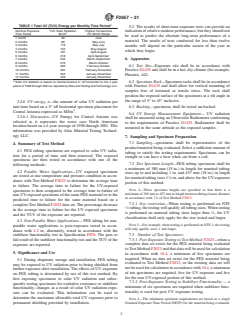
- UV Exposure Measurement: Exposure is quantified as total solar UV (TUV) energy, with values derived from Central Arizona's climate, representing a worst-case scenario for North America.
- Post-Exposure Performance Testing: After UV exposure, tubing is assessed either for oxidative resistance (using ASTM F2023) or stabilizer functionality (per ASTM F876). This step measures degradation as indicated by reduced performance.
- Reporting Requirements: Documentation of material identification, test conditions, exposure parameters, and results is clearly outlined to maintain transparency and traceability.
Applications
- Quality Assurance During Storage and Installation: The method helps manufacturers, distributors, and installers determine the maximum allowable duration of outdoor UV exposure for PEX tubing before it must be protected by installation.
- Material Selection and Comparison: Producers and specifiers can compare the relative outdoor performance of different PEX formulations, supporting informed product selection for plumbing and heating systems.
- Regulatory Compliance and Market Access: Adherence to ASTM F2657-21 supports compliance with industry best practices, international trade requirements, and specification calls in construction projects.
- Research & Development: The standard provides a basis for testing innovations in PEX tubing materials and formulations, facilitating the development of products with improved UV resistance.
Related Standards
This test method references and is complemented by several other ASTM standards:
- ASTM F876: Specification for Crosslinked Polyethylene (PEX) Tubing. Defines the material and dimensional requirements for PEX tubing used in various applications.
- ASTM F2023: Test method for evaluating oxidative resistance of PEX pipe, tubing, and systems, typically for hot chlorinated water exposure.
- ASTM D1435: Practice for outdoor weathering of plastics, which specifies exposure site and apparatus conditions.
- ASTM D1598: Test method for determining the time-to-failure of plastic pipe under constant internal pressure.
- ASTM F412: Terminology relating to plastic piping systems, providing standardized language for the industry.
- ASTM D1600: Terminology for abbreviated terms relating to plastics.
- ASTM G147: Practice for conditioning and handling of nonmetallic materials for natural and artificial weathering tests.
Practical Value
ASTM F2657-21 is essential for mitigating the risks associated with unintentional outdoor exposure of PEX tubing to solar UV during critical phases such as shipment and storage. The standard allows industry professionals to evaluate UV resistance, ensure compliance with project requirements, and make informed decisions about PEX tubing selection and handling. Ultimately, it supports the longevity, safety, and reliability of PEX piping systems in building and construction applications.
Keywords: ASTM F2657-21, crosslinked polyethylene, PEX tubing, outdoor weathering, UV exposure, natural sunlight, oxidative resistance, stabilizer functionality, plastic piping systems, ASTM standards, material durability.
Relations
- Effective Date
- 01-Feb-2024
- Effective Date
- 01-Dec-2023
- Effective Date
- 01-Apr-2020
- Effective Date
- 01-Jan-2019
- Refers
ASTM D1600-18 - Standard Terminology for Abbreviated Terms Relating to Plastics (Withdrawn 2024) - Effective Date
- 01-Jan-2018
- Effective Date
- 01-Aug-2017
- Effective Date
- 01-Jun-2017
- Effective Date
- 01-Feb-2017
- Effective Date
- 15-Nov-2016
- Effective Date
- 01-Aug-2016
- Effective Date
- 01-Nov-2015
- Effective Date
- 01-Jun-2015
- Effective Date
- 01-Feb-2014
- Effective Date
- 01-Nov-2013
- Effective Date
- 15-Apr-2013
Buy Documents
ASTM F2657-21 - Standard Test Method for Outdoor Weathering Exposure of Crosslinked Polyethylene (PEX) Tubing
REDLINE ASTM F2657-21 - Standard Test Method for Outdoor Weathering Exposure of Crosslinked Polyethylene (PEX) Tubing
Get Certified
Connect with accredited certification bodies for this standard

Institut za varilstvo d.o.o. (Welding Institute)
Slovenia's leading welding institute since 1952. ISO 3834, EN 1090, pressure equipment certification, NDT personnel, welder qualification. Only IIW Au
Sponsored listings
Frequently Asked Questions
ASTM F2657-21 is a standard published by ASTM International. Its full title is "Standard Test Method for Outdoor Weathering Exposure of Crosslinked Polyethylene (PEX) Tubing". This standard covers: SIGNIFICANCE AND USE 5.1 During shipment, storage and installation, PEX tubing may be exposed to UV radiation prior to being shielded from further exposure after installation. The effects of UV exposure on PEX tubing is determined by use of this test method. By first exposing specimens to solar UV radiation and subsequently testing specimens for oxidative resistance or stabilizer functionality, changes as a result of solar UV radiation exposure can be evaluated. This information can be used to determine the maximum allowable total UV exposure prior to permanent shielding provided by installation. 5.2 The results of short-term exposure tests can provide an indication of relative outdoor performance, but they should not be used to predict the absolute long-term performance of a material. The results of tests conducted for less than twelve months will depend on the particular season of the year in which they begin. SCOPE 1.1 This test method describes the procedure for exposing crosslinked polyethylene (PEX) tubing produced in accordance with Specification F876 to natural (sunlight) ultraviolet (UV) radiation and evaluating the effects of the exposure. This test method outlines the requirements for specimen size and preparation, exposure orientation, minimum UV exposure energy, post exposure testing and reporting. Note 1: While other laboratory UV exposure systems are available, this test method relies on natural sunlight as the UV radiation source. Laboratory methods may be added in the future if testing confirms a correlation between natural sunlight and laboratory exposure. 1.2 PEX tubing is not designed for outdoor use. Data from short-term exposure testing per this test method can be used to judge the relative performance of PEX tubing stored outdoors for short periods of time prior to installation completely shielded from sunlight. 1.3 The values stated in SI units are to be regarded as standard. No other units of measurement are included in this standard. 1.4 The following precautionary caveat pertains only to the test method and post exposure testing portions, Sections 8 and 9 of this test method. This standard does not purport to address all of the safety concerns, if any, associated with its use. It is the responsibility of the user of this standard to establish appropriate safety, health, and environmental practices and determine the applicability of regulatory limitations prior to use. 1.5 This international standard was developed in accordance with internationally recognized principles on standardization established in the Decision on Principles for the Development of International Standards, Guides and Recommendations issued by the World Trade Organization Technical Barriers to Trade (TBT) Committee.
SIGNIFICANCE AND USE 5.1 During shipment, storage and installation, PEX tubing may be exposed to UV radiation prior to being shielded from further exposure after installation. The effects of UV exposure on PEX tubing is determined by use of this test method. By first exposing specimens to solar UV radiation and subsequently testing specimens for oxidative resistance or stabilizer functionality, changes as a result of solar UV radiation exposure can be evaluated. This information can be used to determine the maximum allowable total UV exposure prior to permanent shielding provided by installation. 5.2 The results of short-term exposure tests can provide an indication of relative outdoor performance, but they should not be used to predict the absolute long-term performance of a material. The results of tests conducted for less than twelve months will depend on the particular season of the year in which they begin. SCOPE 1.1 This test method describes the procedure for exposing crosslinked polyethylene (PEX) tubing produced in accordance with Specification F876 to natural (sunlight) ultraviolet (UV) radiation and evaluating the effects of the exposure. This test method outlines the requirements for specimen size and preparation, exposure orientation, minimum UV exposure energy, post exposure testing and reporting. Note 1: While other laboratory UV exposure systems are available, this test method relies on natural sunlight as the UV radiation source. Laboratory methods may be added in the future if testing confirms a correlation between natural sunlight and laboratory exposure. 1.2 PEX tubing is not designed for outdoor use. Data from short-term exposure testing per this test method can be used to judge the relative performance of PEX tubing stored outdoors for short periods of time prior to installation completely shielded from sunlight. 1.3 The values stated in SI units are to be regarded as standard. No other units of measurement are included in this standard. 1.4 The following precautionary caveat pertains only to the test method and post exposure testing portions, Sections 8 and 9 of this test method. This standard does not purport to address all of the safety concerns, if any, associated with its use. It is the responsibility of the user of this standard to establish appropriate safety, health, and environmental practices and determine the applicability of regulatory limitations prior to use. 1.5 This international standard was developed in accordance with internationally recognized principles on standardization established in the Decision on Principles for the Development of International Standards, Guides and Recommendations issued by the World Trade Organization Technical Barriers to Trade (TBT) Committee.
ASTM F2657-21 is classified under the following ICS (International Classification for Standards) categories: 23.040.20 - Plastics pipes. The ICS classification helps identify the subject area and facilitates finding related standards.
ASTM F2657-21 has the following relationships with other standards: It is inter standard links to ASTM F876-24, ASTM F876-23a, ASTM F412-20, ASTM F412-19, ASTM D1600-18, ASTM F412-17a, ASTM G147-17, ASTM F412-17, ASTM F412-16a, ASTM F412-16, ASTM D1598-15, ASTM F412-15, ASTM D1600-14, ASTM F2023-13, ASTM D1600-13. Understanding these relationships helps ensure you are using the most current and applicable version of the standard.
ASTM F2657-21 is available in PDF format for immediate download after purchase. The document can be added to your cart and obtained through the secure checkout process. Digital delivery ensures instant access to the complete standard document.
Standards Content (Sample)
This international standard was developed in accordance with internationally recognized principles on standardization established in the Decision on Principles for the
Development of International Standards, Guides and Recommendations issued by the World Trade Organization Technical Barriers to Trade (TBT) Committee.
Designation: F2657 − 21
Standard Test Method for
Outdoor Weathering Exposure of Crosslinked Polyethylene
(PEX) Tubing
This standard is issued under the fixed designation F2657; the number immediately following the designation indicates the year of
original adoption or, in the case of revision, the year of last revision. A number in parentheses indicates the year of last reapproval. A
superscript epsilon (´) indicates an editorial change since the last revision or reapproval.
1. Scope* 2. Referenced Documents
1.1 This test method describes the procedure for exposing 2.1 ASTM Standards:
D1435 Practice for Outdoor Weathering of Plastics
crosslinkedpolyethylene(PEX)tubingproducedinaccordance
with Specification F876 to natural (sunlight) ultraviolet (UV) D1598 Test Method for Time-to-Failure of Plastic Pipe
Under Constant Internal Pressure
radiation and evaluating the effects of the exposure. This test
D1600 Terminology forAbbreviatedTerms Relating to Plas-
method outlines the requirements for specimen size and
tics
preparation, exposure orientation, minimum UV exposure
F412 Terminology Relating to Plastic Piping Systems
energy, post exposure testing and reporting.
F876 SpecificationforCrosslinkedPolyethylene(PEX)Tub-
NOTE 1—While other laboratory UV exposure systems are available,
ing
this test method relies on natural sunlight as the UV radiation source.
F2023 Test Method for Evaluating the Oxidative Resistance
Laboratory methods may be added in the future if testing confirms a
of Crosslinked Polyethylene (PEX) Pipe, Tubing and
correlation between natural sunlight and laboratory exposure.
Systems to Hot Chlorinated Water
1.2 PEX tubing is not designed for outdoor use. Data from
G147 Practice for Conditioning and Handling of Nonmetal-
short-term exposure testing per this test method can be used to
lic Materials for Natural and Artificial Weathering Tests
judge the relative performance of PEX tubing stored outdoors
for short periods of time prior to installation completely
3. Terminology
shielded from sunlight.
3.1 Definitions—Definitions are in accordance with Termi-
1.3 The values stated in SI units are to be regarded as
nology F412 and abbreviations are in accordance with Termi-
standard. No other units of measurement are included in this
nology D1600, unless otherwise indicated.
standard.
3.2 Definitions of Terms Specific to This Standard:
1.4 The following precautionary caveat pertains only to the
3.2.1 nominal exposure time period, n—the number of
test method and post exposure testing portions, Sections 8 and
months corresponding to the measured TUV as defined in
9ofthistestmethod.Thisstandarddoesnotpurporttoaddress
Table 1.
all of the safety concerns, if any, associated with its use. It is
3.2.2 polar orientation, n—the longitudinal direction of the
the responsibility of the user of this standard to establish
specimens with respect to the Equator.
appropriate safety, health, and environmental practices and
determine the applicability of regulatory limitations prior to
3.2.3 solar UV radiation, n—the portion of the light spec-
use.
trum falling within the range of 295nm to 385nm.
1.5 This international standard was developed in accor-
3.2.4 total solar UV radiation (TUV), n—the sum of mea-
dance with internationally recognized principles on standard-
sured UV Energy for the time period specimens are exposed,
ization established in the Decision on Principles for the
expressed in MJ/m . The historical average monthly TUV
Development of International Standards, Guides and Recom-
valuesforCentralArizona,5°offhorizontalexposurearelisted
mendations issued by the World Trade Organization Technical
in Table 1.
Barriers to Trade (TBT) Committee.
3.2.5 tubing bow, n—the resultant curvature of a tubing
sample taken from a coil.
This test method is under the jurisdiction of ASTM Committee F17 on Plastic
Piping Systems and is the direct responsibility of Subcommittee F17.40 on Test
Methods. For referenced ASTM standards, visit the ASTM website, www.astm.org, or
Current edition approved May 1, 2021. Published May 2021. Originally contact ASTM Customer Service at service@astm.org. For Annual Book of ASTM
approved in 2007. Last previous edition approved in 2018 as F2657–07(2018). Standards volume information, refer to the standard’s Document Summary page on
.DOI: 10.1520/F2657-21. the ASTM website.
*A Summary of Changes section appears at the end of this standard
Copyright © ASTM International, 100 Barr Harbor Drive, PO Box C700, West Conshohocken, PA 19428-2959. United States
F2657 − 21
A
TABLE 1 Total UV (TUV) Energy per Monthly Time Period
5.2 The results of short-term exposure tests can provide an
Nominal Exposure TUV Solar Radiation Highest Consecutive
indication of relative outdoor performance, but they should not
Time Period MJ/m UV Month Range
be used to predict the absolute long-term performance of a
1 month 40 June
material. The results of tests conducted for less than twelve
2 months 80 May-June
3 months 119 May-July
months will depend on the particular season of the year in
4 months 154 May-August
which they begin.
5 months 187 April-August
6 months 218 April-September
6. Apparatus
7 months 246 March-September
8 months 270 March-October
6.1 Test Site—Exposure site shall be in accordance with
9 months 289 February-October
10 months 307 February-November
Practice D1435 and shall be in a hot, dry climate (for example,
11 months 324 January-November
Phoenix, AZ).
12 months 339 January-December
A 6.2 Specimen Rack—Specimen racks shall be in accordance
Solar UV radiation is based on Central Arizona 5° off horizontal for the 4 year
periodof1998through2001asreportedbyAtlasandTestingandTechnologyLLC.
with Practice D1435 and shall allow for vertical mounting of
samples free of torsional or tensile stress. The rack shall
position the exposed surface of the specimens at a tilt angle in
the range of 5° to 45° inclusive.
3.2.6 UV energy, n—the amount of solar UV radiation per
unit time based on a 5° off horizontal specimen placement for 6.3 Backing—specimens shall be tested un-backed.
Central Arizona expressed as MJ/m .
6.4 UV Energy Measurement Equipment— UV radiation
3.2.6.1 Discussion—UV Energy for Central Arizona was
shall be measured using an Ultraviolet Radiometer conforming
selected as it represents the worst case North American
to the requirements of Practice D1435. Radiometer shall be
location based on a 4-year average of 1998 through 2001. This
mounted in the same attitude as the exposed samples.
information was provided by Atlas Material Testing Technol-
ogy LLC.
7. Sampling and Specimen Preparation
7.1 Sampling—specimens shall be representative of the
4. Summary of Test Method
product/material being evaluated. Select a sufficient amount of
4.1 PEX tubing specimens are exposed to solar UV radia-
tubing to satisfy the testing requirements. Specimens can be
tion for a period of time and then removed. The exposed
straight or can have a bow when cut from a coil.
specimens are then tested in accordance with one of the
7.2 Test Specimen Length—PEX tubing specimens shall be
following methods:
a minimum of 380 mm (15 in.) in length for nominal tubing
4.2 Potable Water Applications—UV exposed specimens
sizes up to and including 1 in. and 457 mm (18 in.) in length
are tested at one temperature and pressure condition in accor-
fornominaltubingsizes1 ⁄4in.andabovefortheUVexposure
dance with Test Method F2023 to determine the average time
portion of this method.
to failure. The average time to failure for the UV-exposed
NOTE 2—These specimen lengths are specified so that there is a
specimens is then compared to the average time to failure of
minimum of 305 mm to 457 mm in length between fitting closure distance
non UV-exposed specimens of the same PEX material or to the
in accordance with 7.2 of Test Method F2023.
predicted time to failure for the same material based on a
7.2.1 Size restriction—When testing is performed on NTS
completeTestMethodF2023dataset.Thepercentagedecrease
⁄2 tubing, the testing will qualify all tubing sizes.When testing
in the average time to failure for the UV exposed specimens
is performed on nominal tubing sizes larger than ⁄2, the UV
and the TUV of the exposure are reported.
classification shall only apply for the size tested and larger.
4.3 Non-Potable Water Applications— PEX tubing for non-
NOTE 3—For example, when testing is performed on NTS 1, the testing
potable water applications is post-exposure tested in accor-
will only qualify sizes 1 and larger.
dance with 4.2 or, alternately, tested in accordance with the
7.3 Number of Test Specimens:
stabilizer functionality test in Specification F876. The pass or
7.3.1 Post Exposure Testing to Test Method F2023—when a
fail result of the stabilizer functionality test and theTUVof the
complete data set exists for the PEX material being evaluated
exposure are reported.
toTest Method F2023 and that data will be used for calculation
5. Significance and Use
in accordance with 10.4, a minimum of five specimens are
required. When no data set exists for the PEX material being
5.1 During shipment, storage and installation, PEX tubing
evaluated to Test Method F2023, or the existing data set will
may be exposed to UV radiation prior to being shielded from
notbeusedforcalculationinaccordancewith10.4,aminimum
further exposure after installation. The effects of UV exposure
of ten specimens are required, five for UV exposure and five
on PEX tubing is determi
...
This document is not an ASTM standard and is intended only to provide the user of an ASTM standard an indication of what changes have been made to the previous version. Because
it may not be technically possible to adequately depict all changes accurately, ASTM recommends that users consult prior editions as appropriate. In all cases only the current version
of the standard as published by ASTM is to be considered the official document.
Designation: F2657 − 07 (Reapproved 2018) F2657 − 21
Standard Test Method for
Outdoor Weathering Exposure of Crosslinked Polyethylene
(PEX) Tubing
This standard is issued under the fixed designation F2657; the number immediately following the designation indicates the year of
original adoption or, in the case of revision, the year of last revision. A number in parentheses indicates the year of last reapproval. A
superscript epsilon (´) indicates an editorial change since the last revision or reapproval.
1. Scope Scope*
1.1 This test method describes the procedure for exposing crosslinked polyethylene (PEX) tubing produced in accordance with
Specification F876 to natural (sunlight) ultraviolet (UV) radiation and evaluating the effects of the exposure. This test method
outlines the requirements for specimen size and preparation, exposure orientation, minimum UV exposure energy, post exposure
testing and reporting.
NOTE 1—While other laboratory UV exposure systems are available, this test method relies on natural sunlight as the UV radiation source. Laboratory
methods may be added in the future if testing confirms a correlation between natural sunlight and laboratory exposure.
1.2 PEX tubing is not designed for outdoor use. Data from short-term exposure testing per this test method can be used to judge
the relative performance of PEX tubing stored outdoors for short periods of time prior to installation completely shielded from
sunlight.
1.3 The values stated in SI units are to be regarded as standard. No other units of measurement are included in this standard.
1.4 The following precautionary caveat pertains only to the test method and post exposure testing portions, Sections 8 and 9
of this test method. This standard does not purport to address all of the safety concerns, if any, associated with its use. It is the
responsibility of the user of this standard to establish appropriate safety, health, and environmental practices and determine the
applicability of regulatory limitations prior to use.
1.5 This international standard was developed in accordance with internationally recognized principles on standardization
established in the Decision on Principles for the Development of International Standards, Guides and Recommendations issued
by the World Trade Organization Technical Barriers to Trade (TBT) Committee.
2. Referenced Documents
2.1 ASTM Standards:
D1435 Practice for Outdoor Weathering of Plastics
D1598 Test Method for Time-to-Failure of Plastic Pipe Under Constant Internal Pressure
D1600 Terminology for Abbreviated Terms Relating to Plastics
F412 Terminology Relating to Plastic Piping Systems
F876 Specification for Crosslinked Polyethylene (PEX) Tubing
This test method is under the jurisdiction of ASTM Committee F17 on Plastic Piping Systems and is the direct responsibility of Subcommittee F17.40 on Test Methods.
Current edition approved Aug. 1, 2018May 1, 2021. Published August 2018May 2021. Originally approved in 2007. Last previous edition approved in 20122018 as
F2657–07(2012).F2657–07(2018). .DOI: 10.1520/F2657-07R18.10.1520/F2657-21.
For referenced ASTM standards, visit the ASTM website, www.astm.org, or contact ASTM Customer Service at service@astm.org. For Annual Book of ASTM Standards
volume information, refer to the standard’s Document Summary page on the ASTM website.
*A Summary of Changes section appears at the end of this standard
Copyright © ASTM International, 100 Barr Harbor Drive, PO Box C700, West Conshohocken, PA 19428-2959. United States
F2657 − 21
F2023 Test Method for Evaluating the Oxidative Resistance of Crosslinked Polyethylene (PEX) Pipe, Tubing and Systems to
Hot Chlorinated Water
G147 Practice for Conditioning and Handling of Nonmetallic Materials for Natural and Artificial Weathering Tests
3. Terminology
3.1 Definitions—Definitions are in accordance with Terminology F412 and abbreviations are in accordance with Terminology
D1600, unless otherwise indicated.
3.2 Definitions of Terms Specific to This Standard:
3.2.1 nominal exposure time period, n—the number of months corresponding to the measured TUV as defined in Table 1.
3.2.2 polar orientation, n—the longitudinal direction of the specimens with respect to the Equator.
3.2.3 solar UV radiation, n—the portion of the light spectrum falling within the range of 295nm to 385nm.
3.2.4 total solar UV radiation (TUV), n—the sum of measured UV Energy for the time period specimens are exposed, expressed
in MJ/m . The historical average monthly TUV values for Central Arizona, 5° off horizontal exposure are listed in Table 1.
3.2.5 tubing bow, n—the resultant curvature of a tubing sample taken from a coil.
3.2.6 UV energy, n—the amount of solar UV radiation per unit time based on a 5° off horizontal specimen placement for Central
Arizona expressed as MJ/m .
3.2.6.1 Discussion—
UV Energy for Central Arizona was selected as it represents the worst case North American location based on a 4-year average
of 1998 through 2001. This information was provided by Atlas Material Testing Technology LLC.
4. Summary of Test Method
4.1 PEX tubing specimens are exposed to solar UV radiation for a period of time and then removed. The exposed specimens are
then tested in accordance with one of the following methods:
4.2 Potable Water Applications—UV exposed specimens are tested at one temperature and pressure condition in accordance with
Test Method F2023 to determine the average time to failure. The average time to failure for the UV-exposed specimens is then
compared to the average time to failure of non UV-exposed specimens of the same PEX material or to the predicted time to failure
for the same material based on a complete Test Method F2023 data set. The percentage decrease in the average time to failure for
the UV exposed specimens and the TUV of the exposure are reported.
4.3 Non-Potable Water Applications— PEX tubing for non-potable water applications is post-exposure tested in accordance with
A
TABLE 1 Total UV (TUV) Energy per Monthly Time Period
Nominal Exposure TUV Solar Radiation Highest Consecutive
Time Period MJ/m UV Month Range
1 month 40 June
2 months 80 May-June
3 months 119 May-July
4 months 154 May-August
5 months 187 April-August
6 months 218 April-September
7 months 246 March-September
8 months 270 March-October
9 months 289 February-October
10 months 307 February-November
11 months 324 January-November
12 months 339 January-December
A
Solar Solar UV radiation is based on Central Arizona 5° off horizontal for the 4
year period of 1998 through 2001 as reported by Atlas and Testing and Technology
LLC.
F2657 − 21
4.2 or, alternately, tested in accordance with the stabilizer functionality test in Specification F876. The pass or fail result of the
stabilizer functionality test and the TUV of the exposure are reported.
5. Significance and Use
5.1 During shipment, storage and installation, PEX tubing may be exposed to UV radiation prior to being shielded from further
exposure after installation. The effects of UV exposure on PEX tubing is determined by use of this test method. By first exposing
specimens to solar UV radiation and subsequently testing specimens for oxidative resistance or stabilizer functionality, changes
as a result of solar UV radiation exposure can be evaluated. This information can be used to determine the maximum allowable
total UV exposure prior to permanent shielding provided by installation.
5.2 The results of short-term exposure tests can provide an indication of relative outdoor performance, but they should not be used
to predict the absolute long-term performance of a material. The results of tests conducted for less than twelve months will depend
on the particular season of the year in which they begin.
6. Apparatus
6.1 Test Site—Exposure site shall be in accordance with Practice D1435 and shall be in a hot, dry climate (for example, Phoenix,
AZ).
6.2 Specimen Rack—Specimen racks shall be in accordance with Practice D1435 and shall allow for vertical mounting of samples
free of torsional or tensile stress. The rack shall position the exposed surface of the specimens at a tilt angle in the range of 5° to
45° inclusive.
6.3 Backing—specimens shall be tested un-backed.
6.4 UV Energy Measurement Equipment— UV radiation shall be measured using an Ultraviolet Radiometer conforming to the
requirements of Practice D1435. Radiometer shall be mounted in the same attitude as the exposed samples.
7. Sampling and Specimen Preparation
7.1 Sampling—specimens shall be representative of the product/material being evaluated. Select a sufficient amount of tubing to
satisfy the testing requirements. Specimens can be straight or can have a bow when cut from a coil.
7.2 Test Specimen Size—Length—PEX tubing specimens shall be of nominal sizea minimum of ⁄2 in., SDR 9, and shall be a
minimum of 380 mm (15 380 mm (15 in.) in length for nominal tubing sizes up to and including 1 in. and 457 mm (18 in.) in length
for nominal tubing sizes 1 ⁄4 in. and above for the UV exposure portion of this method.
NOTE 2—These specimen lengths are specified so that there is a minimum of 305 mm to 457 mm in length between fitting closure distance in accordance
with 7.2 of Test Method F2023.
7.2.1 Size restriction—When testing is performed on NTS ⁄2 tubing, the testing will qualify all tubing sizes. When testing is
performed on nominal tubing sizes larger than ⁄2, the UV classification shall only apply for the size tested and larger.
NOTE 3—For example, when testing is performed on NTS 1, the testing will only qua
...