

ASTM F733-19
(Practice)Standard Practice for Optical Distortion and Deviation of Transparent Parts Using the Double-Exposure Method
General Information
- Abstract
SIGNIFICANCE AND USE
5.1 Transparent parts, such as aircraft windshields and windows, can be inspected using this practice, and the amount of optical distortion or deviation can be measured. The measurement shall be checked for acceptability against the specification for the part. The photograph (digital file, print, or negative) shall be maintained as a permanent record of the optical quality of the part.
SCOPE
1.1 This photographic practice determines the optical distortion and deviation of a line of sight through a simple transparent part, such as a commercial aircraft windshield or a cabin window. This practice applies to essentially flat or nearly flat parts moreso than to highly curved materials.
1.2 Test Method F801 addresses optical deviation (angular deviation), and Test Method F2156 addresses optical distortion using grid line slope. Use these test methods instead of Practice F733 whenever practical.
1.3 This standard does not purport to address all of the safety concerns, if any, associated with its use. It is the responsibility of the user of this standard to establish appropriate safety, health, and environmental practices and determine the applicability of regulatory limitations prior to use.
1.4 This international standard was developed in accordance with internationally recognized principles on standardization established in the Decision on Principles for the Development of International Standards, Guides and Recommendations issued by the World Trade Organization Technical Barriers to Trade (TBT) Committee.
- Status
- Published
- Publication Date
- 31-Oct-2019
- Technical Committee
- F07 - Aerospace and Aircraft
- Drafting Committee
- F07.08 - Transparent Enclosures and Materials
Buy Documents
ASTM F733-19 - Standard Practice for Optical Distortion and Deviation of Transparent Parts Using the Double-Exposure Method
REDLINE ASTM F733-19 - Standard Practice for Optical Distortion and Deviation of Transparent Parts Using the Double-Exposure Method
Overview
ASTM F733-19 establishes a standard practice for evaluating the optical distortion and deviation in transparent parts-such as aircraft windshields and windows-using the double-exposure photographic method. This standard is particularly suited for essentially flat or nearly flat transparent parts, offering a photographic approach to determine how much a component may distort or deviate a line of sight. These measurements support quality control, maintenance, and compliance with part-specific optical specification requirements.
Key Topics
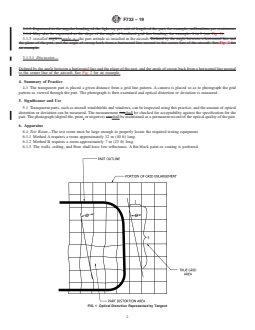
- Optical Distortion: The rate of change in deviation caused by material irregularities, expressed as the angular bending of light per unit length (commonly in milliradians per centimetre). It is crucial to ensure visual clarity through transparent aircraft components.
- Optical Deviation: The displacement of an object or grid line viewed through a transparent part, measured in terms of angle or linear shift. This quantifies how much images seen through the part are altered from their true position.
- Double-Exposure Method: Involves capturing two photographs: one of the grid through the part, and another of the grid alone. These are compared-either via film or digitally-to evaluate changes in the grid lines.
- Grid Board Setup: Utilizes a precise grid pattern as a reference. The grid provides a visual backdrop to measure and assess line displacement or distortion in quantitative terms.
- Permanent Quality Record: Photographs or digital images taken during inspection serve as a documented record of the part's optical quality, aiding traceability and maintenance compliance.
Applications
ASTM F733-19 is widely used in aerospace and related industries, particularly for:
- Aircraft Windshields and Windows: Ensuring pilot and passenger visibility by evaluating the clarity and accuracy of vision through cockpit and cabin transparencies.
- Quality Assurance: Verifying that transparent components meet specified limits for optical distortion and deviation before installation or recertification.
- Manufacturing Validation: Supporting production processes by providing a standardized method for optical inspection of new or replacement transparencies.
- Maintenance and Inspection: Allowing operators and regulators to document, compare, and monitor the optical performance of in-service transparent parts over time.
Related Standards
Several ASTM standards complement or offer alternative methods to F733-19 for evaluating optical characteristics in transparent components:
- ASTM F801: Test Method for Measuring Optical Angular Deviation of Transparent Parts - Focuses on precise measurements of angular deviation, suitable for more detailed or curved parts where double-exposure may not apply.
- ASTM F2156: Test Method for Measuring Optical Distortion in Transparent Parts Using Grid Line Slope - Uses direct measurement of grid line angles to assess distortion, often preferred for certain part geometries or when higher precision is needed.
For most practical applications, especially with essentially flat transparencies, ASTM F733-19 offers a robust, standardized approach for capturing and managing the optical quality of critical components. Adhering to this standard enhances safety, regulatory compliance, and product confidence in aerospace and other industries where transparency performance is a key factor.
Keywords: optical distortion, optical deviation, double-exposure method, transparent parts, aircraft windows, aircraft windshields, transparency inspection, quality control, ASTM F733-19.
Relations
- Effective Date
- 01-Nov-2019
- Effective Date
- 01-Dec-2011
- Effective Date
- 01-Apr-2008
- Effective Date
- 01-Nov-2006
- Effective Date
- 10-Nov-2001
- Refers
ASTM F801-96 - Standard Test Method for Measuring Optical Angular Deviation of Transparent Parts - Effective Date
- 10-Nov-1996
- Effective Date
- 10-Nov-1996
- Referred By
ASTM F801-21 - Standard Test Method for Measuring Optical Angular Deviation of Transparent Parts - Effective Date
- 01-Nov-2019
- Effective Date
- 01-Nov-2019
- Referred By
ASTM F790-23 - Standard Guide for Testing Materials for Aerospace Plastic Transparent Enclosures - Effective Date
- 01-Nov-2019
- Effective Date
- 01-Nov-2019
- Effective Date
- 01-Nov-2019
Buy Documents
ASTM F733-19 - Standard Practice for Optical Distortion and Deviation of Transparent Parts Using the Double-Exposure Method
REDLINE ASTM F733-19 - Standard Practice for Optical Distortion and Deviation of Transparent Parts Using the Double-Exposure Method
Get Certified
Connect with accredited certification bodies for this standard

BUREAU VERITAS Certification Germany
Bureau Veritas certification in Germany.

Element Materials Technology
Materials testing and product certification.

AQMS Ltd.
AQMS provides ISO certification to SMEs across the UK.
Sponsored listings
Frequently Asked Questions
ASTM F733-19 is a standard published by ASTM International. Its full title is "Standard Practice for Optical Distortion and Deviation of Transparent Parts Using the Double-Exposure Method". This standard covers: SIGNIFICANCE AND USE 5.1 Transparent parts, such as aircraft windshields and windows, can be inspected using this practice, and the amount of optical distortion or deviation can be measured. The measurement shall be checked for acceptability against the specification for the part. The photograph (digital file, print, or negative) shall be maintained as a permanent record of the optical quality of the part. SCOPE 1.1 This photographic practice determines the optical distortion and deviation of a line of sight through a simple transparent part, such as a commercial aircraft windshield or a cabin window. This practice applies to essentially flat or nearly flat parts moreso than to highly curved materials. 1.2 Test Method F801 addresses optical deviation (angular deviation), and Test Method F2156 addresses optical distortion using grid line slope. Use these test methods instead of Practice F733 whenever practical. 1.3 This standard does not purport to address all of the safety concerns, if any, associated with its use. It is the responsibility of the user of this standard to establish appropriate safety, health, and environmental practices and determine the applicability of regulatory limitations prior to use. 1.4 This international standard was developed in accordance with internationally recognized principles on standardization established in the Decision on Principles for the Development of International Standards, Guides and Recommendations issued by the World Trade Organization Technical Barriers to Trade (TBT) Committee.
SIGNIFICANCE AND USE 5.1 Transparent parts, such as aircraft windshields and windows, can be inspected using this practice, and the amount of optical distortion or deviation can be measured. The measurement shall be checked for acceptability against the specification for the part. The photograph (digital file, print, or negative) shall be maintained as a permanent record of the optical quality of the part. SCOPE 1.1 This photographic practice determines the optical distortion and deviation of a line of sight through a simple transparent part, such as a commercial aircraft windshield or a cabin window. This practice applies to essentially flat or nearly flat parts moreso than to highly curved materials. 1.2 Test Method F801 addresses optical deviation (angular deviation), and Test Method F2156 addresses optical distortion using grid line slope. Use these test methods instead of Practice F733 whenever practical. 1.3 This standard does not purport to address all of the safety concerns, if any, associated with its use. It is the responsibility of the user of this standard to establish appropriate safety, health, and environmental practices and determine the applicability of regulatory limitations prior to use. 1.4 This international standard was developed in accordance with internationally recognized principles on standardization established in the Decision on Principles for the Development of International Standards, Guides and Recommendations issued by the World Trade Organization Technical Barriers to Trade (TBT) Committee.
ASTM F733-19 is classified under the following ICS (International Classification for Standards) categories: 49.035 - Components for aerospace construction. The ICS classification helps identify the subject area and facilitates finding related standards.
ASTM F733-19 has the following relationships with other standards: It is inter standard links to ASTM F733-09(2014), ASTM F2156-11, ASTM F801-96(2008), ASTM F2156-06, ASTM F2156-01, ASTM F801-96, ASTM F801-96(2002), ASTM F801-21, ASTM F2156-17(2022), ASTM F790-23, ASTM F2469-20, ASTM C1652/C1652M-21. Understanding these relationships helps ensure you are using the most current and applicable version of the standard.
ASTM F733-19 is available in PDF format for immediate download after purchase. The document can be added to your cart and obtained through the secure checkout process. Digital delivery ensures instant access to the complete standard document.
Standards Content (Sample)
This international standard was developed in accordance with internationally recognized principles on standardization established in the Decision on Principles for the
Development of International Standards, Guides and Recommendations issued by the World Trade Organization Technical Barriers to Trade (TBT) Committee.
Designation: F733 − 19
Standard Practice for
Optical Distortion and Deviation of Transparent Parts Using
the Double-Exposure Method
ThisstandardisissuedunderthefixeddesignationF733;thenumberimmediatelyfollowingthedesignationindicatestheyearoforiginal
adoptionor,inthecaseofrevision,theyearoflastrevision.Anumberinparenthesesindicatestheyearoflastreapproval.Asuperscript
epsilon (´) indicates an editorial change since the last revision or reapproval.
1. Scope 3.1.1 deviation, n—the displacement of a line or object
when viewed through the transparent part.
1.1 This photographic practice determines the optical dis-
tortion and deviation of a line of sight through a simple
3.1.1.1 Discussion—Expressed as the angular measurement
transparent part, such as a commercial aircraft windshield or a
of the displaced line, for example, milliradians of angle.
cabinwindow.Thispracticeappliestoessentiallyflatornearly
3.1.2 distortion, n—therateofchangeofdeviationresulting
flat parts moreso than to highly curved materials.
from an irregularity in a transparent part.
1.2 Test Method F801 addresses optical deviation (angular
3.1.2.1 Discussion—Expressed as the angular bending of
deviation),andTestMethodF2156addressesopticaldistortion
the light ray per unit of length of the part, for example,
usinggridlineslope.UsethesetestmethodsinsteadofPractice
milliradians per centimetre.
F733 whenever practical.
3.1.2.2 Discussion—Is also expressed as the slope of the
1.3 This standard does not purport to address all of the
angle of localized grid line bending, for example, 1 in 5 (see
safety concerns, if any, associated with its use. It is the
Fig. 1)
responsibility of the user of this standard to establish appro-
3.1.3 installed angle, n—the part attitude as installed in the
priate safety, health, and environmental practices and deter-
aircraft.
mine the applicability of regulatory limitations prior to use.
3.1.3.1 Discussion—Defined by the angle between a hori-
1.4 This international standard was developed in accor-
zontal line and the plane of the part, and the angle of sweep
dance with internationally recognized principles on standard-
back from a horizontal line normal to the center line of the
ization established in the Decision on Principles for the
aircraft. See Fig. 2 for an example.
Development of International Standards, Guides and Recom-
mendations issued by the World Trade Organization Technical
4. Summary of Practice
Barriers to Trade (TBT) Committee.
4.1 The transparent part is placed a given distance from a
grid line pattern. A camera is placed so as to photograph the
2. Referenced Documents
gridpatternasviewedthroughthepart.Thephotographisthen
2.1 ASTM Standards:
examined and optical distortion or deviation is measured.
F801Test Method for Measuring OpticalAngular Deviation
of Transparent Parts
5. Significance and Use
F2156Test Method for Measuring Optical Distortion in
5.1 Transparent parts, such as aircraft windshields and
Transparent Parts Using Grid Line Slope
windows, can be inspected using this practice, and the amount
of optical distortion or deviation can be measured. The
3. Terminology
measurement shall be checked for acceptability against the
3.1 Definitions:
specification for the part. The photograph (digital file, print, or
negative) shall be maintained as a permanent record of the
optical quality of the part.
This practice is under the jurisdiction ofASTM Committee F07 on Aerospace
6. Apparatus
andAircraft and is the direct responsibility of Subcommittee F07.08 on Transparent
Enclosures and Materials.
6.1 Test Room—The test room must be large enough to
Current edition approved Nov. 1, 2019. Published December 2019. Originally
properly locate the required testing equipment.
approvedin1981.Lastpreviouseditionapprovedin2014asF733–09(2014).DOI:
10.1520/F0733-19.
6.1.1 MethodArequires a room approximately 12 m (40 ft)
For referenced ASTM standards, visit the ASTM website, www.astm.org, or
long.
contact ASTM Customer Service at service@astm.org. For Annual Book of ASTM
6.1.2 Method B requires a room approximately 7 m (23 ft)
Standards volume information, refer to the standard’s Document Summary page on
the ASTM website. long.
Copyright © ASTM International, 100 Barr Harbor Drive, PO Box C700, West Conshohocken, PA 19428-2959. United States
F733 − 19
FIG. 1 Optical Distortion Represented by Tangent
TABLE 1 Optical Inspection Distances
6.1.3 The walls, ceiling, and floor shall have low reflec-
Method A
tance. A flat black paint or coating is preferred.
Camera-to-grid-board distance 1000 cm (32 ft 10 in.)
Camera-to-part distance 550 cm (18 ft 1 in.)
6.2 Grid Board—The grid board provides a defined pattern
Part-to-grid board distance 450 cm (14 ft 9 in.)
againstwhichthetransparentpartisexamined.Gridboardsare
Method B
of the following types.
Camera-to-grid-board distance 450 cm (14 ft 9 in.)
6.2.1 Type 1—The grid board is composed of white strings Camera-to-part distance 150 cm (4 ft 11 in.)
Part-to-grid-board distance 300 cm (9 ft 10 in.)
held taut, each spaced at a specific interval, with the strings
stretched vertically and horizontally.The grid board frame and
background shall have a flat black finish to reduce light
activity, but grids shall not have a line spacing less than
reflection. A bank of fluorescent lights at each side provides
1.27cm ( ⁄2in.), or more than 2.54cm (1in.).
illumination of the strings.
6.2.2 Type 2—The grid board is a transparent sheet having 6.3 Camera—Unless otherwise specified, the camera shall
anopaque,flatblackoutersurfaceexceptforthegridlines.The utilizea4by5in.film size.The lens opening used shall be f8
or smaller. The camera shall be firmly mounted to prevent any
grid lines are left transparent, and when lighted from behind
with fluorescent lights, provide a bright grid pattern with movement during the photographic exposure. Digital cameras
are acceptable if they have sufficient resolution (pixel count)
excellent photographic characteristics.
6.2.3 Type 3—The grid board is a rigid sheet of material for the size of part to be measured.
whichhasagridpatternprintedonthefrontsurface.Detailsof
7. Test Specimen
the grid lines, pattern, and lighting shall be as specified by the
procuring activity. 7.1 The part to be checked shall be cleaned, using any
6.2.4 The grid board shall have a width and height large acceptable procedure, to remove any foreign material that
enough so that the area of the part to be photographed is might cause localized optical distortion. No special
superimposedwithintheperimeterofthegridboard.Detailsof conditioning, other than cleaning, is required.The part shall be
the grid square size shall be as specified by the procuring at ambient temperature.
F733 − 19
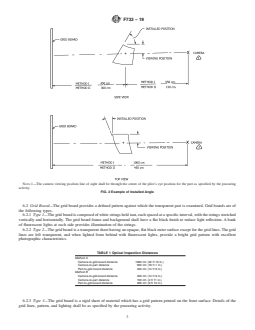
NOTE 1—The camera viewing position line of sight shall be through the center of the pilot’s eye position for the part as specified by the procuring
activity.
FIG. 2 Example of Installed Angle
8. Procedure 8.2.3 Prepareasingleexposurephotographofthegridboard
viewed through the part. The camera shall be focused on the
8.1 The procuring activity shall specify whether Method A
grid board.
...
This document is not an ASTM standard and is intended only to provide the user of an ASTM standard an indication of what changes have been made to the previous version. Because
it may not be technically possible to adequately depict all changes accurately, ASTM recommends that users consult prior editions as appropriate. In all cases only the current version
of the standard as published by ASTM is to be considered the official document.
Designation: F733 − 09 (Reapproved 2014) F733 − 19
Standard Practice for
Optical Distortion and Deviation of Transparent Parts Using
the Double-Exposure Method
This standard is issued under the fixed designation F733; the number immediately following the designation indicates the year of original
adoption or, in the case of revision, the year of last revision. A number in parentheses indicates the year of last reapproval. A superscript
epsilon (´) indicates an editorial change since the last revision or reapproval.
1. Scope
1.1 This photographic practice determines the optical distortion and deviation of a line of sight through a simple transparent
part, such as a commercial aircraft windshield or a cabin window. This practice applies to essentially flat or nearly flat parts and
may not be suitable for moreso than to highly curved materials.
1.2 Test Method F801 addresses optical deviation (angluar deviation)(angular deviation), and Test Method F2156 addresses
optical distortion using grid line slope. These Use these test methods should be used instead of Practice F733 whenever practical.
1.3 This standard does not purport to address all of the safety concerns concerns, if any, associated with its use. It is the
responsibility of the user of this standard to establish appropriate safety safety, health, and healthenvironmental practices and
determine the applicability of regulatory limitations prior to use.
1.4 This international standard was developed in accordance with internationally recognized principles on standardization
established in the Decision on Principles for the Development of International Standards, Guides and Recommendations issued
by the World Trade Organization Technical Barriers to Trade (TBT) Committee.
2. Referenced Documents
2.1 ASTM Standards:
F801 Test Method for Measuring Optical Angular Deviation of Transparent Parts
F2156 Test Method for Measuring Optical Distortion in Transparent Parts Using Grid Line Slope
3. Terminology
3.1 Definitions:
3.1.1 deviation—deviation, n—the displacement of a line or object when viewed through the transparent part. Expressed as the
angular measurement of the displaced line, for example, milliradians of angle.
3.1.1.1 Discussion—
Expressed as the angular measurement of the displaced line, for example, milliradians of angle.
3.1.2 distortion—distortion, n—the rate of change of deviation resulting from an irregularity in a transparent part.
3.1.2.1 Discussion—
Expressed as the angular bending of the light ray per unit of length of the part, for example, milliradians per centimetre.
3.1.2.2 Discussion—
Is also expressed as the slope of the angle of localized grid line bending, for example, 1 in 5 (see Fig. 1)
This practice is under the jurisdiction of ASTM Committee F07 on Aerospace and Aircraft and is the direct responsibility of Subcommittee F07.08 on Transparent
Enclosures and Materials.
Current edition approved Dec. 1, 2014Nov. 1, 2019. Published December 2014December 2019. Originally approved in 1981. Last previous edition approved in 20092014
as F733 – 09.F733 – 09(2014). DOI: 10.1520/F0733-09R14.10.1520/F0733-19.
For referenced ASTM standards, visit the ASTM website, www.astm.org, or contact ASTM Customer Service at service@astm.org. For Annual Book of ASTM Standards
volume information, refer to the standard’s Document Summary page on the ASTM website.
Copyright © ASTM International, 100 Barr Harbor Drive, PO Box C700, West Conshohocken, PA 19428-2959. United States
F733 − 19
3.1.3 Expressed as the angular bending of the light ray per unit of length of the part, for example, milliradians per centimetre.
3.1.4 May also be expressed as the slope of the angle of localized grid line bending, for example, 1 in 5 (see Fig. 1).
3.1.3 installed angle—angle, n—the part attitude as installed in the aircraft. Defined by the angle between a horizontal line and
the plane of the part, and the angle of sweep back from a horizontal line normal to the center line of the aircraft. See Fig. 2 for
an example.
3.1.3.1 Discussion—
Defined by the angle between a horizontal line and the plane of the part, and the angle of sweep back from a horizontal line normal
to the center line of the aircraft. See Fig. 2 for an example.
4. Summary of Practice
4.1 The transparent part is placed a given distance from a grid line pattern. A camera is placed so as to photograph the grid
pattern as viewed through the part. The photograph is then examined and optical distortion or deviation is measured.
5. Significance and Use
5.1 Transparent parts, such as aircraft windshields and windows, can be inspected using this practice, and the amount of optical
distortion or deviation can be measured. The measurement canshall be checked for acceptability against the specification for the
part. The photograph (digital file, print, or negative) canshall be maintained as a permanent record of the optical quality of the part.
6. Apparatus
6.1 Test Room—The test room must be large enough to properly locate the required testing equipment.
6.1.1 Method A requires a room approximately 12 m (40 ft) long.
6.1.2 Method B requires a room approximately 7 m (23 ft) long.
6.1.3 The walls, ceiling, and floor shall have low reflectance. A flat black paint or coating is preferred.
FIG. 1 Optical Distortion Represented by Tangent
F733 − 19
NOTE 1—The camera viewing position line of sight shall be through the center of the pilot’s eye position for the part as specified by the procuring
activity.
FIG. 2 Example of Installed Angle
6.2 Grid Board—The grid board provides a defined pattern against which the transparent part is examined. Grid boards are of
the following types.
6.2.1 Type 1—The grid board is composed of white strings held taut, each spaced at a specific interval, with the strings stretched
vertically and horizontally. The grid board frame and background shall have a flat black finish to reduce light reflection. A bank
of fluorescent lights at each side provides illumination of the strings.
6.2.2 Type 2—The grid board is a transparent sheet having an opaque, flat black outer surface except for the grid lines. The grid
lines are left transparent, and when lighted from behind with fluorescent lights, provide a bright grid pattern with excellent
photographic characteristics.
TABLE 1 Optical Inspection Distances
Method A
Camera-to-grid-board distance 1000 cm (32 ft 10 in.)
Camera-to-part distance 550 cm (18 ft 1 in.)
Part-to-grid board distance 450 cm (14 ft 9 in.)
Method B
Camera-to-grid-board distance 450 cm (14 ft 9 in.)
Camera-to-part distance 150 cm (4 ft 11 in.)
Part-to-grid-board distance 300 cm (9 ft 10 in.)
6.2.3 Type 3—The grid board is a rigid sheet of material which has a grid pattern printed on the front surface. Details of the
grid lines, pattern, and lighting shall be as specified by the procuring activity.
F733 − 19
6.2.4 The grid board shall have a width and height large enough so that the area of the part to be photographed can be is
superimposed within the perimeter of the grid board. Details of the grid square size shall be as specified by the procuring activity,
but grids shall not have a line spacing less than 1.27 cm 1.27 cm ( ⁄2 in.), in.), or more than 2.54 cm (1 in.).2.54 cm (1 in.).
6.3 Camera—Unless otherwise specified, the camera shall utilize a 4 by 5-in.5 in. film size. The lens opening used shall be f 8
or smaller. The camera shall be firmly mounted to prevent any movement during the photographic exposure. Digital cameras are
acceptable if they have sufficient resolution (pixel count) for the size of part to be measured.
7. Test Specimen
7.1 The part to be checked shall be cleaned, using any acceptable p
...