

ASTM C752-18
(Specification)Standard Specification for Nuclear-Grade Silver-Indium-Cadmium Alloy
General Information
- Abstract
ABSTRACT
This specification covers silver-indium-cadmium alloy for use as a control material in light-water nuclear reactors. The use of this material in applications is excluded where material strength of this alloy is a prime requisite. Also, this material must be protected from the primary water by a corrosion and wear resistant cladding. The identity of each lot by melt number shall be maintained at all stages of manufacture. Parts produced to this specification shall be made from billets by hot working and cold finishing to size. The cold-finished parts shall be produced to the finish condition and dimensions as specified. The surface of the cold-finished part shall be free of oxides, grease, oil, residual lubricants, inclusions, and other extraneous materials. Surface defects such as folds, cracks, seams, slivers, and blisters shall be cause for rejection.
SCOPE
1.1 This specification covers silver-indium-cadmium alloy for use as a control material in light-water nuclear reactors.
1.2 The scope of this specification excludes the use of this material in applications where material strength of this alloy is a prime requisite. Also, this material must be protected from the primary water by a corrosion and wear resistant cladding.
1.3 The values stated in SI units are to be regarded as standard.
1.4 This international standard was developed in accordance with internationally recognized principles on standardization established in the Decision on Principles for the Development of International Standards, Guides and Recommendations issued by the World Trade Organization Technical Barriers to Trade (TBT) Committee.
- Status
- Published
- Publication Date
- 31-May-2018
- Technical Committee
- C26 - Nuclear Fuel Cycle
- Drafting Committee
- C26.03 - Neutron Absorber Materials Specifications
Buy Documents
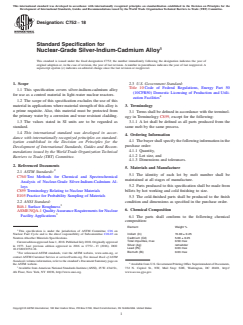


ASTM C752-18 - Standard Specification for Nuclear-Grade Silver-Indium-Cadmium Alloy
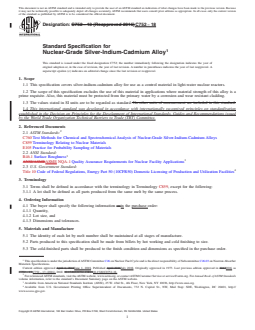
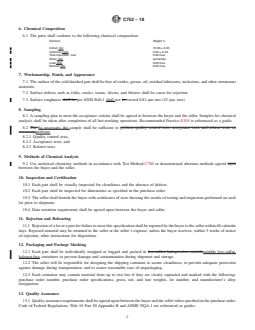


REDLINE ASTM C752-18 - Standard Specification for Nuclear-Grade Silver-Indium-Cadmium Alloy
Overview
ASTM C752-18: Standard Specification for Nuclear-Grade Silver-Indium-Cadmium Alloy is a critical international standard developed by ASTM International. This specification covers the requirements for nuclear-grade silver-indium-cadmium alloy, primarily intended for use as a control material in light-water nuclear reactors. It addresses material composition, manufacturing, testing, quality assurance, and packaging to ensure product integrity and reliability in demanding nuclear applications.
The standard specifically excludes applications where high material strength is required and mandates protection of the alloy from primary water by a corrosion and wear-resistant cladding. Each production lot is to maintain traceability via melt number, and all manufacturing and finishing processes must uphold stringent quality, cleanliness, and dimensional specifications.
Key Topics
Material Applicability
- Designed for control material use in light-water nuclear reactors
- Not intended for applications where high strength is a primary requirement
Chemical Composition
- Indium: 15.00 ± 0.25%
- Cadmium: 5.00 ± 0.25%
- Silver: Remainder
- Impurities: ≤ 0.50%
Manufacturing and Processing
- Parts made from billets by hot working and cold finishing
- Strict guidelines for surface condition: free from oxides, oil, lubricants, and surface defects (e.g., folds, cracks, blisters)
Cladding Requirement
- Alloy must be protected from primary water using a corrosion and wear-resistant cladding
Traceability and Identification
- Maintain melt number identification through all stages of production
- Each lot considered as all parts produced from the same melt via the same process
Testing and Inspection
- Quality control, acceptance, and referee tests required
- Chemical analysis according to ASTM C760 or alternate agreed methods
- Visual inspection and dimensional checks
Packaging and Labeling
- Components individually packaged in low-sulfur, halogen-free containers
- Clear marking with purchase order details, weights, lot number, and alloy designation
Applications
The silver-indium-cadmium alloy specified under ASTM C752-18 is integral to nuclear reactor safety and performance. Its primary application areas include:
Nuclear Reactor Control Rods:
Utilized as a neutron-absorbing material in light-water reactors, vital for regulating reactor power output and ensuring safe shutdown procedures.Neutron Shielding Components:
Employed in specialized shield assemblies where efficient neutron absorption is required without prioritizing mechanical strength.
Limitations: The alloy is not suitable when mechanical strength is the dominant material requirement. It must always be enveloped in appropriate cladding to prevent corrosion from reactor primary water exposure.
Related Standards
Several standards are referenced and closely related to ASTM C752-18, ensuring comprehensive guidance for nuclear applications:
- ASTM C760: Test Methods for Chemical and Spectrochemical Analysis of Nuclear-Grade Silver-Indium-Cadmium Alloys
- ASTM C859: Terminology Relating to Nuclear Materials
- ASTM E105: Practice for Probability Sampling of Materials
- ANSI B46.1: Surface Roughness
- ASME NQA-1: Quality Assurance Requirements for Nuclear Facility Applications
- Title 10 Code of Federal Regulations, Part 50: Domestic Licensing of Production and Utilization Facilities
Summary
ASTM C752-18 plays a crucial role in standardizing nuclear-grade materials, enabling manufacturers and operators to achieve safe, reliable, and traceable control rod and neutron absorber production for modern nuclear power plants. By complying with its strict material, process, and quality requirements, organizations support both operational safety and regulatory compliance in the nuclear industry.
Relations
- Effective Date
- 01-Jun-2018
- Effective Date
- 01-Jan-2024
- Effective Date
- 01-Jan-2015
- Effective Date
- 15-Jun-2014
- Effective Date
- 15-Jan-2014
- Effective Date
- 01-Jun-2013
- Effective Date
- 01-May-2013
- Effective Date
- 01-Nov-2010
- Effective Date
- 01-Oct-2010
- Effective Date
- 01-Aug-2010
- Effective Date
- 01-Feb-2010
- Effective Date
- 15-Feb-2009
- Effective Date
- 15-Sep-2008
- Effective Date
- 01-Jul-2007
- Effective Date
- 01-Jun-2004
Buy Documents
ASTM C752-18 - Standard Specification for Nuclear-Grade Silver-Indium-Cadmium Alloy
REDLINE ASTM C752-18 - Standard Specification for Nuclear-Grade Silver-Indium-Cadmium Alloy
Get Certified
Connect with accredited certification bodies for this standard

Element Materials Technology
Materials testing and product certification.

Inštitut za kovinske materiale in tehnologije
Institute of Metals and Technology. Materials testing, metallurgical analysis, NDT.
Sponsored listings
Frequently Asked Questions
ASTM C752-18 is a technical specification published by ASTM International. Its full title is "Standard Specification for Nuclear-Grade Silver-Indium-Cadmium Alloy". This standard covers: ABSTRACT This specification covers silver-indium-cadmium alloy for use as a control material in light-water nuclear reactors. The use of this material in applications is excluded where material strength of this alloy is a prime requisite. Also, this material must be protected from the primary water by a corrosion and wear resistant cladding. The identity of each lot by melt number shall be maintained at all stages of manufacture. Parts produced to this specification shall be made from billets by hot working and cold finishing to size. The cold-finished parts shall be produced to the finish condition and dimensions as specified. The surface of the cold-finished part shall be free of oxides, grease, oil, residual lubricants, inclusions, and other extraneous materials. Surface defects such as folds, cracks, seams, slivers, and blisters shall be cause for rejection. SCOPE 1.1 This specification covers silver-indium-cadmium alloy for use as a control material in light-water nuclear reactors. 1.2 The scope of this specification excludes the use of this material in applications where material strength of this alloy is a prime requisite. Also, this material must be protected from the primary water by a corrosion and wear resistant cladding. 1.3 The values stated in SI units are to be regarded as standard. 1.4 This international standard was developed in accordance with internationally recognized principles on standardization established in the Decision on Principles for the Development of International Standards, Guides and Recommendations issued by the World Trade Organization Technical Barriers to Trade (TBT) Committee.
ABSTRACT This specification covers silver-indium-cadmium alloy for use as a control material in light-water nuclear reactors. The use of this material in applications is excluded where material strength of this alloy is a prime requisite. Also, this material must be protected from the primary water by a corrosion and wear resistant cladding. The identity of each lot by melt number shall be maintained at all stages of manufacture. Parts produced to this specification shall be made from billets by hot working and cold finishing to size. The cold-finished parts shall be produced to the finish condition and dimensions as specified. The surface of the cold-finished part shall be free of oxides, grease, oil, residual lubricants, inclusions, and other extraneous materials. Surface defects such as folds, cracks, seams, slivers, and blisters shall be cause for rejection. SCOPE 1.1 This specification covers silver-indium-cadmium alloy for use as a control material in light-water nuclear reactors. 1.2 The scope of this specification excludes the use of this material in applications where material strength of this alloy is a prime requisite. Also, this material must be protected from the primary water by a corrosion and wear resistant cladding. 1.3 The values stated in SI units are to be regarded as standard. 1.4 This international standard was developed in accordance with internationally recognized principles on standardization established in the Decision on Principles for the Development of International Standards, Guides and Recommendations issued by the World Trade Organization Technical Barriers to Trade (TBT) Committee.
ASTM C752-18 is classified under the following ICS (International Classification for Standards) categories: 77.120.99 - Other non-ferrous metals and their alloys. The ICS classification helps identify the subject area and facilitates finding related standards.
ASTM C752-18 has the following relationships with other standards: It is inter standard links to ASTM C752-13(2016), ASTM C859-24, ASTM C760-90(2015), ASTM C859-14a, ASTM C859-14, ASTM C859-13a, ASTM C859-13, ASTM C859-10b, ASTM E105-10, ASTM C859-10a, ASTM C859-10, ASTM C859-09, ASTM C859-08, ASTM C760-90(2007), ASTM E105-04. Understanding these relationships helps ensure you are using the most current and applicable version of the standard.
ASTM C752-18 is available in PDF format for immediate download after purchase. The document can be added to your cart and obtained through the secure checkout process. Digital delivery ensures instant access to the complete standard document.
Standards Content (Sample)
This international standard was developed in accordance with internationally recognized principles on standardization established in the Decision on Principles for the
Development of International Standards, Guides and Recommendations issued by the World Trade Organization Technical Barriers to Trade (TBT) Committee.
Designation: C752 −18
Standard Specification for
Nuclear-Grade Silver-Indium-Cadmium Alloy
This standard is issued under the fixed designation C752; the number immediately following the designation indicates the year of
original adoption or, in the case of revision, the year of last revision. A number in parentheses indicates the year of last reapproval. A
superscript epsilon (´) indicates an editorial change since the last revision or reapproval.
1. Scope 2.3 U.S. Government Standard:
Title 10 Code of Federal Regulations, Energy Part 50
1.1 This specification covers silver-indium-cadmium alloy
(10CFR50) Domestic Licensing of Production and Utili-
for use as a control material in light-water nuclear reactors.
zation Facilities
1.2 The scope of this specification excludes the use of this
material in applications where material strength of this alloy is 3. Terminology
a prime requisite. Also, this material must be protected from
3.1 Terms shall be defined in accordance with the terminol-
the primary water by a corrosion and wear resistant cladding.
ogy in Terminology C859, except for the following:
1.3 The values stated in SI units are to be regarded as 3.1.1 A lot shall be defined as all parts produced from the
standard. same melt by the same process.
1.4 This international standard was developed in accor-
4. Ordering Information
dance with internationally recognized principles on standard-
4.1 The buyer shall specify the following information in the
ization established in the Decision on Principles for the
purchase order:
Development of International Standards, Guides and Recom-
4.1.1 Quantity,
mendations issued by the World Trade Organization Technical
4.1.2 Lot size, and
Barriers to Trade (TBT) Committee.
4.1.3 Dimensions and tolerances.
2. Referenced Documents
5. Materials and Manufacture
2.1 ASTM Standards:
5.1 The identity of each lot by melt number shall be
C760 Test Methods for Chemical and Spectrochemical
maintained at all stages of manufacture.
Analysis of Nuclear-Grade Silver-Indium-Cadmium Al-
5.2 Parts produced to this specification shall be made from
loys
billets by hot working and cold finishing to size.
C859 Terminology Relating to Nuclear Materials
E105 Practice for Probability Sampling of Materials
5.3 The cold-finished parts shall be produced to the finish
2.2 ANSI Standard: condition and dimensions as specified in the purchase order.
B46.1 Surface Roughness
6. Chemical Composition
ASME NQA-1 QualityAssurance Requirements for Nuclear
Facility Applications
6.1 The parts shall conform to the following chemical
composition:
Element Weight %
This specification is under the jurisdiction of ASTM Committee C26 on
Indium (In) 15.00 ± 0.25
Nuclear Fuel Cycle and is the direct responsibility of Subcommittee C26.03 on
Cadmium (Cd) 5.00 ± 0.25
Neutron Absorber Materials Specifications.
Total impurities, max 0.50 max
CurrenteditionapprovedJune1,2018.PublishedJuly2018.Originallyapproved
Silver (Ag) remainder
in 1973. Last previous edition approved in 2016 as C752 – 13 (2016). DOI:
Lead (Pb) 0.03 max
10.1520/C0752-18.
2 Bismuth (Bi) 0.03 max
For referenced ASTM standards, visit the ASTM website, www.astm.org, or
contact ASTM Customer Service at service@astm.org. For Annual Book of ASTM
Standards volume information, refer to the standard’s Document Summary page on
the ASTM website. AvailablefromU.S.GovernmentPrintingOfficeSuperintendentofDocuments,
Available from American National Standards Institute (ANSI), 25 W. 43rd St., 732 N. Capitol St., NW, Mail Stop: SDE, Washington, DC 20401, http://
4th Floor, New York, NY 10036, http://www.ansi.org. www.access.gpo.gov.
Copyright © ASTM International, 100 Barr Harbor Drive, PO Box C700, West Conshohocken, PA 19428-2959. United States
C752 − 18
7. Workmanship, Finish, and Appearance 10.4 Data retenti
...
This document is not an ASTM standard and is intended only to provide the user of an ASTM standard an indication of what changes have been made to the previous version. Because
it may not be technically possible to adequately depict all changes accurately, ASTM recommends that users consult prior editions as appropriate. In all cases only the current version
of the standard as published by ASTM is to be considered the official document.
Designation: C752 − 13 (Reapproved 2016) C752 − 18
Standard Specification for
Nuclear-Grade Silver-Indium-Cadmium Alloy
This standard is issued under the fixed designation C752; the number immediately following the designation indicates the year of
original adoption or, in the case of revision, the year of last revision. A number in parentheses indicates the year of last reapproval. A
superscript epsilon (´) indicates an editorial change since the last revision or reapproval.
1. Scope
1.1 This specification covers silver-indium-cadmium alloy for use as a control material in light-water nuclear reactors.
1.2 The scope of this specification excludes the use of this material in applications where material strength of this alloy is a
prime requisite. Also, this material must be protected from the primary water by a corrosion and wear resistant cladding.
1.3 The values stated in SI units are to be regarded as standard. No other units of measurement are included in this standard.
1.4 This international standard was developed in accordance with internationally recognized principles on standardization
established in the Decision on Principles for the Development of International Standards, Guides and Recommendations issued
by the World Trade Organization Technical Barriers to Trade (TBT) Committee.
2. Referenced Documents
2.1 ASTM Standards:
C760 Test Methods for Chemical and Spectrochemical Analysis of Nuclear-Grade Silver-Indium-Cadmium Alloys
C859 Terminology Relating to Nuclear Materials
E105 Practice for Probability Sampling of Materials
2.2 ANSI Standard:
B46.1 Surface Roughness
ANSI/ASMEASME NQA-1 Quality Assurance Requirements for Nuclear Facility Applications
2.3 U.S. Government Standard:
Title 10 Code of Federal Regulations, Energy Part 50 (10CFR50) Domestic Licensing of Production and Utilization Facilities
3. Terminology
3.1 Terms shall be defined in accordance with the terminology in Terminology C859, except for the following:
3.1.1 A lot shall be defined as all parts produced from the same melt by the same process.
4. Ordering Information
4.1 The buyer shall specify the following information onin the purchase order:
4.1.1 Quantity,
4.1.2 Lot size, and
4.1.3 Dimensions and tolerances.
5. Materials and Manufacture
5.1 The identity of each lot by melt number shall be maintained at all stages of manufacture.
5.2 Parts produced to this specification shall be made from billets by hot working and cold finishing to size.
5.3 The cold-finished parts shall be produced to the finish condition and dimensions as specified in the purchase order.
This specification is under the jurisdiction of ASTM Committee C26 on Nuclear Fuel Cycle and is the direct responsibility of Subcommittee C26.03 on Neutron Absorber
Materials Specifications.
Current edition approved April 1, 2016June 1, 2018. Published April 2016July 2018. Originally approved in 1973. Last previous edition approved in 20132016 as
C752 – 13.C752 – 13 (2016). DOI: 10.1520/C0752-13R1610.1520/C0752-18.
For referenced ASTM standards, visit the ASTM website, www.astm.org, or contact ASTM Customer Service at service@astm.org. For Annual Book of ASTM Standards
volume information, refer to the standard’s Document Summary page on the ASTM website.
Available from American National Standards Institute (ANSI), 25 W. 43rd St., 4th Floor, New York, NY 10036, http://www.ansi.org.
Available from U.S. Government Printing Office Superintendent of Documents, 732 N. Capitol St., NW, Mail Stop: SDE, Washington, DC 20401, http://
www.access.gpo.gov.
Copyright © ASTM International, 100 Barr Harbor Drive, PO Box C700, West Conshohocken, PA 19428-2959. United States
C752 − 18
6. Chemical Composition
6.1 The parts shall conform to the following chemical composition:
Element Weight %
Indium (In) 15.00 ± 0.25
Cadmium (Cd) 5.00 ± 0.25
Total impurities, max 0.50 max
Silver (Ag) remainder
Lead (Pb) 0.03 max
Bismuth (Bi) 0.03 max
7. Workmanship, Finish, and A
...