

ASTM D7984-21
(Test Method)Standard Test Method for Measurement of Thermal Effusivity of Fabrics Using a Modified Transient Plane Source (MTPS) Instrument
General Information
- Abstract
SIGNIFICANCE AND USE
5.1 This test method measures the rate of thermal transport between a heating element and a fabric specimen. Some of the comfort properties of a garment relate to initial thermal sensations (that is, cold or warm feeling upon initial contact), where lower thermal effusivity values indicate sensations of warmth and higher values indicate sensations of coolness. The thermal effusivity of different fabrics and their initial perceived surface temperature are important to assist product developers with fabric selection.
5.2 The sensor and the test specimen being measured shall be at the same temperature for measurements at standard conditions. This test method may be applied to any fabric with a thermal effusivity in the range of 35 to 1700 Ws1/2/m2·K.
5.3 Air flow shall be kept at a minimum to ensure temperature fluctuations do not occur during the measurement.
SCOPE
1.1 This test method covers the quantitative measurement of thermal effusivity of woven, knitted, or non-woven fabrics using a guarded modified transient plane source (MTPS) instrument.4 This test method is applicable to a wide range of thicknesses; however, the thickness of the specimen must be greater than the penetration depth of the heat flux during the measurement time.
1.2 This test method is comparative since specimens of known thermal effusivity are used to calibrate the apparatus at the factory level. Thermal effusivity of the calibration specimens are confirmed through calculations that use established properties of thermal conductivity, density, and specific heat.
1.3 This test method is intended for measuring fabrics in a dry state at ambient conditions.
1.4 The values stated in SI units are to be regarded as standard. No other units of measurement are included in this standard.
1.5 This standard does not purport to address all of the safety concerns, if any, associated with its use. It is the responsibility of the user of this standard to establish appropriate safety, health, and environmental practices and determine the applicability of regulatory limitations prior to use.
1.6 This international standard was developed in accordance with internationally recognized principles on standardization established in the Decision on Principles for the Development of International Standards, Guides and Recommendations issued by the World Trade Organization Technical Barriers to Trade (TBT) Committee.
- Status
- Published
- Publication Date
- 30-Jun-2021
- Technical Committee
- D13 - Textiles
- Drafting Committee
- D13.51 - Conditioning, Chemical and Thermal Properties
Buy Documents
ASTM D7984-21 - Standard Test Method for Measurement of Thermal Effusivity of Fabrics Using a Modified Transient Plane Source (MTPS) Instrument
REDLINE ASTM D7984-21 - Standard Test Method for Measurement of Thermal Effusivity of Fabrics Using a Modified Transient Plane Source (MTPS) Instrument
Overview
ASTM D7984-21 is the recognized international standard for the measurement of thermal effusivity of fabrics using a Modified Transient Plane Source (MTPS) instrument. Developed by ASTM Committee D13 on Textiles, this standard provides a quantitative and comparative method to assess how effectively various woven, knitted, or non-woven textile materials transfer heat when in contact with another surface. This property has significant implications for fabric comfort and material selection, particularly in garments and other textile products where the initial sensation of warmth or coolness is important.
Key Topics
- Thermal Effusivity Measurement: The test measures the ability of a fabric to exchange thermal energy, which influences perceived surface temperature and the initial thermal sensation upon contact.
- Applicability: Suitable for a broad range of textile types and thicknesses, so long as specimen thickness exceeds the heat flux penetration depth during measurement.
- Modified Transient Plane Source (MTPS): Utilizes a guarded, single-sided planar heat source and sensor to produce a controlled heat pulse and monitor temperature change.
- Comparative Test Method: Requires calibration using reference specimens of known thermal effusivity, which are validated through established physical property calculations.
- Test Conditions: Designed for fabrics in the dry state at ambient laboratory conditions, with strictly controlled temperature equilibrium between specimen and sensor, and minimal air flow to ensure reliable results.
- Measurement Range: Suitable for fabrics with a thermal effusivity from 35 to 1700 Ws½/m²·K.
- Precision and Repeatability: Involves averaging measurements from multiple specimens to ensure accuracy, with established protocols for repeatability and reproducibility.
Applications
- Textile Comfort Assessment: Core to evaluating the comfort properties of garments and home textiles, ASTM D7984-21 supports product developers in selecting materials that provide desired sensations of warmth or coolness upon first touch.
- Product Development and Optimization: Enables comparative analysis of different fabrics, helping designers choose the right fabric blend, weave, or finish for enhanced user experience.
- Quality Assurance: Serves as a benchmark for textile manufacturers to verify material properties and ensure consistent production quality.
- Research and Development: Aids in the scientific study and development of new textile materials with optimized thermal properties for specific end uses, such as sportswear, bedding, or protective clothing.
- Regulatory Compliance: Establishes an internationally recognized method for demonstrating compliance with industry and safety requirements regarding fabric thermal performance.
Related Standards
- ASTM D123: Terminology Relating to Textiles
- ASTM D1518: Test Method for Thermal Resistance of Batting Systems Using a Hot Plate
- ASTM D1776: Practice for Conditioning and Testing Textiles
- ASTM D4920: Terminology Relating to Conditioning, Chemical, and Thermal Properties
- ASTM F1868: Test Method for Thermal and Evaporative Resistance of Clothing Materials Using a Sweating Hot Plate
- ASTM E691: Practice for Conducting an Interlaboratory Study to Determine the Precision of a Test Method
- ASTM E177: Practice for Use of the Terms Precision and Bias in ASTM Test Methods
Practical Value
Implementing ASTM D7984-21 allows textile organizations to:
- Quantitatively measure a fabric’s thermal effusivity with a standard methodology.
- Compare results across different laboratories and product lines.
- Enhance product differentiation by documenting the comfort-related performance of textile products.
- Meet industry demands for performance textiles in apparel, interior, and technical textile markets.
Keywords: ASTM D7984-21, thermal effusivity, MTPS, textile comfort, fabric selection, heat transfer, transient plane source, textile testing, garment performance, international standard.
Relations
- Effective Date
- 01-Mar-2017
- Effective Date
- 15-Sep-2015
- Effective Date
- 01-Sep-2015
- Effective Date
- 01-Apr-2015
- Effective Date
- 01-May-2014
- Effective Date
- 01-Feb-2014
- Effective Date
- 15-Jun-2013
- Effective Date
- 15-Jun-2013
- Effective Date
- 15-May-2013
- Effective Date
- 01-May-2013
- Effective Date
- 01-May-2013
- Effective Date
- 01-Jun-2012
- Effective Date
- 01-Feb-2012
- Effective Date
- 01-Feb-2012
- Effective Date
- 01-Nov-2011
Buy Documents
ASTM D7984-21 - Standard Test Method for Measurement of Thermal Effusivity of Fabrics Using a Modified Transient Plane Source (MTPS) Instrument
REDLINE ASTM D7984-21 - Standard Test Method for Measurement of Thermal Effusivity of Fabrics Using a Modified Transient Plane Source (MTPS) Instrument
Get Certified
Connect with accredited certification bodies for this standard

Control Union Certifications
Global certification for agriculture and sustainability.

Hohenstein Institut
Textile testing and certification.

Bureau Veritas Bangladesh
Bureau Veritas certification services in Bangladesh.
Sponsored listings
Frequently Asked Questions
ASTM D7984-21 is a standard published by ASTM International. Its full title is "Standard Test Method for Measurement of Thermal Effusivity of Fabrics Using a Modified Transient Plane Source (MTPS) Instrument". This standard covers: SIGNIFICANCE AND USE 5.1 This test method measures the rate of thermal transport between a heating element and a fabric specimen. Some of the comfort properties of a garment relate to initial thermal sensations (that is, cold or warm feeling upon initial contact), where lower thermal effusivity values indicate sensations of warmth and higher values indicate sensations of coolness. The thermal effusivity of different fabrics and their initial perceived surface temperature are important to assist product developers with fabric selection. 5.2 The sensor and the test specimen being measured shall be at the same temperature for measurements at standard conditions. This test method may be applied to any fabric with a thermal effusivity in the range of 35 to 1700 Ws1/2/m2·K. 5.3 Air flow shall be kept at a minimum to ensure temperature fluctuations do not occur during the measurement. SCOPE 1.1 This test method covers the quantitative measurement of thermal effusivity of woven, knitted, or non-woven fabrics using a guarded modified transient plane source (MTPS) instrument.4 This test method is applicable to a wide range of thicknesses; however, the thickness of the specimen must be greater than the penetration depth of the heat flux during the measurement time. 1.2 This test method is comparative since specimens of known thermal effusivity are used to calibrate the apparatus at the factory level. Thermal effusivity of the calibration specimens are confirmed through calculations that use established properties of thermal conductivity, density, and specific heat. 1.3 This test method is intended for measuring fabrics in a dry state at ambient conditions. 1.4 The values stated in SI units are to be regarded as standard. No other units of measurement are included in this standard. 1.5 This standard does not purport to address all of the safety concerns, if any, associated with its use. It is the responsibility of the user of this standard to establish appropriate safety, health, and environmental practices and determine the applicability of regulatory limitations prior to use. 1.6 This international standard was developed in accordance with internationally recognized principles on standardization established in the Decision on Principles for the Development of International Standards, Guides and Recommendations issued by the World Trade Organization Technical Barriers to Trade (TBT) Committee.
SIGNIFICANCE AND USE 5.1 This test method measures the rate of thermal transport between a heating element and a fabric specimen. Some of the comfort properties of a garment relate to initial thermal sensations (that is, cold or warm feeling upon initial contact), where lower thermal effusivity values indicate sensations of warmth and higher values indicate sensations of coolness. The thermal effusivity of different fabrics and their initial perceived surface temperature are important to assist product developers with fabric selection. 5.2 The sensor and the test specimen being measured shall be at the same temperature for measurements at standard conditions. This test method may be applied to any fabric with a thermal effusivity in the range of 35 to 1700 Ws1/2/m2·K. 5.3 Air flow shall be kept at a minimum to ensure temperature fluctuations do not occur during the measurement. SCOPE 1.1 This test method covers the quantitative measurement of thermal effusivity of woven, knitted, or non-woven fabrics using a guarded modified transient plane source (MTPS) instrument.4 This test method is applicable to a wide range of thicknesses; however, the thickness of the specimen must be greater than the penetration depth of the heat flux during the measurement time. 1.2 This test method is comparative since specimens of known thermal effusivity are used to calibrate the apparatus at the factory level. Thermal effusivity of the calibration specimens are confirmed through calculations that use established properties of thermal conductivity, density, and specific heat. 1.3 This test method is intended for measuring fabrics in a dry state at ambient conditions. 1.4 The values stated in SI units are to be regarded as standard. No other units of measurement are included in this standard. 1.5 This standard does not purport to address all of the safety concerns, if any, associated with its use. It is the responsibility of the user of this standard to establish appropriate safety, health, and environmental practices and determine the applicability of regulatory limitations prior to use. 1.6 This international standard was developed in accordance with internationally recognized principles on standardization established in the Decision on Principles for the Development of International Standards, Guides and Recommendations issued by the World Trade Organization Technical Barriers to Trade (TBT) Committee.
ASTM D7984-21 is classified under the following ICS (International Classification for Standards) categories: 59.080.30 - Textile fabrics. The ICS classification helps identify the subject area and facilitates finding related standards.
ASTM D7984-21 has the following relationships with other standards: It is inter standard links to ASTM D123-17, ASTM D123-15b, ASTM D123-15a, ASTM D123-15, ASTM E177-14, ASTM F1868-14, ASTM D123-13a, ASTM D123-13ae1, ASTM D123-13, ASTM E691-13, ASTM E177-13, ASTM F1868-12, ASTM D123-12e1, ASTM D123-12, ASTM E691-11. Understanding these relationships helps ensure you are using the most current and applicable version of the standard.
ASTM D7984-21 is available in PDF format for immediate download after purchase. The document can be added to your cart and obtained through the secure checkout process. Digital delivery ensures instant access to the complete standard document.
Standards Content (Sample)
This international standard was developed in accordance with internationally recognized principles on standardization established in the Decision on Principles for the
Development of International Standards, Guides and Recommendations issued by the World Trade Organization Technical Barriers to Trade (TBT) Committee.
Designation: D7984 −21
Standard Test Method for
Measurement of Thermal Effusivity of Fabrics Using a
Modified Transient Plane Source (MTPS) Instrument
This standard is issued under the fixed designation D7984; the number immediately following the designation indicates the year of
original adoption or, in the case of revision, the year of last revision.Anumber in parentheses indicates the year of last reapproval.A
superscript epsilon (´) indicates an editorial change since the last revision or reapproval.
INTRODUCTION
This standard provides a test method for measuring the thermal effusivity of fabrics under still air
conditions. Other standards, Test Methods F1868 and D1518, measure the thermal insulation of
materials under steady-state conditions; however, this test method is used to measure transient heat
exchangebetweenafabricspecimenandaheatedsurface.Ithasbeenestablishedthatthereisastrong
positive correlation between the thermal effusivity and the initial perceived coldness between human
2,3
skin and different materials.
1. Scope 1.5 This standard does not purport to address all of the
safety concerns, if any, associated with its use. It is the
1.1 Thistestmethodcoversthequantitativemeasurementof
responsibility of the user of this standard to establish appro-
thermal effusivity of woven, knitted, or non-woven fabrics
priate safety, health, and environmental practices and deter-
using a guarded modified transient plane source (MTPS)
4 mine the applicability of regulatory limitations prior to use.
instrument. This test method is applicable to a wide range of
1.6 This international standard was developed in accor-
thicknesses; however, the thickness of the specimen must be
dance with internationally recognized principles on standard-
greater than the penetration depth of the heat flux during the
ization established in the Decision on Principles for the
measurement time.
Development of International Standards, Guides and Recom-
1.2 This test method is comparative since specimens of
mendations issued by the World Trade Organization Technical
known thermal effusivity are used to calibrate the apparatus at
Barriers to Trade (TBT) Committee.
the factory level. Thermal effusivity of the calibration speci-
mens are confirmed through calculations that use established 2. Referenced Documents
properties of thermal conductivity, density, and specific heat. 5
2.1 ASTM Standards:
1.3 This test method is intended for measuring fabrics in a D123Terminology Relating to Textiles
dry state at ambient conditions.
D1518Test Method for Thermal Resistance of Batting
Systems Using a Hot Plate
1.4 The values stated in SI units are to be regarded as
D1776Practice for Conditioning and Testing Textiles
standard. No other units of measurement are included in this
D4920Terminology Relating to Conditioning, Chemical,
standard.
and Thermal Properties
E691Practice for Conducting an Interlaboratory Study to
ThistestmethodisunderthejurisdictionofASTMCommitteeD13onTextiles
Determine the Precision of a Test Method
andisthedirectresponsibilityofSubcommitteeD13.51onConditioning,Chemical
and Thermal Properties.
E177Practice for Use of the Terms Precision and Bias in
Current edition approved July 1, 2021. Published August 2021. Originally
ASTM Test Methods
approved in 2016. Last previous edition approved in 2016 as D7984–16. DOI:
F1868Test Method forThermal and Evaporative Resistance
10.1520/D7984-21.
of Clothing Materials Using a Sweating Hot Plate
Marin, E., “Teaching Thermal Physics by Touching,” Latin-American Journal
of Physics Education, Vol 2, No. 1, January 2008, pp. 15-17.
Wongsriruska, S., Howes, P., Conreen, M., Miodownik, M., “The Use of
3. Terminology
PhysicalPropertyDatatoPredicttheTouchPerceptionofMaterials,” Materials and
3.1 Definitions of Terms Specific to This Standard:
Design, Vol 42, 2012, pp. 238-244.
ThesolesourceofsupplyoftheTCiinstrumentknowntothecommitteeatthis
time is C-Therm Technologies, Ltd., C/O RPC, 921 College Hill Rd., Fredericton,
NewBrunswick,Canada,E3B6Z9.Ifyouareawareofalternativesuppliers,please For referenced ASTM standards, visit the ASTM website, www.astm.org, or
provide this information toASTM International Headquarters.Your comments will contact ASTM Customer Service at service@astm.org. For Annual Book of ASTM
receive careful consideration at a meeting of the responsible technical committee, Standards volume information, refer to the standard’s Document Summary page on
which you may attend. the ASTM website.
Copyright © ASTM International, 100 Barr Harbor Drive, PO Box C700, West Conshohocken, PA 19428-2959. United States
D7984 − 21
3.1.1 modified transient plane source (MTPS), n—an appa- temperature of the surface as the heat diffuses into the test
ratus that has a one sided planar heat source and a guard, or specimen in one dimensional heat flow. Thermal effusivity is
guard ring, mounted perpendicular to the planar heat source,
determined from the temperature increase at the surface of the
that is put in contact with one side of a test specimen, so that material with elapsed time. The temperature increase at the
a short duration heat pulse can penetrate into the specimen.
surfaceisinverselyproportionaltothethermaleffusivityofthe
3.1.1.1 Discussion—The purpose of the guard (or guard
sample material.
ring) is to maintain a consistent unidirectional heat flow across
the test specimen.
5. Significance and Use
3.1.2 penetration depth, n—the functional depth to which
5.1 This test method measures the rate of thermal transport
the initial radiation applied at the surface travels into the
between a heating element and a fabric specimen. Some of the
specimen.
comfort properties of a garment relate to initial thermal
3.1.2.1 Discussion—To ensure that the heat wave is con-
sensations (that is, cold or warm feeling upon initial contact),
tained within the test specimen, the thickness of the test
where lower thermal effusivity values indicate sensations of
specimen must be greater than the penetration depth.
warmth and higher values indicate sensations of coolness. The
3.1.3 thermal effusivity, n—a material property that de-
thermaleffusivityofdifferentfabricsandtheirinitialperceived
scribes its ability to exchange thermal energy with another
surface temperature are important to assist product developers
material with which it is in contact.
with fabric selection.
e 5 =λ·c ·ρ (1)
p 5.2 The sensor and the test specimen being measured shall
be at the same temperature for measurements at standard
where:
conditions.This test method may be applied to any fabric with
½ 2
e = thermal effusivity, W·S /(m ·K),
½ 2
a thermal effusivity in the range of 35 to 1700 Ws /m ·K.
λ = thermal conductivity, W/(m·K),
c = specific heat capacity, J/(kg·K), and
p
5.3 Air flow shall be kept at a minimum to ensure tempera-
ρ = mass density, kg/m .
ture fluctuations do not occur during the measurement.
3.1.3.1 Discussion—The thermal effusivity of two materials
6. Apparatus
that are in contact determines the temperature at their interface
as a result of heat energy exchange.
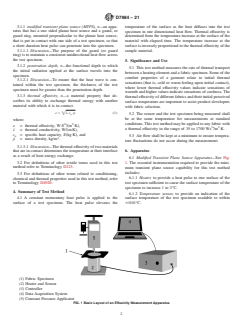
6.1 Modified Transient Plane Source Apparatus—See Fig.
3.2 For definitions of other textile terms used in this test
1. The essential instrumentation required to provide the mini-
method refer to Terminology D123.
mum transient plane source capability for this test method
includes:
3.3 For definitions of other terms related to conditioning,
6.1.1 Heater, to provide a heat pulse to one surface of the
chemical and thermal properties used in this test method, refer
test specimen sufficient to cause the surface temperature of the
to Terminology D4920.
specimen to increase 1 to 3°C.
4. Summary of Test Method
6.1.2 Temperature sensor, to provide an indication of the
4.1 A constant momentary heat pulse is applied to the surface temperature of the test specimen readable to within
surface of a test specimen. The heat pulse elevates the 60.01°C.
(1)Fabric Specimen
(2)Heater and Sensor
(3)Controller
(4)Data Acquisition System
(5)Constant Pressure Applicator
FIG. 1 Basic Layout of an Effusivity Measurement Apparatus
D7984 − 21
6.1.3 Temperature programmer, capable of providing a that a total specimen thickness of more than 1.0 mm is
power pulse of 1 to3stothe heater resulting in an increase in achieved. Rotate each fabric layer by about 30° from those
the specimen surface temperature of 1 to 3°C. above and below so that no layer is aligned with the adjacent
6.1.4 Heated guard ring, or other device to ensure a one.
unidirectional heat flow in the test specimen perpendicular to
10.2 Select and apply a fixed load of between 10-50 kPa to
the heated surface.
the fabric layers on the side opposite to the heater to ensure
6.1.5 Data acquisition device, to provide a means of
intimate contact with the heater.
acquiring, storing, and displaying measured or calculated
10.3 Initiate the experiment. Provide a constant momentary
signals,orboth,withadigitalacquisitionrateof20datapoints
power pulse to the heater and guard ring so that a temperature
persecondorgreater.Theminimumoutputsignalsrequiredare
riseof1to3°Coccursatthesurfaceofthetestspecimenwithin
temperature or temperature rise and time.
1to3s.
6.1.6 Auxiliary instrumentation considered necessary or
NOTE 3—The temperature increase at the surface is inversely propor-
useful for conducting this test method include:
tionaltothethermaleffusivityofthesamplematerial.Ascoutingrunmay
6.1.6.1 Data analysis capability, to perform the necessary
be used to determine the optimal power and timing perimeters.
calculations to derive the property of thermal effusivity from
Alternatively, instrument operations manual may recommend specific
power levels.
the temperature and time experimental variables.
10.4 Record the thermal effusivity (e ).
6.2 Load device,toapplyafixedcontrolledforceof10to50 o
kPa to the specimen to ensure that the test specimen is in
10.5 Allow the test specimen and apparatus to cool to
intimate contact with the heater and temperature sensor.
ambient temperature.
NOTE 4—This normally takes less than 1 min.
7. Preparation of Test Specimens
10.6 Repeat the thermal effusivity measurement according
7.1 Specimen Preparation—Cut specimens so that the sen- to steps 10.3 – 10.5 on each specimen two additional times.
sor area is covered completely. Take a minimum of five
10.7 Repeat steps 10.1 – 10.6 for the additional four
specimens from each sample to be tested. Specimens shall be
specimens.
staggered in such a manner that no two specimens contain the
same yarns. The specimens need to be thicker than 1.0 mm so
11. Calculation
thattheheatwavedoesnotpenetratebeyonditsmaximumtest
11.1 Average data from all five specimens to determine the
penetration of 1.0 mm thickness during the sampling period.
averagethermaleffusivityvaluesandstandarddeviationforthe
That thickness en
...
This document is not an ASTM standard and is intended only to provide the user of an ASTM standard an indication of what changes have been made to the previous version. Because
it may not be technically possible to adequately depict all changes accurately, ASTM recommends that users consult prior editions as appropriate. In all cases only the current version
of the standard as published by ASTM is to be considered the official document.
Designation: D7984 − 16 D7984 − 21
Standard Test Method for
Measurement of Thermal Effusivity of Fabrics Using a
Modified Transient Plane Source (MTPS) Instrument
This standard is issued under the fixed designation D7984; the number immediately following the designation indicates the year of
original adoption or, in the case of revision, the year of last revision. A number in parentheses indicates the year of last reapproval. A
superscript epsilon (´) indicates an editorial change since the last revision or reapproval.
INTRODUCTION
This standard provides a test method for measuring the thermal effusivity of fabrics under still air
conditions. Other standards, Test Methods F1868 and D1518, measure the thermal insulation of
materials under steady-state conditions; however, this test method is used to measure transient heat
exchange between a fabric specimen and a heated surface. It has been established that there is a strong
positive correlation between the thermal effusivity and the initial perceived coldness between human
2,3
skin and different materials.
1. Scope
1.1 This test method covers the quantitative measurement of thermal effusivity of woven, knitted, or non-woven fabrics using a
guarded modified transient plane source (MTPS) instrument. This test method is applicable to a wide range of thicknesses;
however, the thickness of the specimen must be greater than the penetration depth of the heat flux during the measurement time.
1.2 This test method is comparative since specimens of known thermal effusivity are used to calibrate the apparatus at the factory
level. Thermal effusivity of the calibration specimens are confirmed through calculations that use established properties of thermal
conductivity, density, and specific heat.
1.3 This test method is intended for measuring fabrics in a dry state at ambient conditions.
1.4 The values stated in SI units are to be regarded as standard. No other units of measurement are included in this standard.
1.5 This standard does not purport to address all of the safety concerns, if any, associated with its use. It is the responsibility
of the user of this standard to establish appropriate safety safety, health, and healthenvironmental practices and determine the
applicability of regulatory limitations prior to use.
1.6 This international standard was developed in accordance with internationally recognized principles on standardization
established in the Decision on Principles for the Development of International Standards, Guides and Recommendations issued
by the World Trade Organization Technical Barriers to Trade (TBT) Committee.
This test method is under the jurisdiction of ASTM Committee D13 on Textiles and is the direct responsibility of Subcommittee D13.51 on Conditioning, Chemical and
Thermal Properties.
Current edition approved Feb. 15, 2016July 1, 2021. Published March 2016August 2021. Originally approved in 2016. Last previous edition approved in 2016 as
D7984–16. DOI: 10.1520/D7984-16.10.1520/D7984-21.
Marin, E., “Teaching Thermal Physics by Touching,” Latin-American Journal of Physics Education, Vol 2, No. 1, January 2008, pp. 15-17.
Wongsriruska, S., Howes, P., Conreen, M., Miodownik, M., “The Use of Physical Property Data to Predict the Touch Perception of Materials,” Materials and Design,
Vol 42, 2012, pp. 238-244.
The sole source of supply of the TCi instrument known to the committee at this time is C-Therm Technologies, Ltd., C/O RPC, 921 College Hill Rd., Fredericton, New
Brunswick, Canada, E3B 6Z9. If you are aware of alternative suppliers, please provide this information to ASTM International Headquarters. Your comments will receive
careful consideration at a meeting of the responsible technical committee, which you may attend.
Copyright © ASTM International, 100 Barr Harbor Drive, PO Box C700, West Conshohocken, PA 19428-2959. United States
D7984 − 21
2. Referenced Documents
2.1 ASTM Standards:
D123 Terminology Relating to Textiles
D1518 Test Method for Thermal Resistance of Batting Systems Using a Hot Plate
D1776 Practice for Conditioning and Testing Textiles
D4920 Terminology Relating to Conditioning, Chemical, and Thermal Properties
E691 Practice for Conducting an Interlaboratory Study to Determine the Precision of a Test Method
E177 Practice for Use of the Terms Precision and Bias in ASTM Test Methods
F1868 Test Method for Thermal and Evaporative Resistance of Clothing Materials Using a Sweating Hot Plate
3. Terminology
3.1 Definitions of Terms Specific to This Standard:
3.1.1 modified transient plane source (MTPS), n—an apparatus that has a one sided planar heat source and a guard, or guard ring,
mounted perpendicular to the planar heat source, that is put in contact with one side of a test specimen, so that a short duration
heat pulse can penetrate into the specimen.
3.1.1.1 Discussion—
The purpose of the guard (or guard ring) is to maintain a consistent unidirectional heat flow across the test specimen.
3.1.2 penetration depth, n—the functional depth to which the initial radiation applied at the surface travels into the specimen.
3.1.2.1 Discussion—
To ensure that the heat wave is contained within the test specimen, the thickness of the test specimen must be greater than the
penetration depth.
3.1.3 thermal effusivity, n—a material property that describes its ability to exchange thermal energy with another material with
which it is in contact.
e 5=λ·c ·ρ (1)
p
where:
½ 2
e = thermal effusivity, W·S /(m ·K),
λ = thermal conductivity, W/(m·K),
c = specific heat capacity, J/(kg·K), and
p
ρ = mass density, kg/m .
3.1.3.1 Discussion—
The thermal effusivity of two materials that are in contact determines the temperature at their interface as a result of heat energy
exchange.
3.2 For definitions of other textile terms used in this test method refer to Terminology D123.
3.3 For definitions of other terms related to conditioning, chemical and thermal properties used in this test method, refer to
Terminology D4920.
4. Summary of Test Method
4.1 A constant momentary heat pulse is applied to the surface of a test specimen. The heat pulse elevates the temperature of the
surface as the heat diffuses into the test specimen in one dimensional heat flow. Thermal effusivity is determined from the
temperature increase at the surface of the material with elapsed time. The temperature increase at the surface is inversely
proportional to the thermal effusivity of the sample material.
5. Significance and Use
5.1 This test method measures the rate of thermal transport between a heating element and a fabric specimen. Some of the comfort
For referenced ASTM standards, visit the ASTM website, www.astm.org, or contact ASTM Customer Service at service@astm.org. For Annual Book of ASTM Standards
volume information, refer to the standard’s Document Summary page on the ASTM website.
D7984 − 21
properties of a garment relate to initial thermal sensations (that is, cold or warm feeling upon initial contact), where lower thermal
effusivity values indicate sensations of warmth and higher values indicate sensations of coolness. The thermal effusivity of different
fabrics and their initial perceived surface temperature are important to assist product developers with fabric selection.
5.2 The sensor and the test specimen being measured shall be at the same temperature for measurements at standard conditions.
½ 2
This test method may be applied to any fabric with a thermal effusivity in the range of 35 to 1700 Ws /m ·K.
5.3 Air flow shall be kept at a minimum to ensure temperature fluctuations do not occur during the measurement.
6. Apparatus
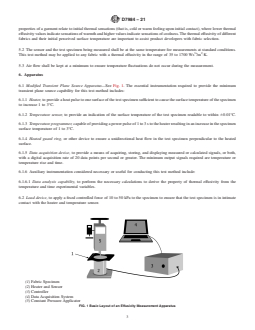
6.1 Modified Transient Plane Source Apparatus—See Fig. 1. The essential instrumentation required to provide the minimum
transient plane source capability for this test method includes:
6.1.1 Heater, to provide a heat pulse to one surface of the test specimen sufficient to cause the surface temperature of the specimen
to increase 1 to 3°C.
6.1.2 Temperature sensor, to provide an indication of the surface temperature of the test specimen readable to within 60.01°C.
6.1.3 Temperature programmer, capable of providing a power pulse of 1 to 3 s to the heater resulting in an increase in the specimen
surface temperature of 1 to 3°C.
6.1.4 Heated guard ring, or other device to ensure a unidirectional heat flow in the test specimen perpendicular to the heated
surface.
6.1.5 Data acquisition device, to provide a means of acquiring, storing, and displaying measured or calculated signals, or both,
with a digital acquisition rate of 20 data points per second or greater. The minimum output signals required are temperature or
temperature rise and time.
6.1.6 Auxiliary instrumentation considered necessary or useful for conducting this test method include:
6.1.6.1 Data analysis capability, to perform the necessary calculations to derive the property of thermal effusivity from the
temperature and time experimental variables.
6.2 Load device, to apply a fixed controlled force of 10 to 50 kPa to the specimen to ensure that the test specimen is in intimate
contact with the heater and temperature sensor.
(1) Fabric Specimen
(2) Heater and Sensor
(3) Controller
(4) Data Acquisition System
(5) Constant Pressure Applicator
FIG. 1 Basic Layout of an Effusivity Measurement Apparatus
D7984 − 21
7. Preparation of Test Specimens
7.1 Specimen Preparation—Cut specimens so that the sensor area is covered completely. Take a minimum of five specimens from
each sample to be tested. Specimens shall be staggered in such a manner that no two specimens contain the same yarns. The
specimens need to be thicker than 1.0 mm so that the heat wave does not penetrate beyond its maximum test penetration of 1.0
mm thickness during the sampling period. That thickness ensures that even if the fabric is on the higher end of the thermal
effusivity range, the penetration depth of the heat flux during the measurement time is maintained within the fabric.
8. Conditioning
8.1 Maintain the room condition as directed in Practice D1776.
8.2 Bring the test specimens to moisture equilibrium for testing as directed in Practice D1776. It is necessary to equalize the
temperatures of the sensor and the specimen by placing them in the same location.
NOTE 1—A repeat sensor temperature measurement before the test may verify the equalization and sensor stabilization.
9. Calibration
9.1 Prepare the instrument for operation and perform any instrument calibrations according to the operations manual.
9.2 Select a industry reference material of known thermal effusivity (e ).
r
NOTE 2—The instrument operations manual may offer suggestions for suitable industry reference materials.
9.3 Determine the thermal effusivity of the industry reference material according to Section 10 and confirm measured values are
within 65 % of the expected value for the material.
10. Procedure
10.1 Place sufficient layers of the fabric test specimen over the heater surface so that the heater is completely covered and that
a total specimen thickness of more than 1.0 mm is achieved. Rotate each fabric layer by about 30° from those above and below
so that no layer is aligned with the adjacent one.
10.2 Select and apply a fixed load of between 10-50 kPa to the fabric layers on the side opposite to the heater to ensure intimate
contact with the heater.
10.3 Initiate the experiment. Provide a constant momentary power pulse to the heater and guard ring so that a temperature rise
of 1 to 3°C occurs at the surface of the test specimen within 1 to 3 s.
NOTE 3—The temperature increase at the surface is inversely proportional to the thermal effusivity of the sample material. A scouting run may be used
to determine the optimal power and timing perimeters. Alternatively, instrument operations manual may recommend specific power levels.
10.4 Record the thermal effusivity (e ).
o
10.5 Allow the test specimen and apparatus to cool to ambient temperature.
NOTE 4—This normally takes less than 1 min.
10.6 Repeat the thermal effusivity measurement according to steps 10.3 – 10.5 on each specimen two additional times.
10.7 Repeat steps 10.1 – 10.6 for the additional four specimens.
"Thermal Conductivity 28/Thermal Expansion 16, with R. Dinwiddie, M. A. White, and D. L. McElroy, eds.,
...