

ASTM D5968-19ae1
(Test Method)Standard Test Method for Evaluation of Corrosiveness of Diesel Engine Oil at 121 °C
General Information
- Abstract
SIGNIFICANCE AND USE
4.1 This test method is intended to simulate the corrosion process of non-ferrous metals in diesel lubricants. The corrosion process under investigation is that believed to be induced primarily by inappropriate lubricant chemistry rather than lubricant degradation or contamination. This test method has been found to correlate with an extensive fleet database containing corrosion-induced cam and bearing failures.
SCOPE
1.1 This test method is used to test diesel engine lubricants to determine their tendency to corrode various metals, specifically alloys of lead and copper commonly used in cam followers and bearings. Correlation with field experience has been established.4
1.2 The values stated in SI units are to be regarded as standard. No other units of measurement are included in this standard.
1.3 This standard does not purport to address all of the safety concerns, if any, associated with its use. It is the responsibility of the user of this standard to establish appropriate safety, health, and environmental practices and determine the applicability of regulatory limitations prior to use. Specific hazard statements are given in 5.3.1, 6.5, 6.6, 6.7, 6.8, 6.9, 7.1.1, 7.1.2, and 7.1.5.
1.4 This international standard was developed in accordance with internationally recognized principles on standardization established in the Decision on Principles for the Development of International Standards, Guides and Recommendations issued by the World Trade Organization Technical Barriers to Trade (TBT) Committee.
- Status
- Published
- Publication Date
- 30-Nov-2019
- Technical Committee
- D02 - Petroleum Products, Liquid Fuels, and Lubricants
- Drafting Committee
- D02.B0.02 - Heavy Duty Engine Oils
Overview
ASTM D5968-19ae1 - Standard Test Method for Evaluation of Corrosiveness of Diesel Engine Oil at 121 °C is an internationally recognized standard published by ASTM International. This method simulates the corrosion processes affecting non-ferrous metals, notably alloys of lead and copper commonly found in cam followers and bearings of diesel engines. The test primarily evaluates the influence of lubricant chemistry on corrosion, rather than lubricant degradation or contamination. The results have been shown to correlate with field data on corrosion-induced engine failures, offering valuable insights for lubricant manufacturers, engine builders, and testing laboratories.
Key Topics
- Corrosiveness Evaluation: Assesses the tendency of diesel engine lubricants to corrode non-ferrous metals such as copper, lead, tin, and phosphor bronze at an elevated temperature (121°C).
- Simulation of Field Conditions: Designed to reproduce the types of corrosion encountered in actual diesel engine operation, aiding in predicting lubricant performance and suitability.
- Standardized Laboratory Testing: Utilizes a controlled laboratory method, enabling consistent, repeatable results across different labs.
- Reference Oil and TMC Validation: Integrates the use of ASTM Test Monitoring Center (TMC) reference oils for quality assurance and statistical comparison, enhancing data reliability.
- Reporting and Precision: Details strict guidelines for reporting results, including mass loss in metal coupons and changes in oil metal content, promoting transparency and comparability.
Applications
ASTM D5968-19ae1 serves several practical applications in the diesel engine lubricant industry:
- Lubricant Qualification: Enables oil formulators to assess new and existing diesel engine oils for corrosive tendencies, supporting product development and quality assurance.
- Regulatory Compliance: Satisfies requirements from organizations such as the U.S. Army and other agencies that specify corrosion performance criteria for lubricants used in military and commercial fleets.
- Field Failure Analysis: Provides a laboratory-based test that correlates with real-world engine corrosion and failure data, aiding in root cause determination and corrective actions.
- Quality Control: Assists lubricant blenders and suppliers in ongoing batch testing to ensure consistent corrosion protection through routine monitoring.
- Comparative Assessments: Assists stakeholders in comparing the corrosivity of different lubricant formulations, ensuring the selection of products that best protect engine components.
Related Standards
When implementing or referencing ASTM D5968-19ae1, the following related ASTM and industry standards may also be consulted:
- ASTM D130: Test Method for Corrosiveness to Copper from Petroleum Products by the Copper Strip Test
- ASTM D5185: Test Method for Multielement Determination of Used and Unused Lubricating Oils and Base Oils by ICP-AES
- ASTM E691: Practice for Conducting an Interlaboratory Study to Determine Precision of a Test Method
- Federal Test Method Standard 791, Method 5308: Corrosiveness and Oxidation Stability of Light Oils (Metal Squares)
These related standards provide additional methods for evaluating lubricant properties, including copper corrosion and elemental analysis, and help form a broader framework for lubricant quality and performance assessment.
Keywords: ASTM D5968-19ae1, diesel engine oil, corrosion test, non-ferrous metals, lubricant corrosiveness, reference oil, cam follower corrosion, bearing failures, laboratory testing, lubricant qualification, TMC, ASTM standards, fleet engine protection.
Relations
- Effective Date
- 01-Apr-2018
- Effective Date
- 01-May-2013
- Effective Date
- 01-Nov-2011
- Effective Date
- 01-Nov-2010
- Effective Date
- 15-Apr-2009
- Effective Date
- 01-Oct-2008
- Effective Date
- 01-Nov-2005
- Effective Date
- 01-Nov-2005
- Effective Date
- 01-May-2004
- Effective Date
- 01-May-2004
- Effective Date
- 10-Jan-2002
- Effective Date
- 10-Jan-2002
- Effective Date
- 10-Jan-2002
- Effective Date
- 10-Jan-2002
- Effective Date
- 10-Aug-2000
Get Certified
Connect with accredited certification bodies for this standard

Element Materials Technology
Materials testing and product certification.

ABS Group Brazil
ABS Group certification services in Brazil.

ABS Quality Evaluations Inc.
American Bureau of Shipping quality certification.
Sponsored listings
Frequently Asked Questions
ASTM D5968-19ae1 is a standard published by ASTM International. Its full title is "Standard Test Method for Evaluation of Corrosiveness of Diesel Engine Oil at 121 °C". This standard covers: SIGNIFICANCE AND USE 4.1 This test method is intended to simulate the corrosion process of non-ferrous metals in diesel lubricants. The corrosion process under investigation is that believed to be induced primarily by inappropriate lubricant chemistry rather than lubricant degradation or contamination. This test method has been found to correlate with an extensive fleet database containing corrosion-induced cam and bearing failures. SCOPE 1.1 This test method is used to test diesel engine lubricants to determine their tendency to corrode various metals, specifically alloys of lead and copper commonly used in cam followers and bearings. Correlation with field experience has been established.4 1.2 The values stated in SI units are to be regarded as standard. No other units of measurement are included in this standard. 1.3 This standard does not purport to address all of the safety concerns, if any, associated with its use. It is the responsibility of the user of this standard to establish appropriate safety, health, and environmental practices and determine the applicability of regulatory limitations prior to use. Specific hazard statements are given in 5.3.1, 6.5, 6.6, 6.7, 6.8, 6.9, 7.1.1, 7.1.2, and 7.1.5. 1.4 This international standard was developed in accordance with internationally recognized principles on standardization established in the Decision on Principles for the Development of International Standards, Guides and Recommendations issued by the World Trade Organization Technical Barriers to Trade (TBT) Committee.
SIGNIFICANCE AND USE 4.1 This test method is intended to simulate the corrosion process of non-ferrous metals in diesel lubricants. The corrosion process under investigation is that believed to be induced primarily by inappropriate lubricant chemistry rather than lubricant degradation or contamination. This test method has been found to correlate with an extensive fleet database containing corrosion-induced cam and bearing failures. SCOPE 1.1 This test method is used to test diesel engine lubricants to determine their tendency to corrode various metals, specifically alloys of lead and copper commonly used in cam followers and bearings. Correlation with field experience has been established.4 1.2 The values stated in SI units are to be regarded as standard. No other units of measurement are included in this standard. 1.3 This standard does not purport to address all of the safety concerns, if any, associated with its use. It is the responsibility of the user of this standard to establish appropriate safety, health, and environmental practices and determine the applicability of regulatory limitations prior to use. Specific hazard statements are given in 5.3.1, 6.5, 6.6, 6.7, 6.8, 6.9, 7.1.1, 7.1.2, and 7.1.5. 1.4 This international standard was developed in accordance with internationally recognized principles on standardization established in the Decision on Principles for the Development of International Standards, Guides and Recommendations issued by the World Trade Organization Technical Barriers to Trade (TBT) Committee.
ASTM D5968-19ae1 is classified under the following ICS (International Classification for Standards) categories: 75.100 - Lubricants, industrial oils and related products. The ICS classification helps identify the subject area and facilitates finding related standards.
ASTM D5968-19ae1 has the following relationships with other standards: It is inter standard links to ASTM D5185-18, ASTM E691-13, ASTM E691-11, ASTM D130-10, ASTM D5185-09, ASTM E691-08, ASTM E691-05, ASTM D5185-05, ASTM D130-04, ASTM D130-04e1, ASTM D5185-02, ASTM D5185-97, ASTM D5185-02e1, ASTM D5185-02e2, ASTM D130-94(2000)e1. Understanding these relationships helps ensure you are using the most current and applicable version of the standard.
ASTM D5968-19ae1 is available in PDF format for immediate download after purchase. The document can be added to your cart and obtained through the secure checkout process. Digital delivery ensures instant access to the complete standard document.
Standards Content (Sample)
This international standard was developed in accordance with internationally recognized principles on standardization established in the Decision on Principles for the
Development of International Standards, Guides and Recommendations issued by the World Trade Organization Technical Barriers to Trade (TBT) Committee.
´1
Designation: D5968 − 19a
Standard Test Method for
Evaluation of Corrosiveness of Diesel Engine Oil at 121 °C
This standard is issued under the fixed designation D5968; the number immediately following the designation indicates the year of
original adoption or, in the case of revision, the year of last revision. A number in parentheses indicates the year of last reapproval. A
superscript epsilon (´) indicates an editorial change since the last revision or reapproval.
ε NOTE—Editorially updated TMC governance information in June 2022.
INTRODUCTION
The method described in this test method is based on the gas turbine lubricant corrosion and
oxidation test described in FederalTest Method Standard 791, Method 5308. Because this test method
relates to corrosion in diesel engines rather than in gas turbines, temperatures, metal coupons, and
certain parts of the test procedure were modified to be more appropriate for heavy duty diesel engines.
The method described in this test method can be used by any properly equipped laboratory, without
outside assistance. However, the ASTM Test Monitoring Center (TMC) provides reference oils and
an assessment of the test results obtained on those oils by the laboratory (see Annex A1). By these
means, the laboratory will know whether their use of the test method gives results statistically similar
to those obtained by other laboratories. Furthermore, various agencies require that a laboratory utilize
the TMC services in seeking qualification of oils against specifications. For example, the U.S. Army
imposes such a requirement in connection with several Army engine lubricating oil specifications.
Accordingly, this test method is written for use by laboratories that utilize the TMC services.
Laboratories that choose not to use those services may simply ignore those portions of the test method
that refer to the TMC.
This test method may be modified by means of Information Letters issued by theTMC. In addition,
the TMC may issue supplementary memoranda related to the method (see Annex A1). For other
information, refer to the research report on the Cummins Bench Corrosion Test.
1. Scope* 1.2 The values stated in SI units are to be regarded as
standard. No other units of measurement are included in this
1.1 This test method is used to test diesel engine lubricants
standard.
to determine their tendency to corrode various metals, specifi-
cally alloys of lead and copper commonly used in cam
1.3 This standard does not purport to address all of the
followers and bearings. Correlation with field experience has
safety concerns, if any, associated with its use. It is the
been established.
responsibility of the user of this standard to establish appro-
priate safety, health, and environmental practices and deter-
This test method is under the jurisdiction of ASTM Committee D02 on mine the applicability of regulatory limitations prior to use.
Petroleum Products, Liquid Fuels, and Lubricantsand is the direct responsibility of
Specific hazard statements are given in 5.3.1, 6.5, 6.6, 6.7, 6.8,
Subcommittee D02.B0.02 on Heavy Duty Engine Oils.
6.9, 7.1.1, 7.1.2, and 7.1.5.
Current edition approved Dec. 1, 2019. Published December 2019. Originally
approved in 1998. Last previous edition approved in 2019 as D5968 – 19. DOI:
1.4 This international standard was developed in accor-
10.1520/D5968-19AE01.
dance with internationally recognized principles on standard-
ASTM Test Monitoring Center, 203 Armstrong Drive, Freeport, PA 16229.
ization established in the Decision on Principles for the
(http://www.astmtmc.org)
Supporting data have been filed at ASTM International Headquarters and may
Development of International Standards, Guides and Recom-
be obtained by requesting Research Report RR:D02-1322. The research report and
mendations issued by the World Trade Organization Technical
this test method are supplemented by Information Letters and Memoranda issued by
Barriers to Trade (TBT) Committee.
theASTM Test Monitoring Center. This edition incorporates revisions contained in
all information letters through No. 19-1. Users of this test method shall contact the
ASTM Test Monitoring Center to obtain the most recent of these.
Wang, J. C., and Cusano, C. M., “Development ofABench Test to Detect Oils
Corrosive to Engine Components,” SAE Technical Paper No. 940790, 1994.
*A Summary of Changes section appears at the end of this standard
Copyright © ASTM International, 100 Barr Harbor Drive, PO Box C700, West Conshohocken, PA 19428-2959. United States
´1
D5968 − 19a
2. Referenced Documents
2.1 ASTM Standards:
D130 Test Method for Corrosiveness to Copper from Petro-
leum Products by Copper Strip Test
D5185 Test Method for Multielement Determination of
Used and Unused Lubricating Oils and Base Oils by
Inductively Coupled Plasma Atomic Emission Spectrom-
etry (ICP-AES)
E691 Practice for Conducting an Interlaboratory Study to
Determine the Precision of a Test Method
2.2 U.S. Federal Test Method Standards:
Federal Test Method Standard 791, Method 5308.7 Corro-
siveness and Oxidation Stability of Light Oils (Metal
Squares)
3. Summary of Test Method
3.1 Four metal coupons of copper, lead, tin, and phosphor
bronze are immersed in a measured amount of engine oil. The
oil, at an elevated temperature, is blown with air for a period of
time. When the test is completed, the coupons and the stressed
oil are examined to detect corrosion.
3.2 An industrial reference oil is tested with each group of
tests to verify test acceptability.
FIG. 1 Sample Tube
4. Significance and Use
4.1 This test method is intended to simulate the corrosion
process of non-ferrous metals in diesel lubricants. The corro-
sion process under investigation is that believed to be induced
primarily by inappropriate lubricant chemistry rather than
lubricant degradation or contamination. This test method has
been found to correlate with an extensive fleet database
containing corrosion-induced cam and bearing failures.
5. Apparatus
5.1 The main apparatus consists of the following items of
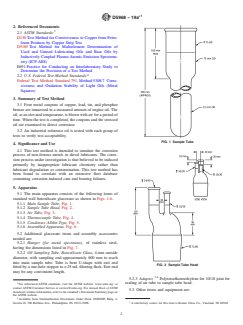
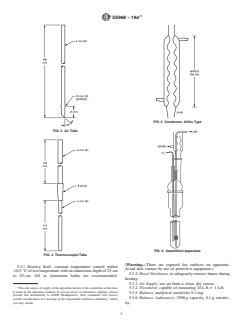
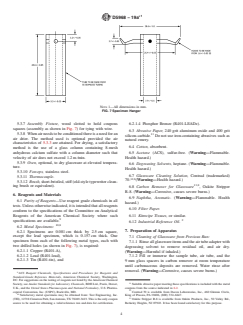
standard wall borosilicate glassware as shown in Figs. 1-6.
5.1.1 Main Sample Tube, Fig. 1.
5.1.2 Sample Tube Head, Fig. 2.
5.1.3 Air Tube, Fig. 3.
5.1.4 Thermocouple Tube, Fig. 4.
5.1.5 Condenser, Allihn Type, Fig. 5.
5.1.6 Assembled Apparatus, Fig. 6.
5.2 Additional glassware items and assembly accessories
needed are:
5.2.1 Hanger (for metal specimens), of stainless steel,
having the dimensions listed in Fig. 7.
5.2.2 Oil Sampling Tube, Borosilicate Glass, 4 mm outside
diameter, with sampling end approximately 600 mm to reach
into main sample tube. Tube is bent U-shape with exit end
FIG. 2 Sample Tube Head
fitted by a one-hole stopper to a 25 mL filtering flask. Exit end
may be any convenient length.
7,8
5.2.3 Adapter, Polytetrafluoroethylene for 10/18 joint for
sealing of air tube to sample tube head.
For referenced ASTM standards, visit the ASTM website, www.astm.org, or
contact ASTM Customer Service at service@astm.org. For Annual Book of ASTM
5.3 Other items and equipment are:
Standards volume information, refer to the standard’s Document Summary page on
the ASTM website.
Available from Standardization Documents Order Desk, DODSSP, Bldg. 4,
Section D, 700 Robbins Ave., Philadelphia, PA 19111-5098. A satisfactory source for this item is Kontes Glass Co., Vineland, NJ 08360.
´1
D5968 − 19a
FIG. 5 Condenser, Allihn Type
FIG. 3 Air Tube
FIG. 6 Assembled Apparatus
FIG. 4 Thermocouple Tube
(Warning—There are exposed hot surfaces on apparatus.
5.3.1 Heating Bath, constant temperature control within
Avoid skin contact by use of protective equipment.)
60.5 °C of test temperature with an immersion depth of 23 cm
5.3.2 Hood Ventilation, to adequately remove fumes during
to 35 cm. Oil or aluminum baths are recommended.
heating.
5.3.3 Air Supply, use air from a clean, dry source.
The sole source of supply of the apparatus known to the committee at this time
5.3.4 Flowmeter, capable of measuring 10 L⁄h 6 1 L/h.
is noted in the adjoining footnote. If you are aware of alternative suppliers, please
5.3.5 Balance, analytical sensitivity 0.1 mg.
provide this information to ASTM Headquarters. Your comments will receive
5.3.6 Balance, Laboratory, 2500 g capacity, 0.1 g sensitiv-
careful consideration at a meeting of the responsible technical committee, which
you may attend. ity.
´1
D5968 − 19a
NOTE 1—All dimensions in mm.
FIG. 7 Specimen Hanger
5.3.7 Assembly Fixture, wood slotted to hold coupons 6.2.1.4 Phosphor Bronze (R401-LEADz).
squares (assembly as shown in Fig. 7) for tying with wire.
6.3 Abrasive Paper, 240 grit aluminum oxide and 400 grit
5.3.8 Whenairneedstobeconditionedthereisaneedforan 11
silicon-carbide. Do not use iron-containing abrasives such as
air drier. The method used is optional provided the air
natural emery.
characteristics of 5.3.3 are attained. For drying, a satisfactory
6.4 Cotton, absorbent.
method is the use of a glass column containing 8-mesh
anhydrous calcium sulfate with a column diameter such that
6.5 Acetone (ACS), sulfur-free. (Warning—Flammable.
velocity of air does not exceed 1.2 m⁄min.
Health hazard.)
5.3.9 Oven, optional, to dry glassware at elevated tempera-
6.6 Degreasing Solvents, heptane. (Warning—Flammable.
ture.
Health hazard.)
5.3.10 Forceps, stainless steel.
6.7 Glassware Cleaning Solution, Contrad (trademarked)
5.3.11 Thermocouple.
12,8
70. (Warning—Health hazard.)
5.3.12 Brush,short-bristled,stiff(old-styletypewriterclean-
13,8
ing brush or equivalent).
6.8 Carbon Remover for Glassware , Oakite Stripper
R-8. (Warning—Corrosive, causes severe burns.)
6. Reagents and Materials
6.9 Naphtha, Aromatic. (Warning—Flammable. Health
6.1 Purity of Reagents—Use reagent grade chemicals in all
hazard.)
tests. Unless otherwise indicated, it is intended that all reagents
6.10 Filter Paper.
conform to the specifications of the Committee on Analytical
Reagents of the American Chemical Society where such 6.11 Kimwipe Tissues, or similar.
specifications are available. 2
6.12 Industrial Reference Oil.
10,8
6.2 Metal Specimens:
7. Preparation of Apparatus
6.2.1 Specimens are 0.081 cm thick by 2.5 cm square,
except the lead specimen, which is 0.157 cm thick. One
7.1 Cleaning of Glassware from Previous Run:
specimen from each of the following metal types, each with
7.1.1 Rinse all glassware items and the air tube adapter with
two drilled holes (as shown in Fig. 7), is required:
degreasing solvent to remove residual oil, and air dry.
6.2.1.1 Copper (R401-A),
(Warning—Harmful if inhaled.)
6.2.1.2 Lead (R401-lead),
7.1.2 Fill or immerse the sample tube, air tube, and the
6.2.1.3 Tin (R401-tin), and
9 mm glass spacers in carbon remover at room temperature
until carbonaceous deposits are removed. Water rinse after
removal. (Warning—Corrosive, causes severe burns.)
ACS Reagent Chemicals, Specifications and Procedures for Reagents and
Standard-Grade Reference Materials, American Chemical Society, Washington,
DC. For suggestions on the testing of reagents not listed by theAmerican Chemical
Society, see Analar Standards for Laboratory Chemicals, BDH Ltd., Poole, Dorset, Suitable abrasive paper meeting these specifications is included with the metal
U.K., and the United States Pharmacopeia and National Formulary, U.S. Pharma- coupons from the source indicated in 6.2.
copeial Convention, Inc. (USPC), Rockville, MD. Contrad 70 is available from Decon Laboratories, Inc., 460 Glennie Circle,
Satisfactory metal specimens may be obtained from: Test Engineering, Inc. King of Prussia, PA 19406, (800) 332–6647.
(TEI), 12718 Cimarron Path, SanAntonio,TX 78249-3423.This is the only coupon Oakite Stripper R-8 is available from Oakite Products, Inc., 50 Valley Rd.,
source to be used for obtaining a valid reference run and data for certification. Berkeley Heights, NJ 07922. It has been found satisfactory for this purpose.
´1
D5968 − 19a
7.1.3 Wash all glassware items and the air tube adapter with 8.1.2.1 Arrange the specimens on the hanger in the se-
14,8
detergent. Rinse with water to remove detergent, and dry. quence: lead, copper, tin, and phosphor bronze.
7.1.4 Store all items in a dust free cabinet until needed for 8.1.3 Insert the air tube with the attached specimens into the
test. If stored longer than one week, rinse again with distilled sample tube so that the air tube rests on the bottom of the
water before use, and dry. sample tube.
7.1.5 A more elaborate glass cleaning procedure can be 8.1.4 Place the sample tube head on the sample tube.
used, if it is for a given situation. This cleaning procedure is 8.1.5 Assemble the test tube and condenser and mount the
necessary in a referee situation unless a cleaning solution can assembly so that the test tube is submerged 23 cm to 35 cm in
be used which is satisfactory to all parties involved. Fill and the bath with the test oil temperature set at 121 °C 6 0.5 °C.
immerse all glassware items with glassware cleaning solution 8.1.6 Start the flow of cooling water through the condenser
and soak for 3 h to 16 h. (Warning—Corrosive, causes severe jacket.
burns.)
8.2 To begin testing connect the source of clean, dry air
7.1.6 Remove glassware from cleaning solution, rinse sev-
5L⁄h 6 0.5 L⁄h to the air tube and allow the air to flow for
eral times with tap water, followed by distilled water, and oven
168 h.
dry.
8.3 End of Test—After 168 h at 121 °C, shut off the air-flow,
7.2 Cleaning of Glassware (New):
disassemble, and check test setup as follows:
7.2.1 Proceed as in 7.1.3 and 7.1.6 in that order (omit 7.1.1,
8.3.1 Remove air supply and disconnect condenser.
7.1.2, 7.1.4, and 7.1.5).
8.3.2 Remove test tube from the constant-temperature bath,
7.3 Assembly—Assemble as shown in Fig. 6 using only the allow it to cool, and wipe off the outside of the tube with a
test oil to lubricate glass joints during assembly.
naphtha-dampened cloth.
8.3.3 Examine the coupons in the test tube. If the coupons
7.4 Preparation of Metal Specimens:
are exposed, for any reason, the test shall be declared invalid.
7.4.1 The metal squares are prepared as follows:
8.3.4 Using forceps, withdraw the coupons from the test
7.4.1.1 Usingthe240gritabrasivepaper,removeallsurface
tube, and remove the wire holding them together. (Retain the
blemishes from both sides and all four edges of each square,
test tube and sample for further examination).
and any burrs from the drilled holes. Finish polishing with 400
grit paper wetted by acetone to remove marks from previous
8.4 Preparing Squares for Examination:
polishing.Agood technique is to place abrasive paper on a flat 8.4.1 Using forceps, wash each square individually in ac-
surface, then rub the specimen with longitudinal strokes in a
etone.
direction perpendicular to that used with 240 grit paper. Use a 8.4.2 Repeat the washing, using fresh acetone, scrubbing
different sheet of paper for each metal type.
the squares with the short-bristled brush until the acetone
7.4.1.2 In all succeeding steps, handle the squares only with shows no additional discoloration. Use a piece of Kimwipe,
tongs or filter paper until the final weighing. If large defects or
dampened with acetone, to rub and wipe the coupons repeat-
particles are present on the metal coupons, course sand paper edly until the tissue remains clean after wiping. Allow the
should be used first to remove them; this is followed by
squares to air-dry.The reaction products that are to be removed
polishing with the 240 and 400 grit abrasive paper.
by this cleaning process may tend to have a stronger affinity to
(1) Store the polished metal coupon in acetone and proceed
the bronze material, and therefore may be more difficult to
until all coupons are polished.
remove from the bronze coupon. Improper removal of the
(2) Remove each square from the acetone, clean all metal
reaction products from the coupons may result in inaccurate
dust from the square by rubbing vigorously with clean pads of
mass change measurements. With the bronze coupon, brushing
absorbent cotton until a fresh pad remains unsoiled.
may need to be more vigorous to remove the reaction products,
(3) Wash squares in acetone and allow them to dry in a
but take care not to scrub to the point where any of the coupon
dessicator. surfaces are being polished or abraded.
(4) Immediately weigh each square to within 0.1 mg.
8.5 Examining Each Square:
(5) Arrange all squares in the wooden assembly fixture in
8.5.1 Re-weigh each square to the nearest 0.1 mg and
the pattern shown in Fig. 7. The sequence should be: lead,
compute (in milligrams per square centimetre of surface) the
copper, tin, phosphor bronze.
change in mass of each square (see 10.1).
7.4.1.3 Using only forceps to handle the clean wire, tie the
8.5.2 RatebothsidesofthecoppercouponaccordingtoTest
squares together as shown in Fig. 7.
Method D130, and note the color of any stains present on the
copper and bronze squares.
8. Procedure
8.6 Examining the New Oil and the Oil Sample in the Test
8.1 Preparation for New Test Set-Up for Reference Oil and
Tube:
Test Oils:
8.6.1 Immediately after calibration of the ICP-AES instru-
8.1.1 Add 100 mL 6 1 mL of oil to the test tube.
ment (as specified in Test Method D5185), use Test Method
8.1.2 Place the specimen hanger onto the air tube, and hang
...