

ASTM E801-21
(Practice)Standard Practice for Controlling Quality of Radiographic Examination of Electronic Devices
General Information
- Abstract
ABSTRACT
This practice is intended to control the quality and repeatability of the radiological examination of electronic devices for internal discontinuities, extraneous material, missing components, crimped or broken wires, and defective solder joints in cavities, in the encapsulating materials, or the boards. However, this practice is not intended to control the acceptability or quality of the electronic devices imaged. The quality of the radiological examination shall be determined by image quality indicators (IQIs), which shall be manufactured from clear acrylic plastic with steel covers serving as shims, lead spheres, gold or tungsten wires, and lead numbers, and shall be permanently identified with the appropriate IQI number. The IQI shall simulate as closely as possible the device being examined. For example, the IQI shall have a radiographic density or grey level nearest to that of the device being examined. Two IQIs shall be used for each radiograph, with each IQI located at diagonally opposite corners of the film, and the radiographic image free of blemishes. To identify the image, in both radiography and radioscopy, a system of positive identification of the image shall be provided, which may include any or all of the following: the name of examining laboratory, the date, the part number, the serial number, the data code, the view, and whether original or subsequent exposure.
SIGNIFICANCE AND USE
4.1 This practice establishes the basic minimum requirements for establishing quality control in radiographic examination of electronic components or devices, or both. Considerations addressed herein include definition of image quality indicator (IQI) features, procedures for imaging of IQI, and reporting.
4.2 This practice is written so it can be specified on the engineering drawing, specification, or contract. It is not a detailed how-to procedure and must be supplemented by a detailed examination technique/procedure.
SCOPE
1.1 This practice relates to the radiographic examination of electronic devices for internal discontinuities, extraneous material, missing components, crimped or broken wires, and defective solder joints in cavities, in the encapsulating materials, or the boards. Requirements expressed in this practice are intended to control the quality and repeatability of the radiographic images and are not intended for controlling the acceptability or quality of the electronic devices imaged.
1.2 There are areas in this practice that may require agreement between the cognizant engineering organization and the supplier, or specific direction from the cognizant engineering organization. These items should be addressed in the purchase order, contract, or inspection technique. Specific applications may require adherence to this practice in part or in full. Deviations from this practice shall be enumerated in inspection plan and approved by both cognizant engineering organization and the supplier.
1.3 This standard does not purport to address all of the safety concerns, if any, associated with its use. It is the responsibility of the user of this standard to establish appropriate safety, health, and environmental practices and determine the applicability of regulatory limitations prior to use.
1.4 This international standard was developed in accordance with internationally recognized principles on standardization established in the Decision on Principles for the Development of International Standards, Guides and Recommendations issued by the World Trade Organization Technical Barriers to Trade (TBT) Committee.
- Status
- Published
- Publication Date
- 31-Oct-2021
- Technical Committee
- E07 - Nondestructive Testing
- Drafting Committee
- E07.01 - Radiography (X and Gamma) Method
Buy Documents
ASTM E801-21 - Standard Practice for Controlling Quality of Radiographic Examination of Electronic Devices
REDLINE ASTM E801-21 - Standard Practice for Controlling Quality of Radiographic Examination of Electronic Devices
Overview
ASTM E801-21: Standard Practice for Controlling Quality of Radiographic Examination of Electronic Devices establishes a framework for maintaining and verifying the quality and repeatability of radiographic examinations in electronic device inspection. This standard, developed by ASTM, outlines the use of image quality indicators (IQIs) to assess the clarity and diagnostic value of radiographic images captured during nondestructive testing (NDT) of electronic components. It targets the detection of internal discontinuities, missing components, crimped or broken wires, defective solder joints, and unwanted materials in devices, encapsulant materials, or electronic boards.
The practice does not set acceptability criteria for electronic devices themselves but focuses solely on the integrity and reliability of radiographic imaging processes.
Key Topics
Scope of Application
- Covers radiographic and radioscopic examination (non-film techniques) of electronic devices.
- Targets internal defects such as discontinuities, missing or damaged parts, and poor soldering.
- Not intended to evaluate the acceptability or functional quality of the devices.
Image Quality Indicators (IQIs)
- Mandates use of acrylic IQIs with steel shims, lead spheres, metal wires (gold or tungsten), and lead numbers.
- IQIs must closely simulate the device under examination in terms of radiographic density or grey level.
- Two IQIs are required per radiograph, positioned at diagonally opposite corners of the image to ensure consistent quality assessment.
Radiographic Image Requirements
- Images must be free of blemishes or artifacts that could obscure interpretation.
- Positive identification for each image is required, including laboratory, date, part or serial numbers, and exposure details.
IQI Qualification and Calibration
- IQIs must be permanently marked with serial and identification numbers.
- Calibration images and records must be maintained for traceability and quality assurance.
Procedural Flexibility
- The standard provides minimum quality control criteria and must be supplemented by detailed procedures for specific applications.
- Variations or deviations require documented agreement between purchaser and supplier.
Applications
Radiographic examination of electronic devices is a critical quality assurance process across industries such as aerospace, defense, telecommunications, automotive, and consumer electronics manufacturing. Practical applications include:
- Defect Detection: Quickly locating internal defects without destructive testing, ensuring reliability and safety of devices.
- Process Validation: Confirming manufacturing process integrity by assessing quality of hidden or encapsulated features.
- Supplier Quality Management: Providing standardized quality control requirements for suppliers and contractors.
- Regulatory Compliance: Meeting contractual or regulatory non-destructive testing requirements for electronic assemblies.
Using ASTM E801-21 ensures that radiographic imaging of electronic components consistently meets a recognized benchmark for quality and repeatability, supporting robust inspection and quality control in electronic device production.
Related Standards
For those implementing ASTM E801-21, the following ASTM standards provide additional guidance and support:
- ASTM E94 - Guide for Radiographic Examination Using Industrial Radiographic Film
- ASTM E543 - Specification for Agencies Performing Nondestructive Testing
- ASTM E1000 - Guide for Radioscopy
- ASTM E1255 - Practice for Radioscopy
- ASTM E1316 - Terminology for Nondestructive Examinations
These related documents expand on radiographic methodologies, safety, agency qualifications, and terminology to support comprehensive nondestructive evaluation (NDE) programs.
Keywords: ASTM E801-21, radiographic examination, electronic devices, image quality indicator, IQI, nondestructive testing, radioscopy, quality control, electronic components inspection, ASTM standards, radiography.
Relations
- Effective Date
- 01-Feb-2024
- Effective Date
- 01-Dec-2019
- Effective Date
- 01-Mar-2019
- Effective Date
- 01-Jan-2018
- Effective Date
- 15-Jun-2017
- Effective Date
- 01-Feb-2017
- Effective Date
- 01-Aug-2016
- Effective Date
- 01-Feb-2016
- Effective Date
- 01-Dec-2015
- Effective Date
- 01-Sep-2015
- Effective Date
- 01-Jun-2014
- Effective Date
- 01-Jun-2014
- Effective Date
- 01-Dec-2013
- Effective Date
- 15-Jun-2013
- Effective Date
- 01-Jun-2013
Buy Documents
ASTM E801-21 - Standard Practice for Controlling Quality of Radiographic Examination of Electronic Devices
REDLINE ASTM E801-21 - Standard Practice for Controlling Quality of Radiographic Examination of Electronic Devices
Get Certified
Connect with accredited certification bodies for this standard

IMP NDT d.o.o.
Non-destructive testing services. Radiography, ultrasonic, magnetic particle, penetrant, visual inspection.
Inštitut za kovinske materiale in tehnologije
Institute of Metals and Technology. Materials testing, metallurgical analysis, NDT.
Q Techna d.o.o.
NDT and quality assurance specialist. 30+ years experience. NDT personnel certification per ISO 9712, nuclear and thermal power plant inspections, QA/
Sponsored listings
Frequently Asked Questions
ASTM E801-21 is a standard published by ASTM International. Its full title is "Standard Practice for Controlling Quality of Radiographic Examination of Electronic Devices". This standard covers: ABSTRACT This practice is intended to control the quality and repeatability of the radiological examination of electronic devices for internal discontinuities, extraneous material, missing components, crimped or broken wires, and defective solder joints in cavities, in the encapsulating materials, or the boards. However, this practice is not intended to control the acceptability or quality of the electronic devices imaged. The quality of the radiological examination shall be determined by image quality indicators (IQIs), which shall be manufactured from clear acrylic plastic with steel covers serving as shims, lead spheres, gold or tungsten wires, and lead numbers, and shall be permanently identified with the appropriate IQI number. The IQI shall simulate as closely as possible the device being examined. For example, the IQI shall have a radiographic density or grey level nearest to that of the device being examined. Two IQIs shall be used for each radiograph, with each IQI located at diagonally opposite corners of the film, and the radiographic image free of blemishes. To identify the image, in both radiography and radioscopy, a system of positive identification of the image shall be provided, which may include any or all of the following: the name of examining laboratory, the date, the part number, the serial number, the data code, the view, and whether original or subsequent exposure. SIGNIFICANCE AND USE 4.1 This practice establishes the basic minimum requirements for establishing quality control in radiographic examination of electronic components or devices, or both. Considerations addressed herein include definition of image quality indicator (IQI) features, procedures for imaging of IQI, and reporting. 4.2 This practice is written so it can be specified on the engineering drawing, specification, or contract. It is not a detailed how-to procedure and must be supplemented by a detailed examination technique/procedure. SCOPE 1.1 This practice relates to the radiographic examination of electronic devices for internal discontinuities, extraneous material, missing components, crimped or broken wires, and defective solder joints in cavities, in the encapsulating materials, or the boards. Requirements expressed in this practice are intended to control the quality and repeatability of the radiographic images and are not intended for controlling the acceptability or quality of the electronic devices imaged. 1.2 There are areas in this practice that may require agreement between the cognizant engineering organization and the supplier, or specific direction from the cognizant engineering organization. These items should be addressed in the purchase order, contract, or inspection technique. Specific applications may require adherence to this practice in part or in full. Deviations from this practice shall be enumerated in inspection plan and approved by both cognizant engineering organization and the supplier. 1.3 This standard does not purport to address all of the safety concerns, if any, associated with its use. It is the responsibility of the user of this standard to establish appropriate safety, health, and environmental practices and determine the applicability of regulatory limitations prior to use. 1.4 This international standard was developed in accordance with internationally recognized principles on standardization established in the Decision on Principles for the Development of International Standards, Guides and Recommendations issued by the World Trade Organization Technical Barriers to Trade (TBT) Committee.
ABSTRACT This practice is intended to control the quality and repeatability of the radiological examination of electronic devices for internal discontinuities, extraneous material, missing components, crimped or broken wires, and defective solder joints in cavities, in the encapsulating materials, or the boards. However, this practice is not intended to control the acceptability or quality of the electronic devices imaged. The quality of the radiological examination shall be determined by image quality indicators (IQIs), which shall be manufactured from clear acrylic plastic with steel covers serving as shims, lead spheres, gold or tungsten wires, and lead numbers, and shall be permanently identified with the appropriate IQI number. The IQI shall simulate as closely as possible the device being examined. For example, the IQI shall have a radiographic density or grey level nearest to that of the device being examined. Two IQIs shall be used for each radiograph, with each IQI located at diagonally opposite corners of the film, and the radiographic image free of blemishes. To identify the image, in both radiography and radioscopy, a system of positive identification of the image shall be provided, which may include any or all of the following: the name of examining laboratory, the date, the part number, the serial number, the data code, the view, and whether original or subsequent exposure. SIGNIFICANCE AND USE 4.1 This practice establishes the basic minimum requirements for establishing quality control in radiographic examination of electronic components or devices, or both. Considerations addressed herein include definition of image quality indicator (IQI) features, procedures for imaging of IQI, and reporting. 4.2 This practice is written so it can be specified on the engineering drawing, specification, or contract. It is not a detailed how-to procedure and must be supplemented by a detailed examination technique/procedure. SCOPE 1.1 This practice relates to the radiographic examination of electronic devices for internal discontinuities, extraneous material, missing components, crimped or broken wires, and defective solder joints in cavities, in the encapsulating materials, or the boards. Requirements expressed in this practice are intended to control the quality and repeatability of the radiographic images and are not intended for controlling the acceptability or quality of the electronic devices imaged. 1.2 There are areas in this practice that may require agreement between the cognizant engineering organization and the supplier, or specific direction from the cognizant engineering organization. These items should be addressed in the purchase order, contract, or inspection technique. Specific applications may require adherence to this practice in part or in full. Deviations from this practice shall be enumerated in inspection plan and approved by both cognizant engineering organization and the supplier. 1.3 This standard does not purport to address all of the safety concerns, if any, associated with its use. It is the responsibility of the user of this standard to establish appropriate safety, health, and environmental practices and determine the applicability of regulatory limitations prior to use. 1.4 This international standard was developed in accordance with internationally recognized principles on standardization established in the Decision on Principles for the Development of International Standards, Guides and Recommendations issued by the World Trade Organization Technical Barriers to Trade (TBT) Committee.
ASTM E801-21 is classified under the following ICS (International Classification for Standards) categories: 19.100 - Non-destructive testing. The ICS classification helps identify the subject area and facilitates finding related standards.
ASTM E801-21 has the following relationships with other standards: It is inter standard links to ASTM E1316-24, ASTM E1316-19b, ASTM E1316-19, ASTM E1316-18, ASTM E1316-17a, ASTM E1316-17, ASTM E1316-16a, ASTM E1316-16, ASTM E1316-15a, ASTM E1316-15, ASTM E1316-14e1, ASTM E1316-14, ASTM E1316-13d, ASTM E1316-13c, ASTM E1316-13b. Understanding these relationships helps ensure you are using the most current and applicable version of the standard.
ASTM E801-21 is available in PDF format for immediate download after purchase. The document can be added to your cart and obtained through the secure checkout process. Digital delivery ensures instant access to the complete standard document.
Standards Content (Sample)
This international standard was developed in accordance with internationally recognized principles on standardization established in the Decision on Principles for the
Development of International Standards, Guides and Recommendations issued by the World Trade Organization Technical Barriers to Trade (TBT) Committee.
Designation: E801 − 21
Standard Practice for
Controlling Quality of Radiographic Examination of
Electronic Devices
This standard is issued under the fixed designation E801; the number immediately following the designation indicates the year of
original adoption or, in the case of revision, the year of last revision. A number in parentheses indicates the year of last reapproval. A
superscript epsilon (´) indicates an editorial change since the last revision or reapproval.
This standard has been approved for use by agencies of the U.S. Department of Defense.
1. Scope 2. Referenced Documents
2.1 ASTM Standards:
1.1 This practice relates to the radiographic examination of
E543 Specification forAgencies Performing Nondestructive
electronic devices for internal discontinuities, extraneous
Testing
material, missing components, crimped or broken wires, and
E1316 Terminology for Nondestructive Examinations
defective solder joints in cavities, in the encapsulating
materials, or the boards. Requirements expressed in this
3. Terminology
practice are intended to control the quality and repeatability of
3.1 Definitions—Definitions relating to radiographic
the radiographic images and are not intended for controlling
examination, which appear in Terminology E1316, shall apply
the acceptability or quality of the electronic devices imaged.
to the terms used in this practice.
1.2 There are areas in this practice that may require agree-
3.2 Definitions of Terms Specific to This Standard:
ment between the cognizant engineering organization and the
3.2.1 detector, n—film, radioscopic detector, or digital de-
supplier, or specific direction from the cognizant engineering
tector array (DDA).
organization. These items should be addressed in the purchase
order, contract, or inspection technique. Specific applications
4. Significance and Use
may require adherence to this practice in part or in full.
4.1 This practice establishes the basic minimum require-
Deviations from this practice shall be enumerated in inspection
ments for establishing quality control in radiographic exami-
plan and approved by both cognizant engineering organization
nation of electronic components or devices, or both. Consid-
and the supplier.
erations addressed herein include definition of image quality
1.3 This standard does not purport to address all of the
indicator (IQI) features, procedures for imaging of IQI, and
safety concerns, if any, associated with its use. It is the
reporting.
responsibility of the user of this standard to establish appro-
4.2 This practice is written so it can be specified on the
priate safety, health, and environmental practices and deter-
engineering drawing, specification, or contract. It is not a
mine the applicability of regulatory limitations prior to use.
detailed how-to procedure and must be supplemented by a
1.4 This international standard was developed in accor-
detailed examination technique/procedure.
dance with internationally recognized principles on standard-
ization established in the Decision on Principles for the
5. Qualification
Development of International Standards, Guides and Recom-
5.1 Agency Evaluation—If specified in the contractual
mendations issued by the World Trade Organization Technical
agreement, Nondestructive Testing agencies shall be qualified
Barriers to Trade (TBT) Committee.
and evaluated as described in accordance with Specification
E543. The applicable revision of Specification E543 shall be
specified in the contractual agreement.
This practice is under the jurisdiction of ASTM Committee E07 on Nonde-
structive Testing and is the direct responsibility of Subcommittee E07.01 on
Radiology (X and Gamma) Method. For referenced ASTM standards, visit the ASTM website, www.astm.org, or
Current edition approved Nov. 1, 2021. Published December 2021. Originally contact ASTM Customer Service at service@astm.org. For Annual Book of ASTM
approved in 1981. Last previous edition approved in 2016 as E801 – 16. DOI: Standards volume information, refer to the standard’s Document Summary page on
10.1520/E0801-21. the ASTM website.
Copyright © ASTM International, 100 Barr Harbor Drive, PO Box C700, West Conshohocken, PA 19428-2959. United States
E801 − 21
6. Direction of Radiation thin coverings. Particle size is normally independent of device
type, so these remain constant.
6.1 When not otherwise specified, the direction of the
central beam of radiation shall be as perpendicular (65%)as 8.2 The IQI used shall be the one with a radiographic
possible to the surface of the film or detector. density or pixel value nearest to that of the electronic device
being examined. The radiographic density or pixel value is
7. Image Quality Indicators (IQI’s)
measured on an area of the IQI image that contains no wire or
particle images. It shall be measured using a calibrated
7.1 The quality of all levels of radiographic examination
densitometer in the case of film, or by pixel value in the case
shall be determined by IQI’s conforming to the following
of non-film examination. When necessary to meet the require-
specifications:
ments of 10.1.1, additional shim stock shall be used. The
7.1.1 The IQI’s shall be fabricated of clear acrylic plastic
shim(s)shallbeofthesametypeofsteelasintheIQIandshall
withsteelcovers,leadspheres,goldortungstenwires,andlead
be placed under the IQI. The additional shim(s) shall exceed
numbers. The steel covers serve as shims.
the IQI outside dimensions by at least 0.125 in. (3.18 mm) on
7.1.2 The IQI’s shall conform to the requirements of Fig. 1.
atleastoneside.Thethicknessoftheshimsshallbenotedwith
7.1.2.1 Wires are denoted asA, B, C (horizontal) and D, E,
lead numerals placed adjacent to the shimmed IQI or docu-
F (vertical);
mented on the radiographic technique.
7.1.2.2 Particles are denoted as G, H, I (top) and J, K, L
(bottom).
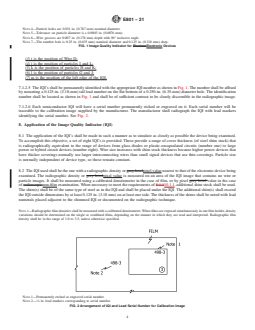
NOTE 1—Radiographic film densities shall be measured with a cali-
7.1.2.3 Distance of features from the top of the IQI are brated densitometer. When films are exposed simultaneously in one film
holder, density variations should be determined on the single or combined
labeled a-f where:
films, depending on the manner in which they are read and interpreted.
(1) a is the position of particles G, H, I;
Radiographic film density shall be in the range of 1.0 to 3.5, unless
(2) b is the position of Wire A;
otherwise specified.
(3) c is the position of Wire B;
8.3 The image distortion shall not exceed 10 % unless a
(4) d is the position of Wire C;
higher or lower percentage is agreed upon between the
(5) e is the position of particles J, K, L;
purchaser and the supplier. Measurements for computation of
(6) f is the position of the bottom edge of IQI.
image distortion shall be made in the grid formed by the
7.1.2.4 Distance of features from the right edge of IQI are
crossing wires.
labeled g-m where:
8.3.1 Determine percent image distortion (Note 2) as fol-
(1) g is the position of Wire F;
lows:
(2) h is the position of Wire E;
D 5 @~S 2 S !/S # 3100
(3) i is the position of Wire D;
M A A
(4) j is the position of particles I and L;
where:
(5) k is the position of particles H and K;
D = percent distortion,
(6) l is the position of particles G and J;
S = wire spacing as measured on the radiograph, and
M
(7) m is the position of the left edge of the IQI.
S = actual wire spacing.
A
7.1.2.5 The IQI’s shall be permanently identified with the
NOTE 2—Distortion may be positive or negative.
appropriate IQI number as shown in Fig. 1. The number shall
8.4 Particles G through L shall be visible in the image when
be affixed by mounting a 0.125-in. (3.18-mm) tall lead number
IQI’s 1 through 7 are used and particles G through K shall be
on the flat bottom of a 0.250-in. (6.35-mm) diameter hole. The
visible in the image when IQI number 8 is used.
identification number shall be located as shown in Fig. 1 and
8.4.1 If shims are required, the number and size of particles
shall be of sufficient contrast to be clearly discernible in the
that can be resolved shall be agreed on between the purchaser
radiogr
...
This document is not an ASTM standard and is intended only to provide the user of an ASTM standard an indication of what changes have been made to the previous version. Because
it may not be technically possible to adequately depict all changes accurately, ASTM recommends that users consult prior editions as appropriate. In all cases only the current version
of the standard as published by ASTM is to be considered the official document.
Designation: E801 − 16 E801 − 21
Standard Practice for
Controlling Quality of Radiographic Examination of
Electronic Devices
This standard is issued under the fixed designation E801; the number immediately following the designation indicates the year of
original adoption or, in the case of revision, the year of last revision. A number in parentheses indicates the year of last reapproval. A
superscript epsilon (´) indicates an editorial change since the last revision or reapproval.
This standard has been approved for use by agencies of the U.S. Department of Defense.
1. Scope
1.1 This practice relates to the radiographic examination of electronic devices for internal discontinuities, extraneous material,
missing components, crimped or broken wires, and defective solder joints in cavities, in the encapsulating materials, or the boards.
Requirements expressed in this practice are intended to control the quality and repeatability of the radiographic images and are not
intended for controlling the acceptability or quality of the electronic devices imaged.
NOTE 1—Refer to the following publications for pertinent information on methodology and safety and protection: Guides E94 and E1000, and “General
Safety Standard for Installation Using Non-Medical X Ray and Sealed Gamma Ray Sources, Energies Up to 10 MeV Equipment Design and Use,”
Handbook No. 114.
1.2 If a nondestructive testing agency as described in PracticeThere are areas in this E543 is used to perform the examination, the
testing agency should meet the requirements of Practicepractice that may require agreement between the cognizant engineering
organization and the supplier, or specific direction from the cognizant engineering organization. These items should be addressed
in the purchase order, contract, or inspection technique. Specific applications may require adherence to this practice in part or in
full. Deviations from this practice shall E543.be enumerated in inspection plan and approved by both cognizant engineering
organization and the supplier.
1.3 This standard does not purport to address all of the safety concerns, if any, associated with its use. It is the responsibility
of the user of this standard to establish appropriate safety safety, health, and healthenvironmental practices and determine the
applicability of regulatory limitations prior to use.
1.4 This international standard was developed in accordance with internationally recognized principles on standardization
established in the Decision on Principles for the Development of International Standards, Guides and Recommendations issued
by the World Trade Organization Technical Barriers to Trade (TBT) Committee.
2. Referenced Documents
2.1 ASTM Standards:
E94 Guide for Radiographic Examination Using Industrial Radiographic Film
E543 Specification for Agencies Performing Nondestructive Testing
E1000 Guide for Radioscopy
This practice is under the jurisdiction of ASTM Committee E07 on Nondestructive Testing and is the direct responsibility of Subcommittee E07.01 on Radiology (X and
Gamma) Method.
Current edition approved Dec. 1, 2016Nov. 1, 2021. Published December 2016December 2021. Originally approved in 1981. Last previous edition approved in 20112016
as E801 - 06E801 – 16.(2011). DOI: 10.1520/E0801-16.10.1520/E0801-21.
For referenced ASTM standards, visit the ASTM website, www.astm.org, or contact ASTM Customer Service at service@astm.org. For Annual Book of ASTM Standards
volume information, refer to the standard’s Document Summary page on the ASTM website.
Copyright © ASTM International, 100 Barr Harbor Drive, PO Box C700, West Conshohocken, PA 19428-2959. United States
E801 − 21
E1255 Practice for Radioscopy
E1316 Terminology for Nondestructive Examinations
3. Terminology
3.1 Definitions—Refer to Definitions relating to radiographic examination, which appear in Terminology E1316, Section D.shall
apply to the terms used in this practice.
3.2 Definitions of Terms Specific to This Standard:
3.2.1 detector, n—film, radioscopic detector, or digital detector array (DDA).
4. Significance and Use
4.1 This practice establishes the basic minimum requirements for establishing quality control in radiographic examination of
electronic components or devices, or both. Considerations addressed herein include definition of image quality indicator (IQI)
features, procedures for imaging of IQI, and reporting.
4.2 This practice is written so it can be specified on the engineering drawing, specification, or contract. It is not a detailed how-to
procedure and must be supplemented by a detailed examination technique/procedure.
5. Qualification
5.1 Agency Evaluation—If specified in the contractual agreement, Nondestructive Testing agencies shall be qualified and evaluated
as described in accordance with Specification E543. The applicable revision of Specification E543 shall be specified in the
contractual agreement.
6. Direction of Radiation
6.1 When not otherwise specified, the direction of the central beam of radiation shall be as perpendicular (65 %) as possible to
the surface of the film or detector.
7. Image Quality Indicators (IQI’s)
7.1 The quality of all levels of radiographic examination shall be determined by IQI’s conforming to the following specifications:
7.1.1 The IQI’s shall be fabricated of clear acrylic plastic with steel covers, lead spheres, gold or tungsten wires, and lead numbers.
The steel covers serve as shims.
7.1.2 The IQI’s shall be fabricated conform to the requirements of Fig. 1clear acrylic plastic with steel covers, lead spheres, gold
or tungsten wires, and lead numbers. The steel covers serve as shims.
7.1.2.1 Wires are denoted as A, B, C (horizontal) and D, E, F (vertical);
7.1.2.2 Particles are denoted as G, H, I (top) and J, K, L (bottom).
7.1.2.3 The IQI’s shall conform to the requirements ofDistance of features from the top of the
Fig. 1.IQI are labeled a-f where:
(1) a is the position of particles G, H, I;
(2) b is the position of Wire A;
(3) c is the position of Wire B;
(4) d is the position of Wire C;
(5) e is the position of particles J, K, L;
(6) f is the position of the bottom edge of IQI.
7.1.2.4 Distance of features from the right edge of IQI are labeled g-m where:
(1) g is the position of Wire F;
(2) h is the position of Wire E;
E801 − 21
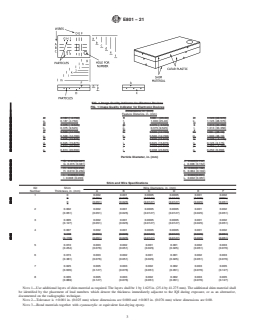
FIG. 1 Image Quality Indicator for Electron Devices
FIG. 1 Image Quality Indicator for Electronic Devices
Dimensions, in. (mm)
Feature Distance, in. (mm)
a. 0.187 ( 4.750) f. 1.00 (25.40) k. 1.125 (28.575)
a. 0.187 (4.750) f. 1.000 (25.40) k. 1.125 (28.575)
b. 0.375 ( 9.525) g. 0.375 ( 9.525) l. 1.313 (33.350)
b. 0.375 (9.525) g. 0.375 (9.525) l. 1.313 (33.350)
c. 0.500 (12.700) h. 0.500 (12.700) m. 1.50 (38.10)
c. 0.500 (12.700) h. 0.500 (12.700) m. 1.500 (38.10)
d. 0.625 (15.875) i. 0.625 (15.875) n. 0.125 ( 3.175)
d. 0.625 (15.875) i. 0.625 (15.875) n. 0.125 (3.175)
e. 0.813 (20.650) j. 0.938 (23.825) p. 0.250 ( 6.350)
e. 0.813 (20.650) j. 0.938 (23.825) p. 0.250 (6.350)
Particle Diameter, in. (mm)
G. 0.015(0.381) J. 0.006(0.152)
G. 0.015 (0.381) J. 0.006 (0.152)
H. 0.010(0.254) K. 0.004(0.102)
H. 0.010 (0.254) K. 0.004 (0.102)
I. 0.008(0.203) L. 0.002(0.051)
I. 0.008 (0.203) L. 0.002 (0.051)
Shim and Wire Specifications
IQI Shim Wire Diameters, in. (mm)
Number Thickness, in. (mm) A B C D E F
1 0 0.002 0.001 0.0005 0.0005 0.001 0.002
0 (0.051) (0.025) (0.0127) (0.0127) (0.025) (0051)
0 (0.051) (0.025) (0.0127) (0.0127) (0.025) (0.051)
2 0.002 0.002 0.001 0.0005 0.0005 0.001 0.002
(0.051) (0.051) (0.025) (0.0127) (0.0127) (0.025) (0.051)
3 0.005 0.002 0.001 0.0005 0.0005 0.001 0.002
(0.127) (0.051) (0.025) (0.0127) (0.0127) (0.025) (0.051)
4 0.007 0.002 0.001 0.0005 0.0005 0.001 0.002
0.178 (0.051) (0.025) (0.0127) (0.0127) (0.025) (0.051)
(0.178) (0.051) (0.025) (0.0127) (0.0127) (0.025) (0.051)
5 0.010 0.003 0.002 0.001 0.001 0.002 0.003
(0.254) (0.076) (0.051) (0.025) (0.025) (0.051) (0.076)
6 0.015 0.003 0.002 0.001 0.001 0.002 0.003
(0.381) (0.076) (0.051) (0.025) (0.025) (0.051) (0.076)
7 0.025 0.005 0.003 0.002 0.002 0.003 0.005
(0.635) (0.127) (0.076) (0.051) (0.051) (0.076) (0.127)
8 0.035 0.005 0.003 0.002 0.002 0.003 0.005
(0.889) (0.127) (0.076) (0.051) (0.051) (0.076) (0.127)
NOTE 1—Use additional layers of shim material as required. The layers shall be 1 by 1.625 in. (25.4 by 41.275 mm). The additional shim material shall
be identified by the placement of lead numbers which denote the thickness immediately adjacent to the IQI during exposure, or as an alternative,
documented on the radiographic technique.
NOTE 2—Tolerance is 60.001 in. (0.025 mm) where dimensions are 0.000 and 60.003 in. (0.076 mm) where dimensions are 0.00.
NOTE 3—Bond materials together with cyanoacrylic or equivalent fast-drying epoxy.
E801 − 21
NOTE 4—Particle holes are 0.031 in. (0.787 mm) nominal diameter.
NOTE 5—Tolerance on
...