

ASTM E3370-23
(Practice)Standard Practice for Matrix Array Ultrasonic Testing of Composites, Sandwich Core Constructions, and Metals
General Information
- Abstract
SIGNIFICANCE AND USE
5.1 The procedures described in this practice have proven utility in the inspecting (1) monolithic polymer matrix composites (laminates) for bulk defects, (2) metals for corrosion during the service life of the part of interest, (3) thickness checks, (4) adhesive bonding of metals, composites, and sandwich core constructions, (5) coatings, and (6) composite filament windings. Both unpressurized, and with suitable precautions, pressurized materials and components are inspected.
5.2 This practice provides guidelines for the application of longitudinal wave examination to the detection and quantitative evaluation of damage, discontinuities, and thickness variations in materials.
5.3 This practice is intended primarily for the testing of parts to acceptance criteria most typically specified in a purchase order or other contractual document, and for testing of parts in-service to detect and evaluate damage.
5.4 MAUT search units provide near-surface resolution and detection of small discontinuities comparable to phased array transducers. They may or may not be capable of beam steering. The advantage of MAUT for straight-beam longitudinal wave inspections is the ability to provide real-time C-scan data, which facilitates data interpretation and shortens inspection time. Depending on inspection needs, data can be displayed as A-, B- or C-scans, or three-dimensional renderings. Toggling between pulse-echo and through transmission ultrasonic (TTU) modes without having to use another system or changing transducers is also possible.
5.5 The MAUT technique has proven utility in the inspection of multi-ply carbon-fiber reinforced laminates used in primary aircraft structures.11
5.6 For ultrasonic testing of laminate composites and sandwich core materials using conventional UT equipment consult Practice E2580. Consult Practice E114 for ultrasonic testing of materials by the pulse-echo method using straightbeam longitudinal waves introduced by a piezoelectric elemen...
SCOPE
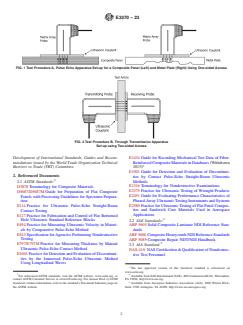
1.1 This practice covers procedures for matrix array ultrasonic testing (MAUT) of monolithic composites, composite sandwich constructions, and metallic test articles. These procedures can be used throughout the life cycle of a part during product and process design optimization, on line process control, post-manufacturing inspection, and in-service inspection.
1.2 In general, ultrasonic testing is a common volumetric method for detection of embedded or subsurface discontinuities. This practice includes general requirements and procedures which may be used for detecting flaws and for making a relative or approximate evaluation of the size of discontinuities and part anomalies. The types of flaws or discontinuities detected include interply delaminations, foreign object debris (FOD), inclusions, disbond/un-bond, fiber debonding, fiber fracture, porosity, voids, impact damage, thickness variation, and corrosion.
1.3 Typical test articles include monolithic composite layups such as uniaxial, cross ply and angle ply laminates, sandwich constructions, bonded structures, and filament windings, as well as forged, wrought and cast metallic parts. Two techniques can be considered based on accessibility of the inspection surface: namely, pulse echo inspection for one-sided access and through-transmission for two-sided access. As used in this practice, both require the use of a pulsed straight-beam ultrasonic longitudinal wave followed by observing indications of either the reflected (pulse-echo) or received (through transmission) wave.
1.4 This practice provides two ultrasonic test procedures. Each has its own merits and requirements for inspection and shall be selected as agreed upon in a contractual document.
1.4.1 Test Procedure A, Pulse Echo (non-contacting and contacting) is at a minimum a single matrix array transducer transmitting and receiving longitudinal waves in the range of 0.5 MHz to 20 MHz (see Fig. 1). Th...
- Status
- Published
- Publication Date
- 30-Jun-2023
- Technical Committee
- E07 - Nondestructive Testing
- Drafting Committee
- E07.06 - Ultrasonic Method
Buy Documents
ASTM E3370-23 - Standard Practice for Matrix Array Ultrasonic Testing of Composites, Sandwich Core Constructions, and Metals
REDLINE ASTM E3370-23 - Standard Practice for Matrix Array Ultrasonic Testing of Composites, Sandwich Core Constructions, and Metals
Overview
ASTM E3370-23: Standard Practice for Matrix Array Ultrasonic Testing of Composites, Sandwich Core Constructions, and Metals provides comprehensive procedures for matrix array ultrasonic testing (MAUT) of composite materials, sandwich core constructions, and metallic items. Published by ASTM International, this practice is highly relevant in industries such as aerospace, automotive, and manufacturing, addressing quality assurance and structural integrity through nondestructive testing methods. The standard outlines general requirements, testing procedures, and use cases for detecting discontinuities, damage, and verifying bond integrity, ensuring high reliability during the product lifecycle-from design optimization to in-service inspection.
Key Topics
- Matrix Array Ultrasonic Testing (MAUT): Focuses on the use of matrix array transducers, offering high-resolution and efficient detection of subsurface defects in various materials.
- Applicable Materials: Applicable to monolithic composites (e.g., carbon-fiber laminates), sandwich constructions, bonded structures, metallic parts (forged, wrought, cast), and filament windings.
- Inspection Methods: Details two techniques based on access:
- Pulse Echo Inspection: For single-side access, using one transducer to transmit and receive longitudinal waves.
- Through Transmission (TTU) Inspection: For double-sided access, with a transmitter and receiver aligned on opposite surfaces.
- Detected Flaws: Addresses interply delaminations, inclusions, voids, porosity, foreign object debris (FOD), disbonds, fiber fracture, impact damage, corrosion, and thickness variations.
- Display Modes: Enables real-time visual representations such as A-scan, B-scan, C-scan, and 3D renderings for improved defect analysis.
Applications
ASTM E3370-23 is designed for broad industrial application, offering significant practical value in various scenarios:
- Product Design & Process Optimization: Supports manufacturers during the development phase to ensure structural reliability and optimize processes for composite and metallic parts.
- Quality Control: Essential for post-manufacturing inspections, allowing early detection of defects such as delaminations, voids, disbonds, or corrosion, minimizing costly repairs or recalls.
- In-Service Inspection: Facilitates ongoing maintenance and lifecycle management by enabling non-destructive evaluation of installed components, identifying hidden damage or corrosion before failures occur.
- Aerospace Applications: Highly effective for inspecting carbon-fiber reinforced laminates in primary aircraft structures, ensuring passenger safety and regulatory compliance.
- Bond Integrity Verification: Inspects adhesive bonds in metals, composites, and sandwich constructions, supporting high-quality assembly and repairs in aerospace and automotive sectors.
- Thickness Measurements: Provides accurate thickness checks for process equipment, structural panels, or machined components using high-frequency pulse-echo techniques.
Related Standards
ASTM E3370-23 carefully aligns with several related industry standards and references for ensuring comprehensive nondestructive testing practice:
- ASTM E114: Ultrasonic Pulse-Echo Straight-Beam Contact Testing
- ASTM E127: Fabrication and Control of Flat Bottomed Hole Ultrasonic Standard Reference Blocks
- ASTM E2580: Ultrasonic Testing of Flat Panel Composites and Sandwich Core Materials
- ASTM E797/E797M: Measuring Thickness by Manual Ultrasonic Pulse-Echo Contact Method
- ASTM E1001: Detection and Evaluation of Discontinuities by Immersed Pulse-Echo Ultrasonic Method
- SAE ARP 5605 & ARP 5606: Reference standards for composite laminates and honeycomb constructions
- ISO 9712, EN 4179: International standards for personnel qualification in nondestructive testing
- MIL-HDBK-1823: Reliability Assessment for Nondestructive Evaluation Systems
Key terms: matrix array ultrasonic testing, MAUT, composites inspection, sandwich core construction testing, ultrasonic nondestructive testing, metal corrosion detection, ASTM E3370, aerospace component inspection, in-service nondestructive evaluation, composite delamination detection.
Following ASTM E3370-23 ensures industry best practices for reliable, repeatable ultrasonic inspection of advanced composite and metallic structures, supporting safety, compliance, and product quality worldwide.
Relations
- Effective Date
- 01-Feb-2024
- Effective Date
- 01-Feb-2024
- Effective Date
- 01-Dec-2019
- Effective Date
- 15-Oct-2019
- Effective Date
- 15-Apr-2019
- Effective Date
- 01-Mar-2019
- Effective Date
- 01-Apr-2018
- Effective Date
- 01-Jan-2018
- Effective Date
- 01-Nov-2017
- Effective Date
- 15-Jun-2017
- Effective Date
- 01-Feb-2017
- Effective Date
- 01-Aug-2016
- Effective Date
- 01-Aug-2016
- Effective Date
- 01-Feb-2016
- Effective Date
- 01-Dec-2015
Buy Documents
ASTM E3370-23 - Standard Practice for Matrix Array Ultrasonic Testing of Composites, Sandwich Core Constructions, and Metals
REDLINE ASTM E3370-23 - Standard Practice for Matrix Array Ultrasonic Testing of Composites, Sandwich Core Constructions, and Metals
Get Certified
Connect with accredited certification bodies for this standard

BUREAU VERITAS Certification Germany
Bureau Veritas certification in Germany.

Element Materials Technology
Materials testing and product certification.

AQMS Ltd.
AQMS provides ISO certification to SMEs across the UK.
Sponsored listings
Frequently Asked Questions
ASTM E3370-23 is a standard published by ASTM International. Its full title is "Standard Practice for Matrix Array Ultrasonic Testing of Composites, Sandwich Core Constructions, and Metals". This standard covers: SIGNIFICANCE AND USE 5.1 The procedures described in this practice have proven utility in the inspecting (1) monolithic polymer matrix composites (laminates) for bulk defects, (2) metals for corrosion during the service life of the part of interest, (3) thickness checks, (4) adhesive bonding of metals, composites, and sandwich core constructions, (5) coatings, and (6) composite filament windings. Both unpressurized, and with suitable precautions, pressurized materials and components are inspected. 5.2 This practice provides guidelines for the application of longitudinal wave examination to the detection and quantitative evaluation of damage, discontinuities, and thickness variations in materials. 5.3 This practice is intended primarily for the testing of parts to acceptance criteria most typically specified in a purchase order or other contractual document, and for testing of parts in-service to detect and evaluate damage. 5.4 MAUT search units provide near-surface resolution and detection of small discontinuities comparable to phased array transducers. They may or may not be capable of beam steering. The advantage of MAUT for straight-beam longitudinal wave inspections is the ability to provide real-time C-scan data, which facilitates data interpretation and shortens inspection time. Depending on inspection needs, data can be displayed as A-, B- or C-scans, or three-dimensional renderings. Toggling between pulse-echo and through transmission ultrasonic (TTU) modes without having to use another system or changing transducers is also possible. 5.5 The MAUT technique has proven utility in the inspection of multi-ply carbon-fiber reinforced laminates used in primary aircraft structures.11 5.6 For ultrasonic testing of laminate composites and sandwich core materials using conventional UT equipment consult Practice E2580. Consult Practice E114 for ultrasonic testing of materials by the pulse-echo method using straightbeam longitudinal waves introduced by a piezoelectric elemen... SCOPE 1.1 This practice covers procedures for matrix array ultrasonic testing (MAUT) of monolithic composites, composite sandwich constructions, and metallic test articles. These procedures can be used throughout the life cycle of a part during product and process design optimization, on line process control, post-manufacturing inspection, and in-service inspection. 1.2 In general, ultrasonic testing is a common volumetric method for detection of embedded or subsurface discontinuities. This practice includes general requirements and procedures which may be used for detecting flaws and for making a relative or approximate evaluation of the size of discontinuities and part anomalies. The types of flaws or discontinuities detected include interply delaminations, foreign object debris (FOD), inclusions, disbond/un-bond, fiber debonding, fiber fracture, porosity, voids, impact damage, thickness variation, and corrosion. 1.3 Typical test articles include monolithic composite layups such as uniaxial, cross ply and angle ply laminates, sandwich constructions, bonded structures, and filament windings, as well as forged, wrought and cast metallic parts. Two techniques can be considered based on accessibility of the inspection surface: namely, pulse echo inspection for one-sided access and through-transmission for two-sided access. As used in this practice, both require the use of a pulsed straight-beam ultrasonic longitudinal wave followed by observing indications of either the reflected (pulse-echo) or received (through transmission) wave. 1.4 This practice provides two ultrasonic test procedures. Each has its own merits and requirements for inspection and shall be selected as agreed upon in a contractual document. 1.4.1 Test Procedure A, Pulse Echo (non-contacting and contacting) is at a minimum a single matrix array transducer transmitting and receiving longitudinal waves in the range of 0.5 MHz to 20 MHz (see Fig. 1). Th...
SIGNIFICANCE AND USE 5.1 The procedures described in this practice have proven utility in the inspecting (1) monolithic polymer matrix composites (laminates) for bulk defects, (2) metals for corrosion during the service life of the part of interest, (3) thickness checks, (4) adhesive bonding of metals, composites, and sandwich core constructions, (5) coatings, and (6) composite filament windings. Both unpressurized, and with suitable precautions, pressurized materials and components are inspected. 5.2 This practice provides guidelines for the application of longitudinal wave examination to the detection and quantitative evaluation of damage, discontinuities, and thickness variations in materials. 5.3 This practice is intended primarily for the testing of parts to acceptance criteria most typically specified in a purchase order or other contractual document, and for testing of parts in-service to detect and evaluate damage. 5.4 MAUT search units provide near-surface resolution and detection of small discontinuities comparable to phased array transducers. They may or may not be capable of beam steering. The advantage of MAUT for straight-beam longitudinal wave inspections is the ability to provide real-time C-scan data, which facilitates data interpretation and shortens inspection time. Depending on inspection needs, data can be displayed as A-, B- or C-scans, or three-dimensional renderings. Toggling between pulse-echo and through transmission ultrasonic (TTU) modes without having to use another system or changing transducers is also possible. 5.5 The MAUT technique has proven utility in the inspection of multi-ply carbon-fiber reinforced laminates used in primary aircraft structures.11 5.6 For ultrasonic testing of laminate composites and sandwich core materials using conventional UT equipment consult Practice E2580. Consult Practice E114 for ultrasonic testing of materials by the pulse-echo method using straightbeam longitudinal waves introduced by a piezoelectric elemen... SCOPE 1.1 This practice covers procedures for matrix array ultrasonic testing (MAUT) of monolithic composites, composite sandwich constructions, and metallic test articles. These procedures can be used throughout the life cycle of a part during product and process design optimization, on line process control, post-manufacturing inspection, and in-service inspection. 1.2 In general, ultrasonic testing is a common volumetric method for detection of embedded or subsurface discontinuities. This practice includes general requirements and procedures which may be used for detecting flaws and for making a relative or approximate evaluation of the size of discontinuities and part anomalies. The types of flaws or discontinuities detected include interply delaminations, foreign object debris (FOD), inclusions, disbond/un-bond, fiber debonding, fiber fracture, porosity, voids, impact damage, thickness variation, and corrosion. 1.3 Typical test articles include monolithic composite layups such as uniaxial, cross ply and angle ply laminates, sandwich constructions, bonded structures, and filament windings, as well as forged, wrought and cast metallic parts. Two techniques can be considered based on accessibility of the inspection surface: namely, pulse echo inspection for one-sided access and through-transmission for two-sided access. As used in this practice, both require the use of a pulsed straight-beam ultrasonic longitudinal wave followed by observing indications of either the reflected (pulse-echo) or received (through transmission) wave. 1.4 This practice provides two ultrasonic test procedures. Each has its own merits and requirements for inspection and shall be selected as agreed upon in a contractual document. 1.4.1 Test Procedure A, Pulse Echo (non-contacting and contacting) is at a minimum a single matrix array transducer transmitting and receiving longitudinal waves in the range of 0.5 MHz to 20 MHz (see Fig. 1). Th...
ASTM E3370-23 is classified under the following ICS (International Classification for Standards) categories: 19.100 - Non-destructive testing; 49.025.01 - Materials for aerospace construction in general. The ICS classification helps identify the subject area and facilitates finding related standards.
ASTM E3370-23 has the following relationships with other standards: It is inter standard links to ASTM E1316-24, ASTM E2580-24, ASTM E1316-19b, ASTM D3878-19a, ASTM D3878-19, ASTM E1316-19, ASTM D3878-18, ASTM E1316-18, ASTM E2580-17, ASTM E1316-17a, ASTM E1316-17, ASTM D3878-16, ASTM E1316-16a, ASTM E1316-16, ASTM E1316-15a. Understanding these relationships helps ensure you are using the most current and applicable version of the standard.
ASTM E3370-23 is available in PDF format for immediate download after purchase. The document can be added to your cart and obtained through the secure checkout process. Digital delivery ensures instant access to the complete standard document.
Standards Content (Sample)
This international standard was developed in accordance with internationally recognized principles on standardization established in the Decision on Principles for the
Development of International Standards, Guides and Recommendations issued by the World Trade Organization Technical Barriers to Trade (TBT) Committee.
Designation: E3370 − 23
Standard Practice for
Matrix Array Ultrasonic Testing of Composites, Sandwich
Core Constructions, and Metals
This standard is issued under the fixed designation E3370; the number immediately following the designation indicates the year of
original adoption or, in the case of revision, the year of last revision. A number in parentheses indicates the year of last reapproval. A
superscript epsilon (´) indicates an editorial change since the last revision or reapproval.
1. Scope 0.5 MHz to 20 MHz (see Fig. 1). This procedure requires
access to only one side of the specimen. This procedure can be
1.1 This practice covers procedures for matrix array ultra-
conducted by automated or manual means. Automated and
sonic testing (MAUT) of monolithic composites, composite
manual test results may be analyzed in real time or recorded
sandwich constructions, and metallic test articles. These pro-
and analyzed later.
cedures can be used throughout the life cycle of a part during
product and process design optimization, on line process
1.4.2 Test Procedure B, Through Transmission (non-
control, post-manufacturing inspection, and in-service inspec-
contacting and contacting) is a combination of two transduc-
tion.
ers. One transmits a longitudinal wave and the other receives
the longitudinal wave in the range of 0.5 MHz to 20 MHz (see
1.2 In general, ultrasonic testing is a common volumetric
Fig. 2). This procedure requires access to both sides of the
method for detection of embedded or subsurface discontinui-
specimen. Typically, the signal transmitting and signal receiv-
ties. This practice includes general requirements and proce-
dures which may be used for detecting flaws and for making a ing transducers are perpendicularly aligned with each other.
relative or approximate evaluation of the size of discontinuities This is normally achieved using a yoke transducer holder
and part anomalies. The types of flaws or discontinuities
arrangement, which attaches the two transducers to a single
detected include interply delaminations, foreign object debris
point but deploys them on opposite sides of the structure.
(FOD), inclusions, disbond/un-bond, fiber debonding, fiber
Through transmission inspections are also permitted without
fracture, porosity, voids, impact damage, thickness variation,
the use of a yoke transducer holder. This is due to the capacity
and corrosion.
for improved manual alignment via the matrix array
transducers, whereby the live C-scan display enables visual
1.3 Typical test articles include monolithic composite
confirmation of accurate alignment, and facilitates re-
layups such as uniaxial, cross ply and angle ply laminates,
sandwich constructions, bonded structures, and filament alignment if needed. This procedure can be conducted by
windings, as well as forged, wrought and cast metallic parts. automated or manual means. Automated and manual test
Two techniques can be considered based on accessibility of the
results may be imaged or recorded.
inspection surface: namely, pulse echo inspection for one-sided
1.5 Other contact methods such as angle-beam techniques
access and through-transmission for two-sided access. As used
using shear waves to characterize welds, or surface-beam
in this practice, both require the use of a pulsed straight-beam
techniques using Lamb waves to detect impact damage in
ultrasonic longitudinal wave followed by observing indications
composite panel structures are not covered.
of either the reflected (pulse-echo) or received (through trans-
mission) wave.
1.6 This practice does not specify accept-reject criteria.
1.4 This practice provides two ultrasonic test procedures.
1.7 Units—The values stated in SI units are to be regarded
Each has its own merits and requirements for inspection and
as standard. The values given in parentheses after SI units are
shall be selected as agreed upon in a contractual document.
provided for information only and are not considered standard.
1.4.1 Test Procedure A, Pulse Echo (non-contacting and
contacting) is at a minimum a single matrix array transducer
1.8 This standard does not purport to address all of the
transmitting and receiving longitudinal waves in the range of
safety concerns, if any, associated with its use. It is the
responsibility of the user of this standard to establish appro-
priate safety, health, and environmental practices and deter-
This practice is under the jurisdiction of ASTM Committee E07 on Nonde-
mine the applicability of regulatory limitations prior to use.
structive Testing and is the direct responsibility of Subcommittee E07.06 on
Ultrasonic Method.
1.9 This international standard was developed in accor-
Current edition approved July 1, 2023. Published August 2023. Originally
dance with internationally recognized principles on standard-
approved in 2022. Last previous edition approved in 2022 as E3370 – 22. DOI:
10.1520/E3370-23. ization established in the Decision on Principles for the
Copyright © ASTM International, 100 Barr Harbor Drive, PO Box C700, West Conshohocken, PA 19428-2959. United States
E3370 − 23
FIG. 1 Test Procedure A, Pulse Echo Apparatus Set-up for a Composite Panel (Left) and Metal Plate (Right) Using One-sided Access
FIG. 2 Test Procedure B, Through Transmission Apparatus
Set-up using Two-sided Access
Development of International Standards, Guides and Recom- E1434 Guide for Recording Mechanical Test Data of Fiber-
mendations issued by the World Trade Organization Technical Reinforced Composite Materials in Databases (Withdrawn
Barriers to Trade (TBT) Committee. 2015)
E1901 Guide for Detection and Evaluation of Discontinui-
2. Referenced Documents
ties by Contact Pulse-Echo Straight-Beam Ultrasonic
Methods
2.1 ASTM Standards:
E1316 Terminology for Nondestructive Examinations
D3878 Terminology for Composite Materials
E2375 Practice for Ultrasonic Testing of Wrought Products
D5687/D5687M Guide for Preparation of Flat Composite
E2491 Guide for Evaluating Performance Characteristics of
Panels with Processing Guidelines for Specimen Prepara-
Phased-Array Ultrasonic Testing Instruments and Systems
tion
E2580 Practice for Ultrasonic Testing of Flat Panel Compos-
E114 Practice for Ultrasonic Pulse-Echo Straight-Beam
ites and Sandwich Core Materials Used in Aerospace
Contact Testing
Applications
E127 Practice for Fabrication and Control of Flat Bottomed
Hole Ultrasonic Standard Reference Blocks 2.2 SAE Standards:
E494 Practice for Measuring Ultrasonic Velocity in Materi-
ARP 5605 Solid Composite Laminate NDI Reference Stan-
als by Comparative Pulse-Echo Method dards
E543 Specification for Agencies Performing Nondestructive
ARP 5606 Composite Honeycomb NDI Reference Standards
Testing ARP 5089 Composite Repair NDT/NDI Handbook
E797/E797M Practice for Measuring Thickness by Manual
2.3 AIA Standard:
Ultrasonic Pulse-Echo Contact Method
NAS-410 NAS Certification & Qualification of Nondestruc-
E1001 Practice for Detection and Evaluation of Discontinui-
tive Test Personnel
ties by the Immersed Pulse-Echo Ultrasonic Method
Using Longitudinal Waves
The last approved version of this historical standard is referenced on
www.astm.org.
2 4
For referenced ASTM standards, visit the ASTM website, www.astm.org, or Available from SAE International (SAE), 400 Commonwealth Dr., Warrendale,
contact ASTM Customer Service at service@astm.org. For Annual Book of ASTM PA 15096, http://www.sae.org.
Standards volume information, refer to the standard’s Document Summary page on Available from Aerospace Industries Association (AIA), 1000 Wilson Blvd.,
the ASTM website. Suite 1700, Arlington, VA 22209, http://www.aia-aerospace.org.
E3370 − 23
2.4 ASNT Documents: 3.2.6.1 Discussion—For the purpose of this practice, the
ANSI/ASNT CP-189 Standard for Qualification and Certifi- matrix array transducers used are nonphased.
cation of Nondestructive Testing Personnel
3.2.7 phased array transducer, n—see Terminology E1316.
SNT-TC-1A Recommended Practice for Personnel Qualifi-
3.2.8 pulse echo method, n—see Terminology E1316.
cation and Certification in Nondestructive Testing
3.2.9 sandwich construction, n—see Terminology D3878.
Nondestructive Testing Handbook, Ultrasonic Testing, 2nd
Edition, Vol. 7
3.2.10 through transmission technique, n—see Terminology
E1316.
2.5 ISO Standard:
ISO 9712 NDT–Qualification and Certification of NDT
3.3 Definitions of Terms Specific to This Standard:
Personnel in the Applicable Product Sector “Aerospace”
3.3.1 flat panel composite, n—any fiber reinforced compos-
2.6 European Committee for Standardization Document:
ite lay-up consisting of laminate (plies) with one or more
EN 4179 Aerospace Series - Qualification and Approval of
orientations with respect to some reference direction that are
Personnel for Non-destructive Testing
consolidated by press or autoclave to yield a two-
2.7 FAA Circular Advisory: dimensionally flat article of finite thickness.
AC-65-31B Training, Qualification, and Certification of
3.3.2 time-corrected gain (TCG), n—time-corrected gain is
Nondestructive Inspection Personnel
a method of compensating for a reduction in signal amplitude
2.8 MIL Document:
with increasing range from reflectors of equal area. This is
MIL-HDBK-1823 Nondestructive Evaluation System Reli-
achieved by increasing the system gain with time so that the
ability Assessment
signals appear of equal amplitude. TCG achieves the same
objective as a DAC.
3. Terminology
3.3.2.1 Discussion—Calibration using TCG is required to
3.1 Definitions—Terminology in accordance with Termi- ensure that indications have uniform amplitude with depth and
nologies E1316 and D3878 shall be used where applicable. position.
3.2 Definitions of Terms Not Specific to This Standard:
4. Summary of Practice
3.2.1 defect, n—see Terminology E1316.
4.1 This practice describes two procedures for detecting
3.2.2 delamination, n—see Terminology D3878.
bulk defects in monolithic composites, composite sandwich
3.2.3 disbond, n—see Terminology D3878.
constructions, and metallic parts using ultrasonic longitudinal
waves emitted from a two-dimensional matrix array transducer
3.2.4 distance amplitude correction (DAC), n—see Termi-
and coupled by contact. Equipment, reference blocks, exami-
nology E1316.
nation procedures, data evaluation procedures, and documen-
3.2.5 flaw, n—see Terminology E1316.
tation are described in detail
3.2.6 matrix array transducers, n—these transducers have
4.2 This practice focuses on the advantages and limitations
an active area divided in two dimensions in different elements.
of two-dimensional matrix arrays. Characteristics of phased
This division can, for example, be in the form of a
array transducers such as linear, annular, and “rho-theta” are
checkerboard, or sectored rings. Matrix array transducers may
not discussed.
either be phased or nonphased. Nonphased matrix array trans-
ducers tend not to have discrete piezoelectric elements that
5. Significance and Use
pulse and receive individually. They instead achieve a matrix
5.1 The procedures described in this practice have proven
array aperture by either using a crossed electrode architecture
utility in the inspecting (1) monolithic polymer matrix com-
or by pulsing from a large single crystal and receiving on a
posites (laminates) for bulk defects, (2) metals for corrosion
separate two-dimensional array. Due to this architecture, ma-
during the service life of the part of interest, (3) thickness
trix array transducers may not allow beam steering. They are
checks, (4) adhesive bonding of metals, composites, and
thus typically used for straight beam applications such as
sandwich core constructions, (5) coatings, and (6) composite
inspection of composites and corrosion mapping. Such non-
filament windings. Both unpressurized, and with suitable
phased matrix array transducers use live C-scan displays,
precautions, pressurized materials and components are in-
highlighting the inspection region directly beneath the trans-
spected.
ducers.
5.2 This practice provides guidelines for the application of
longitudinal wave examination to the detection and quantita-
Available from American Society for Nondestructive Testing (ASNT), P.O. Box
tive evaluation of damage, discontinuities, and thickness varia-
28518, 1711 Arlingate Ln., Columbus, OH 43228-0518, http://www.asnt.org.
tions in materials.
Available from International Organization for Standardization (ISO), ISO
Central Secretariat, Chemin de Blandonnet 8, CP 401, 1214 Vernier, Geneva,
5.3 This practice is intended primarily for the testing of
Switzerland, https://www.iso.org.
parts to acceptance criteria most typically specified in a
Available from CEN-CENELEC Management Centre, Rue de la Science 23,
purchase order or other contractual document, and for testing
B-1040 Brussels.
Available from U.S. Department of Transportation Federal Aviation Adminis- of parts in-service to detect and evaluate damage.
tration 800 Independence Ave SW, Washington, DC 20591.
5.4 MAUT search units provide near-surface resolution and
Available from Standardization Documents Order Desk, Bldg. 4 Section D,
700 Robbins Ave., Philadelphia, PA 19111-5094, Attn: NPODS. detection of small discontinuities comparable to phased array
E3370 − 23
transducers. They may or may not be capable of beam steering. 5.8 Test Procedure A, Pulse Echo—Pulsed energy is trans-
The advantage of MAUT for straight-beam longitudinal wave mitted into materials, travels in a direction normal to the
inspections is the ability to provide real-time C-scan data,
contact surface, and is reflected back to the search unit by
which facilitates data interpretation and shortens inspection discontinuity or boundary interfaces, which are parallel or near
time. Depending on inspection needs, data can be displayed as
parallel to the contacted surface. These echoes return to the
A-, B- or C-scans, or three-dimensional renderings. Toggling
search unit, where they are converted from mechanical to
between pulse-echo and through transmission ultrasonic (TTU)
electrical energy and are amplified by a receiver. The amplified
modes without having to use another system or changing
echoes (signals) are displayed as A-, B- or C-scans, or
transducers is also possible.
three-dimensional renderings. Types of information that may
be obtained from the pulsed-echo straight-beam practice are (1)
5.5 The MAUT technique has proven utility in the inspec-
apparent discontinuity size, (2) depth location of
tion of multi-ply carbon-fiber reinforced laminates used in
discontinuities, (3) material properties such as velocity of
primary aircraft structures.
sound in the material, and similarly, the thickness of a material,
5.6 For ultrasonic testing of laminate composites and sand-
and (4) the extent of bond and unbond (or fusion and lack of
wich core materials using conventional UT equipment consult
fusion) between two ultrasonic conducting materials if geom-
Practice E2580. Consult Practice E114 for ultrasonic testing of
etry and materials permit. In addition to detecting volumetric
materials by the pulse-echo method using straightbeam longi-
discontinuities such as delaminations (Fig. 3), ultrasonic thick-
tudinal waves introduced by a piezoelectric element (trans-
ness measurements can be made with MAUT search units in
ducer) with diameters of 3.2 mm to 28.6 mm (⅛ in. to 1⅛ in.)
pulse-echo mode on basic shapes and products of many
in contact with the material being examined and usually
materials, and on precision machined parts, to determine wall
presented in an A-scan display.
thinning in process equipment caused by corrosion and erosion
5.7 This practice is directed towards the evaluation of
(Fig. 4).
discontinuities detectable at normal beam incidence. If discon-
5.9 Test Procedure B, Through Transmission—In TTU, a
tinuities or material integrity at other orientations are of
transducer on one side of a part transmits an ultrasonic pulse to
concern such as through cracks and welds, alternate scanning
an aligned receiving transducer on the other side (Fig. 2).
techniques are required.
Alignment between the two transducers is often accomplished
by automation. Attenuation or absence of the pulse coming to
the receiving transducer indicates the presence of a defect.
Advantages of TTU over pulse-echo include less attenuation of
The Boeing Company, 787 Nondestructive Test Manual Part 4 – Ultrasonic,
Dec. 30, 2015, P.O. Box 3707, Seattle, Washington 98124.
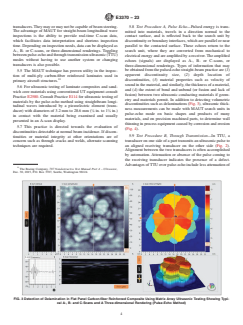
FIG. 3 Detection of Delamination in Flat Panel Carbon-fiber Reinforced Composite Using Matrix Array Ultrasonic Testing Showing Typi-
cal A-, B- and C-Scans and A Three-dimensional Rendering (Pulse-Echo Method)
E3370 − 23
FIG. 4 Detection of Wall Thinning Corrosion in 3.5 mm Thick Aluminum Plate Using Matrix Array Ultrasonic Testing (Pulse-Echo
Method)
sound energy, absence of transducer ringing, and less of an 6. Basis of Application
effect of defect orientation on transmitted signal. However,
6.1 Timing of Examination—The timing of examination
two-sided access is necessary, and like pulse-echo, vertical
shall be in accordance with 9.1 and 9.2 in this practice, unless
defects such as through cracks are difficult to detect. Applica-
specified otherwise.
tions include inspection of plate and bar stock after
6.2 Extent of Examination—The extent of examination
manufacturing, and detection of disbonds in materials with
(coverage) shall be in accordance with 9.4 in this practice,
high attenuation properties that hinder sound propagation, such
unless specified otherwise.
as multiple bond layers, honeycomb cores (Fig. 5), and foam
6.3 Reporting Criteria/Acceptance Criteria—Reporting cri-
cores.
teria for the examination results shall be in accordance with 9.8
5.10 This practice does not discuss nonlinear resonant
and Section 12, unless otherwise specified. Since acceptance
ultrasonic spectroscopy, ultrasonic spectral analysis, use of
criteria (for example, for reference sonograms) are not speci-
angle beams, transverse waves, and guided waves that can be
fied in this practice, they shall be specified in the contractual
used to assist in bond characterization in composites or
agreement.
sandwich constructions. Air coupled ultrasonic inspection
6.4 Reexamination of Repaired/Reworked Items—
using MAUT search units to detect skin-to-core disbonds in
Reexamination of repaired/reworked items is not addressed in
sandwich constructions is also not discussed.
this practice and if required shall be specified in the contractual
agreement. For guidance to assist inspectors on where to
inspect repaired composite and metal bonded parts on the
aircraft, to understand the capabilities of current NDT methods,
Hsu, D. K., Bossi, R. H., and Roach, D. P., Bond Testing, Part 2. Bond Testing
Methods, Chapter 14, American Society of Nondestructive Testing, 2014.
FIG. 5 Detection of Disbond in A Sandwich Construction Consisting of A Graphite Fiber Reinforced Facesheet and An Aluminum Hon-
eycomb Core Using Matrix Array Ultrasonic Testing (Through-Transmission Mode)
E3370 − 23
and to aid interpretation of inspection results, consult ARP 7.6 Wetting Agent Control—When wetting agent solution is
5089. ARP 5089 does not override any instructions that may be used, check the agent concentration in the solutions after initial
issued within a manufacturer’s or operator’s published docu- solution makeup and at 90 day intervals. Wetting agents are
mentation. used to deaerate the couplant and enhance adherence of the
couplant to the material and search unit. The ability of the
6.5 Probability of Detection (POD)—Detailed instruction
wetting agents used as a couplant should be verified during
for assessing the reliability of NDT data using POD with
normal system calibration activities carried out just prior to
composite, sandwich core and metallic test articles is beyond
conducting an inspection.
the scope of this practice. More detailed instruction for
assessing the capability of an NDT method by determining the
8. Apparatus and Materials
POD as a function of flaw size can be found in MIL-HDBK-
1823. Specific performance of NDT methods applied to com-
8.1 Apparatus
posite laminate and composite honeycomb structures can be 8.1.1 Operation—Test equipment shall be capable of pro-
found elsewhere.
viding uniform, repeatable, and controlled operation.
8.1.2 Electronic Equipment—The electronic equipment
7. Quality Assurance Provisions
should be capable of producing and processing electronic
signals at frequencies in the range of search unit frequencies
7.1 There are areas in this practice that require agreement
being used. The equipment and its display should be capable of
between the cognizant engineering organization and the
meeting the minimum equipment requirements to be completed
supplier, or specific direction from the cognizant engineering
by filling in Table 1 in Practice E1001 and are applicable only
organization.
for the frequencies required for the inspection. Also, the
7.2 The following items are subject to contractual agree-
equipment, including the search unit, should be capable of
ment between the parties using or referencing this practice.
producing echo amplitudes of at least 60 %, of full scale, with
7.3 Personnel Qualification—If specified in the contractual
the noise level no greater than 20 %, from the appropriate
agreement, personnel performing examinations to this practice reference reflector at a material distance equal to the thickness
shall be qualified in accordance with a nationally or interna-
of the part to be inspected. Alternatively, if these conditions can
tionally recognized NDT personnel qualification practice or
be met at one half the part thickness, the part may be inspected
standard such as ANSI/ASNT-CP-189, SNT-TC-1A, NAS-410,
from both sides.
ISO 9712, FAA CA-65-31B or similar document and certified
8.1.3 General Considerations for Search Unit(s)—The
by the employer or certifying agency, as applicable. The
search unit(s) selected should be compatible with the electronic
practice or standard used, and its applicable revision, shall be
equipment being used and with the material to be inspected.
identified in the contractual agreement between the using
MAUT search units can be used for both examination and
parties.
evaluation provided their ultrasonic element density is suffi-
cient in each axis to adequately detect and evaluate indications
7.4 Qualification of Nondestructive Agencies—If specified
as required. The assembly of transducer, holder, wearface, and
in the contractual agreement, NDT agencies shall be qualified
electrical connector comprise the search unit. Select a suitable
and evaluated as described in Specification E543. The appli-
search unit size and frequency after consideration of the
cable edition of Specification E543 shall be specified in the
acoustic characteristics of material to be examined, the geom-
contractual agreement.
etry of the production item, and the minimum size and type of
7.5 System Performance—As a minimum requirement, sys-
discontinuity to be detected. The higher the frequency selected,
tem performance should be verified in accordance with the
the higher the resolving capability accompanied with a de-
following schedule (if mutually agreed upon, more stringent or
crease in penetrating power; conversely, the lower the fre-
frequent checks may be specified): (1) Gain settings and
quency used, the greater the penetrating power with decreasing
distance amplitude relationships should be checked after any
resolving capability. Factors limiting the use of higher frequen-
interruption of power, change of operating personnel, replace-
cies are the equipment and the material properties. The limiting
ment of a system component, or adjustment of any electrical or
use of lower frequencies is the loss in sensitivity level for the
mechanical control which cannot be returned exactly to its
examination. Various types of straight-beam search units are
previous position and (2) verification should also be made at
available offering advantages for specific applications.
such interim periods as are needed to assure that any material
NOTE 1—While the use of squirters is allowed, their use is not
previously inspected can be recovered and reinspected. To
specifically addressed in this practice aside from levying a requirement
evaluate performance characteristics of phased array transduc-
that the search unit should match the intended squirter(s) if used.
ers consisting of a series of individually wired elements that are
8.1.4 Search Unit(s) for Thickness Measurements—If a
activated separately using a programmable time delay pattern,
thickness readout instrument has the capability to read thin
and where it is possible to vary the beam angle, focal distance,
sections, a highly damped, high-frequency search unit is
or beam dimensions, consult Practice E2491.
generally used. High-frequency (10 MHz or higher) delay line
search units are generally required for thicknesses less than
about 0.6 mm (0.025 in.). In general, composites will require
Roach, D, Rice, T., “A Quantitative Assessment of Advanced Nondestructive
lower frequency search units compared to metals. Low fre-
Inspection Techniques for Detecting Flaws in Composite Laminate Aircraft
Structures,” U.S. Dept. of Transportation Report DOT/FAA/TC-15/4, March, 2016. quency (0.5 MHz to 1.5 MHz) search units are generally
E3370 − 23
required for composite thicknesses greater than about 25 mm ness and waviness to permit a uniform examination over the
(1.0 in.). The optimum frequency will depend on the inherent required areas. When it is determined that surface roughness
attenuation of the material and also its quality. High porosity
precludes adequate detection and evaluation of subsurface
level composites, especially those manufactured using out-of
discontinuities or anomalies, areas in question can be smoothed
autoclave processes, will require lower search unit frequencies.
by machining, grinding, or other means before the examination
Measurements of materials at high temperatures require search
is performed. For brittle or friable materials or materials prone
units specially designed for the application.
to fraying, care should be taken to avoid generating surface or
8.1.5 Manipulating Equipment should be provided during
near-surface cracks or crumbling or fraying of the surface by
automated inspections to adequately support the search unit(s)
the smoothing operation. During examination and evaluation,
and allow angular adjustment in two mutually perpendicular
ensure that the entry surface and back surface are free of loose
planes. The search unit manipulator shall be capable of
scale, paint, dirt, machining or grinding particles or other loose
providing the adjustments necessary to properly position the
foreign matter. Tightly adhering paint, scale, or coatings do not
search unit during testing. The scanning and indexing appara-
necessarily need to be removed for examining if they present
tus should have sufficient structural rigidity to provide support
uniform attenuation characteristics. If needed, surfaces may be
for the manipulator and should allow smooth, accurate posi-
ground, sanded, wire brushed, scraped, or otherwise prepared
tioning of the search unit. The scanning apparatus should be
for examining purposes.
sufficiently rigid to keep search unit backlash to within
8.2.2 Flat Panel Specimens—Processing guidelines that fa-
tolerances as specified in the contractual agreement.
cilitate fabrication of flat panel composite specimens made
NOTE 2—Matrix array search units used in TTU mode (Procedure B)
from unidirectional tape or using orthogonal weave patterns are
can be used in contact without the requirement for a manipulating
found in Guide D5687/D5687M. For specimen preparation
equipment, because the matrix array and corresponding software display
using other processing techniques, for example, pultrusion,
allow manual alignment adjustments to be made. However, manipulating
equipment can also be used instead of this as required.
filament winding and resin transfer molding, processing guide-
lines are not available and shall be agreed upon by the using
8.1.6 Tank or Gantry System—If required, the tank or gantry
parties.
system should permit accurate positioning of the search unit,
reference standards, and part or material to be examined 8.2.3 Sandwich Construction Specimens—Processing
8.1.7 Scan-Record—The recording shall not exhibit back- guidelines for fabrication of sandwich construction specimens
lash or hysteresis that would hinder detection or evaluation of are diverse and shall be agreed upon by the using parties.
discontinuities.
8.2.4 Metallic Specimens—Processing guidelines for fabri-
8.1.8 Curved Surfaces—Reference blocks with flat surfaces
cation of metallic specimens are diverse and shall be agreed
may be used for establishing gain settings for examinations on
upon by the using parties.
test surfaces with radii of curvature 100 mm to 130 mm (4 in.
8.2.5 Couplants—A couplant, usually a liquid or semi-
to 5 in.) or greater. For test surfaces with radii of curvature less
liquid, shall provide intimate coupling between search unit and
than 100 mm to 130 mm, reference blocks with the same
part. Couplants shall be compatible with the part and shall be
nominal curvature should be used, unless otherwise agreed
easily removed from the part using an applicable cleaning
upon between the supplier and the purchaser. Additional details
process. Typical couplants include water, cellulose gel, oil, and
on curved surface reference blocks are discussed in subsection
grease. The couplant used in the standardization should be used
7.3.3 in Practice E2375.
for the examination. The couplant should be selected so that its
8.1.9 Transfer Cutouts—When non-contact through-
viscosity is appropriate for the surface finish of the part being
transmission is used, transfer cutouts may be used in lieu of
examined. For example, parts with a rough surface finish
reference blocks when agreed upon contractually. The size of
generally require a high viscosity couplant. For details on
the transfer cutouts shall be agreed contractually. The transfer
suggested oil couplant viscosities and precautions when per-
cutouts must provide sufficient attenuation to simulate voids or
forming examinations at high temperatures or over large areas,
disbonds in the part. Transfer cutouts shall be attached to the
consult Section 6 and Table 1 in Practice E114, and subsection
part and be placed to cover changes in part configuration and
7.2 in Guide E1901.
alignment. Transfer cutouts shall be made of two layers of lead
foil tape cut to size.
8.2.5.1 For composite test articles, the coupling agent shall
not dissolve, swell, or have any adverse effect on the composite
8.2 Materials:
matrix resin, bondline adhesive, or other materials present in
8.2.1 Material Condition—In accordance with Guide
the composite or sandwich construction.
E1901, unless otherwise agreed upon, the surface finish of the
8.2.5.2 For metallic test articles, a suitable corrosion inhib-
article under examination shall not exceed 6.4 μm (250 μin.)
iting agent, or a wetting agent, or both, shall be added to the
rms and shall be free from waviness that may affect the
water, if necessary. Glycerin (pure), silicones, and graphite
examination. Ultrasonic examination should be performed in
greases shall not be used as couplants, unless specifically
the simplest configuration possible and after all operations that
permitted by the cognizant engineering organization. Any
may cause a discontinuity. If surface roughness and part
geometry are within the tolerance specified in the contractual inhibiting and wetting agents including mixing concentrations
shall have been previously determined to be compatible with
agreement, MAUT is performed on the part or material before
machining. Surfaces may already be sufficiently free of rough- the materials to be examined.
E3370 − 23
8.2.5.3 Care should be taken to ensure that extraneous in the material, in a representative sample of the part or
indications caused by particulates, air bubbles, etc. in the material, or in reference blocks, should be used to reference
couplant, do not interfere with the examination at the required echo amplitude or to perform distance-amplitude correction
test sensitivity. (DAC), or both. Metal reference standards should not be used
for examining composites and vice-versa because of the large
9. General Requirements
differences in attenuation velocity and acoustic impedance.
Standardization (1) verifies that the instrument/search unit
9.1 In-Process Testing shall be conducted using manual or
combination is performing as required, and (2) establishes a
automated equipment capable of electronically recording the
basic defect detection level for discontinuities and anomalies.
test output. There shall be a direct correlation of the electronic
9.3.1 Composite Reference Blocks—Composite reference
recording and indication detected in the tested specimen.
blocks contain either foreign inclusions introduced during
Transducer frequency shall be determined by the material’s
fabrication, or actual structural discontinuities known to be
apparent attenuation and the required acceptance criteria. The
possible during the life cycle of the material. Debonding during
scan increment shall be set to provide three ultrasonic signal
manufacturing or delamination during service may be repre-
violations from the standard at the specified threshold level.
sented by appropriate reference blocks. Stepped wedge blocks
In-process testing of monolithic composites shall be for the
may be useful for assessing ply count and disbond or delami-
detection of foreign material, delamination, voids, porosity,
nation depths. Reference blocks with flat-bottom holes may be
and other manufacturing defects introduced during part fabri-
useful for determining the size of delaminated areas at a known
cation. In-process testing of sandwich constructions shall be
ply or material thickness. Reference blocks are used to produce
for the detection of the above indications and for disbond
proper equipment set-up to optimize subsequent inspection
between the face sheet and core in sandwich constructions.
results. Reference blocks are not used for determining the
9.2 In-Service Testing shall be conducted using manual or
damage detection capability of the inspection system. Addi-
automated equipment capable of electronically recording the
tional details on the design and fabrication of solid composite
test output. There shall be a direct correlation of the electronic
laminate and honeycomb reference standards can be found in
recording and indication detected in the tested specimen. These
SAE ARP 5605 and SAE ARP 5606, respectively.
tests are conducted to determine suspected areas of damage,
9.3.2 Composite Proficiency Specimens—Use of proficiency
corrosion, and flaw growth. In-service testing of monolithic
specimens provide more detailed performance assessment
composites and sandwich constructions shall be for the detec-
measures of MAUT inspections. These test specimens are
tion of damage such as delamination, disbond between the face
representative of production parts made from carbon-fiber
sheet and core, and crushed core induced during operation of
reinforced polymer (CFRP) laminate material at thicknesses
the structure. In-service testing of metals shall be for the
representative of structural composites used on commercial
detection of corrosion and evaluation of thickness or disbonds
aircraft. Design and fabrication of composite proficiency speci-
in metal-to-metal or composite-to-metal joints.
mens is described elsewhere. These specimens contain engi-
9.3 Physical Reference Standards—Ultrasonic testing pro-
neered flaws that are more challenging to inspect than normal
vides indications that are of no value unless interpretations are
NDT reference standards. Engineered flaws (and the actual
made. Interpretations are often dependent on calibration and
flaws they simulate) include pillow inserts using polyimide
standardization that must be performed either before, during, or
tape (delamination/disbond), paper backing (FOD), grease
after each test. Ultrasonic reference blocks, or reference
(contamination), carbospheres (localized porosity), Grafoil
specimens, are used to standardize the ultrasonic equipment
inserts (tight delamination or disbonds produced by similar
and to evaluate the indications received from discontinuities
material as in the parent structure), flat-bottom holes (impact
within the test part. Quantitative evaluation of indications
damage or significant delamination), and grinder groves and
entails the use of reference standards made from the same
cuts (deep cuts/gouging, cracked or broken substructure).
material in the same or similar configuration. This ensures the
9.4 Metallic Reference Standards—The three most com-
reference standard will be acoustically similar with respect to
monly used sets of metallic reference blocks are (1) area-
attenuation, noise level, surface condition, and sound velocity.
amplitude blocks, containing blocks with the same material
If the surface finish of the reference standard and part being
path and various sizes of reference reflectors; (2) distance-
examined do not match, or where there is an acoustic differ-
amplitude blocks containing blocks with one-size reference
ence between the two, an attenuation correction should be
reflector at various material paths; and (3) a combination
made to compensate for the difference. For optimum exami-
including both area-amplitude and distance-amplitude blocks
nation performance, compensation should be made for both
in one set. These sets are described in Practices E127 and
near and far-field effects arising from attenuation differences.
E797/E797M. For example, metallic reference blocks with flat
The type and size of reference blocks shall be specified in the
and round bottom holes of varying depth and diameter and
contractual agreement. Typical reference standards include
reference blocks and stepped wedges. Reference blocks may
also contain simulated (flat-bottom holes, side drilled holes,
Neidigk, S., Roach, D., and Rice, T. “FAA Composite Inspector Training
notches, slots, or embedded programmed defects) or actual
Course to Enhance Proficiency and Improve Reliability,” Dept. of Transportation
discontinuities (parts with rejectable levels of delamination,
Report DOT/FAA/TC-18/12, June 2019.
impact damage, corrosion, etc.). For example, flat-bottomed
Grafoil is a registered trademark of NeoGraf Solutions, LLC, 11709 Madison
holes (FBH), or other artificial discontinuities, located directly Ave., Lakewood, OH 44107 and has been found satisfactory for this purpose.
E3370 − 23
stepped wedges have been found useful for calibrating search and lateral resolution, while lower frequencies provide better
units prior to inspection for the presence of corrosion. penetration and better detection of planar discontinuities. For a
particular test, select the frequency which will provide the
9.5 Coverage—In all examinations, perform scanning to
penetration and resolution required for valid examination based
locate discontinuities that are oriented parallel with the entry
on the material being inspected and of the anticipated types of
surface. The surfaces of the examination piece that will be
discontinuities.
scanned should be as specified in the contractual agreement.
The index increment shall be such that the target simulated
9.8 Evaluation—Evaluate each discontinuity to determine
anomaly registers three times at a contractually agreed upon
its type, size, location, and conformance to the applicable
threshold.
accept/reject criteria. Specific discontinuity evaluation proce-
dures shall be agreed upon contractually.
9.6 Resolution—If entry surface resolution (based on agreed
upon signal-to-noise ratio) is not sufficient to allow detection of
9.9 Inspection Record—For each part inspected, an inspec-
the required reference reflectors near the examination surfaces,
tion record shall be completed for each discontinuity, scan,
perform additional examinations from the opposite side. If
indication evaluation, and set-up used. The technique record
surface roughness prevents the required resolution from being
shall identify the part, areas or zones of special concern (for
obtained, correct the problem before performing the examina-
example, bond-lines in sandwich constructions), the inspector,
tion. Also, for each examination direction, perform examina-
the inspection procedure, and the equipment used. The record
tions from opposite sides when the maximum material travel
shall include cross-sectional sketches as necessary to show part
distance is such that the minimum size reference reflector
coverage. The record shall also note instrument control settings
cannot be detected by examinations applied from only one side
to allow the test to be repeated.
(see 8.1.2).
9.7 Ultrasonic Frequency—In general, higher frequencies
provide a more directive sound beam and provide better depth
TEST PROCEDURES
10. General Examination Procedures
10.1 System Setup point calibration, using a single thickness, or via two-point
10.1.1 Following 8.2, select the appropriate physical refer- calibration, using two thicknesses. Velocity calibration is
particularly important for composite materials, where ultra-
ence standard(s).
sonic velocities vary to a greater extent than in metallic parts of
10.1.2 For metal examinations performed either in the
given classes, where nominal values can be applicable. Such
near-field or far-field portions of the sound beam, or both,
nominal values can be found in Table X3.1 in Practice E494 or
follow subsections 8.1.2.1 through 8.1.2.3 in Practice E1001.
from the ASNT Nondestructive Testing Handbook.
NOTE 3—When inspecting with matrix array transducers with affixed
10.1.6 Transfer Corrections—If the reference blocks being
delay lines, near-field examination is not applicable. Most MAUT
examinations are far field. used do not have the same attenuation properties as the part or
material being inspected, transfer corrections may be required.
10.1.3 Search Unit Adjustment—If the equipment has the
To date, no consensus exists on the correct technique for
capability to digitally balance the amplitude of the ultrasonic
making transfer corrections. The two most widely used meth-
elements, perform this normalization process as directed. Then
ods are described in Appendix X1 in Practice E1001. Addi-
place the search unit on the part and ensure that the whole
tional guidance on the use of transfer techniques is given in
transducer face is in contact with the part. Ensure that the front
subsection 7.4.10.4 in Practice E2375. The technique used
surface reflection and back surface reflection are both clearly
should be mutually agreed upon between the supplier and the
visible. For inspection of curved surfaces such as pipes, a
purchaser.
curved delay line may be required to ensure correct contact
10.1.7 Amplitude Threshold—If the equipment can apply an
without any air gaps between the search unit and the part.
amplitude or a depth threshold, these may be used to aid
10.1.4 Initial Scanning Standardization—Using the selected
evaluation. With this functionality, signals below a particular
blocks and search unit, determine the maximum allowable scan
percentage amplitude can be omitted from the C-scan display,
index, distance-amplitude relationship, and scanning gain ac-
so that only relevant signals are displayed. This amplitude
cording to subsection 8.2 in Practice E1001. If the equipment
threshold can also be used as either a front- or back-reflection
can apply Time-Corrected Gain (TCG), then use this function-
monitor.
ality if needed.
10.1.8 Defect Detection Tool—If the equipment can apply a
10.1.5 Velocity Calibration—If the equipment has the capa-
bility to calibrate the ultrasonic velocity, perform this as defect detection tool, this may be used to aid interpretation.
With this functionality, signals either between or outside a
directed. This will require a reference block with paralle
...
This document is not an ASTM standard and is intended only to provide the user of an ASTM standard an indication of what changes have been made to the previous version. Because
it may not be technically possible to adequately depict all changes accurately, ASTM recommends that users consult prior editions as appropriate. In all cases only the current version
of the standard as published by ASTM is to be considered the official document.
Designation: E3370 − 22 E3370 − 23
Standard Practice for
Matrix Array Ultrasonic Testing of Composites, Sandwich
Core Constructions, and Metals Used in Aerospace
Applications
This standard is issued under the fixed designation E3370; the number immediately following the designation indicates the year of
original adoption or, in the case of revision, the year of last revision. A number in parentheses indicates the year of last reapproval. A
superscript epsilon (´) indicates an editorial change since the last revision or reapproval.
1. Scope
1.1 This practice establishescovers procedures for matrix array ultrasonic testing (MAUT) of monolithic composites, composite
sandwich constructions, and metallic test articles. These procedures can be used throughout the life cycle of a part during product
and process design optimization, on line process control, post-manufacturing inspection, and in-service inspection.
1.2 In general, ultrasonic testing is a common volumetric method for detection of embedded or subsurface discontinuities. This
practice includes general requirements and procedures which may be used for detecting flaws and for making a relative or
approximate evaluation of the size of discontinuities and part anomalies. The types of flaws or discontinuities detected include
delamination, interply delaminations, foreign object debris, debris (FOD), inclusions, disbond/un-bond, fiber debonding, fiber
fracture, porosity, voids, impact damage, thickness variation, and corrosion.
1.3 Typical test articles include monolithic composite lay-upslayups such as uniaxial, cross ply and angle ply laminates, sandwich
constructions, bonded structures, and filament windings, as well as forged, wrought and cast metallic parts. Two techniques can
be considered based on accessibility of the inspection surface: namely, pulse echo inspection for one-sided access and
through-transmission for two-sided access. As used in this practice, both require the use of a pulsed straight-beam ultrasonic
longitudinal wave followed by observing indications of either the reflected (pulse-echo) or received (through transmission) wave.
1.4 This practice provides two ultrasonic test procedures. Each has its own merits and requirements for inspection and shall be
selected as agreed upon in a contractual document.
1.4.1 Test Procedure A, Pulse Echo (non-contacting and contacting) is at a minimum a single matrix array transducer transmitting
and receiving longitudinal waves in the range of 0.5 to 20 MHz 0.5 MHz to 20 MHz (see Fig. 1). This procedure requires access
to only one side of the specimen. This procedure can be conducted by automated or manual means. Automated and manual test
results may be analyzed in real time or recorded and analyzed later.
1.4.2 Test Procedure B, Through Transmission (non-contacting and contacting) is a combination of two transducers. One transmits
a longitudinal wave and the other receives the longitudinal wave in the range of 0.50.5 MHz to 20 MHz (see Fig. 2). This procedure
requires access to both sides of the specimen. This Typically, the signal transmitting and signal receiving transducers are
perpendicularly aligned with each other. This is normally achieved using a yoke transducer holder arrangement, which attaches the
two transducers to a single point but deploys them on opposite sides of the structure. Through transmission inspections are also
permitted without the use of a yoke transducer holder. This is due to the capacity for improved manual alignment via the matrix
This practice is under the jurisdiction of ASTM Committee E07 on Nondestructive Testing and is the direct responsibility of Subcommittee E07.06 on Ultrasonic Method.
Current edition approved Dec. 1, 2022July 1, 2023. Published January 2023August 2023. Originally approved in 2022. Last previous edition approved in 2022 as
E3370 – 22. DOI: 10.1520/E3370-22.10.1520/E3370-23.
Copyright © ASTM International, 100 Barr Harbor Drive, PO Box C700, West Conshohocken, PA 19428-2959. United States
E3370 − 23
FIG. 1 Test Procedure A, Pulse Echo Apparatus Set-up for a Composite Panel (Left) and Metal Plate (Right) Using One-sided Access
FIG. 2 Test Procedure B, Through Transmission Apparatus
Set-up using Two-sided Access
array transducers, whereby the live C-scan display enables visual confirmation of accurate alignment, and facilitates re-alignment
if needed. This procedure can be conducted by automated or manual means. Automated and manual test results may be imaged
or recorded.
1.5 Other contact methods such as angle-beam techniques using shear waves to characterize welds, or surface-beam techniques
using Lamb waves to detect impact damage in composite panel structures are not covered.
1.6 This practice does not specify accept-reject criteria.
1.7 Units—The values stated in SI units are to be regarded as standard. The values given in parentheses after SI units are provided
for information only and are not considered standard.
1.8 This standard does not purport to address all of the safety concerns, if any, associated with its use. It is the responsibility
of the user of this standard to establish appropriate safety, health, and environmental practices and determine the applicability of
regulatory limitations prior to use.
1.9 This international standard was developed in accordance with internationally recognized principles on standardization
established in the Decision on Principles for the Development of International Standards, Guides and Recommendations issued
by the World Trade Organization Technical Barriers to Trade (TBT) Committee.
2. Referenced Documents
2.1 ASTM Standards:
D3878 Terminology for Composite Materials
D5687/D5687M Guide for Preparation of Flat Composite Panels with Processing Guidelines for Specimen Preparation
E114 Practice for Ultrasonic Pulse-Echo Straight-Beam Contact Testing
E127 Practice for Fabrication and Control of Flat Bottomed Hole Ultrasonic Standard Reference Blocks
E494 Practice for Measuring Ultrasonic Velocity in Materials by Comparative Pulse-Echo Method
E543 Specification for Agencies Performing Nondestructive Testing
For referenced ASTM standards, visit the ASTM website, www.astm.org, or contact ASTM Customer Service at service@astm.org. For Annual Book of ASTM Standards
volume information, refer to the standard’s Document Summary page on the ASTM website.
E3370 − 23
E797/E797M Practice for Measuring Thickness by Manual Ultrasonic Pulse-Echo Contact Method
E1001 Practice for Detection and Evaluation of Discontinuities by the Immersed Pulse-Echo Ultrasonic Method Using
Longitudinal Waves
E1434 Guide for Recording Mechanical Test Data of Fiber-Reinforced Composite Materials in Databases (Withdrawn 2015)
E1901 Guide for Detection and Evaluation of Discontinuities by Contact Pulse-Echo Straight-Beam Ultrasonic Methods
E1316 Terminology for Nondestructive Examinations
E2375 Practice for Ultrasonic Testing of Wrought Products
E2491 Guide for Evaluating Performance Characteristics of Phased-Array Ultrasonic Testing Instruments and Systems
E2580 Practice for Ultrasonic Testing of Flat Panel Composites and Sandwich Core Materials Used in Aerospace Applications
2.2 SAE Standards:
ARP 5605 Solid Composite Laminate NDI Reference Standards
ARP 5606 Composite Honeycomb NDI Reference Standards
ARP 5089 Composite Repair NDT/NDI Handbook
2.3 AIA Standard:
NAS-410 NAS Certification & Qualification of Nondestructive Test Personnel
2.4 ASNT Documents:
SNT-TC-1AANSI/ASNT CP-189 Recommended Practice for Personnel Standard for Qualification and Certification inof
Nondestructive Testing Personnel
ANSI/ASNT CP-189SNT-TC-1A Standard for Recommended Practice for Personnel Qualification and Certification orin
Nondestructive Testing Personnel
Nondestructive Testing Handbook, Ultrasonic Testing, 2nd Edition, Vol. 7
2.5 ISO Standard:
ISO 9712 NDT–Qualification and Certification of NDT Personnel in the Applicable Product Sector “Aerospace”
2.6 European Committee for Standardization Document:
EN 4179 Aerospace Series - Qualification and Approval of Personnel for Non-destructive Testing
2.7 FAA Circular Advisory:
AC-65-31B Training, Qualification, and Certification of Nondestructive Inspection Personnel
2.8 MIL Document:
MIL-HDBK-1823 Nondestructive Evaluation System Reliability Assessment
3. Terminology
3.1 Definitions—Terminology in accordance with Terminologies E1316 and D3878 shall be used where applicable.
3.2 Definitions of Terms Not Specific to This Standard:
3.2.1 defect, n—see Terminology E1316.
3.2.2 delamination, n—see Terminology D3878.
3.2.3 disbond, n—see Terminology D3878.
3.2.4 distance amplitude correction (DAC), n—see Terminology E1316.
3.2.5 flaw, n—see Terminology E1316.
3.2.6 matrix array probes,transducers, n—these probestransducers have an active area divided in two dimensions in different
elements. This division can, for example, be in the form of a checkerboard, or sectored rings. Matrix array probestransducers may
either be phased or nonphased. Nonphased matrix array probestransducers tend not to have discrete piezoelectric elements that
The last approved version of this historical standard is referenced on www.astm.org.
Available from SAE International (SAE), 400 Commonwealth Dr., Warrendale, PA 15096, http://www.sae.org.
Available from Aerospace Industries Association (AIA), 1000 Wilson Blvd., Suite 1700, Arlington, VA 22209, http://www.aia-aerospace.org.
Available from American Society for Nondestructive Testing (ASNT), P.O. Box 28518, 1711 Arlingate Ln., Columbus, OH 43228-0518, http://www.asnt.org.
Available from International Organization for Standardization (ISO), ISO Central Secretariat, Chemin de Blandonnet 8, CP 401, 1214 Vernier, Geneva, Switzerland,
https://www.iso.org.
Available from CEN-CENELEC Management Centre, Rue de la Science 23, B-1040 Brussels.
Available from U.S. Department of Transportation Federal Aviation Administration 800 Independence Ave SW, Washington, DC 20591.
Available from Standardization Documents Order Desk, Bldg. 4 Section D, 700 Robbins Ave., Philadelphia, PA 19111-5094, Attn: NPODS.
E3370 − 23
pulse and receive individually. They instead achieve a matrix array aperture by either using a crossed electrode architecture or by
pulsing from a large single crystal and receiving on a separate two-dimensional array. Due to this architecture, the matrix array
probes dotransducers may not allow beam steering. They are thus typically used for straight beam applications such as inspection
of composites and corrosion mapping. Such nonphased matrix array probes typically transducers use live C-scan displays,
highlighting the inspection region directly beneath the probe.transducers.
3.2.6.1 Discussion—
For the purpose of this practice, the matrix array probestransducers used are nonphased.
3.2.7 phased array transducer, n—see Terminology E1316.
3.2.8 pulse echo method, n—see Terminology E1316.
3.2.9 sandwich construction, n—see Terminology D3878.
3.2.10 through transmission technique, n—see Terminology E1316.
3.3 Definitions of Terms Specific to This Standard:
3.3.1 flat panel composite, n—any fiber reinforced composite lay-up consisting of laminate (plies) with one or more orientations
with respect to some reference direction that are consolidated by press or autoclave to yield a two-dimensionally flat article of finite
thickness.
3.3.2 time-corrected gain (TCG), n—time-corrected gain is a method of compensating for a reduction in signal amplitude with
increasing range from reflectors of equal area. This is achieved by increasing the system gain with time so that the signals appear
of equal amplitude. TCG achieves the same objective as a DAC.
3.3.2.1 Discussion—
Calibration using TCG is required to ensure that indications have uniform amplitude with depth and position.
4. Summary of Practice
4.1 This practice describes two procedures for detecting bulk defects in monolithic composites, composite sandwich constructions,
and metallic parts using ultrasonic longitudinal waves emitted from a two-dimensional matrix array probetransducer and coupled
by contact. Equipment, reference blocks, examination procedures, data evaluation procedures, and documentation are described in
detail
4.2 This practice focuses on the advantages and limitations of two-dimensional matrix arrays. Characteristics of phased array
probestransducers such as linear, annular, and “rho-theta” are not discussed.
5. Significance and Use
5.1 The procedures described in this practice have proven utility in the inspecting (1) monolithic polymer matrix composites
(laminates) for bulk defects, (2) metals for corrosion during the service life of the part of interest, (3) thickness checks, (4) adhesive
bonding of metals, composites, and sandwich core constructions, (5) coatings, and (6) composite filament windings. Both
unpressurized, and with suitable precautions, pressurized materials and components are inspected.
5.2 This practice provides guidelines for the application of longitudinal wave examination to the detection and quantitative
evaluation of damage, discontinuities, and thickness variations in materials.
5.3 This practice is intended primarily for the testing of parts to acceptance criteria most typically specified in a purchase order
or other contractual document, and for testing of parts in-service to detect and evaluate damage.
5.4 MAUT search units provide near-surface resolution and detection of small discontinuities comparable to phased array
probes.transducers. They may or may not be capable of beam steering. The advantage of MAUT for straight-beam longitudinal
wave inspections is the ability to provide real-time C-scan data, which facilitates data interpretation and shortens inspection time.
Depending on inspection needs, data can be displayed as A-, B- or C-scans, or three-dimensional renderings. Toggling between
pulse-echo and through transmission ultrasonic (TTU) modes without having to use another system or changing transducers is also
possible.
E3370 − 23
5.5 The MAUT technique has proven utility in the inspection of multi-ply carbon-fiber reinforced laminates used in primary
aircraft structures.
5.6 For ultrasonic testing, the flat panel testing of laminate composites and sandwich core materials using conventional UT
equipment consult Practice E2580. Consult Practice E114 for ultrasonic testing of materials by the pulse-echo method using
straightbeam longitudinal waves introduced by a piezoelectric element (transducer) with diameters of 3.23.2 mm to 28.6 mm
(⅛(⅛ in. to 1⅛ in.) in contact with the material being examined and usually presented in an A-scan display.
5.7 This practice is directed towards the evaluation of discontinuities detectable at normal beam incidence. If discontinuities or
material integrity at other orientations are of concern such as through cracks and welds, alternate scanning techniques are required.
5.8 Test Procedure A, Pulse Echo—Pulsed energy is transmitted into materials, travels in a direction normal to the contact surface,
and is reflected back to the search unit by discontinuity or boundary interfaces, which are parallel or near parallel to the contacted
surface. These echoes return to the search unit, where they are converted from mechanical to electrical energy and are amplified
by a receiver. The amplified echoes (signals) are displayed as A-, B- or C-scans, or three-dimensional renderings. Types of
information that may be obtained from the pulsed-echo straight-beam practice are (1) apparent discontinuity size, (2) depth location
of discontinuities, (3) material properties such as velocity of sound in the material, and similarly, the thickness of a material, and
(4) the extent of bond and unbond (or fusion and lack of fusion) between two ultrasonic conducting materials if geometry and
materials permit. In addition to detecting volumetric discontinuities such as delaminations (Fig. 3), ultrasonic thickness
measurements can be made with MAUT search units in pulse-echo mode on basic shapes and products of many materials, and on
precision machined parts, to determine wall thinning in process equipment caused by corrosion and erosion (Fig. 4).
5.9 Test Procedure B, Through Transmission—In TTU, a probetransducer on one side of a part transmits an ultrasonic pulse to an
aligned receiving probetransducer on the other side (Fig. 2). Alignment between the two probestransducers is often accomplished
by automation. Attenuation or absence of the pulse coming to the receiving probetransducer indicates the presence of a defect.
Advantages of TTU over pulse-echo include less attenuation of sound energy, absence of probetransducer ringing, and less of an
FIG. 3 Detection of Delamination in Flat Panel Carbon-fiber Reinforced Composite Using Matrix Array Ultrasonic Testing Showing Typi-
cal A-, B- and C-Scans and A Three-dimensional Rendering (Pulse-Echo Method)
The Boeing Company, 787 Nondestructive Test Manual Part 4 – Ultrasonic, Dec. 30, 2015, P.O. Box 3707, Seattle, Washington 98124.
E3370 − 23
FIG. 4 Detection of Wall Thinning Corrosion in 3.5 mm Thick Aluminum Plate Using Matrix Array Ultrasonic Testing (Pulse-Echo
Method)
effect of defect orientation on transmitted signal. However, two-sided access is necessary, and like pulse-echo, vertical defects such
as through cracks are difficult to detect. Applications include inspection of plate and bar stock after manufacturing, and detection
of disbonds in materials with high attenuation properties that hinder sound propagation, such as multiple bond layers, honeycomb
cores (Fig. 5), and foam cores.
5.10 This practice does not discuss nonlinear resonant ultrasonic spectroscopy, ultrasonic spectral analysis, use of angle beams,
transverse waves, and guided waves that can be used to assist in bond characterization in composites or sandwich constructions.
Air coupled ultrasonic inspection using MAUT search units to detect skin-to-core disbonds in sandwich constructions is also not
discussed.
6. Basis of Application
6.1 Timing of Examination—The timing of examination shall be in accordance with 9.1 and 9.2 in this practice, unless specified
otherwise.
6.2 Extent of Examination—The extent of examination (coverage) shall be in accordance with 9.4 in this practice, unless specified
otherwise.
FIG. 5 Detection of Disbond in A Sandwich Construction Consisting of A Graphite Fiber Reinforced Facesheet and An Aluminum Hon-
eycomb Core Using Matrix Array Ultrasonic Testing (Through-Transmission Mode)
Hsu, D. K., Bossi, R. H., and Roach, D. P., Bond Testing, Part 2. Bond Testing Methods, Chapter 14, American Society of Nondestructive Testing, 2014.
E3370 − 23
6.3 Reporting Criteria/Acceptance Criteria—Reporting criteria for the examination results shall be in accordance with 9.8 and
Section 12, unless otherwise specified. Since acceptance criteria (for example, for reference sonograms) are not specified in this
practice, they shall be specified in the contractual agreement.
6.4 Reexamination of Repaired/Reworked Items—Reexamination of repaired/reworked items is not addressed in this practice and
if required shall be specified in the contractual agreement. For guidance to assist inspectors on where to inspect repaired composite
and metal bonded parts on the aircraft, to understand the capabilities of current NDT methods, and to aid interpretation of
inspection results, consult ARP 5089. ARP 5089 does not override any instructions that may be issued within a manufacturer’s or
operator’s published documentation.
6.5 Probability of Detection (POD)—Detailed instruction for assessing the reliability of NDT data using POD with composite,
sandwich core and metallic test articles is beyond the scope of this practice. More detailed instruction for assessing the capability
of an NDT method by determining the POD as a function of flaw size can be found in MIL-HDBK-1823. Specific performance
of NDT methods applied to composite laminate and composite honeycomb structures can be found elsewhere.
7. Quality Assurance Provisions
7.1 There are areas in this practice that require agreement between the cognizant engineering organization and the supplier, or
specific direction from the cognizant engineering organization.
7.2 The following items are subject to contractual agreement between the parties using or referencing this practice.
7.3 Personnel Qualification—If specified in the contractual agreement, personnel performing examinations to this practice shall
be qualified in accordance with a nationally or internationally recognized NDT personnel qualification practice or standard such
as ANSI/ASNT-CP-189, SNT-TC-1A, NAS-410, ISO 9712, FAA CA-65-31B or similar document and certified by the employer
or certifying agency, as applicable. The practice or standard used, and its applicable revision, shall be identified in the contractual
agreement between the using parties.
7.4 Qualification of Nondestructive Agencies—If specified in the contractual agreement, NDT agencies shall be qualified and
evaluated as described in Specification E543. The applicable edition of Specification E543 shall be specified in the contractual
agreement.
7.5 System Performance—As a minimum requirement, system performance should be verified in accordance with the following
schedule (if mutually agreed upon, more stringent or frequent checks may be specified): (1) Gain settings and distance amplitude
relationships should be checked after any interruption of power, change of operating personnel, replacement of a system
component, or adjustment of any electrical or mechanical control which cannot be returned exactly to its previous position and (2)
verification should also be made at such interim periods as are needed to assure that any material previously inspected can be
recovered and reinspected. To evaluate performance characteristics of phased array probestransducers consisting of a series of
individually wired elements that are activated separately using a programmable time delay pattern, and where it is possible to vary
the beam angle, focal distance, or beam dimensions, consult Practice E2491.
7.6 Wetting Agent Control—When wetting agent solution is used, check the agent concentration in the solutions after initial
solution makeup and at 90-day90 day intervals. Wetting agents are used to deaerate the couplant and enhance adherence of the
couplant to the material and search unit. The ability of the wetting agents used as a couplant should be verified during normal
system calibration activities carried out just prior to conducting an inspection.
8. Apparatus and Materials
8.1 Apparatus
8.1.1 Operation—Test equipment shall be capable of providing uniform, repeatable, and controlled operation.
Roach, D, Rice, T., “A Quantitative Assessment of Advanced Nondestructive Inspection Techniques for Detecting Flaws in Composite Laminate Aircraft Structures,”
U.S. Dept. of Transportation Report DOT/FAA/TC-15/4, March, 2016.
E3370 − 23
8.1.2 Electronic Equipment—The electronic equipment should be capable of producing and processing electronic signals at
frequencies in the range of search unit frequencies being used. The equipment and its display should be capable of meeting the
minimum equipment requirements to be completed by filling in Table 1 in Practice E1001 and are applicable only for the
frequencies required for the inspection. Also, the equipment, including the search unit, should be capable of producing echo
amplitudes of at least 60 %, of full scale, with the noise level no greater than 20 %, 20 %, from the appropriate reference reflector
at a material distance equal to the thickness of the part to be inspected. Alternatively, if these conditions can be met at one half
the part thickness, the part may be inspected from both sides.
8.1.3 General Considerations for Search Unit(s)—The search unit(s) selected should be compatible with the electronic equipment
being used and with the material to be inspected. MAUT search units can be used for both examination and evaluation provided
their ultrasonic element density is sufficient in each axis to adequately detect and evaluate indications as required. The assembly
of transducer, holder, wearface, and electrical connector comprise the search unit. Select a suitable search unit size and frequency
after consideration of the acoustic characteristics of material to be examined, the geometry of the production item, and the
minimum size and type of discontinuity to be detected. The higher the frequency selected, the higher the resolving capability
accompanied with a decrease in penetrating power; conversely, the lower the frequency used, the greater the penetrating power
with decreasing resolving capability. Factors limiting the use of higher frequencies are the equipment and the material properties.
The limiting use of lower frequencies is the loss in sensitivity level for the examination. Various types of straight-beam search units
are available offering advantages for specific applications.
NOTE 1—While the use of squirters is allowed, their use is not specifically addressed in this practice aside from levying a requirement that the search
unit should match the intended squirter(s) if used.
8.1.4 Search Unit(s) for Thickness Measurements—If a thickness readout instrument has the capability to read thin sections, a
highly damped, high-frequency search unit is generally used. High-frequency (10 MHz or higher) delay line search units are
generally required for thicknesses less than about 0.6 mm (0.025 in.). In general, composites will require lower frequency search
units compared to metals. Low frequency (0.5 MHz to 1.5 MHz) search units are generally required for composite thicknesses
greater than about 25 mm (1.0 in.). The optimum frequency will depend on the inherent attenuation of the material and also its
quality. High porosity level composites, especially those manufactured using out-of autoclave processes, will require lower search
unit frequencies. Measurements of materials at high temperatures require search units specially designed for the application.
8.1.5 Manipulating Equipment should be provided during automated inspections to adequately support the search unit(s) and allow
angular adjustment in two mutually perpendicular planes. The search unit manipulator shall be capable of providing the
adjustments necessary to properly position the search unit during testing. The scanning and indexing apparatus should have
sufficient structural rigidity to provide support for the manipulator and should allow smooth, accurate positioning of the search unit.
The scanning apparatus should be sufficiently rigid to keep search unit backlash to within tolerances as specified in the contractual
agreement.
NOTE 2—Matrix array search units used in TTU mode (Procedure B) can be used in contact without the requirement for a manipulating equipment,
because the matrix array and corresponding software display allow manual alignment adjustments to be made. However, manipulating equipment can also
be used instead of this as required.
8.1.6 Tank or Gantry System—If required, the tank or gantry system should permit accurate positioning of the search unit,
reference standards, and part or material to be examined
8.1.7 Scan-Record—The recording shall not exhibit back- lash or hysteresis that would hinder detection or evaluation of
discontinuities.
8.1.8 Curved Surfaces—Reference blocks with flat surfaces may be used for establishing gain settings for examinations on test
surfaces with radii of curvature 100100 mm to 130 mm (4 to 5 in.) (4 in. to 5 in.) or greater. For test surfaces with radii of curvature
less than 100100 mm to 130 mm, reference blocks with the same nominal curvature should be used, unless otherwise agreed upon
between the supplier and the purchaser. Additional details on curved surface reference blocks are discussed in subsection 7.3.3 in
Practice E2375.
8.1.9 Transfer Cutouts—When non-contact through-transmission is used, transfer cutouts may be used in lieu of reference blocks
when agreed upon contractually. The size of the transfer cutouts shall be agreed contractually. The transfer cutouts must provide
sufficient attenuation to simulate voids or disbonds in the part. Transfer cutouts shall be attached to the part and be placed to cover
changes in part configuration and alignment. Transfer cutouts shall be made of two layers of lead foil tape cut to size.
E3370 − 23
8.2 Materials:
8.2.1 Material Condition—Per In accordance with Guide E1901, unless otherwise agreed upon, the surface finish of the article
under examination shall not exceed 6.4 μm (250 μin.) rms and shall be free from waviness that may affect the examination.
Ultrasonic examination should be performed in the simplest configuration possible and after all operations that may cause a
discontinuity. If surface roughness and part geometry are within the tolerance specified in the contractual agreement, MAUT is
performed on the part or material before machining. Surfaces may already be sufficiently free of roughness and waviness to permit
a uniform examination over the required areas. When it is determined that surface roughness precludes adequate detection and
evaluation of subsurface discontinuities or anomalies, areas in question can be smoothed by machining, grinding, or other means
before the examination is performed. For brittle or friable materials or materials prone to fraying, care should be taken to avoid
generating surface or near-surface cracks or crumbling or fraying of the surface by the smoothing operation. During examination
and evaluation, ensure that the entry surface and back surface are free of loose scale, paint, dirt, machining or grinding particles
or other loose foreign matter. Tightly adhering paint, scale, or coatings do not necessarily need to be removed for examining if they
present uniform attenuation characteristics. If needed, surfaces may be ground, sanded, wire brushed, scraped, or otherwise
prepared for examining purposes.
8.2.2 Flat Panel Specimens—Processing guidelines that facilitate fabrication of flat panel composite specimens made from
unidirectional tape or using orthogonal weave patterns are found in Guide D5687/D5687M. For specimen preparation using other
processing techniques, for example, pultrusion, filament winding and resin transfer molding, processing guide- lines are not
available and shall be agreed upon by the using parties.
8.2.3 Sandwich Construction Specimens—Processing guidelines for fabrication of sandwich construction specimens are diverse
and shall be agreed upon by the using parties.
8.2.4 Metallic Specimens—Processing guidelines for fabrication of metallic specimens are diverse and shall be agreed upon by the
using parties.
8.2.5 Couplants—A couplant, usually a liquid or semi-liquid, shall provide intimate coupling between search unit and part.
Couplants shall be compatible with the part and shall be easily removed from the part using an applicable cleaning process. Typical
couplants include water, cellulose gel, oil, and grease. The couplant used in the standardization should be used for the examination.
The couplant should be selected so that its viscosity is appropriate for the surface finish of the part being examined. For example,
parts with a rough surface finish generally require a high viscosity couplant. For details on suggested oil couplant viscosities and
precautions when performing examinations at high temperatures or over large areas, consult Section 6 and Table 1 in Practice E114,
and subsection 7.2 in Guide E1901.
8.2.5.1 orFor composite test articles, the coupling agent shall not dissolve, swell, or have any adverse effect on the composite
matrix resin, bondline adhesive, or other materials present in the composite or sandwich construction.
8.2.5.2 For metallic test articles, a suitable corrosion inhibiting agent, or a wetting agent, or both, shall be added to the water, if
necessary. Glycerin (pure), silicones, and graphite greases shall not be used as couplants, unless specifically permitted by the
cognizant engineering organization. Any inhibiting and wetting agents including mixing concentrations shall have been previously
determined to be compatible with the materials to be examined.
8.2.5.3 Care should be taken to ensure that extraneous indications caused by particulates, air bubbles, etc. in the couplant, do not
interfere with the examination at the required test sensitivity.
9. General Requirements
9.1 In-Process Testing shall be conducted using manual or automated equipment capable of electronically recording the test
output. There shall be a direct correlation of the electronic recording and indication detected in the tested specimen. Transducer
frequency shall be determined by the material’s apparent attenuation and the required acceptance criteria. The scan increment shall
be set to provide three ultrasonic signal violations from the standard at the specified threshold level. In-process testing of
monolithic composites shall be for the detection of foreign material, delamination, voids, porosity, and other manufacturing defects
introduced during part fabrication. In-process testing of sandwich constructions shall be for the detection of the above indications
and for disbond between the face sheet and core in sandwich constructions.
9.2 In-Service Testing shall be conducted using manual or automated equipment capable of electronically recording the test output.
E3370 − 23
There shall be a direct correlation of the electronic recording and indication detected in the tested specimen. These tests are
conducted to determine suspected areas of damage, corrosion, and flaw growth. In-service testing of monolithic composites and
sandwich constructions shall be for the detection of damage such as delamination, disbond between the face sheet and core, and
crushed core. core induced during operation of the structure. In-service testing of metals shall be for the detection of corrosion and
evaluation of thickness.thickness or disbonds in metal-to-metal or composite-to-metal joints.
9.3 Physical Reference Standards—Ultrasonic testing provides indications that are of no value unless interpretations are made.
Interpretations are often dependent on calibration and standardization that must be performed either before, during, or after each
test. Ultrasonic reference blocks, or reference specimens, are used to standardize the ultrasonic equipment and to evaluate the
indications received from discontinuities within the test part. Quantitative evaluation of indications entails the use of reference
standards made from the same material in the same or similar configuration. This ensures the reference standard will be
acoustically similar with respect to attenuation, noise level, surface condition, and sound velocity. If the surface finish of the
reference standard and part being examined do not match, or where there is an acoustic difference between the two, an attenuation
correction should be made to compensate for the difference. For optimum examination performance, compensation should be made
for both near and far-field effects arising from attenuation differences. The type and size of reference blocks shall be specified in
the contractual agreement. Typical reference standards include reference blocks and stepped wedges. Reference blocks may also
contain simulated (flat-bottom holes, side drilled holes, notches, slots, or embedded programmed defects) or actual discontinuities
(parts with rejectable levels of delamination, impact damage, corrosion, etc.). For example, flat-bottomed holes (FBH), or other
artificial discontinuities, located directly in the material, in a representative sample of the part or material, or in reference blocks,
should be used to reference echo amplitude or to perform distance-amplitude correction (DAC), or both. Metal reference standards
should not be used for examining composites and vice-versa because of the large differences in attenuation velocity and acoustic
impedance. Standardization (1) verifies that the instrument/search unit combination is performing as required, and (2) establishes
a basic defect detection level for discontinuities and anomalies.
9.3.1 Composite Reference Blocks—Composite reference blocks contain either foreign inclusions introduced during fabrication,
or actual structural discontinuities known to be possible during the life cycle of the material. Debonding during manufacturing or
delamination during service may be represented by appropriate reference blocks. Stepped wedge blocks may be useful for
assessing ply count and disbond or delamination. delamination depths. Reference blocks with flat-bottom holes may be useful for
determining the size of delaminated areas at a known ply or material thickness. Reference blocks are used to produce proper
equipment set-up to optimize subsequent inspection results. Reference blocks are not used for determining the damage detection
capability of the inspection system. Additional details on the design and fabrication of solid composite laminate and honeycomb
reference standards can be found in SAE ARP 5605 and SAE ARP 5606, respectively.
9.3.2 Composite Proficiency Specimens—Preparation and NDE and MAUT inspection of test specimens Use of proficiency
specimens provide more detailed performance assessment measures of MAUT inspections. These test specimens are representative
of production parts made from carbon-fiber reinforced polymer (CFRP) laminate material at thicknesses representative of structural
composites used on commercial aircraft aircraft. Design and fabrication of composite proficiency specimens is described
elsewhere. These proficiency standards specimens contain engineered flaws simulating actual flaws such as that are more
challenging to inspect than normal NDT reference standards. Engineered flaws (and the actual flaws they simulate) include pillow
inserts using polyimide tape (delamination/disbond), backing/polytetrafluoroethylene (PTFE) inserts in the bond line (foreign
object debris (FOD)), paper backing (FOD), grease (contamination), carbospheres (porosity), (localized porosity), Grafoil inserts
(tight delamination), delamination or disbonds produced by similar material as in the parent structure), flat-bottom holes (impact
damage), damage or significant delamination), and grinder cuts (deep cuts/gouging).groves and cuts (deep cuts/gouging, cracked
or broken substructure).
9.4 Metallic Reference Standards—The three most commonly used sets of metallic reference blocks are (1) area-amplitude blocks,
containing blocks with the same material path and various sizes of reference reflectors; (2) distance-amplitude blocks containing
blocks with one-size reference reflector at various material paths; and (3) a combination including both area-amplitude and
distance-amplitude blocks in one set. These sets are described in Practices E127 and E797/E797M. For example, metallic reference
blocks with flat and round bottom holes of varying depth and diameter and stepped wedges have been found useful for calibrating
search units prior to inspection for the presence of corrosion.
9.5 Coverage—In all examinations, perform scanning to locate discontinuities that are oriented parallel with the entry surface. The
Neidigk, S., Roach, D., and Rice, T. “FAA Composite Inspector Training Course to Enhance Proficiency and Improve Reliability,” Dept. of Transportation Report
DOT/FAA/TC-18/12, June 2019.
Grafoil is a registered trademark of NeoGraf Solutions, LLC, 11709 Madison Ave., Lakewood, OH 44107 and has been found satisfactory for this purpose.
E3370 − 23
surfaces of the examination piece that will be scanned should be as specified in the contractual agreement. The index increment
shall be such that the target simulated anomaly registers three times at a contractually agreed upon threshold.
9.6 Resolution—If entry surface resolution (based on 2:1 agreed upon signal-to-noise ratio) is not sufficient to allow detection of
the required reference reflectors near the examination surfaces, perform additional examinations from the opposite side. If surface
roughness prevents the required resolution from being obtained, correct the problem before performing the examination. Also, for
each examination direction, perform examinations from opposite sides when the maximum material travel distance is such that the
minimum size reference reflector cannot be detected by examinations applied from only one side (see 8.1.2).
9.7 Ultrasonic Frequency—In general, higher frequencies provide a more directive sound beam and provide better depth and
lateral resolution, while lower frequencies provide better penetration and better detection of planar discontinuities. For a particular
test, select the frequency which will provide the penetration and resolution required for valid examination based on the material
being inspected and of the anticipated types of discontinuities.
9.8 Evaluation—Evaluate each discontinuity to determine its type, size, location, and conformance to the applicable accept/reject
criteria. Specific discontinuity evaluation procedures shall be agreed upon contractually.
9.9 Inspection Record—For each part inspected, an inspection record shall be completed for each discontinuity, scan, indication
evaluation, and set-up used. The technique record shall identify the part, areas or zones of special concern (for example, bond-lines
in sandwich constructions), the inspector, the inspection procedure, and the equipment used. The record shall include
cross-sectional sketches as necessary to show part coverage. The record shall also note instrument control settings to allow the test
to be repeated.
TEST PROCEDURES
10. General Examination Procedures
10.1 System Setup
10.1.1 Following 8.2, select the appropriate physical reference standard(s).
10.1.2 For metal examinations performed either in the near-field or far-field portions of the sound beam, or both, follow
subsections 8.1.2.1 through 8.1.2.3 in Practice E1001.
NOTE 3—When inspecting with Time Reversal Mirroring (TRM) matrix array transducers with affixed delay lines, near-surfacenear-field examination is
not applicable. Most MAUT examinations are far field.
10.1.3 Search Unit Adjustment—If the equipment has the capability to digitally balance the amplitude of the ultrasonic elements,
perform this normalization process as directed. Then place the search unit on the part and ensure that the whole transducer face
is in contact with the part. Ensure that the front surface reflection and back surface reflection are both clearly visible. For inspection
of curved surfaces such as pipes, a curved delay line may be required to ensure correct contact without any air gaps between the
search unit and the part.
10.1.4 Initial Scanning Standardization—Using the selected blocks and search unit, determine the maximum allowable scan index,
distance-amplitude relationship, and scanning gain according to subsection 8.2 in Practice E1001. If the equipment can apply
Time-Corrected Gain (TCG), then use this functionality if needed.
10.1.5 Velocity Calibration—If the equipment has the capability to calibrate the ultrasonic velocity, perform this as directed. This
will require a reference block with parallel surfaces of known thickness(es), composed of the same material as the part. part and
produced using the same fabrication process. Velocity calibration can either be achieved via one-point calibration, using a single
thickness, or via two-point calibration, using two thicknesses. Velocity calibration is particularly important for composite materials,
where ultrasonic velocities vary to a greater extent than in metallic parts of given classes, where nominal values can be applicable.
Such nominal values can be found in Table X3.1 in Practice E494 or from the ASNT Nondestructive Testing Handbook.
10.1.6 Transfer Corrections—If the reference blocks being used do not have the same
...