

ASTM D1230-22a
(Test Method)Standard Test Method for Flammability of Apparel Textiles
General Information
- Abstract
SIGNIFICANCE AND USE
5.1 Test Method D1230 cannot be recommended for the acceptance testing of commercial shipments since Federal regulations require apparel fabrics to meet the criteria of 16 CFR Part 1610 and correlation of test results with actual performance has not been established. Although Test Method D1230 is not recommended for acceptance testing, it is useful because it provides a method to test general non-regulated textile fabrics.
5.1.1 In case of a dispute arising from differences in reported test results when using Test Method D1230 for testing of commercial shipments, the purchaser and the supplier shall conduct comparative tests to determine if there is a statistical bias between their laboratories. Competent statistical assistance is recommended for the investigation of bias. At a minimum, the two parties shall take a group of test specimens which are as homogeneous as possible and which are from a lot of material of the type in question. The test specimens shall be randomly assigned in equal numbers to each laboratory for testing. The average results from the two laboratories shall be compared using a nonparametric test for unpaired data and an acceptable probability level chosen by the two parties before testing is begun. If a bias is found, either its cause must be found and corrected or the purchaser and the supplier must agree to interpret future test results in light of the known bias.
5.2 All fabrics made of natural or regenerated cellulose, as well as many made from other natural or man-made fibers, are combustible. Some combustible fabrics when used for clothing are potentially dangerous to the wearer because of such factors as ease of ignition, burn time, amount of heat released, and design of the garment. This test measures two such factors: ease of ignition and burn time.
5.3 In order to place fabrics in one of the three flammability classes, arbitrary limits have been selected for time of application of the flame and for the burn time. These limit...
SCOPE
1.1 This test method covers the evaluation of the flammability of textile fabrics as they reach the consumer for apparel. This test method sets forth a classification system for apparel textiles and identifies textiles which have burning characteristics that make them unsuitable for use in clothing, by using as the ignition source a 26-gauge hypodermic needle.
1.1.1 This test method shall be used for the flammability of specific categories of tight fitting children’s sleepwear in accordance with 16 CFR 1615 and 16 CFR 1616 which are accessed by the test procedure in 16 CFR 1610 (or ASTM D1230 equivalent).
1.1.2 This test method shall not be used for the evaluation of the flammability of textiles used in children's sleepwear, to which 16 CFR 1615 and 16 CFR 1616 apply. These items are addressed in Test Method D6545.
1.1.3 This test method shall not be used for the evaluation of the flammability of decorative fabrics or of textiles not intended for use as apparel. Suitable test methods for such applications include Test Method D6413/D6413M or NFPA 701.
1.1.4 This test method shall not be used for the evaluation of the flammability of protective clothing, such as those worn by individuals in the fire service or in other occupations where exposure to heat, flame, or electric arc is likely. Suitable test methods for such applications have been developed by ASTM Committee F23, on Personal Protective Clothing and Equipment.
1.2 This test method is used to measure and describe the response of materials, products, or assemblies to heat and flame under controlled conditions, but does not by itself incorporate all factors required for fire hazard or fire risk assessment of the materials, products, or assemblies under actual fire conditions.
1.3 Fire testing is inherently hazardous. Adequate safeguards for personnel and property shall be employed in conducting these tests.
Note 1: This test method is not identica...
- Status
- Published
- Publication Date
- 30-Jun-2022
- Technical Committee
- D13 - Textiles
- Drafting Committee
- D13.52 - Flammability
Overview
ASTM D1230-22a: Standard Test Method for Flammability of Apparel Textiles provides procedures for evaluating the flammability of textile fabrics intended for apparel, except for certain regulated items such as children’s sleepwear and protective clothing. Developed by ASTM International, this standard defines a classification system for apparel textiles based on burning behavior under controlled test conditions. The method measures factors such as ease of ignition and burn time, helping identify materials unsuitable for use in clothing due to excessive flammability.
While ASTM D1230 is not recommended for acceptance testing of commercial shipments-since federal regulations (16 CFR Part 1610) govern such assessments-it is a practical tool for characterizing the flammability of general, non-regulated textile fabrics intended for apparel use.
Key Topics
- Test Scope: Evaluates the flammability of textiles as they are marketed to consumers for apparel, excluding children’s sleepwear (covered by other standards) and textiles not intended for apparel (such as decorative or protective fabrics).
- Flammability Classification: The test categorizes fabrics into three classes based on burn time and ignition characteristics, aiding manufacturers and stakeholders in understanding relative risks.
- Test Method: Uses a 26-gauge hypodermic needle as the ignition source and standardized procedures, including specimen preparation, mounting, and exposure to flame at a 45° angle.
- Applicability Limits: Not suitable for evaluating children’s sleepwear, decorative fabrics, or protective clothing. Alternate standards should be applied for those categories.
- Variability Factors: Recognizes variability due to fabric composition, atmospheric conditions, and specimen preparation, underscoring the importance of standardized procedures and comparative testing if disputes arise.
Applications
- Product Development: Textile manufacturers can use ASTM D1230 to screen new apparel fabric designs for flammability characteristics before market introduction, helping prevent the use of highly flammable materials in garments.
- Quality Assurance for Non-Regulated Fabrics: Brands and suppliers may apply this standard to verify safety and performance of fabrics not specifically regulated under federal flammability regulations.
- Internal R&D and Comparative Testing: Laboratories and organizations can use ASTM D1230 to benchmark fabrics or resolve discrepancies between different test results, following its comparative test guidance.
- Academic and Industrial Research: Researchers studying material science, textile engineering, or fire risk can utilize these standardized procedures for consistent results across studies.
Related Standards
- 16 CFR Part 1610 - Standard for Flammability of Clothing Textiles (Federal requirement for apparel fabrics)
- ASTM D6413/D6413M - Test Method for Flame Resistance of Textiles (Vertical Test, suitable for fabrics not intended for apparel)
- ASTM D6545 - Standard Test Method for Flammability of Textiles Used in Children's Sleepwear
- NFPA 701 - Standard Methods of Fire Tests for Flame Propagation of Textiles and Films (commonly used for decorative fabrics)
- ISO 4880 - Burning behaviour of textiles and textile products (International standard covering similar testing)
- Other Referenced Terminology: ASTM D123, D3136, D4391, and AATCC methods for terminology and laundering procedures
Practical Value
ASTM D1230-22a supports improved apparel safety by providing a reliable, uniform method for assessing and classifying textile fabric flammability. Its use helps inform sourcing, research, and manufacturing decisions, reducing fire risk in consumer clothing and supporting best practices in the textile industry. For those seeking compliance with regulations or product safety benchmarks, referencing related federal and international standards is essential to ensure products meet all necessary legal and safety requirements.
Keywords: apparel flammability, textile safety, ASTM D1230, flammability testing, fabric burn time, garment fire risk, textile standards
Relations
- Effective Date
- 01-Jan-2024
- Effective Date
- 15-Dec-2018
- Effective Date
- 01-May-2018
- Effective Date
- 01-Mar-2018
- Effective Date
- 01-Mar-2017
- Effective Date
- 15-Feb-2016
- Effective Date
- 15-Feb-2016
- Effective Date
- 15-Sep-2015
- Effective Date
- 01-Sep-2015
- Effective Date
- 01-Aug-2015
- Effective Date
- 01-Aug-2015
- Effective Date
- 01-Apr-2015
- Effective Date
- 01-Feb-2015
- Effective Date
- 01-Oct-2014
- Effective Date
- 15-Aug-2014
Get Certified
Connect with accredited certification bodies for this standard

Control Union Certifications
Global certification for agriculture and sustainability.

Hohenstein Institut
Textile testing and certification.

Bureau Veritas Bangladesh
Bureau Veritas certification services in Bangladesh.
Sponsored listings
Frequently Asked Questions
ASTM D1230-22a is a standard published by ASTM International. Its full title is "Standard Test Method for Flammability of Apparel Textiles". This standard covers: SIGNIFICANCE AND USE 5.1 Test Method D1230 cannot be recommended for the acceptance testing of commercial shipments since Federal regulations require apparel fabrics to meet the criteria of 16 CFR Part 1610 and correlation of test results with actual performance has not been established. Although Test Method D1230 is not recommended for acceptance testing, it is useful because it provides a method to test general non-regulated textile fabrics. 5.1.1 In case of a dispute arising from differences in reported test results when using Test Method D1230 for testing of commercial shipments, the purchaser and the supplier shall conduct comparative tests to determine if there is a statistical bias between their laboratories. Competent statistical assistance is recommended for the investigation of bias. At a minimum, the two parties shall take a group of test specimens which are as homogeneous as possible and which are from a lot of material of the type in question. The test specimens shall be randomly assigned in equal numbers to each laboratory for testing. The average results from the two laboratories shall be compared using a nonparametric test for unpaired data and an acceptable probability level chosen by the two parties before testing is begun. If a bias is found, either its cause must be found and corrected or the purchaser and the supplier must agree to interpret future test results in light of the known bias. 5.2 All fabrics made of natural or regenerated cellulose, as well as many made from other natural or man-made fibers, are combustible. Some combustible fabrics when used for clothing are potentially dangerous to the wearer because of such factors as ease of ignition, burn time, amount of heat released, and design of the garment. This test measures two such factors: ease of ignition and burn time. 5.3 In order to place fabrics in one of the three flammability classes, arbitrary limits have been selected for time of application of the flame and for the burn time. These limit... SCOPE 1.1 This test method covers the evaluation of the flammability of textile fabrics as they reach the consumer for apparel. This test method sets forth a classification system for apparel textiles and identifies textiles which have burning characteristics that make them unsuitable for use in clothing, by using as the ignition source a 26-gauge hypodermic needle. 1.1.1 This test method shall be used for the flammability of specific categories of tight fitting children’s sleepwear in accordance with 16 CFR 1615 and 16 CFR 1616 which are accessed by the test procedure in 16 CFR 1610 (or ASTM D1230 equivalent). 1.1.2 This test method shall not be used for the evaluation of the flammability of textiles used in children's sleepwear, to which 16 CFR 1615 and 16 CFR 1616 apply. These items are addressed in Test Method D6545. 1.1.3 This test method shall not be used for the evaluation of the flammability of decorative fabrics or of textiles not intended for use as apparel. Suitable test methods for such applications include Test Method D6413/D6413M or NFPA 701. 1.1.4 This test method shall not be used for the evaluation of the flammability of protective clothing, such as those worn by individuals in the fire service or in other occupations where exposure to heat, flame, or electric arc is likely. Suitable test methods for such applications have been developed by ASTM Committee F23, on Personal Protective Clothing and Equipment. 1.2 This test method is used to measure and describe the response of materials, products, or assemblies to heat and flame under controlled conditions, but does not by itself incorporate all factors required for fire hazard or fire risk assessment of the materials, products, or assemblies under actual fire conditions. 1.3 Fire testing is inherently hazardous. Adequate safeguards for personnel and property shall be employed in conducting these tests. Note 1: This test method is not identica...
SIGNIFICANCE AND USE 5.1 Test Method D1230 cannot be recommended for the acceptance testing of commercial shipments since Federal regulations require apparel fabrics to meet the criteria of 16 CFR Part 1610 and correlation of test results with actual performance has not been established. Although Test Method D1230 is not recommended for acceptance testing, it is useful because it provides a method to test general non-regulated textile fabrics. 5.1.1 In case of a dispute arising from differences in reported test results when using Test Method D1230 for testing of commercial shipments, the purchaser and the supplier shall conduct comparative tests to determine if there is a statistical bias between their laboratories. Competent statistical assistance is recommended for the investigation of bias. At a minimum, the two parties shall take a group of test specimens which are as homogeneous as possible and which are from a lot of material of the type in question. The test specimens shall be randomly assigned in equal numbers to each laboratory for testing. The average results from the two laboratories shall be compared using a nonparametric test for unpaired data and an acceptable probability level chosen by the two parties before testing is begun. If a bias is found, either its cause must be found and corrected or the purchaser and the supplier must agree to interpret future test results in light of the known bias. 5.2 All fabrics made of natural or regenerated cellulose, as well as many made from other natural or man-made fibers, are combustible. Some combustible fabrics when used for clothing are potentially dangerous to the wearer because of such factors as ease of ignition, burn time, amount of heat released, and design of the garment. This test measures two such factors: ease of ignition and burn time. 5.3 In order to place fabrics in one of the three flammability classes, arbitrary limits have been selected for time of application of the flame and for the burn time. These limit... SCOPE 1.1 This test method covers the evaluation of the flammability of textile fabrics as they reach the consumer for apparel. This test method sets forth a classification system for apparel textiles and identifies textiles which have burning characteristics that make them unsuitable for use in clothing, by using as the ignition source a 26-gauge hypodermic needle. 1.1.1 This test method shall be used for the flammability of specific categories of tight fitting children’s sleepwear in accordance with 16 CFR 1615 and 16 CFR 1616 which are accessed by the test procedure in 16 CFR 1610 (or ASTM D1230 equivalent). 1.1.2 This test method shall not be used for the evaluation of the flammability of textiles used in children's sleepwear, to which 16 CFR 1615 and 16 CFR 1616 apply. These items are addressed in Test Method D6545. 1.1.3 This test method shall not be used for the evaluation of the flammability of decorative fabrics or of textiles not intended for use as apparel. Suitable test methods for such applications include Test Method D6413/D6413M or NFPA 701. 1.1.4 This test method shall not be used for the evaluation of the flammability of protective clothing, such as those worn by individuals in the fire service or in other occupations where exposure to heat, flame, or electric arc is likely. Suitable test methods for such applications have been developed by ASTM Committee F23, on Personal Protective Clothing and Equipment. 1.2 This test method is used to measure and describe the response of materials, products, or assemblies to heat and flame under controlled conditions, but does not by itself incorporate all factors required for fire hazard or fire risk assessment of the materials, products, or assemblies under actual fire conditions. 1.3 Fire testing is inherently hazardous. Adequate safeguards for personnel and property shall be employed in conducting these tests. Note 1: This test method is not identica...
ASTM D1230-22a is classified under the following ICS (International Classification for Standards) categories: 13.220.40 - Ignitability and burning behaviour of materials and products; 59.080.30 - Textile fabrics. The ICS classification helps identify the subject area and facilitates finding related standards.
ASTM D1230-22a has the following relationships with other standards: It is inter standard links to ASTM E176-24, ASTM E176-18a, ASTM D4391-18, ASTM E176-18, ASTM D123-17, ASTM D4391-16e1, ASTM D4391-16, ASTM D123-15b, ASTM D123-15a, ASTM E176-15a, ASTM E176-15ae1, ASTM D123-15, ASTM E176-15, ASTM E176-14c, ASTM E176-14b. Understanding these relationships helps ensure you are using the most current and applicable version of the standard.
ASTM D1230-22a is available in PDF format for immediate download after purchase. The document can be added to your cart and obtained through the secure checkout process. Digital delivery ensures instant access to the complete standard document.
Standards Content (Sample)
This international standard was developed in accordance with internationally recognized principles on standardization established in the Decision on Principles for the
Development of International Standards, Guides and Recommendations issued by the World Trade Organization Technical Barriers to Trade (TBT) Committee.
Designation: D1230 − 22a
Standard Test Method for
Flammability of Apparel Textiles
This standard is issued under the fixed designation D1230; the number immediately following the designation indicates the year of
original adoption or, in the case of revision, the year of last revision. A number in parentheses indicates the year of last reapproval. A
superscript epsilon (´) indicates an editorial change since the last revision or reapproval.
Flammability of ClothingTextiles. Consumer Product Safety Commission
1. Scope
regulations require that clothing fabrics introduced into commerce meet
1.1 This test method covers the evaluation of the flamma-
the requirements of 16 CFR Part 1610.
bility of textile fabrics as they reach the consumer for apparel.
1.4 The values stated in SI units are to be regarded as
This test method sets forth a classification system for apparel
standard. The values given in parentheses after SI units are
textiles and identifies textiles which have burning characteris-
provided for information only and are not considered standard.
tics that make them unsuitable for use in clothing, by using as
the ignition source a 26-gauge hypodermic needle. 1.5 This standard does not purport to address all of the
1.1.1 This test method shall be used for the flammability of safety concerns, if any, associated with its use. It is the
specific categories of tight fitting children’s sleepwear in responsibility of the user of this standard to establish appro-
accordance with 16 CFR 1615 and 16 CFR 1616 which are priate safety, health, and environmental practices and deter-
accessed by the test procedure in 16 CFR 1610 (or ASTM mine the applicability of regulatory limitations prior to use.
D1230 equivalent).
1.6 This international standard was developed in accor-
1.1.2 Thistestmethodshallnotbeusedfortheevaluationof
dance with internationally recognized principles on standard-
the flammability of textiles used in children’s sleepwear, to
ization established in the Decision on Principles for the
which 16 CFR 1615 and 16 CFR 1616 apply. These items are
Development of International Standards, Guides and Recom-
addressed in Test Method D6545.
mendations issued by the World Trade Organization Technical
1.1.3 Thistestmethodshallnotbeusedfortheevaluationof
Barriers to Trade (TBT) Committee.
the flammability of decorative fabrics or of textiles not
intended for use as apparel. Suitable test methods for such
2. Referenced Documents
applications include Test Method D6413/D6413M or NFPA
2.1 ASTM Standards:
701.
D123 Terminology Relating to Textiles
1.1.4 Thistestmethodshallnotbeusedfortheevaluationof
D3136 Terminology Relating to Care Labeling for Apparel,
the flammability of protective clothing, such as those worn by
Textile, Home Furnishing, and Leather Products
individuals in the fire service or in other occupations where
D4391 Terminology Relating to The Burning Behavior of
exposure to heat, flame, or electric arc is likely. Suitable test
Textiles
methods for such applications have been developed by ASTM
D6413/D6413M Test Method for Flame Resistance of Tex-
Committee F23, on Personal Protective Clothing and Equip-
tiles (Vertical Test)
ment.
D6545 Test Method for Flammability of Textiles Used in
1.2 This test method is used to measure and describe the
Children’s Sleepwear
responseofmaterials,products,orassembliestoheatandflame
E176 Terminology of Fire Standards
under controlled conditions, but does not by itself incorporate
2.2 AATCC Test Method:
all factors required for fire hazard or fire risk assessment of the
AATCC Manual of International Test Methods and Proce-
materials, products, or assemblies under actual fire conditions.
dures
1.3 Fire testing is inherently hazardous. Adequate safe-
LP 1 Home Laundering: Machine Washing
guards for personnel and property shall be employed in
M11 Glossary of AATCC Standard Terminology
conducting these tests.
NOTE 1—This test method is not identical to 16 CFR Part 1610,
For referenced ASTM standards, visit the ASTM website, www.astm.org, or
contact ASTM Customer Service at service@astm.org. For Annual Book of ASTM
ThistestmethodisunderthejurisdictionofASTMCommitteeD13onTextiles Standards volume information, refer to the standard’s Document Summary page on
and is the direct responsibility of Subcommittee D13.52 on Flammability. the ASTM website.
Current edition approved July 1, 2022. Published August 2022. Originally Available from American Association of Textile Chemists and Colorists
approved in 1952. Last previous edition approved in 2022 as D1230–22. DOI: (AATCC), P.O. Box 12215, Research Triangle Park, NC 27709-2215, http://
10.1520/D1230-22A. www.aatcc.org.
Copyright © ASTM International, 100 Barr Harbor Drive, PO Box C700, West Conshohocken, PA 19428-2959. United States
D1230 − 22a
2.3 CPSC Guidance Document: of 127 mm 6 0.2 mm (5 in. 6 0.008 in.) is recorded. Notation
16CFRPart1610 StandardfortheFlammabilityofClothing is made as to whether the base of a raised fiber surface fabric
Textiles October 2008 ignites, chars, melts, or fuses.
16 CFR Part 1615 Standard for the Flammability of Chil-
5. Significance and Use
dren’s Sleepwear: Sizes 0 through 6X (FF 3-71)
5.1 Test Method D1230 cannot be recommended for the
16 CFR Part 1616 Standard for the Flammability of Chil-
acceptance testing of commercial shipments since Federal
dren’s Sleepwear: Sizes 7 through 14 (FF 5-74)
regulations require apparel fabrics to meet the criteria of 16
2.4 NFPA Standards:
CFR Part 1610 and correlation of test results with actual
NFPA701 Standard Methods of Fire Tests for Flame Propa-
performance has not been established. Although Test Method
gation of Textiles and Films
D1230 is not recommended for acceptance testing, it is useful
2.5 ISO Standards
because it provides a method to test general non-regulated
ISO 4880 Burning behaviour of textiles and textile products
textile fabrics.
ISO 13943 Fire safety
5.1.1 In case of a dispute arising from differences in
3. Terminology
reported test results when usingTest Method D1230 for testing
of commercial shipments, the purchaser and the supplier shall
3.1 The following terms are relevant to this standard: base
conduct comparative tests to determine if there is a statistical
burn, burn time, combustible textile, dry cleaning, flame
bias between their laboratories. Competent statistical assis-
application time, flame spread, flame-spread, flame retardant,
tance is recommended for the investigation of bias. At a
flame-retardant-treated, flammability, ignition, interlining,
minimum, the two parties shall take a group of test specimens
laundering, plain surface textile fabric, raised fiber surface,
whichareashomogeneousaspossibleandwhicharefromalot
refurbish, surface flash.
of material of the type in question. The test specimens shall be
3.2 For terms related to burning behavior of textiles, see
randomly assigned in equal numbers to each laboratory for
Terminology D4391.
testing. The average results from the two laboratories shall be
3.3 Fortermsrelatedtocarelabels,seeTerminologyD3136. compared using a nonparametric test for unpaired data and an
acceptable probability level chosen by the two parties before
3.4 For terms related to laundering and drycleaning, see
testing is begun. If a bias is found, either its cause must be
TerminologyinthereferencedAATCCManualofInternational
found and corrected or the purchaser and the supplier must
Test Methods and Procedures.
agree to interpret future test results in light of the known bias.
3.5 For terminology related to fire issues other than burning
5.2 All fabrics made of natural or regenerated cellulose, as
behavior of textiles, see Terminology E176 and ISO 13943. In
well as many made from other natural or man-made fibers, are
case of conflict, the terminology in E176 will prevail.
combustible. Some combustible fabrics when used for clothing
3.6 For other terms related to textiles, see Terminology
are potentially dangerous to the wearer because of such factors
D123 and AATCC M11.
as ease of ignition, burn time, amount of heat released, and
design of the garment. This test measures two such factors:
4. Summary of Test Method
ease of ignition and burn time.
4.1 The test method provides methods of testing the flam-
5.3 In order to place fabrics in one of the three flammability
mability of textiles from or intended to be used for apparel,
classes, arbitrary limits have been selected for time of appli-
explains three classes of flammability, sets forth the require-
cationoftheflameandfortheburntime.Theselimitsarebased
ments for classifying textiles, and warns against the use of
on extensive testing experience and are believed to be a useful
single or multilayer textile fabrics that have burning character-
guide in judging the relative flammability of apparel textiles. It
istics considered by the trade to make them unsuitable for
must be understood, however, that no guarantee can be given
apparel.
and none is implied that garments made from a fabric or
4.2 Specimens cut from the textile are prepared by brushing
productfallingintoanyoneoftheflammabilityclasseswillnot
if they have a raised fiber surface. All textiles require testing
be hazardous under some conditions.
before and after refurbishing. Refurbishing consists of one
5.3.1 Because of the sensitivity of fabrics to ambient atmo-
cycle of dry cleaning followed by laundering of all textiles. A
spheric conditions, technique of specimen preparation, and
specimen is inserted in a frame, dried in an oven, and placed in
inherentvariabilityintheclothitself,testresultsarenotalways
a dessicator before testing. The framed specimen is held in the
closely reproducible either in the same laboratory or among
flammability tester at an angle of 45°, a standardized flame is
several laboratories.
applied to the surface near the lower end for 1 6 0.1 s, and the
5.4 Finishes and fabric surface changes can exert a large
time required for the flame to proceed up the fabric a distance
effect on flammability. Therefore, fabrics are tested before as
well as after one cycle of dry cleaning followed by laundering.
AvailablefromtheU.S.ConsumerProductSafetyCommission,www.cpsc.gov.
6. Apparatus and Materials
Available from National Fire Protection Association (NFPA), 1 Batterymarch
Park, Quincy, MA 02169-7471, http://www.nfpa.org.
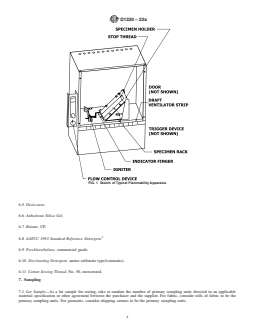
6.1 Flammability Tester, with a separate timer capable of
Available from International Organization for Standardization (ISO), 1, ch. de
providing flame impingement on the specimen for 1 60.1sas
la Voie-Creuse, Case postale 56, CH-1211, Geneva 20, Switzerland, http://
www.iso.ch. shown in Fig. 1 or an equivalent electrically operated tester
D1230 − 22a
FIG. 1 Sketch of Typical Flammability Apparatus
equipped with an automatic electric timer, as described in 7. Sampling
Annex A1. Testers are normally supplied with specimen
7.1 Lot Sample—As a lot sample for testing, take at random
holders.
the number of primary sampling units directed in an applicable
6.2 Brushing Device, as shown in Fig. 2, Fig. 3 and Fig. 4
material specification or other agreement between the pur-
and described in Annex A1.
chaserandthesupplier.Forfabric,considerrollsoffabrictobe
6.3 Drycleaning Machine—A commercial drycleaning ma- the primary sampling units. For garments, consider shipping
chine shall be capable of providing a complete automatic
cartons to be the primary sampling units.
dry-to-drycycleusingperchloroethylenesolventandacationic
NOTE 2—A realistic specification or other agreement between the
drycleaning detergent.
purchaser and the supplier requires taking into account the variability
6.4 Laboratory Drying Oven.
between primary sampling units and within primary sampling units so as
to provide a sampling plan which has a meaningful producer’s risk,
6.5 Desiccator,
consumer’s risk, acceptable quality level, and limiting quality level.Alot
6.6 Anhydrous Silica Gel,
sample normally consists of a very small fraction of the total primary
sampling units.
6.7 Butane, CP.
7.2 Laboratory Sample—As a laboratory sample for testing,
6.8 AATCC 1993 Standard Reference Detergent.
proceed as follows:
6.9 Perchlorethylene, commercial grade.
1 1
7.2.1 For fabric take a full-width swatch ⁄2m( ⁄2 yd) long
6.10 Drycleaning Detergent, amine sulfonate type/
from the end of each roll of fabric in the lot sample, after first
(catatonic).
discarding any fabric from the very outside of the roll that
6.11 Cotton Sewing Thread, No. 50, mercerized. contains folds, creases, or any evidence of displaced weave.
D1230 − 22a
FIG. 2 Brush (SI)
FIG. 3 Brush (in./lb)
D1230 − 22a
NOTE 1—See Fig. 5 and Fig. 6.
FIG. 4 Brushing Device
7.2.2 For garments, take the number of garments per ship- by 150 mm (2 in. by 6 in.) on the surface opposite that to be
ping carton in the lot sample directed in an applicable material tested, with the long dimension in the direction in which
specification or other agreement between the purchaser and burning is most rapid as established in the preliminary trials
supplier. (see 8.1). Long dimension is the longer length of test specimen
for purposes of this method. In cases where it is difficult to
7.3 Test Specimens:
determine the direction of the lay of the nap, it is possible to
7.3.1 Use exploratory tests as directed to select the orienta-
identify it following the method stated in the CPSC Laboratory
tion of specimens, the face of the fabric to be tested, and the
Manual: Laboratory Test Manual for 16 CFR Part 1610.
part of any pattern to be tested so as to minimize burn time.
Identify the end of each specimen toward which, and on the
7.3.2 For fabric, cut final test specimens from each swatch
surface of which burn time is most rapid by attaching a staple
in the laboratory sample as directed in 9.1. For fabrics that can
to it. Then cut specimens from the fabric. Place any identifi-
be refurbished, cut additional final test specimens from each
cation markings on the side and end opposite of that to be
swatch in the lot sample after the swatches have been refur-
tested.
bished as directed in 9.2. Identify the specimens as coming
from a swatch before or after refurbishing.
9. Specimens for Final Testing
7.3.3 For garments, cut final test specimens from each
garment in the laboratory sample as directed in 9.1. For
9.1 Test all fabrics as received per 9.1.1. If fabric is Class 3
garments that can be refurbished, cut additional final test
as-received (see Sections 11 and 12) proceed to Section 13.If
specimens from each garment in the lot sample after the
fabricisClass1orClass2as-received(seeSections 11and12)
garments have been refurbished as directed in 9.2. Identify the
proceed to 9.1.2.
specimens as coming from a garment before or after refurbish-
9.1.1 Fabric as Received—Cut five specimens (see,
ing.
however, 11.1) as directed in 8.2, in addition to the one
previously tested in the preliminary trials. Specimen is a
8. Preparation of Specimens
section of sample to be tested having specific dimension. Five
8.1 Perform tests on the finished production fabric or fabric
or ten specimens are required to be tested for a complete test.
taken from the finished apparel product. Perform preliminary
(Refer to Section 11 for additional information as to when an
testingtodeterminethe proper orientation of specimens,which
additional five specimens are required.)
sideoffabric,andwhichpartofpatterntodeterminethefastest
9.1.2 Refurbished Fabric—Cut a swatch large enough to
burning area.
provide five or ten specimens, as indicated in 11.1, with
8.1.1 Mark and cut (see 8.2) a single 50 mm by 150 mm
allowance for shrinkage in drycleaning and washing, and
(2 in. by 6 in.) specimen for each fabric surface, direction, and
subject the swatch to drycleaning and washing procedures as
pattern and testing according to Section 10.
per 9.2. Specimen is a section of sample to be tested having
NOTE 3—For fabric with a raised-fiber surface, it is usually found that
specific dimension. Five or ten specimens are required to be
the long dimension of the specimen needs to be parallel with the lay of the
tested for a complete test. (Refer to Section 11 for additional
pile, and that burn time is most rapid when progressing against the lay of
information as to the need for an additional five specimens.)
the pile.
9.2 Refurbishing:
8.2 Marking and Cutting, General Directions—Mark out
the required number of specimens (see Section 9) each 50 mm 9.2.1 Drycleaning:
D1230 − 22a
FIG. 5 Brushing Device Template (SI)
9.2.1.1 Solvent: Perchloroethylene, commercial grade 9.2.3 Cut five or ten specimens (as indicated in 11.1)of
Detergent class: Cationic. refurbished fabric as directed in 8.2.
Cleaning time: 10 to 15 min.
NOTE 4—Dry cleaning followed by laundering is intended to remove
Extraction time: 3 min.
additives which could affect the burning characteristics of the textile.
Drying Temperature: 60 °C to 66 °C (140 °F to 150 °F).
9.3 SpecimenMounting—Clamp the specimens individually
Drying Time: 18 to 20 min.
in the specimen holders of the flammabi
...
This document is not an ASTM standard and is intended only to provide the user of an ASTM standard an indication of what changes have been made to the previous version. Because
it may not be technically possible to adequately depict all changes accurately, ASTM recommends that users consult prior editions as appropriate. In all cases only the current version
of the standard as published by ASTM is to be considered the official document.
Designation: D1230 − 22 D1230 − 22a
Standard Test Method for
Flammability of Apparel Textiles
This standard is issued under the fixed designation D1230; the number immediately following the designation indicates the year of
original adoption or, in the case of revision, the year of last revision. A number in parentheses indicates the year of last reapproval. A
superscript epsilon (´) indicates an editorial change since the last revision or reapproval.
1. Scope
1.1 This test method covers the evaluation of the flammability of textile fabrics as they reach the consumer for apparel items other
than children’s sleepwear or protective clothing. apparel. This test method sets forth a classification system for apparel textiles and
identifies textiles which have burning characteristics that make them unsuitable for use in clothing, by using as the ignition source
a 26-gauge hypodermic needle.
1.1.1 This test method shall be used for the flammability of specific categories of tight fitting children’s sleepwear in accordance
with 16 CFR 1615 and 16 CFR 1616 which are accessed by the test procedure in 16 CFR 1610 (or ASTM D1230 equivalent).
1.1.2 This test method shall not be used for the evaluation of the flammability of textiles used in children’s sleepwear, to which
16 CFR 1615 and 16 CFR 1616 apply. These items are addressed in Test Method D6545.
1.1.3 This test method shall not be used for the evaluation of the flammability of decorative fabrics or of textiles not intended for
use as apparel. Suitable test methods for such applications include Test Method D6413/D6413M or NFPA 701.
1.1.4 This test method shall not be used for the evaluation of the flammability of protective clothing, such as those worn by
individuals in the fire service or in other occupations where exposure to heat, flame, or electric arc is likely. Suitable test methods
for such applications have been developed by ASTM Committee F23, on Personal Protective Clothing and Equipment.
1.2 This test method is used to measure and describe the response of materials, products, or assemblies to heat and flame under
controlled conditions, but does not by itself incorporate all factors required for fire hazard or fire risk assessment of the materials,
products, or assemblies under actual fire conditions.
1.3 Fire testing is inherently hazardous. Adequate safeguards for personnel and property shall be employed in conducting these
tests.
NOTE 1—This test method is not identical to 16 CFR Part 1610, Flammability of Clothing Textiles. Consumer Product Safety Commission regulations
require that clothing fabrics introduced into commerce meet the requirements of 16 CFR Part 1610.
1.4 The values stated in SI units are to be regarded as the standard; inch-pound standard. The values given in parentheses after
SI units are provided for information only.only and are not considered standard.
1.5 This standard does not purport to address all of the safety concerns, if any, associated with its use. It is the responsibility
of the user of this standard to establish appropriate safety, health, and environmental practices and determine the applicability of
regulatory limitations prior to use.
This test method is under the jurisdiction of ASTM Committee D13 on Textiles and is the direct responsibility of Subcommittee D13.52 on Flammability.
Current edition approved Feb. 1, 2022July 1, 2022. Published May 2022August 2022. Originally approved in 1952. Last previous edition approved in 20172022 as
D1230–17.–22. DOI: 10.1520/D1230-22.10.1520/D1230-22A.
Copyright © ASTM International, 100 Barr Harbor Drive, PO Box C700, West Conshohocken, PA 19428-2959. United States
D1230 − 22a
1.6 This international standard was developed in accordance with internationally recognized principles on standardization
established in the Decision on Principles for the Development of International Standards, Guides and Recommendations issued
by the World Trade Organization Technical Barriers to Trade (TBT) Committee.
2. Referenced Documents
2.1 ASTM Standards:
D123 Terminology Relating to Textiles
D3136 Terminology Relating to Care Labeling for Apparel, Textile, Home Furnishing, and Leather Products
D4391 Terminology Relating to The Burning Behavior of Textiles
D6413/D6413M Test Method for Flame Resistance of Textiles (Vertical Test)
D6545 Test Method for Flammability of Textiles Used in Children’s Sleepwear
E176 Terminology of Fire Standards
2.2 AATCC Test Method:
124 - 2011AATCC Manual Smoothness Appearance of Fabrics after Repeated Home Launderingof International Test Methods
and Procedures
LP 1 Home Laundering: Machine Washing
M11 Glossary of AATCC Standard Terminology
2.3 CPSC Guidance Document:
16 CFR Part 1610 Standard for the Flammability of Clothing Textiles October 2008
16 CFR Part 1615 Standard for the Flammability of Children’s Sleepwear: Sizes 0 through 6X (FF 3-71)
16 CFR Part 1616 Standard for the Flammability of Children’s Sleepwear: Sizes 7 through 14 (FF 5-74)
2.4 NFPA Standards:
NFPA 701 Standard Methods of Fire Tests for Flame Propagation of Textiles and Films
2.5 ISO Standards
ISO 4880 Burning behaviour of textiles and textile products
ISO 13943 Fire safety
3. Terminology
3.1 The following terms are relevant to this standard: base burn, burn time, combustible textile, dry cleaning, flame application
time, flame spread, flame-spread time, flame-spread, flame retardant, flame-retardant-treated, flammability, ignition, interlining,
laundering, plain surface textile fabric, raised fiber surface, refurbish, surface flash.
3.2 For terms related to burning behavior of textiles, see Terminology D4391.
3.3 For terms related to fabric treatments and finishings, care labels, see Terminology D3136.
3.4 For terms related to fabric treatments laundering and finishings,drycleaning, see Terminology in the referenced AATCC test
method.Manual of International Test Methods and Procedures.
3.5 For terminology related to fire issues other than burning behavior of textiles, see Terminology E176 and ISO 13943. In case
of conflict, the terminology in E176 will prevail.
3.6 For other terms related to textiles, see Terminology D123 and the American Association of Textile Chemists and Colorists test
method.AATCC M11.
4. Summary of Test Method
4.1 The test method provides methods of testing the flammability of textiles from or intended to be used for apparel, explains three
For referenced ASTM standards, visit the ASTM website, www.astm.org, or contact ASTM Customer Service at service@astm.org. For Annual Book of ASTM Standards
volume information, refer to the standard’s Document Summary page on the ASTM website.
AATCC Technical Manual of the Available from American Association of Textile Chemists and Colorists, Colorists (AATCC), P.O. Box 12215, Research Triangle Park,
NC 27709.27709-2215, http://www.aatcc.org.
Available from the U.S. Consumer Product Safety Commission, www.cpsc.gov.
Available from National Fire Protection Association (NFPA), 1 Batterymarch Park, Quincy, MA 02169-7471, http://www.nfpa.org.
Available from International Organization for Standardization (ISO), 1, ch. de la Voie-Creuse, Case postale 56, CH-1211, Geneva 20, Switzerland, http://www.iso.ch.
D1230 − 22a
classes of flammability, sets forth the requirements for classifying textiles, and warns against the use of single or multilayer textile
fabrics that have burning characteristics considered by the trade to make them unsuitable for apparel.
4.2 Specimens cut from the textile are prepared by brushing if they have a raised fiber surface. All textiles require testing before
and after refurbishing. Refurbishing consists of one cycle of drycleaning dry cleaning followed by laundering of all textiles. A
specimen is inserted in a frame, dried in an oven, and placed in a dessicator before testing. The framed specimen is held in the
flammability tester at an angle of 45°, a standardized flame is applied to the surface near the lower end for 1 6 0.1 s, and the time
required for the flame to proceed up the fabric a distance of 127 mm 6 0.2 mm (5 in. 6 0.008 in.) is recorded. Notation is made
as to whether the base of a raised-surface raised fiber surface fabric ignites, chars, melts, or fuses.
5. Significance and Use
5.1 Test Method D1230 cannot be recommended for the acceptance testing of commercial shipments since Federal regulations
require apparel fabrics to meet the criteria of 16 CFR Part 1610 and correlation of test results with actual performance has not been
established. Although Test Method D1230 is not recommended for acceptance testing, it is useful because it provides a method
to test general non-regulated textile fabrics.
5.1.1 In case of a dispute arising from differences in reported test results when using Test Method D1230 for testing of commercial
shipments, the purchaser and the supplier shall conduct comparative tests to determine if there is a statistical bias between their
laboratories. Competent statistical assistance is recommended for the investigation of bias. At a minimum, the two parties shall take
a group of test specimens which are as homogeneous as possible and which are from a lot of material of the type in question. The
test specimens shall be randomly assigned in equal numbers to each laboratory for testing. The average results from the two
laboratories shall be compared using a nonparametric test for unpaired data and an acceptable probability level chosen by the two
parties before testing is begun. If a bias is found, either its cause must be found and corrected or the purchaser and the supplier
must agree to interpret future test results in light of the known bias.
5.2 All fabrics made of natural or regenerated cellulose, as well as many made from other natural or man-made fibers, are
combustible. Some combustible fabrics when used for clothing are potentially dangerous to the wearer because of such factors as
ease of ignition, flame spread burn time, amount of heat released, and design of the garment. This test measures two such factors:
ease of ignition and flame spread burn time.
5.3 In order to place fabrics in one of the three flammability classes, arbitrary limits have been selected for time of application
of the flame and for time of flame spread. the burn time. These limits are based on extensive testing experience and are believed
to be a useful guide in judging the relative flammability of apparel textiles. It must be understood, however, that no guarantee can
be given and none is implied that garments made from a fabric or product falling into any one of the flammability classes will not
be hazardous under some conditions.
5.3.1 Because of the sensitivity of fabrics to ambient atmospheric conditions, technique of specimen preparation, and inherent
variability in the cloth itself, test results are not always closely reproducible either in the same laboratory or among several
laboratories.
5.4 Finishes and fabric surface changes can exert a large effect on flammability. Therefore, fabrics are tested before as well as after
one cycle of drycleaning dry cleaning followed by laundering.
6. Apparatus and Materials
6.1 Flammability Tester, with a separate timer capable of providing flame impingement on the specimen for 1 + 0.011 6 0.1 s as
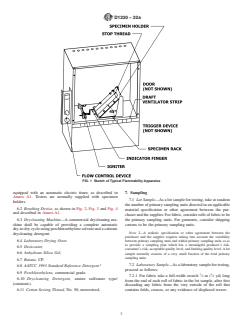
shown in Fig. 1 or an equivalent electrically operated tester equipped with an automatic electric timer, as described in Annex A1.
Testers are normally supplied with specimen holders.
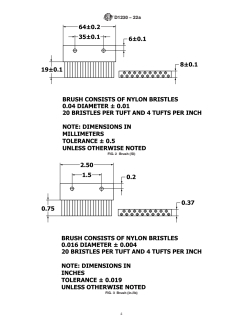
6.2 Brushing Device, as shown in Fig. 2, Fig. 3 and Fig. 4 and described in Annex A1.
6.3 Drycleaning Machine—A commercial dry cleaning drycleaning machine shall be capable of providing a complete automatic
dry-to-dry cycle using perchloroethylene solvent and a cationic drycleaning detergent.
6.4 Laboratory Drying Oven.
D1230 − 22a
FIG. 1 Sketch of Typical Flammability Apparatus
6.5 Desiccator,
6.6 Anhydrous Silica Gel,
6.7 Butane, CP.
6.8 AATCC 1993 Standard Reference Detergent.
6.9 Perchlorethylene, commercial grade.
6.10 Drycleaning Detergent, amine sulfonate type/(catatonic).
6.11 Cotton Sewing Thread, No. 50, mercerized.
7. Sampling
7.1 Lot Sample—As a lot sample for testing, take at random the number of primary sampling units directed in an applicable
material specification or other agreement between the purchaser and the supplier. For fabric, consider rolls of fabric to be the
primary sampling units. For garments, consider shipping cartons to be the primary sampling units.
D1230 − 22a
FIG. 2 Brush (SI)
FIG. 3 Brush (in./lb)
NOTE 2—A realistic specification or other agreement between the purchaser and the supplier requires taking into account the variability between primary
D1230 − 22a
NOTE 1—See Fig. 5 and Fig. 6.
FIG. 4 Brushing Device
sampling units and within primary sampling units so as to provide a sampling plan which has a meaningful producer’s risk, consumer’s risk, acceptable
quality level, and limiting quality level. A lot sample normally consists of a very small fraction of the total primary sampling units.
7.2 Laboratory Sample—As a laboratory sample for testing, proceed as follows:
1 1
7.2.1 For fabric take a full-width swatch ⁄2 m ( ⁄2 yd) long from the end of each roll of fabric in the lot sample, after first discarding
any fabric from the very outside of the roll that contains folds, creases, or any evidence of displaced weave.
7.2.2 For garments, take the number of garments per shipping carton in the lot sample directed in an applicable material
specification or other agreement between the purchaser and supplier.
7.3 Test Specimens:
7.3.1 Use exploratory tests as directed in to select the orientation of specimens, the face of the fabric to be tested, and the part
of any pattern to be tested so as to maximize the rate of flame spread.minimize burn time.
7.3.2 For fabric, cut final test specimens from each swatch in the laboratory sample as directed in 9.1. For fabrics that can be
refurbished, cut additional final test specimens from each swatch in the lot sample after the swatches have been refurbished as
directed in 9.2. Identify the specimens as coming from a swatch before or after refurbishing.
7.3.3 For garments, cut final test specimens from each garment in the laboratory sample as directed in 9.1. For garments that can
be refurbished, cut additional final test specimens from each garment in the lot sample after the garments have been refurbished
as directed in 9.2. Identify the specimens as coming from a garment before or after refurbishing.
8. Preparation of Specimens
8.1 Perform tests on the finished production fabric or fabric taken from the finished apparel product. Perform preliminary testing
to determine the proper orientation of specimens, which side of fabric, and which part of pattern to determine the fastest burning
area.
8.1.1 Mark and cut (see 8.2) a single 50 mm by 150 mm (2 in. by 6 in.) specimen for each fabric surface, direction, and pattern
and testing according to Section 10.
NOTE 3—For fabric with a raised-fiber surface, it is usually found that the long dimension of the specimen needs to be parallel with the lay of the pile,
and that flame spreadburn time is most rapid when progressing against the lay of the pile.
D1230 − 22a
8.2 Marking and Cutting, General Directions—Mark out the required number of specimens (see Section 9) each 50 mm by 150
mm (2 in. by 6 in.) on the surface opposite that to be tested, with the long dimension in the direction in which burning is most
rapid as established in the preliminary trials (see 8.1). Long dimension is the longer length of test specimen for purposes of this
method. In cases where it is difficult to determine the direction of the lay of the nap, it is possible to identify it following the method
stated in the CPSC Laboratory Manual: Laboratory Test Manual for 16 CFR Part 1610. Identify the end of each specimen toward
which, and on the surface of which flame spreadburn time is most rapid by attaching a staple to it. Then cut specimens from the
fabric. Place any identification markings on the side and end opposite of that to be tested.
9. Specimens for Final Testing
9.1 Test all fabrics as received per 9.1.1. If fabric is Class 3 as-received (see Sections 11 and 12) proceed to Section 13. If fabric
is Class 1 or Class 2 as-received (see Sections 11 and 12) proceed to 9.1.2.
9.1.1 Fabric as Received—Cut five specimens (see, however, 11.1) as directed in 8.2, in addition to the one previously tested in
the preliminary trials. Specimen is a section of sample to be tested having specific dimension. Five or ten specimens are required
to be tested for a complete test. (Refer to Section 11 for additional information as to when an additional five specimens are
required.)
9.1.2 Refurbished Fabric—Cut a swatch large enough to provide five or ten specimens, as indicated in 11.1, with allowance for
shrinkage in dry cleaning drycleaning and washing, and subject the swatch to drycleaning and washing procedures as per 9.2.
Specimen is a section of sample to be tested having specific dimension. Five or ten specimens are required to be tested for a
complete test. (Refer to Section 11 for additional information as to the need for an additional five specimens.)
9.2 Refurbishing:
FIG. 5 Brushing Device Template (SI)
D1230 − 22a
FIG. 6 Brushing Device Template (in./lb)
9.2.1 Drycleaning:
9.2.1.1 Solvent: Perchloroethylene, commercial grade
Detergent class: Cationic.
Cleaning time: 10 to 15 min.
Extraction time: 3 min.
Drying Temperature: 60 °C to 66 °C (140 °F to 150 °F).
Drying Time: 18 to 20 min.
Cool Down/Deodorization time: 5 min.
9.2.1.2 Perchloroethylene is toxic and a suspected carcinogen, and the usual precautions for handling chlorinated solvents need
to be taken. Perchloroethylene is to be used only under
...