


ASTM D6097-16
(Test Method)Standard Test Method for Relative Resistance to Vented Water-Tree Growth in Solid Dielectric Insulating Materials
Standard Test Method for Relative Resistance to Vented Water-Tree Growth in Solid Dielectric Insulating Materials
SIGNIFICANCE AND USE
5.1 This is a laboratory test designed to simulate the growth of vented water-trees in the solid dielectric insulating material initiated by a sharp protrusion at the insulating and conductive interface under a wet environment in a high electrical field. Water-treeing is the phenomenon which describes the appearance of tree-like growth in organic dielectrics under an ac field when exposed to moist environments. Two types of water-trees are formed. Bow tie trees (within the dielectric) and vented water-trees formed from conductive/insulating material interface into the insulating material. The water-trees referred to in this test method are the vented type. The insulating material is the solid dielectric organic material. The conductive material is the salt solution. This salt solution is used on both sides of the insulating material to simulate the same inner and outer semiconductive shields saturated with moisture between the insulation layer used in a medium-voltage underground power cable.
5.2 This test method provides comparative data. The degree of correlation with the performance in service has not been established.
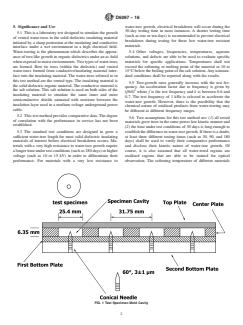
5.3 The standard test conditions are designed to grow a sufficient water-tree length for most solid dielectric insulating materials of interest before electrical breakdown occurs. Materials with a very high resistance to water-tree growth require a longer time under test conditions (such as 180 days) or higher voltage (such as 10 or 15 kV) in order to differentiate their performance. For materials with a very low resistance to water-tree growth, electrical breakdown will occur during the 30-day testing time in most instances. A shorter testing time (such as one or ten days) is recommended to prevent electrical breakdown during testing for those low water-tree resistant materials.
5.4 Other voltages, frequencies, temperatures, aqueous solutions, and defects are able to be used to evaluate specific materials for specific applications. Tempe...
SCOPE
1.1 This test method covers the relative resistance to vented water-tree growth in solid translucent thermoplastic or cross-linked electrical insulating materials. This test method is especially applicable to extruded polymeric insulation materials used in medium-voltage cables.
1.2 The values stated in SI units are to be regarded as standard. No other units of measurement are included in this standard.
1.3 This standard does not purport to address all of the safety concerns, if any, associated with its use. It is the responsibility of the user of this standard to establish appropriate safety and health practices and determine the applicability of regulatory limitation prior to use. For specific hazard statements see 8.1.
1.4 There is no similar or equivalent IEC standard.
General Information
- Status
- Published
- Publication Date
- 31-Oct-2016
- Technical Committee
- D09 - Electrical and Electronic Insulating Materials
- Drafting Committee
- D09.12 - Electrical Tests
Relations
- Effective Date
- 01-Nov-2016
- Effective Date
- 01-Mar-2024
- Effective Date
- 29-Sep-2023
- Effective Date
- 01-Nov-2018
- Effective Date
- 01-Nov-2015
- Effective Date
- 01-Nov-2014
- Effective Date
- 01-May-2014
- Effective Date
- 01-Nov-2013
- Effective Date
- 01-Aug-2011
- Effective Date
- 01-Oct-2010
- Effective Date
- 01-May-2008
- Effective Date
- 01-May-2008
- Effective Date
- 01-Mar-2004
- Effective Date
- 10-Mar-2002
- Effective Date
- 10-Mar-2001
Overview
ASTM D6097-16 is a standard test method developed by ASTM International for determining the relative resistance to vented water-tree growth in solid dielectric insulating materials. This laboratory test simulates how vented water-trees initiate and grow in solid organic insulation, generally under conditions analogous to wet, high-voltage environments found in underground medium-voltage power cables. Water-treeing refers to the micro-channel, tree-like feature that can develop in organic dielectrics when subjected to alternating current (AC) fields and moisture. The results from this test method provide comparative data on different insulating materials’ susceptibility to this form of degradation, supporting the selection and evaluation of materials for cable insulation applications.
Key Topics
Water-Treeing Phenomenon: The standard specifically addresses vented water-trees, which develop from the interface between conductive and insulating materials and grow into the insulation layer. This process can eventually result in deteriorated electrical properties and premature failure for cable insulation.
Test Methodology: The method involves exposing polymeric insulating material specimens-such as thermoplastic or cross-linked polyethylenes-to a simulated wet, high-voltage environment using a sharp defect to initiate tree growth. The specimens are typically subjected to 5 kV at 1 kHz in a saltwater solution over a prescribed period, most commonly 30 days.
Evaluation Metrics: Water-tree length (WTL) and resistance to water-tree growth (RWTG) are key metrics determined by measuring the maximum length of treeing paths and relating it to specimen thickness. These values help stakeholders compare the performance of different insulation materials.
Application Flexibility: The standard recognizes that various test voltages, frequencies, temperatures, and electrolyte compositions can be used to tailor the evaluation to specific materials or use cases.
Applications
Medium-Voltage Cable Insulation: This test is essential for manufacturers and users of extruded polymeric insulation materials, especially those used in underground medium-voltage power cables. Identifying materials with high resistance to water-treeing enables longer service life, fewer failures, and improved safety.
Material Development and Selection: The test supports R&D departments and material scientists in assessing new or modified dielectric materials for enhanced durability and moisture resistance under real-world conditions.
Quality Control: Utilities and cable manufacturers can use the standard to benchmark and verify the water-tree resistance of insulation batches, thereby reducing in-field failures.
Comparative Analysis: The method is especially valuable for comparative studies, allowing stakeholders to make informed decisions based on the relative performance of different insulating materials in simulated wet AC environments.
Related Standards
While ASTM D6097-16 is highly specialized and currently has no equivalent IEC standard, several other ASTM documents relate to electrical insulation and water-treeing resistance, including:
- ASTM D1711: Terminology relating to electrical insulation, supporting clarity in test methods and results.
- ASTM D2275: Test method for voltage endurance of solid insulating materials.
- ASTM D3756: Test method for evaluation of resistance to electrical breakdown by treeing in solid dielectric materials.
- ASTM D1928: Practice for preparation of molded test specimens from plastics (historical reference).
Keywords: water-treeing, vented water-tree, solid dielectric insulating materials, polymeric insulation, underground cable, medium-voltage cable insulation, electrical breakdown, ASTM D6097-16, water-tree resistance, dielectric material testing.
By adhering to ASTM D6097-16, manufacturers and engineers can ensure a rigorous, consistent evaluation of insulation materials under conditions that closely simulate those found in actual cable installations, leading to improved longevity and reliability in electrical infrastructure.
Buy Documents
ASTM D6097-16 - Standard Test Method for Relative Resistance to Vented Water-Tree Growth in Solid Dielectric Insulating Materials
REDLINE ASTM D6097-16 - Standard Test Method for Relative Resistance to Vented Water-Tree Growth in Solid Dielectric Insulating Materials
Get Certified
Connect with accredited certification bodies for this standard

Intertek Testing Services NA Inc.
Intertek certification services in North America.

UL Solutions
Global safety science company with testing, inspection and certification.

ANCE
Mexican certification and testing association.
Sponsored listings
Frequently Asked Questions
ASTM D6097-16 is a standard published by ASTM International. Its full title is "Standard Test Method for Relative Resistance to Vented Water-Tree Growth in Solid Dielectric Insulating Materials". This standard covers: SIGNIFICANCE AND USE 5.1 This is a laboratory test designed to simulate the growth of vented water-trees in the solid dielectric insulating material initiated by a sharp protrusion at the insulating and conductive interface under a wet environment in a high electrical field. Water-treeing is the phenomenon which describes the appearance of tree-like growth in organic dielectrics under an ac field when exposed to moist environments. Two types of water-trees are formed. Bow tie trees (within the dielectric) and vented water-trees formed from conductive/insulating material interface into the insulating material. The water-trees referred to in this test method are the vented type. The insulating material is the solid dielectric organic material. The conductive material is the salt solution. This salt solution is used on both sides of the insulating material to simulate the same inner and outer semiconductive shields saturated with moisture between the insulation layer used in a medium-voltage underground power cable. 5.2 This test method provides comparative data. The degree of correlation with the performance in service has not been established. 5.3 The standard test conditions are designed to grow a sufficient water-tree length for most solid dielectric insulating materials of interest before electrical breakdown occurs. Materials with a very high resistance to water-tree growth require a longer time under test conditions (such as 180 days) or higher voltage (such as 10 or 15 kV) in order to differentiate their performance. For materials with a very low resistance to water-tree growth, electrical breakdown will occur during the 30-day testing time in most instances. A shorter testing time (such as one or ten days) is recommended to prevent electrical breakdown during testing for those low water-tree resistant materials. 5.4 Other voltages, frequencies, temperatures, aqueous solutions, and defects are able to be used to evaluate specific materials for specific applications. Tempe... SCOPE 1.1 This test method covers the relative resistance to vented water-tree growth in solid translucent thermoplastic or cross-linked electrical insulating materials. This test method is especially applicable to extruded polymeric insulation materials used in medium-voltage cables. 1.2 The values stated in SI units are to be regarded as standard. No other units of measurement are included in this standard. 1.3 This standard does not purport to address all of the safety concerns, if any, associated with its use. It is the responsibility of the user of this standard to establish appropriate safety and health practices and determine the applicability of regulatory limitation prior to use. For specific hazard statements see 8.1. 1.4 There is no similar or equivalent IEC standard.
SIGNIFICANCE AND USE 5.1 This is a laboratory test designed to simulate the growth of vented water-trees in the solid dielectric insulating material initiated by a sharp protrusion at the insulating and conductive interface under a wet environment in a high electrical field. Water-treeing is the phenomenon which describes the appearance of tree-like growth in organic dielectrics under an ac field when exposed to moist environments. Two types of water-trees are formed. Bow tie trees (within the dielectric) and vented water-trees formed from conductive/insulating material interface into the insulating material. The water-trees referred to in this test method are the vented type. The insulating material is the solid dielectric organic material. The conductive material is the salt solution. This salt solution is used on both sides of the insulating material to simulate the same inner and outer semiconductive shields saturated with moisture between the insulation layer used in a medium-voltage underground power cable. 5.2 This test method provides comparative data. The degree of correlation with the performance in service has not been established. 5.3 The standard test conditions are designed to grow a sufficient water-tree length for most solid dielectric insulating materials of interest before electrical breakdown occurs. Materials with a very high resistance to water-tree growth require a longer time under test conditions (such as 180 days) or higher voltage (such as 10 or 15 kV) in order to differentiate their performance. For materials with a very low resistance to water-tree growth, electrical breakdown will occur during the 30-day testing time in most instances. A shorter testing time (such as one or ten days) is recommended to prevent electrical breakdown during testing for those low water-tree resistant materials. 5.4 Other voltages, frequencies, temperatures, aqueous solutions, and defects are able to be used to evaluate specific materials for specific applications. Tempe... SCOPE 1.1 This test method covers the relative resistance to vented water-tree growth in solid translucent thermoplastic or cross-linked electrical insulating materials. This test method is especially applicable to extruded polymeric insulation materials used in medium-voltage cables. 1.2 The values stated in SI units are to be regarded as standard. No other units of measurement are included in this standard. 1.3 This standard does not purport to address all of the safety concerns, if any, associated with its use. It is the responsibility of the user of this standard to establish appropriate safety and health practices and determine the applicability of regulatory limitation prior to use. For specific hazard statements see 8.1. 1.4 There is no similar or equivalent IEC standard.
ASTM D6097-16 is classified under the following ICS (International Classification for Standards) categories: 29.035.20 - Plastics and rubber insulating materials. The ICS classification helps identify the subject area and facilitates finding related standards.
ASTM D6097-16 has the following relationships with other standards: It is inter standard links to ASTM D6097-01a(2008)e1, ASTM D1711-24, ASTM D1898-68(1989), ASTM D3756-18, ASTM D1711-15, ASTM D1711-14a, ASTM D1711-14, ASTM D1711-13, ASTM D1711-11a, ASTM D3756-97(2010), ASTM D1711-08, ASTM D2275-01(2008)e1, ASTM D3756-97(2004), ASTM D1711-02, ASTM D2275-01. Understanding these relationships helps ensure you are using the most current and applicable version of the standard.
ASTM D6097-16 is available in PDF format for immediate download after purchase. The document can be added to your cart and obtained through the secure checkout process. Digital delivery ensures instant access to the complete standard document.
Standards Content (Sample)
This international standard was developed in accordance with internationally recognized principles on standardization established in the Decision on Principles for the
Development of International Standards, Guides and Recommendations issued by the World Trade Organization Technical Barriers to Trade (TBT) Committee.
Designation: D6097 − 16
Standard Test Method for
Relative Resistance to Vented Water-Tree Growth in Solid
Dielectric Insulating Materials
This standard is issued under the fixed designation D6097; the number immediately following the designation indicates the year of
original adoption or, in the case of revision, the year of last revision.Anumber in parentheses indicates the year of last reapproval.A
superscript epsilon (´) indicates an editorial change since the last revision or reapproval.
1. Scope 3. Terminology
1.1 This test method covers the relative resistance to vented 3.1 Definitions:
water-tree growth in solid translucent thermoplastic or cross- 3.1.1 Use Terminology D1711 for definitions of terms used
linked electrical insulating materials. This test method is
in this test method and associated with electrical insulation
especially applicable to extruded polymeric insulation materi- materials.
als used in medium-voltage cables.
3.2 Definitions of Terms Specific to This Standard:
3.2.1 water tree length (WTL), n—the maximum length of a
1.2 The values stated in SI units are to be regarded as
stained tree-like micro-channel path in millimeters, measured
standard. No other units of measurement are included in this
fromthetipoftheconicaldefectinthedirectionoftheconical
standard.
axis.
1.3 This standard does not purport to address all of the
3.2.2 resistance to water-tree growth (RWTG), n—a dimen-
safety concerns, if any, associated with its use. It is the
sionless value which is L divided by the WTL.
responsibility of the user of this standard to establish appro-
3.2.3 thickness of point-to-plane specimen (L), n—the ver-
priate safety and health practices and determine the applica-
bility of regulatory limitation prior to use. For specific hazard tical distance in millimeters from the tip of the conical defect
to the opposite surface of the solid dielectric material.
statements see 8.1.
1.4 There is no similar or equivalent IEC standard.
3.2.4 semiconductive shield, n—polymer/carbonblackcom-
posite material used in medium voltage cables with volume
2. Referenced Documents 4 5
resistivity between 10 and 10 ohm-cm.
2.1 ASTM Standards:
D1711Terminology Relating to Electrical Insulation 4. Summary of Test Method
D1898Practice for Sampling of Plastics (Withdrawn 1998)
4.1 Ten compression-molded disk specimens, each contain-
D1928Practice for Preparation of Compression-Molded
ingaconical-shapeddefect,aresubjectedtoanappliedvoltage
PolyethyleneTest Sheets andTest Specimens (Withdrawn
of 5 kV at 1 kHz and 23 6 2°C in an aqueous conductive
2001)
solution of 1.0 N sodium chloride (NaCl) for 30 days. This
D2275Test Method for Voltage Endurance of Solid Electri-
controlled conical defect is created by a sharp needle with an
cal Insulating Materials Subjected to Partial Discharges
included angle of 60° and a tip radius of 3 µm. The electrical
(Corona) on the Surface
stress at the defect tip is enhanced and is estimated by the
D3756Test Method for Evaluation of Resistance to Electri-
Mason’s Hyperbolic point-to-plane stress enhancement equa-
cal Breakdown by Treeing in Solid Dielectric Materials 4
tion. This enhanced electrical stress initiates the formation of
Using Diverging Fields
a vented water-tree grown from the defect tip. Each treed
specimen is stained and sliced. The water-tree length and
point-to-plane specimen thickness measured under microscope
This test method is under the jurisdiction of ASTM Committee D09 on
are used to calculate a ratio that is defined as the resistance to
Electrical and Electronic Insulating Materials and is the direct responsibility of
water-tree growth.
Subcommittee D09.12 on Electrical Tests.
Current edition approved Nov. 1, 2016. Published December 2016. Originally
ε1
approvedin1997.Lastpreviouseditionapprovedin2008asD6097–01a(2008) .
DOI: 10.1520/D6097-16.
2 4
For referenced ASTM standards, visit the ASTM website, www.astm.org, or The sole source of supply of the base, Dow Corning 3110RTV, the catalyst,
contact ASTM Customer Service at service@astm.org. For Annual Book of ASTM DowCorningRTVCatalystS,andthesealant,DowCorningMultipurposeSilicone
Standards volume information, refer to the standard’s Document Summary page on Sealant732,knowntothecommitteeatthistimeisDowCorning,Inc.,Midland,MI
the ASTM website. 48686. If you are aware of alternative suppliers, please provide this information to
The last approved version of this historical standard is referenced on ASTM International Headquarters. Your comments will receive careful consider-
www.astm.org. ation at a meeting of the responsible technical committee, which you may attend.
Copyright © ASTM International, 100 Barr Harbor Drive, PO Box C700, West Conshohocken, PA 19428-2959. United States
D6097 − 16
5. Significance and Use water-tree growth, electrical breakdown will occur during the
30-day testing time in most instances. A shorter testing time
5.1 Thisisalaboratorytestdesignedtosimulatethegrowth
(such as one or ten days) is recommended to prevent electrical
of vented water-trees in the solid dielectric insulating material
breakdown during testing for those low water-tree resistant
initiated by a sharp protrusion at the insulating and conductive
materials.
interface under a wet environment in a high electrical field.
Water-treeing is the phenomenon which describes the appear- 5.4 Other voltages, frequencies, temperatures, aqueous
anceoftree-likegrowthinorganicdielectricsunderanacfield solutions, and defects are able to be used to evaluate specific
whenexposedtomoistenvironments.Twotypesofwater-trees materials for specific applications. Temperatures shall not
are formed. Bow tie trees (within the dielectric) and vented exceed the softening or melting point of the material or 10 to
water-trees formed from conductive/insulating material inter- 15°Cbelowtheboilingpointofthesaltsolution.Anynonstan-
face into the insulating material. The water-trees referred to in dard conditions shall be reported along with the results.
this test method are the vented type. The insulating material is
5.5 Tree-growth rates generally increase with the test fre-
thesoliddielectricorganicmaterial.Theconductivematerialis
quency. An acceleration factor due to frequency is given by
k
the salt solution. This salt solution is used on both sides of the
(f/60) where f is the test frequency and k is between 0.6 and
insulating material to simulate the same inner and outer
0.7. The test frequency of 1 kHz is selected to accelerate the
semiconductive shields saturated with moisture between the
water-tree growth. However, there is the possibility that the
insulation layer used in a medium-voltage underground power
chemical nature of oxidized products from water-treeing may
cable.
be different at different frequency ranges.
5.2 Thistestmethodprovidescomparativedata.Thedegree
5.6 Two assumptions for this test method are: (1) all tested
of correlation with the performance in service has not been
materialsgrowtreesinthesamepowerlawkineticmannerand
established.
(2) the time under test conditions of 30 days is long enough to
5.3 The standard test conditions are designed to grow a establishthedifferenceinwater-treegrowth.Ifthereisadoubt,
sufficient water-tree length for most solid dielectric insulating at least three different testing times (such as 30, 90, and 180
materials of interest before electrical breakdown occurs. Ma- days) shall be used to verify their comparative performance
terials with a very high resistance to water-tree growth require and disclose their kinetic nature of water-tree growth. Of
alongertimeundertestconditions(suchas180days)orhigher course, it is also assumed that all water-treed regions are
voltage (such as 10 or 15 kV) in order to differentiate their oxidized regions that are able to be stained for optical
performance. For materials with a very low resistance to observation. The softening temperature of different materials
FIG. 1 Test Specimen Mold Cavity
D6097 − 16
will require different temperature and times to stain the support assembly is carefully screwed into the base until the
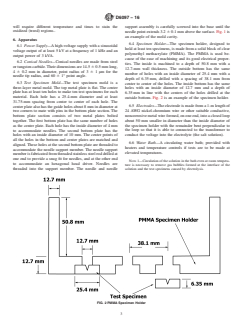
oxidized (treed) regions. needlepointextends3.2 60.1mmabovethesurface.Fig.1is
an example of the mold cavity.
6. Apparatus
6.4 Specimen Holder—The specimen holder, designed to
6.1 Power Supply—Ahigh-voltage supply with a sinusoidal
holdatleasttenspecimens,ismadefromasolidblockofclear
voltage output of at least 5 kV at a frequency of 1 kHz and an
polymethyl methacrylate (PMMA). The PMMA is used be-
output power of 3 kVA.
cause of the ease of machining and its good electrical proper-
6.2 Conical Needles—Conical needles are made from steel
ties. The inside is machined to a depth of 50.8 mm with a
ortungstencarbide.Theirdimensionsare14.5 60.5mmlong,
12.7-mm wall thickness. The outside bottom has the same
4 6 0.2 mm in diameter, point radius of 3 6 1 µm for the
number of holes with an inside diameter of 25.4 mm with a
needle tip radius, and 60 6 1° point angle.
depth of 6.35mm, drilled with a spacing of 38.1 mm from
6.3 Test Specimen Mold—The test specimen mold is a
center to center of the holes. The inside bottom has the same
three-layer metal mold. The top metal plate is flat. The center
holes with an inside diameter of 12.7 mm and a depth of
plate has at least ten holes to make ten test specimens for each
6.35mm in line with the centers of the holes drilled at the
material. Each hole has a 25.4-mm diameter and at least
outside bottom. Fig. 2 is an example of the specimen holder.
31.75-mm spacing from center to center of each hole. The
6.5 Electrodes—Theelectrodeismadefroma1-mlengthof
centerplatealsohastheguideholesabout8mmindiameterat
24 AWG nickel-chromium wire or other suitable conductive,
two corners to mate with pins in the bottom plate section. The
noncorrosivemetalwireformed,ononeend,intoaclosedloop
bottom plate section consists of two metal plates bolted
about 50 mm smaller in diameter than the inside diameter of
together. The first bottom plate has the same number of holes
as the center plate. Each hole has the inside diameter of 4 mm the specimen holder with the remainder bent perpendicular to
to accommodate needles. The second bottom plate has the the loop so that it is able to connected to the transformer to
holes with an inside diameter of 10 mm. The center points of
conduct the voltage into the electrolyte (the salt solution).
all the holes in the bottom and center plates are matched and
6.6 Water Bath—A circulating water bath; provided with
aligned.Theseholesatthesecondbottomplatearethreadedto
heaters and temperature controls if tests are to be made at
accommodate the needle support member. The needle support
elevated temperatures.
memberisfabricatedfromthreadedstainlesssteelroddrilledat
one end to provide a snug fit for needles, and at the other end
NOTE 1—Circulation of the solution in the bath even at room tempera-
to accommodate an hexagonal head driver. Needles are
ture is necessary to remove gas bubbles formed at the interface of the
threaded into the support member. The needle and needle solution and the test specimens caused by electrolysis.
FIG. 2 PMMA Specimen Holder
D6097 − 16
6.7 Microscope—A microscope equipped for 20 and 100× 9. Sampling
magnification.
9.1 Sample in accordance with Practice D1898.
7. Reagents
10. Test Specimen
7.1 Salt—Reagent-grade sodium chloride.
10.1 Geometry of Test Specimens—The test specimen is a
7.2 Sealants—The material used for sealing in this test
disk containing a conical defect at the center of one side. The
method is a two-part silicone rubber sealant consisting of a
disk has a diameter of 25.4 mm and a thickness of 6.35 mm.
4 4
base and a catalyst.
This conical defect has a diameter of 3.2mm and height of
7.3 Multipurpose Silicone Sealant—One-part silicone rub-
3.2mm with an included angle of 60°. The radius of the cone
ber sealant.
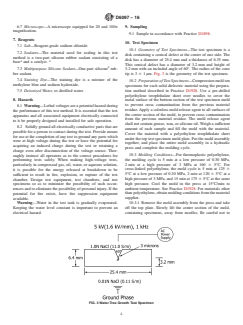
tip is 3 6 1µm. Fig. 3 is the geometry of the test specimen.
7.4 Staining Dye—The staining dye is a mixture of the
10.2 Preparation of Test Specimens—Compressionmoldten
methylene blue and sodium hydroxide.
specimens for each solid dielectric material using the prepara-
tion method described in Practice D1928. Use a pre-drilled
7.5 Deionized Water, or distilled water.
polyethylene terephthalate sheet over needles to cover the
8. Hazards
metal surface of the bottom section of the test specimen mold
to prevent cross contamination from the previous material
8.1 Warning—Lethalvoltagesareapotentialhazardduring
residue.Apply a colorless mold release agent to all surfaces of
the performance of this test method. It is essential that the test
the center section of the mold, to prevent cross contamination
apparatus and all associated equipment electrically connected
from the previous material residue. The mold release agent
to it be properly designed and installed for safe operation.
shallnotcontaingrease,wax,orsiliconeoil.Weighasufficient
8.2 Solidly ground all electrically conductive parts that are
amount of each sample and fill the mold with the material.
possible for a person to contact during the test. Provide means
Cover the material with a polyethylene terephthalate sheet
foruseatthecompletionofanytesttogroundanypartswhich
under the top test specimen mold plate. Put the mold assembly
were at high voltage during the test or have the potential for
together, and place the entire mold assembly in a hydraulic
acquiring an induced charge during the test or retaining a
press and complete the molding cycle.
charge even after disconnection of the voltage source. Thor-
10.3 Molding Conditions—For thermoplastic polyethylene,
oughly instruct all operators as to the correct procedures for
the molding cycle is 5 min at a low pressure of 0.30 MPa,
performing tests safely. When making high-voltage tests,
2min at a high pressure of 3 MPa at 160 6 5°C. For
particularly in compressed gas, oil, water, or aqueous solution,
cross-linked polyethylene, the mold cycle is 5 min at 125 6
it is possible for the energy released at breakdown to be
5°C at a low pressure of 0.30 MPa, 2 min at 120 6 5°C at a
sufficient to result in fire, explosion, or rupture of the test
high pressure of 3 MPa, and 15 min at 175 6 5°C at the same
chamber. Design test equipment, test chambers, and test
high pressure. Cool the mold in the press at 15°C/min to
specimens so as to minimize the possibility of such occur-
ambient temperature. See Practice D1928. For materials other
rencesandtoeliminatethe
...
This document is not an ASTM standard and is intended only to provide the user of an ASTM standard an indication of what changes have been made to the previous version. Because
it may not be technically possible to adequately depict all changes accurately, ASTM recommends that users consult prior editions as appropriate. In all cases only the current version
of the standard as published by ASTM is to be considered the official document.
´1
Designation: D6097 − 01a (Reapproved 2008) D6097 − 16
Standard Test Method for
Relative Resistance to Vented Water-Tree Growth in Solid
Dielectric Insulating Materials
This standard is issued under the fixed designation D6097; the number immediately following the designation indicates the year of
original adoption or, in the case of revision, the year of last revision. A number in parentheses indicates the year of last reapproval. A
superscript epsilon (´) indicates an editorial change since the last revision or reapproval.
ε NOTE—The units statement in subsection 1.2 was corrected and the warning in old Note 2 was moved into the text of
8.2 editorially in July 2008.
1. Scope
1.1 This test method covers the relative resistance to vented water-tree growth in solid translucent thermoplastic or cross-linked
electrical insulating materials. This test method is especially applicable to extruded polymeric insulation materials used in
medium-voltage cables.
1.2 The values stated in SI units are to be regarded as standard. No other units of measurement are included in this standard.
1.3 This standard does not purport to address all of the safety concerns, if any, associated with its use. It is the responsibility
of the user of this standard to establish appropriate safety and health practices and determine the applicability of regulatory
limitation prior to use. For specific hazard statements see 8.1.
1.4 There is no similar or equivalent IEC standard.
2. Referenced Documents
2.1 ASTM Standards:
D1711 Terminology Relating to Electrical Insulation
D1898 Practice for Sampling of Plastics (Withdrawn 1998)
D1928 Practice for Preparation of Compression-Molded Polyethylene Test Sheets and Test Specimens (Withdrawn 2001)
D2275 Test Method for Voltage Endurance of Solid Electrical Insulating Materials Subjected to Partial Discharges (Corona) on
the Surface
D3756 Test Method for Evaluation of Resistance to Electrical Breakdown by Treeing in Solid Dielectric Materials Using
Diverging Fields
3. Terminology
3.1 Definitions:
3.1.1 Use Terminology D1711 for definitions of terms used in this test method and associated with electrical insulation
materials.
3.2 Definitions of Terms Specific to This Standard:
3.2.1 water tree length (WTL), n—the maximum length of a stained tree-like micro-channel path in millimetres,millimeters,
measured from the tip of the conical defect in the direction of the conical axis.
3.2.2 resistance to water-tree growth (RWTG)—(RWTG), n—a dimensionless value which is L divided by the WTL.
3.2.3 thickness of point-to-plane specimen (L), n—the vertical distance in millimetresmillimeters from the tip of the conical
defect to the opposite surface of the solid dielectric material.
3.2.4 semiconductive shield, n—polymer/carbon black composite material used in medium voltage cables with volume
4 5
resistivity between 10 and 10 ohm-cm.
This test method is under the jurisdiction of ASTM Committee D09 on Electrical and Electronic Insulating Materials and is the direct responsibility of Subcommittee
D09.12 on Electrical Tests.
Current edition approved May 1, 2008Nov. 1, 2016. Published July 2008December 2016. Originally approved in 1997. Last previous edition approved in 20012008 as
ε1
D6097 – 01a.D6097 – 01a (2008) . DOI: 10.1520/D6097-01AR08E01.10.1520/D6097-16.
For referenced ASTM standards, visit the ASTM website, www.astm.org, or contact ASTM Customer Service at service@astm.org. For Annual Book of ASTM Standards
volume information, refer to the standard’s Document Summary page on the ASTM website.
The last approved version of this historical standard is referenced on www.astm.org.
Copyright © ASTM International, 100 Barr Harbor Drive, PO Box C700, West Conshohocken, PA 19428-2959. United States
D6097 − 16
4. Summary of Test Method
4.1 Ten compression-molded disk specimens, each containing a conical-shaped defect, are subjected to an applied voltage of
5 kV at 1 kHz and 23 6 2°C in an aqueous conductive solution of 1.0 N NaCl sodium chloride (NaCl) for 30 days. This controlled
conical defect is created by a sharp needle with an included angle of 60° and a tip radius of 3 μm. The electrical stress at the defect
tip is enhanced and can be is estimated by the Mason’s Hyperbolic point-to-plane stress enhancement equation. This enhanced
electrical stress initiates the formation of a vented water-tree grown from the defect tip. Each treed specimen is stained and sliced.
The water-tree length and point-to-plane specimen thickness measured under microscope are used to calculate a ratio that is defined
as the resistance to water-tree growth.
5. Significance and Use
5.1 This is a laboratory test designed to simulate the growth of vented water-trees in the solid dielectric insulating material
initiated by a sharp protrusion at the insulating and conductive interface under a wet environment in a high electrical field.
Water-treeing is the phenomenon which describes the appearance of tree-like growth in organic dielectrics under an ac field when
exposed to moist environments. Two types of water-trees are formed. Bow tie trees (within the dielectric) and vented water-trees
formed from conductive/insulating material interface into the insulating material. The water-trees referred to in this test method
are the vented type. The insulating material is the solid dielectric organic material. The conductive material is the salt solution. This
salt solution is used on both sides of the insulating material to simulate the same inner and outer semiconductive shields saturated
with moisture between the insulation layer used in a medium-voltage underground power cable.
5.2 This test method provides comparative data. The degree of correlation with the performance in service has not been
established.
5.3 The standard test conditions are designed to grow a sufficient water-tree length for most solid dielectric insulating materials
of interest before electrical breakdown occurs. Materials with a very high resistance to water-tree growth may require a longer time
under test conditions (such as 180 days) or higher voltage (such as 10 or 15 kV) in order to differentiate their performance. For
The sole source of supply of the base, Dow Corning 3110RTV, the catalyst, Dow Corning RTV Catalyst S, and the sealant, Dow Corning Multipurpose Silicone Sealant
732, known to the committee at this time is Dow Corning, Inc., Midland, MI 48686. If you are aware of alternative suppliers, please provide this information to ASTM
International Headquarters. Your comments will receive careful consideration at a meeting of the responsible technical committe,committee, which you may attend.
FIG. 1 TestTest Specimen Mold Cavity
D6097 − 16
materials with a very low resistance to water-tree growth, electrical breakdown maywill occur during the 30-day testing time. time
in most instances. A shorter testing time (such as one or ten days) is recommended to prevent electrical breakdown during testing
for those low water-tree resistant materials.
5.4 Other voltages, frequencies, temperatures, aqueous solutions, and defects can are able to be used to evaluate specific
materials for specific applications. Temperatures shouldshall not exceed the softening or melting point of the material or 10 to 15°C
below the boiling point of the salt solution. Any nonstandard conditions shouldshall be reported along with the results.
k
5.5 Tree-growth rates generally increase with the test frequency. An acceleration factor due to frequency is given by (f/60)
where f is the test frequency and k is between 0.6 and 0.7. The test frequency of 1 kHz is selected to accelerate the water-tree
growth. However, the there is the possibility that the chemical nature of oxidized products from water-treeing may be different at
different frequency ranges.
5.6 Two assumptions for this test method are: (1) all tested materials grow trees in the same power law kinetic manner and (2)
the time under test conditions of 30 days is long enough to establish the difference in water-tree growth. If there is a doubt, at least
three different testing times (such as 30, 90, and 180 days) shouldshall be used to verify their comparative performance and disclose
their kinetic nature of water-tree growth. Of course, it is also assumed that all water-treed regions are oxidized regions that can
are able to be stained for optical observation. Different materials may also have different temperaturesThe softening temperature
of different materials will require different temperature and times to stain the oxidized (treed) regions due to their different
softening temperature.regions.
6. Apparatus
6.1 Power Supply—A high-voltage supply with a sinusoidal voltage output of at least 5 kV at a frequency of 1 kHz and an output
power of 3 kVA.
6.2 Conical Needles—Conical needles are made from steel or tungsten carbide. Their dimensions are 14.5 6 0.5 mm long, 4
6 0.2 mm in diameter, point radius of 3 6 1 μm for the needle tip radius, and 60 6 1° point angle.
6.3 Test Specimen Mold—The test specimen mold is a three-layer metal mold. The top metal plate is flat. The center plate has
at least ten holes to make ten test specimens for each material. Each hole has a 25.4-mm diameter and at least 31.75-mm spacing
from center to center of each hole. The center plate also has the guide holes about 8 mm in diameter at two corners to mate with
pins in the bottom plate section. The bottom plate section consists of two metal plates bolted together. The first bottom plate has
the same number of holes as the center plate. Each hole has the inside diameter of 4 mm to accommodate needles. The second
bottom plate has the holes with an inside diameter of 10 mm. The center points of all the holes in the bottom and center plates
are matched and aligned. These holes at the second bottom plate are threaded to accommodate the needle support member. The
needle support member is fabricated from threaded stainless steel rod drilled at one end to provide a snug fit for needles, and at
the other end to accommodate an hexagonal head driver. Needles are threaded into the support member. The needle and needle
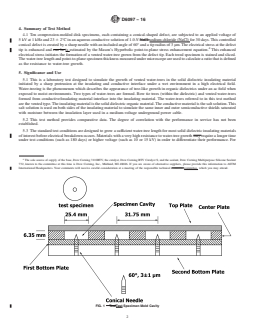
support assembly is carefully screwed into the base until the needle point extends 3.2 6 0.1 mm above the surface. Fig. 1 is an
example of the mold cavity.
6.4 Specimen Holder—The specimen holder, designed to hold at least ten specimens, is made from a solid block of clear
polymethyl methacrylate (PMMA). The PMMA is used because of the ease of machining and its good electrical properties. The
inside is machined to a depth of 50.8 mm with a 12.7-mm wall thickness. The outside bottom has the same number of holes with
an inside diameter of 25.4 mm with a depth of 6.35 mm, 6.35 mm, drilled with a spacing of 38.1 mm from center to center of the
holes. The inside bottom has the same holes with an inside diameter of 12.7 mm and a depth of 6.35 mm 6.35 mm in line with
the centers of the holes drilled at the outside bottom. Fig. 2 is an example of the specimen holder.
6.5 Electrodes—The electrode is made from a 1-m length of 24 AWG nickel-chromium wire or other suitable conductive,
noncorrosive metal wire formed, on one end, into a closed loop about 50 mm smaller in diameter than the inside diameter of the
specimen holder with the remainder bent perpendicular to the loop so that it can be is able to connected to the transformer to
conduct the voltage into the electrolyte (the salt solution).
6.6 Water Bath—A circulating water bath; provided with heaters and temperature controls if tests are to be made at elevated
temperatures.
NOTE 1—Circulation of the solution in the bath even at room temperature is necessary to remove gas bubbles formed at the interface of the solution
and the test specimens caused by electrolysis.
6.7 Microscope—A microscope equipped for 20 and 100× magnification.
7. Reagents
7.1 Salt—Reagent-grade sodium chloride.
7.2 Sealants—The material used for sealing in this test method is a two-part silicone rubber sealant consisting of a base and
a catalyst.
7.3 Multipurpose Silicone Sealant —Sealant—One-part silicone rubber sealant.
D6097 − 16
FIG. 2 PMMAPMMA Specimen Holder
7.4 Staining Dye—The staining dye is a mixture of the methylene blue and sodium hydroxide.
7.5 Deionized Water, or distilled water.
8. Hazards
8.1 Warning—Lethal voltages are a potential hazard during the performance of this test method. It is essential that the test
apparatus and all associated equipment that may be electrically connected to it be properly designed and installed for safe
operation.
8.2 Solidly ground all electrically conductive parts that may be are possible for a person to contact during the test. Provide
means for use at the completion of any test to ground any parts which were at high voltage during the test or have the potential
for acquiring an induced charge during the test or retaining a charge even after disconnection of the voltage source. Thoroughly
instruct all operators as to the correct procedures for performing tests safely. When making high-voltage tests, particularly in
compressed gas, oil, water, or aqueous solution, it is possible for the energy released at breakdown to be sufficient to result in fire,
explosion, or rupture of the test chamber. Design test equipment, test chambers, and test specimens so as to minimize the possibility
of such occurrences and to eliminate the possibility of personal injury. If the potential for fire exists, have fire suppression
equipment available.
Warning—Water in the test tank is gradually evaporated. Keeping the water level constant is important to prevent an electrical
hazard.
9. Sampling
9.1 Sample in accordance with Practice D1898.
10. Test Specimen
10.1 Geometry of Test Specimens —Specimens—The test specimen is a disk containing a conical defect at the center of one side.
The disk has a diameter of 25.4 mm and a thickness of 6.35 mm. This conical defect has a diameter of 3.2 mm 3.2 mm and height
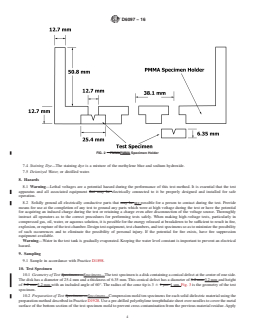
of 3.2 mm 3.2 mm with an included angle of 60°. The radius of the cone tip is 3 6 1 μm. 1 μm. Fig. 3 is the geometry of the test
specimen.
10.2 Preparation of Test Specimens —Specimens—Compression mold ten specimens for each solid dielectric material using the
preparation method described in Practice D1928. Use a pre-drilled polyethylene terephthalate sheet over needles to cover the metal
surface of the bottom section of the test specimen mold to prevent cross contamination from the previous material residue. Apply
D6097 − 16
FIG. 3 Water-TreeWater-Tree Growth Test Specimen
a colorless mold release agent to all surfaces of the center section of the mold, to prevent cross contamination from the previous
material residue. The mold release agent shouldshall not contain grease, wax, or silicone oil. Weigh a sufficient amount of each
sample and fill the mold with the material. Cover the material with a polyethylene terephthalate sheet under the top test specimen
mold plate. Put the mold assembly together, and place the entire mold assembly in a
...
Questions, Comments and Discussion
Ask us and Technical Secretary will try to provide an answer. You can facilitate discussion about the standard in here.
Loading comments...