

ASTM D3756-18
(Test Method)Standard Test Method for Evaluation of Resistance to Electrical Breakdown by Treeing in Solid Dielectric Materials Using Diverging Fields
General Information
- Abstract
SIGNIFICANCE AND USE
5.1 This is a laboratory test designed to simulate the effects of (1) the presence of rough interfaces between conductor or semiconductive screen and primary insulation in an insulation system, (2) the presence of foreign particles (contaminants) in an insulation system, and (3) the presence of small voids or cavities within the insulation.
5.2 This test method provides comparative data. The degree of correlation with actual performance in service has not been established.
SCOPE
1.1 This test method covers the evaluation and comparison of the resistance of solid organic dielectric materials to the initiation or growth, or both, of tubular tree-like channels resulting from partial discharge (corona) and molecular decomposition that occur in the region of very high, diverging electric fields.3,4
1.2 This test method is primarily for use at a power frequency of 50 or 60 Hz.
1.3 The test is able to be carried out at room temperature or temperatures above or below room temperature. The temperature shall not exceed the softening or melting point of the sample material.
1.4 This test method can be used for any solid material into which needles can be cast, molded, or inserted with heat after molding. The resistance to tree initiation is measured by the double-needle characteristic voltage, which is only applicable to non-opaque materials so that tree can be observed optically. The resistance to tree initiation and growth is reported by the double-needle voltage life, which is applicable to both opaque and non-opaque materials.
1.5 The values stated in SI units are to be regarded as the standard.
1.6 This standard does not purport to address all of the safety concerns, if any, associated with its use. It is the responsibility of the user of this standard to establish appropriate safety, health, and environmental practices and determine the applicability of regulatory limitations prior to use.
1.7 This international standard was developed in accordance with internationally recognized principles on standardization established in the Decision on Principles for the Development of International Standards, Guides and Recommendations issued by the World Trade Organization Technical Barriers to Trade (TBT) Committee.
- Status
- Published
- Publication Date
- 31-Oct-2018
- Technical Committee
- D09 - Electrical and Electronic Insulating Materials
- Drafting Committee
- D09.12 - Electrical Tests
Buy Documents
ASTM D3756-18 - Standard Test Method for Evaluation of Resistance to Electrical Breakdown by Treeing in Solid Dielectric Materials Using Diverging Fields
REDLINE ASTM D3756-18 - Standard Test Method for Evaluation of Resistance to Electrical Breakdown by Treeing in Solid Dielectric Materials Using Diverging Fields
Overview
ASTM D3756-18 is the Standard Test Method for Evaluation of Resistance to Electrical Breakdown by Treeing in Solid Dielectric Materials Using Diverging Fields. Issued by ASTM International, this laboratory test provides a reliable method for assessing how solid organic dielectric materials resist electrical breakdown, specifically through a process known as electrical treeing. Electrical treeing occurs in high-voltage insulation systems when partial discharge leads to the creation of tree-like channels within the material, often at rough interfaces, contamination points, or voids. The standard is widely used for power frequency applications, typically at 50 or 60 Hz, and can be applied to a variety of solid dielectric materials into which electrodes can be embedded or inserted.
Key Topics
- Electrical Treeing: The primary failure mechanism in solid organic dielectrics under high, nonuniform electric fields, characterized by the formation of micro-channels due to partial discharges and molecular decomposition.
- Test Setup: Utilizes two needle electrodes (one pointed, one hemispherical) embedded in specimen blocks, creating a diverging electric field to simulate real-world insulation stresses.
- Characteristic Voltage and Voltage Life:
- Double-needle characteristic voltage measures the voltage causing tree initiation in half of the specimens.
- Double-needle voltage life assesses the time to breakdown under a specified electrical stress.
- Comparative Analysis: Results are intended for material comparison; direct correlation with in-service performance is not established by the standard.
- Sample Preparation: Specifies molding, electrode insertion, and conditioning requirements to ensure specimen homogeneity and test reproducibility.
- Applicability: Suitable for opaque and non-opaque solid dielectric materials, with optical observation required for some tests.
Applications
ASTM D3756-18 is widely utilized in industries where high-performance electrical insulation is crucial, including:
- Power Cable Manufacturing: Evaluates treeing resistance in insulation materials for high-voltage and medium-voltage cables, informing material selection and design.
- Electrical Equipment Insulation: Assists manufacturers in qualifying materials for bushings, transformers, and other apparatus relying on durable dielectric barriers.
- Quality Assurance: Provides a consistent, comparative method to screen insulation materials prior to implementation in critical applications.
- R&D Material Development: Enables researchers to compare new polymeric compounds, additives, or crosslinking processes for improved electrical endurance.
- Failure Analysis: Supports diagnostics by simulating field-relevant treeing mechanisms under controlled laboratory conditions.
Related Standards
ASTM D3756-18 references and complements several other standards in the evaluation and terminology of electrical insulation:
- ASTM D149: Test Method for Dielectric Breakdown Voltage and Dielectric Strength of Solid Electrical Insulating Materials at Commercial Power Frequencies.
- ASTM D1711: Terminology Relating to Electrical Insulation.
- ASTM D2275: Test Method for Voltage Endurance of Solid Electrical Insulating Materials Subjected to Partial Discharges (Corona) on the Surface.
- ANSI/IEEE 930-1987: IEEE Guide for the Statistical Analysis of Electrical Insulation Voltage Endurance Data.
These related documents support context, terminology, and additional test protocols for comprehensive insulation system assessment.
Keywords: dielectric materials, electrical breakdown, treeing, partial discharge, voltage life, ASTM D3756-18, insulation testing, diverging electric fields, electrical insulation standards.
Relations
- Effective Date
- 01-Nov-2018
- Effective Date
- 01-Mar-2024
- Effective Date
- 01-Jan-2020
- Effective Date
- 01-Nov-2015
- Effective Date
- 01-Nov-2014
- Effective Date
- 01-May-2014
- Effective Date
- 01-Nov-2013
- Effective Date
- 01-Aug-2011
- Effective Date
- 01-May-2008
- Effective Date
- 01-Mar-2004
- Effective Date
- 10-Mar-2002
- Effective Date
- 10-Oct-1999
- Effective Date
- 01-Jan-1997
- Effective Date
- 01-Nov-2018
Buy Documents
ASTM D3756-18 - Standard Test Method for Evaluation of Resistance to Electrical Breakdown by Treeing in Solid Dielectric Materials Using Diverging Fields
REDLINE ASTM D3756-18 - Standard Test Method for Evaluation of Resistance to Electrical Breakdown by Treeing in Solid Dielectric Materials Using Diverging Fields
Get Certified
Connect with accredited certification bodies for this standard

IMQ S.p.A. (Certification)
Italian electrical product certification.

SLG Prüf- und Zertifizierungs GmbH
German testing and certification body.

UL Solutions
Global safety science company with testing, inspection and certification.
Sponsored listings
Frequently Asked Questions
ASTM D3756-18 is a standard published by ASTM International. Its full title is "Standard Test Method for Evaluation of Resistance to Electrical Breakdown by Treeing in Solid Dielectric Materials Using Diverging Fields". This standard covers: SIGNIFICANCE AND USE 5.1 This is a laboratory test designed to simulate the effects of (1) the presence of rough interfaces between conductor or semiconductive screen and primary insulation in an insulation system, (2) the presence of foreign particles (contaminants) in an insulation system, and (3) the presence of small voids or cavities within the insulation. 5.2 This test method provides comparative data. The degree of correlation with actual performance in service has not been established. SCOPE 1.1 This test method covers the evaluation and comparison of the resistance of solid organic dielectric materials to the initiation or growth, or both, of tubular tree-like channels resulting from partial discharge (corona) and molecular decomposition that occur in the region of very high, diverging electric fields.3,4 1.2 This test method is primarily for use at a power frequency of 50 or 60 Hz. 1.3 The test is able to be carried out at room temperature or temperatures above or below room temperature. The temperature shall not exceed the softening or melting point of the sample material. 1.4 This test method can be used for any solid material into which needles can be cast, molded, or inserted with heat after molding. The resistance to tree initiation is measured by the double-needle characteristic voltage, which is only applicable to non-opaque materials so that tree can be observed optically. The resistance to tree initiation and growth is reported by the double-needle voltage life, which is applicable to both opaque and non-opaque materials. 1.5 The values stated in SI units are to be regarded as the standard. 1.6 This standard does not purport to address all of the safety concerns, if any, associated with its use. It is the responsibility of the user of this standard to establish appropriate safety, health, and environmental practices and determine the applicability of regulatory limitations prior to use. 1.7 This international standard was developed in accordance with internationally recognized principles on standardization established in the Decision on Principles for the Development of International Standards, Guides and Recommendations issued by the World Trade Organization Technical Barriers to Trade (TBT) Committee.
SIGNIFICANCE AND USE 5.1 This is a laboratory test designed to simulate the effects of (1) the presence of rough interfaces between conductor or semiconductive screen and primary insulation in an insulation system, (2) the presence of foreign particles (contaminants) in an insulation system, and (3) the presence of small voids or cavities within the insulation. 5.2 This test method provides comparative data. The degree of correlation with actual performance in service has not been established. SCOPE 1.1 This test method covers the evaluation and comparison of the resistance of solid organic dielectric materials to the initiation or growth, or both, of tubular tree-like channels resulting from partial discharge (corona) and molecular decomposition that occur in the region of very high, diverging electric fields.3,4 1.2 This test method is primarily for use at a power frequency of 50 or 60 Hz. 1.3 The test is able to be carried out at room temperature or temperatures above or below room temperature. The temperature shall not exceed the softening or melting point of the sample material. 1.4 This test method can be used for any solid material into which needles can be cast, molded, or inserted with heat after molding. The resistance to tree initiation is measured by the double-needle characteristic voltage, which is only applicable to non-opaque materials so that tree can be observed optically. The resistance to tree initiation and growth is reported by the double-needle voltage life, which is applicable to both opaque and non-opaque materials. 1.5 The values stated in SI units are to be regarded as the standard. 1.6 This standard does not purport to address all of the safety concerns, if any, associated with its use. It is the responsibility of the user of this standard to establish appropriate safety, health, and environmental practices and determine the applicability of regulatory limitations prior to use. 1.7 This international standard was developed in accordance with internationally recognized principles on standardization established in the Decision on Principles for the Development of International Standards, Guides and Recommendations issued by the World Trade Organization Technical Barriers to Trade (TBT) Committee.
ASTM D3756-18 is classified under the following ICS (International Classification for Standards) categories: 29.035.01 - Insulating materials in general. The ICS classification helps identify the subject area and facilitates finding related standards.
ASTM D3756-18 has the following relationships with other standards: It is inter standard links to ASTM D3756-97(2010), ASTM D1711-24, ASTM D149-20, ASTM D1711-15, ASTM D1711-14a, ASTM D1711-14, ASTM D1711-13, ASTM D1711-11a, ASTM D1711-08, ASTM D149-97a(2004), ASTM D1711-02, ASTM D1711-99, ASTM D149-97a, ASTM D6097-16. Understanding these relationships helps ensure you are using the most current and applicable version of the standard.
ASTM D3756-18 is available in PDF format for immediate download after purchase. The document can be added to your cart and obtained through the secure checkout process. Digital delivery ensures instant access to the complete standard document.
Standards Content (Sample)
This international standard was developed in accordance with internationally recognized principles on standardization established in the Decision on Principles for the
Development of International Standards, Guides and Recommendations issued by the World Trade Organization Technical Barriers to Trade (TBT) Committee.
Designation: D3756 − 18
Standard Test Method for
Evaluation of Resistance to Electrical Breakdown by Treeing
in Solid Dielectric Materials Using Diverging Fields
This standard is issued under the fixed designation D3756; the number immediately following the designation indicates the year of
original adoption or, in the case of revision, the year of last revision.Anumber in parentheses indicates the year of last reapproval.A
superscript epsilon (´) indicates an editorial change since the last revision or reapproval.
INTRODUCTION
When failure occurs in solid organic dielectrics that are subjected to very high, continuous, and
nonuniform electrical gradients, it generally occurs by a mechanism called treeing. Materials of
different molecular structures have different degrees of resistance to failure by treeing, and this
resistance can sometimes be increased by the addition of other materials in low concentration.
Treesthatgrowbyamoleculardegradationmechanismresultingfrompartialdischarge(corona)are
called electrical trees to distinguish them from water and electrochemical trees which are quite
different.
This test method makes use of two opposing thin cylindrical electrodes, one sharpened to a point,
the other with a hemispherical end. They are molded or inserted into blocks of the material to be
tested. Because of the shape of the electrodes this is often called a needle test. This test provides a
statistical estimate of electrical treeing initiation and propagation of solid dielectric materials in high,
diverging electrical fields.
1. Scope 1.3 The test is able to be carried out at room temperature or
temperatures above or below room temperature. The tempera-
1.1 This test method covers the evaluation and comparison
ture shall not exceed the softening or melting point of the
of the resistance of solid organic dielectric materials to the
sample material.
initiation or growth, or both, of tubular tree-like channels
resultingfrompartialdischarge(corona)andmoleculardecom-
1.4 This test method can be used for any solid material into
positionthatoccurintheregionofveryhigh,divergingelectric
which needles can be cast, molded, or inserted with heat after
3,4
fields.
molding. The resistance to tree initiation is measured by the
double-needle characteristic voltage, which is only applicable
1.2 This test method is primarily for use at a power
to non-opaque materials so that tree can be observed optically.
frequency of 50 or 60 Hz.
The resistance to tree initiation and growth is reported by the
double-needle voltage life, which is applicable to both opaque
This test method is under the jurisdiction of ASTM Committee D09 on
and non-opaque materials.
Electrical and Electronic Insulating Materials and is the direct responsibility of
Subcommittee D09.12 on Electrical Tests.
1.5 The values stated in SI units are to be regarded as the
Current edition approved Nov. 1, 2018. Published November 2018. Originally
approved in 1990. Last previous edition approved in 2010 as D3756–97(2010). standard.
DOI: 10.1520/D3756-18.
1.6 This standard does not purport to address all of the
Symposium on Engineering Dielectrics, ASTM STP 783, ASTM, 1982, and
Symposium on Engineering Dielectrics, ASTM STP 926, ASTM, 1986.
safety concerns, if any, associated with its use. It is the
W. D.Wilkens, Chapter 7, “Statistical Methods for the Evaluation of Electrical
responsibility of the user of this standard to establish appro-
InsulatingSystems,” Engineering Dielectrics, Vol IIB, Electrical Properties of Solid
priate safety, health, and environmental practices and deter-
Insulating Materials, Measurement Techniques, R. Bartnikas, Editor, ASTM STP
mine the applicability of regulatory limitations prior to use.
926, ASTM, Philadelphia, 1987.
R. M. Eichorn, Chapter 4, “Treeing in Solid Organic Dielectric Materials,”
1.7 This international standard was developed in accor-
Engineering Dielectrics, Vol IIA, Electrical Properties of Solid Insulating Materi-
dance with internationally recognized principles on standard-
als: Molecular Structure and Electrical Behavior, R. Bartnikas and R. M. Eichorn,
Editors, ASTM STP 783, ASTM Philadelphia, 1983. ization established in the Decision on Principles for the
Copyright © ASTM International, 100 Barr Harbor Drive, PO Box C700, West Conshohocken, PA 19428-2959. United States
D3756 − 18
Development of International Standards, Guides and Recom- 5.2 Thistestmethodprovidescomparativedata.Thedegree
mendations issued by the World Trade Organization Technical of correlation with actual performance in service has not been
Barriers to Trade (TBT) Committee. established.
2. Referenced Documents 6. Apparatus
6.1 Power Supply—Ahigh voltage supply having a sinusoi-
2.1 ASTM Standards:
D149Test Method for Dielectric Breakdown Voltage and dal voltage output at a power frequency equipped with con-
DielectricStrengthofSolidElectricalInsulatingMaterials tinuous voltage control and an adjustable protective automatic
at Commercial Power Frequencies circuit-breaking device that operates at a controllable current
D1711Terminology Relating to Electrical Insulation level. See Test Method D149.
D1928Practice for Preparation of Compression-Molded
6.2 Current—Sensitive Individual Specimen Disconnect—
PolyethyleneTest Sheets andTest Specimens (Withdrawn
When ten specimens are tested to failure for the voltage life
2001)
test, use a disconnect circuit for each.
2.2 Other Document:
6.3 Electrodes—The critical electrode is a round steel rod,
ANSI/IEEE930-1987IEEE Guide for the StatisticalAnaly-
1mm in diameter, sharpened at one end to a controlled radius
sis of Electrical Insulation Voltage Endurance Data
of 3 6 1µm and an included angle of 30 6 1°.
3. Terminology
6.4 Needle-Grinding Lathe,forpreparationofthesharpened
electrodes to a controlled-point sharpness and included angle.
3.1 Definitions:
A typical lathe and grinder combination are shown in Fig. 1.
3.1.1 partial discharge, n—refer to D1711.
6.5 Specimen Molding Chase, for single-step preparation of
3.2 Definitions of Terms Specific to This Standard:
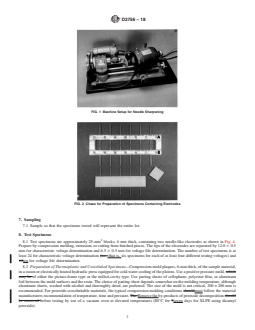
compression molded specimens containing needles. A typical
3.2.1 characteristic voltage or DNCV (double-needle char-
chase is shown in Fig. 2.
acteristic voltage), n—thatvoltagewhich,whenappliedfor1h
between the ends of two thin cylindrical electrodes (one
6.6 Needle-Insertion Jig—A jig is required for slow, con-
sharpened to a point, the other with a hemispherical end) in a
trolled insertion of electrodes. Fig. 3 shows a specimen
group of replicate specimens, produces observable dielectric
insertion jig.
damage at the point of the sharp electrode in half of the
6.7 Test Chamber—Any temperature-controlled test cham-
specimens.
ber or enclosure, which can hold at least ten specimens and
3.2.2 medianvoltagelife(t ),n—thetime,determinedfrom
maintain uniform temperature, is appropriate for this test.
a Weibull plot, when 50% failure occurs from a group of ten
identical specimens subjected to the same voltage stress.
7. Sampling
7.1 Sample so that the specimens tested will represent the
4. Summary of Method
entire lot.
4.1 In this test method, specimens are prepared and needles
insertedtoserveaselectrodes.Voltageisappliedtotheneedles
8. Test Specimens
and continued for1hinthe double-needle characteristic 2
8.1 Testspecimensareapproximately25-mm blocks,6mm
voltage test or until electrical breakdown occurs in the double-
thick,containingtwoneedle-likeelectrodesasshowninFig.4.
needle voltage life test. Results are expressed as the voltage at
Prepare by compression molding, extrusion, or cutting from
which half of the specimens show dielectric damage in 1 h, or
themediantimetofailureofagroupofspecimenssubjectedto
a given continuous voltage, at a selected or predetermined
temperature.
5. Significance and Use
5.1 This is a laboratory test designed to simulate the effects
of (1) the presence of rough interfaces between conductor or
semiconductive screen and primary insulation in an insulation
system, (2) the presence of foreign particles (contaminants) in
an insulation system, and (3) the presence of small voids or
cavities within the insulation.
For referenced ASTM standards, visit the ASTM website, www.astm.org, or
contact ASTM Customer Service at service@astm.org. For Annual Book of ASTM
Standards volume information, refer to the standard’s Document Summary page on
the ASTM website.
The last approved version of this historical standard is referenced on
www.astm.org.
Available fromAmerican National Standards Institute (ANSI), 25 W. 43rd St.,
4th Floor, New York, NY 10036. FIG. 1 Machine Setup for Needle Sharpening
D3756 − 18
FIG. 2 Chase for Preparation of Specimens Containing Elec-
trodes
FIG. 3 Needle Insertion Jig
FIG. 4 Finished Specimen
finishedpieces.Thetipsoftheelectrodesareseparatedby12.0
6 0.5 mm for characteristic voltage determination and 6.5 6 ditions must follow the material manufacturers recommenda-
0.5 mm for voltage life determination. The number of test tion of temperature, time and pressure. Remove the by-
specimensisatleast24forcharacteristicvoltagedetermination products of peroxide decomposition before testing by use of a
(that is, six specimens for each of at least four different testing vacuumovenatelevatedtemperatures(80°Cforsevendaysfor
voltages) and ten for voltage life determination. XLPE using dicumyl peroxide).
8.2.1 After molding, cut the plaque into 25-mm square
8.2 Preparation of Thermoplastic and Crosslinked
blocks with square and smooth edges. Store the squares under
Specimens—Compression-mold plaques, 6-mm thick, of the
standard laboratory conditions, 23°C and 50 % relative
sample material, in a steam or electrically heated hydraulic
humidity,andprotectthemfromdirtandatmosphericcontami-
press equipped for cold-water cooling of the platens. Use a
nation until used.
positive pressure mold, of either the picture-frame type or the
milled-cavity type. Use parting sheets of cellophane, polyester 8.3 Insertion of Needles—Insert the needle electrodes into
film,oraluminumfoilbetweenthemoldsurfacesandtheresin. the specimen blocks slowly and carefully to avoid orientation
The choice of parting sheet depends somewhat on the molding strains, formation of cavities, and damage to the sharp points.
temperature, although aluminum sheets, washed with alcohol Use a jig, such as the one shown in Fig. 3, to ensure that every
andthoroughlydried,arepreferred.Thesizeofthemoldisnot needle will be inserted under identical conditions.
critical, 200 × 200 mm is recommended. For peroxide- 8.3.1 Maketheinsertionsasfollows:Placetwelvespecimen
crosslinkable materials, the typical compression-molding con- blocks in the slots provided for them and lightly clamp into
D3756 − 18
place.Inspectthetwelvesharpenedneedles,aftercleaningwith polyester film or aluminum foil, at least 0.1-mm thick, to
methyl ethyl ketone; then carefully place them into the needle preventstickingoftheresininthepolishedplate.Laythechase
slotsononesidesotheirtipsjusttouchthespecimens.Usethe centrally on this polyester sheet or aluminum foil. Evenly
individual adjusting screws for positioning the needles. Slip distribute approximately 30 g of the molding material (for
shims into the needle slots above the needles, and use a cover example, polyethylene) to be tested within the cavity in the
platetoclosethetopoftheneedleslots.Securethiscoverwith mold.Then lay a second sheet of polyester film or foil and the
small C-clamps at each end. The purpose of the shims and second polished plate over the mold.
cover is to prevent the needle from cocking, and to force it to 8.4.5 Mold the specimen in accordance with Practice
enter straight into the specimen. Place twelve electrodes with D1928.
hemispheric ends in the slots on the opposite sides of the 8.4.6 Remove the specimens by removing the screws in
specimens in the same manner. both plates A and B.
8.3.2 When the specimens and needles are mounted and the 8.4.7 Cut the 150-mm block into six 25-mm individual
specimens.
needles are adjusted into proper position, place the whole jig
into a circulating air oven at 105°C, for low-density polyeth- 8.4.8 Check each specimen under a microscope with an
optical scale and use only if the electrode spacing is found to
ylene or crosslinked materials, for a 1-h preheating period. For
be correct. If any contamination or voids are found within the
other partially crystalline polymeric materials use a tempera-
test region, reject the specimen.
ture approximately 10°C below the thermodynamic first-order
transition point. After preheating, simultaneously advance the
9. Conditioning
needles 1.30 mm by making one full turn of the large lead
screw. Repeat at 5-min intervals. Make sufficient turns to
9.1 After specimen preparation is complete, store all speci-
accomplish the insertion. Five turns are normally required for
mens for approximat
...
This document is not an ASTM standard and is intended only to provide the user of an ASTM standard an indication of what changes have been made to the previous version. Because
it may not be technically possible to adequately depict all changes accurately, ASTM recommends that users consult prior editions as appropriate. In all cases only the current version
of the standard as published by ASTM is to be considered the official document.
Designation: D3756 − 97 (Reapproved 2010) D3756 − 18
Standard Test Method for
Evaluation of Resistance to Electrical Breakdown by Treeing
in Solid Dielectric Materials Using Diverging Fields
This standard is issued under the fixed designation D3756; the number immediately following the designation indicates the year of
original adoption or, in the case of revision, the year of last revision. A number in parentheses indicates the year of last reapproval. A
superscript epsilon (´) indicates an editorial change since the last revision or reapproval.
INTRODUCTION
When failure occurs in solid organic dielectrics that are subjected to very high, continuous, and
nonuniform electrical gradients, it generally occurs by a mechanism called treeing. Materials of
different molecular structures have different degrees of resistance to failure by treeing, and this
resistance can sometimes be increased by the addition of other materials in low concentration.
Trees that grow by a molecular degradation mechanism resulting from partial discharge (corona) are
called electrical trees to distinguish them from water and electrochemical trees which are quite
different.
This test method makes use of two opposing thin cylindrical electrodes, one sharpened to a point,
the other with a hemispherical end. They are molded or inserted into blocks of the material to be
tested. Because of the shape of the electrodes this is often called a needle test. This test provides a
statistical estimate of electrical treeing initiation and propagation of solid dielectric materials in high,
diverging electrical fields.
1. Scope
1.1 This test method covers the evaluation and comparison of the resistance of solid organic dielectric materials to the initiation
or growth, or both, of tubular tree-like channels resulting from partial discharge (corona) and molecular decomposition that occur
3,4
in the region of very high, diverging electric fields.
1.2 This test method is primarily for use at a power frequency of 50 or 60 Hz.
1.3 The test may is able to be carried out at room temperature or temperatures above or below room temperature. The
temperature shouldshall not exceed the softening or melting point of the sample material.
1.4 This test method can be used for any solid material into which needles can be cast, molded, or inserted with heat after
molding. The resistance to tree initiation is measured by the double-needle characteristic voltage, which is only applicable to
non-opaque materials so that tree can be observed optically. The resistance to tree initiation and growth is reported by the
double-needle voltage life, which is applicable to both opaque and non-opaque materials.
1.5 The values stated in SI units are to be regarded as the standard.
1.6 This standard does not purport to address all of the safety concerns, if any, associated with its use. It is the responsibility
of the user of this standard to establish appropriate safety safety, health, and healthenvironmental practices and determine the
applicability of regulatory limitations prior to use.
1.7 This international standard was developed in accordance with internationally recognized principles on standardization
established in the Decision on Principles for the Development of International Standards, Guides and Recommendations issued
by the World Trade Organization Technical Barriers to Trade (TBT) Committee.
This test method is under the jurisdiction of ASTM Committee D09 on Electrical and Electronic Insulating Materials and is the direct responsibility of Subcommittee
D09.12 on Electrical Tests.
Current edition approved Oct. 1, 2010Nov. 1, 2018. Published October 2010November 2018. Originally approved in 1990. Last previous edition approved in 20042010
as D3756 – 97 (2010).(2004). DOI: 10.1520/D3756-97R10.10.1520/D3756-18.
Symposium on Engineering Dielectrics, ASTM STP 783, ASTM, 1982, and Symposium on Engineering Dielectrics, ASTM STP 926, ASTM, 1986.
W. D. Wilkens, Chapter 7, “Statistical Methods for the Evaluation of Electrical Insulating Systems,” Engineering Dielectrics, Vol IIB, Electrical Properties of Solid
Insulating Materials, Measurement Techniques, R. Bartnikas, Editor, ASTM STP 926, ASTM, Philadelphia, 1987.
R. M. Eichorn, Chapter 4, “Treeing in Solid Organic Dielectric Materials,” Engineering Dielectrics, Vol IIA, Electrical Properties of Solid Insulating Materials:
Molecular Structure and Electrical Behavior, R. Bartnikas and R. M. Eichorn, Editors, ASTM STP 783, ASTM Philadelphia, 1983.
Copyright © ASTM International, 100 Barr Harbor Drive, PO Box C700, West Conshohocken, PA 19428-2959. United States
D3756 − 18
2. Referenced Documents
2.1 ASTM Standards:
D149 Test Method for Dielectric Breakdown Voltage and Dielectric Strength of Solid Electrical Insulating Materials at
Commercial Power Frequencies
D1711 Terminology Relating to Electrical Insulation
D1928 Practice for Preparation of Compression-Molded Polyethylene Test Sheets and Test Specimens (Withdrawn 2001)
D2275 Test Method for Voltage Endurance of Solid Electrical Insulating Materials Subjected to Partial Discharges (Corona) on
the Surface
2.2 Other Document:
ANSI/IEEE 930-1987 IEEE Guide for the Statistical Analysis of Electrical Insulation Voltage Endurance Data
3. Terminology
3.1 Definitions:
3.1.1 partial discharge, n—refer to D1711.
3.2 Definitions of Terms Specific to This Standard:
3.2.1 characteristic voltage or DNCV (double-needle characteristic voltage), n—that voltage which, when applied for 1 h 1 h
between the ends of two thin cylindrical electrodes (one sharpened to a point, the other with a hemispherical end) in a group of
replicate specimens, produces observable dielectric damage at the point of the sharp electrode in half of the specimens.
3.2.2 median voltage life (t ), n—the time, determined from a Weibull plot, when 50 % failure occurs from a group of 10ten
identical specimens subjected to the same voltage stress.
4. Summary of Method
4.1 In this test method, specimens are prepared and needles inserted to serve as electrodes. Voltage is applied to the needles and
continued for 1 h in the double-needle characteristic voltage test or until electrical breakdown occurs in the double-needle voltage
life test. Results are expressed as the voltage at which half of the specimens show dielectric damage in 1 h, or the median time
to failure of a group of specimens subjected to a given continuous voltage, at a selected or predetermined temperature.
5. Significance and Use
5.1 This is a laboratory test designed to simulate the effects of (1) the presence of rough interfaces between conductor or
semiconductive screen and primary insulation in an insulation system, (2) the presence of foreign particles (contaminants) in an
insulation system, and (3) the presence of small voids or cavities within the insulation.
5.2 This test method provides comparative data. The degree of correlation with actual performance in service has not been
established.
6. Apparatus
6.1 Power Supply—A high voltage supply having a sinusoidal voltage output at a power frequency equipped with continuous
voltage control and an adjustable protective automatic circuit-breaking device that operates at a controllable current level. See Test
Method D149.
6.2 Current—Sensitive Individual Specimen Disconnect—When ten specimens are tested to failure for the voltage life test, use
a disconnect circuit for each.
6.3 Electrodes—The critical electrode is a round steel rod, 1 mm 1 mm in diameter, sharpened at one end to a controlled radius
of 3 6 1 μm 1 μm and an included angle of 30 6 1 degrees. 1°.
6.4 Needle-Grinding Lathe, for preparation of the sharpened electrodes to a controlled-point sharpness and included angle. A
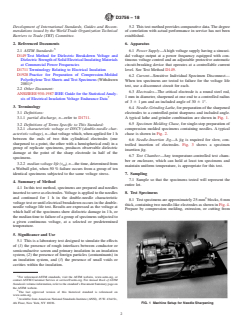
typical lathe and grinder combination are shown in Fig. 1.
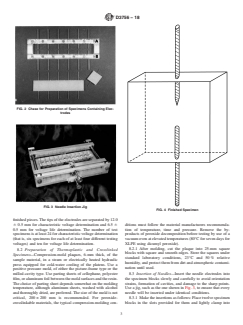
6.5 Specimen Molding Chase, for single-step preparation of compression molded specimens containing needles. A typical chase
is shown in Fig. 2.
6.6 Needle-Insertion Jig—A jig is required for slow, controlled insertion of electrodes. Fig. 3 shows a specimen insertion jig.
6.7 Test Chamber—Any temperature-controlled test chamber or enclosure, which can hold at least ten specimens and maintain
uniform temperature, is appropriate for this test.
For referenced ASTM standards, visit the ASTM website, www.astm.org, or contact ASTM Customer Service at service@astm.org. For Annual Book of ASTM Standards
volume information, refer to the standard’s Document Summary page on the ASTM website.
The last approved version of this historical standard is referenced on www.astm.org.
Available from American National Standards Institute (ANSI), 25 W. 43rd St., 4th Floor, New York, NY 10036.
D3756 − 18
FIG. 1 Machine Setup for Needle Sharpening
FIG. 2 Chase for Preparation of Specimens Containing Electrodes
7. Sampling
7.1 Sample so that the specimens tested will represent the entire lot.
8. Test Specimens
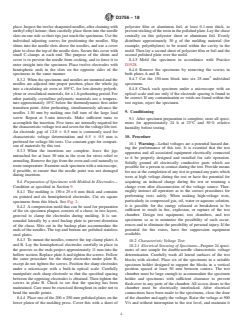
8.1 Test specimens are approximately 25-mm blocks, 6 mm thick, containing two needle-like electrodes as shown in Fig. 4.
Prepare by compression molding, extrusion, or cutting from finished pieces. The tips of the electrodes are separated by 12.0 6 0.5
mm for characteristic voltage determination and 6.5 6 0.5 mm for voltage life determination. The number of test specimens is at
least 24 for characteristic voltage determination (i.e. (that is, six specimens for each of at least four different testing voltages) and
10ten for voltage life determination.
8.2 Preparation of Thermoplastic and Crosslinked Specimens—Compression-mold plaques, 6-mm thick, of the sample material,
in a steam or electrically heated hydraulic press equipped for cold-water cooling of the platens. Use a positive pressure mold, which
may be of either the picture-frame type or the milled-cavity type. Use parting sheets of cellophane, polyester film, or aluminum
foil between the mold surfaces and the resin. The choice of parting sheet depends somewhat on the molding temperature, although
aluminum sheets, washed with alcohol and thoroughly dried, are preferred. The size of the mold is not critical, 200 × 200 mm is
recommended. For peroxide-crosslinkable materials, the typical compression-molding conditions shouldmust follow the material
manufacturers recommendation of temperature, time and pressure. The Remove the by-products of peroxide decomposition should
be removed before testing by use of a vacuum oven at elevated temperatures (80°C for 7seven days for XLPE using dicumyl
peroxide).
D3756 − 18
FIG. 3 Needle Insertion Jig
8.2.1 After molding, cut the plaque into 25-mm square blocks with square and smooth edges. Store the squares under standard
laboratory conditions, 23°C and 50 % relative humidity, and protect them from dirt and atmospheric contamination until used.
8.3 Insertion of Needles—Insert the needle electrodes into the specimen blocks slowly and carefully to avoid orientation strains,
formation of cavities, and damage to the sharp points. Use a jig, such as the one shown in Fig. 3, to ensure that every needle will
be inserted under identical conditions.
8.3.1 Make the insertions as follows: Place twelve specimen blocks in the slots provided for them and lightly clamp into place.
Inspect the twelve sharpened needles, after cleaning with methyl ethyl ketone; then carefully place them into the needle slots on
one side so their tips just touch the specimens. Use the individual adjusting screws for positioning the needles. Slip shims into the
needle slots above the needles, and use a cover plate to close the top of the needle slots. Secure this cover with small C-clamps
at each end. The purpose of the shims and cover is to prevent the needle from cocking, and to force it to enter straight into the
specimen. Place twelve electrodes with hemispheric ends in the slots on the opposite sides of the specimens in the same manner.
8.3.2 When the specimens and needles are mounted and the needles are adjusted into proper position, place the whole jig into
a circulating air oven at 105°C, for low-density polyethylene or crosslinked materials, for a 1-h preheating period. For other
partially crystalline polymeric materials use a temperature approximately 10°C below the thermodynamic first-order transition
point. After preheating, simultaneously advance the needles 1.30 mm by making one full turn of the large lead screw. Repeat at
5-min intervals. Make sufficient turns to accomplish the insertion. Five turns are normally required for the characteristic voltage
test and seven for the voltage life test. An electrode gap of 12.0 6 0.5 mm is commonly used for characteristic voltage
determination and 6.5 6 0.5 mm is preferred for voltage life tests. Use constant gaps for comparison of materials by this test.
8.3.3 When the insertions are complete, leave the jigs untouched for at least 30 min in the oven for stress relief or annealing.
Remove the jigs from the oven and cool naturally to room temperature. Examine each specimen with a microscope, if possible,
to ensure that the needle point was not damaged during insertion.
8.4 Preparation of Specimens with Molded-In Electrodes—Condition as specified in Section 9.
8.4.1 The molding is 150 × 25 × 6 mm thick and contains six pointed and six hemispherical electrodes. Cut six square
specimens from this block. See Fig. 2.
8.4.2 A compression mold that can be us
...