

ASTM A225/A225M-17(2022)
(Specification)Standard Specification for Pressure Vessel Plates, Alloy Steel, Manganese-Vanadium-Nickel
General Information
- Abstract
ABSTRACT
This specification covers manganese-vanadium-nickel alloy steel plates intended primarily for welded layered pressure vessels. Plates that shall be used are of Grades C and D and their maximum thickness is limited only by the capacity of the chemical composition to meet the specified mechanical property requirements. The steel shall be killed and shall conform to fine austenitic grain size requirements. The plates shall undergo heat treatment. The mechanical properties such as tensile strength, yield strength, and elongation shall be determined by subjecting the plates to a tension test.
SCOPE
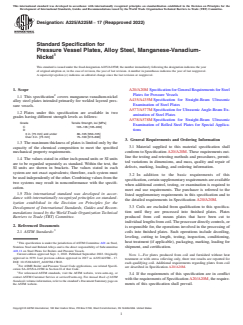
1.1 This specification2 covers manganese-vanadium-nickel alloy steel plates intended primarily for welded layered pressure vessels.
1.2 Plates under this specification are available in two grades having different strength levels as follows:
Grade
Tensile Strength, ksi [MPa]
C
105–135 [725–930]
D
3 in. [75 mm] and under
80–105 [550–725]
Over 3 in. [75 mm]
75–100 [515–690]
1.3 The maximum thickness of plates is limited only by the capacity of the chemical composition to meet the specified mechanical property requirements.
1.4 The values stated in either inch-pound units or SI units are to be regarded separately as standard. Within the text, the SI units are shown in brackets. The values stated in each system are not exact equivalents; therefore, each system must be used independently of the other. Combining values from the two systems may result in nonconformance with the specification.
1.5 This international standard was developed in accordance with internationally recognized principles on standardization established in the Decision on Principles for the Development of International Standards, Guides and Recommendations issued by the World Trade Organization Technical Barriers to Trade (TBT) Committee.
- Status
- Published
- Publication Date
- 31-Aug-2022
- Technical Committee
- A01 - Steel, Stainless Steel and Related Alloys
- Drafting Committee
- A01.11 - Steel Plates for Boilers and Pressure Vessels


Overview
ASTM A225/A225M-17(2022) is an internationally recognized standard specification issued by ASTM International, focusing on manganese-vanadium-nickel alloy steel plates specifically designed for pressure vessel applications. These plates are primarily intended for welded layered pressure vessels and are supplied in two grades - C and D - each offering distinct strength levels. The specification ensures that steel plates meet rigorous chemical composition and mechanical property requirements to guarantee safety, performance, and reliability under high-pressure environments.
Key Topics
Alloy Composition: The standard dictates precise content of manganese, vanadium, and nickel for both Grade C and Grade D plates. This composition enhances mechanical strength and toughness, making these plates suitable for critical pressure vessel applications.
Grades and Strength Levels:
- Grade C: Delivers higher tensile strength (105–135 ksi [725–930 MPa]) and is typically used when superior strength is required.
- Grade D: Offers a range of tensile strengths depending on thickness:
- Up to 3 in. (75 mm): 80–105 ksi [550–725 MPa]
- Over 3 in.: 75–100 ksi [515–690 MPa]
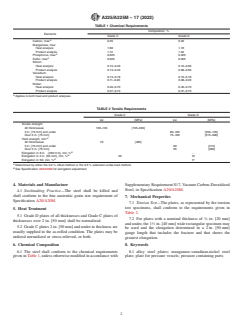
Mechanical Properties: Requirements include specific values for tensile strength, minimum yield strength, and elongation, determined through tension tests, ensuring plates are capable of withstanding demanding operating conditions.
Manufacturing and Heat Treatment:
- Plates must be of killed steel and exhibit a fine austenitic grain structure.
- Heat treatment processes, such as normalization or stress relieving, are specified based on grade and thickness to achieve the desired mechanical properties.
Dimensional Standards: The maximum plate thickness is governed by the alloy's ability to meet mechanical property requirements, allowing for flexibility in engineering design.
Supplementary Requirements: Optional additional testing and controls - such as impact testing, ultrasonic examination, and vacuum treatment - can be specified by purchasers for enhanced assurance of quality and performance.
Applications
ASTM A225/A225M alloy steel plates are particularly valued in industries where welded pressure vessels are essential for safe operation under high pressure. Typical applications include:
- Petrochemical and Chemical Processing: Manufacturing vessels, tanks, and reactors where both strength and resistance to harsh environments are vital.
- Power Generation: Construction of boilers and pressure vessels that demand stringent performance criteria.
- Industrial Gas Storage: Suitable for storing gases under pressure where safety is paramount.
- Oil & Gas Industry: Used in separators and high-pressure containment units.
- Other High-Pressure Appliances: Any setting requiring robust, tough alloy steel plate for pressure retention.
Related Standards
For comprehensive quality assurance and compliance, several related standards are referenced or may be applicable alongside ASTM A225/A225M:
- ASTM A20/A20M – General requirements for steel plates for pressure vessels.
- ASTM A435/A435M – Straight-beam ultrasonic examination of steel plates.
- ASTM A577/A577M – Ultrasonic angle-beam examination.
- ASTM A578/A578M – Straight-beam ultrasonic examination for special applications.
- ASME SA-225/SA-225M – Equivalent specification for boiler and pressure vessel code applications.
Practical Value
Adherence to ASTM A225/A225M-17(2022) ensures standardized alloy steel plates with proven composition, mechanical integrity, and traceability. The standard supports manufacturers, fabricators, and end-users in producing pressure vessels that comply with global safety and quality benchmarks, reducing risk and fostering reliable operation across critical industries.
Keywords: ASTM A225, pressure vessel plates, alloy steel, manganese-vanadium-nickel, pressure-containing parts, welded layered vessels, steel plate standards, boiler plate, mechanical properties, heat treatment.
Relations
- Effective Date
- 01-Nov-2023
- Effective Date
- 01-Nov-2023
- Effective Date
- 01-Nov-2023
- Effective Date
- 01-Mar-2018
- Effective Date
- 15-Nov-2017
- Effective Date
- 01-Nov-2017
- Effective Date
- 01-Nov-2015
- Effective Date
- 01-Oct-2014
- Effective Date
- 01-Oct-2013
- Effective Date
- 01-Mar-2012
- Effective Date
- 01-Mar-2012
- Effective Date
- 01-Mar-2012
- Effective Date
- 01-Nov-2011
- Effective Date
- 01-Oct-2010
- Effective Date
- 01-Oct-2009
Get Certified
Connect with accredited certification bodies for this standard

Element Materials Technology
Materials testing and product certification.

Inštitut za kovinske materiale in tehnologije
Institute of Metals and Technology. Materials testing, metallurgical analysis, NDT.
Sponsored listings
Frequently Asked Questions
ASTM A225/A225M-17(2022) is a technical specification published by ASTM International. Its full title is "Standard Specification for Pressure Vessel Plates, Alloy Steel, Manganese-Vanadium-Nickel". This standard covers: ABSTRACT This specification covers manganese-vanadium-nickel alloy steel plates intended primarily for welded layered pressure vessels. Plates that shall be used are of Grades C and D and their maximum thickness is limited only by the capacity of the chemical composition to meet the specified mechanical property requirements. The steel shall be killed and shall conform to fine austenitic grain size requirements. The plates shall undergo heat treatment. The mechanical properties such as tensile strength, yield strength, and elongation shall be determined by subjecting the plates to a tension test. SCOPE 1.1 This specification2 covers manganese-vanadium-nickel alloy steel plates intended primarily for welded layered pressure vessels. 1.2 Plates under this specification are available in two grades having different strength levels as follows: Grade Tensile Strength, ksi [MPa] C 105–135 [725–930] D 3 in. [75 mm] and under 80–105 [550–725] Over 3 in. [75 mm] 75–100 [515–690] 1.3 The maximum thickness of plates is limited only by the capacity of the chemical composition to meet the specified mechanical property requirements. 1.4 The values stated in either inch-pound units or SI units are to be regarded separately as standard. Within the text, the SI units are shown in brackets. The values stated in each system are not exact equivalents; therefore, each system must be used independently of the other. Combining values from the two systems may result in nonconformance with the specification. 1.5 This international standard was developed in accordance with internationally recognized principles on standardization established in the Decision on Principles for the Development of International Standards, Guides and Recommendations issued by the World Trade Organization Technical Barriers to Trade (TBT) Committee.
ABSTRACT This specification covers manganese-vanadium-nickel alloy steel plates intended primarily for welded layered pressure vessels. Plates that shall be used are of Grades C and D and their maximum thickness is limited only by the capacity of the chemical composition to meet the specified mechanical property requirements. The steel shall be killed and shall conform to fine austenitic grain size requirements. The plates shall undergo heat treatment. The mechanical properties such as tensile strength, yield strength, and elongation shall be determined by subjecting the plates to a tension test. SCOPE 1.1 This specification2 covers manganese-vanadium-nickel alloy steel plates intended primarily for welded layered pressure vessels. 1.2 Plates under this specification are available in two grades having different strength levels as follows: Grade Tensile Strength, ksi [MPa] C 105–135 [725–930] D 3 in. [75 mm] and under 80–105 [550–725] Over 3 in. [75 mm] 75–100 [515–690] 1.3 The maximum thickness of plates is limited only by the capacity of the chemical composition to meet the specified mechanical property requirements. 1.4 The values stated in either inch-pound units or SI units are to be regarded separately as standard. Within the text, the SI units are shown in brackets. The values stated in each system are not exact equivalents; therefore, each system must be used independently of the other. Combining values from the two systems may result in nonconformance with the specification. 1.5 This international standard was developed in accordance with internationally recognized principles on standardization established in the Decision on Principles for the Development of International Standards, Guides and Recommendations issued by the World Trade Organization Technical Barriers to Trade (TBT) Committee.
ASTM A225/A225M-17(2022) is classified under the following ICS (International Classification for Standards) categories: 77.140.30 - Steels for pressure purposes. The ICS classification helps identify the subject area and facilitates finding related standards.
ASTM A225/A225M-17(2022) has the following relationships with other standards: It is inter standard links to ASTM A578/A578M-17(2023), ASTM A435/A435M-17(2023), ASTM A577/A577M-17(2023), ASTM A20/A20M-18, ASTM A20/A20M-17, ASTM A578/A578M-17, ASTM A20/A20M-15, ASTM A20/A20M-14, ASTM A20/A20M-13, ASTM A577/A577M-90(2012), ASTM A435/A435M-90(2012), ASTM A578/A578M-07(2012), ASTM A20/A20M-11, ASTM A20/A20M-10, ASTM A20/A20M-09. Understanding these relationships helps ensure you are using the most current and applicable version of the standard.
ASTM A225/A225M-17(2022) is available in PDF format for immediate download after purchase. The document can be added to your cart and obtained through the secure checkout process. Digital delivery ensures instant access to the complete standard document.
Standards Content (Sample)
This international standard was developed in accordance with internationally recognized principles on standardization established in the Decision on Principles for the
Development of International Standards, Guides and Recommendations issued by the World Trade Organization Technical Barriers to Trade (TBT) Committee.
Designation: A225/A225M −17 (Reapproved 2022)
Standard Specification for
Pressure Vessel Plates, Alloy Steel, Manganese-Vanadium-
Nickel
This standard is issued under the fixed designationA225/A225M; the number immediately following the designation indicates the year
of original adoption or, in the case of revision, the year of last revision. A number in parentheses indicates the year of last reapproval.
A superscript epsilon (´) indicates an editorial change since the last revision or reapproval.
1. Scope A20/A20M SpecificationforGeneralRequirementsforSteel
Plates for Pressure Vessels
1.1 This specification covers manganese-vanadium-nickel
A435/A435M Specification for Straight-Beam Ultrasonic
alloy steel plates intended primarily for welded layered pres-
Examination of Steel Plates
sure vessels.
A577/A577M Specification for Ultrasonic Angle-Beam Ex-
1.2 Plates under this specification are available in two
amination of Steel Plates
grades having different strength levels as follows:
A578/A578M Specification for Straight-Beam Ultrasonic
Grade Tensile Strength, ksi [MPa]
Examination of Rolled Steel Plates for Special Applica-
C 105–135 [725–930]
D tions
3 in. [75 mm] and under 80–105 [550–725]
Over 3 in. [75 mm] 75–100 [515–690]
3. General Requirements and Ordering Information
1.3 The maximum thickness of plates is limited only by the
capacity of the chemical composition to meet the specified 3.1 Material supplied to this material specification shall
mechanical property requirements. conform to Specification A20/A20M. These requirements out-
line the testing and retesting methods and procedures, permit-
1.4 The values stated in either inch-pound units or SI units
ted variations in dimensions, and mass, quality and repair of
are to be regarded separately as standard. Within the text, the
defects, marking, loading, and ordering information.
SI units are shown in brackets. The values stated in each
system are not exact equivalents; therefore, each system must
3.2 In addition to the basic requirements of this
be used independently of the other. Combining values from the
specification, certain supplementary requirements are available
two systems may result in nonconformance with the specifi-
when additional control, testing, or examination is required to
cation.
meet end use requirements. The purchaser is referred to the
1.5 This international standard was developed in accor-
listed supplementary requirements in this specification and to
dance with internationally recognized principles on standard-
the detailed requirements in Specification A20/A20M.
ization established in the Decision on Principles for the
3.3 Coils are excluded from qualification to this specifica-
Development of International Standards, Guides and Recom-
tion until they are processed into finished plates. Plates
mendations issued by the World Trade Organization Technical
produced from coil means plates that have been cut to
Barriers to Trade (TBT) Committee.
individuallengthsfromcoil.Theprocessordirectlycontrols,or
2. Referenced Documents
is responsible for, the operations involved in the processing of
2.1 ASTM Standards: coils into finished plates. Such operations include decoiling,
leveling, cutting to length, testing, inspection, conditioning,
1 heat treatment (if applicable), packaging, marking, loading for
This specification is under the jurisdiction of ASTM Committee A01 on Steel,
Stainless Steel and Related Alloys and is the direct responsibility of Subcommittee shipment, and certification.
A01.11 on Steel Plates for Boilers and Pressure Vessels.
Current edition approved Sept. 1, 2022. Published September 2022. Originally
NOTE 1—For plates produced from coil and furnished without heat
approved in 1939. Last previous edition approved in 2017 as A225/A225M – 17.
treatment or with stress relieving only, three test results are reported for
DOI: 10.1520/A0225_A0225M-17R22.
each qualifying coil. Additional requirements regarding plates from coil
For ASME Boiler and Pressure Vessel Code applications, see related Specifi-
are described in Specification A20/A20M.
cation SA-225/SA-225M in Section II of that Code.
For referenced ASTM standards, visit the ASTM website, www.astm.org, or
3.4 If the requirements of this specification are in conflict
contact ASTM Customer Service at service@astm.org. For Annual Book of ASTM
with the requirements of Specification A20/A20M, the require-
Standards volume information, refer to the standard’s Document Summary page on
ments of this specification shall prevail.
the ASTM website.
Copyright © ASTM International, 100 Barr Harbor Drive, PO Box C700, West Conshohocken, PA
...