

ASTM D7216-23
(Test Method)Standard Test Method for Determining Automotive Engine Oil Compatibility with Typical Seal Elastomers
General Information
- Abstract
SIGNIFICANCE AND USE
5.1 Some engine oil formulations have been shown to lack compatibility with certain elastomers used for seals in automotive engines. These deleterious effects on the elastomer are greatest with new engine oils (that is, oils that have not been exposed to an engine’s operating environment) and when the exposure is at elevated temperatures.
5.2 This test method requires that non-reference oil(s) be tested in parallel with a reference oil known to be aggressive for some parameters under service conditions. This relative compatibility permits decisions on the anticipated or predicted performance of the non-reference oil in service.
5.3 Elastomer materials can show significant variation in physical properties, not only from batch to batch but also within a sheet and from sheet to sheet. Results obtained with the reference oil are submitted by the test laboratories to the TMC to allow it to update continually the total and within-laboratory standard deviation estimates. These estimates, therefore, incorporate effects of variations in the properties of the reference elastomers on the test variability.
5.4 This test method is suitable for specification compliance testing, quality control, referee testing, and research and development.
5.5 The reference elastomers, reference oil, and the physical properties involved in this test method address the specific requirements of engine oils. Although other tests exist for compatibility of elastomers with liquids, these are considered too generalized for engine oils.
SCOPE
1.1 This test method covers quantitative procedures for the evaluation of the compatibility of automotive engine oils with several reference elastomers typical of those used in the sealing materials in contact with these oils. Compatibility is evaluated by determining the changes in volume, Durometer A hardness, and tensile properties when the elastomer specimens are immersed in the oil for a specified time and temperature.
1.2 Effective sealing action requires that the physical properties of elastomers used for any seal have a high level of resistance to the liquid or oil in which they are immersed. When such a high level of resistance exists, the elastomer is said to be compatible with the liquid or oil.
Note 1: The user of this test method should be proficient in the use of Test Methods D412 (tensile properties), D471 (effect of rubber immersion in liquids), D2240 (Durometer hardness), and D5662 (gear oil compatibility with typical oil seal elastomers), all of which are involved in the execution of the operations of this test method.
1.3 This test method provides a preliminary or first order evaluation of oil/elastomer compatibility only. Because seals might be subjected to static or dynamic loads, or both, and they can operate over a range of conditions, a complete evaluation of the potential sealing performance of any elastomer-oil combination in any service condition usually requires tests additional to those described in this test method.
1.4 The several reference elastomer formulations specified in this test method were chosen to be representative of those used in both heavy-duty diesel engines (detailed in Annex A1) and passenger-car spark-ignition engines (the latter are covered in Annex A2). The procedures described in this test method can, however, also be used to evaluate the compatibility of automotive engine oils with different elastomer types/formulations or different test durations and temperatures to those employed in this test method.
Note 2: In such cases, the precision and bias statement in Section 12 does not apply. In addition to agreeing acceptable limits of precision, where relevant, the user and supplier should also agree: (1) test temperatures and immersion times to be used; (2) the formulations and typical properties of the elastomers; and (3) the sourcing and quality control of the elastomer sheets.
Note 3: The TMC may also issue In...
- Status
- Published
- Publication Date
- 30-Sep-2023
- Technical Committee
- D02 - Petroleum Products, Liquid Fuels, and Lubricants
- Drafting Committee
- D02.B0.07 - Development and Surveillance of Bench Tests Methods
Buy Documents
ASTM D7216-23 - Standard Test Method for Determining Automotive Engine Oil Compatibility with Typical Seal Elastomers
REDLINE ASTM D7216-23 - Standard Test Method for Determining Automotive Engine Oil Compatibility with Typical Seal Elastomers
Overview
ASTM D7216-23: Standard Test Method for Determining Automotive Engine Oil Compatibility with Typical Seal Elastomers is an international standard published by ASTM International. This test method provides a quantitative procedure for evaluating the compatibility of automotive engine oils with various reference elastomers commonly used as sealing materials in automotive engines. Compatibility is assessed by measuring changes in volume, Durometer A hardness, and tensile properties of elastomer specimens after immersion in the engine oil at specified times and temperatures. Ensuring oil-seal compatibility is critical for sustaining proper engine function, preventing leakage, and prolonging the service life of engine components.
Key Topics
- Engine Oil and Seal Elastomer Compatibility: Some engine oil formulations may adversely affect the integrity of elastomeric seals, leading to seal degradation, leakage, or failure. This test method allows for quantitative assessment of such risks.
- Test Procedure: Specimens of reference elastomers are immersed in test and reference oils at controlled temperatures and durations. Pre- and post-immersion measurements of mass, hardness, and tensile strength are compared to assess material changes.
- Reference Materials: Utilizes standardized reference oils and elastomer sheets to ensure consistency and comparability across laboratories.
- Quality Control and Specification Testing: Suitable for specification compliance testing, quality control in production, dispute resolution (referee testing), and research and development of engine oils and elastomers.
- Collaborative Testing: Laboratories may submit results to the ASTM Test Monitoring Center (TMC) for statistical analysis and industry-wide harmonization.
- Applicability: Designed primarily for initial screening-comprehensive seal performance evaluation under dynamic operating conditions may require additional tests.
Applications
ASTM D7216-23 is widely used in the automotive industry and by related stakeholders:
- Engine Oil Manufacturers: For developing and validating oil formulations that are compatible with typical automotive seal materials, ensuring product reliability and customer satisfaction.
- Automotive OEMs (Original Equipment Manufacturers): For quality assurance of both engine oils and elastomeric seals to meet durability and performance standards.
- Laboratories and Test Centers: For routine quality control, third-party verification, and research focused on new engine oil technologies and sealing materials.
- Regulatory Compliance: Supports compliance with industry and government specifications for engine lubricants and seals.
- Seal Manufacturers: For evaluating the compatibility of new elastomer formulations with various commercial engine oils, thereby minimizing warranty issues and field failures.
- Military and Fleet Operations: Certain agencies, such as the U.S. Army, require this method for qualifying lubricants for operational readiness.
Related Standards
To effectively use ASTM D7216-23, knowledge of related standards is essential. These include:
- ASTM D412: Test Methods for Vulcanized Rubber and Thermoplastic Elastomers - Tension
- ASTM D471: Rubber Property-Effect of Liquids
- ASTM D2240: Durometer Hardness of Rubber and Plastics
- ASTM D5662: Automotive Gear Oil Compatibility with Typical Oil Seal Elastomers
- ASTM D4485: Performance of Active API Service Category Engine Oils
- SAE J2643: Standard Reference Elastomers for Characterizing the Effect of Liquids on Vulcanized Rubbers
Understanding and applying these standards collectively ensures robust, repeatable, and comparable results when evaluating oil-elastomer compatibility.
Implementing ASTM D7216-23 helps assure the long-term performance and reliability of automotive engines, supporting essential goals in automotive engineering, lubricant formulation, and maintenance. For laboratories and manufacturers, adopting this standard strengthens quality assurance, reduces risk, and aligns with industry best practices for engine oil and elastomer compatibility testing.
Relations
- Effective Date
- 01-Oct-2023
- Refers
ASTM D4175-23a - Standard Terminology Relating to Petroleum Products, Liquid Fuels, and Lubricants - Effective Date
- 15-Dec-2023
- Effective Date
- 01-Nov-2023
- Refers
ASTM D4175-23 - Standard Terminology Relating to Petroleum Products, Liquid Fuels, and Lubricants - Effective Date
- 01-Jul-2023
- Refers
ASTM D4175-23e1 - Standard Terminology Relating to Petroleum Products, Liquid Fuels, and Lubricants - Effective Date
- 01-Jul-2023
- Effective Date
- 01-Nov-2019
- Referred By
ASTM D4485-22e1 - Standard Specification for Performance of Active API Service Category Engine Oils - Effective Date
- 01-Oct-2023
Buy Documents
ASTM D7216-23 - Standard Test Method for Determining Automotive Engine Oil Compatibility with Typical Seal Elastomers
REDLINE ASTM D7216-23 - Standard Test Method for Determining Automotive Engine Oil Compatibility with Typical Seal Elastomers
Get Certified
Connect with accredited certification bodies for this standard

Element Materials Technology
Materials testing and product certification.

ABS Group Brazil
ABS Group certification services in Brazil.

ABS Quality Evaluations Inc.
American Bureau of Shipping quality certification.
Sponsored listings
Frequently Asked Questions
ASTM D7216-23 is a standard published by ASTM International. Its full title is "Standard Test Method for Determining Automotive Engine Oil Compatibility with Typical Seal Elastomers". This standard covers: SIGNIFICANCE AND USE 5.1 Some engine oil formulations have been shown to lack compatibility with certain elastomers used for seals in automotive engines. These deleterious effects on the elastomer are greatest with new engine oils (that is, oils that have not been exposed to an engine’s operating environment) and when the exposure is at elevated temperatures. 5.2 This test method requires that non-reference oil(s) be tested in parallel with a reference oil known to be aggressive for some parameters under service conditions. This relative compatibility permits decisions on the anticipated or predicted performance of the non-reference oil in service. 5.3 Elastomer materials can show significant variation in physical properties, not only from batch to batch but also within a sheet and from sheet to sheet. Results obtained with the reference oil are submitted by the test laboratories to the TMC to allow it to update continually the total and within-laboratory standard deviation estimates. These estimates, therefore, incorporate effects of variations in the properties of the reference elastomers on the test variability. 5.4 This test method is suitable for specification compliance testing, quality control, referee testing, and research and development. 5.5 The reference elastomers, reference oil, and the physical properties involved in this test method address the specific requirements of engine oils. Although other tests exist for compatibility of elastomers with liquids, these are considered too generalized for engine oils. SCOPE 1.1 This test method covers quantitative procedures for the evaluation of the compatibility of automotive engine oils with several reference elastomers typical of those used in the sealing materials in contact with these oils. Compatibility is evaluated by determining the changes in volume, Durometer A hardness, and tensile properties when the elastomer specimens are immersed in the oil for a specified time and temperature. 1.2 Effective sealing action requires that the physical properties of elastomers used for any seal have a high level of resistance to the liquid or oil in which they are immersed. When such a high level of resistance exists, the elastomer is said to be compatible with the liquid or oil. Note 1: The user of this test method should be proficient in the use of Test Methods D412 (tensile properties), D471 (effect of rubber immersion in liquids), D2240 (Durometer hardness), and D5662 (gear oil compatibility with typical oil seal elastomers), all of which are involved in the execution of the operations of this test method. 1.3 This test method provides a preliminary or first order evaluation of oil/elastomer compatibility only. Because seals might be subjected to static or dynamic loads, or both, and they can operate over a range of conditions, a complete evaluation of the potential sealing performance of any elastomer-oil combination in any service condition usually requires tests additional to those described in this test method. 1.4 The several reference elastomer formulations specified in this test method were chosen to be representative of those used in both heavy-duty diesel engines (detailed in Annex A1) and passenger-car spark-ignition engines (the latter are covered in Annex A2). The procedures described in this test method can, however, also be used to evaluate the compatibility of automotive engine oils with different elastomer types/formulations or different test durations and temperatures to those employed in this test method. Note 2: In such cases, the precision and bias statement in Section 12 does not apply. In addition to agreeing acceptable limits of precision, where relevant, the user and supplier should also agree: (1) test temperatures and immersion times to be used; (2) the formulations and typical properties of the elastomers; and (3) the sourcing and quality control of the elastomer sheets. Note 3: The TMC may also issue In...
SIGNIFICANCE AND USE 5.1 Some engine oil formulations have been shown to lack compatibility with certain elastomers used for seals in automotive engines. These deleterious effects on the elastomer are greatest with new engine oils (that is, oils that have not been exposed to an engine’s operating environment) and when the exposure is at elevated temperatures. 5.2 This test method requires that non-reference oil(s) be tested in parallel with a reference oil known to be aggressive for some parameters under service conditions. This relative compatibility permits decisions on the anticipated or predicted performance of the non-reference oil in service. 5.3 Elastomer materials can show significant variation in physical properties, not only from batch to batch but also within a sheet and from sheet to sheet. Results obtained with the reference oil are submitted by the test laboratories to the TMC to allow it to update continually the total and within-laboratory standard deviation estimates. These estimates, therefore, incorporate effects of variations in the properties of the reference elastomers on the test variability. 5.4 This test method is suitable for specification compliance testing, quality control, referee testing, and research and development. 5.5 The reference elastomers, reference oil, and the physical properties involved in this test method address the specific requirements of engine oils. Although other tests exist for compatibility of elastomers with liquids, these are considered too generalized for engine oils. SCOPE 1.1 This test method covers quantitative procedures for the evaluation of the compatibility of automotive engine oils with several reference elastomers typical of those used in the sealing materials in contact with these oils. Compatibility is evaluated by determining the changes in volume, Durometer A hardness, and tensile properties when the elastomer specimens are immersed in the oil for a specified time and temperature. 1.2 Effective sealing action requires that the physical properties of elastomers used for any seal have a high level of resistance to the liquid or oil in which they are immersed. When such a high level of resistance exists, the elastomer is said to be compatible with the liquid or oil. Note 1: The user of this test method should be proficient in the use of Test Methods D412 (tensile properties), D471 (effect of rubber immersion in liquids), D2240 (Durometer hardness), and D5662 (gear oil compatibility with typical oil seal elastomers), all of which are involved in the execution of the operations of this test method. 1.3 This test method provides a preliminary or first order evaluation of oil/elastomer compatibility only. Because seals might be subjected to static or dynamic loads, or both, and they can operate over a range of conditions, a complete evaluation of the potential sealing performance of any elastomer-oil combination in any service condition usually requires tests additional to those described in this test method. 1.4 The several reference elastomer formulations specified in this test method were chosen to be representative of those used in both heavy-duty diesel engines (detailed in Annex A1) and passenger-car spark-ignition engines (the latter are covered in Annex A2). The procedures described in this test method can, however, also be used to evaluate the compatibility of automotive engine oils with different elastomer types/formulations or different test durations and temperatures to those employed in this test method. Note 2: In such cases, the precision and bias statement in Section 12 does not apply. In addition to agreeing acceptable limits of precision, where relevant, the user and supplier should also agree: (1) test temperatures and immersion times to be used; (2) the formulations and typical properties of the elastomers; and (3) the sourcing and quality control of the elastomer sheets. Note 3: The TMC may also issue In...
ASTM D7216-23 is classified under the following ICS (International Classification for Standards) categories: 75.100 - Lubricants, industrial oils and related products. The ICS classification helps identify the subject area and facilitates finding related standards.
ASTM D7216-23 has the following relationships with other standards: It is inter standard links to ASTM D7216-22, ASTM D4175-23a, ASTM D5662-23, ASTM D4175-23, ASTM D4175-23e1, ASTM D5662-19a, ASTM D4485-22e1. Understanding these relationships helps ensure you are using the most current and applicable version of the standard.
ASTM D7216-23 is available in PDF format for immediate download after purchase. The document can be added to your cart and obtained through the secure checkout process. Digital delivery ensures instant access to the complete standard document.
Standards Content (Sample)
This international standard was developed in accordance with internationally recognized principles on standardization established in the Decision on Principles for the
Development of International Standards, Guides and Recommendations issued by the World Trade Organization Technical Barriers to Trade (TBT) Committee.
Designation: D7216 − 23
Standard Test Method for
Determining Automotive Engine Oil Compatibility with
Typical Seal Elastomers
This standard is issued under the fixed designation D7216; the number immediately following the designation indicates the year of
original adoption or, in the case of revision, the year of last revision. A number in parentheses indicates the year of last reapproval. A
superscript epsilon (´) indicates an editorial change since the last revision or reapproval.
INTRODUCTION
Any properly equipped laboratory, without outside assistance, can use the test method described in
this standard. However, the ASTM Test Monitoring Center (TMC) provides a reference oil (TMC
1006-1) and an assessment of the test results obtained with this oil and the reference elastomers. By
these means, the laboratory will know whether their use of the test method gives results statistically
similar to those obtained by other laboratories.
The TMC also uses the reference oil results on different batches of elastomers from different
laboratories to update continually the total and within-laboratory standard deviation estimates. Some
specifications, for example, Specification D4485, use the updated TMC standard deviation estimates,
pertaining at the time test oils are evaluated, to adjust specification limits for the effects of the industry
test variability.
Various agencies require that a laboratory utilize the TMC services in seeking qualification of oils
against specifications. For example, the U.S. Army imposes such a requirement in connection with
several Army engine lubricating oil specifications.
Accordingly, this test method is written for use by laboratories that utilize the TMC services.
Laboratories that choose not to use those services may simply ignore those portions of the test method
that refer to the TMC.
This test method may be modified by means of information letters issued by the TMC. In addition,
the TMC may issue supplementary memoranda related to this test method.
1. Scope* resistance to the liquid or oil in which they are immersed.
When such a high level of resistance exists, the elastomer is
1.1 This test method covers quantitative procedures for the
said to be compatible with the liquid or oil.
evaluation of the compatibility of automotive engine oils with
NOTE 1—The user of this test method should be proficient in the use of
several reference elastomers typical of those used in the sealing
Test Methods D412 (tensile properties), D471 (effect of rubber immersion
materials in contact with these oils. Compatibility is evaluated
in liquids), D2240 (Durometer hardness), and D5662 (gear oil compat-
by determining the changes in volume, Durometer A hardness,
ibility with typical oil seal elastomers), all of which are involved in the
execution of the operations of this test method.
and tensile properties when the elastomer specimens are
immersed in the oil for a specified time and temperature.
1.3 This test method provides a preliminary or first order
evaluation of oil/elastomer compatibility only. Because seals
1.2 Effective sealing action requires that the physical prop-
might be subjected to static or dynamic loads, or both, and they
erties of elastomers used for any seal have a high level of
can operate over a range of conditions, a complete evaluation
of the potential sealing performance of any elastomer-oil
This test method is under the jurisdiction of ASTM Committee D02 on
combination in any service condition usually requires tests
Petroleum Products, Liquid Fuels, and Lubricants and is the direct responsibility of
additional to those described in this test method.
Subcommittee D02.B0.07 on Development and Surveillance of Bench Tests
Methods.
1.4 The several reference elastomer formulations specified
Current edition approved Oct. 1, 2023. Published October 2023. Originally
in this test method were chosen to be representative of those
approved in 2005. Last previous edition approved in 2022 as D7216 – 22. DOI:
used in both heavy-duty diesel engines (detailed in Annex A1)
10.1520/D7216-23.
Until the next revision of this test method, the ASTM Test Monitoring Center
and passenger-car spark-ignition engines (the latter are covered
updates changes in the test method by means of information letters. Information
in Annex A2). The procedures described in this test method
letters can be obtained from the ASTM Test Monitoring Center, 203 Armstrong
can, however, also be used to evaluate the compatibility of
Drive, Freeport, PA 16229. (www.astmtmc.org) Attention: Director. This edition
incorporates revisions in all information letters through No. 23-1. automotive engine oils with different elastomer types/
*A Summary of Changes section appears at the end of this standard
Copyright © ASTM International, 100 Barr Harbor Drive, PO Box C700, West Conshohocken, PA 19428-2959. United States
D7216 − 23
formulations or different test durations and temperatures to D4485 Specification for Performance of Active API Service
those employed in this test method. Category Engine Oils
NOTE 2—In such cases, the precision and bias statement in Section 12
D5662 Test Method for Determining Automotive Gear Oil
does not apply. In addition to agreeing acceptable limits of precision,
Compatibility with Typical Oil Seal Elastomers
where relevant, the user and supplier should also agree: (1) test tempera-
E29 Practice for Using Significant Digits in Test Data to
tures and immersion times to be used; (2) the formulations and typical
Determine Conformance with Specifications
properties of the elastomers; and (3) the sourcing and quality control of the
E178 Practice for Dealing With Outlying Observations
elastomer sheets.
NOTE 3—The TMC may also issue Information Letters on this matter.
2.2 SAE Standard:
SAE J2643 Standard Reference Elastomers (SRE) for Char-
1.5 The values stated in SI units are to be regarded as
standard. No other units of measurement are included in this acterizing the Effect of Liquids on Vulcanized Rubbers
standard.
3. Terminology
1.6 This test method is arranged as follows:
3.1 Definitions:
Section
3.1.1 automotive, adj—descriptive of equipment associated
Scope 1
Referenced Documents 2
with self-propelled machinery, usually vehicles driven by
Terminology 3
internal combustion engines. D4175
Summary of Test Method 4
Significance and Use 5
3.1.2 candidate oil, n—an oil that is intended to have the
Apparatus 6
performance characteristics necessary to satisfy a specification
Reference Materials 7
and is to be tested against that specification. D4175
Procedure 8
Calculations 9
3.1.3 elastomer, n—a natural or synthetic polymer having
TMC 1006-1 Reference Oil 10
the rubber-like property of substantially recovering its size and
Report 11
Precision and Bias 12
shape after removal of a deforming force. D4175
Keywords 13
Formulations and Physical Properties Annex A1 3.1.4 engine oil, n—a liquid that reduces friction or wear, or
for Reference Elastomers Typically
both, between the moving parts within an engine; removes heat
Used in Heavy-Duty Diesel Engines
particularly from the underside of pistons; and serves as
Test Procedure for Reference Annex A2
Elastomers Typically Used in Spark- combustion gas sealant for the piston rings.
Ignition Engines
3.1.4.1 Discussion—It may contain additives to enhance
1.7 This standard does not purport to address all of the
certain properties. Inhibition of engine rusting, deposit
safety concerns, if any, associated with its use. It is the
formation, valve train wear, oil oxidation and foaming are
responsibility of the user of this standard to establish appro-
examples. D4175
priate safety, health, and environmental practices and deter-
3.1.5 formulation, n—the specific chemical composition
mine the applicability of regulatory limitations prior to use.
used in manufacturing a seal elastomer or a reference oil.
1.8 This international standard was developed in accor-
D5662
dance with internationally recognized principles on standard-
3.1.6 hardness, n—of an elastomer, the resistance to defor-
ization established in the Decision on Principles for the
mation or indentation.
Development of International Standards, Guides and Recom-
3.1.6.1 Discussion—In this test method the hardness of an
mendations issued by the World Trade Organization Technical
elastomer is measured with a Shore Durometer A (see Test
Barriers to Trade (TBT) Committee.
Method D2240). D4175
3.1.7 heavy-duty engine, n—in internal; combustion engine
2. Referenced Documents
3 types, one that is designed to allow operation continuously at or
2.1 ASTM Standards:
close to its peak output.
D297 Test Methods for Rubber Products—Chemical Analy-
3.1.7.1 Discussion—This type of engine is typically in-
sis
stalled in large trucks and buses as well as farm, industrial, and
D412 Test Methods for Vulcanized Rubber and Thermoplas-
construction equipment. D4485
tic Elastomers—Tension
3.1.8 non-reference oil, n—any oil other than a reference oil,
D471 Test Method for Rubber Property—Effect of Liquids
such as a research formulation, commercial oil, or candidate
D1193 Specification for Reagent Water
oil. D4175
D1566 Terminology Relating to Rubber
D2240 Test Method for Rubber Property—Durometer Hard-
3.1.9 reference oil, n—an oil of known performance
ness
characteristics, used as a basis for comparison.
D4175 Terminology Relating to Petroleum Products, Liquid
3.1.9.1 Discussion—Reference oils are used to calibrate
Fuels, and Lubricants
testing facilities, to compare the performance of other oils, or
to evaluate other materials (such as seals) that interact with
oils. D4175
For referenced ASTM standards, visit the ASTM website, www.astm.org, or
contact ASTM Customer Service at service@astm.org. For Annual Book of ASTM
Standards volume information, refer to the standard’s Document Summary page on Available from Society of Automotive Engineers (SAE), 400 Commonwealth
the ASTM website. Dr., Warrendale, PA 15096-0001, http://www.sae.org.
D7216 − 23
TABLE 1 Immersion Temperatures and Times for the Reference
4.3 The effects of the test oils on the elastomers are
A
Elastomers
determined by measuring the changes in volume, hardness, and
Immersion Test Immersion Test
tensile properties resulting from the immersion in the oil.
Elastomer
Temperature, °C Time, h
Nitrile (NBR) 100 ± 1 336.0 ± 0.5
5. Significance and Use
Polyacrylate (ACM) 150 ± 1 336.0 ± 0.5
Fluoroelastomer (FKM) 150 ± 1 336.0 ± 0.5
5.1 Some engine oil formulations have been shown to lack
Silicone (VMQ) 150 ± 1 336.0 ± 0.5
compatibility with certain elastomers used for seals in automo-
VAMAC (MAC) 150 ± 1 336.0 ± 0.5
tive engines. These deleterious effects on the elastomer are
A
Some lubricant specifications might require immersion times other than 336 h.
greatest with new engine oils (that is, oils that have not been
For times <70 h the tolerance is ±0.25 h and for times $70 h the tolerance is ±0.5 h
(see also 1.4).
exposed to an engine’s operating environment) and when the
exposure is at elevated temperatures.
5.2 This test method requires that non-reference oil(s) be
tested in parallel with a reference oil known to be aggressive
3.1.10 tensile strength, n—the maximum tensile stress ap- for some parameters under service conditions. This relative
plied in stretching a specimen to rupture. D1566 compatibility permits decisions on the anticipated or predicted
performance of the non-reference oil in service.
3.1.11 test oil, n—any oil subjected to evaluation in an
established procedure. D4175
5.3 Elastomer materials can show significant variation in
physical properties, not only from batch to batch but also
3.1.12 ultimate elongation, n—the elongation at which rup-
within a sheet and from sheet to sheet. Results obtained with
ture occurs in the application of continued tensile stress. D1566
the reference oil are submitted by the test laboratories to the
3.2 Definitions of Terms Specific to This Standard:
TMC to allow it to update continually the total and within-
3.2.1 compatibility, n—of an engine oil/elastomer
laboratory standard deviation estimates. These estimates,
combination, a characteristic that signifies a complete or high
therefore, incorporate effects of variations in the properties of
level of resistance of the elastomer to deleterious effects
the reference elastomers on the test variability.
imparted by contact with, or immersion in, the oil.
5.4 This test method is suitable for specification compliance
3.2.1.1 Discussion—The phrase “high compatibility” indi-
testing, quality control, referee testing, and research and
cates that after contact or immersion, the elastomer properties
development.
are maintained at or near their initial level. The terms “lack of
compatibility” and “low compatibility” indicate that after
5.5 The reference elastomers, reference oil, and the physical
contact or immersion, the elastomer properties are adversely
properties involved in this test method address the specific
affected to an extent that could be detrimental to sealing
requirements of engine oils. Although other tests exist for
performance.
compatibility of elastomers with liquids, these are considered
too generalized for engine oils.
3.2.2 immersion test, n—an operation to evaluate compat-
ibility by determining the effect of a liquid on elastomer test
6. Apparatus
specimens submerged in the liquid for a specified time and at
a specified temperature.
6.1 The testing equipment as specified in Test Methods
3.2.2.1 Discussion—The effect of the liquid is evaluated by
D412, D471, D2240, and D5662 is required for the use of this
the difference in (typical) elastomer physical properties pre-
test method.
and post-immersion.
6.2 Balance—Use any commercially available balance ca-
3.2.3 reference elastomer, n—an elastomer compound pre-
pable of weighing to the nearest 0.1 mg. Equip the balance with
pared using a specified formulation; its immersion test prop-
a suspension hook and a platform to locate a hydrostatic-
erties with selected oils have been well established by the use
weighing beaker above the balance pan.
of recognized and accepted testing and documentation proce-
6.2.1 Calibration—Calibrate the balance annually as de-
dures.
scribed in Test Method D5662.
3.2.4 tensile stress at 50 % elongation, n—the stress re-
6.3 Hardness Durometer A—See Test Method D2240. Use a
quired to stretch the uniform cross section of a test specimen to
stand-mounted Durometer.
50 % elongation.
6.3.1 Calibration—Calibrate the hardness Durometer annu-
ally as described in Test Method D2240. Use an outside source,
4. Summary of Test Method
with standards traceable to the National Institute for Standards
4.1 Measurements of initial volume, hardness (Durometer Technology (NIST), for annual calibration. Perform checks
A) and tensile properties are made on specimens of specified with internal standards weekly. Checks with internal standards
dimensions cut from sheets of reference elastomers. shall be within 63 points. Calibrate internal standards
4.1.1 Table 1 shows the types of elastomers involved, annually, using an outside source, with standards traceable to
typical of those used in heavy-duty diesel engines. NIST.
4.2 The elastomer specimens are immersed in both non- 6.4 Tension Testing Machine—See the appropriate sections
reference oil(s) and a reference oil and aged for 336 h at of Test Methods D412. The rate of grip separation for the
specified temperatures. tension testing shall be (8.5 6 0.8) mm/s.
D7216 − 23
FIG. 1 Wire Hanger
6.4.1 Calibration—Using an outside source, calibrate the
tension testing machine annually, as described in Test Methods
D412, using standards traceable to NIST.
FIG. 2 Test Tube Arrangement
6.5 Glass Tubes—Preferably of borosilicate glass, having an
outside diameter of 38 mm and an overall length of 300 mm.
Fit each tube loosely with an inert sealing device (such as a
7.1.1 The TMC is responsible for managing a system that
cork stopper covered with aluminum foil) that will not con-
ensures the performance and formulation consistency of the
taminate the test oil.
reference oil. Store the reference oil in locations where the
6.6 Hanger Wire—Stainless steel, about 0.5 mm diameter,
ambient temperature does not exceed 32 °C. Under these
having a suitably sized eye at one end of the wire and a hook
conditions the shelf life of the reference oil is five years. In
at the other end, separated by approximately 8 mm. This is
some circumstances, however, the TMC might specify a shelf
used to suspend the elastomer test specimens when measuring
life longer than five years. In such cases, documented analysis
their mass in water.
procedures are used to justify the longer shelf life.
6.7 Specimen Suspension Wire—Stainless steel, about
7.2 Purity of Water—Unless otherwise indicated, references
0.8 mm to 1 mm diameter to the shape and dimensions shown
to water shall be understood to mean water conforming to
in Fig. 1, to hold the elastomer test specimens submerged in the
Specification D1193 Type III deionized water or water of
immersion oil. (The specimens are attached to the suspension
equivalent purity.
wire that is hung over the edge of the glass tube and held in
7.3 Wetting Agent Solution—0.1 % sodium dioctyl
place by the stopper as shown in Fig. 2.)
sulfosuccinate, made by a suitable dilution of concentrated
6.8 Heated Immersion Test Bath or Block—Capable of
solution with reagent water. (Warning—Eye irritant.)
maintaining the test oil in the glass tube to within 61 °C of the
7.4 Reference Seal Elastomers—Obtain cured prepared
test temperature. The immersion test bath or block shall
sheets of the reference seal elastomers from the Parts Distribu-
contain a rack or holes that will accept the glass tubes specified
tor (PD). The sheets are at least 152 mm by 152 mm and have
in 6.5 and hold them in a vertical position.
a uniform thickness of 2 mm 6 0.1 mm. The specific reference
6.9 Die for Cutting Dumbbells—Use Die C as specified in
elastomers described in this test method are a fluoroelastomer
Test Methods D412.
7. Reference Materials
Aerosol OT has been found satisfactory for this purpose. (Aerosol is a trade
mark of American Cyanamid Co.). Preparation of the wetting agent solution from
7.1 Reference Oil—The reference oil is maintained and
2 the solid reagent is not recommended.
distributed by the TMC. In order to receive this reference oil,
Contact the TMC for the current company. In 2004, the company functioning
individual laboratories shall agree to furnish the TMC with
in this capacity was: OH Technologies Inc., Attention Jason Bowden, PO Box 5039,
immersion test results obtained with the reference oil. 9300 Progress Parkway, Mentor OH 44060, USA.
D7216 − 23
(FKM), a polyacrylate material (ACM), a silicone rubber noted in footnote A to Table A1.1.) Using a die press for the
(VMQ), a nitrile rubber (NBR), and a VAMAC (MAC). operation, cut only one sheet thickness at a time.
8.3.1.1 Depending on the number of oils being evaluated,
NOTE 4—Elastomer sheets received from the PD are labeled with the
two or more sheets are required for each elastomer. Each
elastomer type on the second line of the package label and batch code on
sample of six dumbbells (initial and final sample sets) shall
the third line of the label. On the second line of the label, the elastomer
type is printed, along with the letter code in parenthesis, for example,
contain as close as possible an equal number of dumbbells
Fluoro (FKM), Nitrile (NBR), etc. On the third line, the two-digit numeric
from each of the individual sheets as required for the testing.
batch code is printed following the header “BC” on the label.
8.3.2 Specimens for Mass Measurements Required for Vol-
7.4.1 Table A1.1 shows the formulations and typical prop-
ume Determination—Cut the required number of 25 mm by
erties of some of the reference elastomers (typical of those used
50 mm rectangular specimens from the 2 mm thick sheets.
in heavy-duty diesel engines) listed in 7.4. These data are
Because two or more sheets are required (to prepare at least
provided for information purposes only.
twelve specimens; six for at least one non-reference oil and six
7.4.2 The PD is responsible for maintaining the numbering
for the reference oil) for the total number of specimens for any
and tracking system for the reference elastomers and for
elastomer, each sample of six shall contain an equal number of
managing the procurement of elastomers that meet the speci-
specimens from each of the individual sheets as required for
fications of this standard. Certain specific information concern-
the testing.
ing these reference materials is available only to the PD. This
8.3.3 Specimens for Hardness Testing—Use the specimens
information is used to ensure batch-to-batch consistency.
prepared for the mass measurements (see 8.3.2).
7.4.3 Store the reference elastomers in a location shielded
8.4 Measurement of the Pre-Immersion Elastomer
from light, where the relative humidity is in the range of 40 %
Properties—Measure the initial tensile properties, hardness and
to 55 % and the temperature in the range of 10 °C to 25 °C.
mass, as described in 8.4.1 – 8.4.3, of the pre-immersion
Under these conditions the shelf life of the reference elasto-
specimens. Note that while the pre- and post-immersion
mers is three years from the date of cure provided by the PD.
specimens are different for the tensile measurements, they are
Do not use any elastomer with a seal cure date older than three
the same for the mass and hardness measurements. Ensure,
years.
therefore, that the mass and hardness are measured pre-
8. Procedure immersion.
8.4.1 Tensile Measurements—Using the procedure specified
8.1 General Background—Conduct the immersion tests for
in Test Methods D412, test six dumbbells for each oil/
any non-reference oil(s) on the basis of a test series operation.
elastomer combination, recording for each dumbbell the ulti-
A test series is a complete evaluation program, using the
mate elongation and the tensile strength. To eliminate effects of
specified physical tests, for any selected number of non-
variations in ambient conditions such as temperature and
reference oils and the reference oil using one or more of the
humidity, measure the initial tensile properties in the same time
reference elastomers. Use the same elastomer batch for both
frame as the final tensile proprieties, that is, post-immersion
non-reference oils and the reference oil.
(see 8.6.1).
8.2 Number of Test Specimens—There are two types of test
8.4.2 Hardness—To protect the equipment, it is recom-
specimens: dumbbells for tensile testing and 25 mm by 50 mm
mended that the hardness measurements be carried out before
rectangular sheets for mass measurements and hardness test-
the mass measurements to ensure the Durometer tip is kept dry.
ing. For each elastomer/oil combination to be tested, cut: (1)
Stack three 25 mm by 50 mm specimens on top of each other
twelve dumbbell specimens (six for initial and six for final
to obtain the requisite minimum 6 mm thickness. For ease of
tensile testing); (2) six rectangular specimens (each specimen
reference, the specimens at the top, middle, and bottom of the
is used for both initial and final volume/hardness testing).
stack will be referred to as Specimens A, B, and C, respectively.
Ensure that all reference elastomer specimens for a test series
In accordance with Test Method D2240, determine the Durom-
are cut from the same elastomer batch.
eter A hardness of the elastomer specimens, taking readings 1 s
6 0.1 s after the pin makes contact with the rubber. Make
8.3 Test Specimen Preparation—Determine the number of
repeat measurements on different parts of the specimen. The
elastomer reference sheets required for the projected testing.
following readings are taken:
For each elastomer, this number depends on the number of oils
involved and the number of test specimens required (see 8.2). 8.4.2.1 Take three readings from the top side of Specimen A.
Turn Specimen A over and take three additional readings from
Condition these sheets for at least 3 h at 23 °C 6 2 °C as
specified in Test Methods D412. Ensure cutting dies are sharp; its other side. Calculate and report the arithmetic mean of the
six values.
see Test Methods D412 for additional information on die
maintenance. 8.4.2.2 Move Specimen C to the top of the stack and take
another set of six readings as described in 8.4.2.1.
8.3.1 Specimens for Tensile Testing—From each reference
elastomer, cut the required number of dumbbell specimens 8.4.2.3 Move Specimen B to the top of the stack and take
another set of six readings as described in 8.4.2.1.
from the 2 mm thick sheets, using Die C as specified in Test
Methods D412, with the long axis of the dumbbell parallel to 8.4.2.4 Prepare a second stack of three specimens and repeat
the grain. (The direction of the grain is marked on the sheets as 8.4.2.1 – 8.4.2.3.
D7216 − 23
8.4.3 Measurement of Mass—For each elastomer/oil wire) on a clean, absorbent towel or surface to cool to ambient
combination, measure and record the mass, to the nearest temperature. The cooling period shall not exceed 30 min. If
milligram, of each of the six 25 mm by 50 mm rectangular necessary, increase the cooling rate by placing the specimens
specimens in air and water using the water displacement on a surface that allows cooling from both sides.
method. 8.5.4 At the end of the cooling period, remove the speci-
8.4.3.1 With a leather punch or cork borer, punch or cut a mens from the suspension wire and place them on a new, clean,
absorbent towel or surface. Remove the excess oil with a clean
2 mm to 5 mm diameter hole near the center of a short edge.
Corners or small radiused notches can be cut for identification; absorbent towel. Begin the final testing 30 min to 60 min after
removal of the specimen from the test tube. Take no more than
do not cut V-notches.
8.4.3.2 Weigh the specimen in air to determine M1 (if it is 2 h to complete this final testing.
pre-immersion) or M3 (if it is post-immersion).
8.6 Measurement of Post-Immersion Physical Properties:
8.4.3.3 Using the hole in its short edge, suspend the elasto-
8.6.1 Using the procedure described in 8.4.1, measure the
mer test specimen from the hanger wire. Immerse each
tensile strength and ultimate elongation of both the pre- and
specimen in a beaker of the wetting agent solution to remove
post-immersion specimens.
air bubbles from the surface. Dislodge any air bubbles by
8.6.2 Measure the hardness and the mass in air and water of
agitating the specimen while in the solution.
the post-immersion specimens using the procedures described
8.4.3.4 Suspend the hanger wire and specimen from the
in 8.4.2 and 8.4.3, respectively.
balance hook. Inspect the submerged specimen and remove
9. Calculations
any adhering air bubbles. If the bubbles are difficult to remove,
repeat 8.4.3.3. In uncommon instances, it may be necessary to
9.1 For each combination of reference elastomer/test oil,
devise a means of mechanically dislodging adherent air
calculate the change in properties as follows:
bubbles.
NOTE 5—A negative change indicates a reduction in performance after
8.4.3.5 Weigh the specimen in water to determine M2 (if it
immersion in the oil. For the hardness change, negative and positive
is pre-immersion) or M4 (if it is post-immersion).
changes indicate that the specimen softened or hardened, respectively.
8.5 Immersion Testing—Conduct all immersion tests for a 9.1.1 Ultimate Elongation Change:
test series concurrently in the same heated immersion test bath
ΔE 5 100@~E 2 E !/E # (1)
f i i
or block.
where:
8.5.1 Pour 150 mL 6 5 mL of test oil into the immersion
test tubes. Four test tubes are required for each elastomer/oil ΔE = ultimate elongation change, %,
E = initial ultimate elongation, %, and
combination. In each tube, suspend three rectangular speci-
i
E = final ultimate elongation, %.
mens or three dumbbell specimens from the stainless steel wire
f
hanger, as shown in Fig. 1. Locate inert (to oil or rubber)
9.1.2 Tensile Strength Change:
spacers, such
...
This document is not an ASTM standard and is intended only to provide the user of an ASTM standard an indication of what changes have been made to the previous version. Because
it may not be technically possible to adequately depict all changes accurately, ASTM recommends that users consult prior editions as appropriate. In all cases only the current version
of the standard as published by ASTM is to be considered the official document.
Designation: D7216 − 22 D7216 − 23
Standard Test Method for
Determining Automotive Engine Oil Compatibility with
Typical Seal Elastomers
This standard is issued under the fixed designation D7216; the number immediately following the designation indicates the year of
original adoption or, in the case of revision, the year of last revision. A number in parentheses indicates the year of last reapproval. A
superscript epsilon (´) indicates an editorial change since the last revision or reapproval.
INTRODUCTION
Any properly equipped laboratory, without outside assistance, can use the test method described in
this standard. However, the ASTM Test Monitoring Center (TMC) provides a reference oil (TMC
1006-1) and an assessment of the test results obtained with this oil and the reference elastomers. By
these means, the laboratory will know whether their use of the test method gives results statistically
similar to those obtained by other laboratories.
The TMC also uses the reference oil results on different batches of elastomers from different
laboratories to update continually the total and within-laboratory standard deviation estimates. Some
specifications, for example, Specification D4485, use the updated TMC standard deviation estimates,
pertaining at the time test oils are evaluated, to adjust specification limits for the effects of the industry
test variability.
Various agencies require that a laboratory utilize the TMC services in seeking qualification of oils
against specifications. For example, the U.S. Army imposes such a requirement in connection with
several Army engine lubricating oil specifications.
Accordingly, this test method is written for use by laboratories that utilize the TMC services.
Laboratories that choose not to use those services may simply ignore those portions of the test method
that refer to the TMC.
This test method may be modified by means of information letters issued by the TMC. In addition,
the TMC may issue supplementary memoranda related to this test method.
1. Scope*
1.1 This test method covers quantitative procedures for the evaluation of the compatibility of automotive engine oils with several
reference elastomers typical of those used in the sealing materials in contact with these oils. Compatibility is evaluated by
determining the changes in volume, Durometer A hardness, and tensile properties when the elastomer specimens are immersed in
the oil for a specified time and temperature.
1.2 Effective sealing action requires that the physical properties of elastomers used for any seal have a high level of resistance to
the liquid or oil in which they are immersed. When such a high level of resistance exists, the elastomer is said to be compatible
with the liquid or oil.
This test method is under the jurisdiction of ASTM Committee D02 on Petroleum Products, Liquid Fuels, and Lubricants and is the direct responsibility of Subcommittee
D02.B0.07 on Development and Surveillance of Bench Tests Methods.
Current edition approved April 1, 2022Oct. 1, 2023. Published April 2022October 2023. Originally approved in 2005. Last previous edition approved in 20202022 as
D7216 – 20a.D7216 – 22. DOI: 10.1520/D7216-22.10.1520/D7216-23.
Until the next revision of this test method, the ASTM Test Monitoring Center updates changes in the test method by means of information letters. Information letters
can be obtained from the ASTM Test Monitoring Center, 203 Armstrong Drive, Freeport, PA 16229. (www.astmtmc.org) Attention: Director. This edition incorporates
revisions in all information letters through No. 21-1.23-1.
*A Summary of Changes section appears at the end of this standard
Copyright © ASTM International, 100 Barr Harbor Drive, PO Box C700, West Conshohocken, PA 19428-2959. United States
D7216 − 23
NOTE 1—The user of this test method should be proficient in the use of Test Methods D412 (tensile properties), D471 (effect of rubber immersion in
liquids), D2240 (Durometer hardness), and D5662 (gear oil compatibility with typical oil seal elastomers), all of which are involved in the execution of
the operations of this test method.
1.3 This test method provides a preliminary or first order evaluation of oil/elastomer compatibility only. Because seals might be
subjected to static or dynamic loads, or both, and they can operate over a range of conditions, a complete evaluation of the potential
sealing performance of any elastomer-oil combination in any service condition usually requires tests additional to those described
in this test method.
1.4 The several reference elastomer formulations specified in this test method were chosen to be representative of those used in
both heavy-duty diesel engines (detailed in Annex A1) and passenger-car spark-ignition engines (the latter are covered in Annex
A2). The procedures described in this test method can, however, also be used to evaluate the compatibility of automotive engine
oils with different elastomer types/formulations or different test durations and temperatures to those employed in this test method.
NOTE 2—In such cases, the precision and bias statement in Section 12 does not apply. In addition to agreeing acceptable limits of precision, where relevant,
the user and supplier should also agree: (1) test temperatures and immersion times to be used; (2) the formulations and typical properties of the elastomers;
and (3) the sourcing and quality control of the elastomer sheets.
NOTE 3—The TMC may also issue Information Letters on this matter.
1.5 The values stated in SI units are to be regarded as standard. No other units of measurement are included in this standard.
1.6 This test method is arranged as follows:
Section
Scope 1
Referenced Documents 2
Terminology 3
Summary of Test Method 4
Significance and Use 5
Apparatus 6
Reference Materials 7
Procedure 8
Calculations 9
TMC 1006-1 Reference Oil 10
Report 11
Precision and Bias 12
Keywords 13
Formulations and Physical Properties Annex A1
for Reference Elastomers Typically
Used in Heavy-Duty Diesel Engines
Test Procedure for Reference Annex A2
Elastomers Typically Used in Spark-
Ignition Engines
1.7 This standard does not purport to address all of the safety concerns, if any, associated with its use. It is the responsibility
of the user of this standard to establish appropriate safety, health, and environmental practices and determine the applicability of
regulatory limitations prior to use.
1.8 This international standard was developed in accordance with internationally recognized principles on standardization
established in the Decision on Principles for the Development of International Standards, Guides and Recommendations issued
by the World Trade Organization Technical Barriers to Trade (TBT) Committee.
2. Referenced Documents
2.1 ASTM Standards:
D297 Test Methods for Rubber Products—Chemical Analysis
D412 Test Methods for Vulcanized Rubber and Thermoplastic Elastomers—Tension
D471 Test Method for Rubber Property—Effect of Liquids
D1193 Specification for Reagent Water
D1566 Terminology Relating to Rubber
For referenced ASTM standards, visit the ASTM website, www.astm.org, or contact ASTM Customer Service at service@astm.org. For Annual Book of ASTM Standards
volume information, refer to the standard’s Document Summary page on the ASTM website.
D7216 − 23
D2240 Test Method for Rubber Property—Durometer Hardness
D4175 Terminology Relating to Petroleum Products, Liquid Fuels, and Lubricants
D4485 Specification for Performance of Active API Service Category Engine Oils
D5662 Test Method for Determining Automotive Gear Oil Compatibility with Typical Oil Seal Elastomers
E29 Practice for Using Significant Digits in Test Data to Determine Conformance with Specifications
E178 Practice for Dealing With Outlying Observations
2.2 SAE Standard:
SAE J2643 Standard Reference Elastomers (SRE) for Characterizing the Effect of Liquids on Vulcanized Rubbers
3. Terminology
3.1 Definitions:
3.1.1 automotive, adj—descriptive of equipment associated with self-propelled machinery, usually vehicles driven by internal
combustion engines. D4175
3.1.2 candidate oil, n—an oil that is intended to have the performance characteristics necessary to satisfy a specification and is
to be tested against that specification. D4175
3.1.3 elastomer, n—a natural or synthetic polymer having the rubber-like property of substantially recovering its size and shape
after removal of a deforming force. D4175
3.1.4 engine oil, n—a liquid that reduces friction or wear, or both, between the moving parts within an engine; removes heat
particularly from the underside of pistons; and serves as combustion gas sealant for the piston rings.
3.1.4.1 Discussion—
It may contain additives to enhance certain properties. Inhibition of engine rusting, deposit formation, valve train wear, oil
oxidation and foaming are examples. D4175
3.1.5 formulation, n—the specific chemical composition used in manufacturing a seal elastomer or a reference oil. D5662
3.1.6 hardness, n—of an elastomer, the resistance to deformation or indentation.
3.1.6.1 Discussion—
In this test method the hardness of an elastomer is measured with a Shore Durometer A (see Test Method D2240). D4175
3.1.7 heavy-duty engine, n—in internal; combustion engine types, one that is designed to allow operation continuously at or close
to its peak output.
3.1.7.1 Discussion—
This type of engine is typically installed in large trucks and buses as well as farm, industrial, and construction equipment. D4485
3.1.8 non-reference oil, n—any oil other than a reference oil, such as a research formulation, commercial oil, or candidate oil.
D4175
3.1.9 reference oil, n—an oil of known performance characteristics, used as a basis for comparison.
3.1.9.1 Discussion—
Reference oils are used to calibrate testing facilities, to compare the performance of other oils, or to evaluate other materials (such
as seals) that interact with oils. D4175
3.1.10 tensile strength, n—the maximum tensile stress applied in stretching a specimen to rupture. D1566
3.1.11 test oil, n—any oil subjected to evaluation in an established procedure. D4175
3.1.12 ultimate elongation, n—the elongation at which rupture occurs in the application of continued tensile stress. D1566
3.2 Definitions of Terms Specific to This Standard:
Available from Society of Automotive Engineers (SAE), 400 Commonwealth Dr., Warrendale, PA 15096-0001, http://www.sae.org.
D7216 − 23
TABLE 1 Immersion Temperatures and Times for the Reference
A
Elastomers
Immersion Test Immersion Test
Elastomer
Temperature, °C Time, h
Nitrile (NBR) 100 ± 1 336.0 ± 0.5
Polyacrylate (ACM) 150 ± 1 336.0 ± 0.5
Fluoroelastomer (FKM) 150 ± 1 336.0 ± 0.5
Silicone (VMQ) 150 ± 1 336.0 ± 0.5
VAMAC (MAC) 150 ± 1 336.0 ± 0.5
A
Some lubricant specifications might require immersion times other than 336 h.
For times <70 h the tolerance is ±0.25 h and for times $70 h the tolerance is ±0.5 h
(see also 1.4).
3.2.1 compatibility, n—of an engine oil/elastomer combination, a characteristic that signifies a complete or high level of resistance
of the elastomer to deleterious effects imparted by contact with, or immersion in, the oil.
3.2.1.1 Discussion—
The phrase “high compatibility” indicates that after contact or immersion, the elastomer properties are maintained at or near their
initial level. The terms “lack of compatibility” and “low compatibility” indicate that after contact or immersion, the elastomer
properties are adversely affected to an extent that could be detrimental to sealing performance.
3.2.2 immersion test, n—an operation to evaluate compatibility by determining the effect of a liquid on elastomer test specimens
submerged in the liquid for a specified time and at a specified temperature.
3.2.2.1 Discussion—
The effect of the liquid is evaluated by the difference in (typical) elastomer physical properties pre- and post-immersion.
3.2.3 reference elastomer, n—an elastomer compound prepared using a specified formulation; its immersion test properties with
selected oils have been well established by the use of recognized and accepted testing and documentation procedures.
3.2.4 tensile stress at 50 % elongation, n—the stress required to stretch the uniform cross section of a test specimen to 50 %
elongation.
4. Summary of Test Method
4.1 Measurements of initial volume, hardness (Durometer A) and tensile properties are made on specimens of specified
dimensions cut from sheets of reference elastomers.
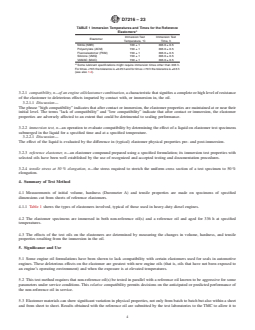
4.1.1 Table 1 shows the types of elastomers involved, typical of those used in heavy-duty diesel engines.
4.2 The elastomer specimens are immersed in both non-reference oil(s) and a reference oil and aged for 336 h at specified
temperatures.
4.3 The effects of the test oils on the elastomers are determined by measuring the changes in volume, hardness, and tensile
properties resulting from the immersion in the oil.
5. Significance and Use
5.1 Some engine oil formulations have been shown to lack compatibility with certain elastomers used for seals in automotive
engines. These deleterious effects on the elastomer are greatest with new engine oils (that is, oils that have not been exposed to
an engine’s operating environment) and when the exposure is at elevated temperatures.
5.2 This test method requires that non-reference oil(s) be tested in parallel with a reference oil known to be aggressive for some
parameters under service conditions. This relative compatibility permits decisions on the anticipated or predicted performance of
the non-reference oil in service.
5.3 Elastomer materials can show significant variation in physical properties, not only from batch to batch but also within a sheet
and from sheet to sheet. Results obtained with the reference oil are submitted by the test laboratories to the TMC to allow it to
D7216 − 23
update continually the total and within-laboratory standard deviation estimates. These estimates, therefore, incorporate effects of
variations in the properties of the reference elastomers on the test variability.
5.4 This test method is suitable for specification compliance testing, quality control, referee testing, and research and development.
5.5 The reference elastomers, reference oil, and the physical properties involved in this test method address the specific
requirements of engine oils. Although other tests exist for compatibility of elastomers with liquids, these are considered too
generalized for engine oils.
6. Apparatus
6.1 The testing equipment as specified in Test Methods D412, D471, D2240, and D5662 is required for the use of this test method.
6.2 Balance—Use any commercially available balance capable of weighing to the nearest 0.1 mg. Equip the balance with a
suspension hook and a platform to locate a hydrostatic-weighing beaker above the balance pan.
6.2.1 Calibration—Calibrate the balance annually as described in Test Method D5662.
6.3 Hardness Durometer A—See Test Method D2240. Use a stand-mounted Durometer.
6.3.1 Calibration—Calibrate the hardness Durometer annually as described in Test Method D2240. Use an outside source, with
standards traceable to the National Institute for Standards Technology (NIST), for annual calibration. Perform checks with internal
standards weekly. Checks with internal standards shall be within 63 points. Calibrate internal standards annually, using an outside
source, with standards traceable to NIST.
6.4 Tension Testing Machine—See the appropriate sections of Test Methods D412. The rate of grip separation for the tension
testing shall be (8.5 6 0.8) mm/s.
6.4.1 Calibration—Using an outside source, calibrate the tension testing machine annually, as described in Test Methods D412,
using standards traceable to NIST.
6.5 Glass Tubes—Preferably of borosilicate glass, having an outside diameter of 38 mm and an overall length of 300 mm. Fit each
tube loosely with an inert sealing device (such as a cork stopper covered with aluminum foil) that will not contaminate the test
oil.
6.6 Hanger Wire—Stainless steel, about 0.5 mm diameter, having a suitably sized eye at one end of the wire and a hook at the
other end, separated by approximately 8 mm. This is used to suspend the elastomer test specimens when measuring their mass in
water.
6.7 Specimen Suspension Wire—Stainless steel, about 0.8 mm to 1 mm diameter to the shape and dimensions shown in Fig. 1, to
hold the elastomer test specimens submerged in the immersion oil. (The specimens are attached to the suspension wire that is hung
over the edge of the glass tube and held in place by the stopper as shown in Fig. 2.)
6.8 Heated Immersion Test Bath or Block—Capable of maintaining the test oil in the glass tube to within 61 °C of the test
temperature. The immersion test bath or block shall contain a rack or holes that will accept the glass tubes specified in 6.5 and
hold them in a vertical position.
6.9 Die for Cutting Dumbbells—Use Die C as specified in Test Methods D412.
7. Reference Materials
7.1 Reference Oil—The reference oil is maintained and distributed by the TMC. In order to receive this reference oil, individual
laboratories shall agree to furnish the TMC with immersion test results obtained with the reference oil.
7.1.1 The TMC is responsible for managing a system that ensures the performance and formulation consistency of the reference
D7216 − 23
FIG. 1 Wire Hanger
FIG. 2 Test Tube Arrangement
oil. Store the reference oil in locations where the ambient temperature does not exceed 32 °C. Under these conditions the shelf life
of the reference oil is five years. In some circumstances, however, the TMC might specify a shelf life longer than five years. In
such cases, documented analysis procedures are used to justify the longer shelf life.
D7216 − 23
7.2 Purity of Water—Unless otherwise indicated, references to water shall be understood to mean water conforming to
Specification D1193 Type III deionized water or water of equivalent purity.
7.3 Wetting Agent Solution—0.1 % sodium dioctyl sulfosuccinate, made by a suitable dilution of concentrated solution with
reagent water. (Warning—Eye irritant.)
7.4 Reference Seal Elastomers—Obtain cured prepared sheets of the reference seal elastomers from the Parts Distributor (PD).
The sheets are at least 152 mm by 152 mm and have a uniform thickness of 2 mm 6 0.1 mm. The specific reference elastomers
described in this test method are a fluoroelastomer (FKM), a polyacrylate material (ACM), a silicone rubber (VMQ), a nitrile
rubber (NBR), and a VAMAC (MAC).
NOTE 4—Elastomer sheets received from the PD are labeled with the elastomer type on the second line of the package label and batch code on the third
line of the label. On the second line of the label, the elastomer type is printed, along with the letter code in parenthesis, for example, Fluoro (FKM), Nitrile
(NBR), etc. On the third line, the two-digit numeric batch code is printed following the header “BC” on the label.
7.4.1 Table A1.1 shows the formulations and typical properties of some of the reference elastomers (typical of those used in
heavy-duty diesel engines) listed in 7.4. These data are provided for information purposes only.
7.4.2 The PD is responsible for maintaining the numbering and tracking system for the reference elastomers and for managing the
procurement of elastomers that meet the specifications of this standard. Certain specific information concerning these reference
materials is available only to the PD. This information is used to ensure batch-to-batch consistency.
7.4.3 Store the reference elastomers in a location shielded from light, where the relative humidity is in the range of 40 % to 55 %
and the temperature in the range of 10 °C to 25 °C. Under these conditions the shelf life of the reference elastomers is three years
from the date of cure provided by the PD. Do not use any elastomer with a seal cure date older than three years.
8. Procedure
8.1 General Background—Conduct the immersion tests for any non-reference oil(s) on the basis of a test series operation. A test
series is a complete evaluation program, using the specified physical tests, for any selected number of non-reference oils and the
reference oil using one or more of the reference elastomers. Use the same elastomer batch for both non-reference oils and the
reference oil.
8.2 Number of Test Specimens—There are two types of test specimens: dumbbells for tensile testing and 25 mm by 50 mm
rectangular sheets for mass measurements and hardness testing. For each elastomer/oil combination to be tested, cut: (1) twelve
dumbbell specimens (six for initial and six for final tensile testing); (2) six rectangular specimens (each specimen is used for both
initial and final volume/hardness testing). Ensure that all reference elastomer specimens for a test series are cut from the same
elastomer batch.
8.3 Test Specimen Preparation—Determine the number of elastomer reference sheets required for the projected testing. For each
elastomer, this number depends on the number of oils involved and the number of test specimens required (see 8.2). Condition
these sheets for at least 3 h at 23 °C 6 2 °C as specified in Test Methods D412. Ensure cutting dies are sharp; see Test Methods
D412 for additional information on die maintenance.
8.3.1 Specimens for Tensile Testing—From each reference elastomer, cut the required number of dumbbell specimens from the 2
mm thick sheets, using Die C as specified in Test Methods D412, with the long axis of the dumbbell parallel to the grain. (The
direction of the grain is marked on the sheets as noted in footnote A to Table A1.1.) Using a die press for the operation, cut only
one sheet thickness at a time.
Aerosol OT has been found satisfactory for this purpose. (Aerosol is a trade mark of American Cyanamid Co.). Preparation of the wetting agent solution from the solid
reagent is not recommended.
Contact the TMC for the current company. In 2004, the company functioning in this capacity was: OH Technologies Inc., Attention Jason Bowden, PO Box 5039, 9300
Progress Parkway, Mentor OH 44060, USA.
D7216 − 23
8.3.1.1 Depending on the number of oils being evaluated, two or more sheets are required for each elastomer. Each sample of six
dumbbells (initial and final sample sets) shall contain as close as possible an equal number of dumbbells from each of the
individual sheets as required for the testing.
8.3.2 Specimens for Mass Measurements Required for Volume Determination—Cut the required number of 25 mm by 50 mm
rectangular specimens from the 2 mm thick sheets. Because two or more sheets are required (to prepare at least twelve specimens;
six for at least one non-reference oil and six for the reference oil) for the total number of specimens for any elastomer, each sample
of six shall contain an equal number of specimens from each of the individual sheets as required for the testing.
8.3.3 Specimens for Hardness Testing—Use the specimens prepared for the mass measurements (see 8.3.2).
8.4 Measurement of the Pre-Immersion Elastomer Properties—Measure the initial tensile properties, hardness and mass, as
described in 8.4.1 – 8.4.3, of the pre-immersion specimens. Note that while the pre- and post-immersion specimens are different
for the tensile measurements, they are the same for the mass and hardness measurements. Ensure, therefore, that the mass and
hardness are measured pre-immersion.
8.4.1 Tensile Measurements—Using the procedure specified in Test Methods D412, test six dumbbells for each oil/elastomer
combination, recording for each dumbbell the ultimate elongation and the tensile strength. To eliminate effects of variations in
ambient conditions such as temperature and humidity, measure the initial tensile properties in the same time frame as the final
tensile proprieties, that is, post-immersion (see 8.6.1).
8.4.2 Hardness—To protect the equipment, it is recommended that the hardness measurements be carried out before the mass
measurements to ensure the Durometer tip is kept dry. Stack three 25 mm by 50 mm specimens on top of each other to obtain the
requisite minimum 6 mm thickness. For ease of reference, the specimens at the top, middle, and bottom of the stack will be referred
to as Specimens A,B, and C, respectively. In accordance with Test Method D2240, determine the Durometer A hardness of the
elastomer specimens, taking readings 1 s 6 0.1 s after the pin makes contact with the rubber. Make repeat measurements on
different parts of the specimen. The following readings are taken:
8.4.2.1 Take three readings from the top side of Specimen A. Turn Specimen A over and take three additional readings from its
other side. Calculate and report the arithmetic mean of the six values.
8.4.2.2 Move Specimen C to the top of the stack and take another set of six readings as described in 8.4.2.1.
8.4.2.3 Move Specimen B to the top of the stack and take another set of six readings as described in 8.4.2.1.
8.4.2.4 Prepare a second stack of three specimens and repeat 8.4.2.1 – 8.4.2.3.
8.4.3 Measurement of Mass—For each elastomer/oil combination, measure and record the mass, to the nearest milligram, of each
of the six 25 mm by 50 mm rectangular specimens in air and water using the water displacement method.
8.4.3.1 With a leather punch or cork borer, punch or cut a 2 mm to 5 mm diameter hole near the center of a short edge. Corners
or small radiused notches can be cut for identification; do not cut V-notches.
8.4.3.2 Weigh the specimen in air to determine M1 (if it is pre-immersion) or M3 (if it is post-immersion).
8.4.3.3 Using the hole in its short edge, suspend the elastomer test specimen from the hanger wire. Immerse each specimen in a
beaker of the wetting agent solution to remove air bubbles from the surface. Dislodge any air bubbles by agitating the specimen
while in the solution.
8.4.3.4 Suspend the hanger wire and specimen from the balance hook. Inspect the submerged specimen and remove any adhering
air bubbles. If the bubbles are difficult to remove, repeat 8.4.3.3. In uncommon instances, it may be necessary to devise a means
of mechanically dislodging adherent air bubbles.
8.4.3.5 Weigh the specimen in water to determine M2 (if it is pre-immersion) or M4 (if it is post-immersion).
8.5 Immersion Testing—Conduct all immersion tests for a test series concurrently in the same heated immersion test bath or block.
D7216 − 23
8.5.1 Pour 150 mL 6 5 mL of test oil into the immersion test tubes. Four test tubes are required for each elastomer/oil
combination. In each tube, suspend three rectangular specimens or three dumbbell specimens from the stainless steel wire hanger,
as shown in Fig. 1. Locate inert (to oil or rubber) spacers, such as stainless steel washers 1 mm to 2 mm thick, between each test
specimen to prevent specimens from touching each other or the test tube wall (see Fig. 2). Cover each test tube with a stopper as
specified in 6.5.
8.5.2 Set the heating block/bath temperature to the appropriate value for the elastomer under test. (Table 1 shows the immersion
test temperatures and immersion times to be used for the reference elastomers.) When the test temperature has been attained, insert
the test tubes into the heating block/bath.
8.5.2.1 To minimize effects of temperature variations within the heating block/bath, spread the tubes randomly, avoiding placing
all the tubes in the same portion or putting tubes containing the same samples together.
8.5.2.2 Ensure that no specimen touches another specimen or the test tube wall. Such an occurrence invalidates the test.
8.5.2.3 To ensure that aging conditions are equivalent for both non-reference and reference oils, insert all tubes in the heating
block/bath within 8 h of each other.
8.5.2.4 Each tube shall be in the block/bath for the period specified in Table 1. The time starts when a tube is inserted in the heating
block/bath, provided the latter is already at the correct temperature. If desired, as a check, insert a dummy tube containing an
appropriate amount of oil and measure its temperature.
8.5.3 At the end of the aging period, remove the specimens from the test t
...