

ASTM D7273/D7273M-08(2020)
(Guide)Standard Guide for Acceptance Testing Requirements for Geonets and Geonet Drainage Geocomposites
General Information
- Abstract
SCOPE
1.1 This guide covers guidelines for the acceptance testing frequency requirements for geonet and geonet drainage geocomposite materials describing types of tests, test methods, and recommended verifications.
1.2 This guide is intended to aid purchasers, installers, contractors, owners, operators, designers, and agencies in establishing a minimum level of effort for product acceptance testing and verification. This is intended to ensure that the supplied geonet and/or geonet drainage geocomposite roll(s) meet accepted material specifications.
1.3 This guide offers an organized collection of information or a series of options and does not recommend a specific course of action. This guide cannot replace education or experience and should be used in conjunction with professional judgment. Not all aspects of this guide may be applicable in all circumstances. This guide is not intended to represent or replace the standard of care by which the adequacy of a given professional service must be judged, nor should this guide be applied without consideration of a project's many unique aspects. The word “Standard” in the title of this guide means only that the guide has been approved through the ASTM International consensus process.
1.4 The values stated in either SI units or inch-pound units are to be regarded separately as standard. The values stated in each system are not necessarily exact equivalents; therefore, to ensure conformance with the standard, each system shall be used independently of the other, and values from the two systems shall not be combined.
1.5 This standard does not purport to address all of the safety concerns, if any, associated with its use. It is the responsibility of the user of this standard to establish appropriate safety, health, and environmental practices and determine the applicability of regulatory limitations prior to use.
1.6 This international standard was developed in accordance with internationally recognized principles on standardization established in the Decision on Principles for the Development of International Standards, Guides and Recommendations issued by the World Trade Organization Technical Barriers to Trade (TBT) Committee.
- Status
- Published
- Publication Date
- 31-May-2020
- Technical Committee
- D35 - Geosynthetics
- Drafting Committee
- D35.01 - Mechanical Properties

Overview
ASTM D7273/D7273M-08(2020) is a standard guide developed by ASTM International that provides acceptance testing requirements for geonets and geonet drainage geocomposites. This guide outlines recommended testing types, relevant ASTM test methods, and verification processes that support the acceptance and quality assurance of geonet materials and geonet drainage geocomposite products. Designed for users such as purchasers, installers, contractors, designers, owners, operators, and regulatory agencies, the guide assists in developing procedures to ensure that supplied materials meet specified material and project requirements.
By implementing ASTM D7273/D7273M-08(2020), stakeholders in geosynthetic and civil engineering projects can foster material compliance, promote safer project outcomes, and support international standardization in geosynthetics testing.
Key Topics
The standard covers the following main topics:
- Acceptance Testing Frequency: Guidance on how often to conduct tests throughout production, delivery, and installation, based on project size and sensitivity.
- Test Types and Methods: Lists specific ASTM test methods for evaluating key properties of geonets and geonet drainage geocomposites, including density, strength, transmissivity, and adhesion.
- Verification Requirements: Recommends verifying manufacturer quality control (MQC) data and conducting supplemental testing as needed.
- Quality Assurance Practices: Incorporates quality assurance and quality control practices, including clear steps for documenting test results and managing nonconforming rolls.
- Reporting Requirements: Specifies necessary documentation, such as product identification, test results, and details of any irregularities encountered during acceptance testing.
- Units of Measure: Clarifies proper use of SI and inch-pound units for all testing and reporting, emphasizing the need to avoid mixing unit systems.
Applications
ASTM D7273/D7273M-08(2020) is widely used in projects involving geonets and geonet drainage geocomposites, which are essential materials for civil engineering and environmental containment. Practical applications include:
- Landfill Liners and Caps: Ensuring that drainage layers perform as designed for leachate collection and control.
- Roadway and Railway Construction: Verifying the drainage and reinforcement capabilities of materials used to stabilize embankments and subgrades.
- Retaining Walls and Slopes: Assuring geonet-based systems meet specified mechanical and hydraulic properties for proper drainage and structural support.
- Environmental Barriers: Supporting the use of geonet geocomposites in containment applications, such as reservoirs and wastewater treatment plants, where drainage performance is critical.
Implementing this standard boosts confidence in material compliance and consistency, supporting project specifications and broader regulatory requirements.
Related Standards
Several ASTM standards are referenced within ASTM D7273/D7273M-08(2020) to support specific testing and classification requirements. Key related documents include:
- ASTM D792 / D1505 - Test methods for density and specific gravity of plastics
- ASTM D1603 / D4218 - Test methods for carbon black content in polyolefin plastics and polyethylene compounds
- ASTM D4354 - Practice for sampling of geosynthetics and rolled erosion control products
- ASTM D4632 / D4533 / D6241 - Test methods for strength and puncture resistance in geotextiles
- ASTM D4716 - Test method for in-plane flow rate and transmissivity of geosynthetics
- ASTM D7005 - Test method for bond strength (ply adhesion) of geocomposites
- ASTM D4759 - Practice for determining specification conformance of geosynthetics
- ASTM D4439 - Terminology for geosynthetics
These standards, alongside ASTM D7273/D7273M-08(2020), form a comprehensive framework for acceptance testing, quality control, and specification compliance for geonets and geonet drainage geocomposites across infrastructure, environmental, and geotechnical projects.
Keywords: geonets, geonet drainage geocomposite, acceptance testing, ASTM, geosynthetics, material verification, quality assurance, civil engineering, project specifications.
Relations
- Effective Date
- 01-Jun-2020
- Effective Date
- 01-Feb-2024
- Effective Date
- 01-Feb-2024
- Effective Date
- 01-May-2020
- Effective Date
- 01-Feb-2020
- Effective Date
- 01-Feb-2020
- Effective Date
- 01-Jan-2020
- Effective Date
- 01-Jul-2019
- Refers
ASTM D5199-12(2019) - Standard Test Method for Measuring the Nominal Thickness of Geosynthetics - Effective Date
- 15-Jun-2019
- Effective Date
- 01-Jul-2018
- Effective Date
- 15-Apr-2018
- Effective Date
- 01-Aug-2017
- Effective Date
- 01-Jun-2017
- Refers
ASTM D4491/D4491M-17 - Standard Test Methods for Water Permeability of Geotextiles by Permittivity - Effective Date
- 01-Jan-2017
- Refers
ASTM D4491/D4491M-16 - Standard Test Methods for Water Permeability of Geotextiles by Permittivity - Effective Date
- 01-Jul-2016
Get Certified
Connect with accredited certification bodies for this standard

Control Union Certifications
Global certification for agriculture and sustainability.

Hohenstein Institut
Textile testing and certification.

Bureau Veritas Bangladesh
Bureau Veritas certification services in Bangladesh.
Sponsored listings
Frequently Asked Questions
ASTM D7273/D7273M-08(2020) is a guide published by ASTM International. Its full title is "Standard Guide for Acceptance Testing Requirements for Geonets and Geonet Drainage Geocomposites". This standard covers: SCOPE 1.1 This guide covers guidelines for the acceptance testing frequency requirements for geonet and geonet drainage geocomposite materials describing types of tests, test methods, and recommended verifications. 1.2 This guide is intended to aid purchasers, installers, contractors, owners, operators, designers, and agencies in establishing a minimum level of effort for product acceptance testing and verification. This is intended to ensure that the supplied geonet and/or geonet drainage geocomposite roll(s) meet accepted material specifications. 1.3 This guide offers an organized collection of information or a series of options and does not recommend a specific course of action. This guide cannot replace education or experience and should be used in conjunction with professional judgment. Not all aspects of this guide may be applicable in all circumstances. This guide is not intended to represent or replace the standard of care by which the adequacy of a given professional service must be judged, nor should this guide be applied without consideration of a project's many unique aspects. The word “Standard” in the title of this guide means only that the guide has been approved through the ASTM International consensus process. 1.4 The values stated in either SI units or inch-pound units are to be regarded separately as standard. The values stated in each system are not necessarily exact equivalents; therefore, to ensure conformance with the standard, each system shall be used independently of the other, and values from the two systems shall not be combined. 1.5 This standard does not purport to address all of the safety concerns, if any, associated with its use. It is the responsibility of the user of this standard to establish appropriate safety, health, and environmental practices and determine the applicability of regulatory limitations prior to use. 1.6 This international standard was developed in accordance with internationally recognized principles on standardization established in the Decision on Principles for the Development of International Standards, Guides and Recommendations issued by the World Trade Organization Technical Barriers to Trade (TBT) Committee.
SCOPE 1.1 This guide covers guidelines for the acceptance testing frequency requirements for geonet and geonet drainage geocomposite materials describing types of tests, test methods, and recommended verifications. 1.2 This guide is intended to aid purchasers, installers, contractors, owners, operators, designers, and agencies in establishing a minimum level of effort for product acceptance testing and verification. This is intended to ensure that the supplied geonet and/or geonet drainage geocomposite roll(s) meet accepted material specifications. 1.3 This guide offers an organized collection of information or a series of options and does not recommend a specific course of action. This guide cannot replace education or experience and should be used in conjunction with professional judgment. Not all aspects of this guide may be applicable in all circumstances. This guide is not intended to represent or replace the standard of care by which the adequacy of a given professional service must be judged, nor should this guide be applied without consideration of a project's many unique aspects. The word “Standard” in the title of this guide means only that the guide has been approved through the ASTM International consensus process. 1.4 The values stated in either SI units or inch-pound units are to be regarded separately as standard. The values stated in each system are not necessarily exact equivalents; therefore, to ensure conformance with the standard, each system shall be used independently of the other, and values from the two systems shall not be combined. 1.5 This standard does not purport to address all of the safety concerns, if any, associated with its use. It is the responsibility of the user of this standard to establish appropriate safety, health, and environmental practices and determine the applicability of regulatory limitations prior to use. 1.6 This international standard was developed in accordance with internationally recognized principles on standardization established in the Decision on Principles for the Development of International Standards, Guides and Recommendations issued by the World Trade Organization Technical Barriers to Trade (TBT) Committee.
ASTM D7273/D7273M-08(2020) is classified under the following ICS (International Classification for Standards) categories: 59.080.70 - Geotextiles. The ICS classification helps identify the subject area and facilitates finding related standards.
ASTM D7273/D7273M-08(2020) has the following relationships with other standards: It is inter standard links to ASTM D7273/D7273M-08(2013)e1, ASTM D4439-24, ASTM D7005/D7005M-16(2024), ASTM D4354-12(2020), ASTM D1603-20, ASTM D4218-20, ASTM D4751-20, ASTM D5321/D5321M-19, ASTM D5199-12(2019), ASTM D7179-18, ASTM D4439-18, ASTM D4439-17, ASTM D5321/D5321M-17, ASTM D4491/D4491M-17, ASTM D4491/D4491M-16. Understanding these relationships helps ensure you are using the most current and applicable version of the standard.
ASTM D7273/D7273M-08(2020) is available in PDF format for immediate download after purchase. The document can be added to your cart and obtained through the secure checkout process. Digital delivery ensures instant access to the complete standard document.
Standards Content (Sample)
This international standard was developed in accordance with internationally recognized principles on standardization established in the Decision on Principles for the
Development of International Standards, Guides and Recommendations issued by the World Trade Organization Technical Barriers to Trade (TBT) Committee.
Designation: D7273/D7273M − 08 (Reapproved 2020)
Standard Guide for
Acceptance Testing Requirements for Geonets and Geonet
Drainage Geocomposites
This standard is issued under the fixed designation D7273/D7273M; the number immediately following the designation indicates the
year of original adoption or, in the case of revision, the year of last revision. A number in parentheses indicates the year of last
reapproval. A superscript epsilon (´) indicates an editorial change since the last revision or reapproval.
1. Scope ization established in the Decision on Principles for the
Development of International Standards, Guides and Recom-
1.1 This guide covers guidelines for the acceptance testing
mendations issued by the World Trade Organization Technical
frequency requirements for geonet and geonet drainage geo-
Barriers to Trade (TBT) Committee.
compositematerialsdescribingtypesoftests,testmethods,and
recommended verifications.
2. Referenced Documents
1.2 This guide is intended to aid purchasers, installers,
2.1 ASTM Standards:
contractors, owners, operators, designers, and agencies in
D792 Test Methods for Density and Specific Gravity (Rela-
establishing a minimum level of effort for product acceptance
tive Density) of Plastics by Displacement
testing and verification. This is intended to ensure that the
D1505 Test Method for Density of Plastics by the Density-
supplied geonet and/or geonet drainage geocomposite roll(s)
Gradient Technique
meet accepted material specifications.
D1603 Test Method for Carbon Black Content in Olefin
1.3 This guide offers an organized collection of information
Plastics
oraseriesofoptionsanddoesnotrecommendaspecificcourse
D4218 Test Method for Determination of Carbon Black
of action. This guide cannot replace education or experience
Content in Polyethylene Compounds by the Muffle-
and should be used in conjunction with professional judgment.
Furnace Technique
Not all aspects of this guide may be applicable in all circum-
D4354 Practice for Sampling of Geosynthetics and Rolled
stances. This guide is not intended to represent or replace the
Erosion Control Products (RECPs) for Testing
standard of care by which the adequacy of a given professional
D4355/D4355M Test Method for Deterioration of Geotex-
service must be judged, nor should this guide be applied
tiles by Exposure to Light, Moisture and Heat in a Xenon
without consideration of a project’s many unique aspects. The
Arc-Type Apparatus
word “Standard” in the title of this guide means only that the
D4439 Terminology for Geosynthetics
guide has been approved through the ASTM International
D4491/D4491M Test Methods for Water Permeability of
consensus process.
Geotextiles by Permittivity
D4533/D4533M Test Method for Trapezoid Tearing
1.4 The values stated in either SI units or inch-pound units
are to be regarded separately as standard. The values stated in Strength of Geotextiles
D4632/D4632M Test Method for Grab Breaking Load and
each system are not necessarily exact equivalents; therefore, to
ensure conformance with the standard, each system shall be Elongation of Geotextiles
D4716/D4716M Test Method for Determining the (In-plane)
used independently of the other, and values from the two
systems shall not be combined. Flow Rate per Unit Width and Hydraulic Transmissivity
of a Geosynthetic Using a Constant Head
1.5 This standard does not purport to address all of the
D4751 Test Methods for Determining Apparent Opening
safety concerns, if any, associated with its use. It is the
Size of a Geotextile
responsibility of the user of this standard to establish appro-
D4759 Practice for Determining the Specification Confor-
priate safety, health, and environmental practices and deter-
mance of Geosynthetics
mine the applicability of regulatory limitations prior to use.
D4873/D4873M Guide for Identification, Storage, and Han-
1.6 This international standard was developed in accor-
dling of Geosynthetic Rolls and Samples
dance with internationally recognized principles on standard-
This guide is under the jurisdiction ofASTM Committee D35 on Geosynthetics
and is the direct responsibility of Subcommittee D35.01 on Mechanical Properties. For referenced ASTM standards, visit the ASTM website, www.astm.org, or
Current edition approved June 1, 2020. Published June 2020. Originally contact ASTM Customer Service at service@astm.org. For Annual Book of ASTM
approved in 2008. Last previous edition approved in 2013 as D7273/D7273M – 08 Standards volume information, refer to the standard’s Document Summary page on
ɛ1
(2013) . DOI: 10.1520/D7273_D7273M-08R20. the ASTM website.
Copyright © ASTM International, 100 Barr Harbor Drive, PO Box C700, West Conshohocken, PA 19428-2959. United States
D7273/D7273M − 08 (2020)
D5199 Test Method for Measuring the Nominal Thickness 3.3.2 MQC, n—manufacturing quality control.
of Geosynthetics
D5321/D5321M Test Method for Determining the Shear
4. Summary of Guide
Strength of Soil-Geosynthetic and Geosynthetic-
4.1 Thisguidesuggeststhetypesoftests,themethodsofthe
Geosynthetic Interfaces by Direct Shear
testing, and verification requirements for acceptance testing of
D6241 Test Method for Static Puncture Strength of Geotex-
geonet and geonet geocomposite materials.
tiles and Geotextile-Related Products Using a 50-mm
4.2 It should be recognized that parties, organizations, or
Probe
representatives may perform additional tests at other frequen-
D7005/D7005M Test Method for Determining the Bond
ciesthanrequiredinthisguide.Inthiscase,theproject-specific
Strength (Ply Adhesion) of Geocomposites
acceptance plan will then take precedence over this guide.
D7179 Test Method for Determining Geonet Breaking Force
5. Procedure
3. Terminology
5.1 The geocomposite components are typically tested dur-
3.1 Definitions—For definitions of terms related to
ing MQC (Practice D4354) and typically documented by
geosynthetics, refer to Terminology D4439.
means of a letter of certification or summarized MQC test data,
3.2 Definitions of Terms Specific to This Standard:
or both. These actual tested values (MQC test data) should be
3.2.1 acceptance testing, n—testing performed on a product
verified to be in conformance with the accepted material
to determine whether or not an individual lot of the product
specifications. This can be done by reviewing the MQC test
conforms to specified requirements.
data or by additional quality assurance testing, or both, and
3.2.2 agency, n—in geosynthetics, the organization that
purchaser’s specification conformance testing. Purchaser’s
reviews the permit application for compliance with the agen-
specification acceptance/conformance testing should be done
cy’s regulation and all quality assurance documentation before
directly after arrival of the product on-site, and definitely
and after construction.
before product installation. Properties of the individual geo-
3.2.3 contractor, n—in geosynthetics, the party or organiza- composite components (geonet and geotextile) are likely to
change during the lamination process. If the properties of the
tion that has the responsibility for the construction of the
manmade project, structure, or system. finished geocomposite’s component to be controlled are those
measured before lamination, it might be necessary to sample
3.2.4 designer, n—in geosynthetics, the person or organiza-
the individual components in the plant, before lamination. If
tion that designs a manmade project, structure, or system that
the tests are conducted on the components delaminated from
fulfills the owner’s/operator’s requirements and meets or
the geocomposite, those test results will not reflect what is
exceeds the minimum requirements of the agency.
intended to be controlled.
3.2.5 geonet geocomposite, n—product composed of two or
5.2 Supplied geonet/geonet geocomposite rolls should be
more materials, at least one of which is a geonet.
observed on-site to identify any damage to the rolls or
3.2.6 installer, n—in geosynthetics, the party that installs, or
wrapping. In case of any damage, Guide D4873/D4873M
facilitates installation of, any materials purchased from manu-
should be followed.Any damage should be noted and reported.
facturers or suppliers.
5.3 Before storing or unrolling geonet/geonet geocomposite
3.2.7 manufacturer, n—in geosynthetics, the group,
rolls, or both, the individual roll identification should be
corporation, partnership, or individual that manufactures a
verified and compared with the packing list. Irregularities
product.
should be noted and reported.
3.2.8 manufacturing quality control (MQC), n—planned
5.4 If sampling of geonet/geonet geocomposite material is
system of activities by the manufacturer whose purpose is to
necessary, for example, for testing purposes, Guide D4354
provide a level of quality that meets the needs of product
should be followed.
requirements; also, the use of such a system.
5.5 The recommended acceptance tests and test methods for
3.2.9 operator, n—in geosynthetics, the person or organiza-
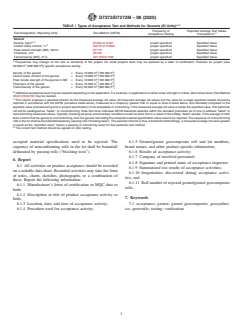
geonets are given in Table 1 and for geonet geocomposite
tion that operates the manmade project, structure, or system.
materials are given in Table 2. The tests are performed on the
3.2.10 owner, n—in geosynthetics, the person or organiza-
geonets and geotextiles before lamination except for geocom-
tion that owns the manmade project, structure, or system.
posite transmissivity and geocomposite ply adhesion and
3.2.11 purchaser, n—in geosynthetics, the person, company,
should be compared with the accepted material specifications.
or organization that purchases any materials or work to be
Irregularities should be noted and reported.
performed.
5.6 All test results should be reported as average roll values
3.2.12 quality assurance (QA), n—all those planned or
(notthevalueforasinglespecimentested)inaccordancetothe
systematic actions necessary to provide adequate confidence
ASTM procedures listed in Tables 1 and 2, and ultimately
that a material, product,
...