

ASTM C16-03(2018)
(Test Method)Standard Test Method for Load Testing Refractory Shapes at High Temperatures
General Information
- Abstract
SIGNIFICANCE AND USE
3.1 The ability of refractory shapes to withstand prescribed loads at elevated temperatures is a measure of the high-temperature service potential of the material. By definition, refractory shapes must resist change due to high temperature, and the ability to withstand deformation or shape change when subjected to significant loading at elevated temperatures is clearly demonstrated when refractory shapes are subjected to this test method. The test method is normally run at a sufficiently high temperature to allow some liquids to form within the test brick or to cause weakening of the bonding system. The result is usually a decrease in sample dimension parallel to the applied load and increase in sample dimensions perpendicular to the loading direction. Occasionally, shear fracture can occur. Since the test provides easily measurable changes in dimensions, prescribed limits can be established, and the test method has been long used to determine refractory quality. The test method has often been used in the establishment of written specifications between producers and consumers.
3.2 This test method is not applicable for refractory materials that are unstable in an oxidizing atmosphere unless means are provided to protect the specimens.
SCOPE
1.1 This test method covers the determination of the resistance to deformation or shear of refractory shapes when subjected to a specified compressive load at a specified temperature for a specified time.
1.2 The values stated in inch-pound units are to be regarded as standard. The values given in parentheses are mathematical conversions to SI units that are provided for information only and are not considered standard.
1.3 This standard does not purport to address all of the safety concerns, if any, associated with its use. It is the responsibility of the user of this standard to establish appropriate safety, health, and environmental practices and determine the applicability of regulatory limitations prior to use.
1.4 This international standard was developed in accordance with internationally recognized principles on standardization established in the Decision on Principles for the Development of International Standards, Guides and Recommendations issued by the World Trade Organization Technical Barriers to Trade (TBT) Committee.
- Status
- Published
- Publication Date
- 31-Jan-2018
- Technical Committee
- C08 - Refractories
- Drafting Committee
- C08.01 - Strength
Overview
ASTM C16-03(2018) - Standard Test Method for Load Testing Refractory Shapes at High Temperatures is a widely recognized standard published by ASTM International. This standard defines procedures for evaluating the resistance to deformation or shear in refractory shapes when subjected to specified compressive loads at high temperatures for a predetermined period. The test results are essential in determining the high-temperature service potential and overall quality of refractory materials, a critical factor in industries such as metallurgy, ceramics, and glass manufacturing.
This standard follows internationally established guidelines from the World Trade Organization Technical Barriers to Trade (TBT) Committee, ensuring its relevance and acceptability in global markets.
Key Topics
- High-Temperature Load Testing: The method focuses on exposing refractory shapes-such as bricks-to significant compressive loads at elevated temperatures that may cause phase changes, softening, or partial liquefaction within the specimen.
- Dimensional Changes: Under load and heat, refractory shapes typically demonstrate measurable changes, including a decrease in dimensions parallel to the load’s direction and an increase in perpendicular dimensions.
- Test Applicability: While broadly useful, the test method is not suitable for materials unstable in oxidizing atmospheres unless protective measures for the specimens are implemented.
- Measurement Precision: Detailed procedures for measuring, setting, and testing specimens ensure reliable and reproducible results, forming the foundation for material specifications and compliance assessment.
- Specification Agreements: The outcomes from this test method are often referenced in contracts and written specifications between producers and consumers to ensure material performance criteria are met.
Applications
ASTM C16-03(2018) is instrumental in a range of practical applications within the refractory industry and among end-users who require quality assurance for materials exposed to high thermal and mechanical stress. Key applications include:
- Quality Control: Manufacturing facilities rely on this standard to verify the resistance of refractory bricks and shapes to deformation at operating temperatures, maintaining batch-to-batch consistency.
- Material Development: R&D departments use this test method to compare new refractory materials’ performance against established benchmarks.
- Specification Compliance: Both buyers and suppliers reference these test results to fulfill technical specifications specified in contracts and procurement documents.
- Predictive Maintenance and Design: Engineers and maintenance professionals use the test data to select suitable refractory materials for furnaces, kilns, and other high-temperature equipment, optimizing longevity and reducing the risk of unexpected material failure.
Related Standards
The ASTM C16-03(2018) standard frequently references or is used in combination with other industry standards to ensure comprehensive evaluation and compliance, including:
- ASTM C862 - Practice for Preparing Refractory Concrete Specimens by Casting
- ASTM E220 - Test Method for Calibration of Thermocouples by Comparison Techniques
These related standards complement C16 by addressing specimen preparation and accurate measurement of test conditions.
Keywords: ASTM C16-03, refractory load testing, high-temperature deformation, compressive load resistance, refractory quality, refractory shapes, ASTM standards, industrial furnaces, material specification.
By adhering to ASTM C16-03(2018), organizations can confidently evaluate and specify refractory shapes, ensuring their reliability in demanding thermal environments and supporting both product development and quality assurance initiatives.
Relations
- Replaces
ASTM C16-03(2012)e2 - Standard Test Method for Load Testing Refractory Shapes at High Temperatures - Effective Date
- 01-Feb-2018
- Effective Date
- 01-Nov-2013
- Effective Date
- 01-Mar-2008
- Refers
ASTM E220-07a - Standard Test Method for Calibration of Thermocouples By Comparison Techniques - Effective Date
- 01-Nov-2007
- Effective Date
- 01-May-2007
- Refers
ASTM E220-07e1 - Standard Test Method for Calibration of Thermocouples By Comparison Techniques - Effective Date
- 01-May-2007
- Effective Date
- 10-Nov-2002
- Effective Date
- 10-May-2002
- Effective Date
- 10-Feb-2001
- Effective Date
- 10-Feb-2001
- Effective Date
- 10-Nov-1996
- Effective Date
- 01-Feb-2018
- Referred By
ASTM C27-98(2022) - Standard Classification of Fireclay and High-Alumina Refractory Brick - Effective Date
- 01-Feb-2018
- Effective Date
- 01-Feb-2018
Frequently Asked Questions
ASTM C16-03(2018) is a standard published by ASTM International. Its full title is "Standard Test Method for Load Testing Refractory Shapes at High Temperatures". This standard covers: SIGNIFICANCE AND USE 3.1 The ability of refractory shapes to withstand prescribed loads at elevated temperatures is a measure of the high-temperature service potential of the material. By definition, refractory shapes must resist change due to high temperature, and the ability to withstand deformation or shape change when subjected to significant loading at elevated temperatures is clearly demonstrated when refractory shapes are subjected to this test method. The test method is normally run at a sufficiently high temperature to allow some liquids to form within the test brick or to cause weakening of the bonding system. The result is usually a decrease in sample dimension parallel to the applied load and increase in sample dimensions perpendicular to the loading direction. Occasionally, shear fracture can occur. Since the test provides easily measurable changes in dimensions, prescribed limits can be established, and the test method has been long used to determine refractory quality. The test method has often been used in the establishment of written specifications between producers and consumers. 3.2 This test method is not applicable for refractory materials that are unstable in an oxidizing atmosphere unless means are provided to protect the specimens. SCOPE 1.1 This test method covers the determination of the resistance to deformation or shear of refractory shapes when subjected to a specified compressive load at a specified temperature for a specified time. 1.2 The values stated in inch-pound units are to be regarded as standard. The values given in parentheses are mathematical conversions to SI units that are provided for information only and are not considered standard. 1.3 This standard does not purport to address all of the safety concerns, if any, associated with its use. It is the responsibility of the user of this standard to establish appropriate safety, health, and environmental practices and determine the applicability of regulatory limitations prior to use. 1.4 This international standard was developed in accordance with internationally recognized principles on standardization established in the Decision on Principles for the Development of International Standards, Guides and Recommendations issued by the World Trade Organization Technical Barriers to Trade (TBT) Committee.
SIGNIFICANCE AND USE 3.1 The ability of refractory shapes to withstand prescribed loads at elevated temperatures is a measure of the high-temperature service potential of the material. By definition, refractory shapes must resist change due to high temperature, and the ability to withstand deformation or shape change when subjected to significant loading at elevated temperatures is clearly demonstrated when refractory shapes are subjected to this test method. The test method is normally run at a sufficiently high temperature to allow some liquids to form within the test brick or to cause weakening of the bonding system. The result is usually a decrease in sample dimension parallel to the applied load and increase in sample dimensions perpendicular to the loading direction. Occasionally, shear fracture can occur. Since the test provides easily measurable changes in dimensions, prescribed limits can be established, and the test method has been long used to determine refractory quality. The test method has often been used in the establishment of written specifications between producers and consumers. 3.2 This test method is not applicable for refractory materials that are unstable in an oxidizing atmosphere unless means are provided to protect the specimens. SCOPE 1.1 This test method covers the determination of the resistance to deformation or shear of refractory shapes when subjected to a specified compressive load at a specified temperature for a specified time. 1.2 The values stated in inch-pound units are to be regarded as standard. The values given in parentheses are mathematical conversions to SI units that are provided for information only and are not considered standard. 1.3 This standard does not purport to address all of the safety concerns, if any, associated with its use. It is the responsibility of the user of this standard to establish appropriate safety, health, and environmental practices and determine the applicability of regulatory limitations prior to use. 1.4 This international standard was developed in accordance with internationally recognized principles on standardization established in the Decision on Principles for the Development of International Standards, Guides and Recommendations issued by the World Trade Organization Technical Barriers to Trade (TBT) Committee.
ASTM C16-03(2018) is classified under the following ICS (International Classification for Standards) categories: 81.080 - Refractories. The ICS classification helps identify the subject area and facilitates finding related standards.
ASTM C16-03(2018) has the following relationships with other standards: It is inter standard links to ASTM C16-03(2012)e2, ASTM E220-13, ASTM C862-02(2008), ASTM E220-07a, ASTM E220-07, ASTM E220-07e1, ASTM C862-02, ASTM E220-02, ASTM C862-91(1997), ASTM C862-01, ASTM E220-86(1996)e1, ASTM C865-22, ASTM C27-98(2022), ASTM C467-14(2023). Understanding these relationships helps ensure you are using the most current and applicable version of the standard.
ASTM C16-03(2018) is available in PDF format for immediate download after purchase. The document can be added to your cart and obtained through the secure checkout process. Digital delivery ensures instant access to the complete standard document.
Standards Content (Sample)
This international standard was developed in accordance with internationally recognized principles on standardization established in the Decision on Principles for the
Development of International Standards, Guides and Recommendations issued by the World Trade Organization Technical Barriers to Trade (TBT) Committee.
Designation: C16 − 03 (Reapproved 2018)
Standard Test Method for
Load Testing Refractory Shapes at High Temperatures
This standard is issued under the fixed designation C16; the number immediately following the designation indicates the year of original
adoption or, in the case of revision, the year of last revision.Anumber in parentheses indicates the year of last reapproval.Asuperscript
epsilon (´) indicates an editorial change since the last revision or reapproval.
1. Scope temperature service potential of the material. By definition,
refractory shapes must resist change due to high temperature,
1.1 This test method covers the determination of the resis-
and the ability to withstand deformation or shape change when
tance to deformation or shear of refractory shapes when
subjected to significant loading at elevated temperatures is
subjected to a specified compressive load at a specified
clearly demonstrated when refractory shapes are subjected to
temperature for a specified time.
this test method. The test method is normally run at a
1.2 The values stated in inch-pound units are to be regarded
sufficiently high temperature to allow some liquids to form
as standard. The values given in parentheses are mathematical
within the test brick or to cause weakening of the bonding
conversions to SI units that are provided for information only
system. The result is usually a decrease in sample dimension
and are not considered standard.
parallel to the applied load and increase in sample dimensions
1.3 This standard does not purport to address all of the
perpendicular to the loading direction. Occasionally, shear
safety concerns, if any, associated with its use. It is the
fracture can occur. Since the test provides easily measurable
responsibility of the user of this standard to establish appro-
changes in dimensions, prescribed limits can be established,
priate safety, health, and environmental practices and deter-
and the test method has been long used to determine refractory
mine the applicability of regulatory limitations prior to use.
quality. The test method has often been used in the establish-
1.4 This international standard was developed in accor-
ment of written specifications between producers and consum-
dance with internationally recognized principles on standard-
ers.
ization established in the Decision on Principles for the
3.2 This test method is not applicable for refractory mate-
Development of International Standards, Guides and Recom-
rials that are unstable in an oxidizing atmosphere unless means
mendations issued by the World Trade Organization Technical
are provided to protect the specimens.
Barriers to Trade (TBT) Committee.
4. Apparatus
2. Referenced Documents
4.1 The apparatus shall consist essentially of a furnace and
2.1 ASTM Standards:
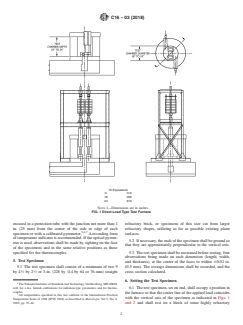
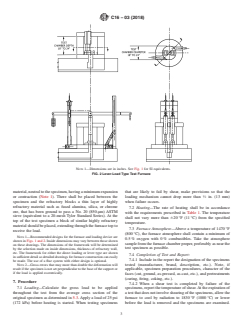
a loading device. It may be constructed in accordance withFig.
C862 Practice for Preparing Refractory Concrete Specimens
1 or Fig. 2 or their equivalent.
by Casting
4.1.1 The furnace shall be so constructed that the tempera-
E220 Test Method for Calibration of Thermocouples By
ture is substantially uniform in all parts of the furnace. The
Comparison Techniques
temperature as measured at any point on the surface of the test
2.2 ASTM Adjuncts:
specimens shall not differ by more than 10 °F (5.5 °C) during
Direct-LoadTypeFurnace(OilorGasFired,orElectrically
the holding period of the test or, on test to failure, above
Fired); Lever-Load Type Furnace
2370 °F (1300 °C). To accomplish this, it may be necessary to
3. Significance and Use
install and adjust baffles within the furnace.Aminimum of two
3.1 The ability of refractory shapes to withstand prescribed
burners shall be used. If difficulty is encountered in following
loads at elevated temperatures is a measure of the high-
the low-temperature portion of the schedule (particularly for
silica brick), a dual-burner system is recommended, one to
This test method is under the jurisdiction of ASTM Committee C08 on
supply heat for low temperatures and another for the higher
Refractories and is the direct responsibility of C08.01 on Strength.
temperatures.
Current edition approved Feb. 1, 2018. Published February 2018. Originally
ε2
approved in 1917. Last previous edition approved in 2012 as C16 – 03 (2012) .
4.2 The temperature shall be measured either with cali-
5,6,7
DOI: 10.1520/C0016-03R18.
brated platinum - platinum - rhodium thermocouples, each
For referenced ASTM standards, visit the ASTM website, www.astm.org, or
contact ASTM Customer Service at service@astm.org. For Annual Book of ASTM
Standards volume information, refer to the standard’s Document Summary page on
the ASTM website. Digital blueprints of detailed drawings of the furnaces shown in Figs. 1 and 2
Available from ASTM International Headquarters. Order Adjunct No. are available from ASTM International. Request Adjunct No. ADJC0016-E-PDF.
ADJC0016-E-PDF. Original adjunct produced in 1969; digitized in 2017. Test Method E220 specifies calibration procedures for thermocouples.
Copyright © ASTM International, 100 Barr Harbor Drive, PO Box C700, West Conshohocken, PA 19428-2959. United States
C16 − 03 (2018)
SI Equivalents
in. mm
18 460
24 610
NOTE 1—Dimensions are in inches.
FIG. 1 Direct-Load Type Test Furnace
encased in a protection tube with the junction not more than 1 refractory brick, or specimens of this size cut from larger
in. (25 mm) from the center of the side or edge of each refractory shapes, utilizing as far as possible existing plane
5,6,7
specimen or with a calibrated pyrometer. Arecording form surfaces.
of temperature indicator is recommended. If the optical pyrom-
5.2 Ifnecessary,theendsofthespecimenshallbegroundso
eter is used, observations shall be made by sighting on the face
that they are approximately perpendicular to the vertical axis.
of the specimens and in the same relative positions as those
5.3 The test specimen shall be measured before testing, four
specified for the thermocouples.
observations being made on each dimension (length, width,
5. Test Specimen
and thickness), at the center of the faces to within 60.02 in.
(0.5 mm). The average dimensions shall be recorded, and the
5.1 The test specimen shall consist of a minimum of two 9
1 1
cross section calculated.
by 4 ⁄2 by 2 ⁄2 or 3-in. (228 by 114 by 64 or 76-mm) straight
6. Setting the Test Specimen
The National Institutes of Standards andTechnology, Gaithersburg, MD 20899,
will, for a fee, furnish calibrations for radiation-type pyrometers and for thermo-
6.1 The test specimen, set on end, shall occupy a position in
couples.
the furnace so that the center line of the applied load coincides
All temperatures specified in this test conform to the International Practical
with the vertical axis of the specimen as indicated in Figs. 1
Temperature Scale of 1968 (IPTS 1968) as described in Metrologia, Vol 5, No. 2,
1969, pp. 35–44. and 2 and shall rest on a block of some highly refractory
C16 − 03 (2018)
NOTE 1—Dimensions are in inches. See Fig. 1 for SI equivalents.
FIG. 2 Lever-Load Type Test Furnace
material,neutraltothespecimen,havingaminimumexpansion that are likely to fail by shear, make provisions so that the
or contraction (Note 1). There shall be placed between the loading mechanism cannot drop more than ⁄2 in. (13 mm)
specimen and the refractory blocks a thin layer of highly when failure occurs.
refractory material such as fused alumina, silica, or chrome
7.2 Heating—The rate of heating shall be in accordance
ore, that has been ground to pass a No. 20 (850-µm) ASTM
with the requireme
...