


ASTM D7250/D7250M-20
(Practice)Standard Practice for Determining Sandwich Beam Flexural and Shear Stiffness
Standard Practice for Determining Sandwich Beam Flexural and Shear Stiffness
SIGNIFICANCE AND USE
5.1 Flexure tests on flat sandwich constructions may be conducted to determine the sandwich flexural stiffness, the core shear strength and shear modulus, or the facing’s compressive and tensile strengths. Tests to evaluate core shear strength may also be used to evaluate core-to-facing bonds.
5.2 This practice provides a standard method of determining sandwich flexural and shear stiffness and core shear modulus using calculations involving measured deflections of sandwich flexure specimens. Tests can be conducted on short specimens and on long specimens (or on one specimen loaded in two ways), and the flexural stiffness, shear rigidity, and core shear modulus can be determined by simultaneous solution of the complete deflection equations for each span or each loading. If the facing modulus values are known, a short span beam can be tested and the calculated bending deflection subtracted from the beam's total deflection. This gives the shear deflection from which the transverse shear modulus can be determined.
Note 1: Core shear strength and shear modulus are best determined in accordance with Test Method C273, provided bare core material is available.
Note 2: For cores with high shear modulus, the shear deflection will be quite small and ordinary errors in deflection measurements will cause considerable variations in the calculated shear modulus.
Note 3: To ensure that simple sandwich beam theory is valid, a good rule of thumb for a four-point bending test is the span length divided by the sandwich thickness should be greater than 20 (L1/d > 20) with the ratio of facing thickness to core thickness less than 0.1 (t/c
SCOPE
1.1 This practice covers determination of the flexural and transverse shear stiffness properties of flat sandwich constructions subjected to flexure in such a manner that the applied moments produce curvature of the sandwich facing planes. Permissible core material forms include those with continuous bonding surfaces (such as balsa wood and foams) as well as those with discontinuous bonding surfaces (such as honeycomb). The calculation methods in this practice are limited to sandwich beams exhibiting linear force-deflection response. This practice uses test results obtained from Test Methods C393/C393M or D7249/D7249M, or both.
1.2 Units—The values stated in either SI units or inch-pound units are to be regarded separately as standard. The values stated in each system are not necessarily exact equivalents; therefore, to ensure conformance with the standard, each system shall be used independently of the other, and values from the two systems shall not be combined.
1.2.1 Within the text, the inch-pound units are shown in brackets.
1.3 This standard does not purport to address all of the safety concerns, if any, associated with its use. It is the responsibility of the user of this standard to establish appropriate safety, health, and environmental practices and determine the applicability of regulatory limitations prior to use.
1.4 This international standard was developed in accordance with internationally recognized principles on standardization established in the Decision on Principles for the Development of International Standards, Guides and Recommendations issued by the World Trade Organization Technical Barriers to Trade (TBT) Committee.
General Information
- Status
- Published
- Publication Date
- 30-Jun-2020
- Technical Committee
- D30 - Composite Materials
- Drafting Committee
- D30.09 - Sandwich Construction
Relations
- Replaces
ASTM D7250/D7250M-16 - Standard Practice for Determining Sandwich Beam Flexural and Shear Stiffness - Effective Date
- 01-Jul-2020
- Effective Date
- 01-Feb-2024
- Effective Date
- 01-Nov-2023
- Effective Date
- 01-Apr-2022
- Effective Date
- 01-Feb-2020
- Effective Date
- 01-Jan-2020
- Effective Date
- 15-Oct-2019
- Effective Date
- 01-Aug-2019
- Effective Date
- 15-Apr-2019
- Effective Date
- 15-Apr-2019
- Effective Date
- 01-Feb-2019
- Effective Date
- 01-Dec-2018
- Effective Date
- 01-Nov-2018
- Effective Date
- 01-Apr-2018
- Effective Date
- 01-Apr-2018
Overview
ASTM D7250/D7250M-20: Standard Practice for Determining Sandwich Beam Flexural and Shear Stiffness provides a recognized method for measuring the flexural stiffness, transverse shear rigidity, and core shear modulus of flat sandwich constructions under flexural loading. Sandwich structures, consisting of thin, stiff facings bonded to a lightweight core, are widely used in industries such as aerospace, marine, construction, and transportation for their favorable strength-to-weight ratios.
This standard practice establishes procedures for:
- Preparing specimens
- Selecting appropriate testing configurations
- Calculating mechanical stiffness parameters using measured force-deflection data
It applies to sandwich constructions with both continuous (e.g., foam, balsa) and discontinuous (e.g., honeycomb) core materials, provided the response remains linear. ASTM D7250/D7250M-20 relies on test results obtained from ASTM C393/C393M or D7249/D7249M test methods.
Key Topics
- Flexural Stiffness: The resistance of a sandwich beam to bending, influenced by facing thickness, core geometry, and overall construction.
- Core Shear Modulus: Mechanical property quantifying the core’s ability to resist shear deformation. It's critical for understanding overall panel performance.
- Shear Rigidity: Through-thickness stiffness that includes contributions from both the facing and the core.
- Testing Configurations:
- 3-point and 4-point bending tests are utilized, with configurations varying according to the known or unknown modulus of facings.
- Proper selection ensures accurate structure characterization without premature facing or core failure.
- Data Analysis:
- Use of linear force-deflection curves is required for reliable calculations.
- Statistical reporting includes mean values, standard deviation, and coefficient of variation.
- Specimen Preparation and Environmental Effects:
- Core orientation, density, and surface quality can influence results.
- Test conditions (temperature, humidity) must be controlled and reported.
Applications
Employing ASTM D7250/D7250M-20 delivers practical value for engineers, manufacturers, and quality assurance professionals who need to:
- Validate new sandwich construction designs by confirming flexural and shear behavior.
- Compare material performance (e.g., honeycomb vs. foam core) under standardized conditions.
- Assess core-to-facing bond integrity, which can affect sandwich stiffness and long-term durability.
- Satisfy regulatory or customer requirements for mechanical property testing in aerospace, automotive, marine, and civil engineering products.
- Ensure that sandwich panels meet performance criteria before being integrated into structural applications such as aircraft interiors, wind turbine blades, building panels, and transportation components.
Related Standards
- ASTM C273: Standard Test Method for Shear Properties of Sandwich Core Materials - Preferred method for core shear properties if bare core material is available.
- ASTM C393/C393M: Standard Test Method for Core Shear Properties of Sandwich Constructions by Beam Flexure.
- ASTM D7249/D7249M: Standard Test Method for Facesheet Properties of Sandwich Constructions by Long Beam Flexure.
- ASTM D883: Terminology Relating to Plastics.
- ASTM D3878: Terminology for Composite Materials.
- ASTM E6, E122, E177, E456: Standards relating to mechanical testing methods, sample size determination, precision and bias, and quality/statistics terminology.
Keywords: sandwich beam stiffness, flexural stiffness, core shear modulus, shear rigidity, sandwich panel testing, ASTM D7250, mechanical testing of composites, sandwich construction properties
By adhering to ASTM D7250/D7250M-20, organizations enhance consistency in testing and credibility in reporting sandwich beam mechanical properties. This standard supports informed material selection, structural design, and quality assurance in high-performance composite applications.
Buy Documents
ASTM D7250/D7250M-20 - Standard Practice for Determining Sandwich Beam Flexural and Shear Stiffness
REDLINE ASTM D7250/D7250M-20 - Standard Practice for Determining Sandwich Beam Flexural and Shear Stiffness
Get Certified
Connect with accredited certification bodies for this standard

Gozdarski inštitut Slovenije
Slovenian Forestry Institute. Forest management certification support, timber testing.
Sponsored listings
Frequently Asked Questions
ASTM D7250/D7250M-20 is a standard published by ASTM International. Its full title is "Standard Practice for Determining Sandwich Beam Flexural and Shear Stiffness". This standard covers: SIGNIFICANCE AND USE 5.1 Flexure tests on flat sandwich constructions may be conducted to determine the sandwich flexural stiffness, the core shear strength and shear modulus, or the facing’s compressive and tensile strengths. Tests to evaluate core shear strength may also be used to evaluate core-to-facing bonds. 5.2 This practice provides a standard method of determining sandwich flexural and shear stiffness and core shear modulus using calculations involving measured deflections of sandwich flexure specimens. Tests can be conducted on short specimens and on long specimens (or on one specimen loaded in two ways), and the flexural stiffness, shear rigidity, and core shear modulus can be determined by simultaneous solution of the complete deflection equations for each span or each loading. If the facing modulus values are known, a short span beam can be tested and the calculated bending deflection subtracted from the beam's total deflection. This gives the shear deflection from which the transverse shear modulus can be determined. Note 1: Core shear strength and shear modulus are best determined in accordance with Test Method C273, provided bare core material is available. Note 2: For cores with high shear modulus, the shear deflection will be quite small and ordinary errors in deflection measurements will cause considerable variations in the calculated shear modulus. Note 3: To ensure that simple sandwich beam theory is valid, a good rule of thumb for a four-point bending test is the span length divided by the sandwich thickness should be greater than 20 (L1/d > 20) with the ratio of facing thickness to core thickness less than 0.1 (t/c SCOPE 1.1 This practice covers determination of the flexural and transverse shear stiffness properties of flat sandwich constructions subjected to flexure in such a manner that the applied moments produce curvature of the sandwich facing planes. Permissible core material forms include those with continuous bonding surfaces (such as balsa wood and foams) as well as those with discontinuous bonding surfaces (such as honeycomb). The calculation methods in this practice are limited to sandwich beams exhibiting linear force-deflection response. This practice uses test results obtained from Test Methods C393/C393M or D7249/D7249M, or both. 1.2 Units—The values stated in either SI units or inch-pound units are to be regarded separately as standard. The values stated in each system are not necessarily exact equivalents; therefore, to ensure conformance with the standard, each system shall be used independently of the other, and values from the two systems shall not be combined. 1.2.1 Within the text, the inch-pound units are shown in brackets. 1.3 This standard does not purport to address all of the safety concerns, if any, associated with its use. It is the responsibility of the user of this standard to establish appropriate safety, health, and environmental practices and determine the applicability of regulatory limitations prior to use. 1.4 This international standard was developed in accordance with internationally recognized principles on standardization established in the Decision on Principles for the Development of International Standards, Guides and Recommendations issued by the World Trade Organization Technical Barriers to Trade (TBT) Committee.
SIGNIFICANCE AND USE 5.1 Flexure tests on flat sandwich constructions may be conducted to determine the sandwich flexural stiffness, the core shear strength and shear modulus, or the facing’s compressive and tensile strengths. Tests to evaluate core shear strength may also be used to evaluate core-to-facing bonds. 5.2 This practice provides a standard method of determining sandwich flexural and shear stiffness and core shear modulus using calculations involving measured deflections of sandwich flexure specimens. Tests can be conducted on short specimens and on long specimens (or on one specimen loaded in two ways), and the flexural stiffness, shear rigidity, and core shear modulus can be determined by simultaneous solution of the complete deflection equations for each span or each loading. If the facing modulus values are known, a short span beam can be tested and the calculated bending deflection subtracted from the beam's total deflection. This gives the shear deflection from which the transverse shear modulus can be determined. Note 1: Core shear strength and shear modulus are best determined in accordance with Test Method C273, provided bare core material is available. Note 2: For cores with high shear modulus, the shear deflection will be quite small and ordinary errors in deflection measurements will cause considerable variations in the calculated shear modulus. Note 3: To ensure that simple sandwich beam theory is valid, a good rule of thumb for a four-point bending test is the span length divided by the sandwich thickness should be greater than 20 (L1/d > 20) with the ratio of facing thickness to core thickness less than 0.1 (t/c SCOPE 1.1 This practice covers determination of the flexural and transverse shear stiffness properties of flat sandwich constructions subjected to flexure in such a manner that the applied moments produce curvature of the sandwich facing planes. Permissible core material forms include those with continuous bonding surfaces (such as balsa wood and foams) as well as those with discontinuous bonding surfaces (such as honeycomb). The calculation methods in this practice are limited to sandwich beams exhibiting linear force-deflection response. This practice uses test results obtained from Test Methods C393/C393M or D7249/D7249M, or both. 1.2 Units—The values stated in either SI units or inch-pound units are to be regarded separately as standard. The values stated in each system are not necessarily exact equivalents; therefore, to ensure conformance with the standard, each system shall be used independently of the other, and values from the two systems shall not be combined. 1.2.1 Within the text, the inch-pound units are shown in brackets. 1.3 This standard does not purport to address all of the safety concerns, if any, associated with its use. It is the responsibility of the user of this standard to establish appropriate safety, health, and environmental practices and determine the applicability of regulatory limitations prior to use. 1.4 This international standard was developed in accordance with internationally recognized principles on standardization established in the Decision on Principles for the Development of International Standards, Guides and Recommendations issued by the World Trade Organization Technical Barriers to Trade (TBT) Committee.
ASTM D7250/D7250M-20 is classified under the following ICS (International Classification for Standards) categories: 79.060.01 - Wood-based panels in general. The ICS classification helps identify the subject area and facilitates finding related standards.
ASTM D7250/D7250M-20 has the following relationships with other standards: It is inter standard links to ASTM D7250/D7250M-16, ASTM D883-24, ASTM D883-23, ASTM E456-13a(2022)e1, ASTM D7249/D7249M-20, ASTM D883-20, ASTM D3878-19a, ASTM D883-19c, ASTM D3878-19, ASTM D883-19a, ASTM D883-19, ASTM D883-18a, ASTM D883-18, ASTM D3878-18, ASTM D7249/D7249M-18. Understanding these relationships helps ensure you are using the most current and applicable version of the standard.
ASTM D7250/D7250M-20 is available in PDF format for immediate download after purchase. The document can be added to your cart and obtained through the secure checkout process. Digital delivery ensures instant access to the complete standard document.
Standards Content (Sample)
This international standard was developed in accordance with internationally recognized principles on standardization established in the Decision on Principles for the
Development of International Standards, Guides and Recommendations issued by the World Trade Organization Technical Barriers to Trade (TBT) Committee.
Designation: D7250/D7250M − 20
Standard Practice for
Determining Sandwich Beam Flexural and Shear Stiffness
This standard is issued under the fixed designation D7250/D7250M; the number immediately following the designation indicates the
year of original adoption or, in the case of revision, the year of last revision. A number in parentheses indicates the year of last
reapproval. A superscript epsilon (´) indicates an editorial change since the last revision or reapproval.
1. Scope 2. Referenced Documents
2.1 ASTM Standards:
1.1 This practice covers determination of the flexural and
C273 Test Method for Shear Properties of Sandwich Core
transverse shear stiffness properties of flat sandwich construc-
Materials
tions subjected to flexure in such a manner that the applied
C393/C393M Test Method for Core Shear Properties of
moments produce curvature of the sandwich facing planes.
Sandwich Constructions by Beam Flexure
Permissible core material forms include those with continuous
D883 Terminology Relating to Plastics
bonding surfaces (such as balsa wood and foams) as well as
D3878 Terminology for Composite Materials
those with discontinuous bonding surfaces (such as honey-
D7249/D7249M Test Method for Facesheet Properties of
comb). The calculation methods in this practice are limited to
Sandwich Constructions by Long Beam Flexure
sandwich beams exhibiting linear force-deflection response.
E6 Terminology Relating to Methods of Mechanical Testing
This practice uses test results obtained from Test Methods
E122 Practice for Calculating Sample Size to Estimate,With
C393/C393M or D7249/D7249M, or both.
Specified Precision, the Average for a Characteristic of a
Lot or Process
1.2 Units—The values stated in either SI units or inch-
E177 Practice for Use of the Terms Precision and Bias in
pound units are to be regarded separately as standard. The
ASTM Test Methods
values stated in each system are not necessarily exact equiva-
E456 Terminology Relating to Quality and Statistics
lents; therefore, to ensure conformance with the standard, each
system shall be used independently of the other, and values
3. Terminology
from the two systems shall not be combined.
3.1 Definitions—Terminology D3878 defines terms relating
1.2.1 Within the text, the inch-pound units are shown in
to high-modulus fibers and their composites, as well as terms
brackets.
relating to sandwich constructions. Terminology D883 defines
1.3 This standard does not purport to address all of the
terms relating to plastics. Terminology E6 defines terms
safety concerns, if any, associated with its use. It is the
relating to mechanical testing. Terminology E456 and Practice
responsibility of the user of this standard to establish appro-
E177 define terms relating to statistics. In the event of a
priate safety, health, and environmental practices and deter-
conflict between terms, Terminology D3878 shall have prece-
mine the applicability of regulatory limitations prior to use.
dence over the other terminologies.
1.4 This international standard was developed in accor-
3.2 Symbols:
dance with internationally recognized principles on standard-
b = sandwich width, mm [in.]
ization established in the Decision on Principles for the
c = core thickness, mm [in.]
Development of International Standards, Guides and Recom-
d = sandwich thickness, mm [in.]
2 2
mendations issued by the World Trade Organization Technical
D = flexural stiffness, N-mm [lb-in. ]
Barriers to Trade (TBT) Committee.
∆ = beam mid-span deflection, mm [in.]
G = core shear modulus, MPa [psi]
S = support span length, mm [in.]
L = load span length, mm [in.] (L = 0.0 for 3-point mid-span
loading configuration)
n = number of specimens
This practice is under the jurisdiction ofASTM Committee D30 on Composite
Materials and is the direct responsibility of Subcommittee D30.09 on Sandwich
Construction. For referenced ASTM standards, visit the ASTM website, www.astm.org, or
Current edition approved July 1, 2020. Published August 2020. Originally contact ASTM Customer Service at service@astm.org. For Annual Book of ASTM
approved in 2006. Last previous edition approved in 2016 as D7250/D7250M – 16. Standards volume information, refer to the standard’s Document Summary page on
DOI: 10.1520/D7250_D7250M-20. the ASTM website.
Copyright © ASTM International, 100 Barr Harbor Drive, PO Box C700, West Conshohocken, PA 19428-2959. United States
D7250/D7250M − 20
P = total applied force, N [lb] independently for each specific combination of core material,
t = facing thickness, mm [in.] facing material, and core-to-facing interfacial adhesive (if
U = transverse shear rigidity, N [lb] used) that is tested.
6.4 Core Material—For some core materials, the core shear
4. Summary of Practice
modulus is a function of the direction that the core is oriented
4.1 This practice consists of calculating the flexural
relative to the length of the specimen. Another material factor
stiffness,transverse(through-thickness)shearrigidity,andcore
thataffectssandwichcorestiffnessisvariabilityincoredensity.
shear modulus of a sandwich beam using deflection or strain
data, or both, from two or more flexure tests of different
7. Sampling and Test Specimens
loading configurations conducted under Test Methods C393/
7.1 Sampling—Test at least five specimens per test condi-
C393M or D7249/D7249M, or both. This practice also in-
tion unless valid results can be gained through the use of fewer
cludes equations for calculating the shear rigidity and core
specimens, as in the case of a designed experiment. For
shear modulus of a sandwich beam using deflection data from
statistically significant data, consult the procedures outlined in
a single flexure test conducted under Test Method C393/
Practice E122. Report the method of sampling.
C393M when the facing modulus is known.
7.2 Specimen Geometry—The test specimens shall be rect-
5. Significance and Use
angular in cross section. The depth of the specimens shall be
equal to the thickness of the sandwich construction, and the
5.1 Flexure tests on flat sandwich constructions may be
width shall be not less than twice the total thickness, not less
conductedtodeterminethesandwichflexuralstiffness,thecore
than three times the dimension of a core cell, nor greater than
shear strength and shear modulus, or the facing’s compressive
one half the span length.The specimen length shall be equal to
and tensile strengths. Tests to evaluate core shear strength may
the span length plus 50 mm [2 in.] or plus one half the
also be used to evaluate core-to-facing bonds.
sandwich thickness, whichever is the greater.
5.2 Thispracticeprovidesastandardmethodofdetermining
7.3 Loading Configurations, Unknown Facing Modulus—
sandwich flexural and shear stiffness and core shear modulus
For cases where the facing modulus is not known, a minimum
using calculations involving measured deflections of sandwich
of two loading configurations must be selected. Refer to Test
flexure specimens. Tests can be conducted on short specimens
Methods C393/C393M and D7249/D7249M for the equations
and on long specimens (or on one specimen loaded in two
usedtosizethespecimenlengthsandloadingconfigurationsso
ways), and the flexural stiffness, shear rigidity, and core shear
that facing failure and core shear failures do not occur below
modulus can be determined by simultaneous solution of the
the desired maximum applied force level. It is recommended
complete deflection equations for each span or each loading. If
that one loading configuration use a short support span and
thefacingmodulusvaluesareknown,ashortspanbeamcanbe
specimen and the other loading configuration use a long
tested and the calculated bending deflection subtracted from
support span and specimen. The purpose of this recommenda-
thebeam’stotaldeflection.Thisgivesthesheardeflectionfrom
tion is to obtain force-deflection data for one test with
which the transverse shear modulus can be determined.
relativelyhighsheardeflectionandonetestwithrelativelyhigh
NOTE 1—Core shear strength and shear modulus are best determined in
accordance with Test Method C273, provided bare core material is
flexural deformation. If two short configurations or two long
available.
configurations are tested, measurement errors may be large
NOTE 2—For cores with high shear modulus, the shear deflection will
relative to the difference in shear and flexural deflections
be quite small and ordinary errors in deflection measurements will cause
between the two tests and may lead to significant errors in the
considerable variations in the calculated shear modulus.
NOTE 3—To ensure that simple sandwich beam theory is valid, a good
calculated flexural and shear stiffness values.
rule of thumb for a four-point bending test is the span length divided by
7.4 Loading Configurations, Known Facing Modulus—For
thesandwichthicknessshouldbegreaterthan20(L /d>20)withtheratio
cases where the facing modulus is known for sandwich beams
of facing thickness to core thickness less than 0.1 (t/c < 0.1).
with identical facings, a short support span loading configura-
6. Interferences
tion test should be conducted per Test Method C393/C393M.
6.1 Material and Specimen Preparation—Important aspects
8. Procedure
of sandwich core specimen preparation that contribute to data
scatter include the existence of joints, voids or other core
8.1 Unknown Facing Modulus—Conduct tests on sandwich
discontinuities, out-of-plane curvature, and surface roughness.
beam specimens per Test Methods C393/C393M or D7249/
6.2 Geometry—Specific geometric factors that affect sand- D7249M, or both, using two or more different loading con-
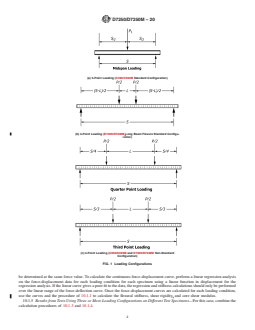
figurations; see Fig. 1. It is preferable to conduct each of the
wich facing stiffness and thereby the sandwich flexural stiff-
ness include facing thickness, core cell geometry, and facing loadingconditionsoneachtestspecimen.Thisrequiresthatthe
applied forces for all but the last loading condition to be kept
surface flatness (toolside or bagside surface in compression).
sufficientlylowtoavoidfailureandpermanentdeformationsof
6.3 Environment—Resultsareaffectedbytheenvironmental
the specimen.
conditions under which specimens are conditioned, as well as
the conditions under which the tests are conducted. Specimens 8.2 Known Facing Modulus—Conduct tests on sandwich
tested in various environments can exhibit significant differ- beam specimens per Test Method C393/C393M using a single
ences in stiffness. Critical environments must be assessed short support span loading configuration.
D7250/D7250M − 20
(a) 3-Point Loading (C393/C393M Standard Configuration)
(b) 4-Point Loading (D7249/D7249M Long Beam Flexure Standard Configu-
ration)
(c) 4-Point Loading (C393/C393M and D7249/D7249M Non-Standard Con-
figuration)
FIG. 1 Loading Configurations
8.3 Data Recording—Record force-deflection curves for 9. Validation
each test specimen using a transducer, deflectometer, or dial
9.1 Values for stiffness properties shall not be calculated at
gauge to measure the mid-span deflection.
any applied force level above or beyond the point of initial
NOTE 4—The use of crosshead or actuator displacement for the beam
specimen failure, or above a point where the specimen exhibits
mid-span deflection produces inaccurate results; the direct measurement
of the deflection of the mid-span of the beam must be made by a suitable
obvious non-linear deflection response due to excessive local
instrument.
D7250/D7250M − 20
or overall deflection. Retests shall be performed for any of stiffness values as a function of force level. If the sandwich
specimen on which values are not calculated. response is linear, then calculate an overall average flexural
stiffness, shear rigidity, and core shear modulus using the
10. Calculation
values from all force levels. Report all of the individual and
average calculated stiffness values.
10.1 General Instructions, Unknown Facing Modulus—
10.1.3 Results from Tests Using Three or More Loading
Calculation procedures for flexural stiffness and transverse
Configurations on the Same Test Specimen—For each
shearrigidityforcaseswherethefacingmodulusvaluesarenot
specimen, calculate the flexural stiffness, shear rigidity, and
known are given in 10.1 – 10.2. Calculation procedures for
core shear modulus using the equations in 10.2 for each pair of
transverse shear rigidity and core shear modulus for cases
loading configurations for a series of applied forces up to the
where the facing modulus is known are given in 10.3.
lowest maximum applied force of the loading configurations.
NOTE 5—The equations in this section assume linear force-deflection
Values should be calculated for a minimum of ten (10) force
response for both the facing and core materials. If the force-deflection
levels evenly spaced over the force range. Next, calculate the
response is non-linear, the extraction of non-linear flexural and shear
stiffnesses is significantly more complicated and is beyond the scope of averagevalueofflexuralstiffness,shearrigidity,andcoreshear
this standard practice.
modulusforeachforcelevelforeachspecimen.Thencalculate
the average values of the flexural stiffness, shear rigidity, and
10.1.1 Criteria for Force-Deflection Linearity—For pur-
poses of validating the force-displacement linearity core shear modulus using the values calculated at each force
level for each specimen replicate.The result is a set of stiffness
assumption, determine the maximum offs
...
This document is not an ASTM standard and is intended only to provide the user of an ASTM standard an indication of what changes have been made to the previous version. Because
it may not be technically possible to adequately depict all changes accurately, ASTM recommends that users consult prior editions as appropriate. In all cases only the current version
of the standard as published by ASTM is to be considered the official document.
Designation: D7250/D7250M − 16 D7250/D7250M − 20
Standard Practice for
Determining Sandwich Beam Flexural and Shear Stiffness
This standard is issued under the fixed designation D7250/D7250M; the number immediately following the designation indicates the
year of original adoption or, in the case of revision, the year of last revision. A number in parentheses indicates the year of last
reapproval. A superscript epsilon (´) indicates an editorial change since the last revision or reapproval.
1. Scope
1.1 This practice covers determination of the flexural and transverse shear stiffness properties of flat sandwich constructions
subjected to flexure in such a manner that the applied moments produce curvature of the sandwich facing planes. Permissible core
material forms include those with continuous bonding surfaces (such as balsa wood and foams) as well as those with discontinuous
bonding surfaces (such as honeycomb). The calculation methods in this practice are limited to sandwich beams exhibiting linear
force-deflection response. This practice uses test results obtained from Test Methods C393/C393M and/oror D7249/D7249M., or
both.
1.2 Units—The values stated in either SI units or inch-pound units are to be regarded separately as standard. The values stated
in each system mayare not benecessarily exact equivalents; therefore, to ensure conformance with the standard, each system shall
be used independently of the other. Combiningother, and values from the two systems may result in non-conformance with the
standard.shall not be combined.
1.2.1 Within the text, the inch-pound units are shown in brackets.
1.3 This standard does not purport to address all of the safety concerns, if any, associated with its use. It is the responsibility
of the user of this standard to establish appropriate safety safety, health, and healthenvironmental practices and determine the
applicability of regulatory limitations prior to use.
1.4 This international standard was developed in accordance with internationally recognized principles on standardization
established in the Decision on Principles for the Development of International Standards, Guides and Recommendations issued
by the World Trade Organization Technical Barriers to Trade (TBT) Committee.
2. Referenced Documents
2.1 ASTM Standards:
C273 Test Method for Shear Properties of Sandwich Core Materials
C393/C393M Test Method for Core Shear Properties of Sandwich Constructions by Beam Flexure
D883 Terminology Relating to Plastics
D3878 Terminology for Composite Materials
D7249/D7249M Test Method for Facesheet Properties of Sandwich Constructions by Long Beam Flexure
E6 Terminology Relating to Methods of Mechanical Testing
E122 Practice for Calculating Sample Size to Estimate, With Specified Precision, the Average for a Characteristic of a Lot or
Process
E177 Practice for Use of the Terms Precision and Bias in ASTM Test Methods
E456 Terminology Relating to Quality and Statistics
3. Terminology
3.1 Definitions—Terminology D3878 defines terms relating to high-modulus fibers and their composites, as well as terms
relating to sandwich constructions. Terminology D883 defines terms relating to plastics. Terminology E6 defines terms relating to
mechanical testing. Terminology E456 and Practice E177 define terms relating to statistics. In the event of a conflict between terms,
Terminology D3878 shall have precedence over the other terminologies.
This practice is under the jurisdiction of ASTM Committee D30 on Composite Materials and is the direct responsibility of Subcommittee D30.09 on Sandwich
Construction.
Current edition approved April 1, 2016July 1, 2020. Published April 2016August 2020. Originally approved in 2006. Last previous edition approved in 20122016 as
D7250/D7250M – 06D7250/D7250M – 16.(2012). DOI: 10.1520/D7250_D7250M-16.10.1520/D7250_D7250M-20.
For referenced ASTM standards, visit the ASTM website, www.astm.org, or contact ASTM Customer Service at service@astm.org. For Annual Book of ASTM Standards
volume information, refer to the standard’s Document Summary page on the ASTM website.
Copyright © ASTM International, 100 Barr Harbor Drive, PO Box C700, West Conshohocken, PA 19428-2959. United States
D7250/D7250M − 20
3.2 Symbols:
b = sandwich width, mm [in.]
c = core thickness, mm [in.]
d = sandwich thickness, mm [in.]
2 2
D = flexural stiffness, N-mm [lb-in. ]
Δ = beam mid-span deflection, mm [in.]
G = core shear modulus, MPa [psi]
S = support span length, mm [in.]
L = load span length, mm [in.] (L = 0.0 for 3-point mid-span loading configuration)
n = number of specimens
P = total applied force, N [lb]
t = facing thickness, mm [in.]
U = transverse shear rigidity, N [lb]
4. Summary of Practice
4.1 This practice consists of calculating the flexural stiffness, transverse (through-thickness) shear rigidity, and core shear
modulus of a sandwich beam using deflection and/or strain data or strain data, or both, from two or more flexure tests of different
loading configurations conducted under Test Methods C393/C393M and/oror D7249/D7249M. , or both. This practice also
includes equations for calculating the shear rigidity and core shear modulus of a sandwich beam using deflection data from a single
flexure test conducted under Test Method C393/C393M when the facing modulus is known.
5. Significance and Use
5.1 Flexure tests on flat sandwich constructions may be conducted to determine the sandwich flexural stiffness, the core shear
strength and shear modulus, or the facingsfacing’s compressive and tensile strengths. Tests to evaluate core shear strength may also
be used to evaluate core-to-facing bonds.
5.2 This practice provides a standard method of determining sandwich flexural and shear stiffness and core shear modulus using
calculations involving measured deflections of sandwich flexure specimens. Tests can be conducted on short specimens and on long
specimens (or on one specimen loaded in two ways), and the flexural stiffness, shear rigidity, and core shear modulus can be
determined by simultaneous solution of the complete deflection equations for each span or each loading. If the facing modulus
values are known, a short span beam can be tested and the calculated bending deflection subtracted from the beam’s total
deflection. This gives the shear deflection from which the transverse shear modulus can be determined.
NOTE 1—Core shear strength and shear modulus are best determined in accordance with Test Method C273, provided bare core material is available.
NOTE 2—For cores with high shear modulus, the shear deflection will be quite small and ordinary errors in deflection measurements will cause
considerable variations in the calculated shear modulus.
NOTE 3—To insureensure that simple sandwich beam theory is valid, a good rule of thumb for a four-point bending test is the span length divided by
the sandwich thickness should be greater than 20 (L /d > 20) with the ratio of facing thickness to core thickness less than 0.1 (t/c < 0.1).
6. Interferences
6.1 Material and Specimen Preparation—Important aspects of sandwich core specimen preparation that contribute to data
scatter include the existence of joints, voids or other core discontinuities, out-of-plane curvature, and surface roughness.
6.2 Geometry—Specific geometric factors that affect sandwich facing stiffness and thereby the sandwich flexural stiffness
include facing thickness, core cell geometry, and facing surface flatness (toolside or bagside surface in compression).
6.3 Environment—Results are affected by the environmental conditions under which specimens are conditioned, as well as the
conditions under which the tests are conducted. Specimens tested in various environments can exhibit significant differences in
stiffness. Critical environments must be assessed independently for each specific combination of core material, facing material, and
core-to-facing interfacial adhesive (if used) that is tested.
6.4 Core Material—For some core materials, the core shear modulus is a function of the direction that the core is oriented
relative to the length of the specimen. Another material factor that affects sandwich core stiffness is variability in core density.
7. Sampling and Test Specimens
7.1 Sampling—Test at least five specimens per test condition unless valid results can be gained through the use of fewer
specimens, as in the case of a designed experiment. For statistically significant data, consult the procedures outlined in Practice
E122. Report the method of sampling.
7.2 Specimen Geometry—The test specimens shall be rectangular in cross section. The depth of the specimens shall be equal
to the thickness of the sandwich construction, and the width shall be not less than twice the total thickness, not less than three times
the dimension of a core cell, nor greater than one half the span length. The specimen length shall be equal to the span length plus
50 mm [2 in.] or plus one half the sandwich thickness, whichever is the greater.
D7250/D7250M − 20
7.3 Loading Configurations, Unknown Facing Modulus—For cases where the facing modulus is not known, a minimum of two
loading configurations must be selected. Refer to Test Methods C393/C393M and D7249/D7249M for the equations used to size
the specimen lengths and loading configurations so that facing failure and core shear failures do not occur below the desired
maximum applied force level. It is recommended that one loading configuration use a short support span and specimen and the
other loading configuration use a long support span and specimen. The purpose of this recommendation is to obtain force-deflection
data for one test with relatively high shear deflection and one test with relatively high flexural deformation. If two short
configurations or two long configurations are tested, measurement errors may be large relative to the difference in shear and
flexural deflections between the two tests and may lead to significant errors in the calculated flexural and shear stiffness values.
7.4 Loading Configurations, Known Facing Modulus—For cases where the facing modulus is known for sandwich beams with
identical facings, a short support span loading configuration test should be conducted per Test Method C393/C393M.
8. Procedure
8.1 Unknown Facing Modulus—Conduct tests on sandwich beam specimens per Test Methods C393/C393M and/oror
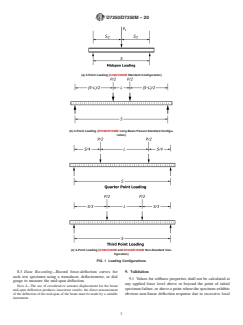
D7249/D7249M, or both, using two or more different loading configurations; see Fig. 1. It is preferable to conduct each of the
loading conditions on each test specimen. This requires that the applied forces for all but the last loading condition to be kept
sufficiently low to avoid failure and permanent deformations of the specimen.
8.2 Known Facing Modulus—Conduct tests on sandwich beam specimens per Test MethodsMethod C393/C393M using a single
short support span loading configuration.
8.3 Data Recording—Record force-deflection curves for each test specimen using a transducer, deflectometer, or dial gagegauge
to measure the mid-span deflection.
NOTE 4—The use of crosshead or actuator displacement for the beam mid-span deflection produces inaccurate results; the direct measurement of the
deflection of the mid-span of the beam must be made by a suitable instrument.
9. Validation
9.1 Values for stiffness properties shall not be calculated at any applied force level above or beyond the point of initial specimen
failure, or above a point where the specimen exhibits obvious non-linear deflection response due to excessive local or overall
deflection. Retests shall be performed for any specimen on which values are not calculated.
10. Calculation
10.1 General Instructions, Unknown Facing Modulus—Calculation procedures for flexural stiffness and transverse shear
rigidity for cases where the facing modulus values are not known are given in 10.1 – 10.2. Calculation procedures for transverse
shear rigidity and core shear modulus for cases where the facing modulus is known are given in 10.3.
NOTE 5—The equations in this section assume linear force-deflection response for both the facing and core materials. If the force-deflection response
is non-linear, the extraction of non-linear flexural and shear stiffnesses is significantly more complicated and is beyond the scope of this standard practice.
10.1.1 Criteria for Force-Deflection Linearity—For purposes of validating the force-displacement linearity assumption,
determine the maximum offset from a linear force-displacement curve over the range of applied forces to be used to calculate the
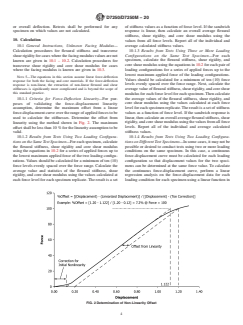
stiffnesses. Determine the offset from linearity using the method shown in Fig. 2. The maximum offset shall be less than 10 % for
the linearity assumption to be valid.
10.1.2 Results from Tests Using Two Loading Configurations on the Same Test Specimen—For each specimen, calculate the
flexural stiffness, shear rigidity and core shear modulus using the equations in 10.2 for a series of applied forces up to the lowest
maximum applied force of the two loading configurations. Values should be calculated for a minimum of ten (10) force levels
evenly spaced over the force range. Calculate the average value and statistics of the flexural stiffness, shear rigidity, and core shear
modulus using the values calculated at each force level for each specimen replicate. The result is a set of stiffness values as a
function of force level. If the sandwich response is linear, then calculate an overall average flexural stiffness, shear rigidity, and
core shear modulus using the values from all force levels. Report all of the individual and average calculated stiffness values.
10.1.3 Results from Tests Using Three or More Loading Configurations on the Same Test Specimen—For each specimen,
calculate the flexural
...
Questions, Comments and Discussion
Ask us and Technical Secretary will try to provide an answer. You can facilitate discussion about the standard in here.
Loading comments...